

Student skills checklists turn scattered impressions into clear, useful information about what a child can do today. Picture a busy morning: one student finally zips her coat alone, another greets a classmate without a prompt, and by lunchtime nobody remembers exactly what happened or when.
After reading this guide, you will be able to choose the right skills to track, break each skill into observable steps, record quickly during the day, read the patterns, and turn them into next steps you can share with families. Every step follows one fictional student so you can see how the pieces fit.
Examples are fictional. Adapt to the student’s goals and agreed supports. This is guidance, not a diagnosis.
At a glance
- Track a few skills that matter now, not everything at once.
- Break each skill into small steps you can see and count.
- Use a simple code so recording takes seconds.
- Look for patterns weekly and change one thing at a time.
- Share short, positive summaries with families.
1. Choose the skills that matter most right now
The biggest mistake with tracking is trying to watch everything. A long list quickly becomes a chore, and then it stops. Instead, pick two or three skills that would make the biggest difference in the student’s day.
Look at the student’s goals first. If there is an IEP, start with the skills it names. Then add skills that unlock independence or participation, such as getting ready to leave, joining a group, or asking for help.
| Skill area | Example skills |
|---|---|
| Daily living | Tying shoes, packing a bag, handwashing |
| Social | Greeting, turn-taking, joining play |
| Academic habits | Starting work, asking for help, finishing |
| Communication | Requesting, commenting, answering questions |
Here is our fictional example. Maya is in second grade. Her teacher, Ms. Brooks, and her family agree on three priorities: tying her shoes, packing her bag at the end of the day, and asking for help when she is stuck. Those three become her first student skills checklists.
Notice that the list is short. Ms. Brooks still sees many other skills during the day, but she only records these three. Fewer targets mean more consistent data, and consistent data is what makes student skills checklists useful.
It also helps to involve the student when you can. Ask which skill they want to get better at, or show them two options and let them pick. Student skills checklists feel less like surveillance and more like a shared project when the child has a voice in the choice.
Also, write down why each skill matters. “Packing her bag lets Maya leave with the class instead of last” is a reason everyone can understand, including Maya.
2. Break each skill into observable steps
A skill like “ties shoes” sounds simple, but it hides many small steps. When you break it down, you can see exactly where a student is succeeding and where they need help. This process is often called task analysis.
Write each step as something you can see. “Crosses the laces” is observable. “Understands how to tie” is not. Aim for four to eight steps for most daily skills, and keep the wording short.
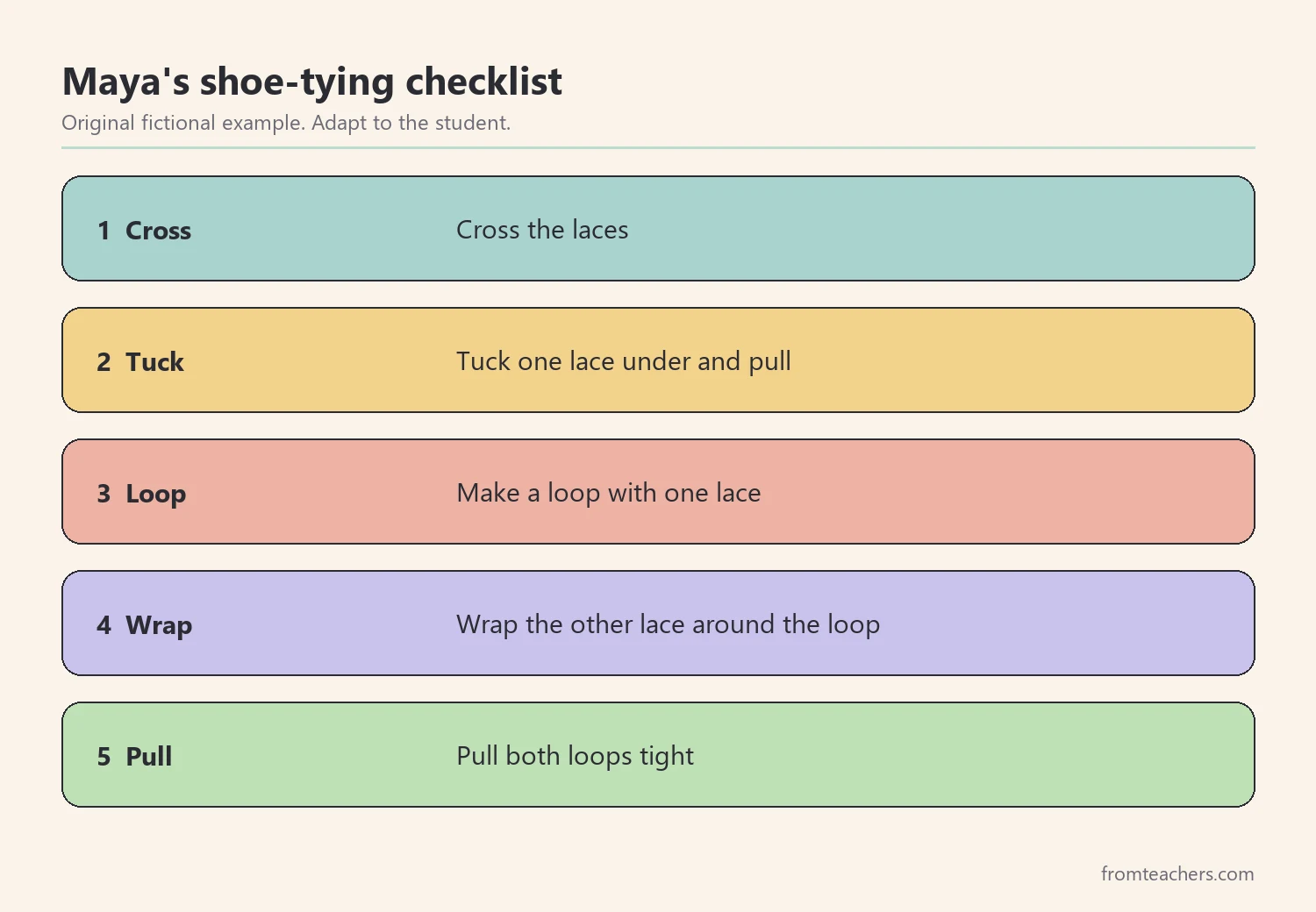
For Maya, Ms. Brooks split shoe tying into five steps: cross the laces, tuck one under and pull, make a loop, wrap the other lace around, and pull the loops tight. Packing her bag became six steps, and asking for help became three steps: notice she is stuck, raise her help card, and say what she needs.
Before using a new list, test it yourself. Walk through the skill and check that every step appears in the right order. Then watch the student once without recording, just to confirm that your steps match what really happens. Small edits at this stage make student skills checklists far more accurate later.
Good student skills checklists also allow for partial success. A step done with a reminder is different from a step done alone, and that difference shows real growth over time.
If writing steps from scratch feels slow, a ready set such as the Special Education Checklists Bundle (2) can give you a starting point that you then adapt to each student.
3. Pick a simple recording code
Recording has to be fast, or it will not happen. A short code lets you mark a step in a second or two, even in the middle of a busy lesson.
Many teachers use a three-level code. For example: I for independent, P for prompted, and N for not yet. Some add a fourth level to separate a verbal reminder from hands-on help. Whatever you choose, keep it the same across every student skills checklist so adults read them the same way.
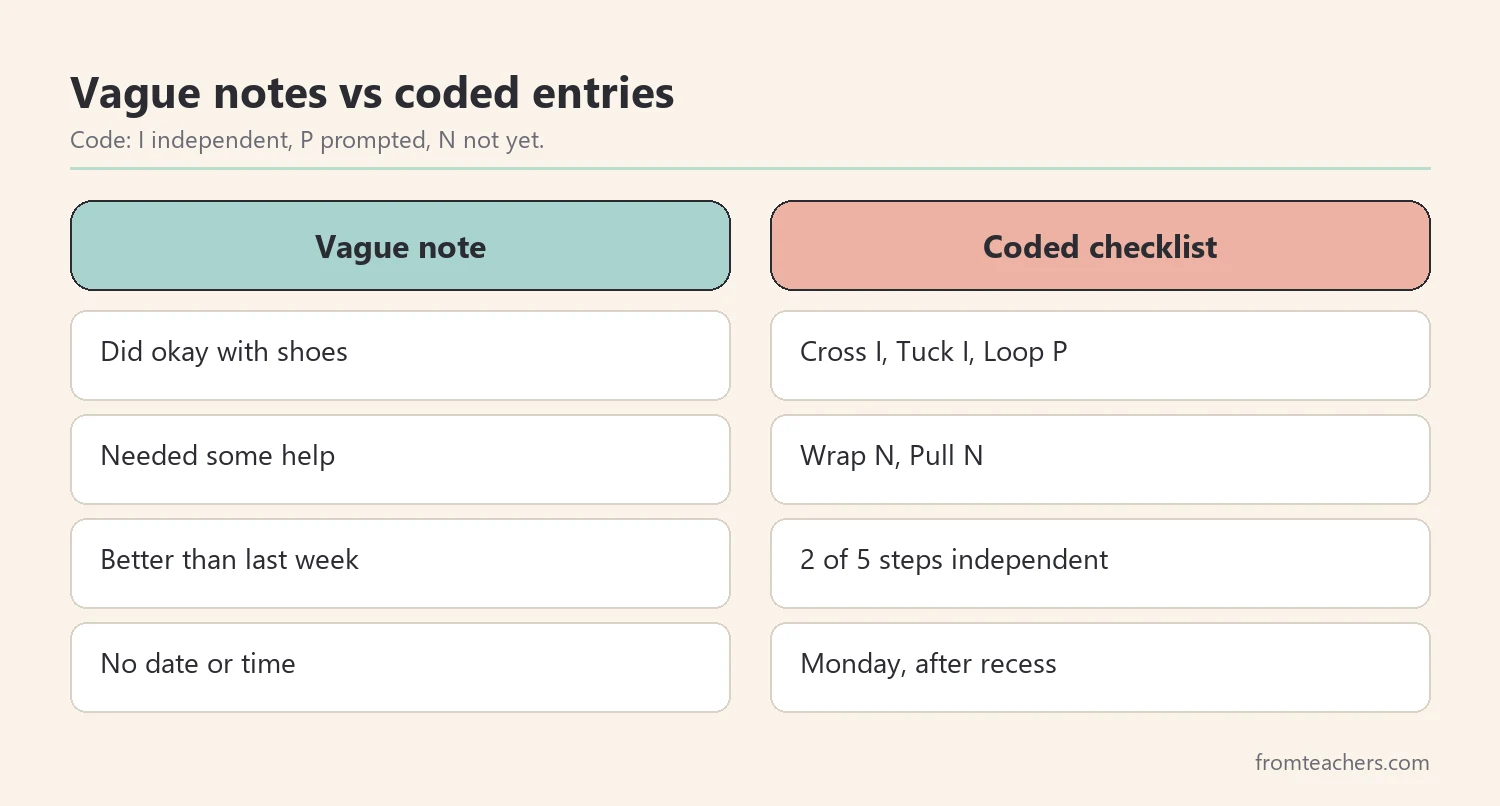
For Maya, Ms. Brooks used I, P, and N. On Monday, Maya’s shoe-tying checklist read: I, I, P, N, N. In other words, Maya crossed and tucked the laces alone, needed a prompt to make the loop, and had not yet wrapped or pulled the loops tight.
Also, decide who records and when. Shoe tying happens after recess. Bag packing happens at dismissal. Asking for help happens during independent work. Linking each checklist to a moment of the day makes recording a habit rather than an extra task.
Add a short notes line at the bottom of each sheet. A few words such as “new shoes today” or “substitute teacher” explain unusual results later. Without notes, student skills checklists can show a dip without any clue about the cause.
Be careful with prompts while you record. If you help more than usual because you are watching, the data will look worse than it really is. Instead, wait a few seconds before stepping in, and give the smallest prompt that works. That pause gives the student a fair chance to show what they can already do, and it keeps student skills checklists honest.
Keep the sheets where the skill happens. A clipboard by the door, a sticky note in the planning book, or a tablet form all work, as long as the right adult can reach it at the right time.
4. Read the patterns in student skills checklists
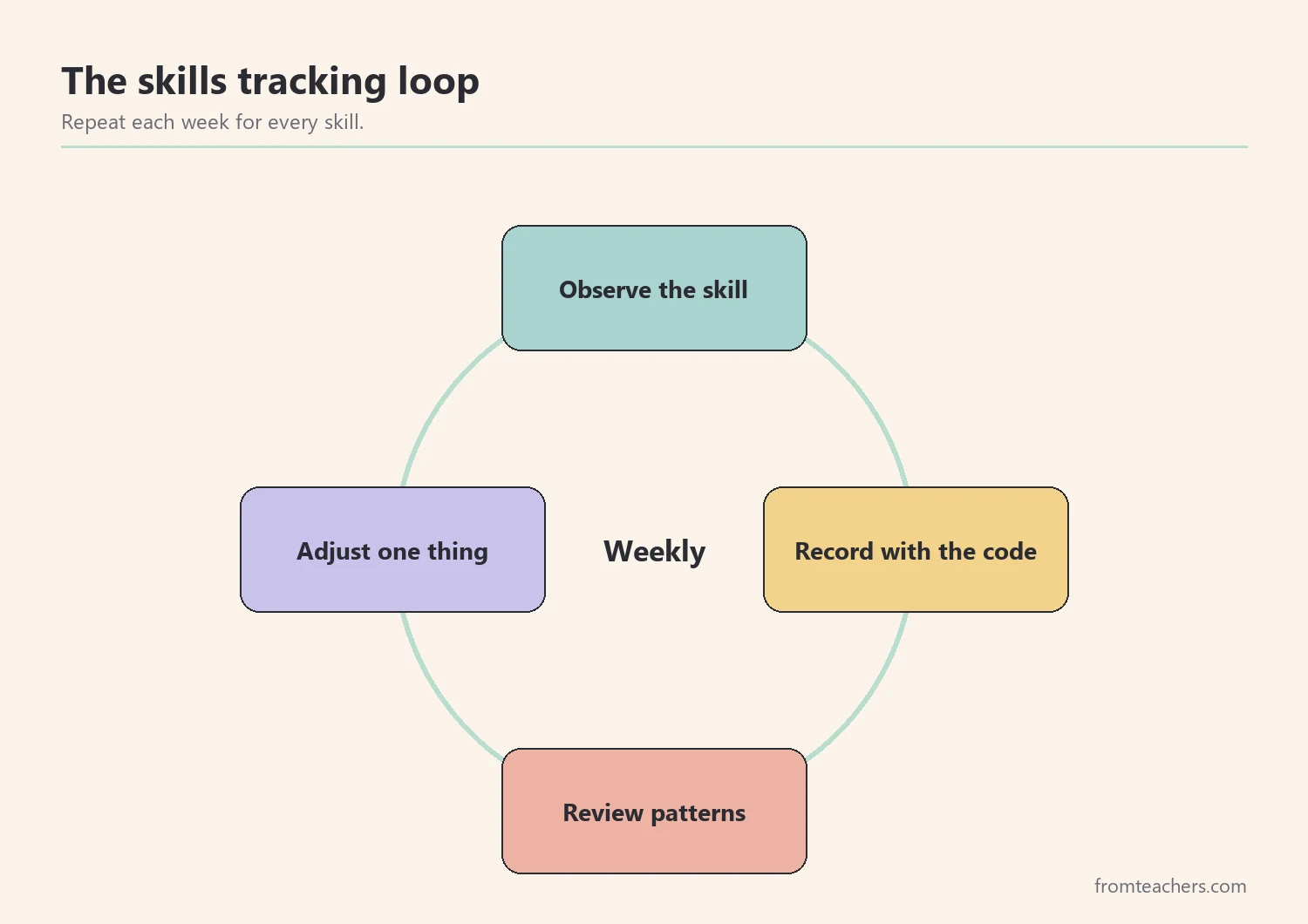
Data is only useful when someone looks at it. Set aside ten minutes once a week to read through each student’s sheets. You are looking for patterns, not perfection.
Ask a few simple questions. Which steps are now independent? Which steps are stuck? Are there days or times when performance drops? Did a change in support make a difference?
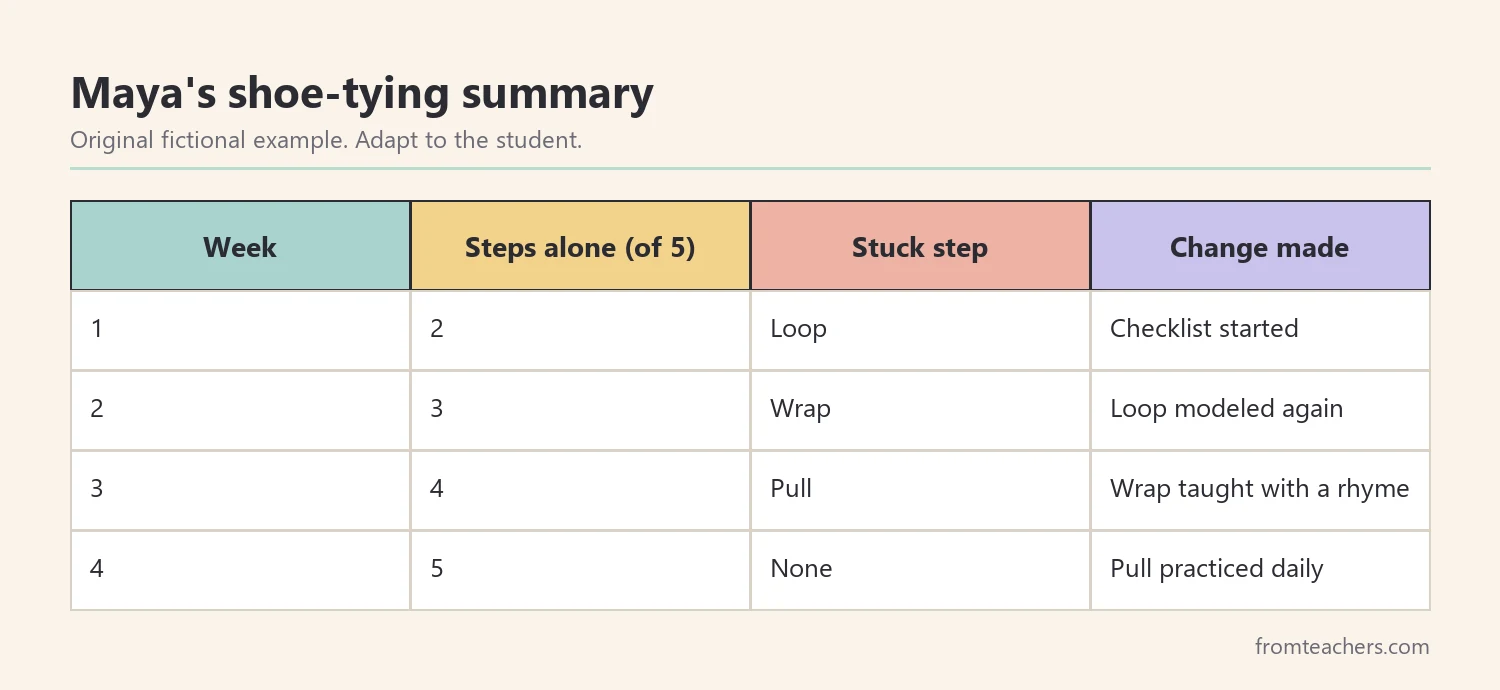
For Maya, the weekly summary showed independent steps rising from 2 of 5 in week one to 5 of 5 in week four. The pattern also showed where she had been stuck: the wrap step. Once Ms. Brooks taught that step with a short rhyme and a colored lace, Maya moved forward quickly.
Student skills checklists also reveal problems that are not about the skill. If Maya always struggled on Mondays, for example, that could point to a different routine at home over the weekend. Patterns like this are worth a gentle conversation with the family.
Graphs can help, but they are optional. Even a simple count of independent steps per week, written at the top of the sheet, turns student skills checklists into a quick visual record of growth that any adult can read in seconds.
Finally, celebrate progress with the student. Showing Maya her own checklist, with more I marks each week, made her proud and eager to keep going.
5. Turn observations into next steps
The goal of tracking is action. Each weekly review should end with one clear decision: keep going, adjust support, or move to a new skill.
When a step is stuck, change one thing. You might model the step again, add a visual cue, practice it more often, or reduce the help you give. When a whole skill is independent for two or three weeks, check that it holds in a new setting, then retire it and choose the next priority.
For Maya, shoe tying stayed independent for three more weeks after that summary, including after gym class. So Ms. Brooks retired that checklist and added a new one: zipping her coat. Bag packing stayed on the list because two steps still needed a prompt.
Sometimes the right decision is to wait. A skill that improves slowly but steadily may need nothing more than time and practice. Student skills checklists help you see that steady climb, so you do not change a plan that is already working.
Keep a short record of each decision. One line is enough: date, skill, and what changed. Over a term, these notes tell the story of the student’s growth and help the team plan the next goals.
6. Share progress with families and the team
Families want to know how their child is doing, and they can often support the same skills at home. Student skills checklists make these conversations concrete and positive.
Keep updates short. A weekly or biweekly note with one success and one focus works well. For example: “Maya tied her shoes alone every day this week. Next, we are practicing zipping her coat. You can help by letting her try first at home.”
In addition, share checklists with other adults who work with the student. When a paraprofessional, specialist, or substitute uses the same steps and code, the data stays consistent and the student gets the same support everywhere.
For families, consider sending home a simple version of the same list. When parents use student skills checklists for shoe tying or bag packing at home, the child practices the same steps in both places, which often speeds up progress.
Language matters in these updates. Focus on what the child can do and what comes next, rather than on what is still missing. Families respond better to “three of five steps on her own” than to “still cannot tie her shoes,” and the numbers come straight from your student skills checklists.
Finally, bring the checklists to team meetings. Clear, dated records support discussions about goals and progress far better than memory alone.
Common mistakes and how to avoid them
- Tracking too many skills. Fix: start with two or three priorities and add more later.
- Writing steps that cannot be observed. Fix: describe actions you can see, such as “makes a loop.”
- Using different codes across adults. Fix: agree on one simple code and post it on every sheet.
- Collecting data but never reviewing it. Fix: schedule ten minutes a week to read patterns.
- Keeping skills on the list forever. Fix: retire skills that stay independent for several weeks.
Questions teachers and parents ask about student skills checklists
How often should I record on a checklist?
Record whenever the skill naturally happens, usually once a day for daily routines. For skills that happen less often, a few times a week can be enough. Consistency matters more than frequency.
Are student skills checklists only for special education?
No. Any teacher or parent can use them to track a skill a child is learning. They are especially common in special education because they support goal tracking and clear communication.
Can students use checklists themselves?
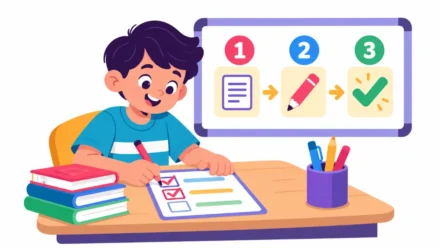
Yes. Picture versions of student skills checklists work well for younger children. Many students enjoy checking off their own steps with a picture checklist. Self-monitoring can build independence and pride, and you can still record your own observations alongside it.
What if a student does a step one day but not the next?
That is normal while a skill is new. Look at the pattern over a week or two rather than single days. If the step stays inconsistent, consider more practice or a visual cue.
How do checklists connect to IEP goals?
Checklists can provide the day-to-day data that shows progress toward a goal. The team decides how goals are measured, so share your checklists and ask how they fit the plan.
Related reading: The Power of Data Tracking in Special Education, Special Education Accommodation and Modification Tracker, and Navigating the Path to Adulthood: Building Essential Life Skills.
A companion resource for student skills checklists:
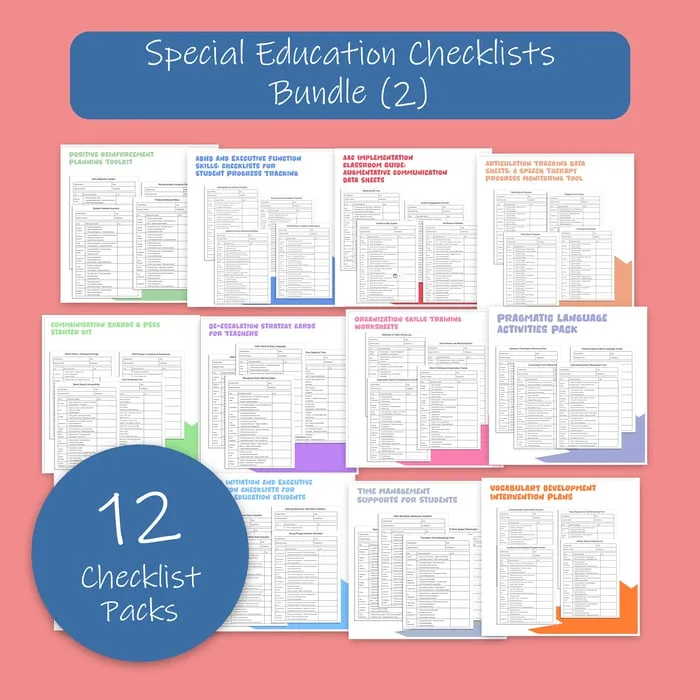
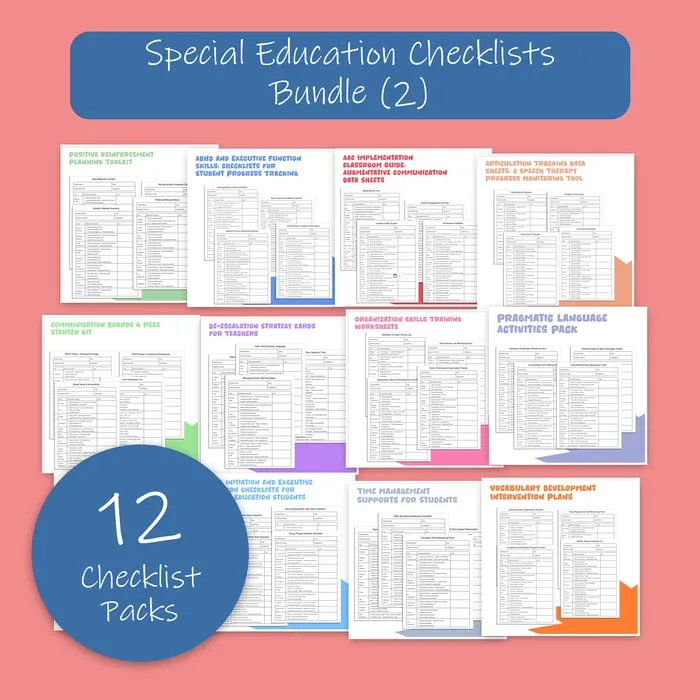
Special Education Checklists Bundle (2): a bundle of ready-to-use special education checklists to help you observe and record student skills consistently.
Sources and scope
- IRIS Center, Vanderbilt University: free modules on progress monitoring, data collection, and evidence-based practices.
- IDEA, U.S. Department of Education: the law behind special education services, IEPs, and progress reporting.
- What Works Clearinghouse: reviews of research on education programs and practices.
This guide covers practical, everyday tracking of student skills in school and at home. It does not cover formal assessment or evaluation, which belong to qualified professionals and the student’s team.
Key takeaways
- Student skills checklists work best with two or three clear priorities.
- Break each skill into small, observable steps.
- Use one simple code so recording takes seconds.
- Review patterns weekly and change one thing at a time.
- Share short, positive updates with families and the team.
Leave a Comment