

ADHD classroom support works best when it starts from how attention actually works, not from the advice to “just try harder.” Picture a fifth grader who builds an amazing model during a hands-on science lab, then cannot start a page of written questions ten minutes later, even though he clearly knows the material.
After reading this guide, you will be able to replace common myths with useful explanations, use interest and movement on purpose, set up fair flexible seating, teach self-regulation with a choice board, and support executive function with simple structures. Each step uses the same fictional student so you can see the plan come together.
Examples are fictional. Adapt to the student’s goals and agreed supports. This is guidance, not a diagnosis.
At a glance
- Drop the “try harder” message: ADHD is about regulating attention, not about caring.
- Use interest, novelty, and urgency to help students get started.
- Treat movement as a regulation tool with clear limits.
- Teach self-regulation with a visual choice board.
- Build outside structure for planning, starting, and finishing work.
1. Replace common myths with what actually helps
Many teachers still hear that students with ADHD are lazy, unmotivated, or simply not listening. These beliefs shape daily reactions, and they often lead to punishment for things the student cannot easily control. Good ADHD classroom support begins by swapping those myths for more accurate ideas.
| Myth | More helpful view |
|---|---|
| “He could focus if he wanted to.” | Attention is harder to regulate, especially on low-interest tasks. |
| “She just needs to try harder.” | Effort is often already high; structure helps more than pressure. |
| “Movement is a distraction.” | Planned movement can help some students stay regulated. |
| “Rewards will fix it.” | Rewards help most when paired with clear, taught routines. |
Here is our fictional example. Jayden is in fifth grade. His teacher, Ms. Reed, used to write “needs to focus” on almost every report. During a lab on simple machines, however, Jayden stayed on task for forty minutes. That contrast made Ms. Reed rethink her assumptions.
Instead of asking why Jayden would not focus, she began asking when he did focus and what was different. That single change in question opened the door to every other step in this guide.
Sharing the more helpful views with colleagues matters as well. When every adult in the building understands the basics, ADHD classroom support becomes consistent from the homeroom to the lunchroom, and the student hears the same calm message everywhere.
It also changed her language. “Try harder” became “Let’s find a way to get started.” Students notice the difference, and so do families.
2. Use interest and urgency to support getting started
Many people with ADHD describe their attention as interest-based. Tasks that are new, interesting, chosen, or urgent are easier to begin. Tasks that feel dull or distant are much harder, no matter how important they are.
Therefore, a key part of ADHD classroom support is adding a spark to the start of a task. You do not need to turn every lesson into a game. Small changes often work: a surprising question, a choice of problems, a short timer, or a real-world connection.
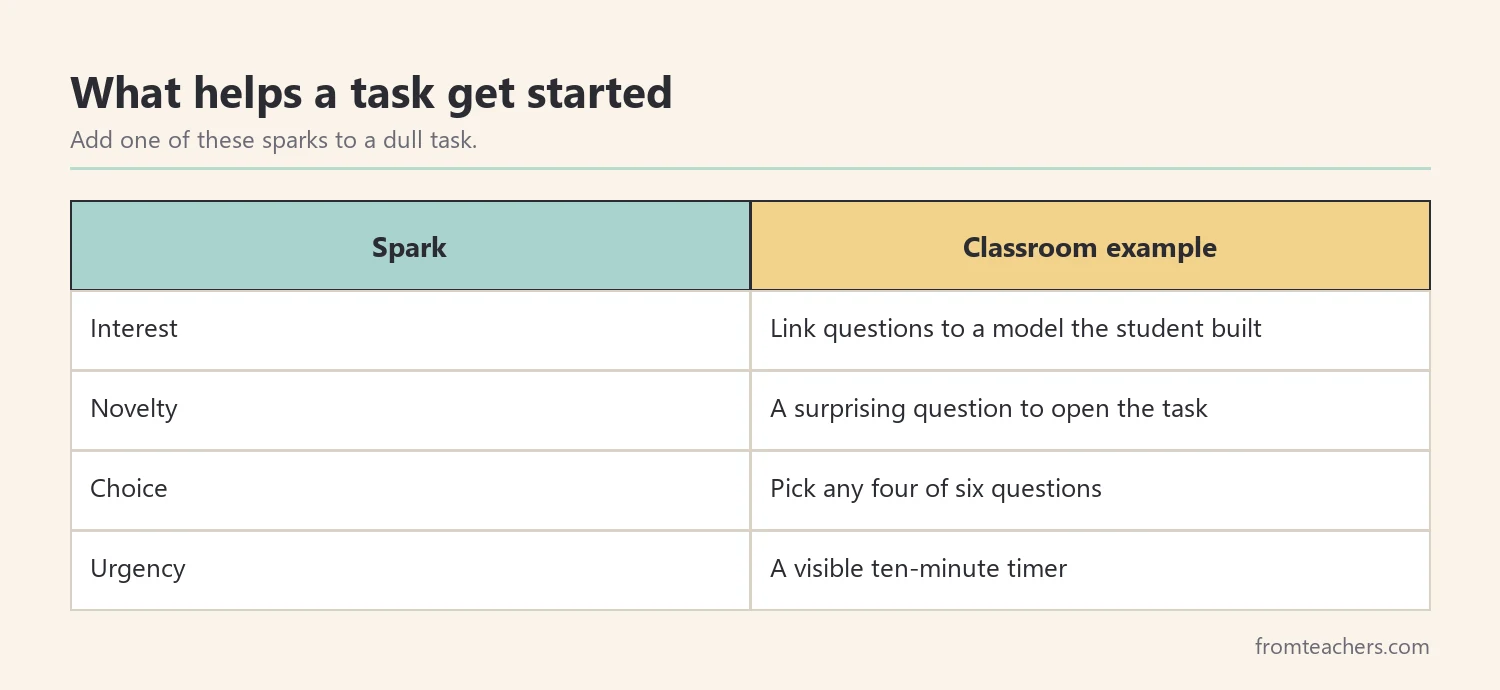
For Jayden, Ms. Reed tried three small changes during written science questions. First, she let him choose any four of six questions. Next, she linked the questions to the machine he had built. Finally, she set a visible ten-minute timer for the first section. Jayden started within two minutes instead of the usual eight.
Notice that the content stayed the same. The questions still covered the science standard. Only the entry point changed, and that is often enough for ADHD classroom support to make a visible difference.
Choice deserves a special mention. Letting a student pick the order of tasks, the tool they write with, or the problems they solve first costs almost nothing. Yet it often turns a stalled start into real progress, which is why choice appears in so many ADHD classroom support plans.
Also, plan for the middle of the task. Interest can fade halfway through. A quick check-in, a second short timer, or a switch from writing to drawing a diagram can renew attention without lowering expectations.
3. Plan movement and flexible seating that stay fair
For many students with ADHD, movement is not the problem; it is part of the solution. Short, planned movement can help the brain stay regulated. The key word is planned: students need to know what movement is allowed, when, and how to return to work.
Build movement into the lesson. Students can stand to answer, walk to a station, or deliver materials. In addition, some students benefit from quiet options at their seat, such as a band on the chair legs, a wobble cushion, or a standing spot at the back.
Flexible seating can support this, but only with a fair system. Without rules, the best spots become a daily argument. Many teachers use a rotation, a sign-up chart, or a short “seat contract” that explains how each seat is used. The ADHD Classroom Support That Actually Works guide includes a section on flexible seating done right, with a fair system for choosing spots.
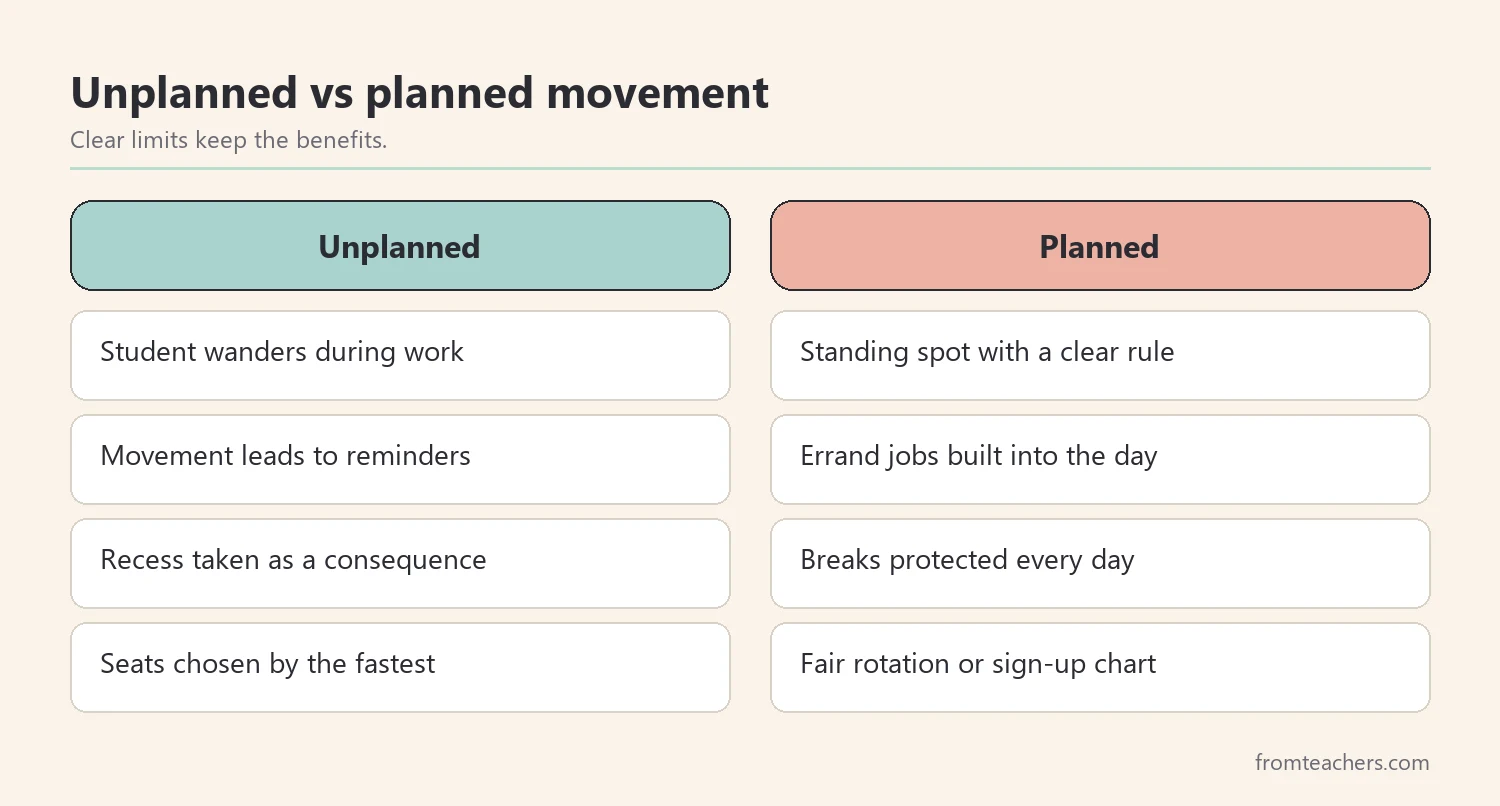
For Jayden, Ms. Reed added a standing desk at the back of the room and two “errand jobs” each morning. She taught the rule once: stand or sit, but stay working, and return after errands within two minutes. Jayden used the standing desk during writing and rarely wandered anymore.
When you introduce these options, present them to the whole class. That way, movement becomes a normal part of the room rather than a special exception, and ADHD classroom support does not make one student feel different from everyone else.
Above all, avoid taking away recess or movement breaks as a consequence. For many students, those breaks are exactly what helps them manage the rest of the day.
4. Teach self-regulation with a choice board
Strong emotions are common for students with ADHD. Frustration can rise fast, and it can take longer to settle. A visual choice board gives students a set of calming options they already know, so they do not have to invent a plan in the middle of a hard moment.
Keep the board simple. Four to six choices are plenty. Include a mix of movement, sensory, and thinking options, such as getting a drink of water, squeezing a stress ball, taking five slow breaths, or using a quiet corner for three minutes.
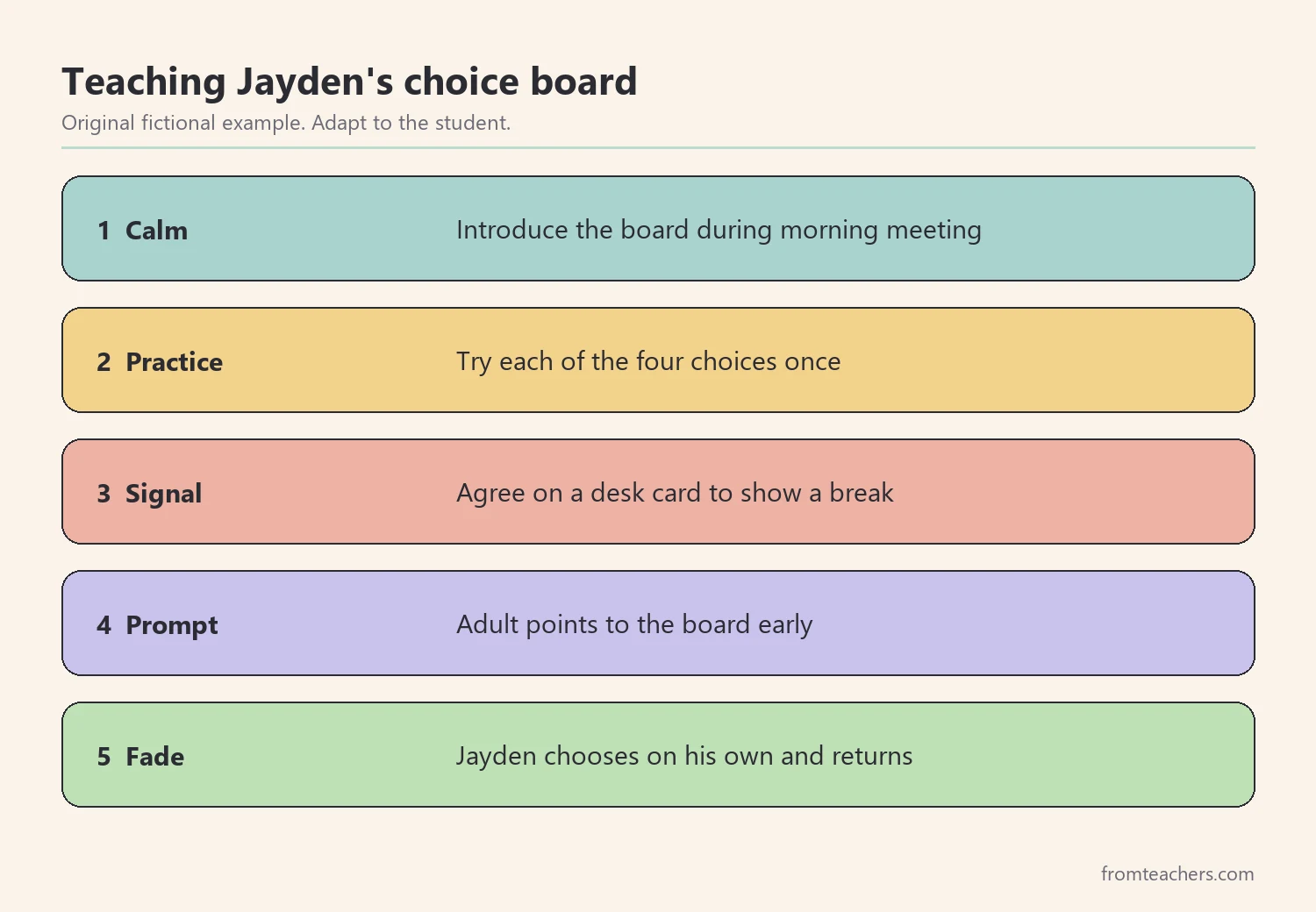
Teach the board when the student is calm. Practice each option, talk about when it might help, and agree on a signal. Then prompt its use early, before frustration peaks. Over time, the student should start choosing on their own.
For Jayden, Ms. Reed taught a board with four choices during morning meeting. The signal was a small card he could place on his desk. In the first week, she prompted him twice a day. By the fourth week, he chose a break on his own most days and returned to work afterward.
It also helps to reflect with the student after a calm return. Ask which choice helped and whether anything should change. These short talks build self-awareness, one of the long-term goals of ADHD classroom support.
Importantly, a choice board is part of ADHD classroom support, not a reward or a punishment. Students should never lose access to it because of behavior, since that is exactly when it is needed.
5. Build structure for executive function
Executive function covers planning, organizing, starting, remembering, and finishing. These skills are often harder for students with ADHD. Instead of expecting students to manage alone, ADHD classroom support builds the structure into the classroom.
Start with the basics. Post a visible agenda for the day. Break long tasks into sections with checkpoints. Give directions in writing as well as aloud. Use a “home” for every material, and a simple end-of-day checklist for packing up.
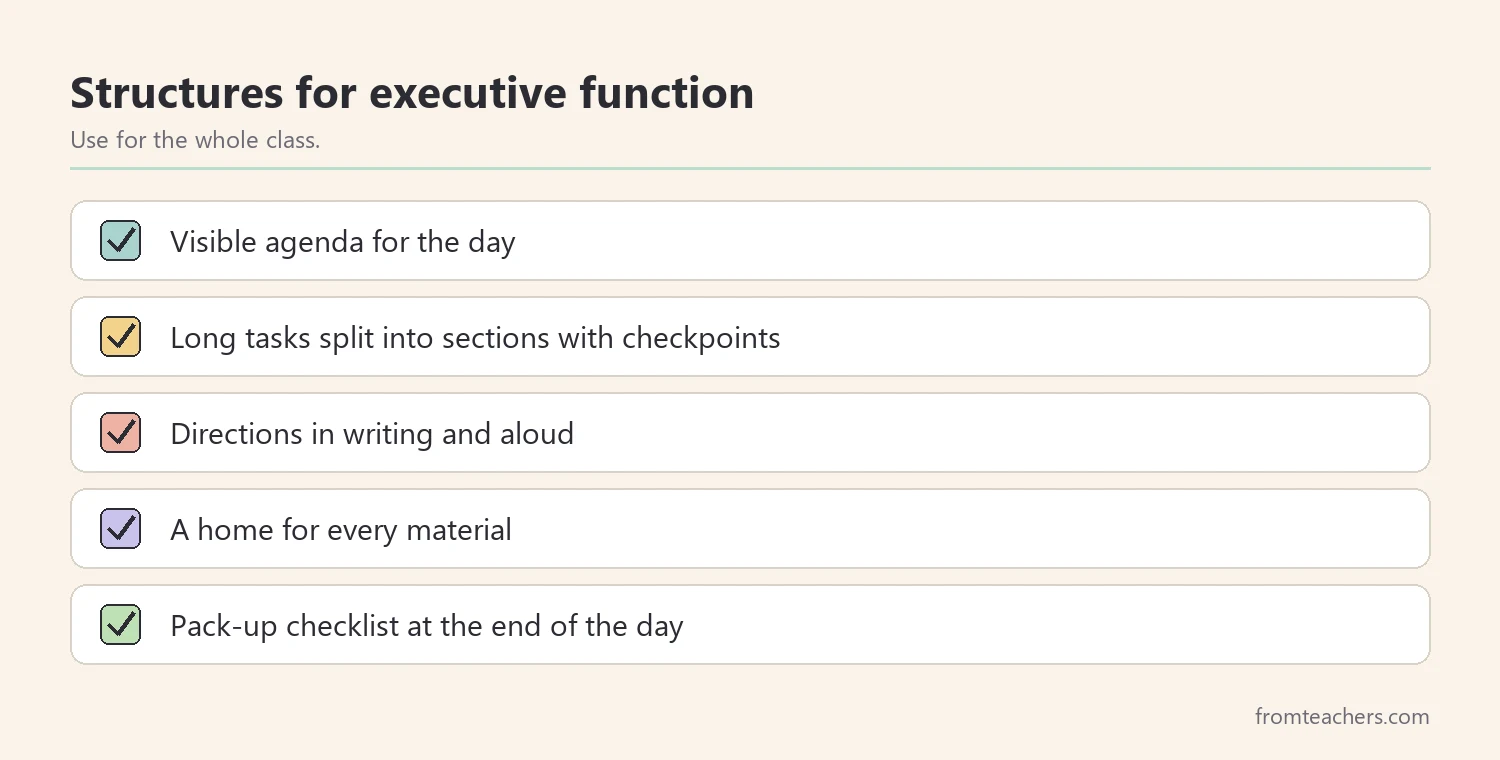
For Jayden, the end of the day was the hardest. Homework and notes often stayed in his desk. Ms. Reed added a five-item pack-up checklist taped inside his folder and a two-minute class pack-up routine. Within three weeks, his homework came home on most days.
These structures help many students, not just those with ADHD. As a result, they rarely single anyone out, and they make the whole room run more smoothly.
Executive function support also includes time. Many students with ADHD find it hard to sense how long something will take. Visual timers, clocks with colored sections, and estimates written before a task are simple ways to make time visible as part of everyday ADHD classroom support.
Finally, fade support slowly. Once a structure is working, the student can take more ownership: checking their own list, setting their own timer, or choosing their own section order.
6. Track and review ADHD classroom support with the family
Strategies are only useful if they help. So choose one or two simple measures and look at them every few weeks. Share what you see with the family and, when appropriate, with the student.
Good measures are quick to collect. For example, you might track minutes to start a task, the number of sections finished, or how often the student used the choice board without a prompt.
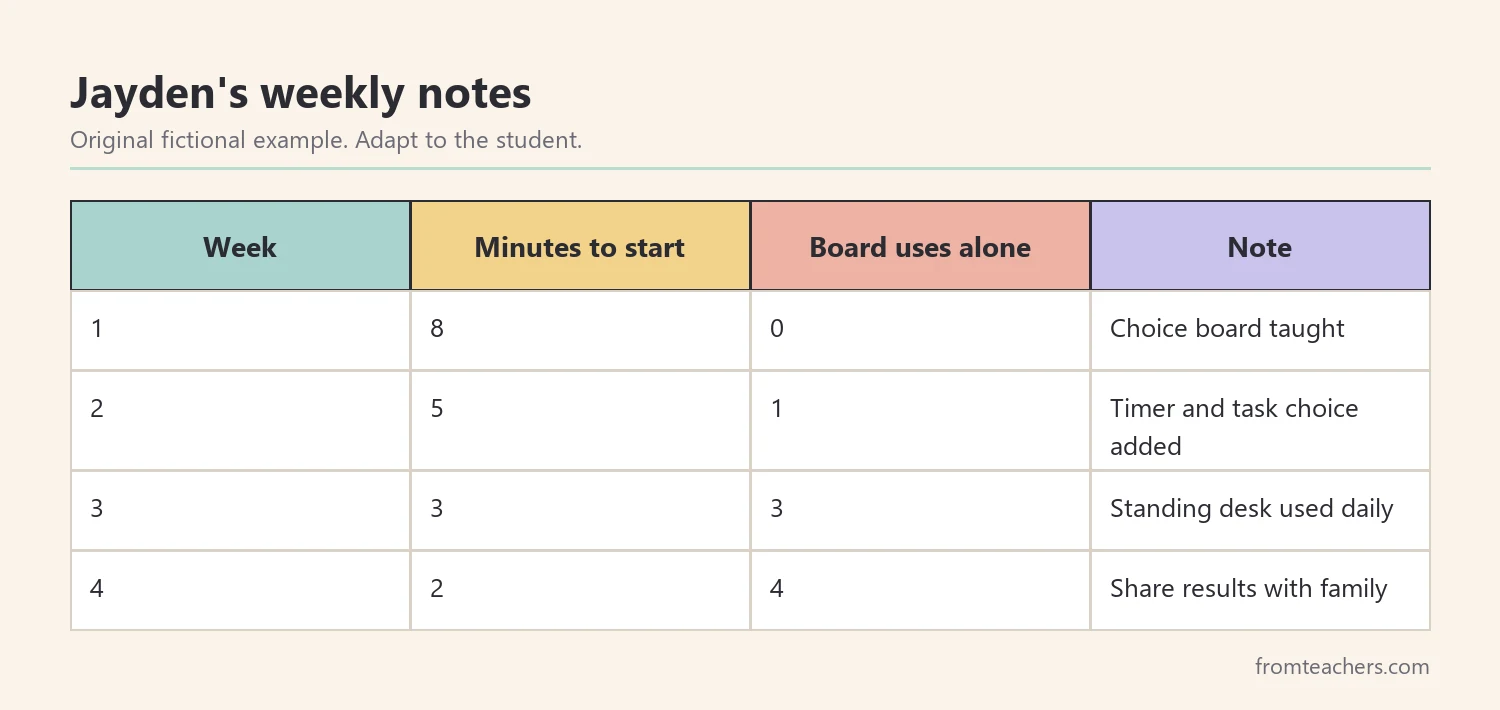
In Jayden’s case, minutes to start written work dropped from 8 to 2 over four weeks. Independent choice board use rose from 0 to 4 times per week. Those two numbers told Ms. Reed and his family that the plan was working and that the next goal could focus on finishing longer tasks.
Families often notice patterns teachers do not, such as sleep, morning routines, or after-school stress. Including those notes in the review makes ADHD classroom support a shared plan rather than a school-only plan.
If progress stalls, change one thing and review again. Often the issue is consistency across adults, so check that everyone uses the same signals and routines.
Common mistakes and how to avoid them
- Treating ADHD as a motivation problem. Fix: focus on starting supports and structure, not on pressure.
- Removing recess as a consequence. Fix: protect movement time and use other responses for behavior.
- Offering flexible seating without rules. Fix: teach a fair system and the expectations for each seat.
- Introducing a choice board in a crisis. Fix: teach and practice it while the student is calm.
- Changing many strategies at once. Fix: change one thing, track it, then decide.
Questions teachers and parents ask about ADHD classroom support
Is ADHD classroom support only for students with a diagnosis?
No. Many of these strategies, such as visible agendas, chunked tasks, and planned movement, help any student who struggles with attention. Formal plans are decided by the student’s team, but good everyday practice is open to all.
Won’t movement distract other students?
Planned movement with clear rules is usually less distracting than a student who is struggling to sit still. Teach the expectations and place movement options where they do not block others.
How do I keep flexible seating fair?
Use a simple, visible system such as a rotation or sign-up chart. Explain how each seat is used, and remove a choice briefly only if the expectations are not followed.
What if the student refuses the choice board?
Ask which options feel useful and adjust the board together. Some students prefer private signals or different choices. Ownership often increases use.
How can families support the same strategies at home?
Families can use similar tools, such as a visual checklist for routines or a short timer for homework. Sharing what works at school helps both settings stay consistent.
Related reading: Effective ADHD Classroom Strategies to Support Student Success, ADHD in Children: A Guide to Effective Classroom and Home Support, and Moving Beyond Shame and Behavior Charts: Positive Alternatives for Effective Classroom Management.
A companion resource for ADHD classroom support:
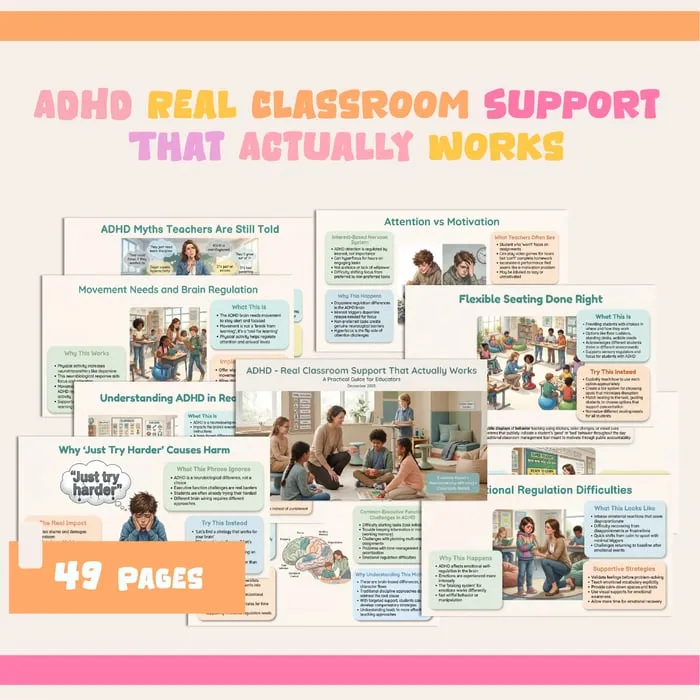
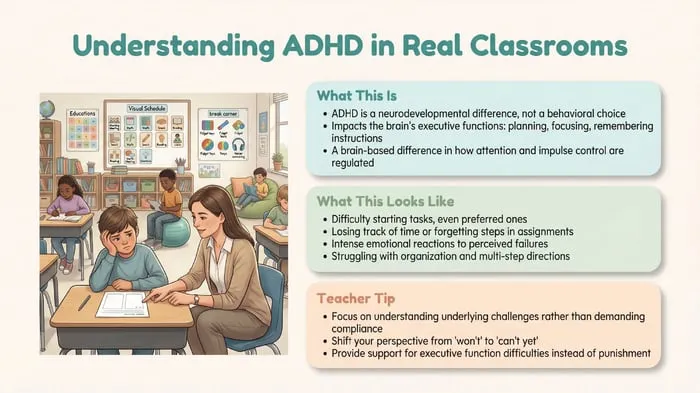
ADHD Classroom Support That Actually Works: a 49-slide practical guide for educators covering ADHD myths, attention and motivation, movement, flexible seating, emotional regulation, regulation choice boards, and executive function challenges.
Sources and scope
- CDC ADHD information: general background on ADHD in children, including school supports.
- CHADD: a national organization with resources on ADHD for educators and families.
- IRIS Center, Vanderbilt University: free modules on classroom behavior, routines, and evidence-based practices.
- Understood.org: practical articles for families and teachers on ADHD and executive function.
This guide covers everyday classroom strategies for attention, movement, regulation, and organization. It does not cover diagnosis, medication, or formal evaluation, which belong to qualified professionals and the student’s team.
Key takeaways
- ADHD classroom support starts by replacing myths with accurate explanations.
- Interest, choice, and short timers make tasks easier to start.
- Planned movement and fair flexible seating help students stay regulated.
- Teach a choice board while calm and never remove it as a consequence.
- Build executive function structures and review progress with the family.










Leave a Comment