

Observation notes for IEP meetings turn a busy school year into clear, fair evidence that the whole team can read. Picture the night before an annual review: you remember that Maya had a better month in October, but you cannot say how much better, on which days, or in which lessons. Memory is kind, yet it is not precise enough for a meeting where goals and supports are decided.
This guide shows you how to collect short daily observations, sort them, and turn them into a one-page summary you can share with families and colleagues. By the end, you will know what to write down, how to keep it objective, and how to present it so the meeting stays focused on the student.
Examples are fictional. Adapt to the student’s goals and agreed supports. This is guidance, not a diagnosis.
At a glance
- Start from the IEP goals, then choose what to observe.
- Write what you saw and heard, not what you think it means.
- Short notes on many days beat long notes on a few days.
- Group notes by goal area before the meeting, not during it.
- Bring one summary page, a few examples, and a clear question for the team.
1. Anchor your observation notes for IEP meetings to the goals
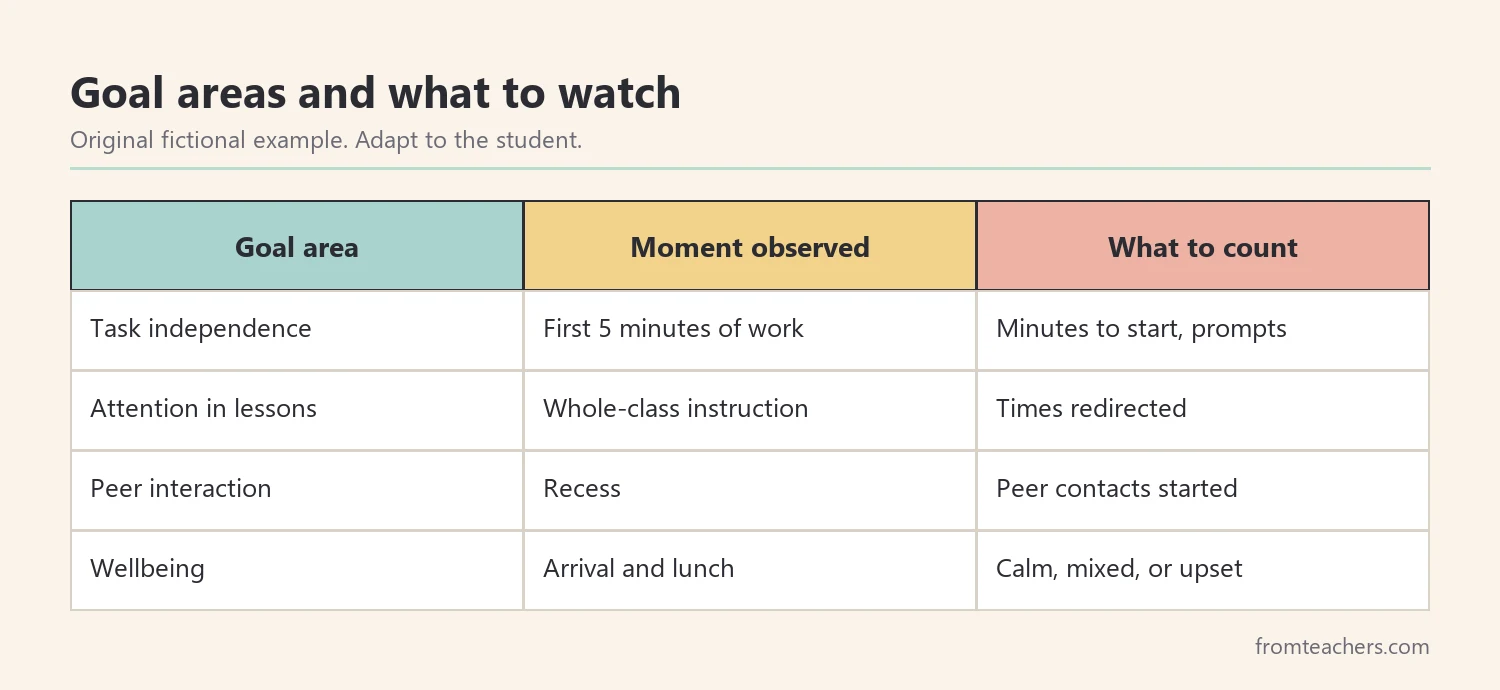
First, open the current IEP and list each annual goal in plain words. For example, “Maya will begin independent work within two minutes of the direction in four out of five opportunities.” That single sentence tells you what to watch, when to watch it, and how to count it.
Next, choose two or three areas per student, not ten. Observation notes for IEP meetings are most useful when they match what the team already agreed to measure. If a goal is about task independence, a note about handwriting may be interesting, but it does not answer the team’s question.
Also, add one area for wellbeing or regulation, even if it is not a formal goal. Families often ask, “Is my child happy at school?” A few notes on mood, comfort, and peer contact let you answer with examples instead of a general impression.
Then, decide the moments you will observe. A short list keeps the work realistic:
- The first five minutes of independent work.
- One transition, such as returning from recess.
- One small-group lesson each week.
- One unstructured time, such as lunch or free choice.
In Maya’s case (fictional, grade 3), her team agreed on three areas: task independence, attention during whole-class instruction, and peer interaction at recess. Her teacher, Ms. Ortiz, wrote these three headings on the inside of her planning folder so they were visible every day.
2. Write objective notes in under two minutes
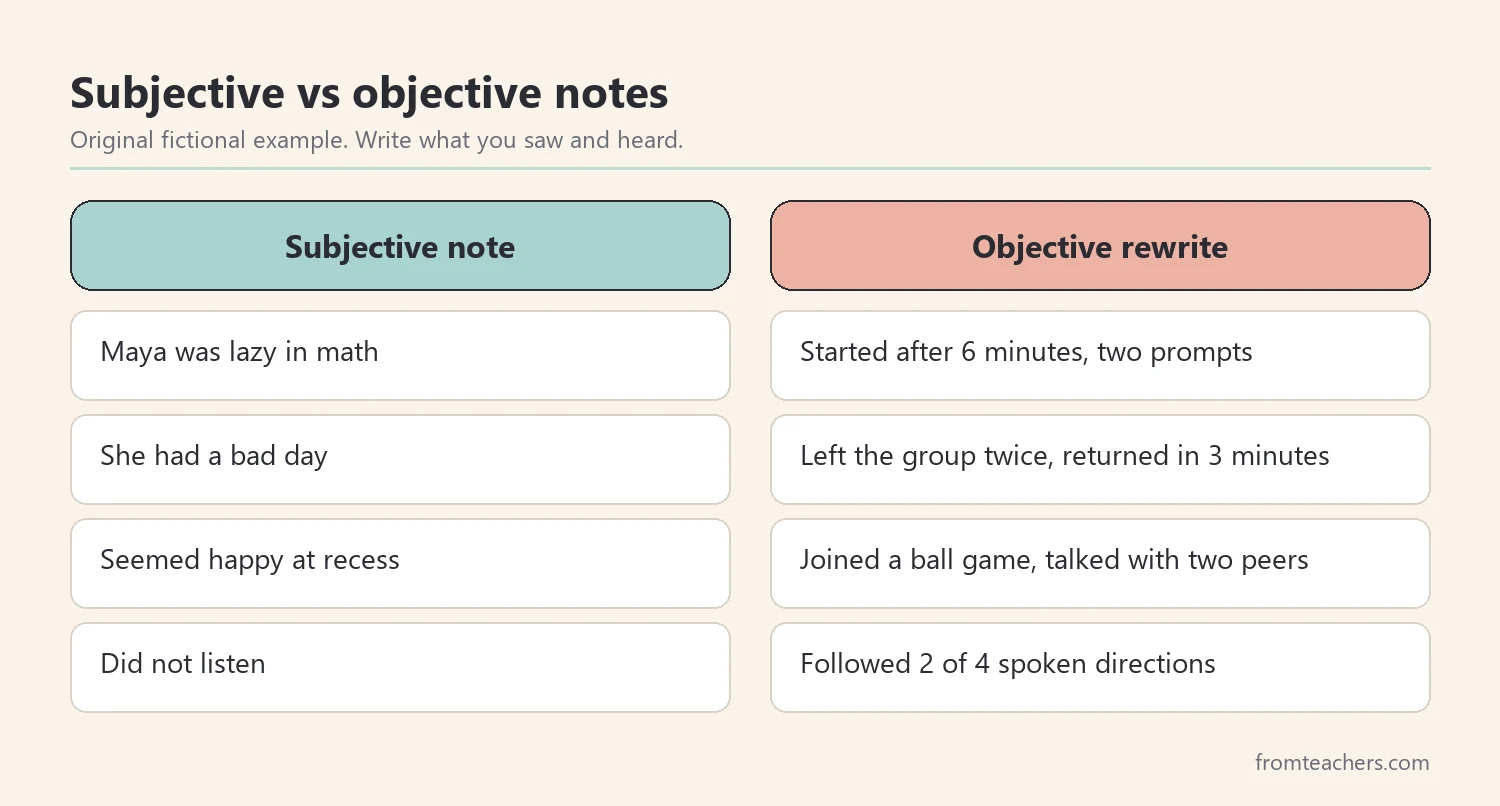
Objective notes describe behavior that anyone in the room could have seen or heard. Because of that, they hold up well when a parent, an administrator, or a related service provider reads them later. Subjective notes, on the other hand, describe feelings or guesses about motives.
For example, “Maya was lazy during math” is a judgment. Instead, write “Maya started the math page after 6 minutes and two prompts.” The second note is shorter, kinder, and far more useful in a meeting.
In addition, use a fixed format so each note takes less than two minutes. A good pattern is date, setting, what happened, and what support was used. A checklist with tick boxes and a short notes column works well here, since you only write words when something stands out.
Ms. Ortiz used the printable classroom observation forms for special education because each page already lists areas such as engagement, attention, task independence, and peer interaction. She ticked boxes during the lesson and added one short sentence at the end of the day.
Moreover, record quotes when they are short and telling. A student’s own words, such as “Can I do the easy ones first?”, often explain a pattern better than any rating. Write the quote exactly, in quotation marks, and add the setting. Over time, these small quotes give observation notes for IEP meetings a human voice that families recognize.
Finally, avoid diagnostic language. Words like “anxious,” “defiant,” or “sensory seeking” may be accurate, but they belong to professionals who assess. In observation notes for IEP meetings, describe the behavior and let the team discuss what it means.
| Part of the note | Example (fictional) |
|---|---|
| Date and setting | Oct 8, math, independent work |
| What happened | Started after 2 minutes, finished 6 of 8 items |
| Support used | Visual first-then card, one verbal prompt |
| Optional quote | “Can I do the easy ones first?” |
3. Build a weekly rhythm that you can keep
A system you can sustain beats a perfect system you drop in November. Therefore, plan a weekly rhythm that fits your real timetable. Most teachers find that two or three observation windows per student per week are enough to show a pattern.
For instance, Ms. Ortiz observed Maya on Monday, Wednesday, and Thursday. She kept the forms on a clipboard by her small-group table, so the materials were always in reach. On Friday, she spent five minutes reading the week’s notes and writing one summary line.
Also, share the work. Paraprofessionals, co-teachers, and specialists see the student in settings you do not. Give them the same form and the same three headings, and ask for one note per week. As a result, your observation notes for IEP meetings will include more than one adult’s view, which families often appreciate.
However, agree on a few shared definitions first. If one adult counts “on task” as eyes on the work and another counts it as pencil moving, the numbers will not match. A short conversation of ten minutes in September can prevent confusion in May.
Similarly, protect the notes from the busiest days. If a fire drill, an assembly, or a substitute changes the schedule, mark the day as “not typical” rather than skipping it or treating it as normal. That small label stops one unusual morning from distorting the trend the team will see.
Store the forms in one place, such as a binder with a tab per student or a single folder per goal. When observation notes for IEP meetings live in one spot, nothing gets lost between the classroom and the conference room.
Here is a simple weekly plan you can copy:
- Monday: observe the first independent work block.
- Wednesday: observe one transition and one peer moment.
- Thursday: collect a note from a second adult.
- Friday: read the week, write one summary sentence.
4. Turn observation notes for IEP meetings into a one-page summary
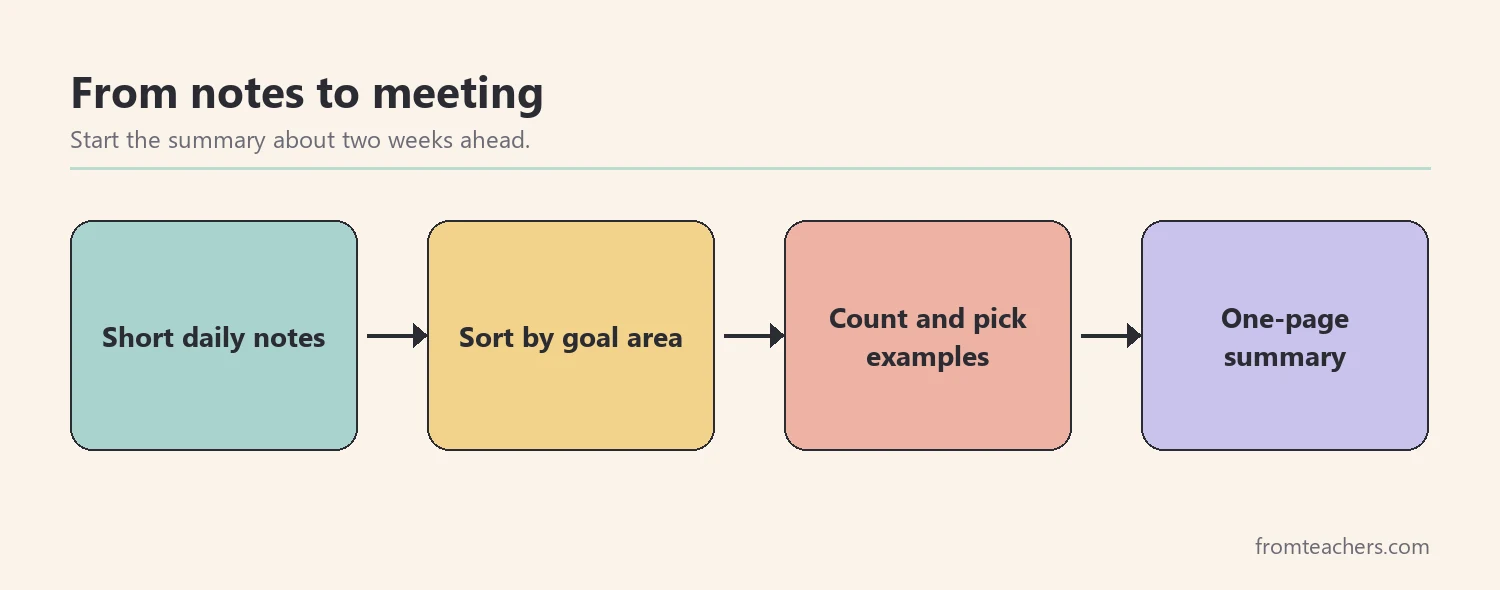
About two weeks before the meeting, gather every note and sort it by goal area. Next, count what you can count, such as the number of days Maya started work within two minutes. Then, choose one or two short examples per area that show what the numbers mean in real life.
This is where observation notes for IEP meetings become powerful. A family member does not need to read forty forms. Instead, they need a clear picture: what went well, what is still hard, and what helped.
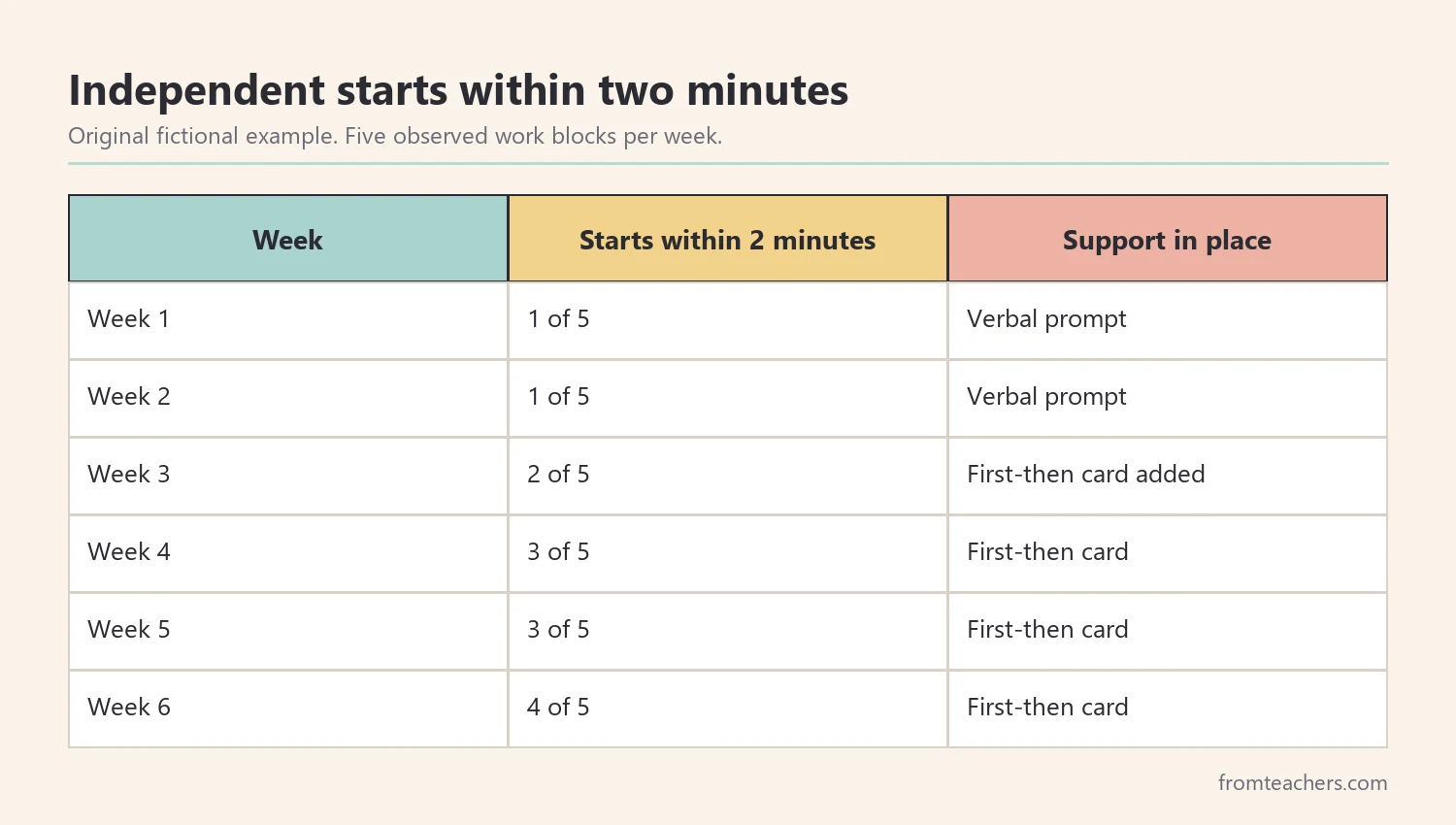
For Maya, the six-week count showed independent starts rising from one day a week to four. Moreover, the notes showed what changed: the team had introduced a first-then card in week three. That detail turned a vague “she is doing better” into a clear finding the team could keep using.
Use a summary page with four short sections:
- Strengths: two or three things the student does well, with an example.
- Progress by goal: one line per goal with a count or trend.
- Still hard: the situations where support is needed most.
- What helped: strategies that made a visible difference.
Before you finalize the page, read it from the family’s point of view. Would a parent who was not in the classroom understand every sentence? If a line needs a teacher to explain it, rewrite it. In addition, check that every number has a short example next to it, because numbers alone can feel cold.
Also, keep the language warm and plain. Avoid acronyms where you can, or explain them once. Families who understand observation notes for IEP meetings are more likely to share their own observations from home.
5. Present the evidence and plan next steps
At the meeting, open with strengths. Starting there sets a respectful tone and reminds everyone that the goal is growth. Then, move goal by goal, using the counts and one example each.
Next, invite the family to add what they see at home. For instance, Maya’s father mentioned that she also asks to do “the easy ones first” with homework. That small quote matched a classroom note and helped the team see a consistent pattern across settings.
In addition, bring one clear question for the team. Examples include: “Should the first-then card become a written accommodation?” or “Is the recess goal still the right priority?” Questions keep observation notes for IEP meetings tied to decisions, not just reports.
Keep the student in mind throughout. Where it is appropriate, older students can see their own counts and add a comment about what helps them. Even a short sentence from the student makes the meeting feel like it is about a person, not a file.
After the meeting, write down what the team agreed and adjust your observation headings. If a goal changed, change the form. If a new support was added, add a line to record when it was used. Consequently, next year’s meeting will start from better evidence.
| Meeting moment | What to bring | Why it helps |
|---|---|---|
| Opening | Two strengths with examples | Sets a respectful tone |
| Goal review | One count and one note per goal | Keeps the talk concrete |
| Family input | An open question | Connects home and school |
| Decisions | One clear question | Leads to an action |
Common mistakes and how to avoid them
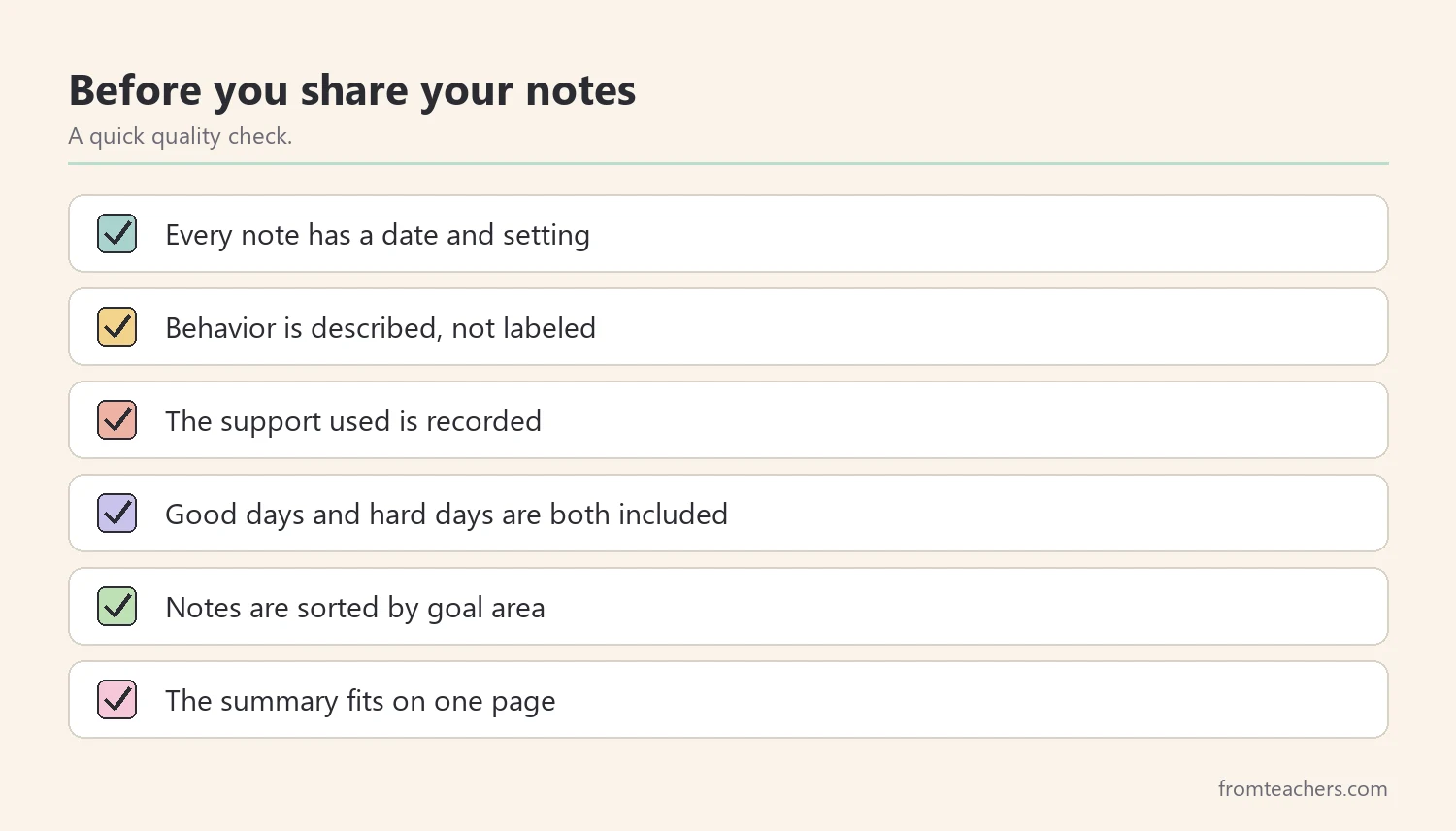
- Writing only on hard days. Observation notes for IEP meetings written only on difficult days paint an unfair picture. Fix: schedule observations on fixed days, regardless of how the day goes.
- Using labels instead of behavior. “Unmotivated” tells the team nothing they can act on. Fix: describe what the student did and how long it took.
- Collecting everything. Ten areas per student leads to burnout. Fix: limit notes to the goals plus one wellbeing area.
- Sorting notes during the meeting. Sorting observation notes for IEP meetings at the table wastes time and stresses everyone. Fix: build the summary page two weeks ahead.
- Forgetting the support. A note without the support used hides what works. Fix: always add the prompt, tool, or strategy you used.
Questions teachers and parents ask about observation notes for IEP meetings
How many notes do I need before a meeting?
There is no fixed number. However, a steady record across several weeks usually shows a clearer pattern than many notes from one week. Aim for regular, short entries rather than a large pile at the end.
Can parents keep observation notes at home?
Yes, and they are often very helpful. Parents can use the same simple format: date, setting, what happened, and what helped. Home notes can show whether a skill is appearing outside school.
Should I share my raw notes with the family?
Follow your school’s policy on records first. In many cases, the summary page is the best thing to share, with raw notes available if the family asks. Either way, keep every note objective and respectful, as if the student might read it one day.
What if my notes disagree with another adult’s notes?
Disagreement is useful information. It may show that the student behaves differently in different settings, or that adults are using different definitions. Talk it through before the meeting and agree on what each term means.
Do observation notes replace formal assessment?
No. Observation notes for IEP meetings add everyday context, but they do not replace evaluations by qualified professionals. They are one source of evidence among several.
Related reading: The Power of Data Tracking in Special Education, Parent-Teacher Collaboration in Special Education, and Special Education Tracking Tools.
You may also need: Classroom Accommodation Feedback Form IEP 504 Effectiveness Tracker.
A companion resource for observation notes for IEP meetings:
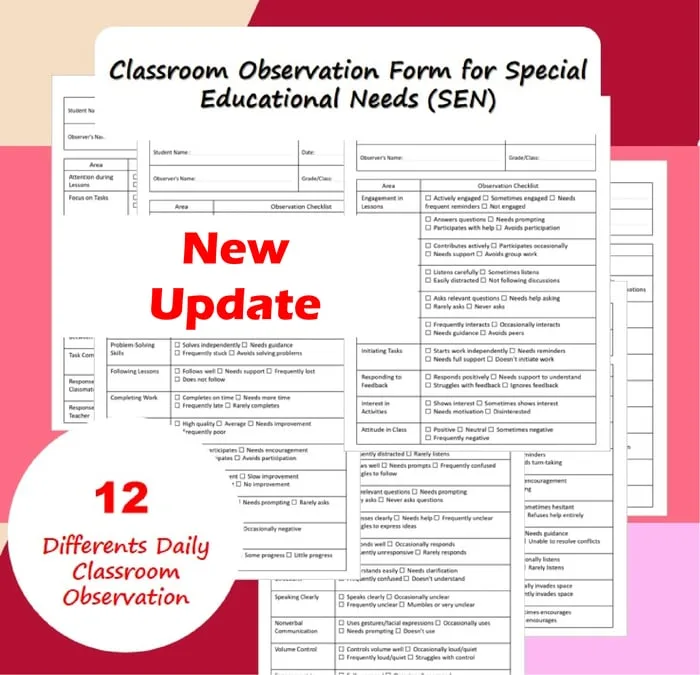
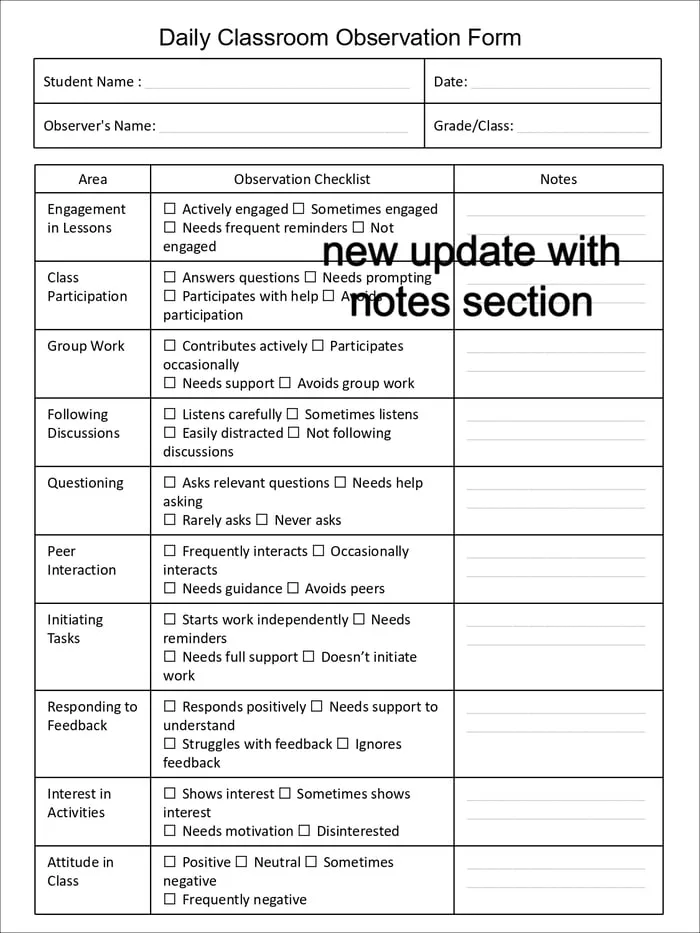
Classroom Observation Forms for Special Education: 12 Daily Checklists: twelve check-box forms in print-ready PDF and editable PowerPoint, covering areas from engagement and attention to communication and executive functioning, so daily notes are quick and consistent.
Sources and scope
- Individuals with Disabilities Education Act (IDEA), U.S. Department of Education: the federal law and guidance on IEPs, progress reporting, and parent participation.
- IRIS Center, Vanderbilt University: free modules on data collection, progress monitoring, and IEP development.
- Understood.org: family-friendly explanations of IEP meetings and how to prepare for them.
- What Works Clearinghouse: reviews of education research and practice guides.
This guide covers informal classroom observation and meeting preparation. It does not cover formal evaluations, eligibility decisions, or legal advice, which belong to qualified professionals and your district’s procedures.
Key takeaways
- Observation notes for IEP meetings start from the goals the team already agreed on.
- Objective, two-minute notes are fairer and more useful than long impressions.
- A steady weekly rhythm, shared with other adults, shows real patterns.
- A one-page summary with counts and examples keeps the meeting focused.
- Every meeting should end with clear decisions and updated observation headings.










Leave a Comment