

AAC at home works best when it feels like part of family life, not homework for the whole house. Picture a Saturday morning: your child points at the fridge, you guess juice, then milk, then a snack, and everyone ends up frustrated. The speech device or picture board is sitting in a backpack by the door, because nobody is sure how to use it outside school.
This guide is for parents and caregivers. You will learn how to make the communication system easy to reach, how to model words during ordinary routines, how to stay in step with the school team, and how to notice progress without turning home into a therapy room.
Examples are fictional. Adapt to the student’s goals and agreed supports. This is guidance, not a diagnosis.
At a glance
- The device or board has to be within reach in every room your child uses.
- Model words on the system yourself, without asking your child to copy.
- Pick two or three daily routines and use the same core words in each.
- Share a short note with school each week so home and class match.
- Progress looks like new words, new reasons to talk, and less frustration.
1. Make AAC at home available all day
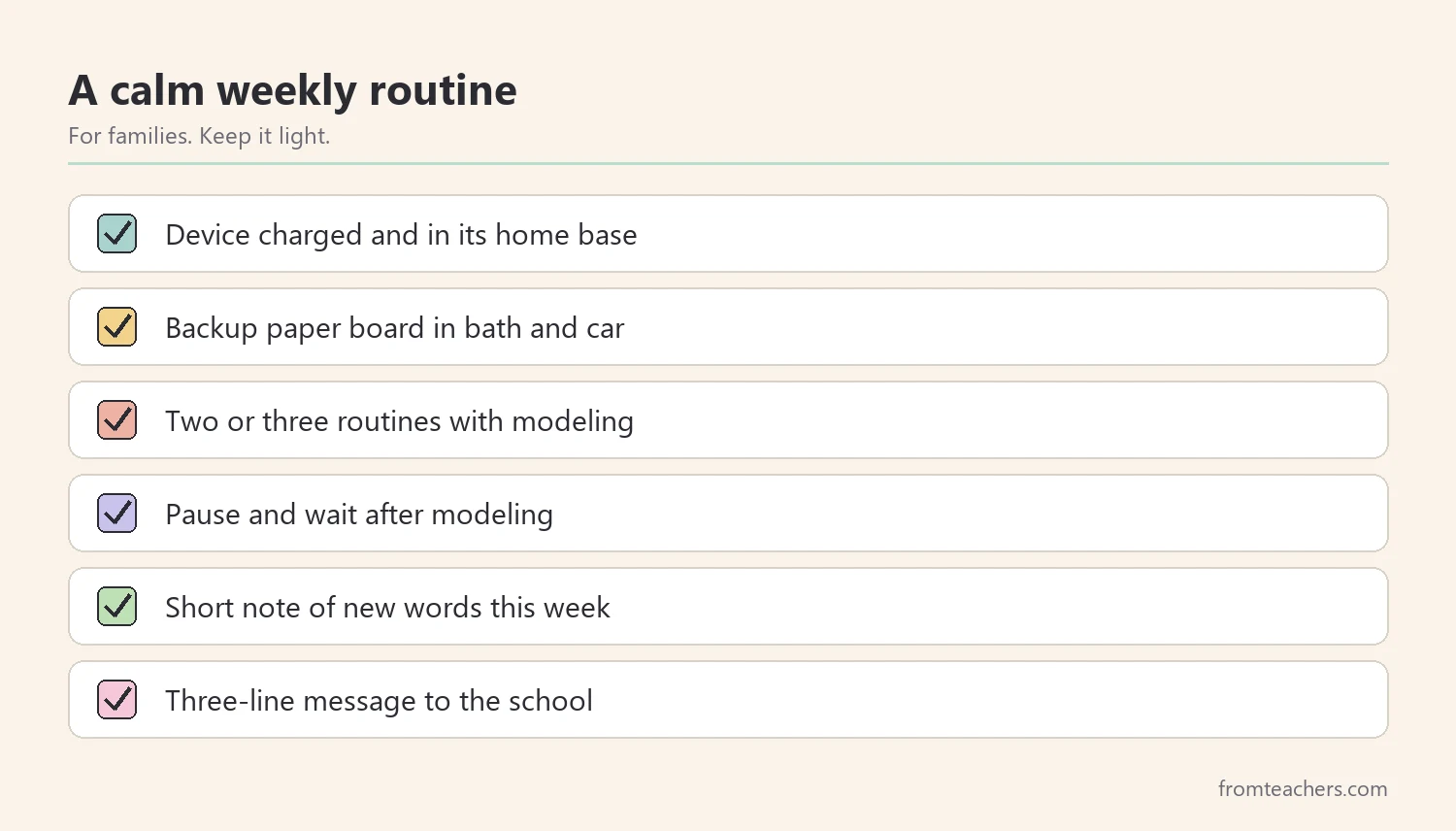
First, think about access. A child cannot use a voice they cannot reach. If the tablet is charging in a bedroom while the family is in the kitchen, the message to the child is that talking with the device is only for certain times.
Next, choose a home base for each room. A tablet stand on the kitchen counter, a printed core board taped inside a cupboard door, and a small board clipped to the car seat all count. In other words, AAC at home should be as easy to find as a spoon or a pair of shoes.
Also, plan for charging and breakage. Many families keep a laminated paper board as a backup for when the battery is low. That way, the child always has a way to say “more,” “stop,” or “help,” even on a messy day.
Leo (fictional, age 7) uses a speech app on a tablet at school. At home, his parents set up three spots: a stand by the dinner table, a hook by the front door, and a paper board in the bath area where the tablet cannot go. Within a week, Leo started bringing the tablet to his father during play, which had not happened before.
Moreover, think about outings. Grandparents’ homes, the playground, and the grocery store are rich places to talk. A small strap case or a pocket board means AAC at home can travel with your child, so new people hear their voice too.
| Place | Access option | Backup |
|---|---|---|
| Kitchen and meals | Tablet on a stand | Core board on the fridge |
| Bath and bedtime | Laminated picture board | Small key ring cards |
| Car and outings | Tablet in a strap case | Pocket core board |
| Play area | Tablet within arm’s reach | Board taped to the wall |
2. Model words during real routines
Modeling means you touch the words on your child’s system while you speak. You are not testing. Instead, you are showing how the language works, the same way babies hear thousands of spoken words before they say their first one.
For example, during breakfast you might say “more juice” while touching MORE and DRINK on the board. Later, you say “all done” and touch ALL DONE as you clear the plate. You do not ask your child to repeat it. You simply keep showing.
In addition, focus on core words. These are small, flexible words like go, stop, more, help, like, not, and want. They work in almost every routine, so your child sees them many times a day. Fringe words, such as “pancake” or “dinosaur,” matter too, but core words do the heavy lifting.
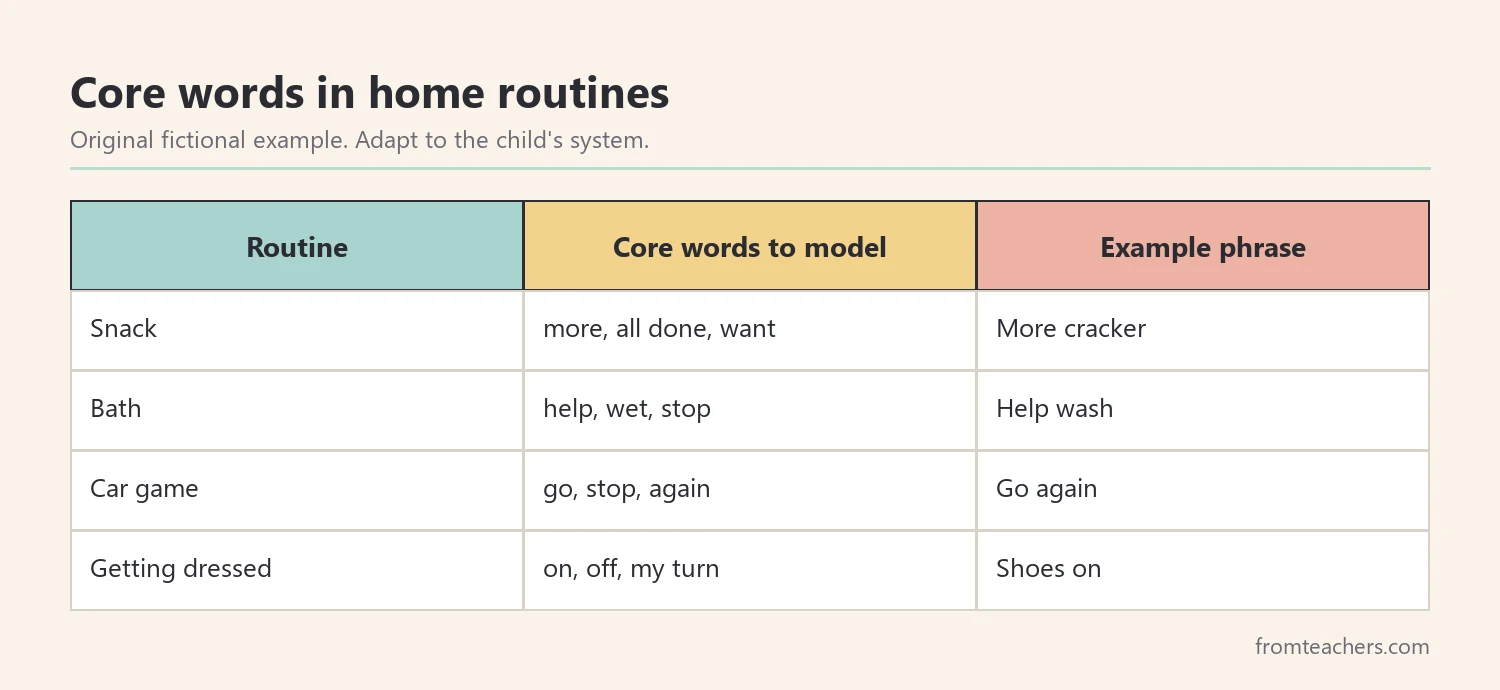
However, avoid turning every moment into a lesson. Pick two or three routines where you have a little time, such as breakfast, bath, and a favorite game. Model in those moments, and let the rest of the day be relaxed. This keeps AAC at home sustainable for tired parents.
Leo’s mother chose snack time, bath time, and a car game. She modeled GO and STOP with toy cars, MORE and ALL DONE at snack, and WET, COLD, and HELP at bath. After a few weeks, Leo began to use GO on his own when he wanted to start the game again.
Equally, let your child see you make mistakes. If you touch the wrong button, say “Oops, I meant GO” and fix it. This shows that mistakes are a normal part of talking, which lowers pressure and makes AAC at home feel safe to explore.
3. Stay in step with the school team
Children learn faster when home and school use the same words, the same symbols, and the same goals. Therefore, ask the teacher or speech-language pathologist which targets they are working on this term. Then, choose one or two to practice at home.
A shared written plan helps a lot here. The individual student communication plan for AAC learning includes sections for communication activities, AAC targets such as the target word or message, progress reflection, and signature lines for parent, teacher, and student. When everyone fills in the same page, nobody has to guess what the others are doing.
Also, keep messages short. A weekly note with three lines is enough: what word your child used, where it happened, and any question you have. For instance, “Leo used GO four times in the car game. He has not used HELP yet. Should we try HELP at bath time?”
Similarly, ask the school to send home any new vocabulary pages or settings changes. If the device layout changes at school but not at home, your child may lose time hunting for buttons that moved. Consistent layouts support motor memory, which makes finding words faster over time.
Finally, remember that you are part of the team. Your observations about AAC at home matter for goal setting, because you see your child in moments the school never sees. Bring your notes to meetings and ask for them to be included.
4. Respond to every attempt at communication
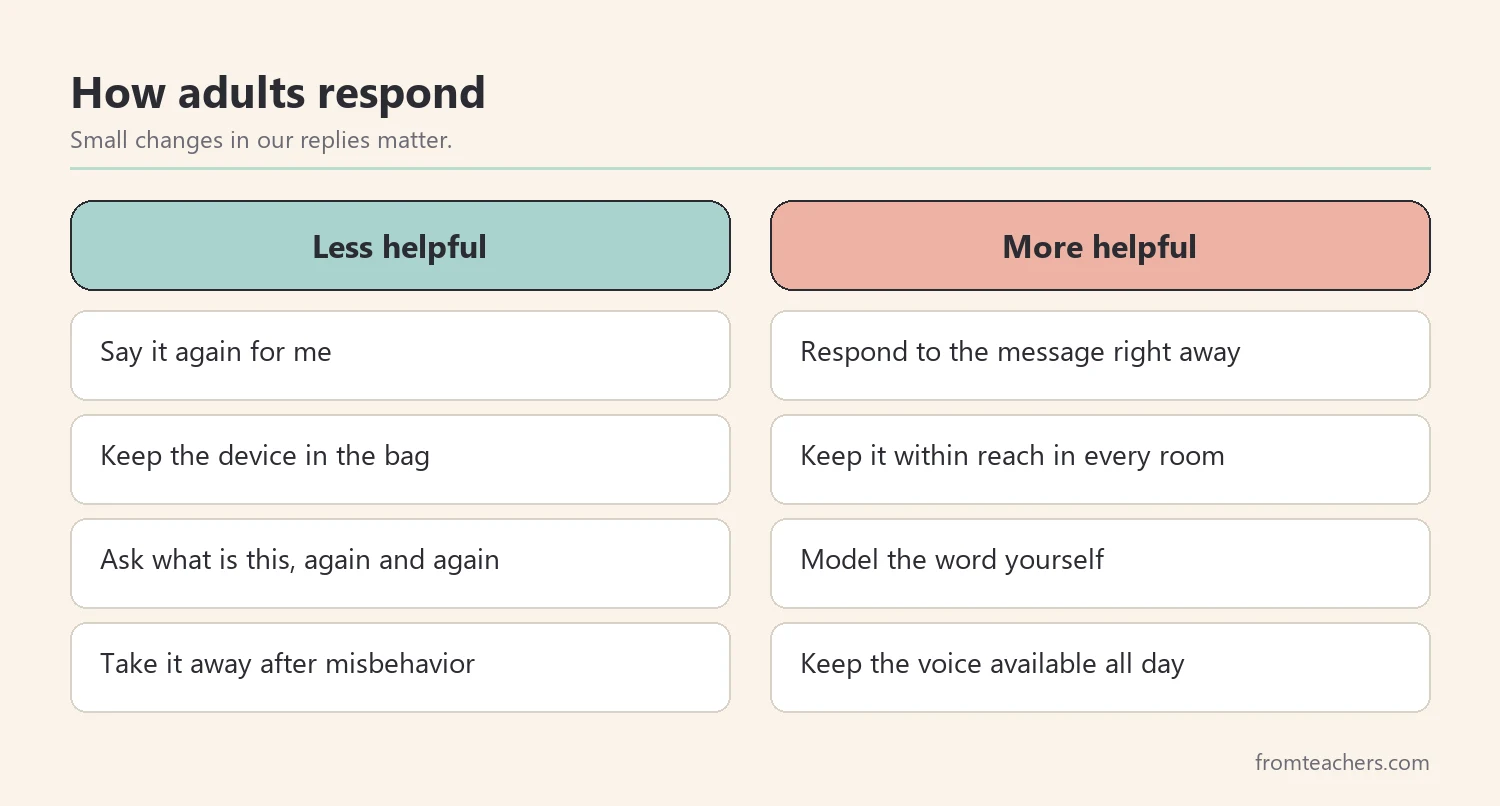
When your child uses the system, respond as if they spoke aloud. If Leo taps STOP during a tickle game, stop right away. That response teaches him that his words have power, which is the main reason any child keeps communicating.
Next, accept all forms of communication. A child might tap a button, point, use a sign, make a sound, or lead you by the hand. AAC at home does not replace these. Instead, it adds another way to be understood, and you can gently model the matching word on the device.
In addition, give wait time. After you model, pause for several seconds and look expectantly. Many children need longer than adults expect to plan a motor movement and find a word. If nothing comes, carry on warmly, without pressure.
Also, expand what your child says. If your child taps JUICE, you can respond “more juice” while touching MORE and JUICE. This adds one word to their message without correcting them. Over time, children often begin to combine words this way on their own.
Another useful habit is to follow your child’s lead. Notice what holds their attention, whether that is water, music, animals, or spinning wheels, and model words about that interest. Children tend to communicate more about the things they already care about, so a favorite toy is often the best starting point.
- Respond quickly, as you would to speech.
- Honor the message, even if it is not the word you hoped for.
- Add one word when you reply.
- Never take the device away as a consequence.
Leo once tapped NOT and BATH together when it was bath time. His father replied, “Not bath yet. Five more minutes,” and set a timer. Leo had communicated a real opinion, and the adult took it seriously while still keeping the routine.
5. Notice progress with AAC at home
Progress does not always mean more buttons pressed. It can mean using a word in a new place, with a new person, or for a new reason. For example, a child who only used the device to request snacks may start to use it to comment, protest, or joke.
Therefore, keep a light record. A sticky note on the fridge or a note on your phone is enough. Write the date, the word or message, and the situation. Once a month, look back and compare.
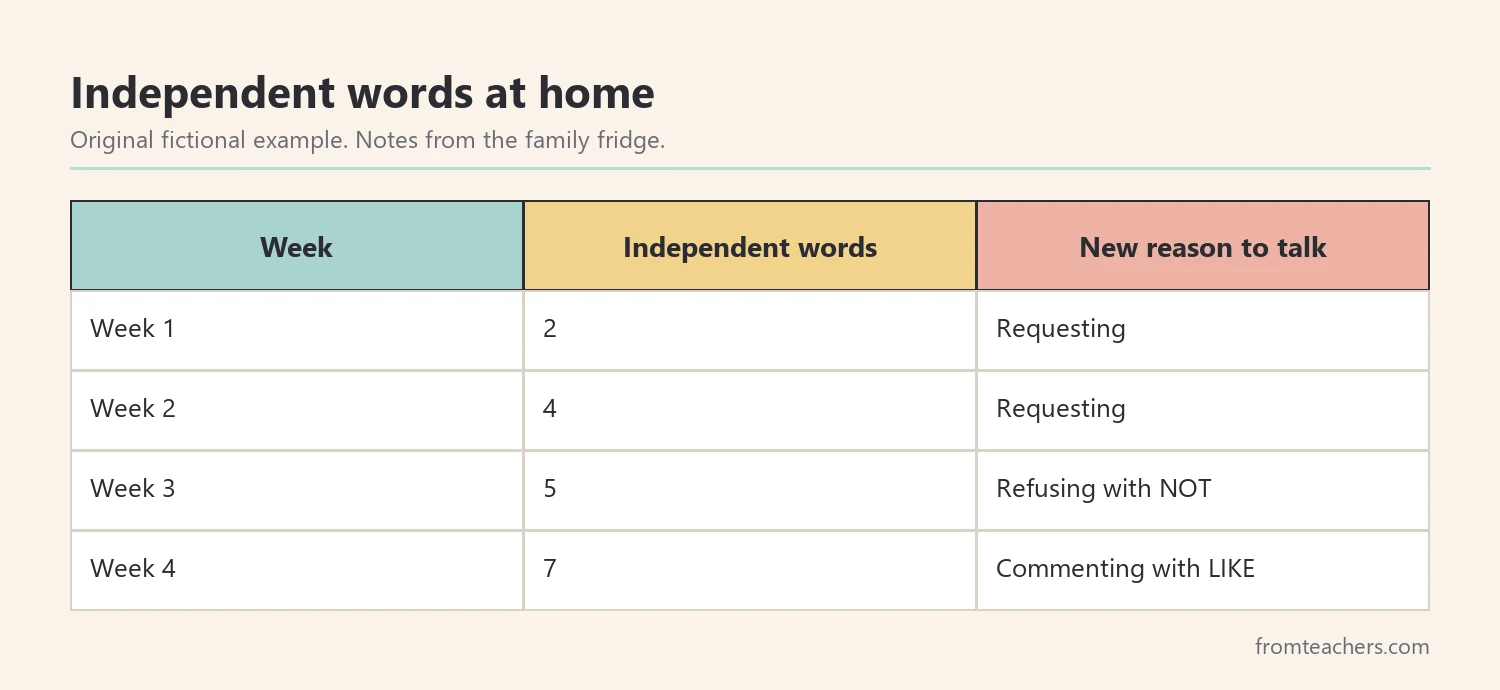
Also, watch for reasons to communicate, not only words. Speech-language pathologists often think about why a child communicates: to request, to refuse, to get attention, to comment, or to ask a question. Seeing a new reason appear is a meaningful step.
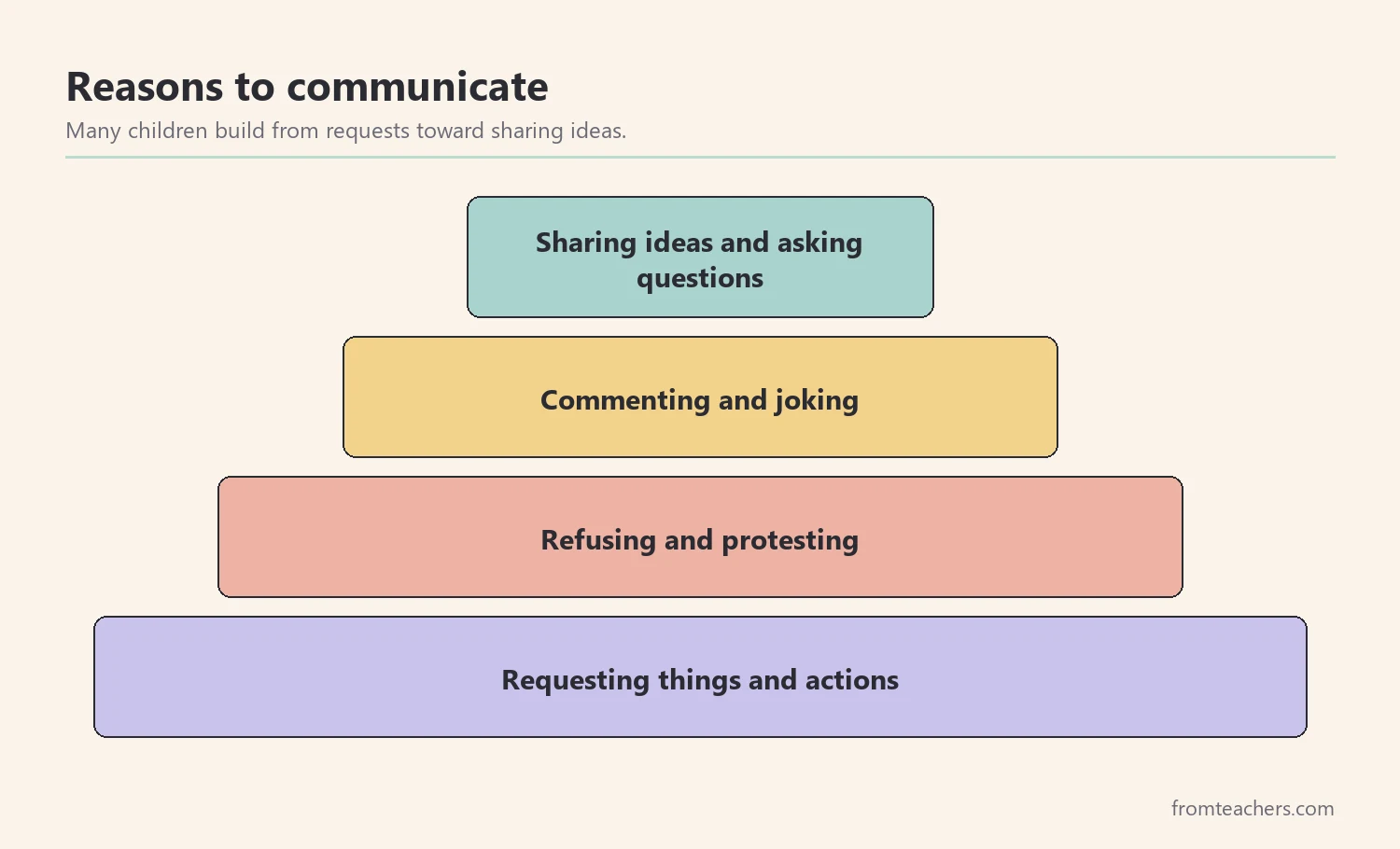
For Leo, the month’s record showed seven independent words at home, up from two. More importantly, he had begun to protest with NOT and to comment with LIKE during the car game. His parents shared this with the school, and the team added a commenting goal to his plan.
Moreover, celebrate the small things. A single new word used with a grandparent, or a request made at a restaurant, is worth noting and sharing. Keeping AAC at home positive helps the whole family stay motivated through slow weeks.
Common mistakes and how to avoid them
- Keeping the device in the bag. If it is out of reach, it will not be used. Fix: set up a home base in each main room.
- Quizzing instead of modeling. Asking “What is this?” again and again adds pressure. Fix: model the words yourself and let your child choose when to use them.
- Using the device as a reward. Taking it away for behavior removes the child’s voice. Fix: keep it available all day, like speech.
- Changing too much at once. Many new words and layouts can overwhelm. Fix: add a few words at a time, agreed with the school.
- Expecting speech to stop. Some families worry AAC replaces talking. Fix: ask your speech-language pathologist about this concern and keep accepting all forms of communication.
Questions teachers and parents ask about AAC at home
Will using AAC stop my child from learning to talk?
This is a common worry. Organizations such as ASHA explain AAC as a support for communication, and many speech-language pathologists address this question directly with families. Talk with your child’s therapist about your specific child.
How much time should we spend on it each day?
There is no set number of minutes. Short moments of modeling inside routines you already have are usually more realistic than a separate practice session. Consistency across days matters more than long sessions.
What if siblings play with the device?
Siblings can be great models. Teach them to use the device kindly and to hand it back. Some families set simple rules, such as “Leo’s voice stays with Leo,” and keep a spare paper board for siblings to model on.
Our home language is not English. What should we do?
Ask the school team whether the system can be set up in your home language or in more than one language. Your child benefits from communicating with the people they love, in the language your family uses.
How do I know if a goal is too hard?
If weeks pass with no use and growing frustration, the goal may need adjusting. Share your notes about AAC at home with the team and ask whether a smaller step or a different word would help.
Related reading: Best Assistive Technology for Special Education Classrooms, Parent-Teacher Collaboration in Special Education, and Teacher-Parent Communication in Special Education.
You may also need: Classroom Observation Form for Special Education (SEN): 12 Daily Checklists.
A companion resource for AAC at home and school:
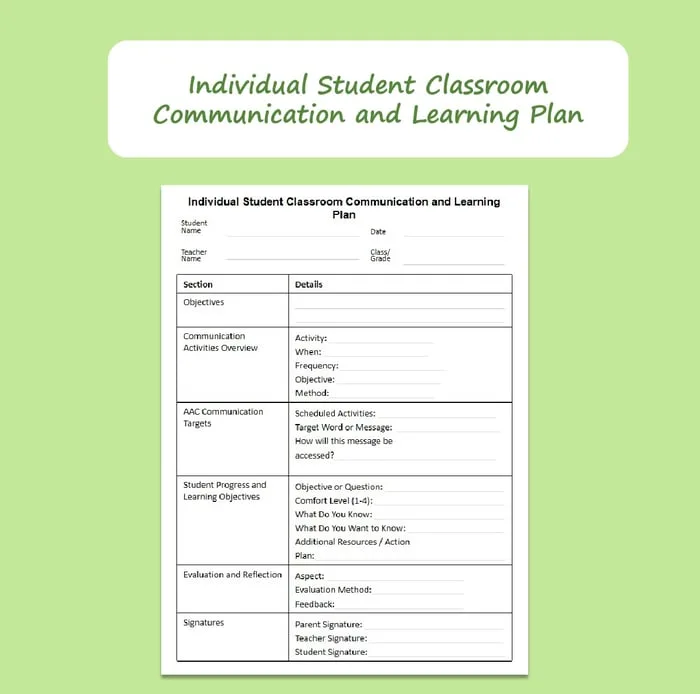
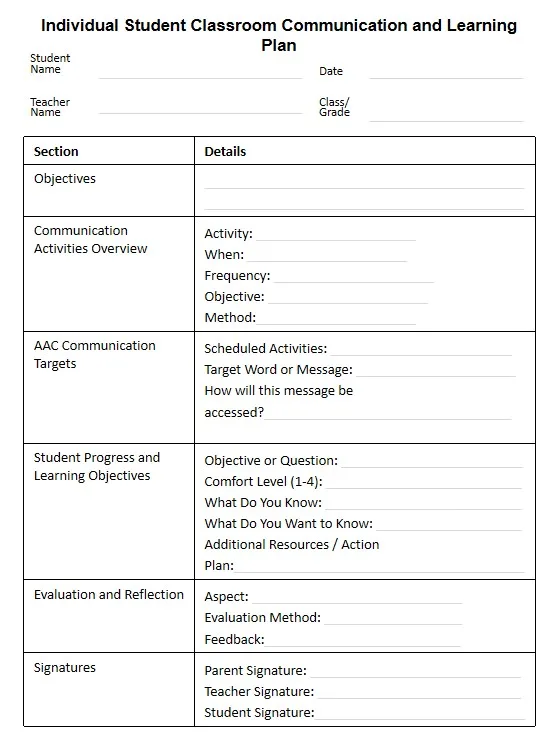
Individual Student Communication Plan AAC Learning Plan for Classrooms: a one-page plan with communication activities, AAC targets, progress reflection, and signature lines for parent, teacher, and student, so the whole team works from the same document.
Sources and scope
- American Speech-Language-Hearing Association (ASHA): professional information on augmentative and alternative communication for families and clinicians.
- Individuals with Disabilities Education Act (IDEA): federal guidance on IEPs, including the consideration of assistive technology.
- IRIS Center, Vanderbilt University: free learning modules on assistive technology and family partnerships.
- Understood.org: family-friendly articles on assistive technology and working with schools.
This guide covers everyday home routines and home-school communication for families of children who use AAC. It does not replace assessment, device selection, or therapy from a qualified speech-language pathologist.
Key takeaways
- AAC at home starts with access: the system must be within reach all day.
- Model core words during two or three routines you already have.
- Match home words and goals to the school plan with short weekly notes.
- Respond to every attempt, and never remove the device as a consequence.
- Track new words and new reasons to communicate, then share them with the team.









Leave a Comment