

Reward chart mistakes are the reason many families give up on charts after two weeks. Picture the fridge in February: a bright chart from January, half filled, with a few stickers peeling off and a reward nobody remembers. The child stopped caring, the parents stopped checking, and everyone quietly agreed that charts “do not work for our kid.”
Often, the chart was not the problem. The setup was. This guide walks parents through the most common reward chart mistakes and gives you a simple fix for each, so a weekly chart can become a calm, positive part of home life.
Examples are fictional. Adapt to the student’s goals and agreed supports. This is guidance, not a diagnosis.
At a glance
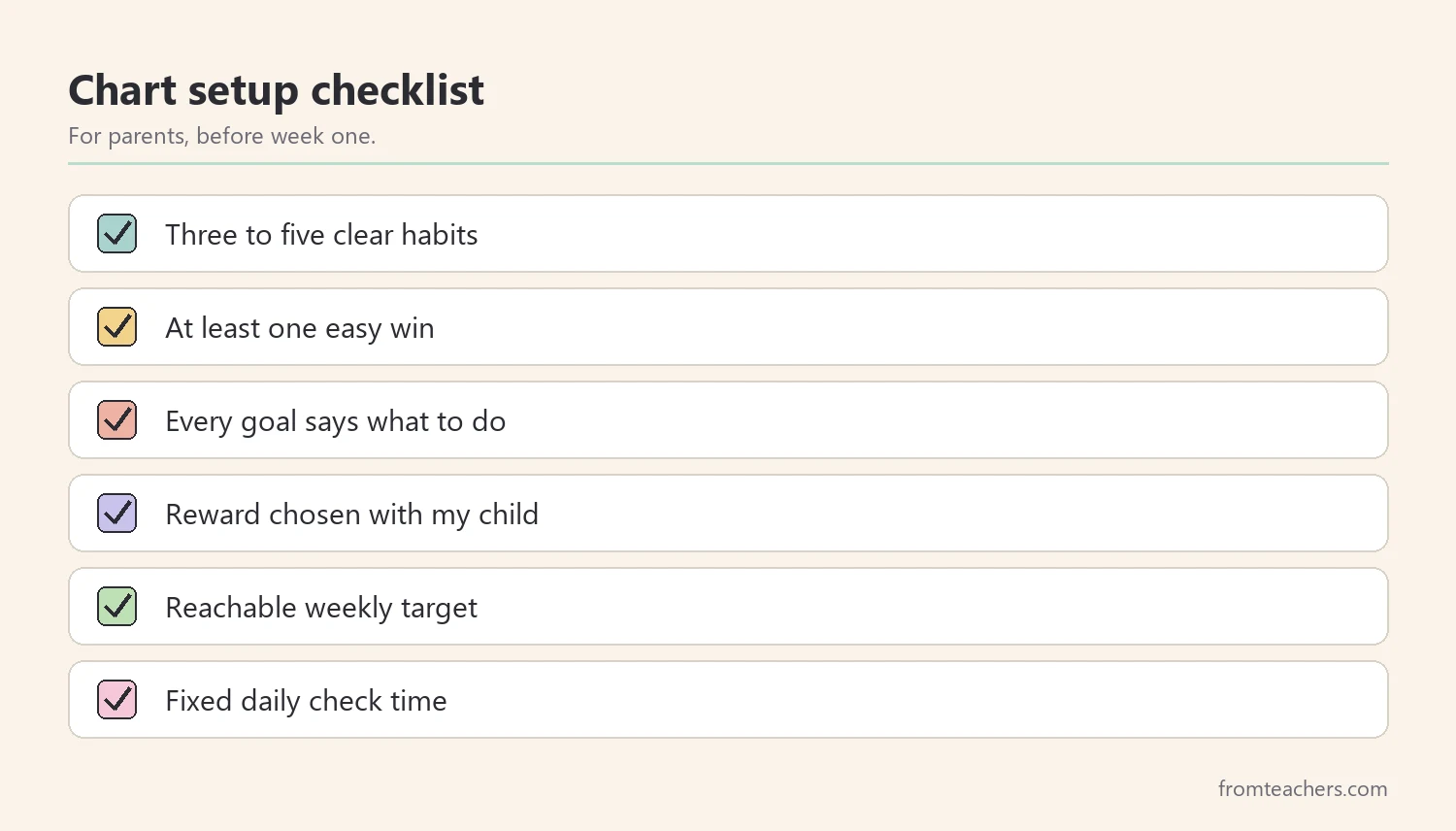
- Start with a few clear habits, not a long list of rules.
- Describe what to do, in words your child understands.
- Choose rewards together, and keep them small and reachable.
- Check the chart at the same time every day, in a warm voice.
- Review each week and change one thing at a time.
1. Avoid the reward chart mistakes that start on day one
The first mistake is tracking too much. A chart with fifteen goals looks thorough to adults, but a young child cannot hold that many targets in mind. As a result, the chart becomes a list of failures instead of a list of wins.
Instead, start with three to five habits. Pick one that your child already does most days, so they feel success right away. Then, add one or two that need a bit of work. This mix keeps motivation high while still building something new.
The second mistake is vague wording. “Be good” or “behave” means different things on different days. In contrast, “put shoes by the door” or “listen the first time” are clear, and both you and your child can agree whether they happened.
Noah (fictional, age 6) had a chart with twelve rules. His parents cut it to four habits: brush teeth, put toys in the bin, use kind words with his sister, and read for ten minutes. Within days, Noah was asking to check the chart himself.

2. Write positive, doable habits
Many reward chart mistakes come from how goals are worded. “No hitting” tells a child what not to do, but not what to do instead. Therefore, turn each “don’t” into a “do.” For example, “no hitting” becomes “keep hands to yourself” or “use words when you are upset.”
Next, check that each habit is doable at your child’s age and on most days. A five-year-old may manage “put pajamas in the basket,” but “keep your room tidy all day” is a big ask. A chart works best when success is likely, not rare.
In addition, keep a separate, small section for behaviors to work on together. A ready chart such as the editable weekly behavior chart for kids includes a daily habits grid, a Things to Avoid section, and a Reward section. That layout keeps the main grid positive while still naming the few things you are both working on.
| Instead of | Try |
|---|---|
| No yelling | Use an indoor voice |
| Stop fighting | Share and take turns |
| Don’t be messy | Toys back in the bin |
| No whining at bedtime | Pajamas on when the timer rings |
Also, involve your child in the wording. Ask, “What does listening look like?” Children who help write a goal are more likely to understand it and own it.
3. Choose rewards that actually motivate
A common mistake is choosing a reward the adult likes rather than one the child wants. A trip to the museum sounds wonderful, but a six-year-old may care more about choosing the dinner menu or an extra bedtime story.
So, make a short reward menu together. Include small, free, or low-cost options, especially ones that involve time with you. Then, let your child pick the weekly goal from the menu at the start of the week.

Another of the classic reward chart mistakes is setting the bar too high. If a child needs every box filled every day to earn the reward, one rough Tuesday can ruin the whole week. Instead, set a target that is reachable, such as most boxes across the week.
Finally, keep the reward promise. If the target is met, the reward happens, even if Saturday was a hard day. Breaking the promise teaches children that the chart cannot be trusted.
For Noah, the menu included a park trip with Dad, choosing a family movie, baking cookies, and a sticker book. He chose baking for week one and earned it with a reachable target of twenty checks.
4. Check the chart at the same time every day
Inconsistent checking is one of the most common reward chart mistakes. When the chart is filled only on good days, or only when a parent remembers, the child learns that it does not really matter.
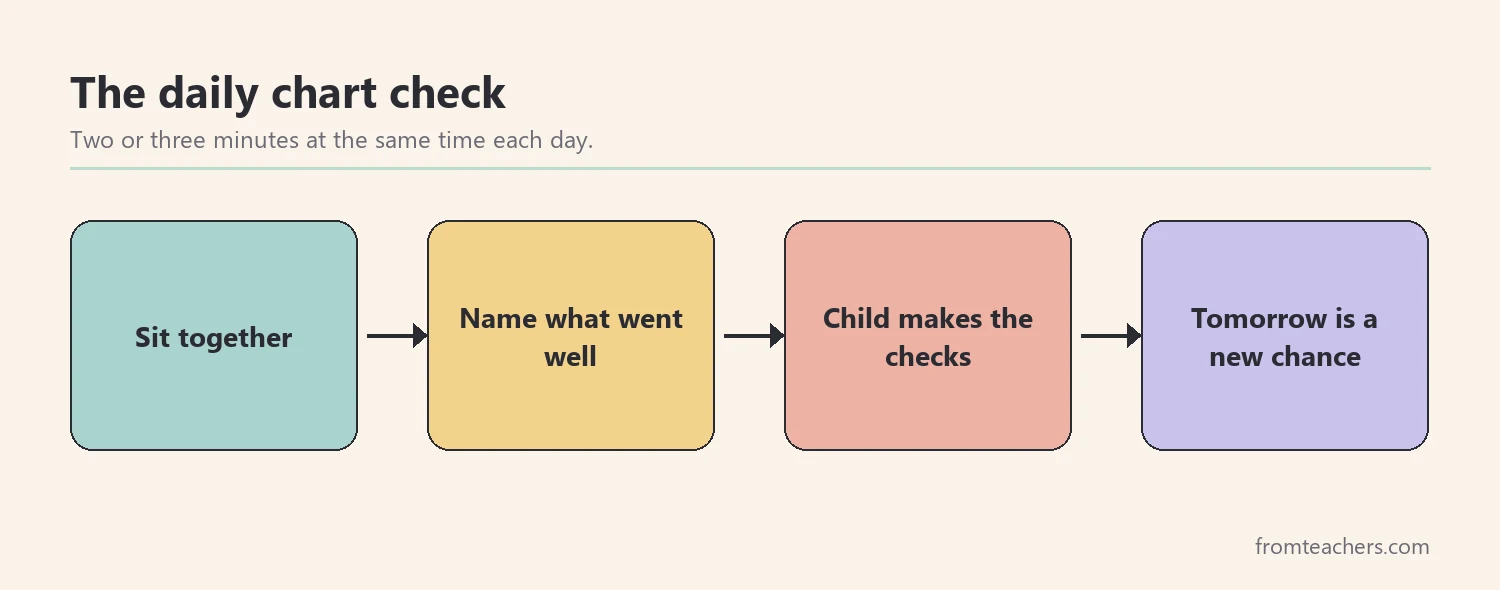
Therefore, pick a fixed moment, such as right after dinner or before bedtime stories. Sit together, look at each habit, and let your child make the check. Keep it short: two or three minutes is enough.
Also, watch your tone. The chart moment should feel like a small celebration, not a court hearing. Name what went well first. Then, for any empty box, say something calm like, “Tomorrow is a new chance.”
In addition, never remove checks as punishment. If a child earned a check for brushing teeth in the morning, it stays, even if there is a meltdown later. Taking earned checks away mixes two different things and quickly makes the chart feel unfair.
Similarly, share the moment with the other adults at home. If one parent checks on Monday and another on Tuesday, agree on the same questions and the same calm words. Mixed messages between caregivers are among the hidden reward chart mistakes, because the child cannot predict how the check will go. A short chat between adults on Sunday evening keeps everyone in step for the week ahead.
Noah’s parents chose “after bath, before story.” On the busiest evenings, they still did a one-minute version. That steady rhythm made the chart part of the routine rather than an extra task.
5. Review the week and fix reward chart mistakes early
At the end of each week, look back together. Which habit was easiest? Which one was hardest? This short review helps you spot reward chart mistakes before they turn into frustration.
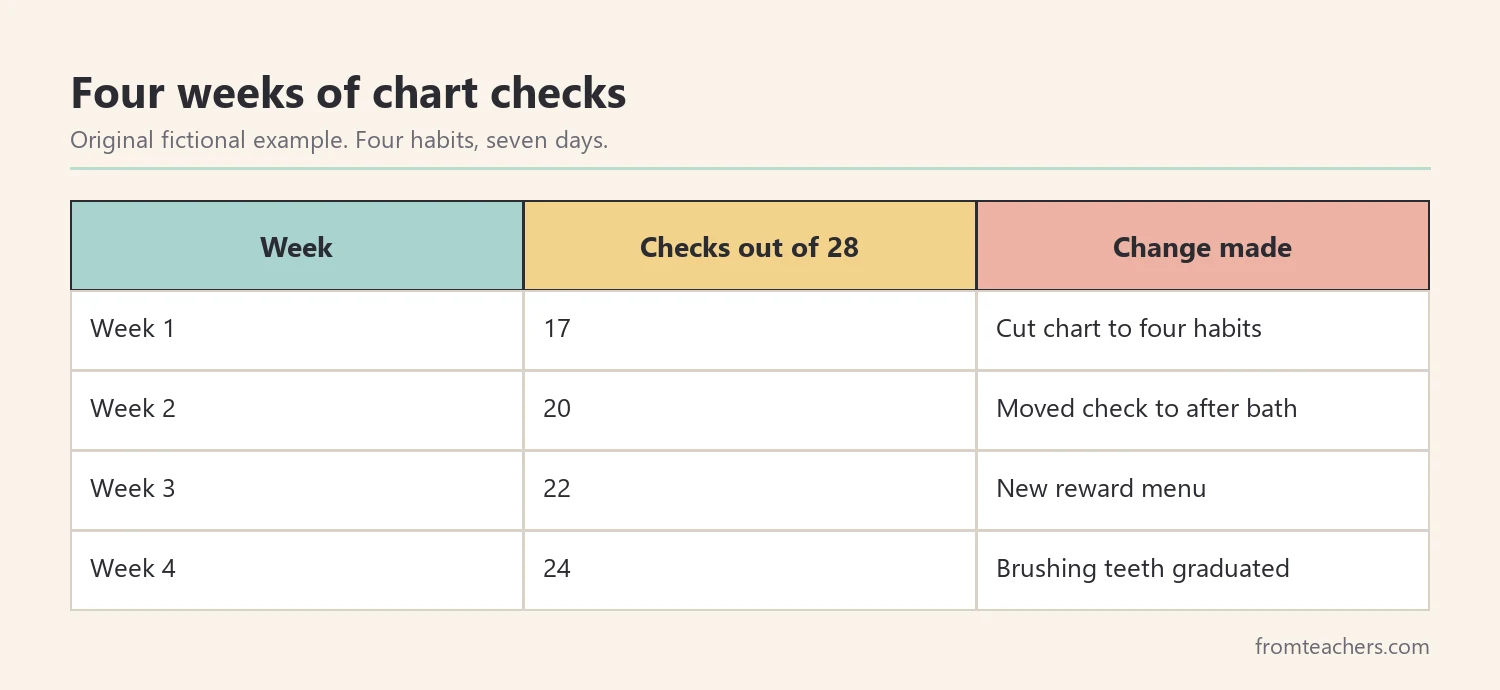
Next, change only one thing at a time. If a habit was checked every single day, it may be ready to “graduate” and be replaced by a new one. If a habit was rarely checked, it may need to be broken into a smaller step.
Also, plan for fading. A chart is a support for building habits, not a forever system. Once habits are steady, you can move to a lighter version, such as checking only two habits, or switching to a weekly conversation without stickers.
For example, after four weeks Noah’s tooth brushing was steady, so it graduated and was replaced by “get dressed before breakfast.” His kind words goal was still hard, so his parents changed it to a smaller step: “say sorry with words when you bump your sister.”
Moreover, keep teachers in the loop if your child has a school behavior plan. Using similar words at home and school can help children see that expectations are consistent. A short note to the teacher about what you are tracking is often enough.
6. Adapt the chart to your child’s age and needs
A chart that suits a four-year-old will feel babyish to a ten-year-old. Likewise, a chart built for an older child may be too wordy for a preschooler. Matching the design to your child prevents some of the quieter reward chart mistakes, the ones that make a child lose interest without anyone noticing why.
For younger children, use pictures next to each habit, very short words, and a reward that comes quickly. Some children this age do better with a daily small reward rather than waiting a full week. A simple sticker or a special high five at the check can be enough.
For school-age children, words work well, and a weekly reward is usually realistic. In addition, let them help track and count their own checks. Counting builds ownership, and many children enjoy seeing the total grow during the week.
For preteens, the word “chart” itself may feel childish. Instead, call it a weekly goal sheet, keep the design simple, and focus on privileges such as later screen time on Friday or choosing a weekend plan. Respect their opinions about which habits matter most.
| Age | Chart style | Reward timing |
|---|---|---|
| 3 to 5 | Pictures, two or three habits | Daily, very small |
| 6 to 9 | Words and checks, three to five habits | Weekly, from a menu |
| 10 to 12 | Simple goal sheet, child tracks | Weekly privileges |
Also, think about your child’s attention and memory. Some children need a reminder of the habits during the day, not only at the evening check. A small copy of the chart on the bathroom mirror or by the front door can help. Similarly, children who find waiting very hard may need a midweek mini reward to stay motivated until Saturday.
Finally, keep the chart about growth, not comparison. Each child’s chart should be measured against their own last week, never against a sibling or a friend.
Common mistakes and how to avoid them
Here is a quick summary of the reward chart mistakes covered above, with a fix for each.
- Too many goals. Fix: start with three to five habits, including one easy win.
- Vague words like “be good.” Fix: describe the action your child can see and do.
- Rewards the child does not care about. Fix: build a reward menu together.
- Perfection targets. Fix: set a reachable target across the week.
- Removing earned checks. Fix: keep earned checks, and handle other behavior separately.
- Never changing the chart. Fix: review weekly and change one thing.
Questions teachers and parents ask about reward chart mistakes
Are reward charts bribery?
Many parents worry about this. A bribe is usually offered in the middle of a problem to stop it, while a chart is agreed in advance and celebrates effort over time. Pairing the chart with real praise and attention helps keep the focus on the habit, not just the prize.
What if my child stops caring about the chart?
This often means the reward is stale or the target is too hard. Refresh the reward menu, check that habits are reachable, and let your child pick a new goal. Sometimes a new chart design is enough to restart interest.
Should siblings have charts too?
Many families give each child their own chart with their own habits, even if the goals are simple. This can feel fairer and prevents one child from feeling singled out. Keep comparisons between siblings out of the chart conversation.
How long should we use a reward chart?
There is no fixed length. Use it while it helps, then fade it as habits become steady. Some families return to a chart during busy seasons, such as a new school year.
What if my child has ADHD or autism?
Charts can still help, but the setup may need adjustments, such as fewer habits, more frequent checks, or visual symbols. Ask your child’s teacher or therapist which supports are already working at school, and avoid the reward chart mistakes above by keeping goals small and clear.
Related reading: Moving Beyond Shame and Behavior Charts: Positive Alternatives, ADHD Children Support Strategies, and Meltdowns vs Tantrums: The Difference.
You may also need: Daily Reflection Journal for Students SEL Check In and Goal Setting Sheet.
A companion resource for a calmer weekly chart:

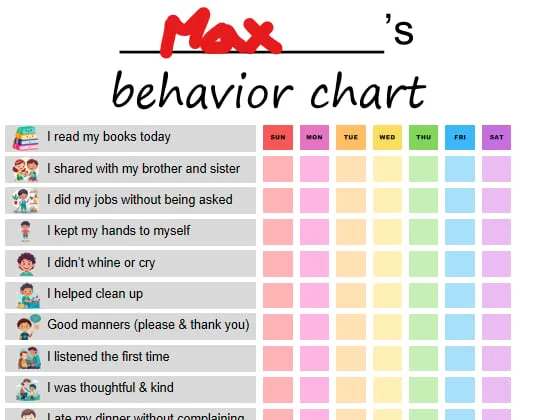
Weekly Behavior Chart for Kids: Editable Reward Chart for Home: one colorful page with space for your child’s name, eleven positive daily habits from Sunday to Saturday, a Things to Avoid section, and a Reward section.
Sources and scope
- CDC Positive Parenting resources: general guidance for parents on encouraging positive behavior.
- Understood.org: family-friendly articles on behavior, ADHD, and routines at home.
- IRIS Center, Vanderbilt University: free modules on positive behavior supports used in schools.
- What Works Clearinghouse: reviews of research on classroom behavior practices.
This guide covers simple reward charts for everyday habits at home. It does not cover intensive behavior plans, safety concerns, or clinical advice, which should come from qualified professionals.
Key takeaways
- Most reward chart mistakes come from setup, not from the child.
- Track three to five clear, positive habits, with one easy win.
- Build a reward menu together and keep the promise when the target is met.
- Check the chart daily at a fixed time, in a warm tone, without removing earned checks.
- Review weekly, change one thing at a time, and plan to fade the chart.










Leave a Comment