

Time blindness strategies help the student who honestly believes a twenty-minute task will take five, then looks up to find the period is over. You have probably seen it: a seventh grader who starts a project the night before, is surprised the bus is already here, and rushes every test. The student is not careless. Time simply does not feel real until it runs out.
This guide walks you through five steps: notice how time blindness shows up, make time visible, practice estimating, build start times and buffers into the day, and review the plan with the student and family. By the end, you will have practical tools for class and home, plus a simple way to check whether they work.
Examples are fictional. Adapt to the student’s goals and agreed supports. This is guidance, not a diagnosis.
At a glance
- Time blindness often shows up as late starts, poor estimates, and last-minute rushing.
- Make time visible with analog clocks, visual timers, and written start times.
- Practice estimating how long tasks take, then compare with the real time.
- Add buffers and fixed start times so deadlines do not arrive as a surprise.
- Review one simple measure with the student and family every few weeks.
1. Notice how time blindness shows up
First, look closely at the problem. Time blindness is an informal term many families and teachers use for difficulty sensing and managing time. It is often described in students with ADHD, though other students can struggle with it too. Effective time blindness strategies start from what you actually see in class.
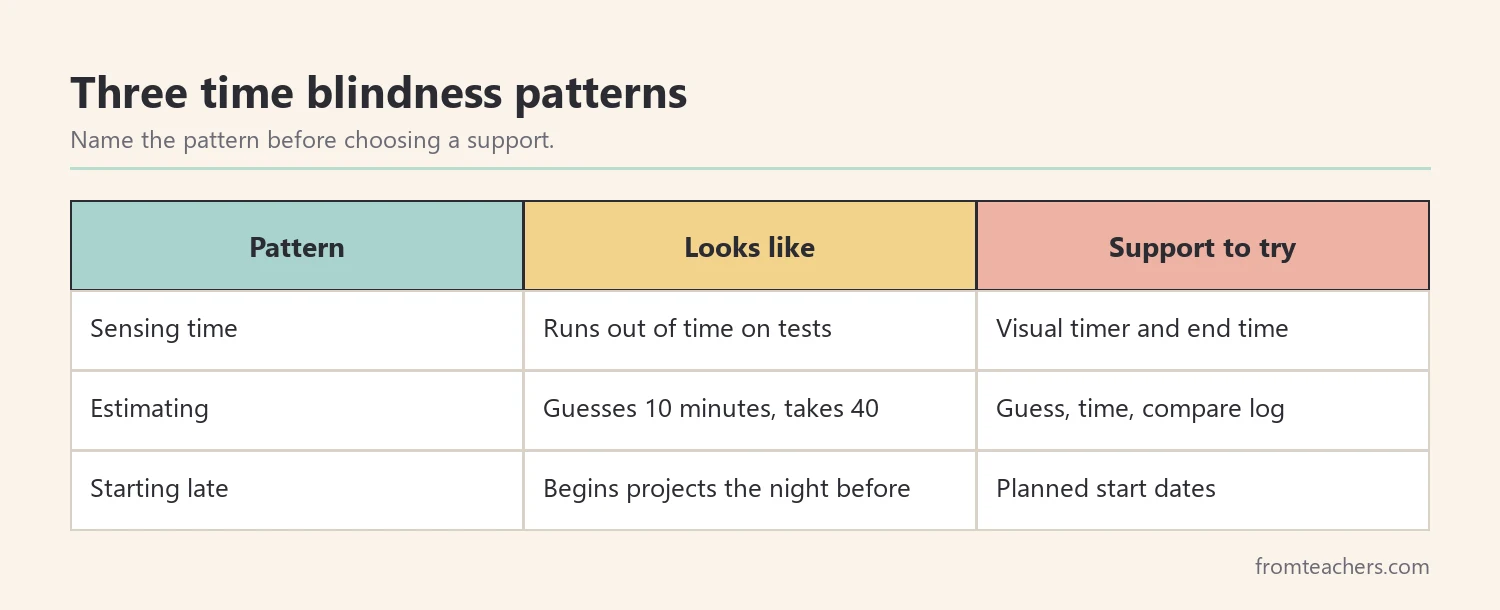
Watch for three common patterns. Some students cannot tell how much time has passed. Others underestimate how long a task will take. Many wait until the last minute because a deadline next week feels the same as no deadline at all.
Meet our fictional student, Jonah, a seventh grader. Jonah is a strong talker in science and loves building models. However, he regularly runs out of time on tests, arrives late after lunch, and starts projects the night before. His teacher noted these moments over one week.
| Moment | Pattern |
|---|---|
| Finished half the quiz when time was up | Cannot sense time passing |
| Guessed homework would take 10 minutes; took 40 | Underestimates tasks |
| Started a lab report the night before | Last-minute starts |
| Arrived 6 minutes late after lunch | Cannot sense time passing |
As a result, the team saw that Jonah needed two kinds of help: tools to feel time passing during a task, and a way to plan when to start. Naming the patterns first keeps you from piling on general reminders that do not address either one.
Also, notice what goes well. Jonah is never late for robotics club, which always starts with a five-minute countdown on the projector. That tells you visible time cues work for him. Strengths like this point straight to the time blindness strategies most likely to succeed.
In addition, ask the student how time feels to them. Some students say a class period “goes by in a blink.” Others say homework “takes forever,” even when it is short. These answers help you choose time blindness strategies that match the student’s experience, and they show the student that you are curious rather than critical.
2. Make time visible with time blindness strategies
Next, turn time into something the student can see. Digital clocks show a number, but they do not show how much time is left. In contrast, an analog clock or a visual timer shows time shrinking. This simple change is at the heart of many time blindness strategies.
- Use a visual timer that shows a colored section getting smaller.
- Put an analog clock where the student can see it without turning.
- Mark the end time on the clock face with a sticky arrow.
- Write start and end times on the board for each activity.
- Announce halfway points: “Twenty minutes left of forty.”
For Jonah, his teacher placed a small visual timer on his desk during tests and wrote “End 10:40” at the top of each quiz. She also gave a quiet halfway signal. Within two weeks, Jonah was finishing more questions, because he could see when to move on from a hard one.
In addition, break long periods into visible chunks. A sixty-minute work block feels endless. Three twenty-minute chunks, each with its own goal, feel manageable. Students with time blindness benefit from shorter, clearly marked units of time.
At home, families can use the same tools. A visual timer for homework, a clock near the front door, and a written “leave at” time on the fridge all make time easier to see. Consistent tools across settings make time blindness strategies easier to learn.
Finally, teach the student to read the tools, not just look at them. Ask quick questions during the day: “How much time is left on the timer?” or “What time does this block end?” Short checks like these build the habit of looking at time on purpose, which is the real goal behind every visual cue.
3. Practice estimating how long tasks take
Then, build the skill of estimating. Many students with time blindness have never checked their guesses against reality. They keep guessing “ten minutes” for everything. Estimating practice is one of the most useful time blindness strategies because it gives the student real feedback.
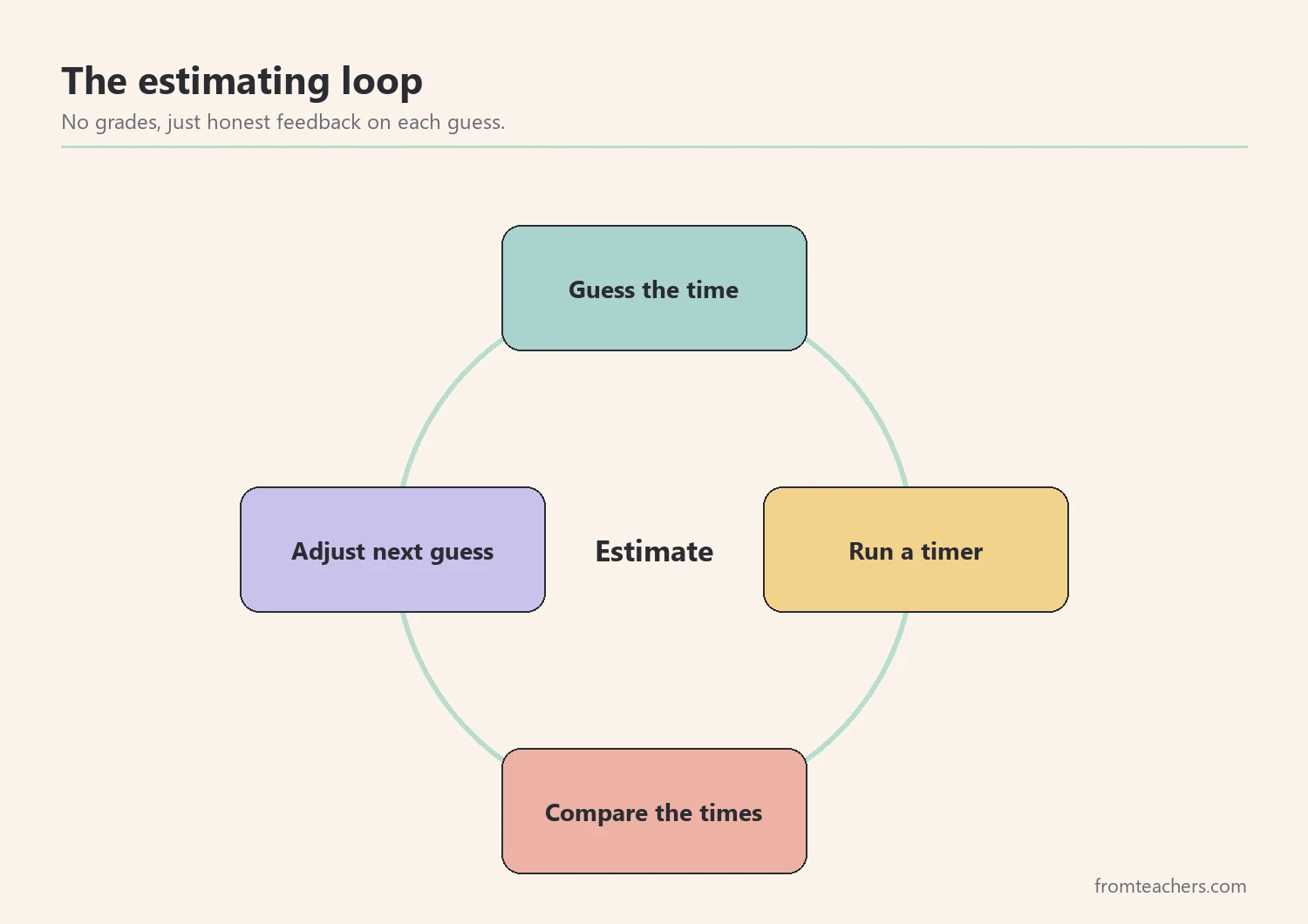
The method is simple. Before a task, the student writes a guess. During the task, a timer runs. After the task, the student writes the actual time and looks at the difference. No grades, no judgment, just data. Over time, guesses get closer.
Jonah practiced with four familiar tasks over two weeks. At first, his guesses were far off. By the end, they were much closer. More importantly, he started to say things like “Math homework is usually about thirty-five minutes for me,” which shows a growing sense of time.
| Task | First guess | Actual time |
|---|---|---|
| Math homework | 10 min | 35 min |
| Reading log | 5 min | 15 min |
| Packing for school | 2 min | 8 min |
| Lab write-up | 20 min | 50 min |
Keep a small “time log” where the student records real times for common tasks. This becomes a personal reference. When a new assignment comes in, the student can look up a similar task instead of guessing from scratch. If you want ready-made ideas, the time management strategy tables for ADHD students pair each time blindness moment with a practical reaction and outcome.
Also, practice estimating whole-class. Ask everyone to guess how long it takes to clean up after an activity, then time it together. Students enjoy checking the result, and the student with time blindness gets practice without being singled out. Whole-class time blindness strategies like this one quietly help many students who never asked for support.
4. Build start times and buffers into the day
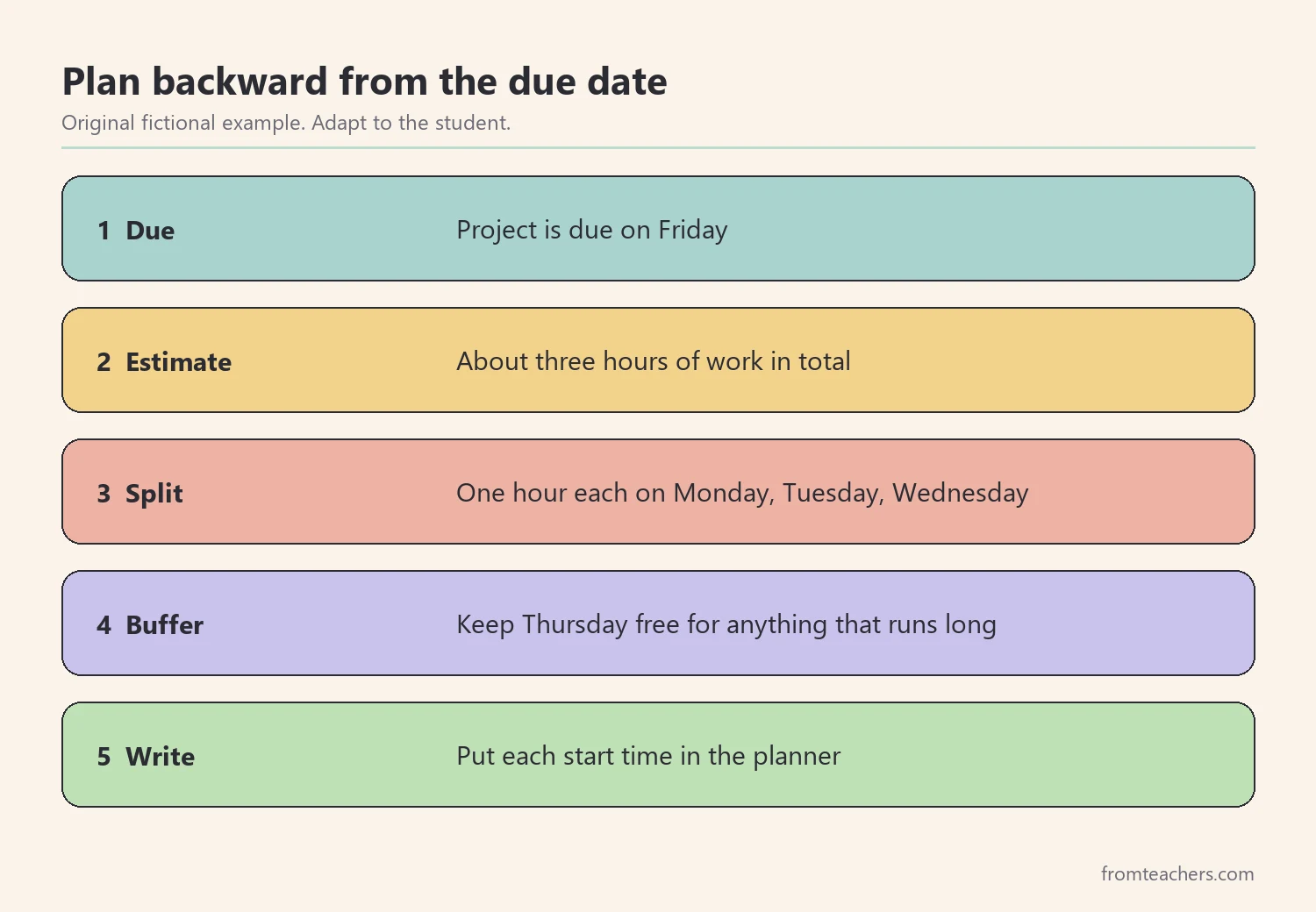
Many students with time blindness focus only on the due date. However, the date that matters most is the start date. Therefore, teach students to plan backward from the deadline and write down when to start, not only when to finish.
For example, if a project is due Friday and will take about three hours, the student might plan one hour on Monday, Tuesday, and Wednesday. Thursday becomes a buffer day for anything that runs long. Writing these start times in a planner turns a far-off deadline into today’s job.
Buffers matter for daily transitions too. If Jonah needs to be in class at 12:30, his alarm on his watch goes off at 12:24. Those extra minutes cover the walk, the locker, and the water fountain. Buffers are simple time blindness strategies that prevent the same late arrival from happening every day.
- Add about half again to any first estimate for new tasks.
- Set alerts for leaving, not for arriving.
- Block one buffer day before every big due date.
- Write start times in the same place every day.
Also, connect time to routines the student already has. A start time tied to an event, such as “after snack,” is easier to remember than a number on a clock. For younger students, use picture schedules with times next to each picture.
During tests, a pacing plan is another useful buffer. Before starting, the student divides the time by the number of sections and writes a target time beside each one. For example, a forty-minute quiz with four sections means about ten minutes each. When the clock passes a target, the student moves on and returns later if time allows. Pacing plans are practical time blindness strategies because they turn one big block into small, visible checkpoints.
5. Review time blindness strategies with the student and family
Finally, measure whether the plan helps. Pick one or two simple measures, such as on-time arrivals after lunch or the share of test questions answered. Count them each week. Avoid tracking too much, because a long data sheet is hard to keep up.
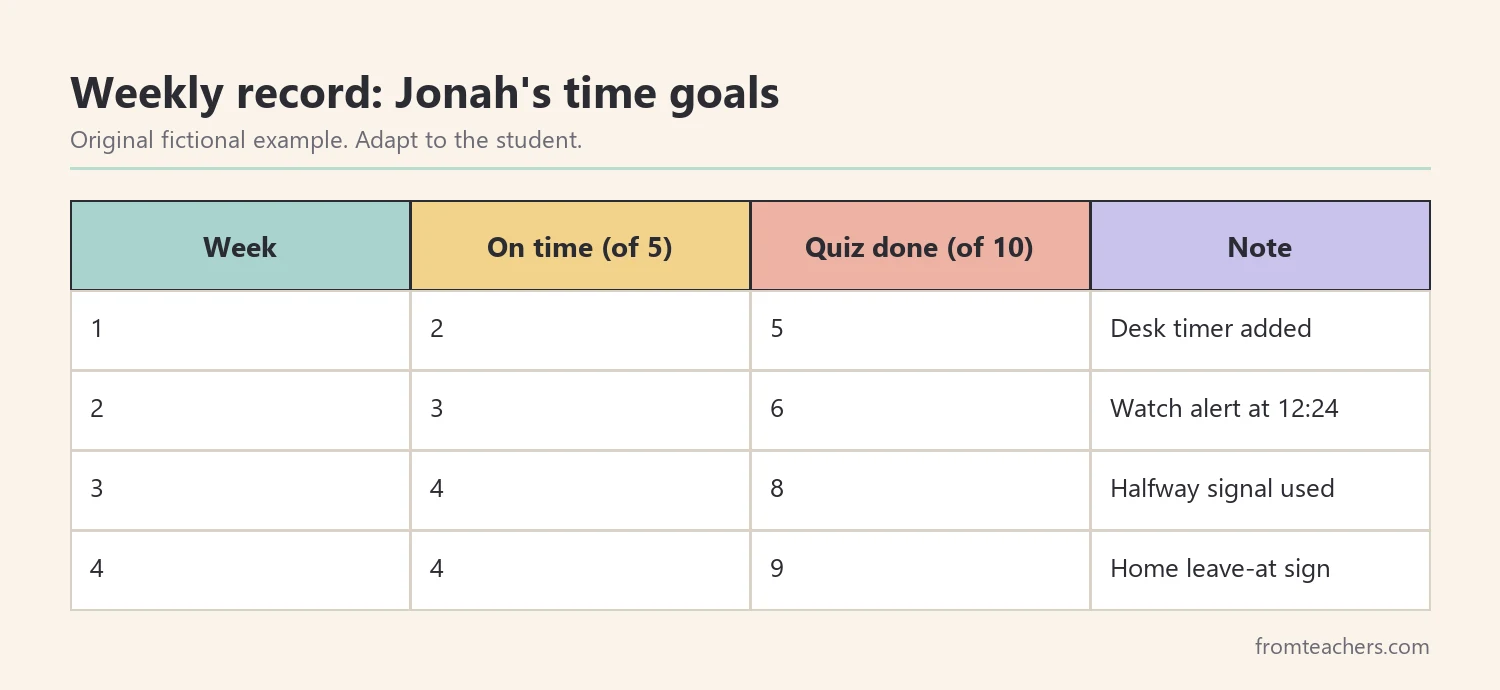
Review the numbers every three to four weeks with the student and the family. Ask which time blindness strategies feel helpful, which feel annoying, and what still causes stress. In Jonah’s case, mornings at home were still rushed. His family added a “leave at 7:35” sign by the door and a visual timer for breakfast, which helped.
Change one support at a time. If you add a new timer, a new planner, and a new alarm at once, you cannot tell what made the difference. Small, steady changes also feel less overwhelming for the student.
In addition, celebrate the process, not only the result. Praise a close estimate, a planned start date, or a quick look at the timer. Because time blindness strategies take weeks to become habits, noticing small wins keeps the student motivated while the bigger results build.
When a support works well, begin to fade it carefully. For instance, move from a desk timer to a classroom clock with a marked end time. Keep the start-time planning and the time log, since these are long-term skills. Also, write a short summary for next year’s teachers so the best time blindness strategies follow the student.
Common mistakes and how to avoid them
- Repeating “hurry up.” Instead, show time with a visual timer and a written end time.
- Focusing only on due dates. Teach students to plan start dates and buffer days.
- Grading estimates. Keep estimating practice judgment-free so students stay honest.
- Using digital clocks only. Add analog clocks or timers that show time shrinking.
- Removing tools too early. Fade slowly and keep the core habits.
Questions teachers and parents ask about time blindness strategies
Is time blindness a diagnosis?
No. Time blindness is an informal term, not a diagnosis. It describes difficulty sensing and managing time, which is often discussed alongside ADHD. Only qualified professionals can evaluate a student.
What is the best tool to start with?
A visual timer is often the easiest first step. It shows time passing in a way the student can see. Pair it with a written end time for each task.
How can I help a student who is always late?
Look at the route and the steps in between. Then set an alert a few minutes earlier than needed, and give the student a simple checklist for the transition. Review after two weeks.
Do time blindness strategies work at home too?
Yes. Families can use the same visual timers, written “leave at” times, and backward planning for projects. Using the same tools in both places helps the student learn faster.
Can these supports go in an IEP or 504 plan?
Teams often include supports like extended time, visual timers, or planner checks. Talk with the student’s team about which supports fit their plan.
Related reading: ADHD in Children: A Guide to Effective Classroom and Home Support, Effective ADHD Classroom Strategies to Support Student Success, and Accommodations vs Modifications in Special Education: The Difference Explained.
A companion resource for time blindness strategies:
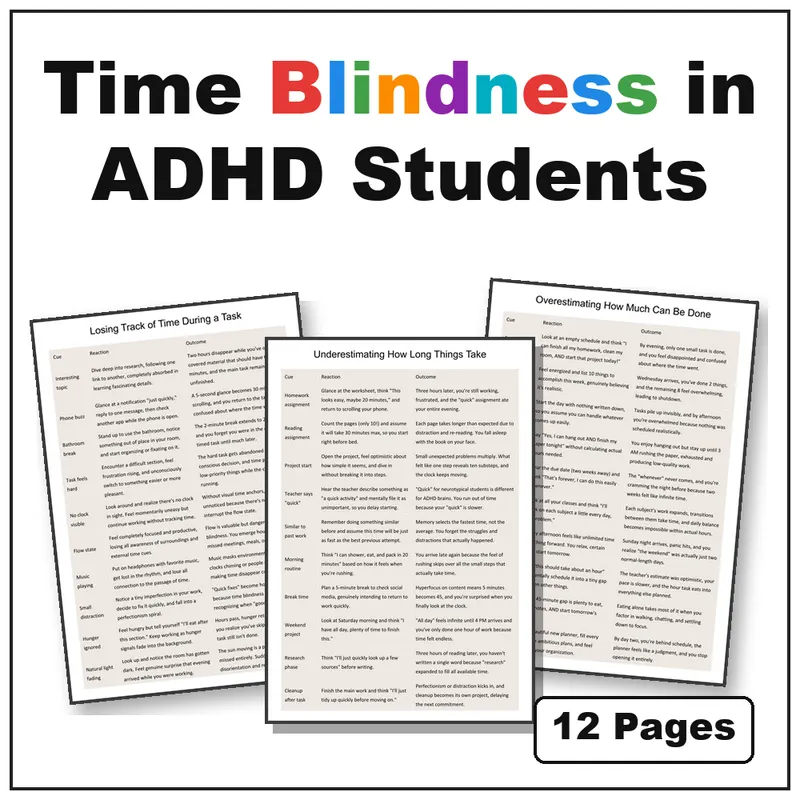

Time Blindness in ADHD Students | Time Management Strategies: 12 printable strategy tables that pair each time blindness moment, such as losing track of time or underestimating a task, with a practical reaction and outcome.
Sources and scope
- CDC ADHD information: general background on ADHD in children, including school supports.
- Center on the Developing Child, Harvard University: background on executive function skills such as planning.
- Understood.org: practical articles for families and teachers on time management and learning differences.
- CHADD: a national organization offering information and support for families affected by ADHD.
This guide covers everyday classroom and home strategies for sensing, estimating, and planning time. It does not cover diagnosis, medication, or formal evaluation, which belong to qualified professionals and the student’s team.
Key takeaways
- Name the pattern: sensing time, estimating tasks, or starting late.
- Make time visible with visual timers, analog clocks, and written end times.
- Practice estimating with a simple guess, time, compare, adjust loop.
- Plan start times and buffers, not only due dates.
- Review your time blindness strategies with the family and fade support slowly.










Leave a Comment