

ADHD executive function strategies help children organize, plan, and follow through on tasks that feel overwhelming. Executive functions are the brain’s management skills. They include working memory, planning, time management, organization, and self-control.
Children with ADHD often have trouble with these skills, even when they are bright and motivated. As a result, they may lose homework, forget steps, or struggle to start assignments. This guide pairs common challenges with practical fixes that teachers and parents can use right away.
Understanding Executive Function and ADHD
Executive function difficulties are not laziness or a lack of effort. Instead, they reflect differences in how the brain manages tasks. The CDC ADHD resources explain how ADHD affects attention and behavior.
Because these skills develop more slowly for many kids with ADHD, adults can provide outside structure while children build inside skills. Think of supports as scaffolding. Over time, you gradually remove pieces as the child grows more independent.
ADHD Executive Function Strategies for Organization
Problem: Papers disappear, backpacks overflow, and materials are never where they should be.
Fix: Simplify the system and make it visual.
- Use one folder with two pockets labeled “To Do” and “Done.”
- Color-code subjects with matching folders and notebooks.
- Post a picture checklist for packing the backpack.
- Schedule a weekly five-minute “clean out” time.
Benefit: Fewer decisions and clear places for everything reduce lost work and morning stress.
Planning and Breaking Down Tasks
Problem: Big assignments feel impossible, so the child avoids them until the last minute.
Fix: Break projects into small, visible steps.
- First, write the final goal at the top of a page.
- Next, list three to five small steps.
- Then, assign each step a day on a calendar.
- Finally, check off steps as they are completed.
Benefit: Small steps lower anxiety and create a sense of progress. In addition, checking items off gives a quick boost of motivation.
ADHD Executive Function Strategies for Time Management
Problem: The child underestimates how long tasks take or loses track of time completely.
Fix: Make time visible.
- Use visual timers that show time running out.
- Have the child estimate how long a task will take, then compare with reality.
- Post a daily schedule with times and pictures.
- Set alarms for transitions and important reminders.
Benefit: Seeing time helps children plan realistically and transition more smoothly.
Supporting Working Memory
Problem: The child forgets multi-step directions halfway through.
Fix: Reduce what the child must hold in mind.
- Give one or two steps at a time.
- Write directions on the board or a sticky note.
- Ask the child to repeat directions back in their own words.
- Use checklists for routines such as morning and homework time.
Benefit: External reminders free up mental energy for the actual task. As a result, the child completes more work with less frustration.
ADHD Executive Function Strategies for Starting and Finishing Tasks
Problem: The child stares at the page and cannot begin, or starts strong and drifts off.
Fix: Lower the barrier to starting and build in checkpoints.
- Use a “first step only” prompt: “Just write your name and the first answer.”
- Work in short bursts with brief movement breaks.
- Check in at set points rather than only at the end.
- Offer a quiet workspace with fewer distractions.
Benefit: Easy starts build momentum, and checkpoints keep the child on track.
Building Independence With ADHD Executive Function Strategies
The goal is not for adults to manage everything forever. Instead, gradually hand over responsibility. For example, you might first pack the backpack together, then have the child pack while you check, and later let them use a checklist alone.
Also, celebrate progress. Praise specific efforts, such as “You used your planner every day this week.” This builds confidence and reinforces the habit.
For a quick reference, this guide to building executive function skills in kids with ADHD organizes problems, fixes, and benefits by skill area. Therefore, teachers and parents can quickly find a strategy for the challenge in front of them.
ADHD Executive Function Strategies for Emotional Regulation
Problem: Small setbacks lead to big reactions, and frustration makes it harder to keep working.
Fix: Teach and practice calming tools before they are needed.
- Create a short list of calm-down choices, such as deep breaths, a drink of water, or a short walk.
- Use a feelings scale so the child can show how upset they are.
- Agree on a signal the child can use to ask for a break.
- Review tough moments later, when everyone is calm.
Benefit: When children can manage frustration, they recover faster and stay engaged with learning.
Making ADHD Executive Function Strategies Stick
Strategies only work when they are used consistently. Therefore, choose a few tools and practice them daily for several weeks before adding new ones. Involve the child in picking strategies, because ownership increases follow-through.
In addition, keep home and school connected. For example, a shared planner or a simple daily note helps adults reinforce the same habits. Finally, review what is working every month and adjust as the child grows. These ADHD executive function strategies become most effective when they are predictable, visual, and repeated.
Frequently Asked Questions
Can executive function skills improve?
Yes. With consistent support, practice, and the right tools, many children build stronger skills over time.
Should home and school use the same strategies?
Whenever possible. Consistent tools, such as matching checklists or planners, help children practice skills everywhere.
How many strategies should I start with?
Start with one or two. Add more once the first strategies become routine.
Ready-to-use resource:
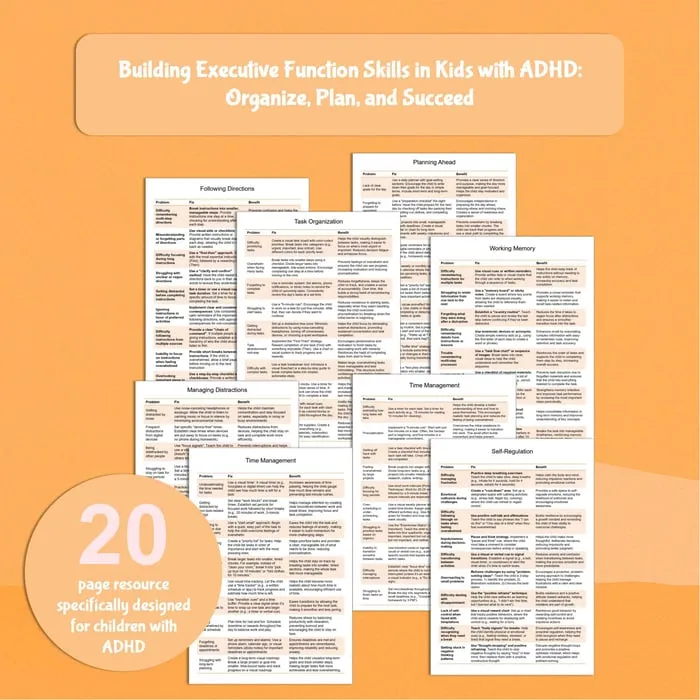
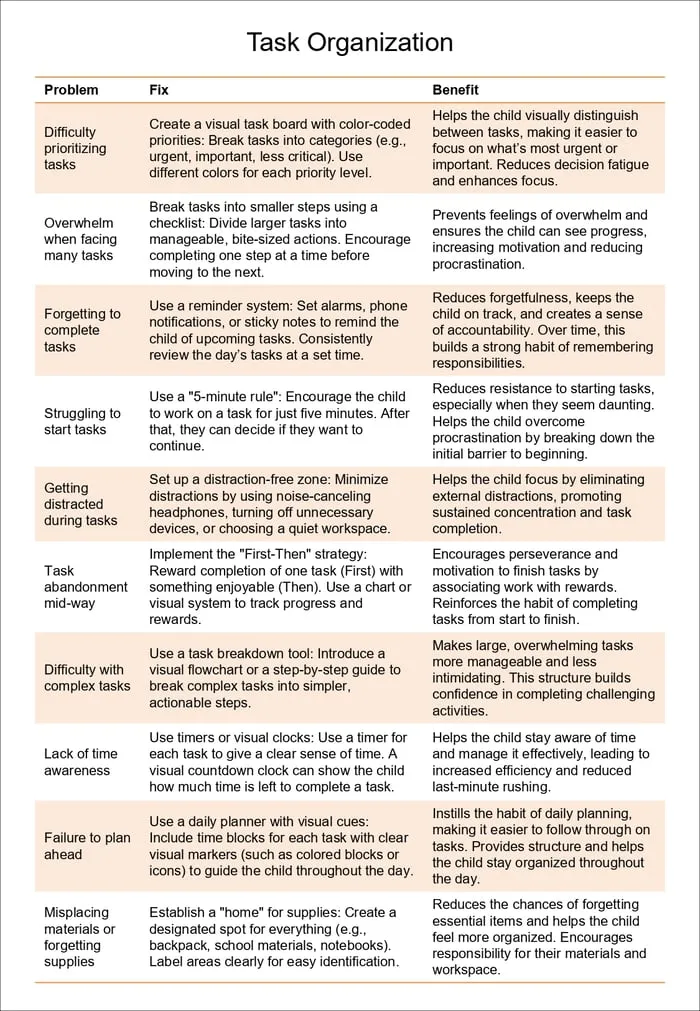
Building Executive Function Skills in Kids with ADHD: Organize, Plan, and Succeed: A 20-page Problem/Fix/Benefit reference that pairs common executive function challenges with concrete fixes.
Related reading: ADHD in Children: A Guide to Effective Classroom and Home Support and Effective ADHD Classroom Strategies to Support Student Success.
Key Takeaways
- Executive function challenges reflect brain differences, not laziness.
- Visual systems support organization, time, and memory.
- Break big tasks into small, checkable steps.
- Gradually shift responsibility to build independence.









Leave a Comment