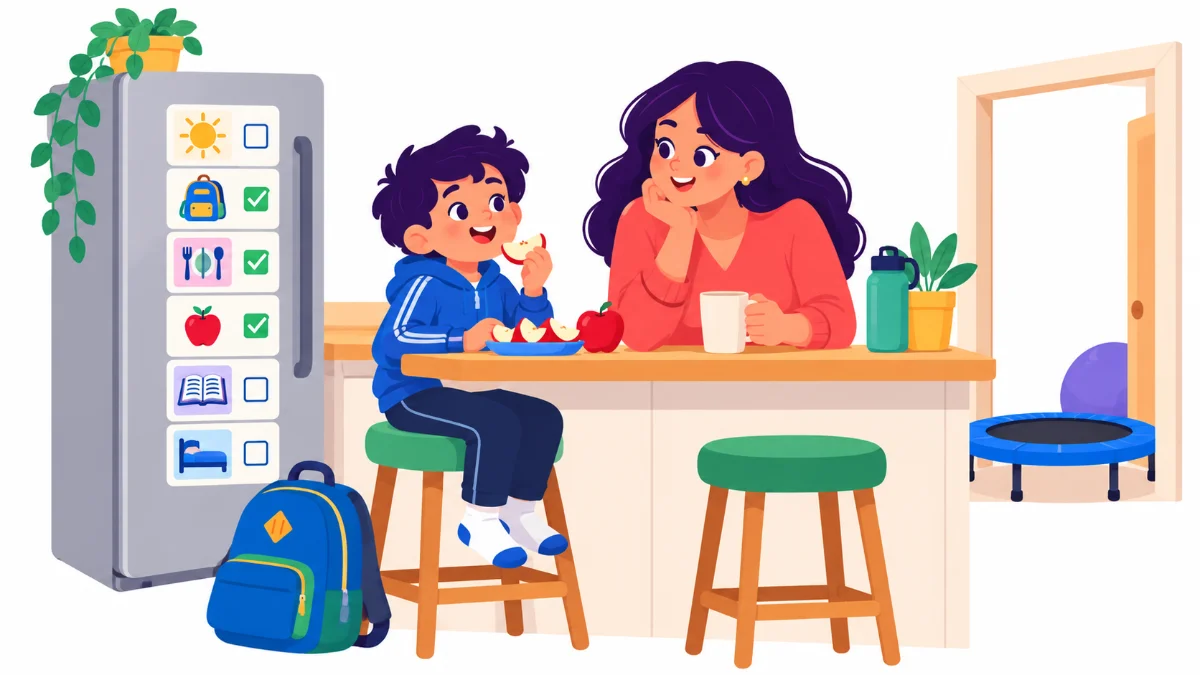

ADHD after-school routine ideas matter because the hours between pickup and dinner are often the hardest of the day. Your child has held it together for six hours of instructions, noise and waiting. Picture Leo, age 8, who walks through the door, drops his backpack in the hallway, argues about a snack and melts down when homework is mentioned. His mom loves him dearly and dreads 3:30.
This list is for parents of children roughly 6 to 10 years old with ADHD or attention challenges. It gives twelve easy ADHD after-school routine ideas, ordered from the ones that take almost no effort to the ones that need a little setup. Each idea covers what it is, why it helps and how Leo’s family tried it. You do not need all twelve. Pick two or three and build from there.
Examples are fictional. Adapt to the student’s goals and agreed supports. This is guidance, not a diagnosis.
At a glance
- Kids with ADHD often arrive home tired from a long day of self-control.
- Food, movement and quiet usually come before homework.
- A picture checklist reduces repeated reminders and arguments.
- Predictable order matters more than a perfect schedule.
- Change one thing at a time and keep it for two weeks.
How these ideas are ordered
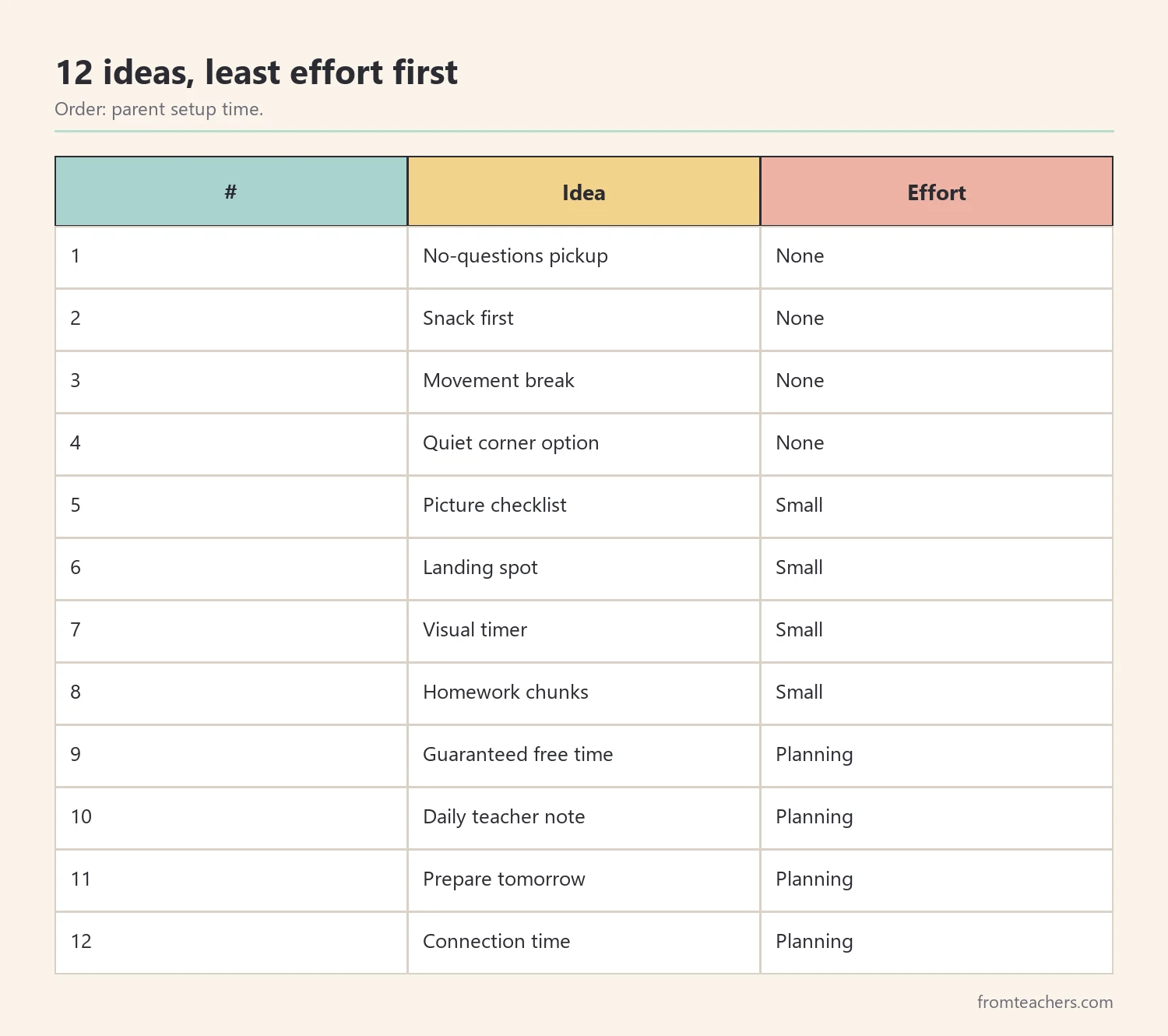
We ordered the twelve ideas by effort for the parent. Ideas 1 to 4 need no materials. Ideas 5 to 8 need a small setup, such as a checklist or a timer. Also, ideas 9 to 12 need some planning or a conversation with school.
The ranking is about effort, not importance. In fact, the easiest ideas often make the biggest difference. Figure 1 shows the full list.
Before you choose, think about your child’s hardest moment. For some families it is the car ride, for others the homework table or the switch from screens to dinner. Start with the ideas that target that moment. Also, notice your own energy: a routine that exhausts the parent will not last, so pick ideas you can repeat on your busiest weekday.
1. Make pickup a no-questions zone
Many parents greet their child with “How was your day? Any homework?” For a tired child with ADHD, that can feel like another test.
Try this: for the first ten minutes, offer a warm hello and silence or music. Save questions for later.
Example: Leo’s mom started playing his favorite songs in the car and saying only “I’m glad to see you.” Within a week, Leo was the one starting conversations on the way home.
2. Snack first, always
Hunger makes everything harder. Many children eat little at school lunch because the cafeteria is loud and rushed.
Try this: have a ready snack waiting, ideally one with protein, and make “snack first” a fixed rule.
Example: Leo’s mom pre-packs cheese and crackers on Sunday for the whole week. The snack argument disappeared because the choice was already made.
3. Build in a movement break
After sitting most of the day, many kids with ADHD need to move before they can focus again.
Try this: give 15 to 20 minutes of active play: a bike ride, jumping, a dance song or a backyard game.
Example: Leo does three laps around the block on his scooter. His mom noticed that homework went faster on days with the scooter than on rainy days without it.
4. Offer a quiet decompression option
Some children need calm rather than movement, and many need both at different times.
Try this: set up a quiet corner with a blanket, a book or headphones. Let your child choose movement or quiet.
Example: On days with a test or an assembly, Leo picks the quiet corner. On normal days he picks the scooter. Letting him choose reduced arguments.
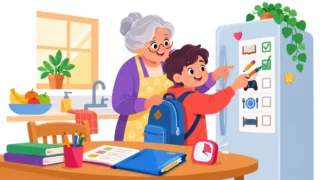
5. Use a picture checklist
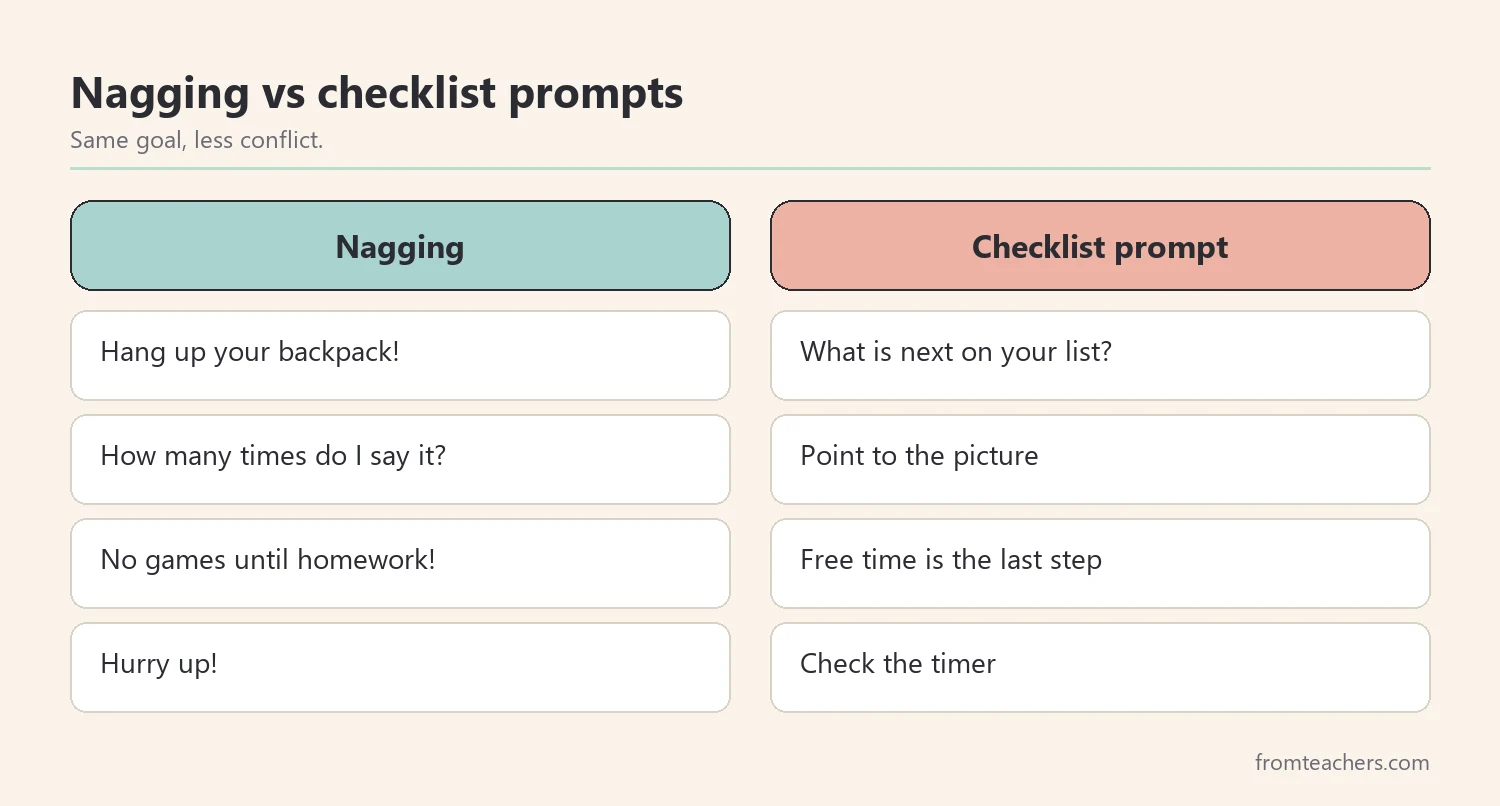
Repeated verbal reminders often turn into nagging, and nagging leads to power struggles.
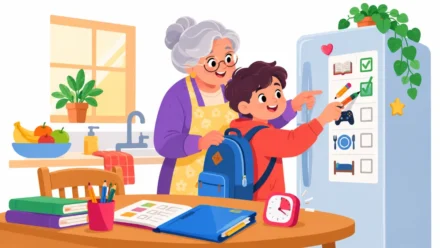
Try this: post a simple picture checklist by the door or on the fridge: backpack on hook, shoes away, snack, move, homework, free time. Your child checks each step.
Example: Leo’s list has six pictures. Instead of “Did you hang your backpack?” his mom says, “What’s next on your list?” That small change removed most of the shouting.
6. Create a landing spot for school things
Lost permission slips and missing homework often start at the front door.
Try this: choose one spot for the backpack, folder and lunchbox. Unpack the folder there every day, together at first.
Example: Leo’s family uses a hook and a basket. The take-home folder goes in the basket, and his mom checks it while he eats his snack.
7. Use a visual timer for transitions
Time is hard to feel for many kids with ADHD. “Five more minutes” means little without a picture of it.
Try this: use a visual timer that shows time disappearing, and give a warning before each change.
Example: When the scooter time ends, Leo sees the red section shrink. He still complains sometimes, but the transition is shorter and calmer.
8. Break homework into short chunks
A long homework session after school is a recipe for conflict for many children with attention difficulties.
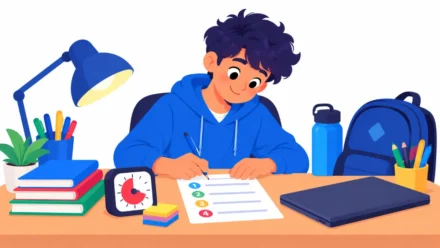
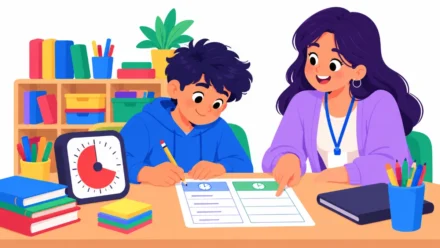
Try this: split work into short blocks, such as 10 minutes of work and a 2-minute break. Put the hardest task first, while energy is highest.
Example: Leo does his math sheet in two 10-minute blocks, with a quick jump on the trampoline between them. The full guide in the ADHD Support Toolkit for classroom and home includes a homework plan without fights that follows the same idea.
9. Plan free time as a reward that is always coming
Free time works best when your child knows it is guaranteed after the routine, not taken away for every slip.
Try this: make free time the last step on the checklist. Keep it predictable, and avoid using it as a constant threat.
Example: Leo knows that after homework he gets 30 minutes of building blocks. Because it is predictable, he works toward it instead of bargaining.
10. Agree on a short daily note with the teacher
Children with ADHD often forget, or cannot explain, what happened at school. A brief note helps you plan the afternoon.
Try this: ask the teacher for a quick daily report with two or three items, such as “followed directions,” “finished work” and “one good moment.”
Example: Leo’s teacher circles a smiley face for each item. On a hard day, his mom plans extra quiet time instead of discussing problems.
11. Prepare tomorrow before dinner
Mornings go better when the afternoon prepares them.
Try this: before dinner, pack the backpack, lay out clothes and put shoes by the door. Make it part of the checklist.
Example: Leo packs his backpack and puts it on the hook before dinner. His mom says mornings have about half as many arguments as before.
12. End with a calm connection time
Finally, end the afternoon with a few minutes of positive attention with no demands.
Try this: 10 minutes of a game, a book or a walk where your child leads. Mention one thing they did well today.
Example: Leo and his mom play one card game before dinner. She names one specific success, such as “You hung up your backpack without a reminder.”
A sample afternoon for Leo
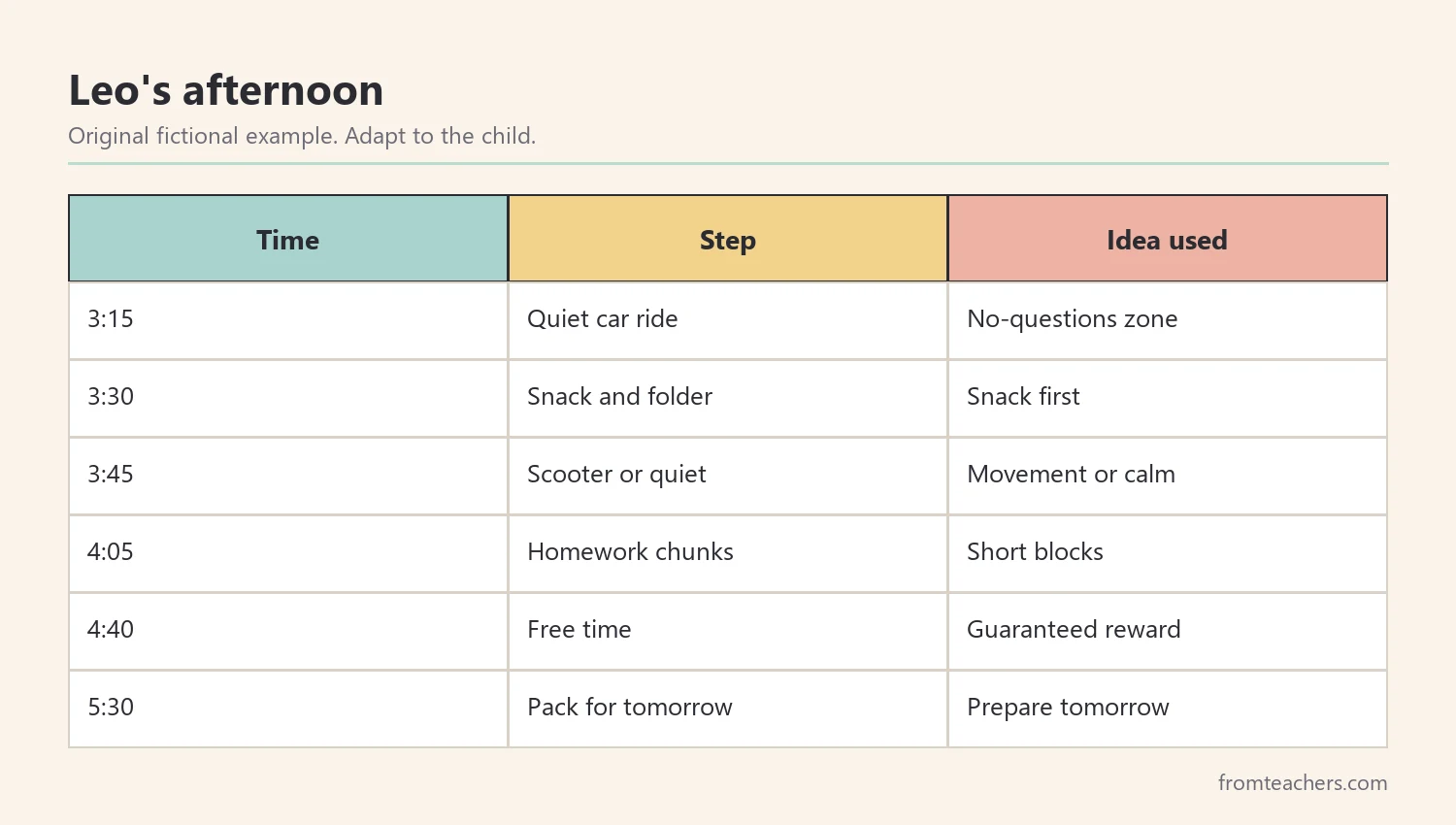
The table below shows how Leo’s family combined several ADHD after-school routine ideas into one afternoon. Times are approximate and fictional.
| Time | Step | Idea used |
|---|---|---|
| 3:15 | Quiet car ride | No-questions zone |
| 3:30 | Snack and folder check | Snack first, landing spot |
| 3:45 | Scooter or quiet corner | Movement or calm |
| 4:05 | Homework in two chunks | Short blocks, timer |
| 4:40 | Free time | Guaranteed reward |
| 5:30 | Pack for tomorrow | Prepare tomorrow |
How to roll out new routines
Changing everything at once rarely works. Figure 4 shows a simple order for introducing new ADHD after-school routine ideas.
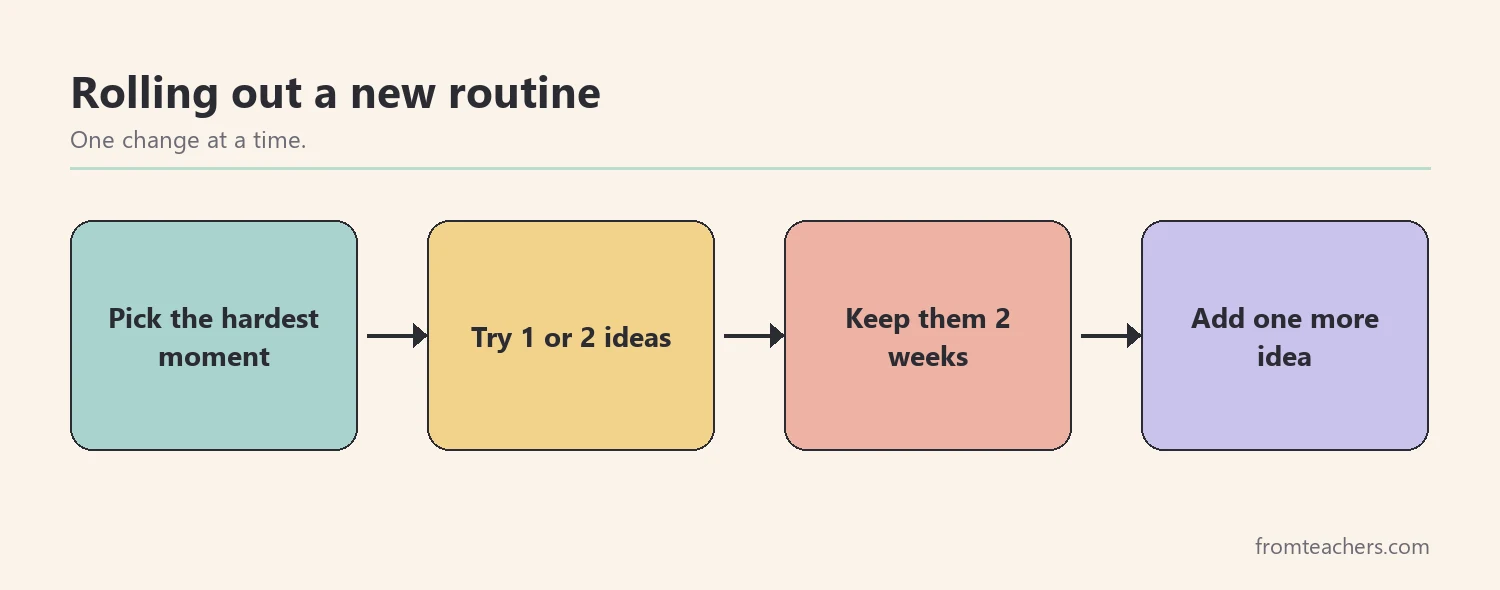
Start with one or two ideas that fix your hardest moment. Keep them for at least two weeks. Then add one more. Also, involve your child in choosing pictures for the checklist, because ownership makes routines stick.
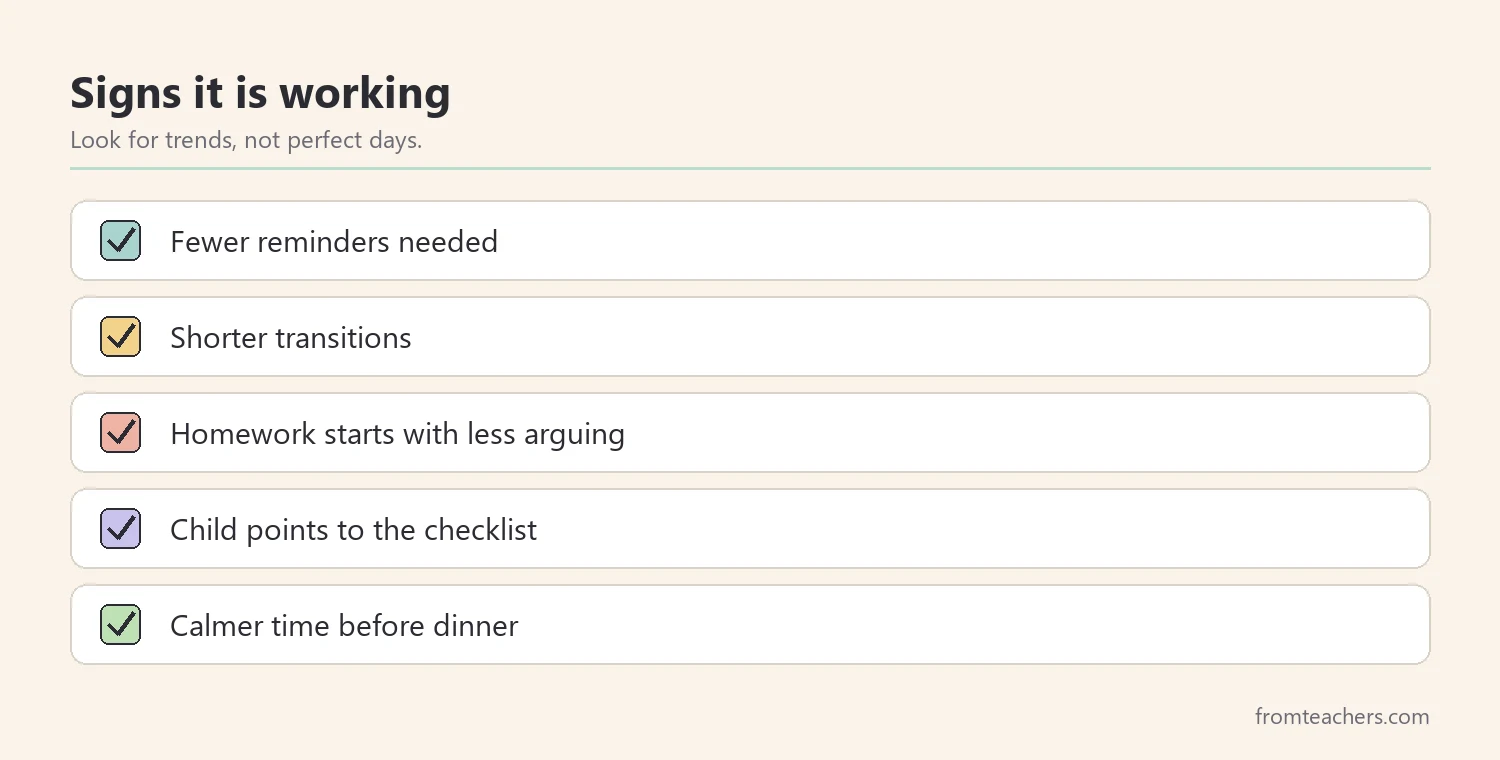
Figure 5 lists the signs that a routine is working, so you know when to add the next step.
Common mistakes with after-school routines
- Starting homework the moment you walk in. Fix: snack and movement first.
- Too many steps on the checklist. Fix: five or six pictures at most for this age.
- Changing the order every day. Fix: keep the same order on school days.
- Taking away free time for small slips. Fix: keep it predictable and use praise for progress.
- Doing it all alone. Fix: share the routine with caregivers and the teacher.
Questions parents ask about ADHD after-school routine ideas
How long until a new routine works?
Many families see some change within one to two weeks, but every child is different. Consistency matters more than speed.
What if my child has a meltdown anyway?
Meltdowns still happen. Stay calm, reduce talking and offer the quiet corner. Talk about it later, when everyone is calm.
Should screen time be part of the routine?
That depends on your family. Many parents place screens after homework and keep a timer, since stopping a screen can be a hard transition.
Do these ideas work for kids without a diagnosis?
Yes. Most children benefit from food, movement, predictable order and short work blocks after school.
How do I share the routine with grandparents or sitters?
Give them a copy of the picture checklist and a one-paragraph summary, so your child hears the same expectations from every adult.
Related reading: ADHD Children Support Strategies, Understanding Autism and ADHD Meltdowns, and Teacher-Parent Communication in Special Education.
You may also need: Homework Help for ADHD: Focused, Simple, and Supportive Study Strategies.
A companion resource for ADHD after-school routine ideas:
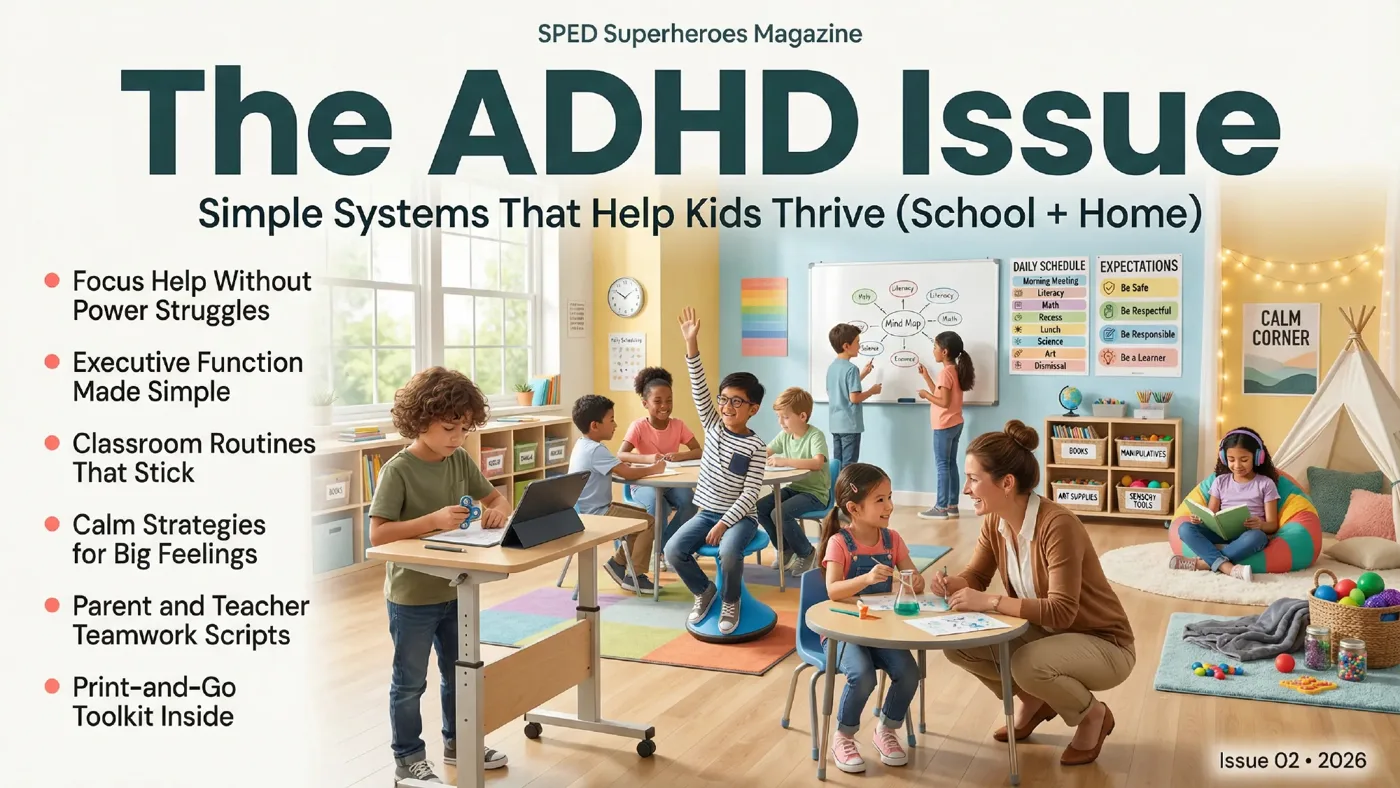
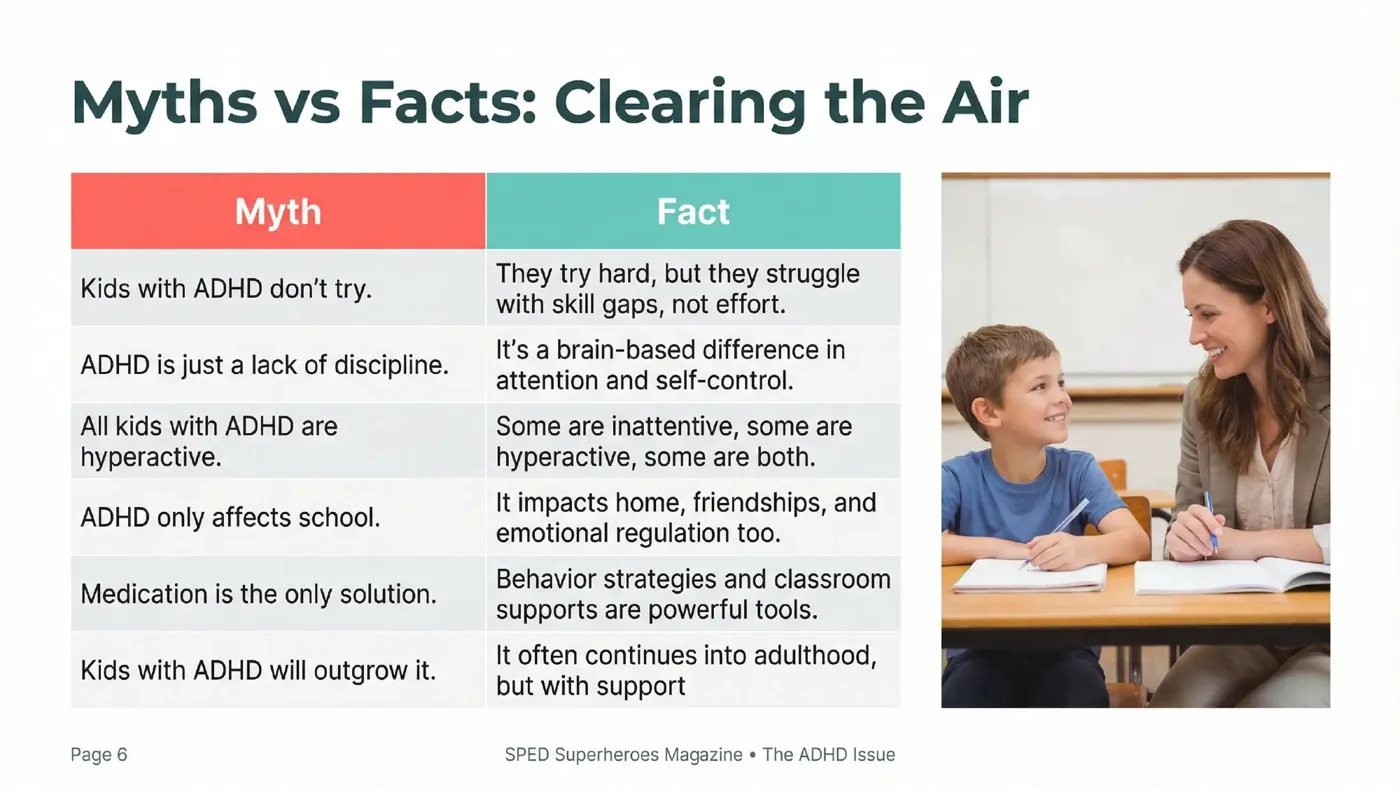
ADHD Support Toolkit: Classroom And Home Strategies: a 49-page guide for teachers and parents with a plain-language ADHD explanation, a strengths spotlight, classroom supports, executive function and emotional regulation strategies, scripts for meltdown moments, a home section with parent partnership scripts, home routines and a homework plan without fights, plus printable data trackers.
Sources and scope
- National Institute of Mental Health: ADHD: an overview of ADHD symptoms, diagnosis and treatment options.
- CHADD: family resources on ADHD, including parenting and daily routines.
- Understood.org: practical articles for parents on focus, routines and homework.
- Center for Parent Information and Resources: information for families on school supports and working with school teams.
These ideas are general parenting strategies for children with ADHD or attention challenges. They do not replace medical advice or a treatment plan; talk with your child’s doctor or care team about medical questions.
Key takeaways
- ADHD after-school routine ideas work best when they start with food, movement and quiet.
- A picture checklist replaces nagging with a shared plan.
- Short homework chunks reduce conflict.
- Predictable free time and connection time end the day well.
- Add one change at a time and keep it for two weeks.





Leave a Comment