

Simple social scripts give students ready words for moments that feel hard to start. Picture a third grader stuck on a worksheet. He knows he needs help, but he sits silently for ten minutes because he cannot find the first words to say.
This guide walks you through a five-step process: choose the moments that matter, write short phrases, teach them with practice, cue them in real situations, and track what changes. By the end, you will have a small set of phrases a student can actually use, plus a simple way to see whether they are working.
Examples are fictional. Adapt to the student’s goals and agreed supports. This is guidance, not a diagnosis.
At a glance
- Start with one or two situations the student meets every day.
- Keep each phrase short, natural, and in the student’s own words.
- Teach scripts like any other skill: model, practice, then use them for real.
- Cue with the smallest prompt that works, then fade it.
- Count chances and uses each week so you know when to add a new script.
1. Choose the moments that need simple social scripts
First, look for the moments where a student goes quiet, grabs, or walks away because the words do not come. These are the best places to start. A script is most useful when the situation happens often and the student clearly wants to take part.
Next, watch for a few days and write short notes. Common moments include asking for help, joining a group, taking a turn, solving a small conflict, saying how you feel, responding to a correction, asking for space, and starting or ending a conversation. You will rarely need all of them at once.
Notice, too, what the student already does well. A student who greets adults easily but freezes with peers needs a different starting point than one who struggles with everyone. Your notes will show this quickly.
Then, pick one or two to teach first. Choose a situation with many daily chances to practice, because practice is what turns a phrase into a habit. In addition, choose one where success will feel good to the student quickly.
| Moment you notice | Script area to try |
|---|---|
| Sits silently when stuck | Asking for help |
| Grabs a toy or game piece | Taking a turn |
| Hovers near a group at recess | Joining a group |
| Leaves the room when upset | Asking for space |
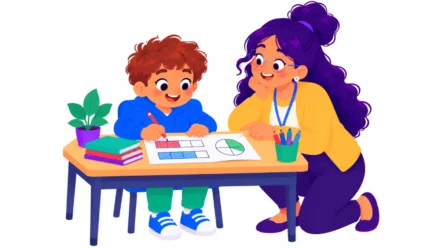
Worked example. Leo, a fictional third grader, freezes during independent math. Over four days, his teacher counts about eight moments a week when he is stuck and says nothing. Asking for help becomes the first script area, and joining a group at recess is saved for later.
2. Write short phrases students can actually say
Good scripts are short enough to say in one breath. “I’m stuck. Can you help me?” works better than a long, polite sentence the student has to plan. Under stress, shorter is easier to recall.
Also, use words the student already says. If a student says “Can I go?” at home, do not replace it with “May I please be excused?” Natural phrases sound like the student and are more likely to be used outside the lesson.
Next, give two or three options per situation, not ten. For example, a student who needs a break might choose between “I need a break” and “I need a quiet moment.” Too many choices bring back the same freezing you are trying to solve.
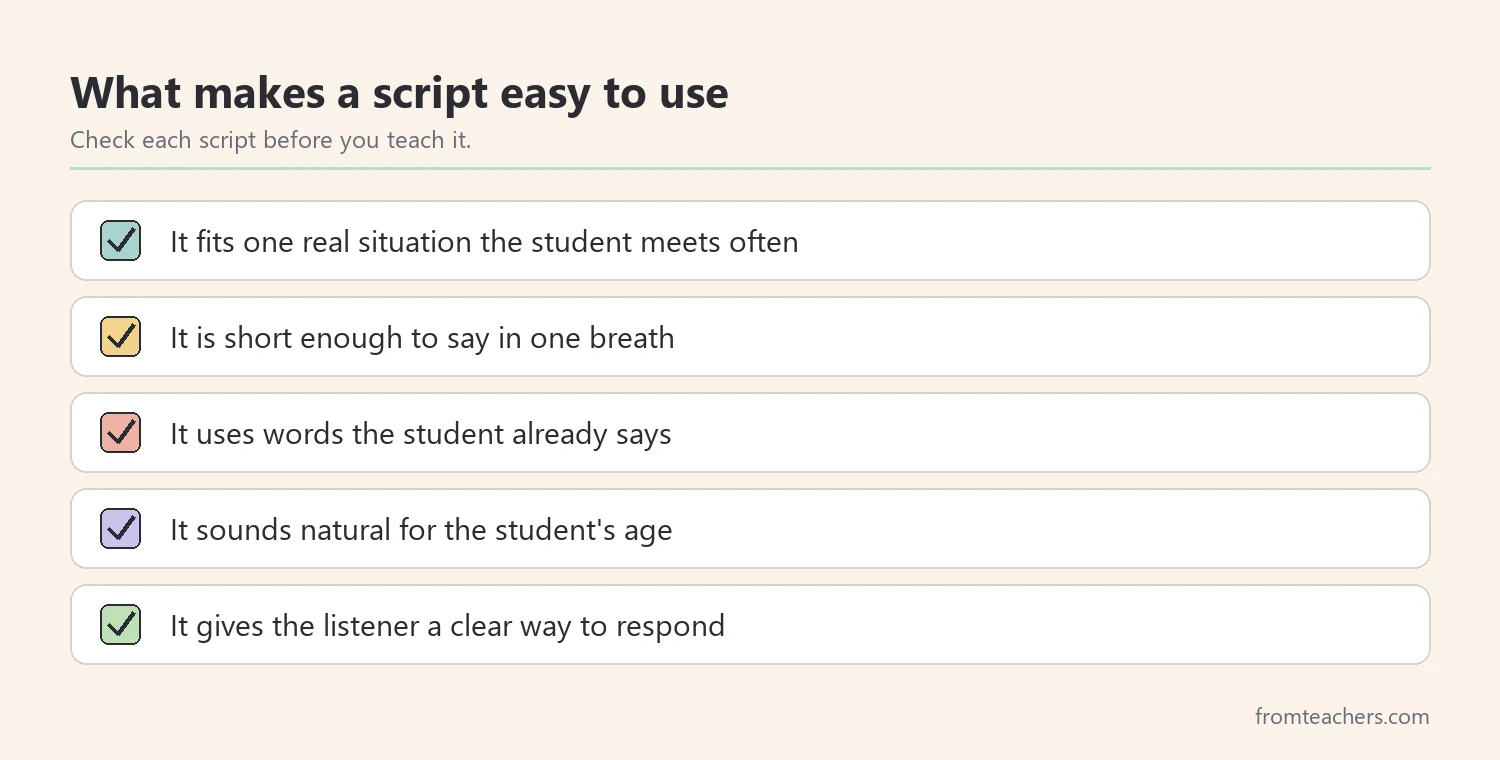
Finally, make the scripts visible. A poster with speech bubbles, a desk card, or a small ring of cards keeps the words in front of the student. As a result, the student does not have to hold the phrase in memory at the exact moment it is needed.
It also helps to match each script to its situation in a quick planning table. Notice that every phrase is under ten words, and each one gives the listener an easy way to answer.
| Situation | Sample script | Listener’s easy reply |
|---|---|---|
| Asking for help | “Can you show me the first step?” | Shows the first step |
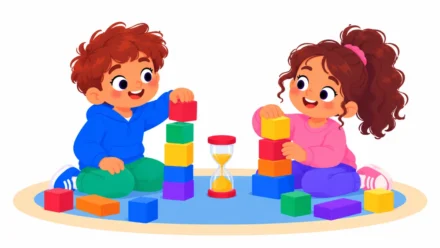
| Joining a group | “Can I play with you?” | “Sure” or “After this round” |
| Solving a conflict | “Let’s find a way we both can be happy.” | Suggests a trade or a turn |
| Responding to a correction | “Okay, I will try again.” | Gives a quick thumbs-up |
| Ending a conversation | “I need to go now. I’ll talk to you later.” | “See you later” |
Before you finalize the list, read each phrase aloud in the student’s voice. If it sounds stiff, shorten it or swap a word. If a phrase could be misread as rude, add a softener such as “please” or “thanks.”
Worked example. Leo’s teacher writes two help scripts: “I’m stuck. Can you help me?” and “Can you show me the first step?” Both match words Leo already uses with his older sister. She also adds one waiting phrase, “I will wait until it’s my turn,” for later.
3. Teach simple social scripts with modeling and role-play
Teaching scripts works best when you treat them like any academic skill. A short sequence is enough: model, echo, role-play, real use, and fade. Each step adds a little more independence.
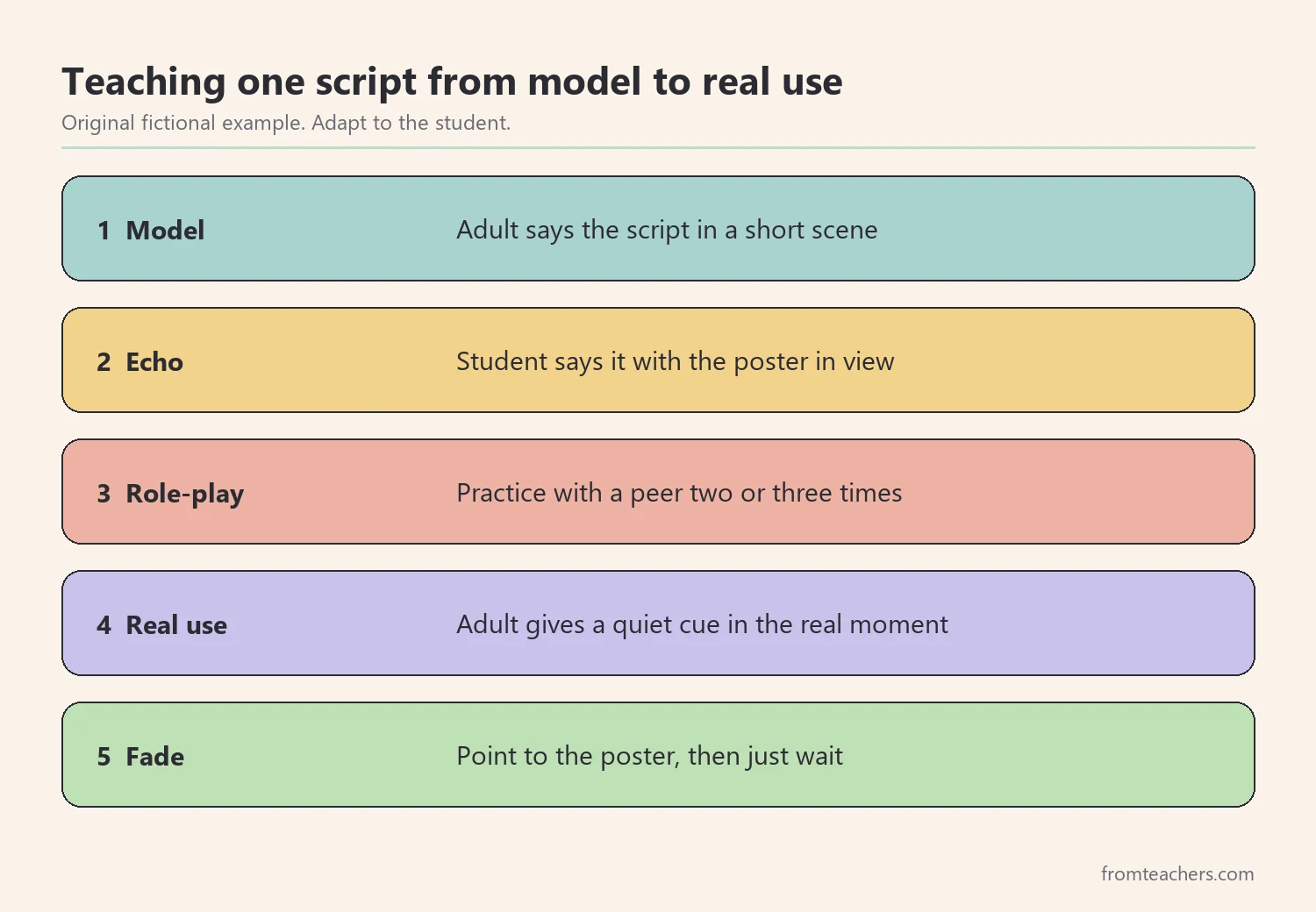
First, model the script in a tiny scene. Act out being stuck, then say the phrase out loud. Next, ask the student to echo it while looking at the poster. After that, practice with a peer two or three times using easy, low-stakes situations.
Keep practice short and positive, and use real classroom materials so the scene feels familiar. Over time, encourage small variations once the student is confident, so the words sound natural rather than fixed. Two to three minutes a day is often more useful than one long lesson. Moreover, praise the attempt, not perfect wording. A student who says “Help me, stuck” is using the skill, and you can shape the words later.
If you want ready-made phrases for several situations at once, the Simple Social Scripts poster with illustrated speech bubbles covers everyday moments like asking for help, joining a group, and asking for space. It works well as the visual you point to during modeling and role-play.
Worked example. During morning work, Leo’s teacher spends two minutes acting out a stuck moment with a puppet. Leo echoes the phrase, then practices with a classmate who plays the teacher. They swap roles so Leo also hears how it sounds.
4. Cue scripts in real moments, then fade the prompt
Practice only matters if the script shows up in the real moment. So, watch for the next real chance and give the smallest cue that works. A quiet point to the poster is usually better than saying the whole phrase for the student.
Use a simple prompt ladder. Start with the least help that gets the script started, and step up only if needed. Over time, step back down the ladder until the student uses the script with no cue at all.
| Prompt level | What the adult does |
|---|---|
| Wait | Pauses with an expectant look |
| Point | Points to the speech bubble on the poster |
| First words | Says “I’m…” and lets the student finish |
| Full model | Says the whole script, student repeats |
In addition, respond warmly every time the script is used. If a student says “I need some space,” honor it in the way you agreed. When the script works, the student learns that words get results faster than grabbing or leaving.
Timing matters too. Cue the script just before the hard moment when you can see it coming, for example as Leo looks around the room with his pencil down. A cue that comes after the student has already left the seat or grabbed the item is much harder to use.
Likewise, plan for moments when the script does not get the expected reply. A classmate might say “No, we’re full” to “Can I play with you?” Practice a backup line such as “Okay, maybe next time,” so the student has a calm way to close the exchange and try someone else.
Also, share the scripts with other adults. Specialists, aides, and families should use the same words and the same cues. Consistency helps the student trust that the phrase will work anywhere.
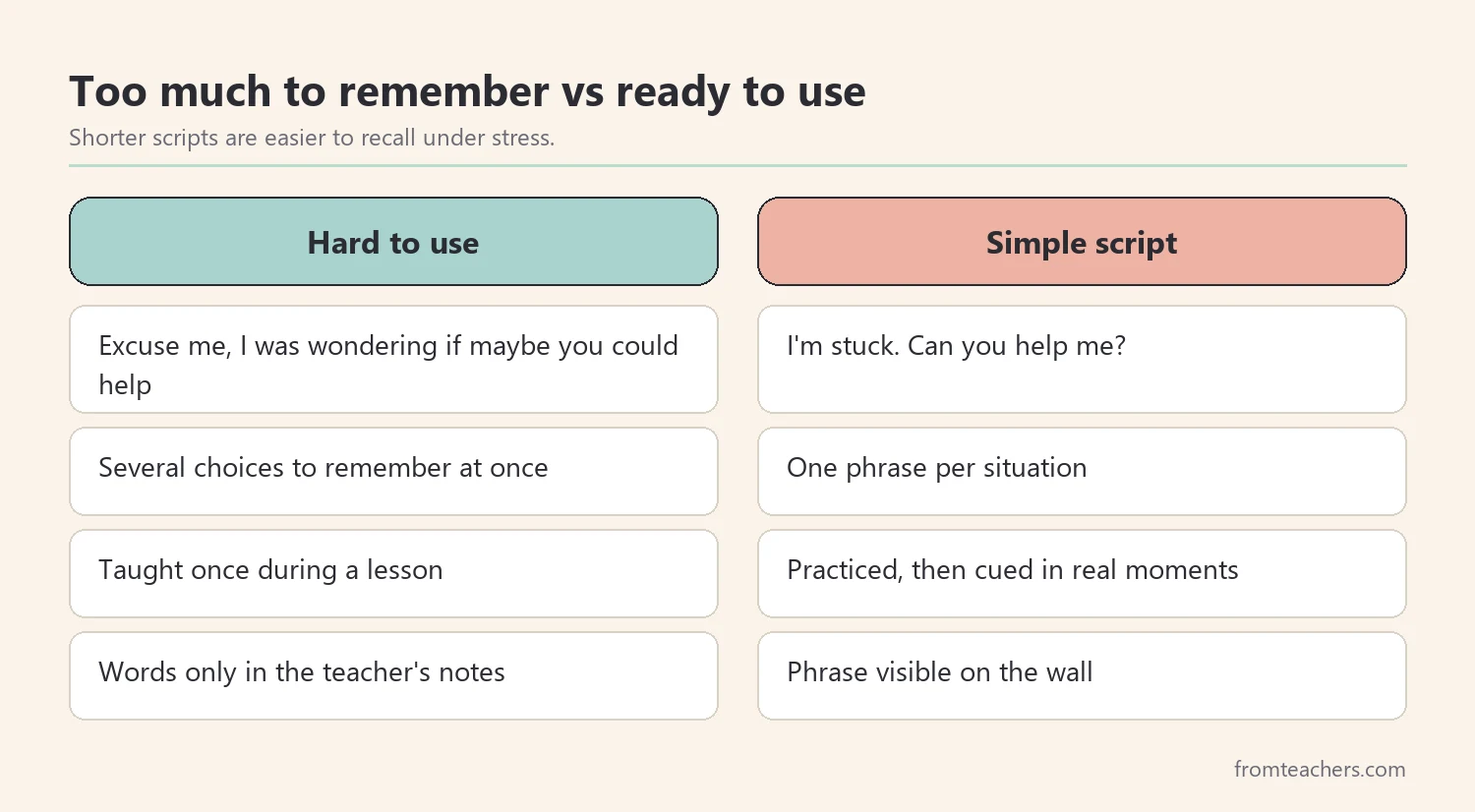
Worked example. In week one, Leo’s teacher often has to say “I’m…” to start him. By week three, a point to the help bubble is enough. Meanwhile, his family uses the same phrase during homework at home.
5. Track progress and add the next simple social scripts
Finally, keep a tiny weekly record. Two numbers are enough: how many chances the student had, and how many times the script was used. Add the prompt level you needed most often, and you have a clear picture.
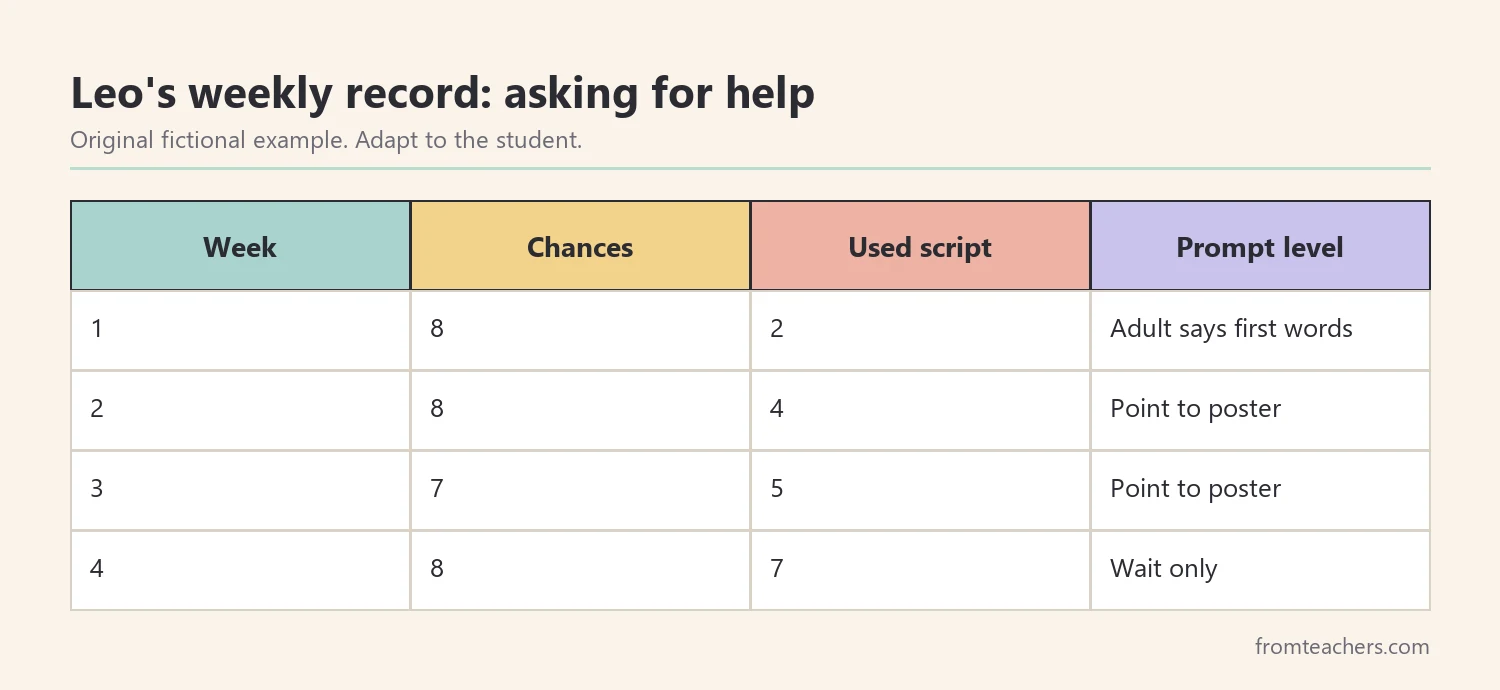
Look at the trend, not one day. For example, Leo used the help script 2 of 8 times in week one and 7 of 8 times in week four, with the prompt faded to waiting only. That is a strong signal the first script is becoming his own.
When a script is used most of the time with little help, add the next one. Many teams move from asking for help to taking a turn, then to joining a group. Next, review together with the family and, where it fits, the student’s IEP team.
It also helps to ask the student. Even young children can point to a happy or unsure face to show how a script feels to use. A student who says a phrase feels “weird” may need a different wording rather than more practice.
If a script is not catching on, check three things. Is the phrase too long? Are there enough daily chances? Do all adults cue it the same way? Usually, one small change fixes the problem.
Worked example. After four weeks, Leo’s team keeps the help script, adds the turn-taking phrase for game time, and plans to review again in a month.
Common mistakes and how to avoid them
- Teaching too many scripts at once. Fix: start with one or two high-frequency situations and add more only when those are steady.
- Writing adult-sounding phrases. Fix: use the student’s own words and keep the phrase short.
- Only practicing in lessons. Fix: cue the script in the real moment the same day it is taught.
- Prompting with the full sentence every time. Fix: use the prompt ladder and step back as soon as you can.
- Ignoring the script when it is used. Fix: respond quickly so the words clearly work.
Questions teachers and parents ask about simple social scripts
Who benefits from social scripts?
Many students do, including autistic students, students with language needs, and students who feel anxious in social moments. Any learner who knows what they want but struggles to start the words can benefit. Adapt the phrases to the student’s age and communication style.
Are scripts the same as social stories?
No. A social story explains a situation and what usually happens. A script gives the exact words to say in that situation. They can work well together.
Should I use scripts with the whole class?
Yes, whole-class teaching often works well. When every student learns the same phrases, peers understand and respond to them, and no one feels singled out. You can then give extra practice to the students who need it most.
What if the student uses AAC or is not speaking yet?
Put the same phrases on the student’s device or picture cards. The teaching steps stay the same: model, practice, cue, and fade. Work with the speech-language pathologist on the best format.
How long before simple social scripts start working?
It depends on the student and how often they practice. Many teams see change within a few weeks when there are daily chances to use the script. Keep tracking so you can decide based on data, not guesses.
Related reading: Autism social skills, High-functioning autism strategies, and Teacher-parent communication in special education.
A companion resource for simple social scripts:
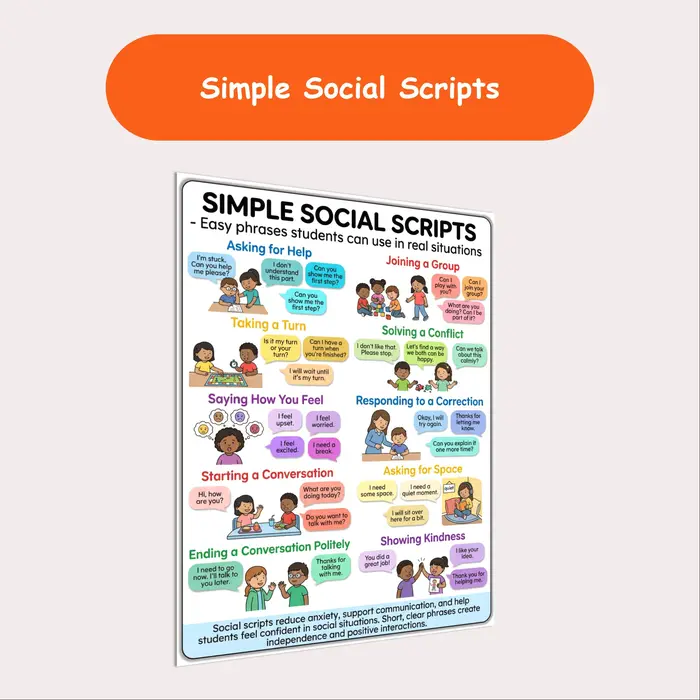
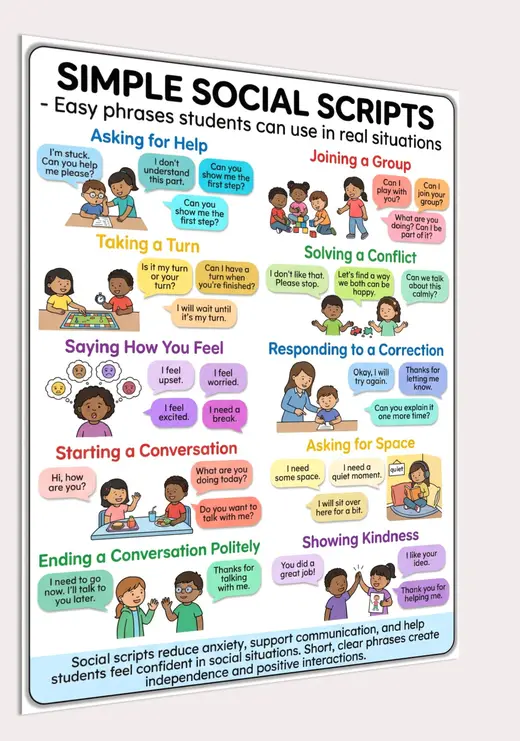
Simple Social Scripts Poster: a printable social skills poster with easy phrases in illustrated speech bubbles for real situations such as asking for help, taking a turn, solving a conflict, and asking for space. Useful for special education, speech therapy, and SEL lessons.
Sources and scope
- IRIS Center, Vanderbilt University: free modules on evidence-based practices, including supports for autistic students.
- American Speech-Language-Hearing Association (ASHA): information on social communication and working with speech-language pathologists.
- Understood.org: practical articles for families and teachers on social skills and learning differences.
- IDEA, U.S. Department of Education: the law behind special education services and IEPs.
This guide covers everyday classroom and home use of short social phrases. It does not cover diagnosis or formal speech-language assessment, which belong to qualified professionals and the student’s team.
Key takeaways
- Short, visible scripts give students ready words for hard moments.
- Start with one or two daily situations and keep phrases short and natural.
- Teach with modeling, echo, and role-play, then cue in real moments.
- Fade prompts from full model to waiting only.
- Track chances and uses weekly before adding the next script.




Leave a Comment