

Teaching the size of feelings helps students respond to emotions in a way that fits the moment. Picture a second grader who loses a pencil and reacts as if the whole morning is ruined. Ten minutes later, she cannot get back to work, and nobody is quite sure what helped.
This guide gives you a five-step process: teach the two sizes, connect them to body clues, match strategies to each size, practice when calm, and review progress with the family. By the end, you will have a shared language that students, teachers, and parents can all use the same way.
Examples are fictional. Adapt to the student’s goals and agreed supports. This is guidance, not a diagnosis.
At a glance
- Big feelings and little feelings are both normal. The goal is a response that fits.
- Body clues help students tell the difference between sizes.
- Little feelings need quick tools. Big feelings need more space and support.
- Practice when calm so the tools are ready in the hard moment.
- Track a few simple numbers each week and share them with the family.
1. Teach the size of feelings with two simple categories
First, keep the language simple. Two categories, little and big, are easier for many students to use than a long scale. You can always add more detail later once the basic idea is solid.
Next, give clear examples of each. Little feelings include being slightly annoyed, a little sad, mildly nervous, a bit frustrated, or a little unsure. Big feelings include being very angry, very sad, very worried or scared, overwhelmed, or feeling out of control.
Then, say the most important message out loud: both sizes are normal. Students should never feel that big feelings are bad or that they must hide them. Instead, the lesson is about noticing the size and choosing a response that helps.
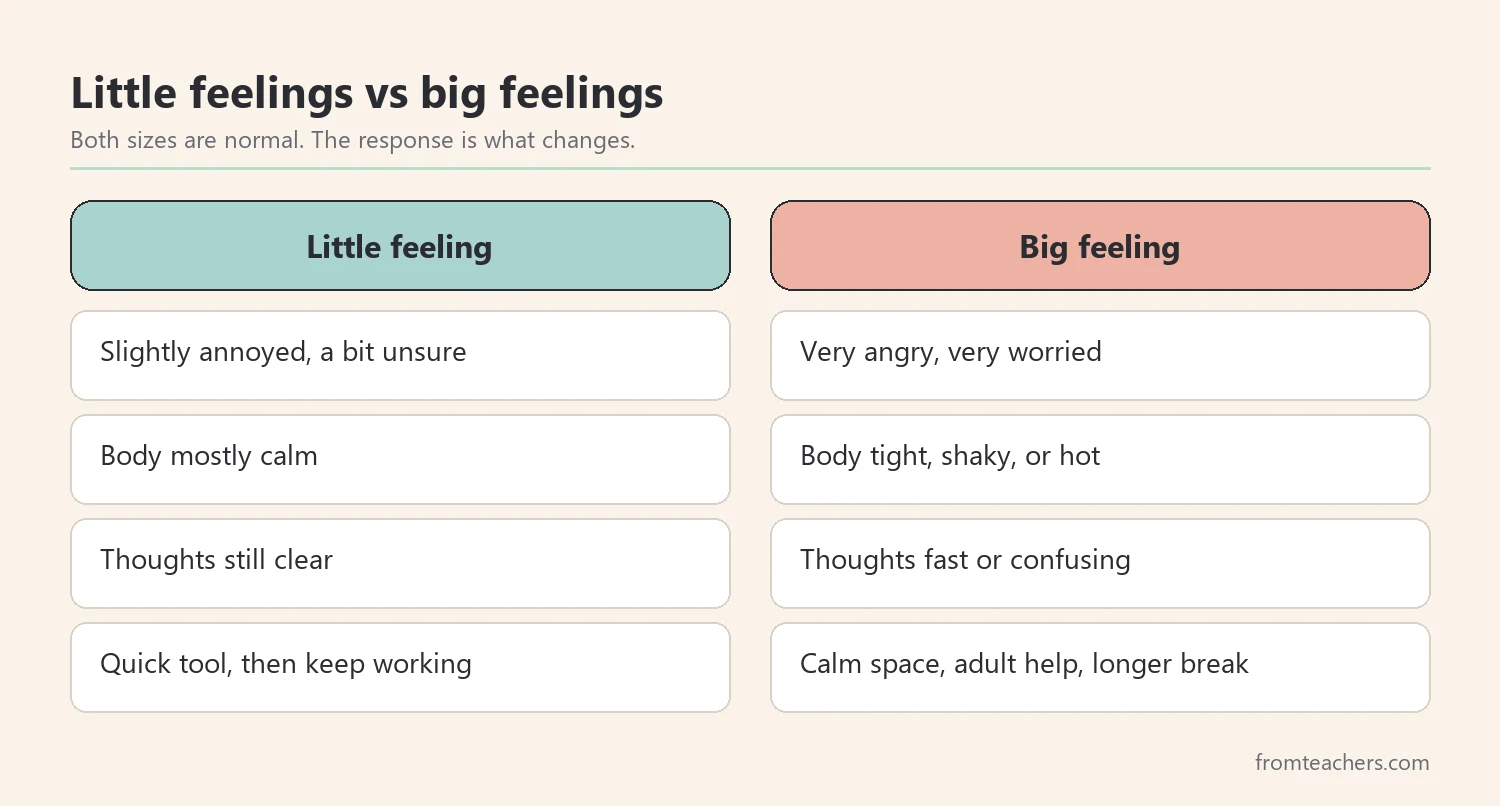
Use friendly visuals to make the idea concrete. Many teachers use two characters, one small and calm, one large and fiery, so students can point instead of explain. Pointing is often easier than talking when emotions are strong.
In addition, sort a few classroom moments together. Read short scenarios aloud, such as “Your friend took the last red crayon” or “The fire alarm went off and you were scared,” and let students hold up a little or big card. Talk about why the same event can feel little to one person and big to another.
A short first lesson is enough to launch the idea. The plan below fits into about fifteen minutes and can be repeated with new scenarios on later days.
| Minutes | Activity | Purpose |
|---|---|---|
| 3 | Introduce the two characters | Give the sizes a face |
| 4 | Read and sort four scenarios | Practice naming the size of feelings |
| 5 | Share one strategy for each size | Link size to action |
| 3 | Quick body check together | Start the noticing habit |
After that first lesson, keep the language alive. Use it during read-alouds by asking whether a character’s feeling looks little or big. Stories give students a safe distance, so they can practice without talking about themselves.
Worked example. Maya, a fictional second grader, often reacts strongly to small setbacks. Her teacher introduces the two sizes during morning meeting with a poster and two cards. Maya sorts five scenarios with a partner and explains one choice in her own words.
2. Connect each size to body clues
Students cannot size a feeling until they notice it. That is why body clues matter. A little feeling usually leaves the body mostly calm and thoughts clear, while a big feeling often brings tight muscles, a hot face, or fast, jumbled thoughts.
First, teach body clues when the student is calm. Ask, “Where do you feel it when you are a little annoyed? Where do you feel it when you are very angry?” Write their answers in their words. Some students notice their hands, others notice their stomach or their voice.
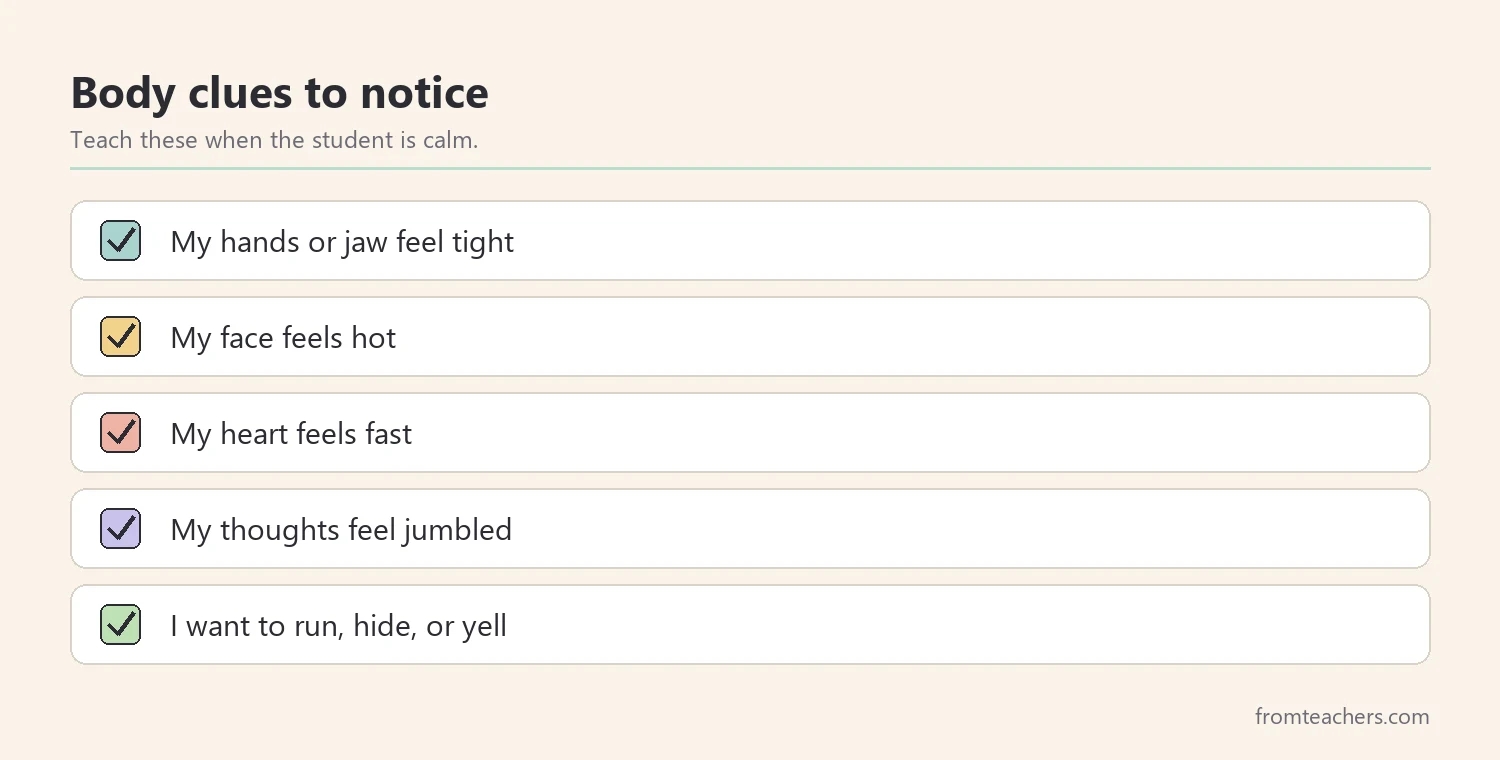
Next, use a quick body check during the day. For example, after recess ask the class to check their hands, face, and breathing. This makes noticing a routine, not something saved for a crisis.
Also, accept that some students find body clues hard to notice. That is fine. You can start with outside clues an adult sees, such as a raised voice or clenched fists, and name them gently: “I see tight fists. Is this a little feeling or a big one?”
For students with limited speech, offer picture choices for body parts and sensations. A simple outline of a body where the student taps the spot can work as well as words. The speech-language pathologist or occupational therapist can help choose the format.
Worked example. Maya says her face gets hot and her hands squeeze when a feeling is big. When it is little, she says she just feels “itchy inside.” Her teacher adds both clues to a small card on Maya’s desk.
3. Match strategies to the size of feelings
This is the heart of the lesson. Little feelings need quick tools that let the student keep going. Big feelings need stronger tools, more space, and often an adult. When the strategy matches the size, students recover faster.
| Feeling size | Strategies that fit |
|---|---|
| Little | Take a deep breath, use a quick coping tool, ask a question, use positive self-talk, keep trying the task |
| Big | Move to a calm space, use strong calming tools such as breathing, squeezing, or grounding, tell an adult, take a longer break, return when the body feels safe |
First, teach two or three tools from each list, not all of them. Let the student help choose. A student who likes movement may pick squeezing a ball, while another prefers counting breaths.
Next, make the tools easy to reach. A calm corner with a timer, a squeeze ball, and a visual of the steps removes the need to remember everything in the moment. For little feelings, a small desk card is often enough.
A clear wall visual helps the whole class share this language. The Big Feelings vs Little Feelings poster compares the two sizes with friendly characters and lists ways to handle each one, which makes it a natural anchor for a calm down corner.
Worked example. Maya picks deep breathing and positive self-talk (“I can try again”) for little feelings. For big feelings, she picks the calm corner, squeezing a pillow, and telling her teacher with a signal card.
4. Practice when calm, then use the plan in the moment
Strategies learned only during a meltdown rarely stick. Therefore, practice them when students are calm and ready to learn. Short daily practice, even two minutes, builds the muscle memory that helps later.
Teach a simple four-part routine: notice, size it, choose, and return. Each part is short, and together they give the student a clear path from feeling to action. Post the routine where the student can see it.
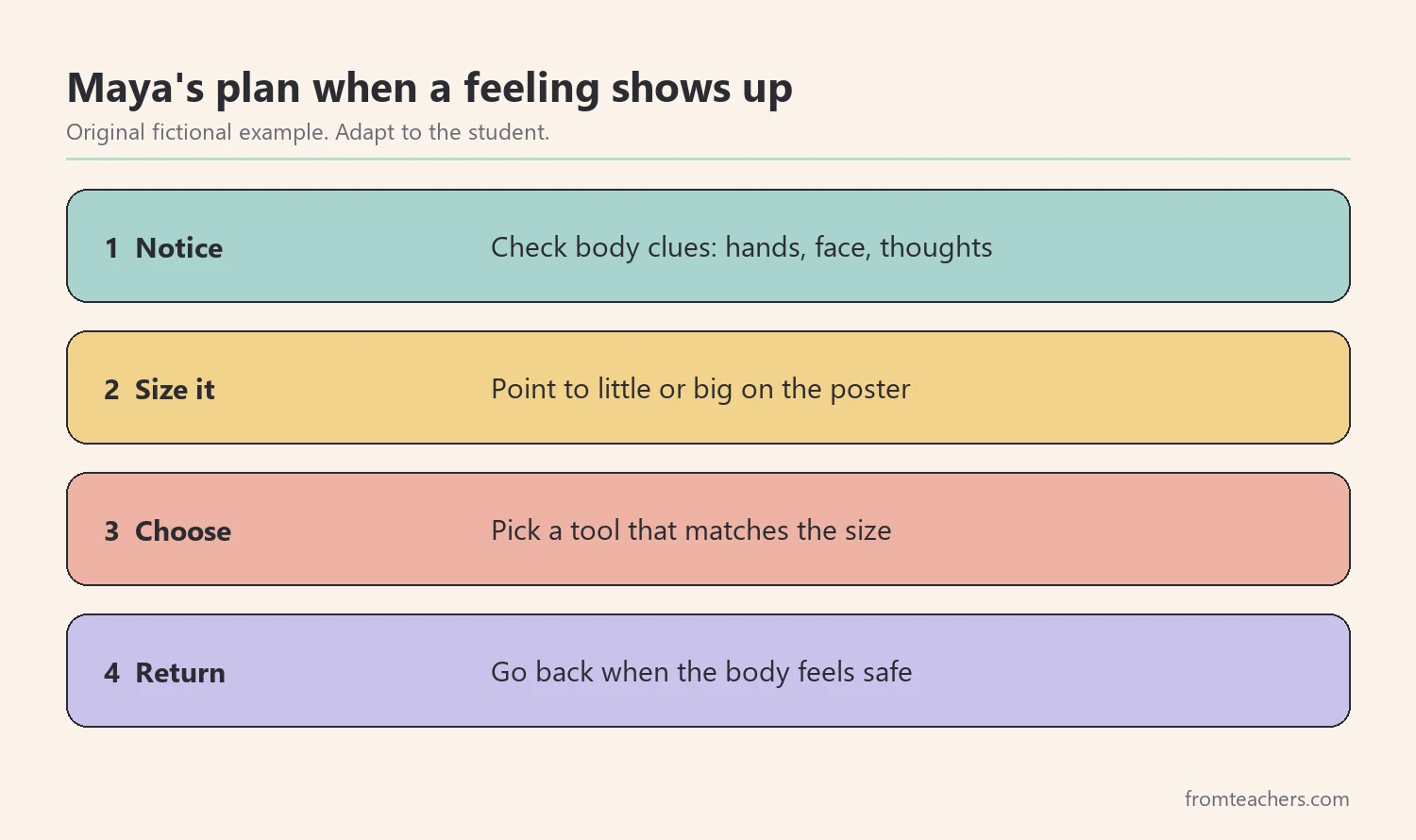
During a real moment, keep your words few. A calm “Little or big?” and a point to the poster is often enough. Long explanations add to the load when a student is already overwhelmed.
After a big feeling passes, reflect briefly and kindly. Ask what helped, then praise the effort. Avoid lectures; the reflection is about learning, not blame. Moreover, celebrate small wins, such as asking for the calm space instead of leaving the room.
Plan for the return, too. Agree in advance what the student does when the timer ends: check the body again, take one breath, and rejoin the task at a clear starting point. A sticky note marking where to restart makes coming back much easier than facing a whole page.
Also, expect some setbacks. A tired Monday or a schedule change can make every feeling seem bigger. That does not mean the plan failed; it means the student needs more support that day, and the routine is still the right tool to return to.
Finally, coach other adults to use the same words. Aides, specialists, and substitutes should all ask “Little or big?” and point to the same visual. Consistent language across settings helps students trust the routine.
Worked example. During a spelling test, Maya’s face gets hot. Her teacher quietly asks, “Little or big?” Maya points to big, shows her signal card, and goes to the calm corner. She squeezes the pillow, sets the timer, and returns after twelve minutes.
5. Review progress on the size of feelings with the family
Finally, track a few simple numbers each week. You might count big-feeling moments, how often the student asked for the calm space on their own, and how many minutes it took to return to work.
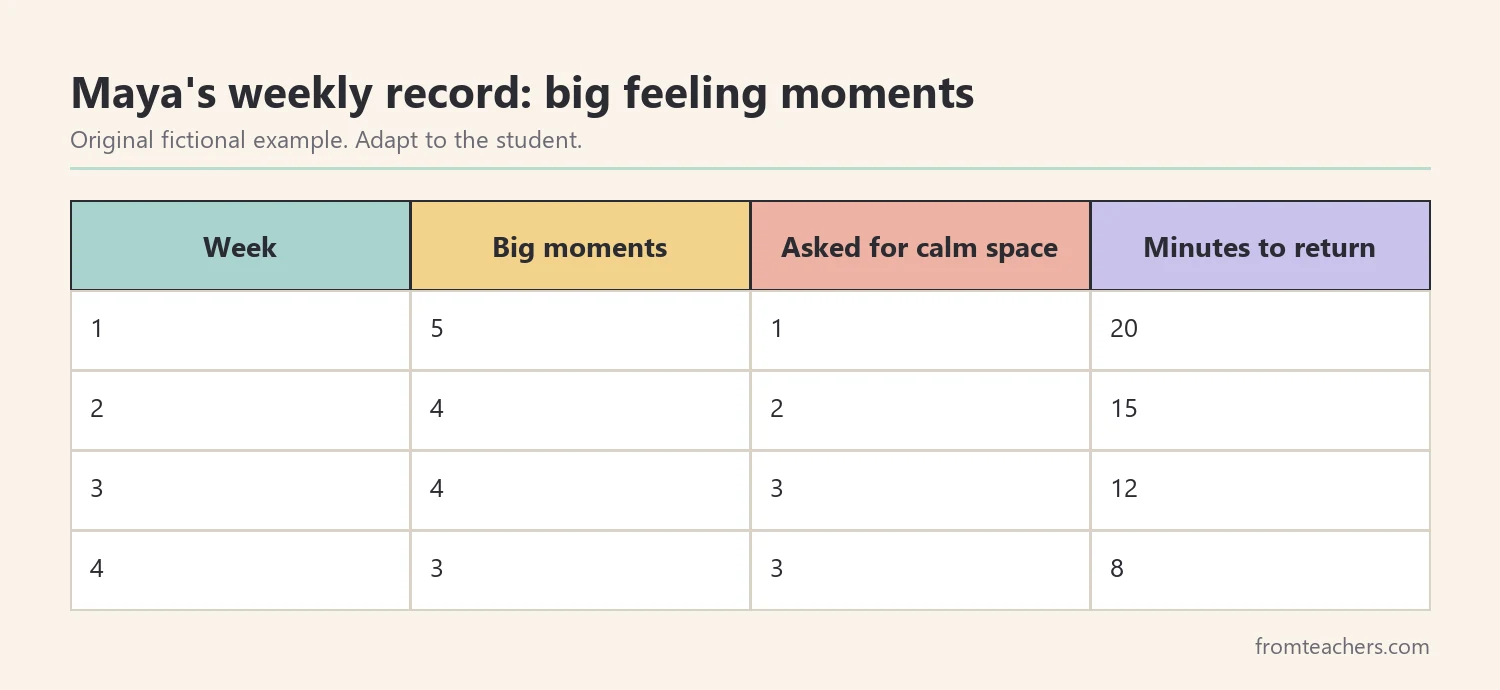
Look at the trend. In this example, Maya asked for the calm space on her own in 1 of 5 big moments in week one and 3 of 3 in week four. Her time to return dropped from about 20 minutes to about 8.
Numbers are only part of the picture. Add one short note per week about what helped, such as a new tool or a change in seating. These notes make the size of feelings plan easier to adjust because you can see which changes came before progress.
Share the record with the family in plain words. Ask what they notice at home and whether the same language could work there. Some families like a small copy of the visual on the fridge.
If progress stalls, check whether the tools still fit the student, whether practice is happening when calm, and whether every adult cues the routine the same way. Change one thing at a time so you can see what helps. If big feelings remain frequent or intense, talk with the school counselor or the student’s team.
Worked example. Maya’s teacher sends a short note home with the four-week record. Her parents start asking “Little or big?” during homework and report fewer long upsets on school nights.
Common mistakes and how to avoid them
- Treating big feelings as bad behavior. Fix: say clearly that every feeling is normal and focus on the response.
- Teaching tools only during a crisis. Fix: practice daily when the student is calm.
- Offering too many strategies. Fix: choose two or three per size with the student.
- Talking too much in the moment. Fix: use a short question and a point to the visual.
- Skipping the return step. Fix: plan how and when the student comes back to work.
Questions teachers and parents ask about the size of feelings
What age is this approach for?
Two sizes work well for young children and for older students who need simple language. Older students may later move to a scale with more steps. Adapt the examples and visuals to the student’s age.
Is it okay if a student rates every size of feelings as big?
Yes, at first. It often means they are still learning to notice body clues. Keep sorting scenarios together, and accept their answer while gently pointing out clues.
How is a calm space different from time-out?
A calm space is a choice the student uses to feel safe and regulated, not a punishment. It has calming tools and a clear plan to return. Time-out removes a student as a consequence.
Can I use this with the whole class?
Yes. Whole-class teaching builds a shared language and reduces stigma. Individual students can then get extra practice or a personal card.
When should I involve other professionals?
If big feelings are very frequent, intense, or unsafe, talk with the school counselor, psychologist, or the student’s team. This guide supports everyday teaching and is not a replacement for professional support.
Related reading: Meltdowns vs tantrums: the difference, Understanding autism and ADHD meltdowns, and Managing sensory overload in autism and ADHD.
A companion resource for teaching the size of feelings:
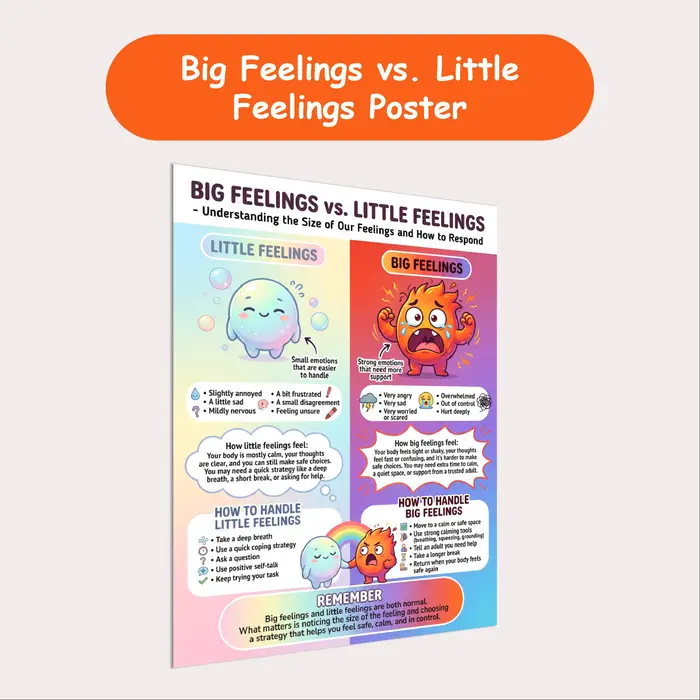
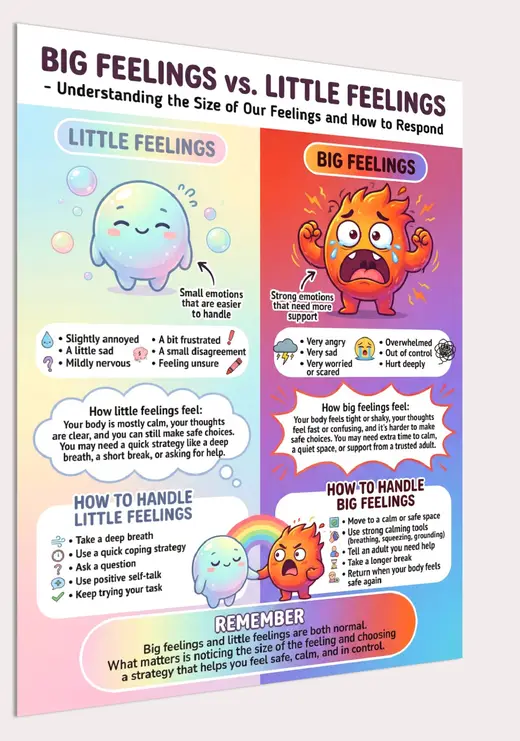
Big Feelings vs Little Feelings Poster: a printable emotional regulation poster where two friendly characters compare little and big feelings, how each one feels in the body, and ways to handle each size. Useful for calm down corners and SEL lessons.
Sources and scope
- CASEL: a widely used framework for social and emotional learning, including self-awareness and self-management.
- Child Mind Institute: family and educator guides on children’s emotions and mental health.
- IRIS Center, Vanderbilt University: free modules on classroom behavior and evidence-based practices.
- Understood.org: practical articles for families and teachers on emotions and learning differences.
This guide covers everyday classroom and home teaching of feeling size and coping strategies. It does not cover diagnosis or treatment of anxiety or other conditions, which belong to qualified professionals.
Key takeaways
- Teaching the size of feelings gives students a simple, shared language.
- Body clues help students tell little feelings from big ones.
- Match quick tools to little feelings and stronger support to big ones.
- Practice when calm and keep words few in the moment.
- Track a few numbers weekly and review them with the family.




Leave a Comment