

FASD strategies help caregivers and educators respond to a child whose behavior is often misunderstood. Picture a third grader who followed the morning routine perfectly yesterday, then today walks in, drops his bag, and wanders the room as if he has never seen the routine before. An adult may think he is not trying. Often, something else is going on.
Fetal alcohol spectrum disorder, or FASD, is a term used for a group of lifelong conditions linked to alcohol exposure before birth. It can affect memory, attention, learning, and behavior. This guide gives you five practical FASD strategies: recognize what it can look like, reframe behavior, adjust the setting, teach with repetition, and track progress with the family.
Examples are fictional. Adapt to the student’s goals and agreed supports. This is guidance, not a diagnosis.
At a glance
- FASD can affect memory, attention, and learning in ways that look like defiance.
- Ask “what skill is missing?” before “why won’t he?”
- Structure, visuals, and calm spaces lower the daily load.
- Teach routines with the same words, and keep practicing after success.
- Work closely with caregivers and celebrate small, steady progress.
1. Recognize what FASD can look like in daily life
First, learn the common patterns. The CDC describes FASDs as a range of conditions that can include problems with learning, memory, attention, and behavior. Each child is different, and many children with FASD are bright, social, and eager to please. Their challenges are real, but they are often hidden.
For example, a child may learn a rule on Monday and seem to forget it on Tuesday. They may repeat the same mistake after a consequence. They may say “yes” to a direction and then not follow it. These patterns can look like choices, which is why good FASD strategies start with understanding.
Also, remember that diagnosis belongs to qualified professionals. Teachers and caregivers do not diagnose FASD. Your role is to notice patterns, share observations with the right people, and support the child in daily routines.
In addition, notice strengths. Many children with FASD are friendly, helpful, creative, or good with hands-on tasks. Strengths give you a place to start and a way to build trust.
Next, keep simple notes. Write what happened, when, and what came before. A week of short notes often reveals patterns, such as harder mornings or trouble after lunch, that help you choose the right FASD strategies.
Worked example. Leo is a fictional third grader with a diagnosis of FASD. His teacher, Ms. Bennett, keeps notes for one week. She sees that his hardest moments come during arrival and transitions, and that he does best in small-group hands-on tasks.
2. Reframe behavior as a skill gap
Next, shift the question. Instead of asking “Why won’t he listen?” ask “What skill might be missing right now?” This one change is at the heart of many FASD strategies. It moves adults away from blame and toward support.
For example, a child who forgets a rule may have trouble with memory, not respect. A child who repeats a mistake may find it hard to connect a past consequence to a new moment. A child who melts down in a noisy room may be overloaded. The response changes when the reason changes.
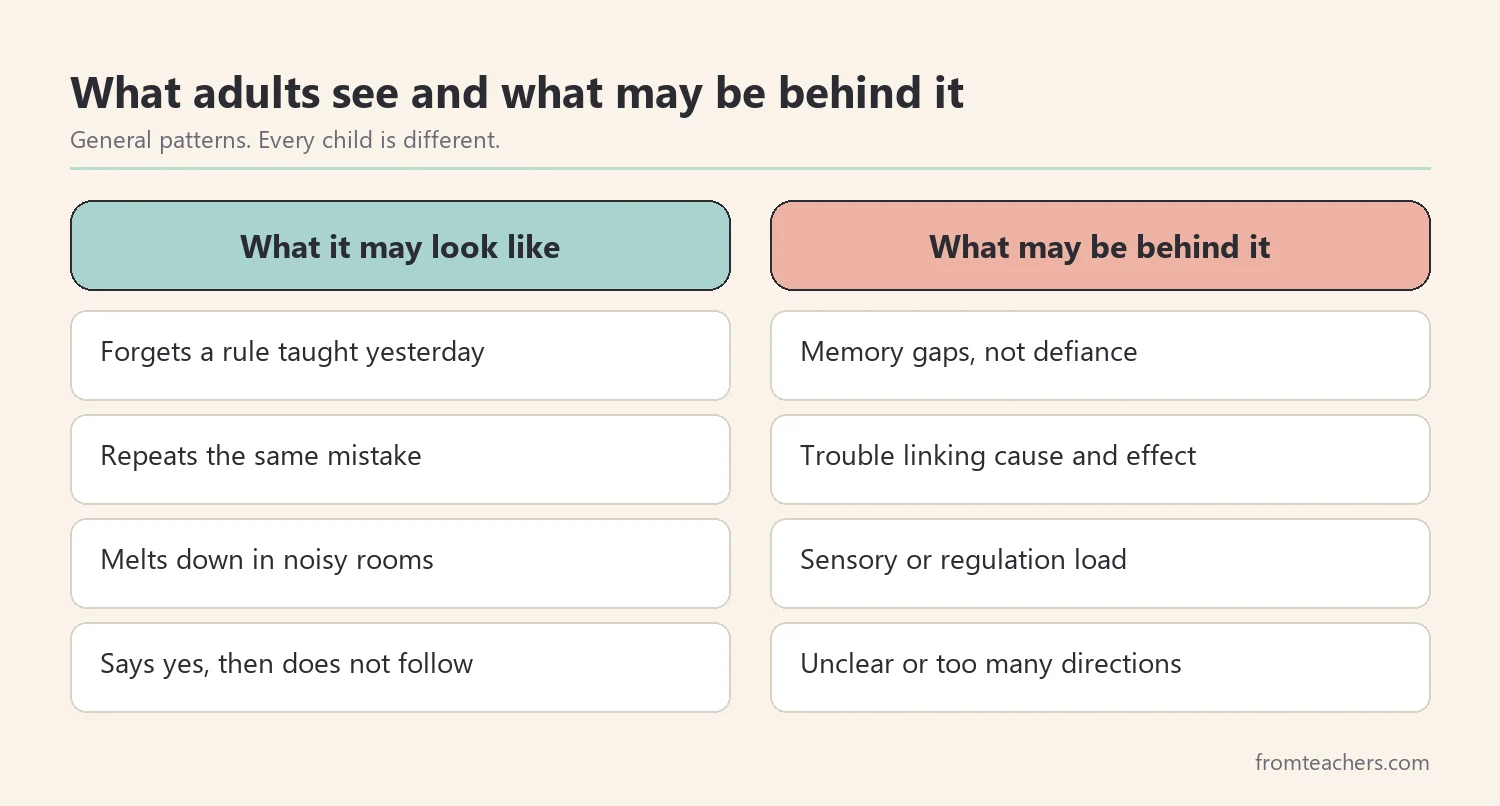
Then, rethink consequences. Many children with FASD do not learn well from punishment alone, because the link between action and result may not stick. Clear supports before a problem usually work better than consequences after it.
Also, watch your words. Calm, short, concrete language helps. Say “Bag on the hook” instead of “Get yourself organized.” Abstract phrases are harder to follow and easier to misunderstand.
In addition, share this view with the whole team. When every adult uses the same reframe, the child gets the same calm response everywhere. Strategy tables that explain common signs and helpful responses can make this shared view easier to keep.
Worked example. Ms. Bennett used to remind Leo of the arrival rules several times each morning. Now she asks, “What part does he forget?” She learns that he forgets the order of steps, not the rules themselves. That tells her what to support.
3. Adjust the setting with simple FASD strategies
Next, change the environment before you ask the child to change. Structure lowers the load on memory and attention. Many FASD strategies are small, practical changes to the room, the schedule, and the way directions are given.
First, keep things the same. The same seat, the same routine, and the same order of activities help a child know what comes next without having to remember it. When a change is needed, give a warning and show it on the schedule.
Then, add visuals. A picture schedule at eye level, a desk checklist, and a visual timer all hold information so the child does not have to. Visuals work like an external memory.
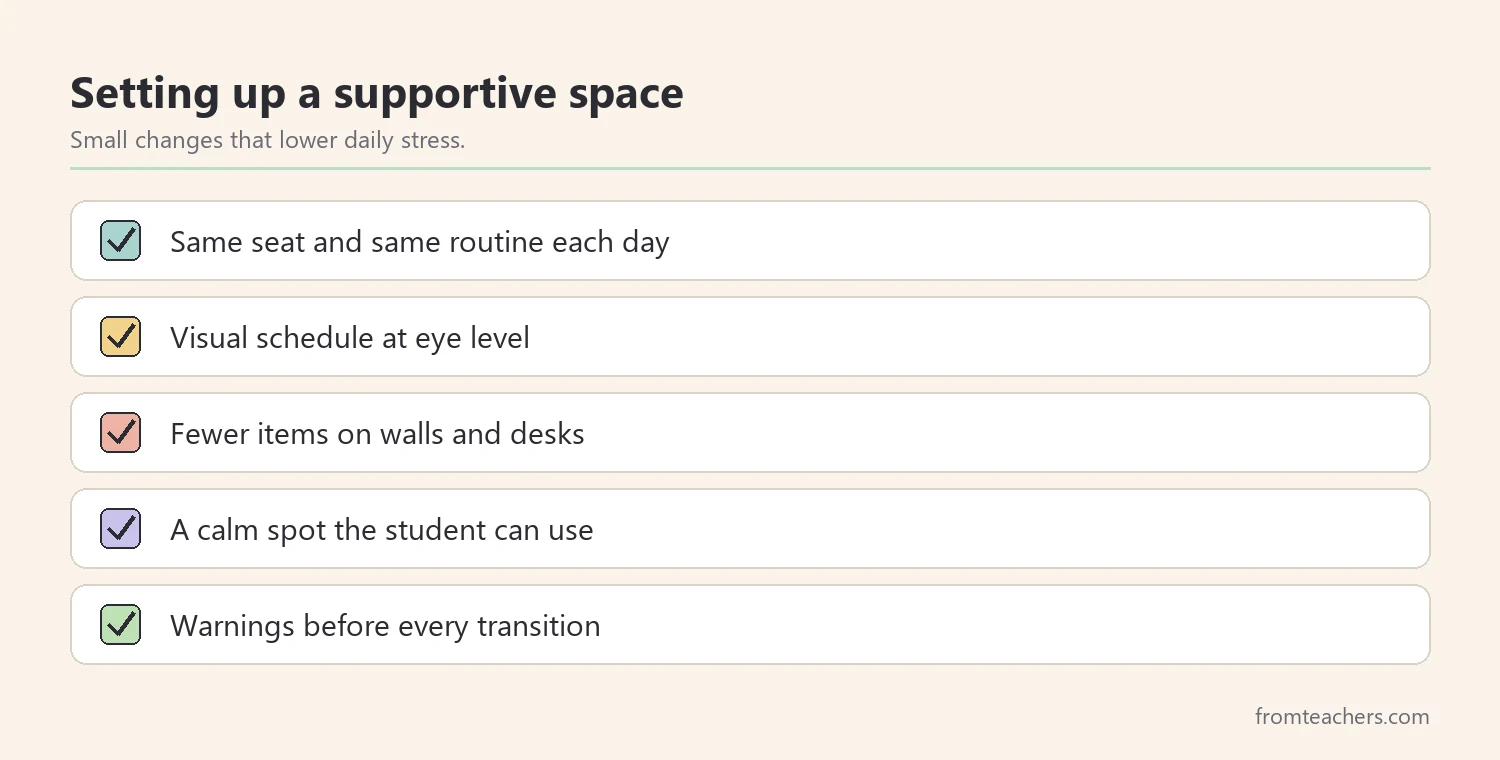
Also, reduce clutter and noise where you can. Busy walls, crowded desks, and loud spaces can overwhelm. A calm corner or quiet spot gives the child a place to reset before a small problem grows.
In addition, prepare for transitions. Many children with FASD find changes hard. A countdown, a picture of the next activity, or a short job to do during the move can make transitions smoother.
For ready-made support, the fetal alcohol spectrum disorder strategy tables help caregivers and educators recognize signs, adjust supports, and celebrate progress, so the team can match each change to what they see.
Worked example. Ms. Bennett gives Leo the same seat near the door and posts a five-picture arrival checklist by his hook. She adds a two-minute warning before each transition. Within a week, his arrival takes less adult help.
4. Teach with repetition and concrete language
Next, plan to teach the same thing many times. Children with FASD often need more repetition than peers, and they may need practice to continue even after they seem to know a skill. Good FASD strategies treat this as normal, not as failure.
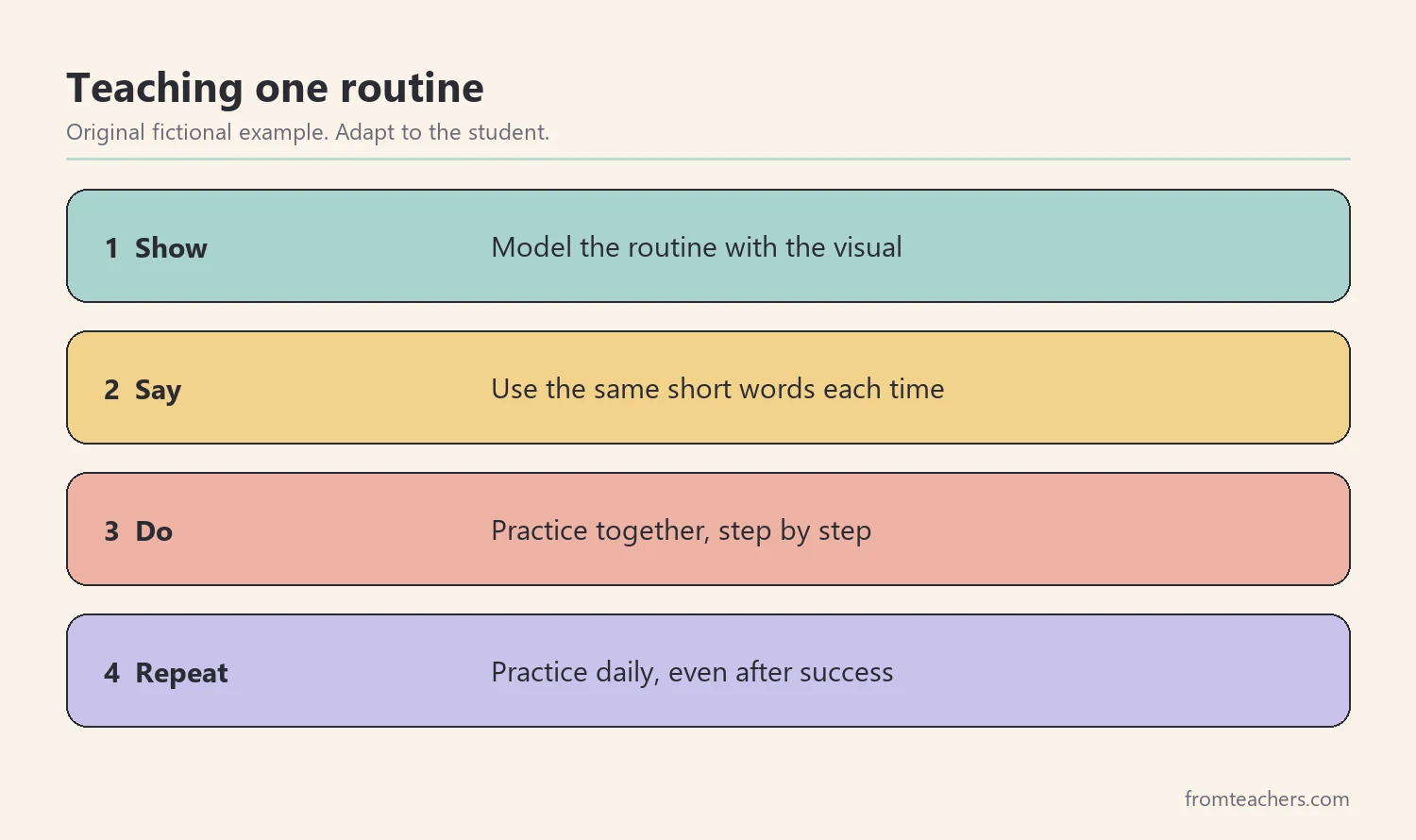
First, show the routine with the visual. Then say the steps in the same short words every time. Next, do it together. Finally, repeat it daily. If the words change from adult to adult, the child may treat it as a new task.
Also, make learning concrete. Abstract ideas such as time, money, and math facts can be hard. Use objects, number lines, visual timers, and real examples. Hands-on tasks often play to the child’s strengths.
In addition, break tasks into small parts. Give one direction at a time. Check understanding by asking the child to show you, not just to say “yes.” Many children agree to directions they did not fully understand.
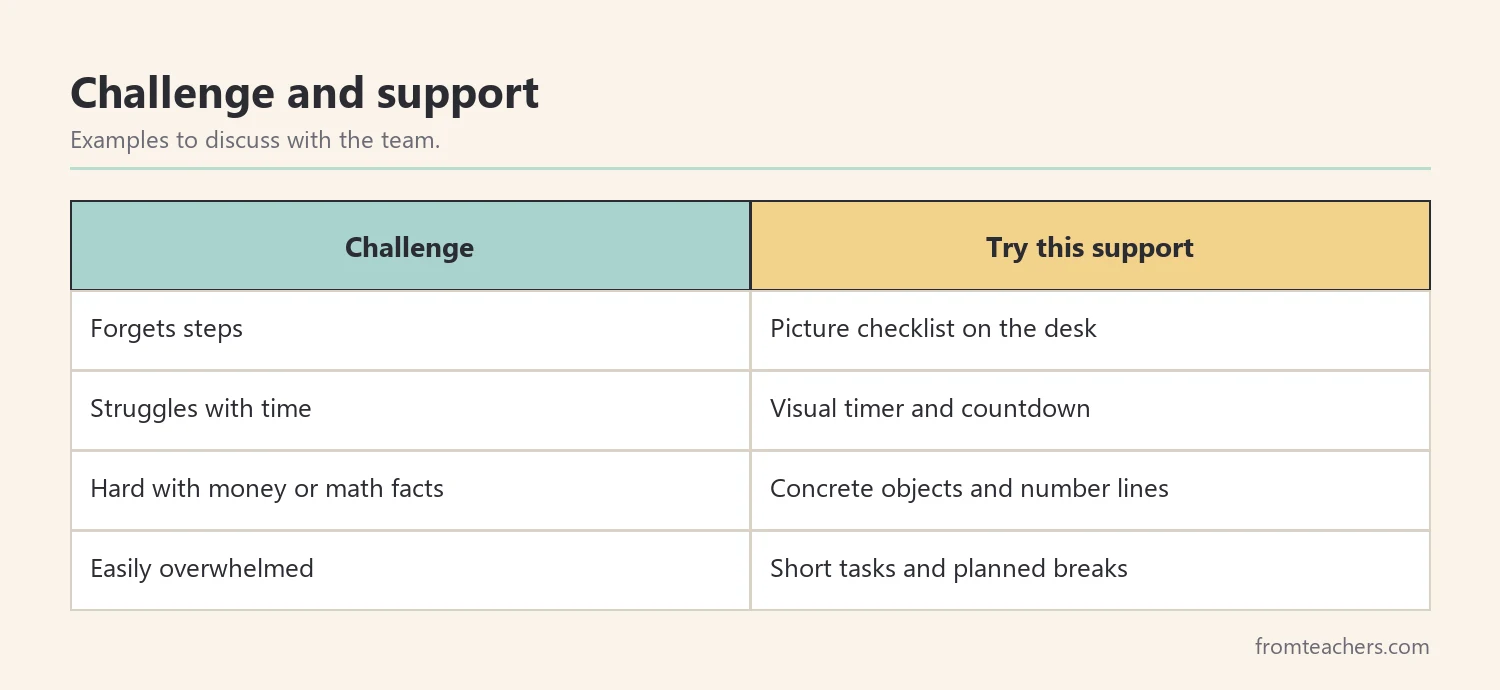
Meanwhile, keep supports in place. A common mistake is removing a visual once the child succeeds for a few days. For many children with FASD, the support is what makes success possible, so fade carefully and watch closely.
Worked example. Ms. Bennett teaches Leo’s arrival routine with the same five phrases every day. When he succeeds for a week, she keeps the checklist up. She also uses a visual timer for independent work and gives one direction at a time.
5. Track progress and partner with caregivers
Finally, measure what matters. Pick one or two targets, such as smooth arrivals or finishing short tasks, and count them each day. A simple tally shows whether your FASD strategies are working and which ones need adjusting.
Next, look at trends over weeks. Children with FASD may have uneven days, and a hard day does not erase progress. A steady trend is more useful than any single day.
Also, partner closely with caregivers. Families often know what works at home: which words calm the child, which routines help, and what signs come before a hard moment. Sharing FASD strategies between home and school creates the consistency these children need.
In addition, celebrate progress openly. Children with FASD may hear a lot of correction. Specific praise, such as “You hung up your bag and started your work,” builds confidence and helps the child remember what success looks like.
Then, bring your data to the team. If the child has an IEP or 504 plan, your notes help the team decide which supports to keep, add, or change. Share both progress and challenges in plain words.
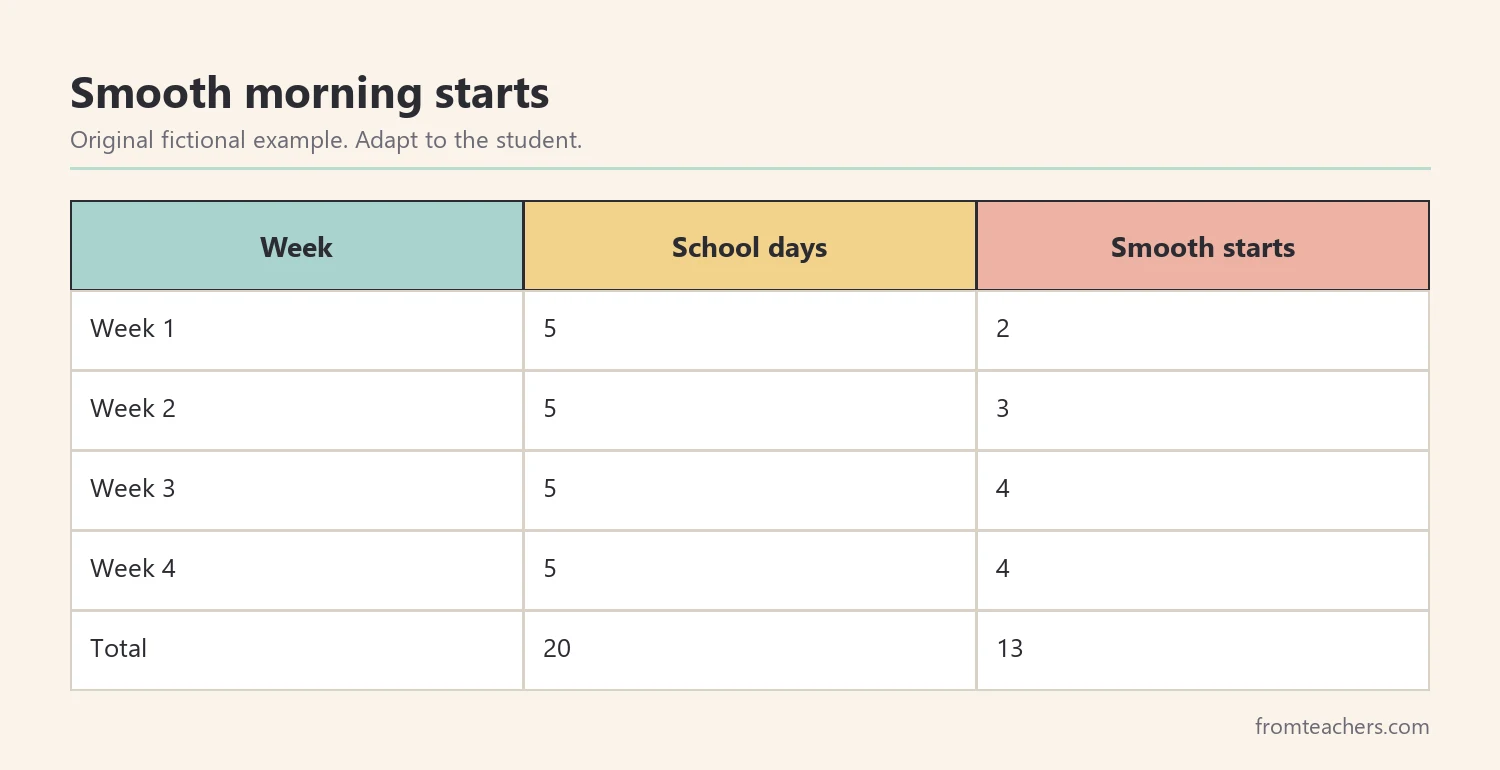
Worked example. Ms. Bennett counts Leo’s smooth morning starts. In week 1, he had 2 of 5. In week 2, 3 of 5. In weeks 3 and 4, 4 of 5 each. That is 13 smooth starts out of 20 days. She shares the chart with Leo’s grandmother, who uses the same arrival words at home.
Using FASD strategies across the school day
Supports work best when they follow the child from room to room. Specials, lunch, recess, and the bus are often the hardest parts of the day, because the adults and the rules change. So, share a short one-page summary of the child’s key FASD strategies with every adult who works with them.
Also, keep the summary practical. List the two or three words or visuals that help most, the signs that a hard moment is coming, and what to do next. A specials teacher who sees the student once a week needs simple, clear steps, not a long report.
In addition, plan for substitutes. A substitute who does not know the routine can unknowingly change everything. Leave the visual schedule, the arrival checklist, and a note about the calm spot. These small steps keep FASD strategies steady even on days when the usual adult is away.
Finally, check in with the student. Older children can often tell you which supports help most. Asking “What makes mornings easier?” shows respect and gives you useful ideas for the next round of FASD strategies.
Caring for the adults, too
Supporting a child with FASD can be tiring. Caregivers and teachers both need support. Share the load across the team, and ask for help from specialists when you need it.
Also, remember that progress may be slow and uneven. Consistent FASD strategies, used over time and with patience, often matter more than any single new idea.
Common mistakes and how to avoid them
- Treating forgetting as defiance. The child may be punished for a skill gap. Fix: ask what skill is missing.
- Relying on consequences alone. Learning from consequences can be hard. Fix: add supports before problems happen.
- Using abstract language. Directions get lost. Fix: give short, concrete, one-step directions.
- Removing supports too soon. Success may disappear. Fix: keep visuals in place and fade slowly.
- Changing routines often. The child has to relearn. Fix: keep routines steady and warn before changes.
- Working without the family. Home and school send mixed messages. Fix: share FASD strategies both ways.
Questions teachers and parents ask about FASD strategies
Can teachers tell if a child has FASD?
No. Only qualified professionals can diagnose FASD. Teachers can notice patterns in learning and behavior and share them with families and the school team, who can decide on next steps.
Do FASD strategies help other students too?
Often, yes. Clear routines, visuals, concrete language, and calm spaces support many students. These strategies tend to make a classroom easier for everyone.
Why does a child with FASD forget something they knew yesterday?
FASD can affect memory and the ability to use information in new moments. This is not a choice. Visual supports and steady repetition help fill the gap.
Should I stop using consequences?
Not necessarily, but do not rely on them alone. Focus on prevention, clear supports, and teaching. Follow the behavior plan agreed by the team.
How can I support the family?
Share positive news often, use the same words and routines they use, and ask what works at home. A brief weekly note builds trust and consistency.
Related reading: Moving Beyond Shame and Behavior Charts: Positive Alternatives for Effective Classroom Management, How Teachers Communicate With Parents in Special Education: Building a Strong Partnership, and Essential Trauma-Informed Teaching Strategies for Modern Classrooms.
A companion resource for FASD strategies:
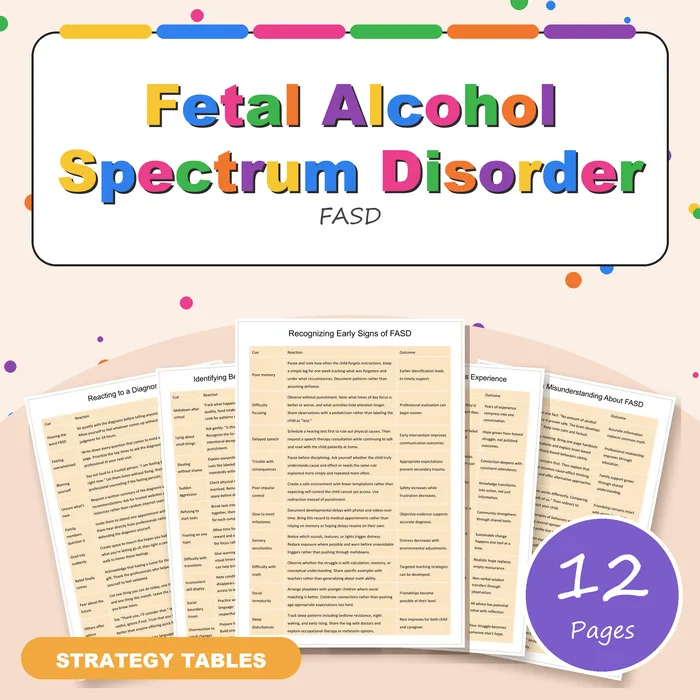
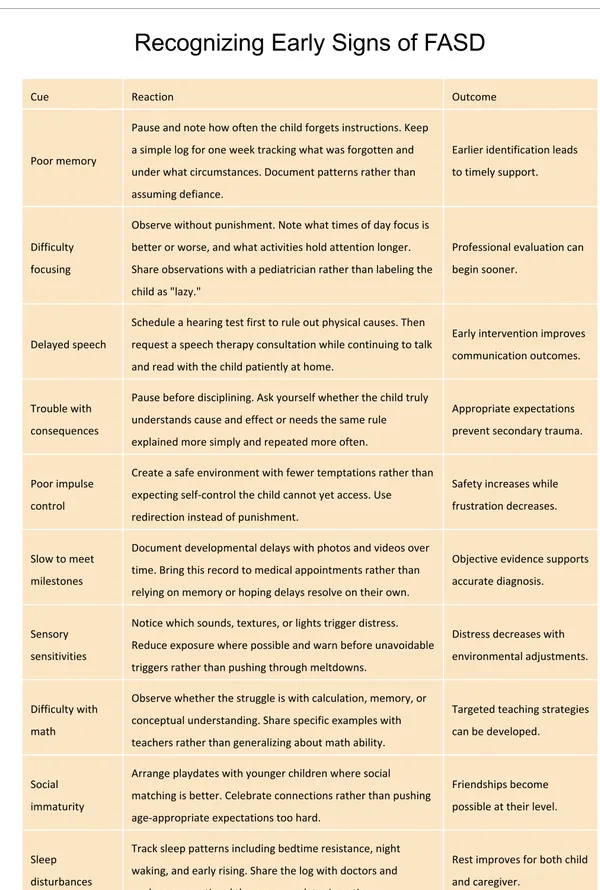
Fetal Alcohol Spectrum Disorder (FASD): Caregiver and Educator Strategy Tables: 12 pages of strategy tables that help caregivers and educators recognize signs, adjust supports, and celebrate progress.
Sources and scope
- Centers for Disease Control and Prevention (CDC): general information on fetal alcohol spectrum disorders.
- National Institute on Alcohol Abuse and Alcoholism (NIAAA): research-based information on alcohol and health, including prenatal exposure.
- IRIS Center, Vanderbilt University: free modules on behavior support and classroom structure.
- IDEA, U.S. Department of Education: the law behind special education services and IEPs.
This guide covers everyday classroom and home strategies for children with FASD. It does not provide medical advice, diagnosis, or treatment, and it does not replace the decisions of the child’s health providers or support team.
Key takeaways
- FASD can affect memory, attention, and learning in hidden ways.
- Reframe behavior as a skill gap before choosing a response.
- Use structure, visuals, and calm spaces to lower the load.
- Teach with repetition, concrete language, and steady supports.
- Track simple targets and share FASD strategies with caregivers.










Leave a Comment