

Classroom accommodations for dyslexia work best when each one answers a specific barrier, not a general label. Picture a third grader who understands every idea in a science discussion, then freezes when the worksheet arrives because the reading and writing stand between him and the answer.
After reading this guide, you will be able to spot the barrier behind a struggle, choose an accommodation that removes it, explain the reason to colleagues and families, and check whether it is working. The approach follows a simple pattern used by many teams: barrier, plan, reason.
Examples are fictional. Adapt to the student’s goals and agreed supports. This is guidance, not a diagnosis.
At a glance
- Name the barrier first: reading, writing, attention, memory, environment, or emotions.
- Match each barrier with one clear accommodation and a short reason.
- Accommodations change how a student accesses or shows learning, not what they learn.
- Teach the student to use each tool, then fade adult prompts.
- Review every few weeks and keep only what helps.
1. Identify the barrier before choosing classroom accommodations for dyslexia
Dyslexia affects students in different ways. One child decodes slowly but writes fluently. Another reads accurately yet spells so inconsistently that written answers become unreadable. Therefore, the first step is to watch closely and name what is actually getting in the way.
Observe the student across a few different tasks over one or two weeks. Notice where work slows down, where errors cluster, and where the student avoids or shuts down. Then group what you see into barrier areas.
| Barrier area | What you might see |
|---|---|
| Reading | Slow decoding, losing place, tiring quickly |
| Writing and spelling | Short answers, many spelling errors |
| Attention | Drifting during long text tasks |
| Memory and recall | Forgetting multi-step directions |
| Social and emotional | Avoiding reading aloud, low confidence |
Here is our fictional example. Noah is in third grade. In discussions, he gives thoughtful answers. On paper, his work is brief, and he often loses his place when reading word problems. His teacher, Mr. Patel, writes down three barriers: slow reading of grade-level text, spelling that blocks written answers, and anxiety about reading aloud.
It also helps to collect a few work samples. A short reading log, a page of written answers, and a note about when the student asked for help give you evidence instead of impressions. Later, those same samples show whether classroom accommodations for dyslexia are making a difference.
Notice what Mr. Patel did not do. He did not jump straight to a long list of supports. Instead, he described the barriers clearly, which made the next step much easier for the whole team.
If the student already has an IEP or 504 plan, read it before you start. Many classroom accommodations for dyslexia are already listed there, and your observations will show which ones are being used and which ones still need attention.
2. Match each barrier to a clear plan
Once barriers are named, choose one accommodation for each. A focused plan is easier to deliver every day than a long list that no one can remember.
Write each match in three short parts: the barrier, the plan, and the reason. The reason matters because it helps substitutes, paraprofessionals, and families understand why the support exists. It also keeps the plan honest: if you cannot state a reason, the accommodation may not fit.
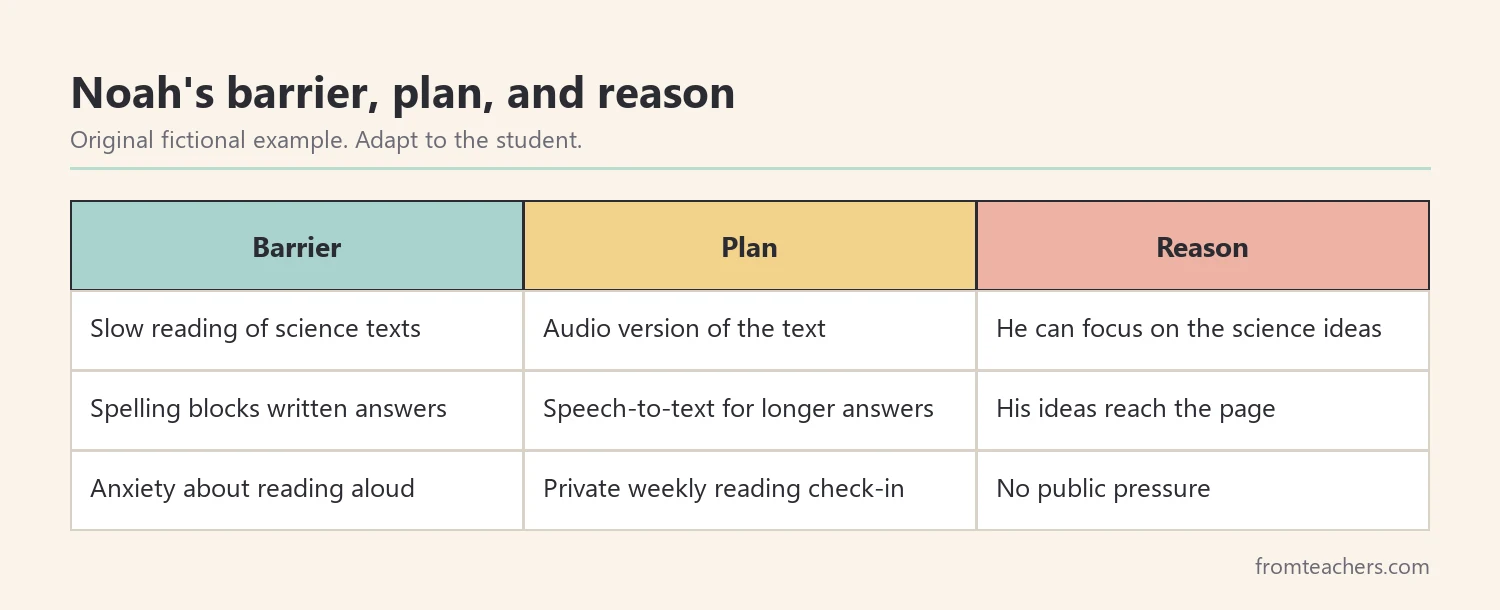
For Noah, Mr. Patel chose audio versions of science and social studies texts, speech-to-text for longer written answers, and a private reading check-in instead of reading aloud to the class. Each plan targets one barrier, and each reason fits on one line.
Keep in mind the difference between accommodations and modifications. Classroom accommodations for dyslexia change how a student reaches or shows the content, such as listening instead of reading. Modifications change what is expected, such as fewer or easier questions. Both can be appropriate, but the team should know which is which.
When you share the table with colleagues, keep it to one page. Short, readable classroom accommodations for dyslexia are far more likely to be used by a substitute on a busy Monday than a long document filed away in a drawer.
Also, think about which subjects the barrier really affects. Noah’s slow reading matters a lot in science, where texts are dense. It matters less in math centers that rely on objects and pictures. Targeting the right moments keeps the plan practical.
3. Put reading and writing supports in place
Reading and writing barriers are usually the most visible, so many classroom accommodations for dyslexia live here. The goal is access: the student should be able to think about the content without the print getting in the way.
Common reading supports include audiobooks or text-to-speech, reading guides or strips that keep one line visible, larger font and more spacing, and extra time on reading-heavy tasks. For writing, teams often use graphic organizers, speech-to-text, word banks, and permission to answer orally or with drawings.
Teach each tool directly. A student who receives audio books without practice may let the narration run while their attention drifts. So model how to pause, rewind, and follow along. Then let the student try it with support before using it independently. Classroom accommodations for dyslexia only help when the student knows how to use them.
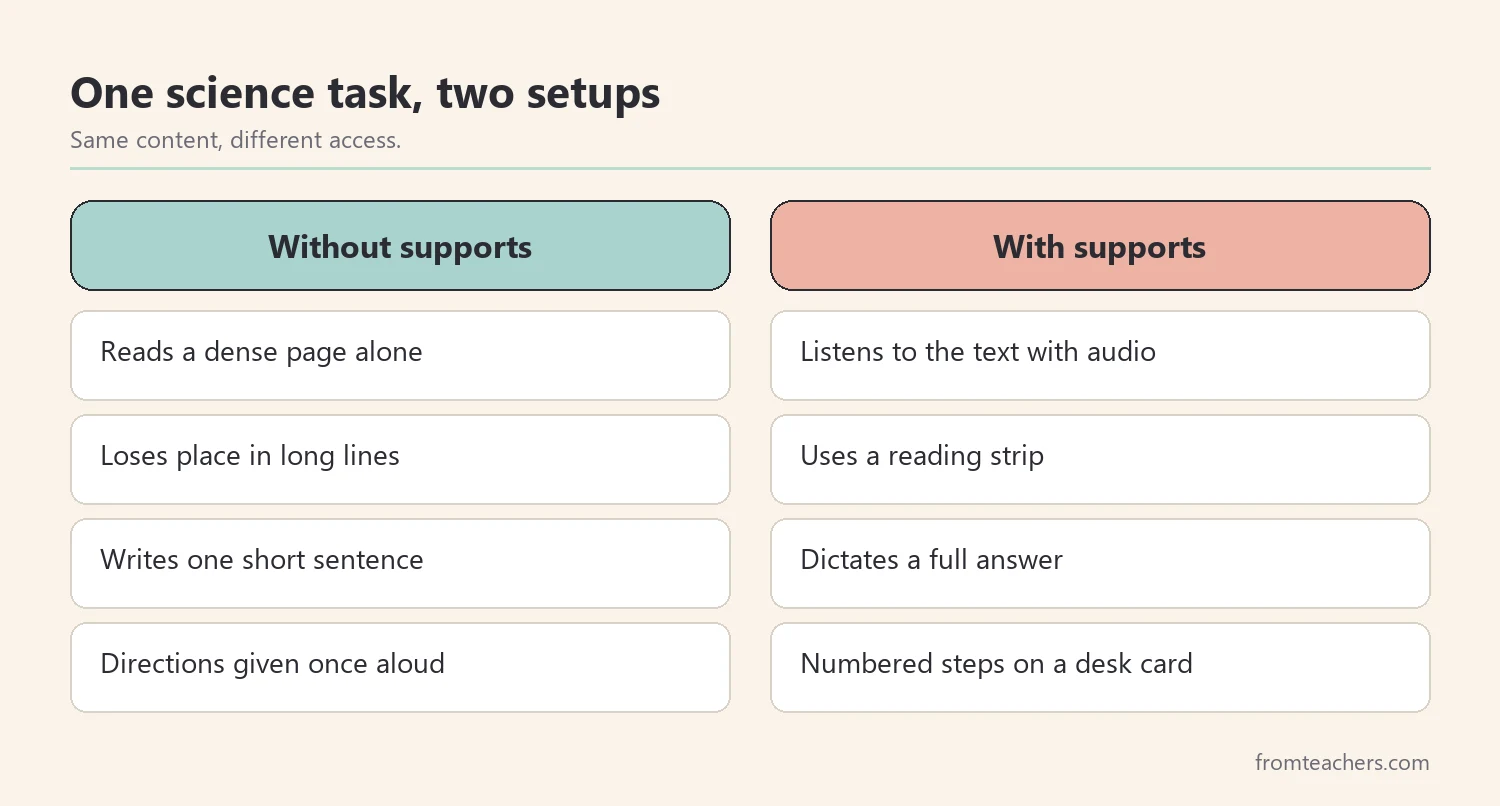
For Noah, Mr. Patel spent two short sessions teaching speech-to-text. First, Noah practiced saying a sentence, checking it on the screen, and fixing one word. Next, he tried a three-sentence science answer. By the end of the week, his written answers were noticeably longer and clearer.
Technology is useful, but low-tech options matter too. A printed word bank, a highlighted copy of the text, or a partner who reads the question aloud are all classroom accommodations for dyslexia that work even when devices are not available.
Keep spelling and reading instruction going, though. Accommodations give access to grade-level content, while structured literacy instruction builds the underlying skills. Students need both, and one should never replace the other.
4. Support attention, memory, and the environment
Reading effort is tiring. Many students with dyslexia also struggle to hold directions in mind or stay focused through long text tasks. Small changes to the environment and to how directions are given can make a real difference.
For attention, consider a quieter workspace option, visual cues for transitions, and breaking long readings into short sections with a check after each. For memory, give directions in writing and aloud, number the steps, and use simple mnemonics or picture cues for routines. For the physical environment, look at seating, lighting, glare on the board, and access to tools such as reading strips.
If you would like a structured reference for these areas, the Classroom Accommodations and Tools for Supporting Dyslexia pack organizes barriers by area, including attention, memory, physical environment, and technology, each with a plan and a reason.
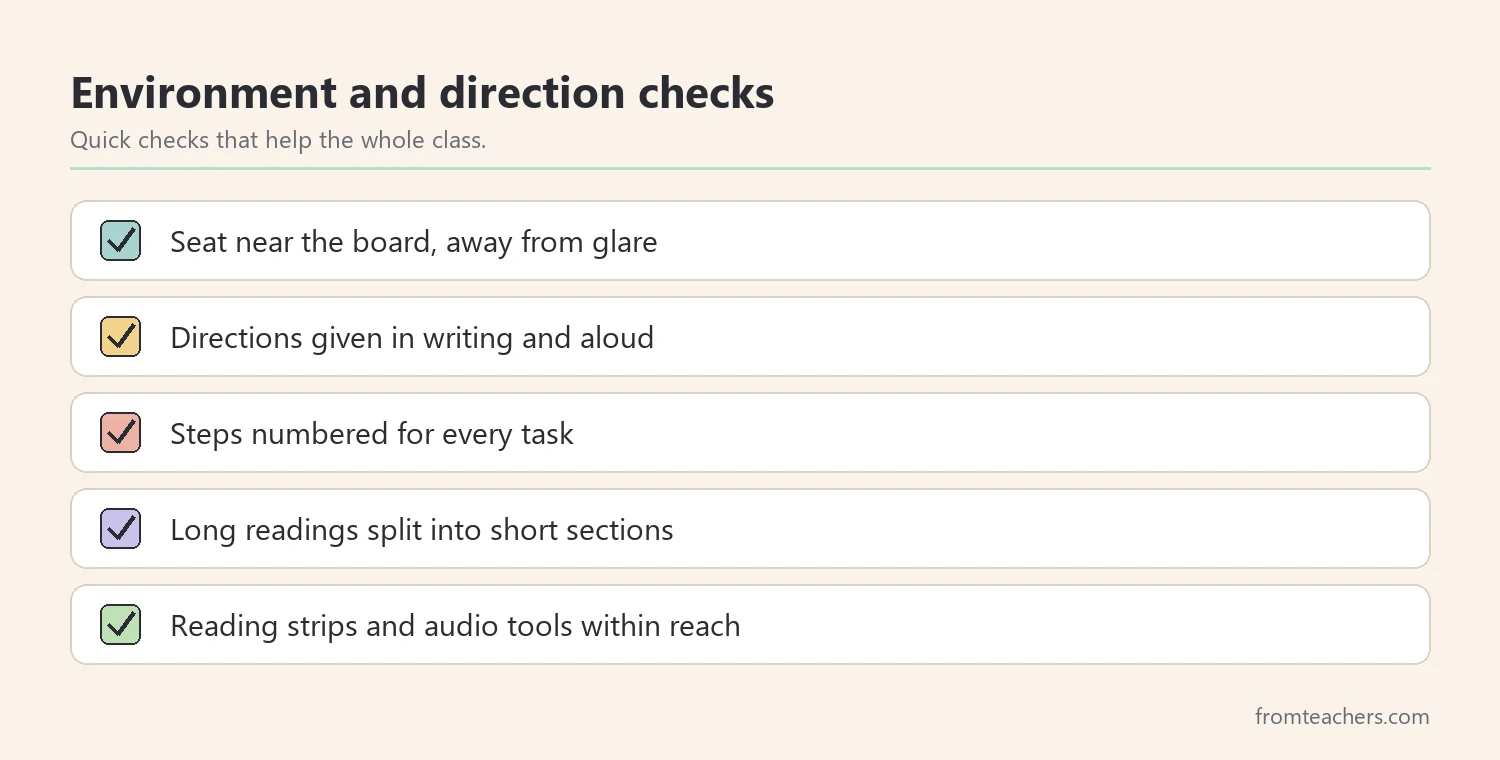
For Noah, Mr. Patel moved his seat closer to the board and away from the window glare. He also began posting numbered steps for every task on a small card on Noah’s desk. Noah stopped asking “what do I do next?” several times per lesson, which freed him to focus on the work.
Testing situations need a plan as well. Extra time, a quiet room, and questions read aloud are common classroom accommodations for dyslexia during assessments. Check with your school about which supports are allowed on which tests, and practice them during regular lessons so nothing feels new on test day.
Many of these changes help the whole class. Written steps, clear transitions, and well-organized materials support all learners, which also means the student with dyslexia does not feel singled out.
5. Protect confidence and peer relationships
Years of struggling with print can wear down a child’s confidence. Some students hide their difficulties by joking, avoiding tasks, or saying that reading is boring. Social and emotional barriers deserve the same careful planning as reading barriers, and good classroom accommodations for dyslexia address both.
Start by removing public pressure. Avoid surprise read-alouds, and let students preview text before any oral reading. Then highlight strengths: many students with dyslexia shine in discussion, building, art, or problem solving. Give them roles where those strengths are visible.
Next, make tools normal. When audio books, reading strips, and speech-to-text are available to anyone who needs them, using them carries less stigma. Some teachers briefly explain to the class that people learn in different ways and use different tools, without naming any student.
For Noah, Mr. Patel replaced reading aloud with a quiet weekly check-in at his desk. He also made Noah the “science discussion leader” for one group. Within a few weeks, Noah volunteered answers more often and asked to try reading a short paragraph aloud to a partner.
Families can help here too. Parents often know which situations feel hardest for their child and which strengths make them proud. A short conversation can shape classroom accommodations for dyslexia that feel respectful rather than embarrassing.
Above all, talk with the student. Ask what helps and what feels embarrassing. Classroom accommodations for dyslexia work best when the student understands them and has a voice in choosing them.
6. Review classroom accommodations for dyslexia and adjust
An accommodation is a hypothesis. It should make the barrier smaller, and you should be able to see that. Therefore, plan a short review every three to four weeks.
Pick one simple measure for each accommodation. For audio texts, you might track whether the student completes the reading task. For speech-to-text, count the sentences in written answers. For confidence, note how often the student volunteers in class.
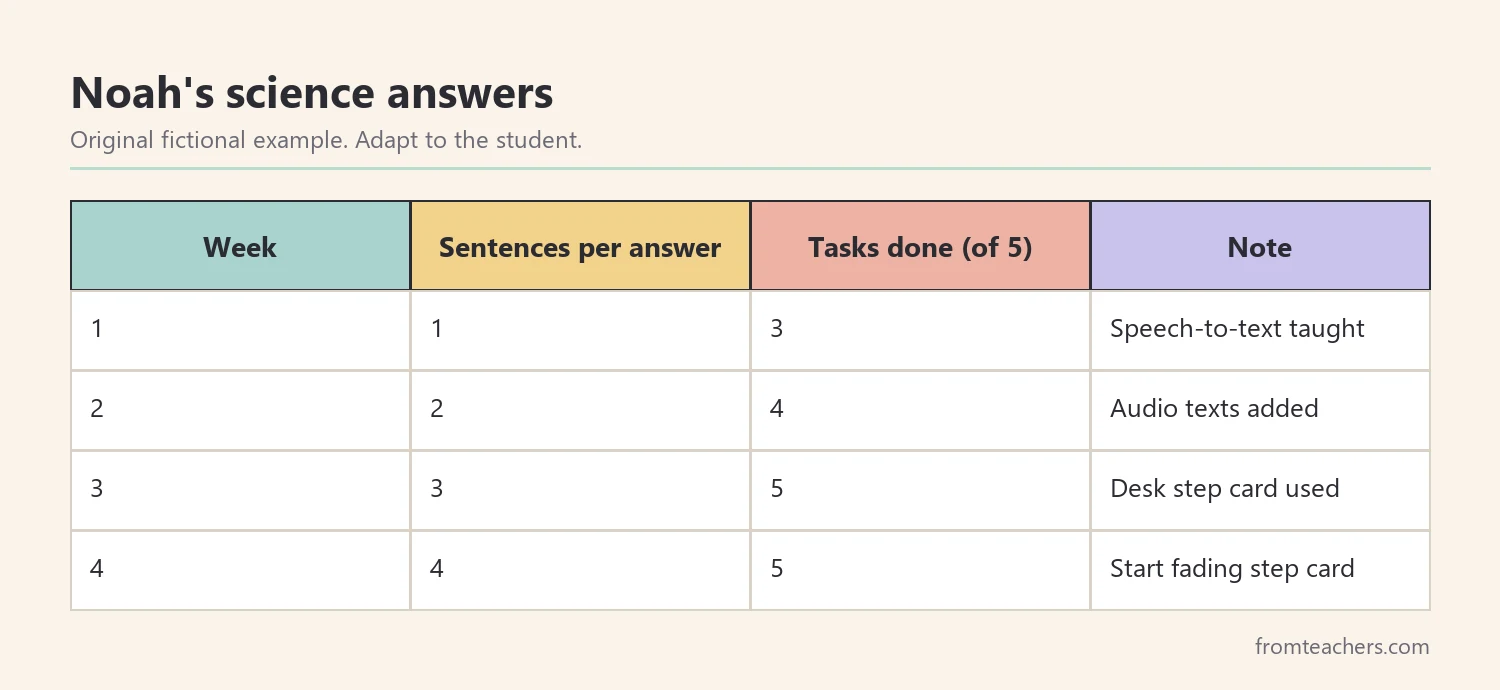
In Noah’s case, his average written answer grew from 1 sentence to 4 sentences over four weeks. Across the same period, he completed 3, then 4, then 5, then 5 of his 5 weekly science tasks. Those numbers gave the team a clear reason to keep speech-to-text and to start fading the desk step card.
Reviews also prevent clutter. Over a school year, classroom accommodations for dyslexia can pile up until no one remembers why each one exists. A quick review lets the team keep what helps, drop what does not, and update the barrier, plan, and reason table.
When something is not working, ask why. The tool may need more teaching, the barrier may be different than expected, or the accommodation may simply not fit. Then change one thing and review again. Share the results with the family so everyone sees the same picture.
Common mistakes and how to avoid them
- Listing many supports without naming the barrier. Fix: write the barrier first, then one plan and one reason.
- Handing over tools without teaching them. Fix: model, practice together, then fade support.
- Replacing reading instruction with accommodations. Fix: keep skill instruction going alongside access supports.
- Calling on the student to read aloud without warning. Fix: offer a preview or a private reading check instead.
- Never reviewing the plan. Fix: check one measure every three to four weeks and adjust.
Questions teachers and parents ask about classroom accommodations for dyslexia
Do accommodations give students an unfair advantage?
No. Accommodations remove a barrier so the student can show what they know. A student listening to a science text still has to understand and explain the science, just like classmates.
Does a student need an IEP or 504 plan to get accommodations?
Formal plans make accommodations official and consistent, especially on tests. However, teachers can often use everyday classroom supports, such as written directions or audio texts, while the school decides on formal steps.
How many accommodations should one student have?
Usually fewer than you think. The best classroom accommodations for dyslexia are the few that are used every day. Start with the supports that target the biggest barriers, make sure they are used well, and add more only when the review shows a clear need.
Will the student become dependent on audio books?
Audio access and reading instruction serve different purposes. Listening keeps the student learning grade-level content, while structured reading lessons build decoding. Both can grow at the same time.
How can parents support classroom accommodations at home?
Families can use the same tools for homework, such as audio texts or dictation, and share what they notice. Regular, short updates between home and school keep the plan consistent.
Related reading: Dyslexia Solutions in the Classroom: Evidence-Based Strategies for Success, Accommodations vs Modifications in Special Education: The Difference Explained, and Best Assistive Technology for Special Education Classrooms.
A companion resource for classroom accommodations for dyslexia:
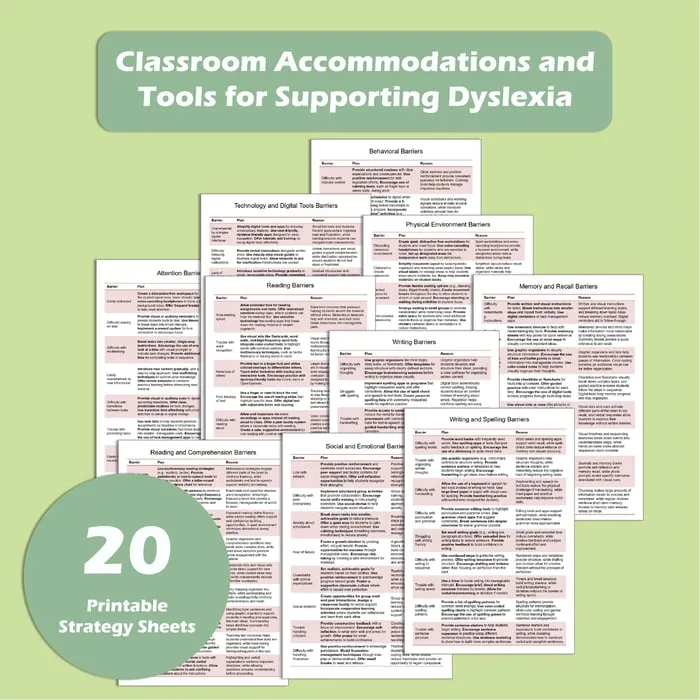
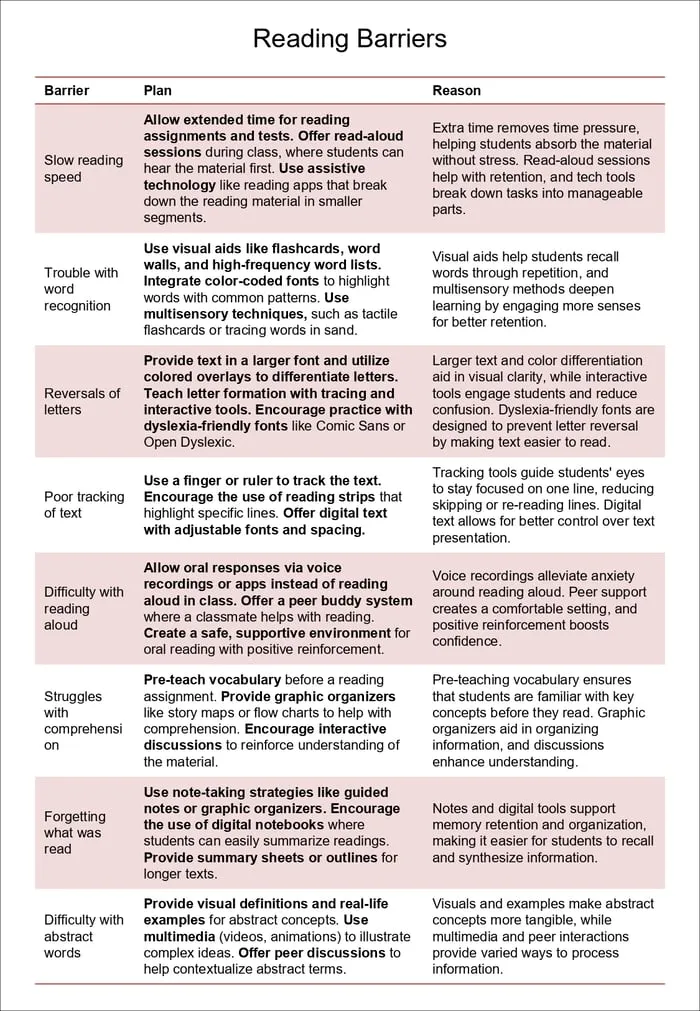
Classroom Accommodations and Tools for Supporting Dyslexia: a 20-page Barrier/Plan/Reason strategy pack covering reading, writing, attention, physical environment, memory, social and emotional, technology, and behavioral barriers.
Sources and scope
- International Dyslexia Association: background on dyslexia, structured literacy, and support for educators and families.
- IRIS Center, Vanderbilt University: free modules on accommodations and instruction for students with disabilities.
- Understood.org: practical articles on dyslexia, assistive technology, and classroom supports.
- IDEA, U.S. Department of Education: the law behind special education services and IEPs.
This guide covers choosing, teaching, and reviewing everyday classroom supports for students with dyslexia. It does not cover diagnosis, formal evaluation, or the design of reading intervention programs, which belong to qualified professionals and the student’s team.
Key takeaways
- Classroom accommodations for dyslexia start with a clearly named barrier.
- Write each support as barrier, plan, and reason.
- Teach every tool and keep reading instruction going alongside it.
- Protect confidence by removing public pressure and showcasing strengths.
- Review one simple measure every few weeks and adjust.







Leave a Comment