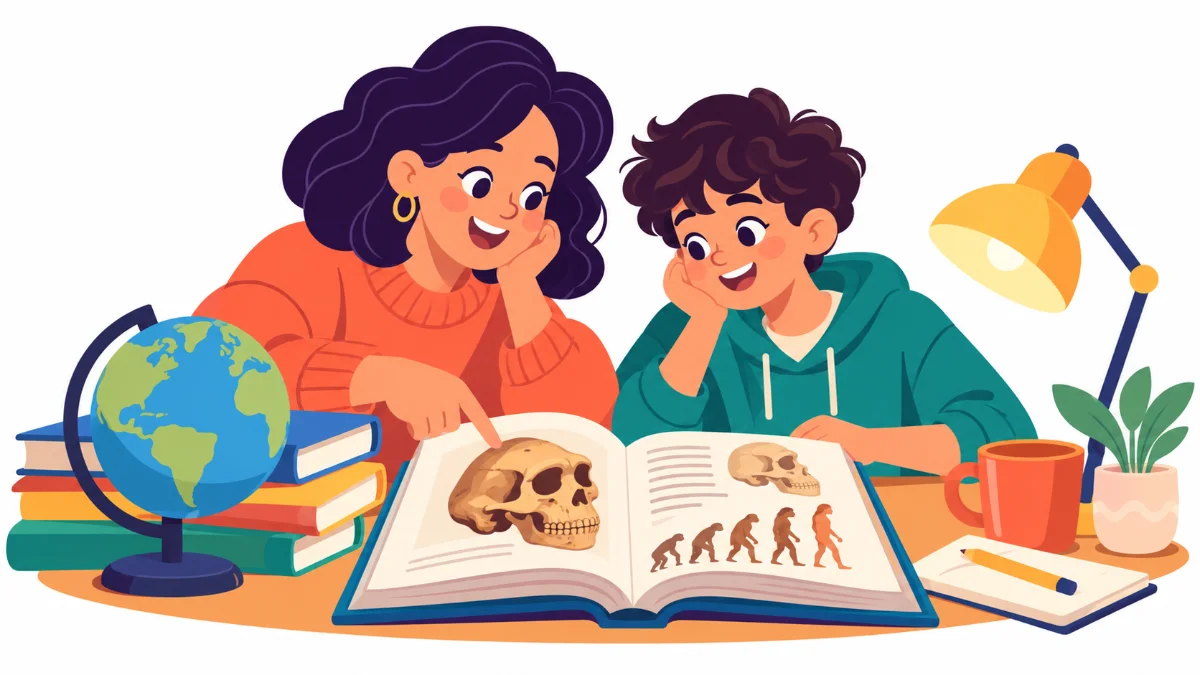

Human evolution questions kids ask usually arrive at the worst moment: in the car, during dinner, or right after a museum trip, when your eleven-year-old turns and says, “Wait, did people really come from monkeys?” Picture Noor, age 12, who just started an evolution unit in sixth grade science. Every evening she brings home a new question, and her dad wants to answer well without getting the science wrong.
This guide is for parents of children roughly 10 to 13 years old. It lists ten human evolution questions kids ask, ordered from the simplest to the most advanced, with a short, accurate answer for each, a follow-up idea and a quick example with Noor. You do not need a science degree. You need a calm tone, a few clear facts and the words “Let’s find out together.”
Examples are fictional. Adapt to the student’s goals and agreed supports. This is guidance, not a diagnosis.
At a glance
- Start with the question your child actually asked, not a full lecture.
- Correct the most common myth early: humans did not evolve from modern monkeys.
- Use timelines and pictures; big numbers are hard for every age.
- Say “scientists think” and “the evidence shows” to model how science works.
- It is fine to say “I do not know yet, let us look it up.”
How this list is ordered
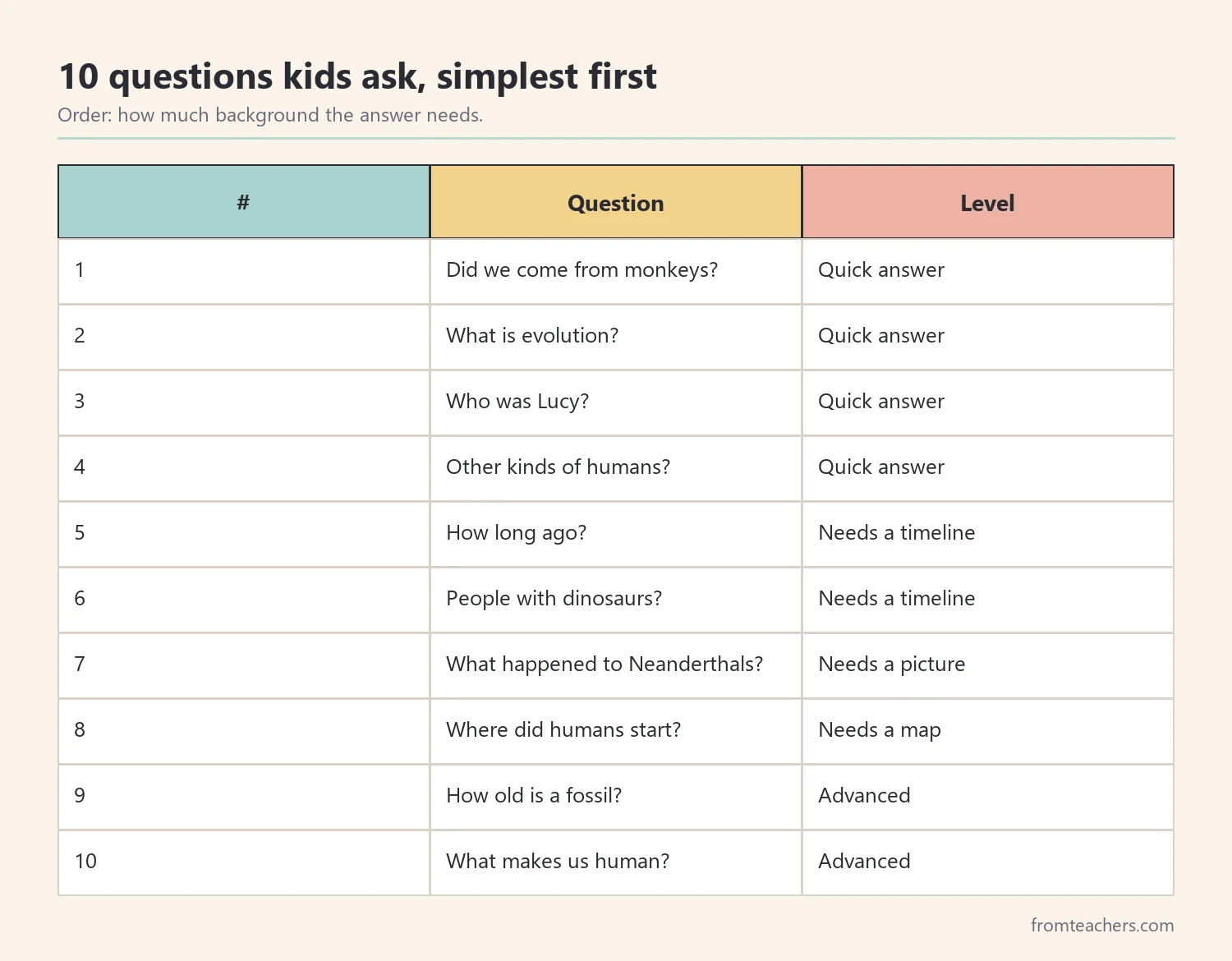
We ordered the ten questions from the easiest to answer to the ones that need more background. The first four can be handled in a single sentence or two. The middle questions need a picture or a timeline. Then, the last three touch on how scientists know what they know, which is the deepest part of the topic.
Also, every answer below follows the same pattern: a short honest answer, one concrete detail and an invitation to keep exploring. That pattern keeps conversations short enough for busy evenings. Figure 1 shows all ten questions at a glance.
1. “Did humans come from monkeys?”
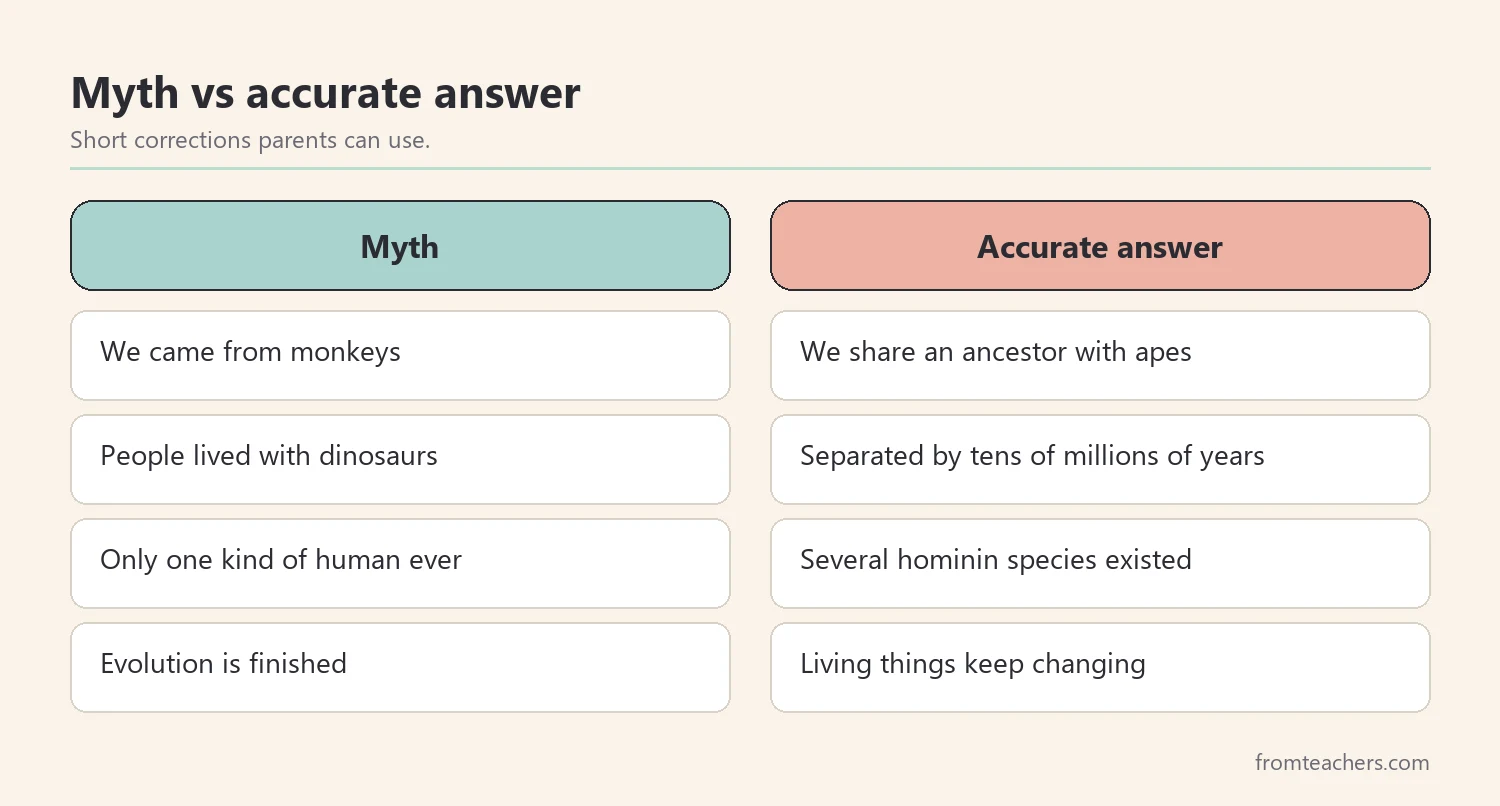
This is the most common of all human evolution questions kids ask, and the most misunderstood. The short answer: no, humans did not evolve from today’s monkeys or chimpanzees.
What to say: “Humans and chimpanzees are cousins. We share a common ancestor that lived millions of years ago. After that, the two family lines went separate ways.”
Why it works: the cousin comparison is familiar. Your child already knows that cousins share grandparents but did not come from each other.
Example: Noor’s dad drew a simple fork on a napkin. One branch said “chimpanzees,” the other said “humans,” and the point where they split said “shared ancestor.” Noor said, “So chimps are still evolving too?” That follow-up is exactly the right idea.
2. “What does evolution actually mean?”
Children often hear the word without a definition. In simple terms, evolution is change in living things over many generations.
What to say: “Living things have small differences. Some differences help them survive and have babies in their environment. Those helpful traits become more common over a very long time. That process is called natural selection.”
Try at home: look at dog breeds or garden plants and talk about variation. Then point out that natural selection works without anyone choosing, unlike dog breeding.
Example: Noor listed differences among her classmates: height, hair, handedness. Her dad asked which ones might matter if everyone lived somewhere very cold. That turned a definition into a thinking game.
3. “Who was Lucy?”
Lucy is the nickname for a famous partial skeleton of Australopithecus afarensis, found in Ethiopia in 1974. She lived about 3.2 million years ago.
What to say: “Lucy was small, had a brain about the size of a chimpanzee’s, but her hips and legs show she walked upright on two legs.”
Why it matters: Lucy helps kids understand that walking upright came before big brains. That surprises many children, and surprises are great for memory.
Example: Noor stood next to a doorframe while her dad marked roughly a little over one meter, a commonly cited estimate of Lucy’s height. “She was shorter than me,” Noor said, and the fact stuck.
4. “Were there other kinds of humans?”
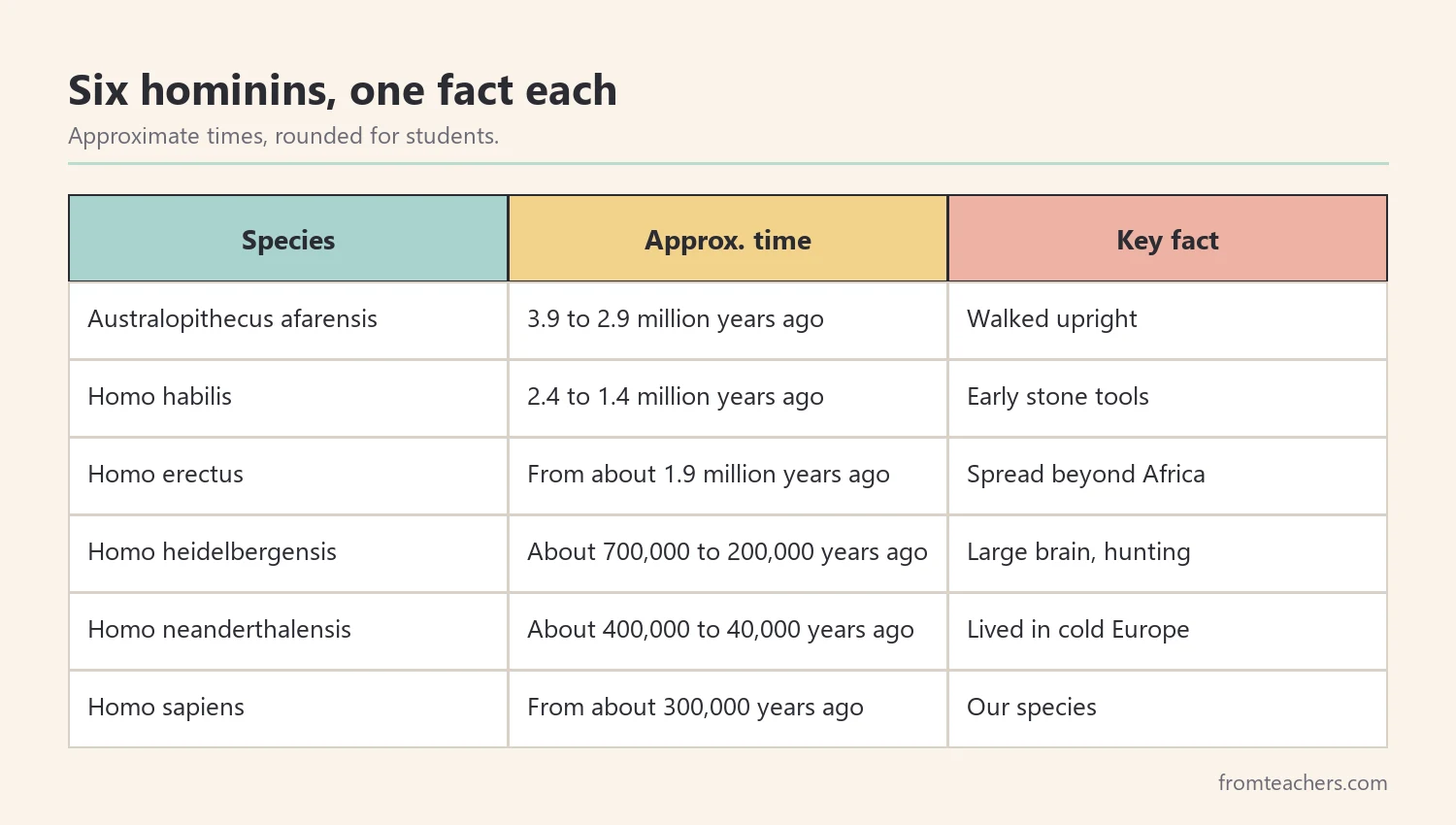
Yes. Scientists have named many hominin species. A useful set of six for this age covers the main story: Australopithecus afarensis, Homo habilis, Homo erectus, Homo heidelbergensis, Homo neanderthalensis and Homo sapiens.
What to say: “For most of history, more than one kind of human lived on Earth at the same time. Today we are the only one left.”
Try at home: make six cards with one species each and put them in order. A ready-made option is the Human Evolution Complete Scientific Guide for ages 11 to 13, which gives a clear section on each of these six species, so your child can read about one per evening.
Example: Noor was most interested in Homo erectus because it was among the first to spread out of Africa. She chose it for her class poster.
5. “How long ago did all this happen?”
Big numbers are hard for everyone. “Millions of years” can sound the same as “a long time ago.”
What to say: give a few anchors. Lucy lived about 3.2 million years ago. Homo sapiens appears in the fossil record roughly 300,000 years ago. Dinosaurs, except birds, died out about 66 million years ago, long before any humans.
Try at home: make a toilet paper or string timeline. Let one sheet or one step equal a fixed amount of time, and mark key events.
Example: On Noor’s hallway string, all of written history fit into the last tiny bit next to the door. She kept saying, “That’s it?” That reaction is the goal.
6. “Did people live with dinosaurs?”
Cartoons and movies often show people and dinosaurs together, so this question comes up often at younger ages and sometimes still at twelve.
What to say: “No. Non-bird dinosaurs disappeared tens of millions of years before the first humans. Birds, though, are living dinosaurs.”
Why it works: the bird detail turns a correction into a fun fact, which keeps your child curious rather than embarrassed.
Example: Noor’s younger brother asked this one. Noor answered it herself using the hallway timeline, which was a good sign she understood the scale.
7. “What happened to the Neanderthals?”
Neanderthals lived in Europe and western Asia and disappeared roughly 40,000 years ago. Scientists still discuss the reasons, and several factors are likely involved.
What to say: “They were skilled, used tools and fire, and cared for each other. They also met Homo sapiens. Genetic studies show many people today carry a small amount of Neanderthal DNA.”
Why it matters: this answer models honest science. It shows that some questions are still open, and that new evidence, such as ancient DNA, changes what we know.
Example: Noor was amazed that Neanderthals are, in a small way, part of many living people’s family stories. She asked how DNA could be read from old bones, which leads to question 9.
8. “Where did the first humans live?”
Fossil and genetic evidence points to Africa as the place where Homo sapiens first appeared. Groups later spread across the world, a story often called “Out of Africa.”
What to say: “Our species began in Africa. Over many thousands of years, groups moved into Asia, Europe, Australia and finally the Americas.”
Try at home: trace the routes on a world map with a pencil, and talk about what people would have needed to cross deserts, mountains or the sea.
Example: Noor marked Australia and asked how people crossed water so early. Her dad said, “Scientists think they used boats or rafts,” and they looked it up together.
9. “How do scientists know how old a fossil is?”
This is one of the more advanced questions on the list, and it is a great one, because it is about evidence.
What to say: “Scientists use several dating methods. Radiocarbon dating works for things up to about 50,000 years old. For older fossils, scientists often date volcanic rock layers above and below the fossil using other radioactive elements.”
Try at home: stack books to show layers. The bottom book went down first, so things found lower are usually older.
Example: Noor stacked five notebooks and slipped a coin between two of them. “So the coin is older than the top layer and younger than the bottom,” she said. That is the core idea of dating by layers.
10. “What makes us human?”
Finally, the deepest question. There is no single answer, but scientists point to a cluster of features: walking upright, large brains, complex language, symbolic art, trade and cooperation across groups.
What to say: “Many animals use tools or communicate. Humans combine many skills, like language, art and planning, in ways no other living species does.”
Try at home: look at pictures of ancient cave paintings and ask what the artists might have wanted to say.
Example: Noor decided that “telling stories” was the most human thing of all. Her answer is not a scientific fact, but it is a thoughtful conclusion built on evidence, and that is what you want.
A quick reference for parents
Keep the table below on the fridge during an evolution unit. It pairs each question with the one fact that does the most work.
| Question | Anchor fact |
|---|---|
| Came from monkeys? | Shared ancestor, not descent from modern apes |
| What is evolution? | Change over many generations |
| Who was Lucy? | Walked upright about 3.2 million years ago |
| How long ago? | Homo sapiens about 300,000 years ago |
| Neanderthals? | Many people carry a little Neanderthal DNA |
| Fossil age? | Rock layers and radioactive dating |
How to talk about evolution calmly at home
The way you answer matters as much as the facts. Figure 4 shows a simple four-part conversation pattern that works for most human evolution questions kids ask.
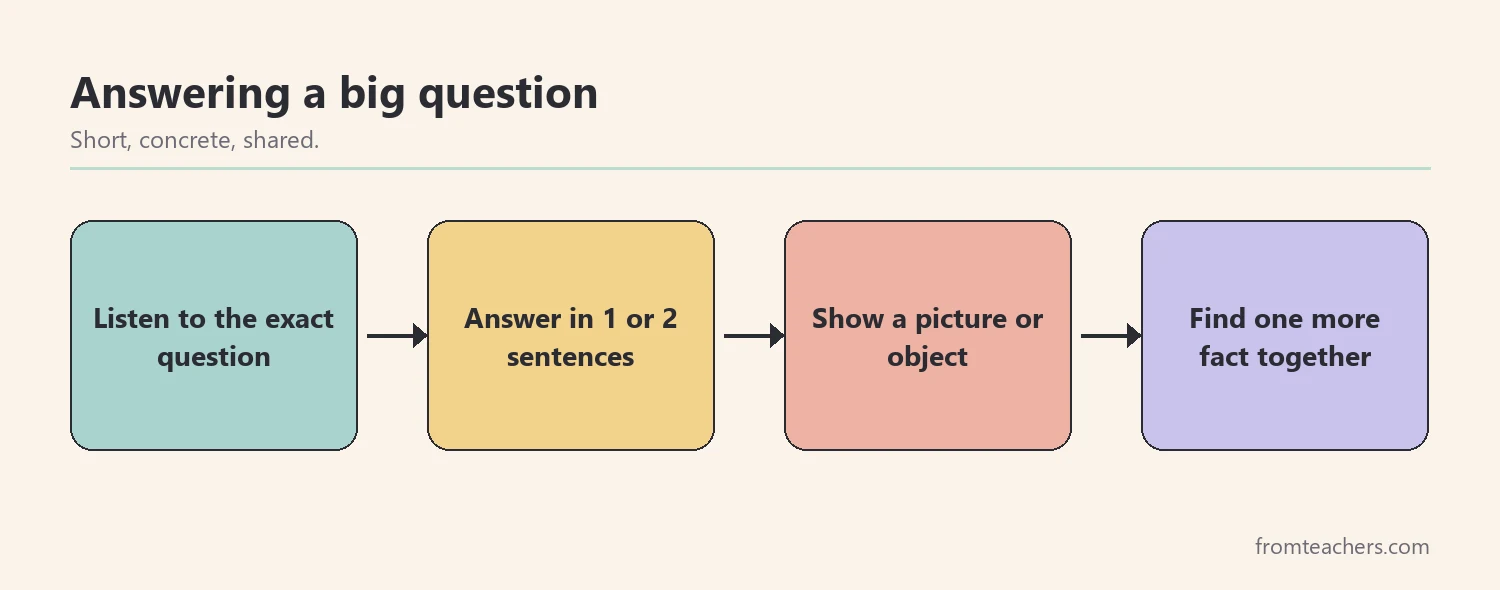
First, listen to the exact question. Second, give a short answer in one or two sentences. Third, add one picture, object or comparison. Fourth, invite your child to find one more fact. As a result, the conversation stays short, and your child does part of the thinking.
Some families also hold religious or personal beliefs about origins. You can explain what scientists have found and what the evidence shows, and then talk about your family’s beliefs in your own way. Many teachers appreciate parents who help children understand the science taught in class, whatever the family’s views.
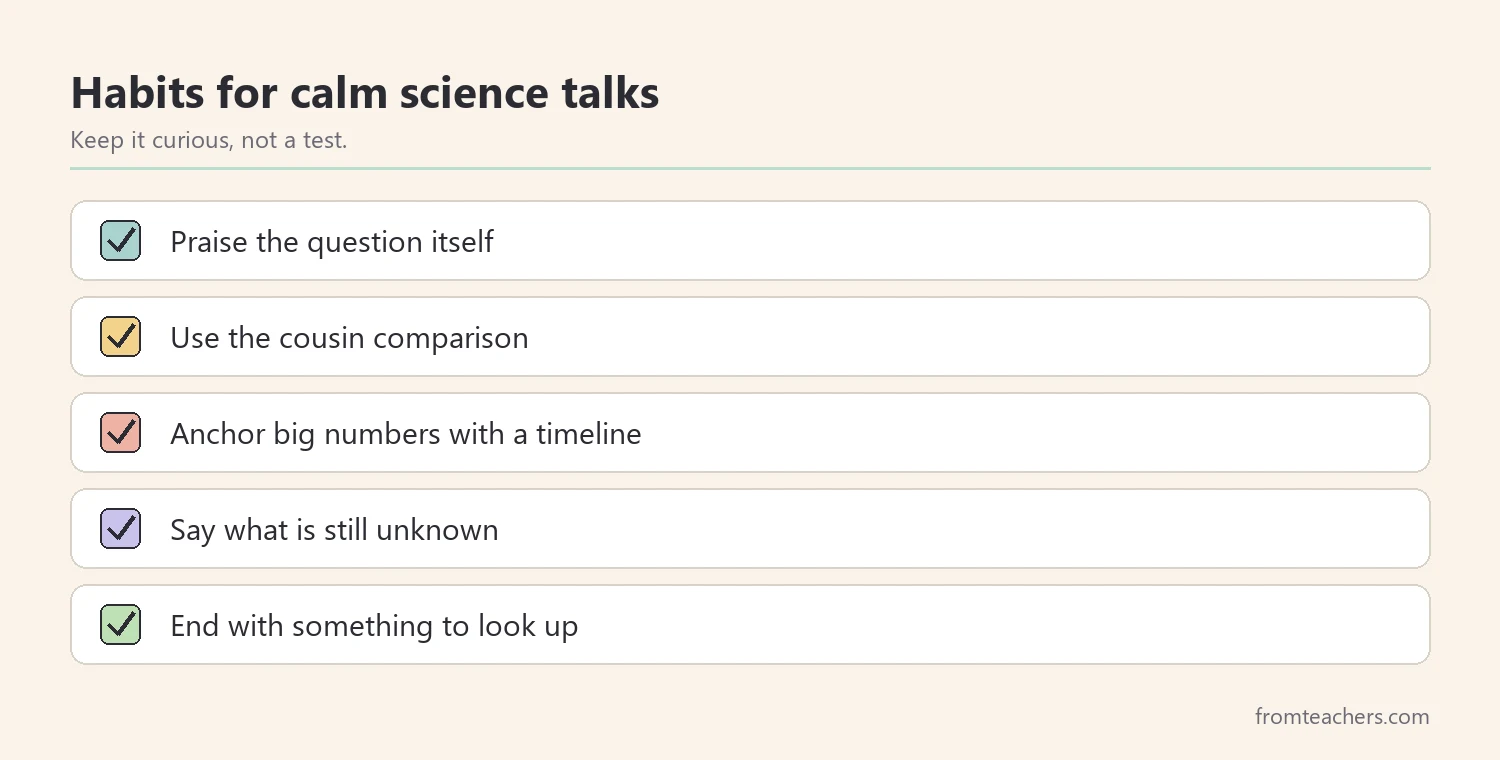
Figure 5 lists the habits that keep these talks positive.
Common mistakes parents make with evolution questions
- Answering with a lecture. Fix: one or two sentences, then pause.
- Repeating the monkey myth. Fix: use the cousin comparison.
- Using huge numbers without anchors. Fix: build a string timeline.
- Pretending to know. Fix: say “Let’s look it up,” and do it together.
- Presenting open questions as settled. Fix: say “scientists are still studying this” when it is true.
Questions parents ask about human evolution questions kids ask
At what age do these questions usually start?
Children ask about dinosaurs and “the first people” from preschool on. Many middle school science classes cover evolution formally, often around ages 11 to 13, which is when deeper questions appear.
What if my child’s question is beyond what I know?
That is normal. Say so, then use a trusted source such as a natural history museum website or a student guide, and read it together.
How do I handle a question during a busy moment?
Give a one-sentence answer and promise to come back to it at dinner. Then actually come back to it, which shows the question mattered.
Should I correct my child’s teacher if I disagree?
If something seems unclear, ask the teacher politely what the class covered. Usually a quick note clears up a misunderstanding.
Are museum visits worth it for this topic?
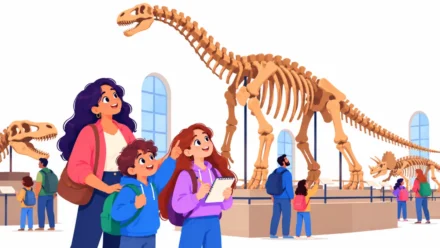
Yes. Seeing casts of skulls and skeletons makes the timeline real, and many museums also have free online collections.
Related reading: Learning Styles and Student Success, Homeschooling vs. Public Schooling, and How Parents and Teachers Can Team Up.
You may also need: Dinosaurs: The Complete Student Field Guide.
A companion resource for answering human evolution questions kids ask:
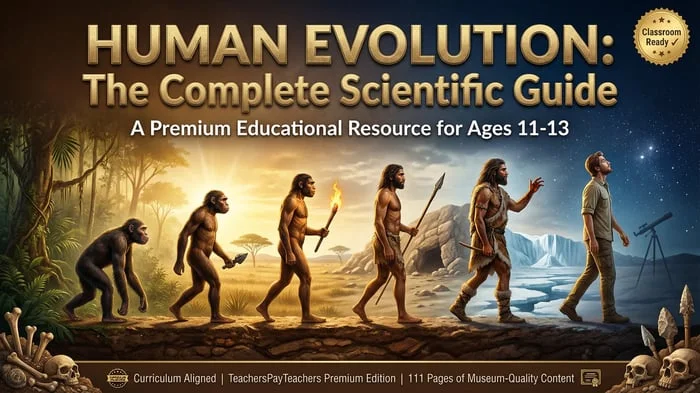
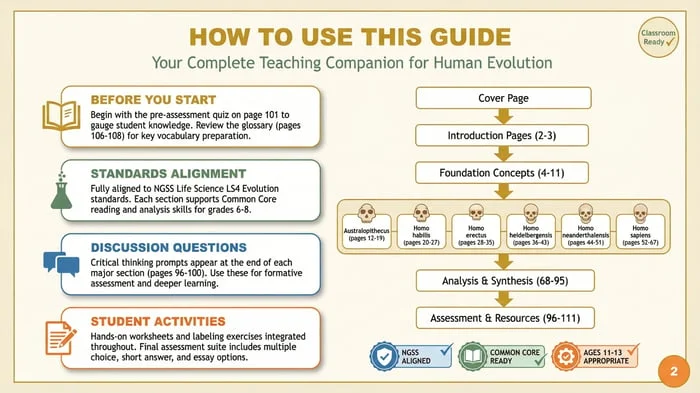
Human Evolution: The Complete Scientific Guide: 111 pages for ages 11 to 13 covering natural selection, the human family tree, six hominin species from Australopithecus afarensis to Homo sapiens, the Out of Africa migration, fossil dating methods, ancient DNA, what makes us human, discussion questions, a student quiz and a glossary.
Sources and scope
- Smithsonian National Museum of Natural History, Human Origins Program: overviews of human evolution evidence, hominin species, fossils and genetics.
- Understanding Evolution (University of California Museum of Paleontology): plain-language explanations of natural selection, common ancestry and common misconceptions.
- Next Generation Science Standards: the life science standards many middle school science units follow.
- Understood.org: practical guidance for parents supporting kids who learn differently.
This guide helps parents answer common questions at home in an accurate, age-appropriate way. It does not replace a science curriculum, and families can discuss personal or religious beliefs in the way that fits their home.
Key takeaways
- Human evolution questions kids ask can be answered briefly and accurately.
- Correct the monkey myth with the cousin comparison.
- Use timelines, maps and objects to make deep time concrete.
- Model honest science: some questions are still being studied.
- Let your child look up one more fact after each talk.
Leave a Comment