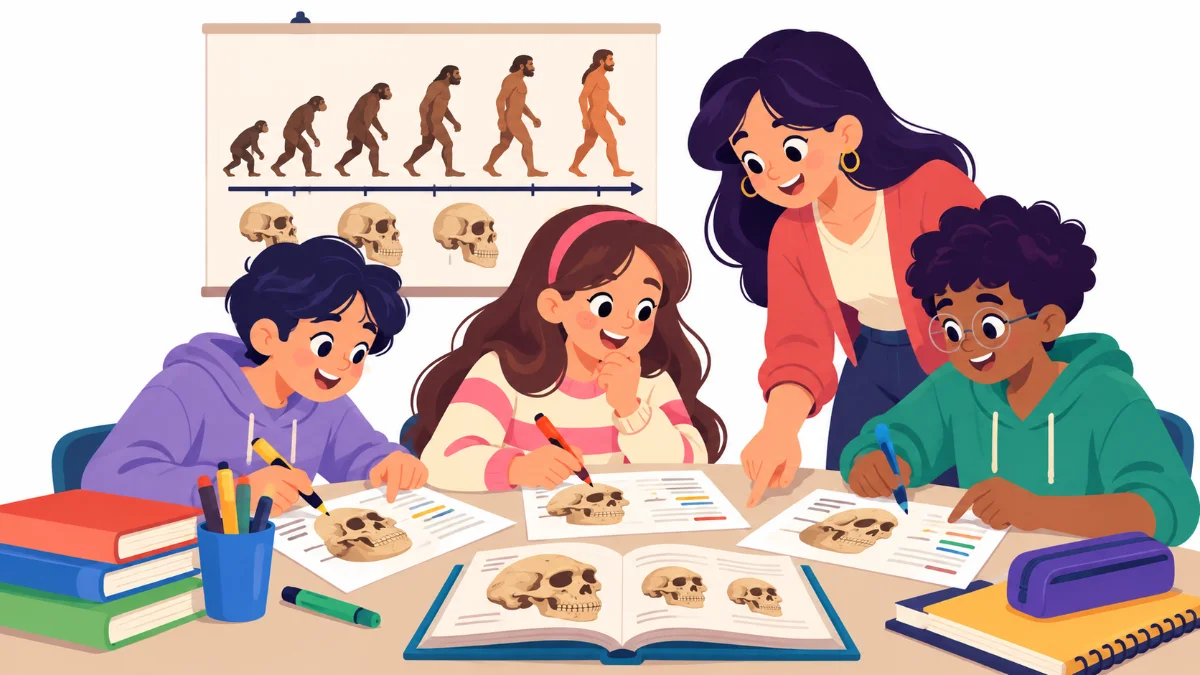

Science reading strategies for middle school help students handle texts full of new vocabulary, long time scales and evidence-based claims. A human evolution unit is a perfect example. Picture Layla, a seventh grader who loves the idea of early humans but gets lost in sentences like “Australopithecus afarensis walked upright but retained climbing adaptations.” Her science teacher, Mr. Banks, sees the same glazed look across half the class.
This list is for science and ELA teachers in grades 6 to 8. It ranks eight reading strategies from quick routines to deeper discussion, using a human evolution unit as the example throughout. Each strategy explains what it is, why it helps with science text, how to run it and how Layla used it. By the end, you will have a set of routines that work for any dense science reading.
Examples are fictional. Adapt to the student’s goals and agreed supports. This is guidance, not a diagnosis.
At a glance
- Science texts are dense with vocabulary, numbers and evidence.
- Preview structure before reading for detail.
- Teach key words with roots, images and examples.
- Turn timelines and maps into reading tools.
- End with discussion based on evidence from the text.
How we ranked these strategies
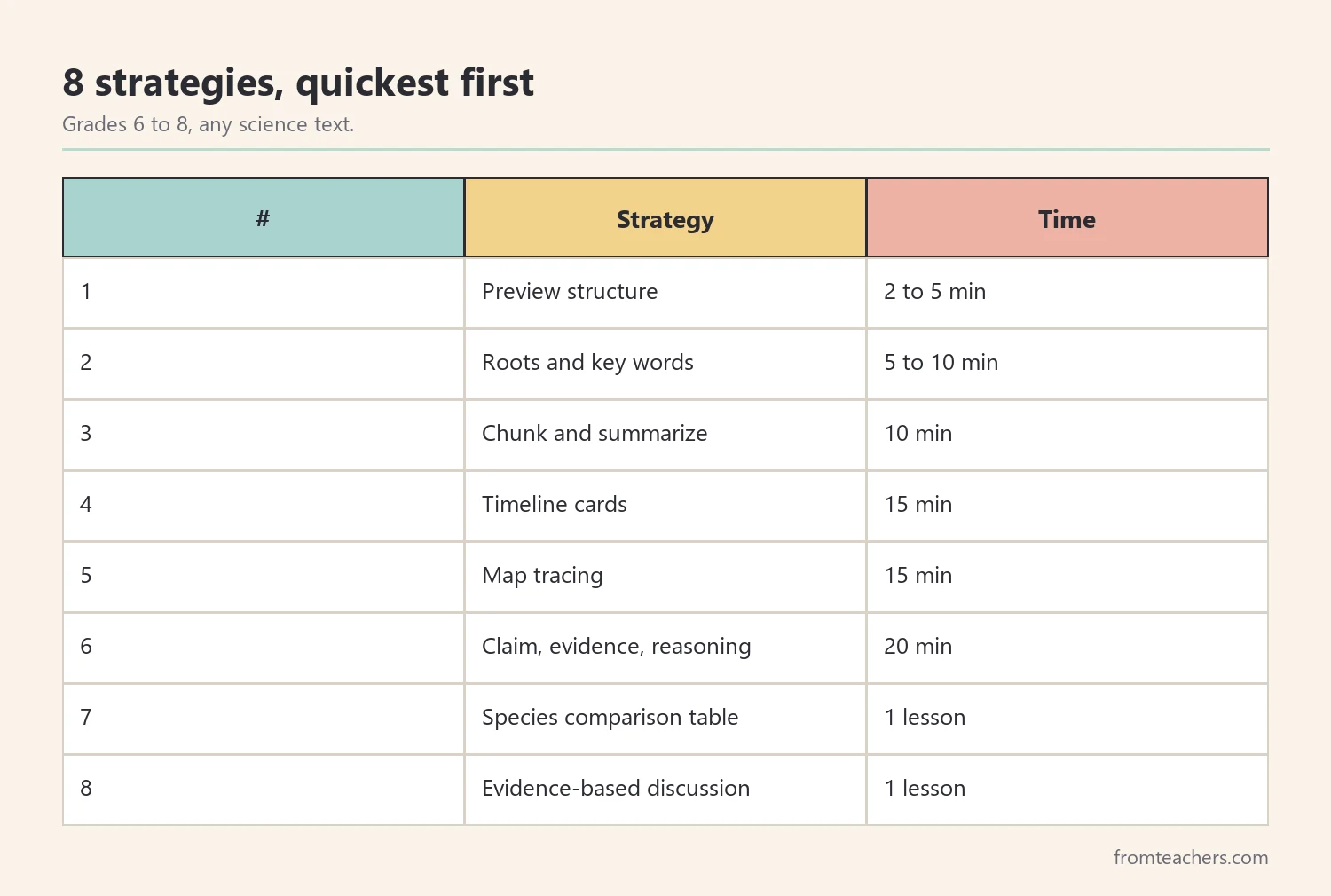
We ranked the eight strategies by class time. Strategies 1 to 3 take five to ten minutes and can be used daily. Strategies 4 to 6 take part of a lesson. Then, strategies 7 and 8 need a full lesson and work best after students have read several sections. Figure 1 shows the full ranking.
None of these strategies is specific to evolution. However, a human evolution unit offers rich practice, because it combines vocabulary, long timelines, maps and claims based on fossil evidence.
1. Preview the text structure
What it is: before reading, students look at headings, images, captions and bold words for two minutes.
Why it helps: knowing the structure helps students predict what each part will explain.
How to run it: ask, “What do you think this section is about? What do the images show?”
Example: Layla noticed that each species page had the same structure: name, time period, location and key features. That pattern made the rest easier.
2. Break down key words with roots
What it is: teach Greek and Latin roots that appear in many science words.
Why it helps: roots unlock many words at once. For instance, “homo” means human, and “erectus” means upright.
How to run it: keep a class root wall and add two roots per lesson.
Example: Once Layla knew “erectus” meant upright, Homo erectus suddenly made sense.
3. Chunk and summarize
What it is: students read one short section, then write a one sentence summary in the margin.
Why it helps: chunking prevents overload and checks understanding before moving on.
How to run it: model one summary first, then let students try in pairs.
Example: Layla summarized a paragraph as “Lucy’s species walked on two legs but could still climb.” That was exactly the main idea.
4. Turn timelines into reading tools
What it is: students place each species or event on a class timeline as they read.
Why it helps: long time scales are hard to imagine. A visual timeline makes “millions of years” concrete.
How to run it: use a long paper strip with a clear scale. Students add cards as they read.
Example: Layla was surprised to see how long ago the earliest species on the list lived compared with Homo sapiens.
5. Read maps alongside the text
What it is: students trace migration routes or fossil sites on a map while reading.
Why it helps: maps connect place and time, and many science texts rely on them.
How to run it: pause at each location in the text and mark it on a printed map.
Example: Tracing the Out of Africa migration helped Layla understand why fossils are found on several continents.
6. Claim, evidence and reasoning notes
What it is: students record a claim from the text, the evidence that supports it and the reasoning that links them.
Why it helps: science is built on evidence. This strategy teaches students to read like scientists.
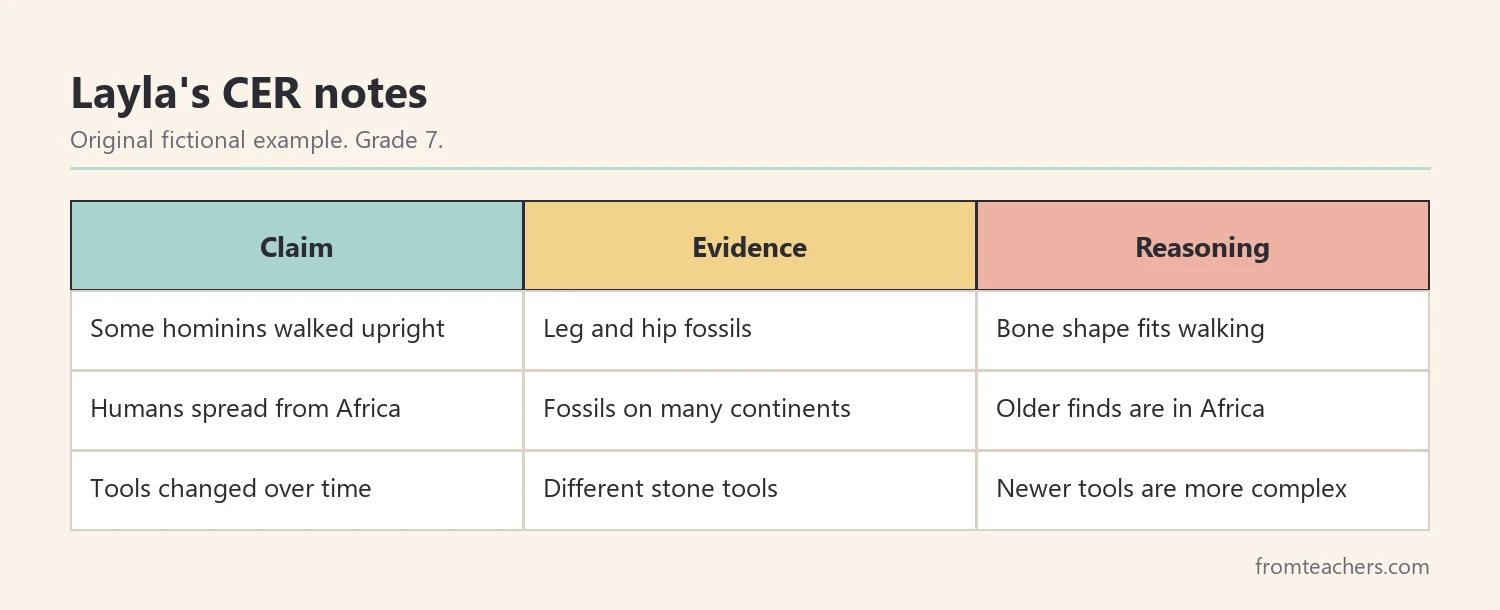
How to run it: use a three column chart. Figure 2 shows Layla’s example.
Example: Layla wrote the claim “some early hominins walked upright,” with fossil leg and hip bones as evidence.
7. Compare species in a table
What it is: students build a comparison table with columns for time, location, brain size and tools.
Why it helps: comparing makes differences and patterns visible.
How to run it: provide the column headings and let students fill rows as they read each section.
Example: Layla’s table showed a clear pattern in tool use across the species she studied.
8. Evidence-based discussion
What it is: a structured discussion where every point must be backed by the text.
Why it helps: discussion deepens understanding, and requiring evidence keeps it accurate.
How to run it: use questions that require text evidence. The Human Evolution complete scientific guide for grades 6 to 8 includes discussion questions, a quiz and a glossary alongside sections on hominin species, migration and fossil dating, which gives students a consistent text to cite.
Example: When a classmate said “humans came from chimpanzees,” Layla pointed to the text explaining that humans and chimpanzees share a common ancestor.
Reading for gist versus reading for evidence
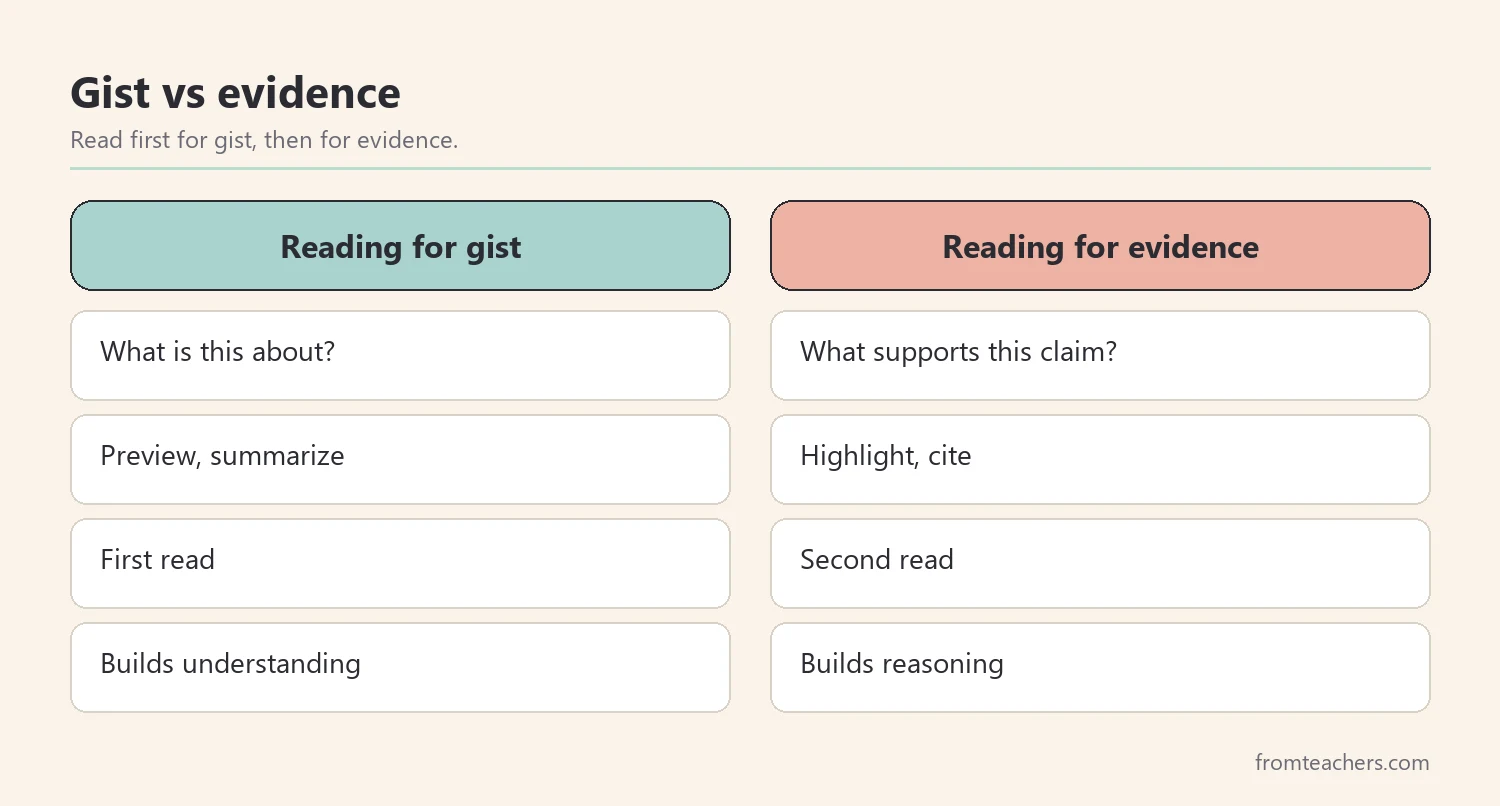
Students need two kinds of reading. First, they read for the general idea. Then they reread for specific evidence. Figure 3 compares the two.
| Reading type | Goal | Strategies |
|---|---|---|
| Gist | Understand the main idea | Preview, chunk and summarize |
| Evidence | Find support for claims | Claim, evidence and reasoning; tables |
| Connection | Link ideas across sections | Timelines, maps, discussion |
A sample lesson using several strategies
These strategies work best together. Figure 4 shows a 50 minute lesson Mr. Banks used for one species section.
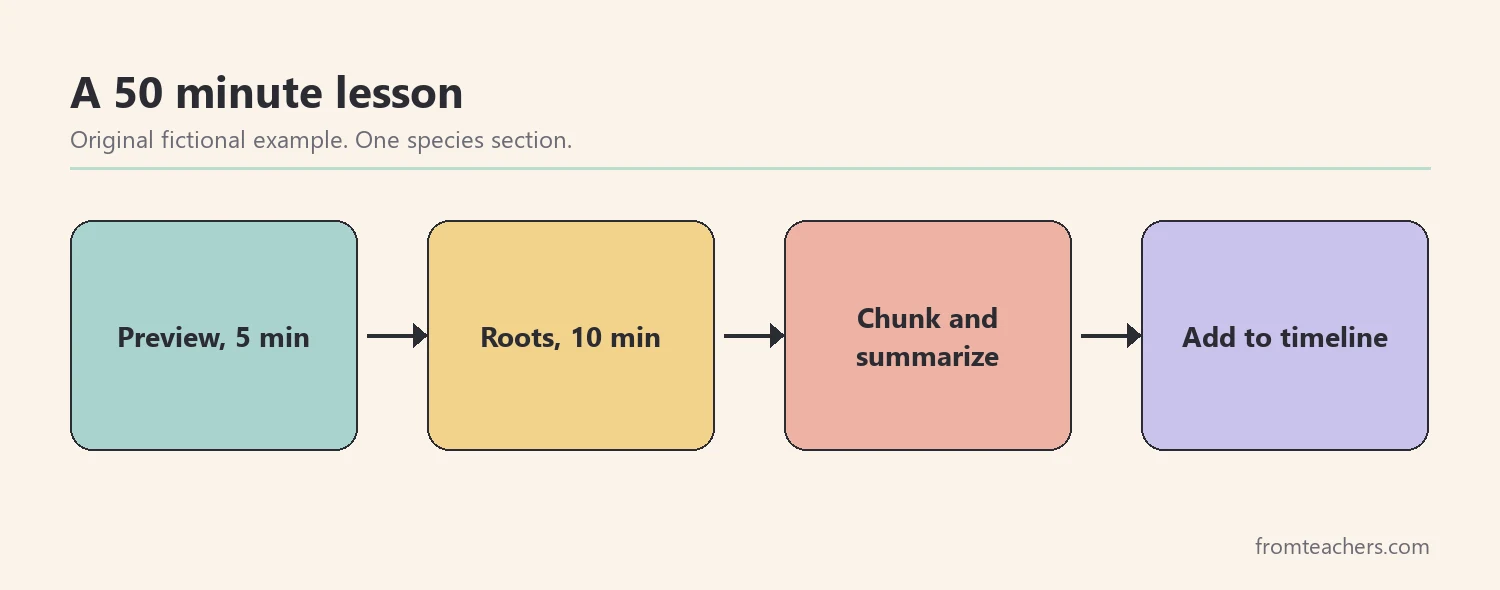
He started with a preview, taught two roots, had students read in chunks with summaries and finished by adding the species to the class timeline. Over the unit, students needed less support with each new section.
Supporting struggling readers
Some students need extra support with dense science text. Offer audio versions, pre-teach vocabulary and allow partner reading. In addition, provide sentence frames for summaries, such as “This section explains that…”
For students with reading disabilities, follow their accommodations and talk with the special education teacher. Many of the strategies here, especially chunking and visuals, help a wide range of learners.
Layla’s classmate Omar used audio and a vocabulary card set. He still completed the comparison table and contributed strong evidence in the discussion.
Checking understanding
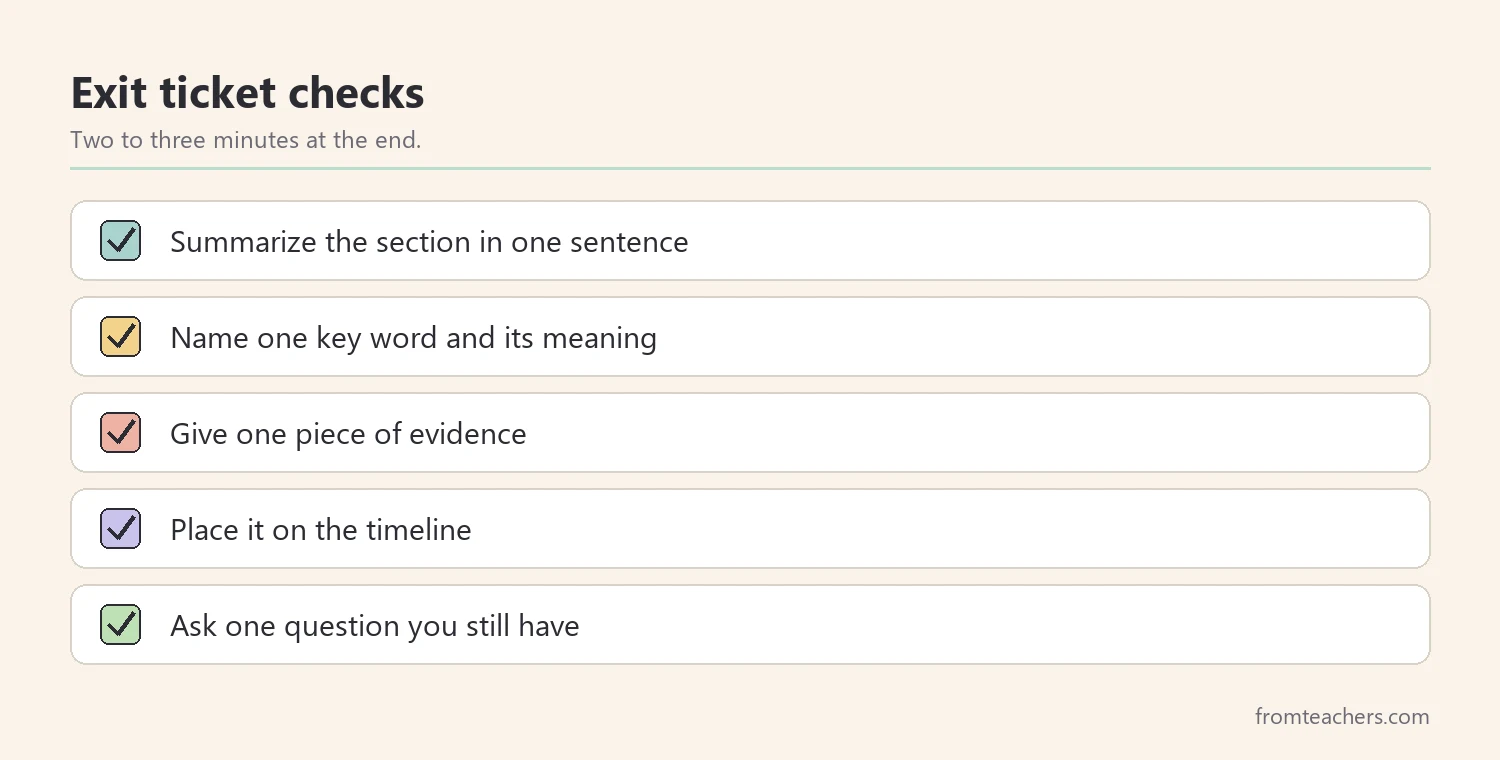
Use quick checks rather than waiting for the unit test. Exit tickets with one summary sentence and one piece of evidence show who is following. Figure 5 lists five check questions Mr. Banks used.
Handling sensitive topics respectfully
Human evolution can raise questions connected to family beliefs. Keep the focus on what the scientific evidence shows and how scientists know it. Many teachers explain that science classes teach the scientific explanation based on evidence, while respecting that students and families hold a range of views.
Clear, calm language helps. When students ask personal questions, acknowledge them and redirect to the evidence in the text. Furthermore, follow your school’s curriculum guidance on this topic.
Building a science vocabulary routine
Vocabulary is often the biggest barrier in science reading. A short, predictable routine helps. Before each section, choose three to five key words. For each word, show an image, give a student-friendly definition and use it in a sentence about the topic.
Next, let students add the words to a personal glossary with a quick drawing. Drawings help many students remember abstract terms, such as “fossil” or “migration.” In addition, review the words briefly at the start of the next lesson, so they move into long-term memory.
Finally, encourage students to use the new words in discussion and writing. A word used three or four times in different ways is far more likely to stick than one only read once. Mr. Banks gave a small shout-out each time a student used a word from the wall correctly, and the habit spread quickly.
Layla’s glossary grew to more than thirty words by the end of the unit. She later said that knowing the words made the reading “feel like a story instead of a puzzle.”
Common mistakes and how to avoid them
- Assigning long readings without support. Fix: chunk the text and summarize each part.
- Skipping vocabulary. Fix: teach roots and key words before reading.
- Ignoring visuals. Fix: use timelines and maps as reading tools.
- Discussion without evidence. Fix: require text support for every claim.
- Waiting for the test. Fix: use quick exit tickets.
Questions teachers ask about science reading strategies for middle school
Should science teachers teach reading strategies?
Yes. Science texts have their own structure and vocabulary, and students benefit from strategies taught in context.
How much reading should students do in a science unit?
It varies. Short, focused readings with clear purposes often work better than long assignments.
Do these strategies work for other science topics?
Yes. They apply to any dense science text, from ecosystems to the solar system.
How do I handle very different reading levels?
Use partner reading, audio and sentence frames, and allow different ways to show understanding.
How long does it take for students to use strategies on their own?
Usually several weeks of modeling and practice. Gradually reduce prompts as students become independent.
Related reading: Learning Styles Student Success Guide, Dyslexia Solutions in the Classroom, and 5 Practical Teaching Tips to Boost Classroom Focus.
You may also need: Dinosaurs: The Complete Student Field Guide.
A companion resource for teachers using science reading strategies for middle school:
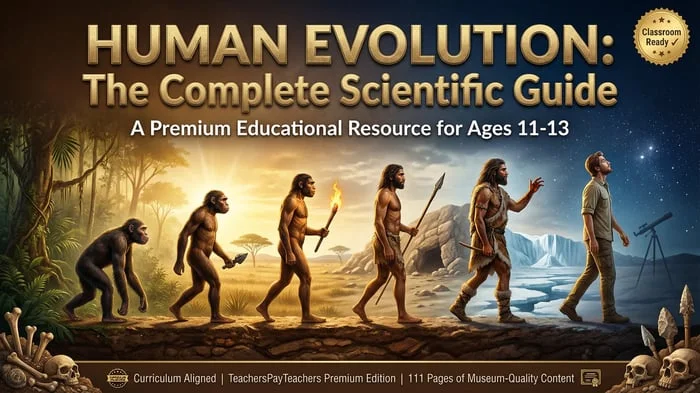
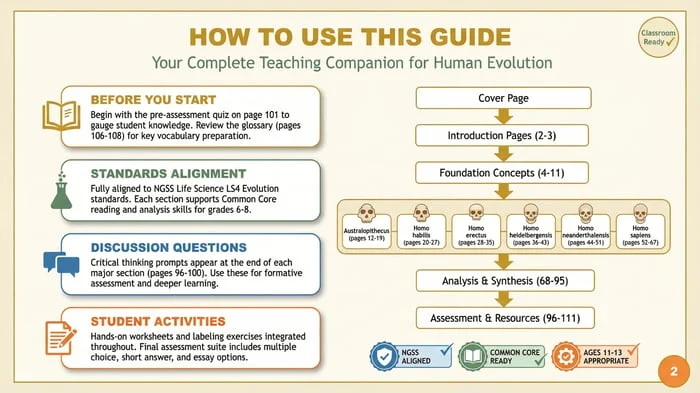
Human Evolution: The Complete Scientific Guide: 111 pages for ages 11 to 13 covering natural selection, the human family tree, six hominin species from Australopithecus afarensis to Homo sapiens, the Out of Africa migration, fossil dating methods, ancient DNA and what makes us human, with discussion questions, a student assessment quiz and a glossary aligned to NGSS Life Science standards and Common Core reading skills for grades 6 to 8.
Sources and scope
- Smithsonian Human Origins Program: reference pages on human evolution, hominin species and fossils.
- What Works Clearinghouse: practice guides on improving adolescent literacy and reading comprehension.
- National Science Teaching Association: resources for science teachers, including literacy in science.
- National Center for Learning Disabilities: resources on supporting students with reading difficulties.
This list covers general reading comprehension strategies for science texts in grades 6 to 8, demonstrated with a human evolution unit. It does not replace reading intervention for students with significant reading difficulties.
Key takeaways
- Science reading strategies for middle school make dense texts manageable.
- Preview, teach roots and chunk the text.
- Use timelines, maps and tables as reading tools.
- Teach students to read for evidence.
- Check understanding often with quick exit tickets.

Leave a Comment