

Reflection journals for school counselors solve a familiar problem: you have hundreds of students, limited minutes and a strong wish to know how kids are really doing between sessions. Picture Ms. Rivera, an elementary counselor, and Theo, age 10, who comes to her office once a week after a rough start to fourth grade. In a 20-minute session, Theo often says “fine” and shrugs. His daily sheets tell a much fuller story.
This list is for school counselors, counseling interns and student support staff. It ranks seven ways to use a one-page daily reflection journal, from the option that needs the least setup to the one that takes the most coordination. Each item covers what it is, why it helps, how to start and a short example with Theo.
Examples are fictional. Adapt to the student’s goals and agreed supports. This is guidance, not a diagnosis.
At a glance
- A one-page daily journal gives counselors information between sessions.
- Start small: one student or one small group before a whole class.
- Use the same questions every day so patterns become visible.
- Look for trends over weeks, not single bad days.
- A journal supports conversation; it is not a screening or diagnostic tool.
How we ranked these seven uses
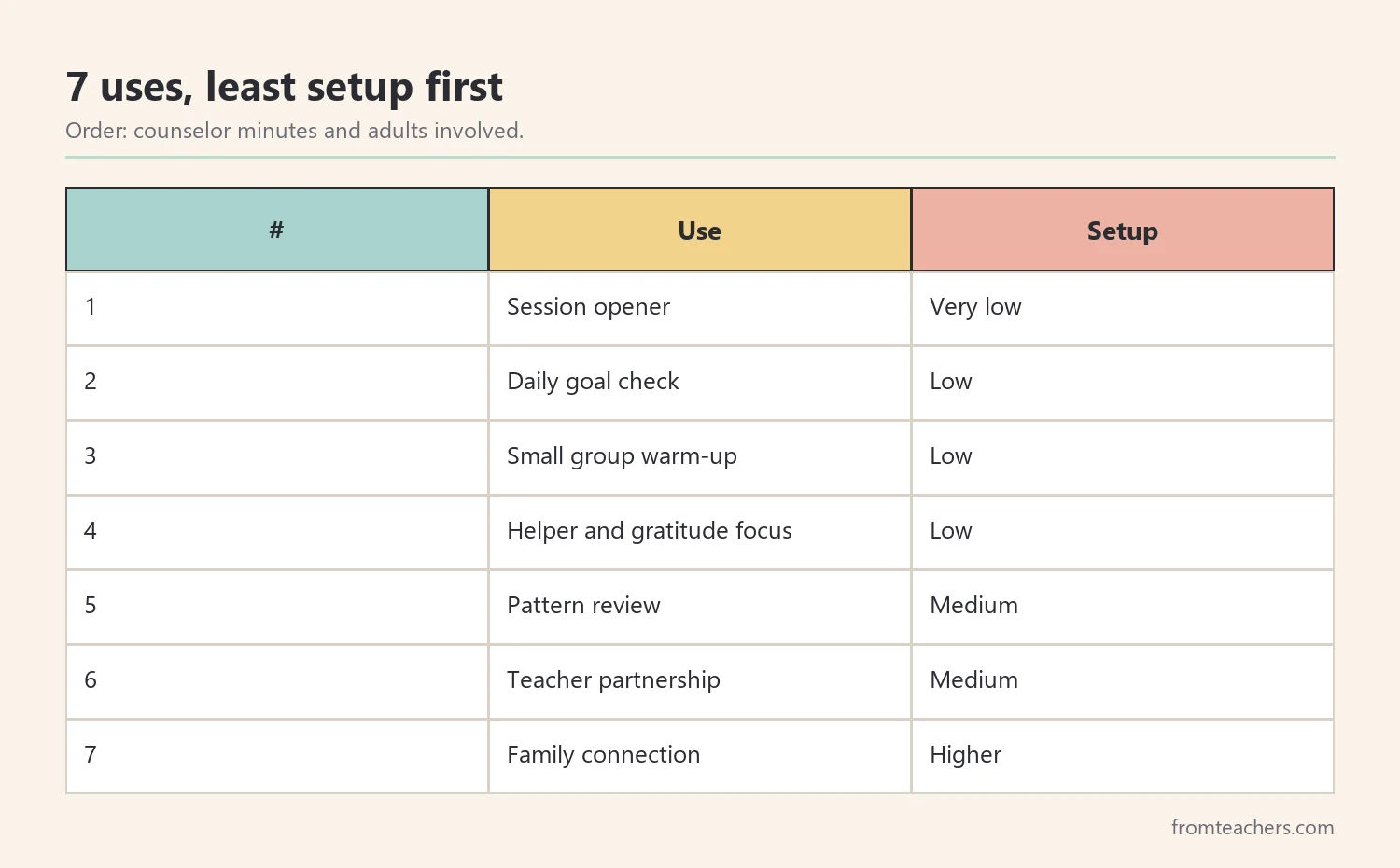
We ranked the seven ways by setup time, from the quickest to start tomorrow to the ones that need planning with teachers or families. All seven use the same sheet, so you can begin with the first and add more uses as the routine grows.
The criteria are practical, not scientific: minutes of counselor time, number of adults involved and how much training students need. Figure 1 summarizes the ranking.
1. Session opener for individual students
What it is: the student brings the last few daily sheets to each counseling session, and you start by reading them together.
Why it works: many children struggle to recall feelings from days ago. The sheet gives them words and examples, so the session starts with real events instead of “I don’t know.”
How to start: ask the student to complete the sheet at the end of each day for one week. In session, ask, “Which day would you like to talk about first?”
Example: Theo marked the sad face on Tuesday and wrote “recess” under something I can improve. That one word opened a conversation about a game where he felt left out. Without the sheet, he would likely have said “fine.”
2. Daily goal check for one student
What it is: you and the student set one small goal together, and the journal’s “My goal for tomorrow” and “Did I meet my goal from yesterday?” sections track it each day.
Why it works: goals feel real when the student sees them every day. The yes or no check is simple enough for younger students.
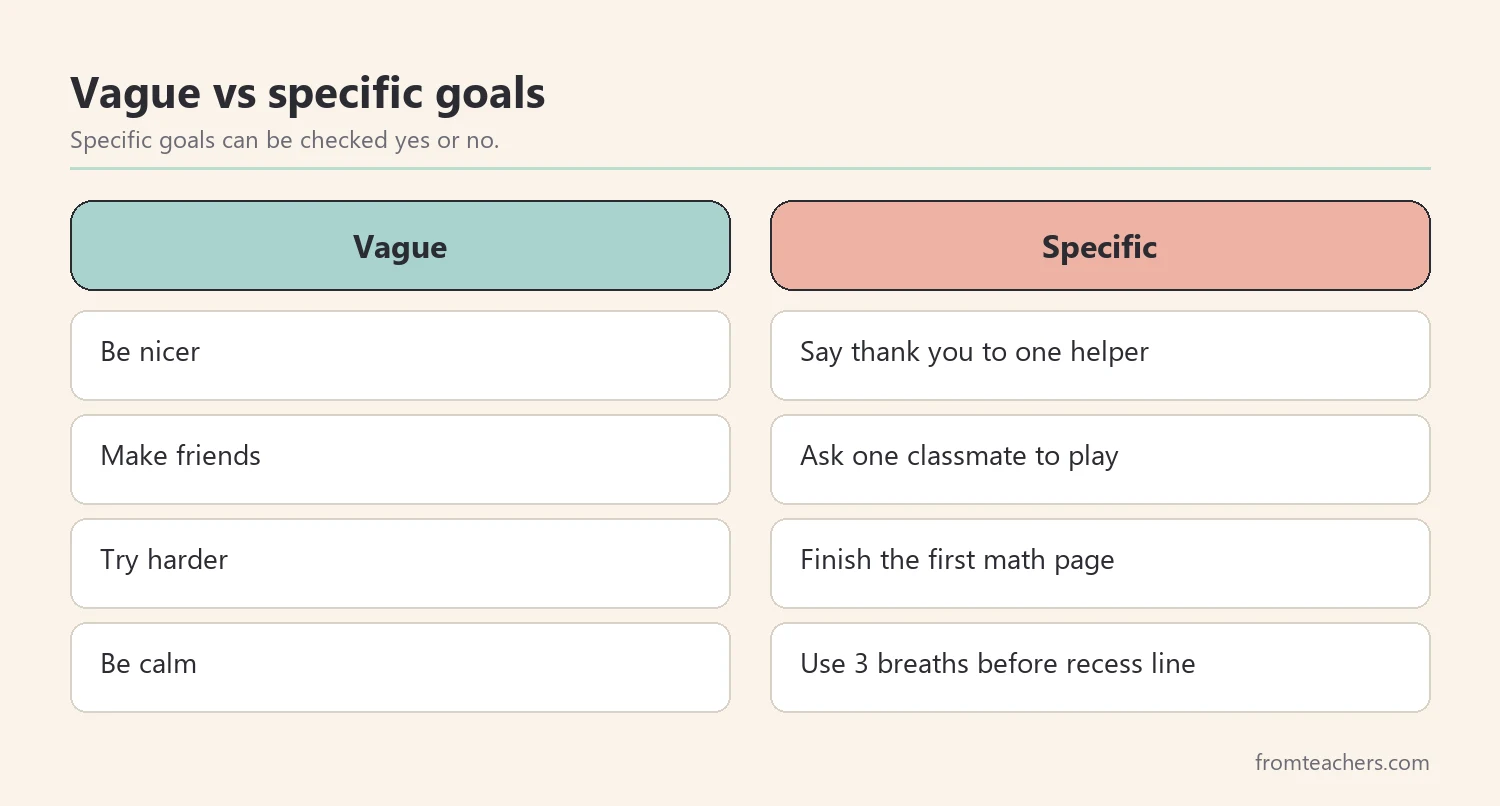
How to start: choose a goal that is specific and observable, such as “Ask one classmate to play at recess.” Avoid vague goals like “be nicer.”
Example: Theo’s goal was to ask one classmate to join him at recess. He met it two days out of five in week one and four out of five in week three. Both numbers were worth celebrating.
3. Small group warm-up
What it is: in a social skills or friendship group, each member completes the sheet at the start, then shares one section, such as “What went well.”
Why it works: sharing a written answer feels safer than speaking off the cuff. It also teaches students to listen to each other’s good moments.
How to start: pick one section to share each week, and rotate. Keep sharing optional for sections that feel personal.
Example: In Ms. Rivera’s Thursday group, Theo shared that a classmate helped him find his lost hat. The group then talked about small kind acts, and two students added “helped someone” to their goals.
4. Gratitude and helper noticing
What it is: you focus on the “Who helped me today” and “What I’m grateful for” sections to build a habit of noticing support.
Why it works: students who feel isolated often do not notice the help around them. Writing a name each day makes support visible.
How to start: at the end of each week, ask the student to count how many different people they named. Then talk about how it felt to be helped.
Example: Theo named six different people in two weeks, including the lunch monitor and a fifth grader. He was surprised. “I thought nobody helped me,” he said, which became a useful turning point.
5. Pattern review across weeks
What it is: every two to four weeks, you and the student sort the sheets and look for patterns in feelings, goals and challenges.
Why it works: one hard day tells you little. However, a cluster of hard Mondays or a pattern after PE tells you a lot. This is where reflection journals for school counselors become real data.
How to start: count the faces by day of the week, or tally goals met. A simple table is enough. Let the student make the counts when possible.
Example: Theo’s sheets showed most sad faces on Mondays and Tuesdays. After talking, they found that weekends at his dad’s house ended late on Sundays, and Mondays started tired. The fix was simple: a quiet check-in each Monday morning.
A structured daily reflection journal with a feeling scale and goal check makes this review easy because every sheet has the same layout.
6. Teacher partnership for a target student
What it is: the classroom teacher gives the student a minute at the end of the day to complete the sheet and adds a short note in the “Comments from my teacher” box.
Why it works: the counselor gets a classroom view, and the student gets daily encouragement from the adult who sees the most of their day.
How to start: agree on a time, usually before dismissal, and a tone. Teacher comments should be brief and positive, such as “Great effort in group work today.”
Example: Theo’s teacher wrote one sentence most days. On Fridays, Ms. Rivera read the week’s comments with Theo. He said the comments were his favorite part.
7. Family connection
What it is: the sheets travel home weekly, or families receive a short summary, so caregivers can see goals and good moments.
Why it works: families often hear from school only when there is a problem. Sharing what went well builds trust and helps caregivers reinforce goals at home.
How to start: ask the student which sheets to share. Respect privacy: some reflections are best kept between student and counselor. Follow your district’s rules on communication and confidentiality.
Example: Theo chose to share his goal sheets and his gratitude lists. His mom later said that reading “Dad helped me with math” on a Sunday sheet made her week.
What the data from one student can look like
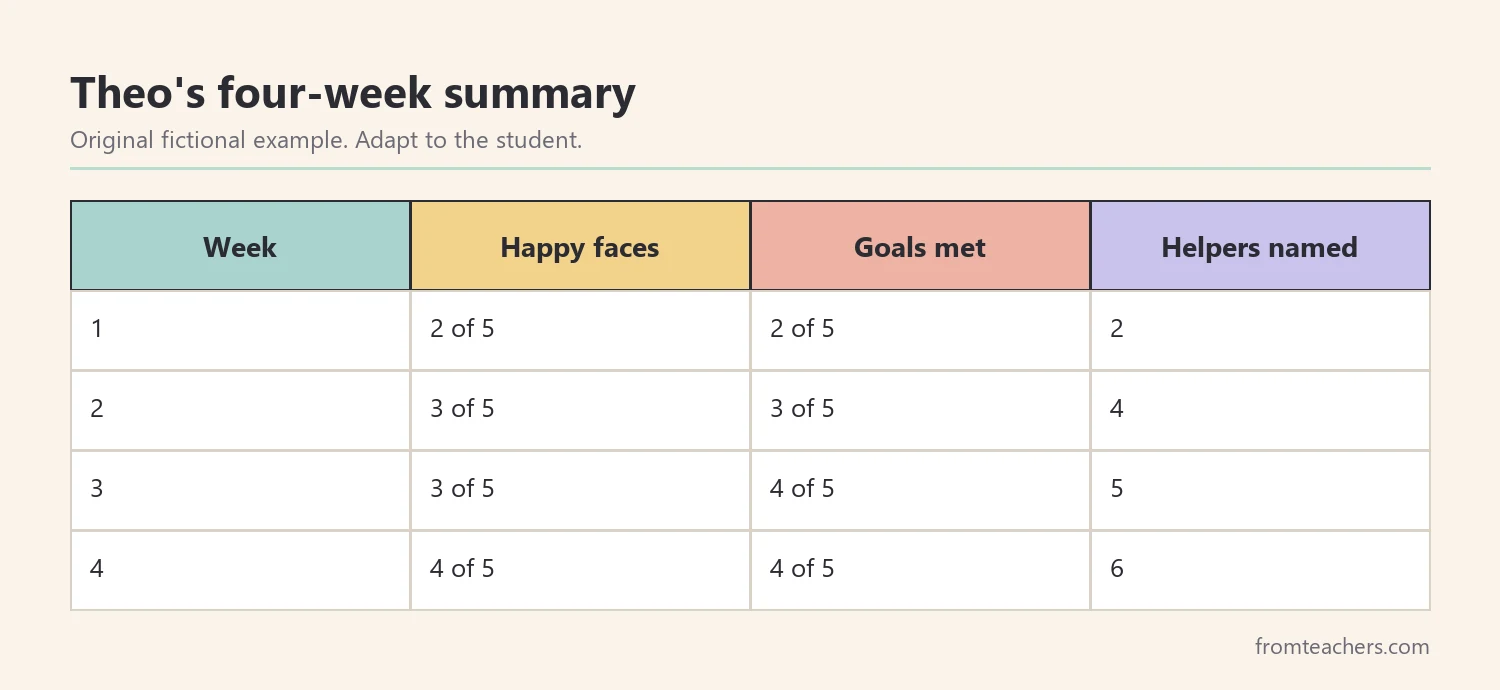
Reflection journals for school counselors are most useful when you turn sheets into a simple summary. The table below shows how Ms. Rivera summarized Theo’s first four weeks. The numbers are fictional and are meant only to show the format.
| Week | Happy faces | Goals met | Helpers named |
|---|---|---|---|
| 1 | 2 of 5 | 2 of 5 | 2 |
| 2 | 3 of 5 | 3 of 5 | 4 |
| 3 | 3 of 5 | 4 of 5 | 5 |
| 4 | 4 of 5 | 4 of 5 | 6 |
Notice that the summary shows progress without judging any single day. Also, it gives the student something concrete to be proud of.
A simple weekly routine
Figure 4 shows a routine that keeps the journal sustainable. Students write daily, the counselor reads weekly and the team reviews monthly.
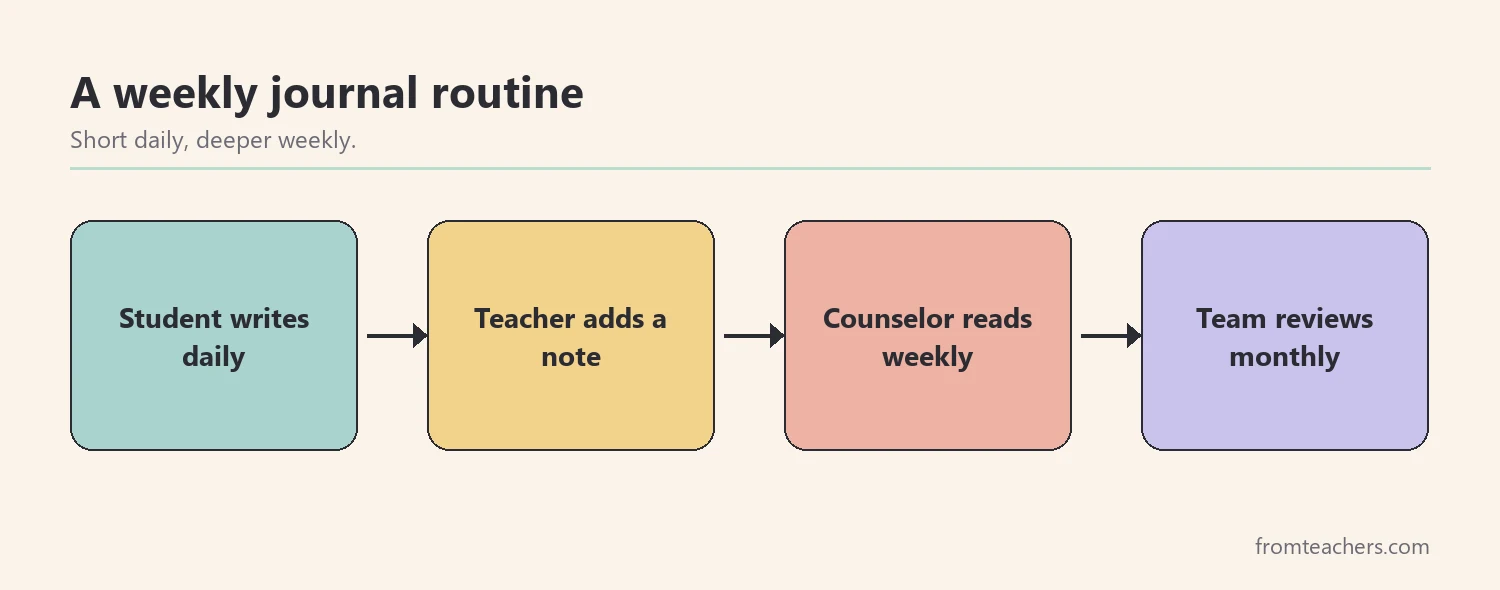
Keep the daily part short. Most students finish the sheet in three to five minutes once they know the sections. As a result, the routine survives busy weeks.
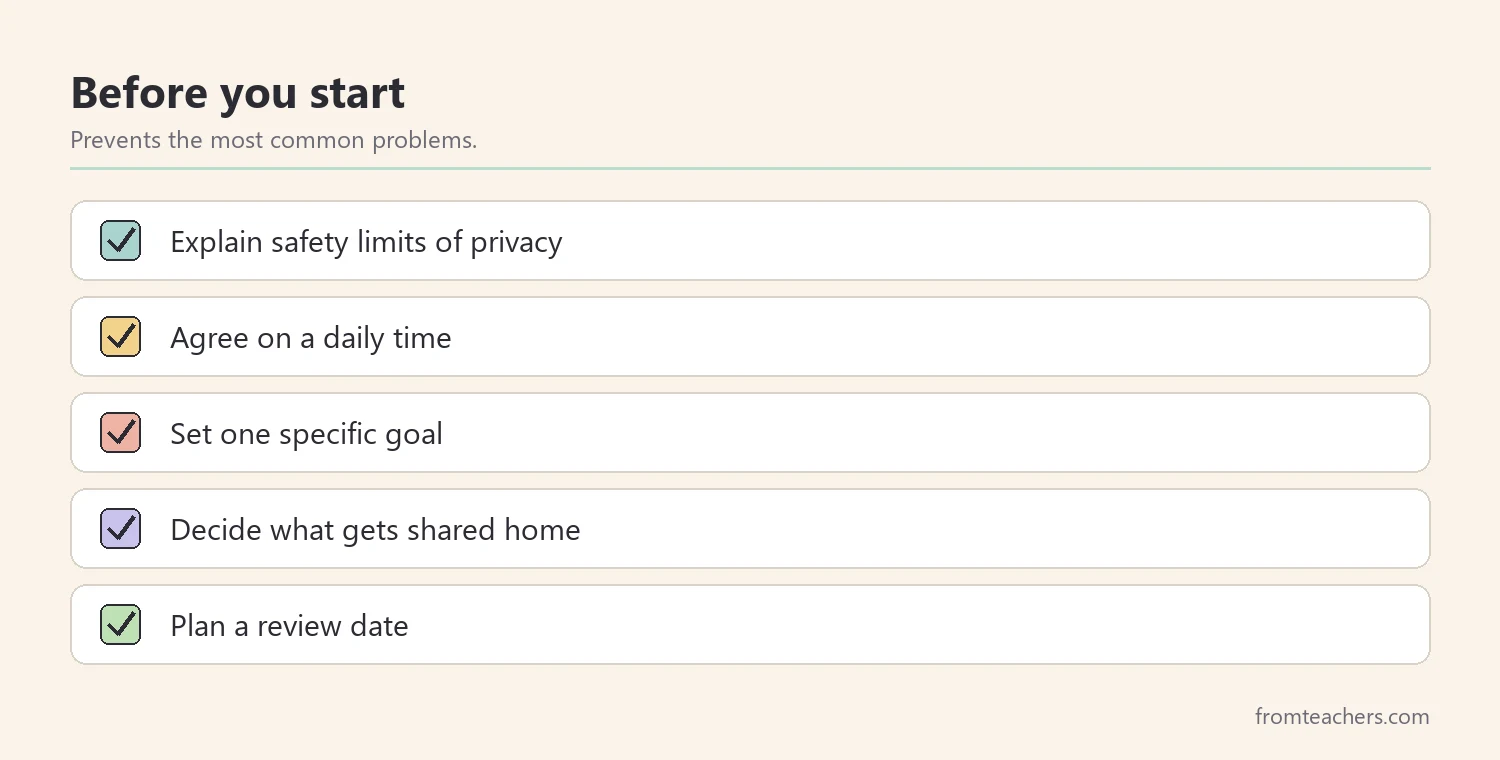
Before you start, check the five points in Figure 5. They prevent the most common problems.
Common mistakes with reflection journals
- Reading every sheet every day. Fix: read weekly, unless a student flags something urgent.
- Treating a sad face as a crisis. Fix: look for patterns, and follow your district protocol if a student writes about safety.
- Grading the journal. Fix: never grade reflections; praise effort and honesty.
- Setting vague goals. Fix: make goals specific and observable.
- Sharing without permission. Fix: ask the student before sharing sheets with others.
Questions counselors ask about reflection journals for school counselors
How long should a student use the journal?
Many counselors use it for a cycle of four to six weeks, then review. Some students like to keep going, while others move to a weekly version.
Does this work for students who do not like writing?
Yes. The feeling scale and yes or no goal check need no writing. Students can also dictate short answers or draw.
What if a student writes something worrying?
Follow your school’s safety and reporting procedures right away. Tell students at the start that you will need to act if they share a safety concern.
Can I use it with a whole class?
Yes, but start with one student or a small group first. A whole-class rollout works best with a teacher who wants to own the daily routine.
Is this the same as a mood tracker?
Partly. It includes a feeling scale, but it also covers goals, helpers, gratitude and improvement, which makes it broader than a mood log.
Related reading: School Counseling Programs, School Counseling Strategies, and The Power of Data Tracking in Special Education.
You may also need: Daily Energy Level Tracker: Sleep, Mood and Habit Reflection Worksheet.
A companion resource for using reflection journals for school counselors:
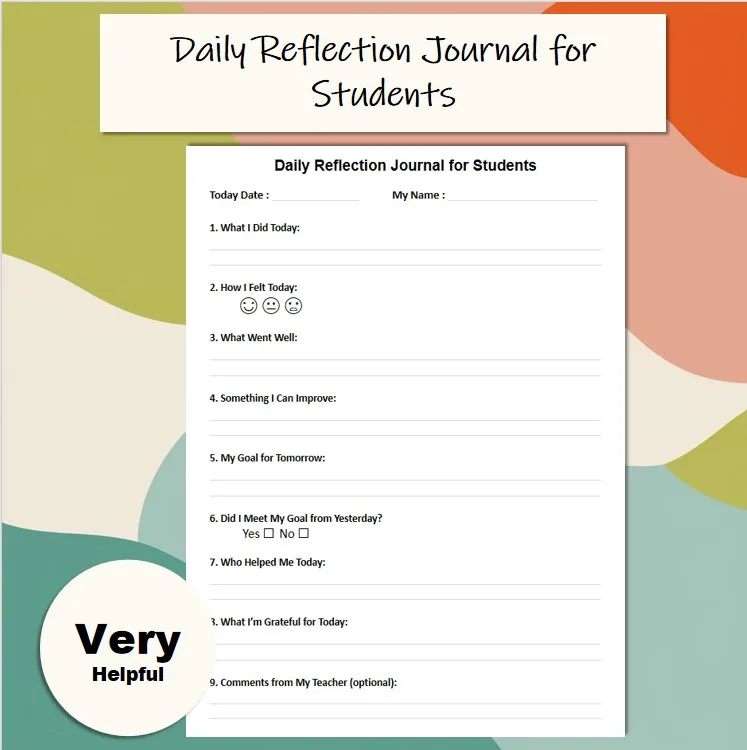
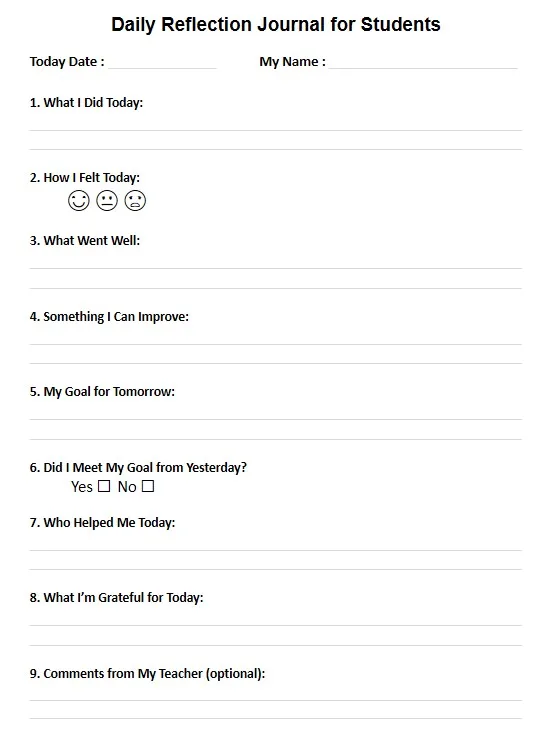
Daily Reflection Journal for Students: SEL Check-In & Goal Setting Sheet: a one-page journal, editable and print-ready, with name and date, what I did today, a three face feeling scale, what went well, something I can improve, my goal for tomorrow, did I meet my goal from yesterday, who helped me today, a gratitude prompt and an optional comments box for the teacher.
Sources and scope
- American School Counselor Association (ASCA): professional standards and guidance on comprehensive school counseling programs.
- CASEL: the widely used framework for social and emotional learning competencies, including self-awareness and self-management.
- IRIS Center: free modules on behavior support and progress monitoring for students with disabilities.
- Understood.org: plain-language guidance for families and educators on emotions, focus and learning differences.
This list covers simple, non-clinical uses of a daily reflection sheet in school counseling. It is not a mental health screening tool. Follow your district procedures for risk concerns, confidentiality and parent communication.
Key takeaways
- Reflection journals for school counselors extend your view between sessions.
- Start with a session opener or one daily goal.
- Review patterns every few weeks, not single days.
- Involve teachers and families with the student’s permission.
- Keep it a conversation tool, not a screening tool.










Leave a Comment