

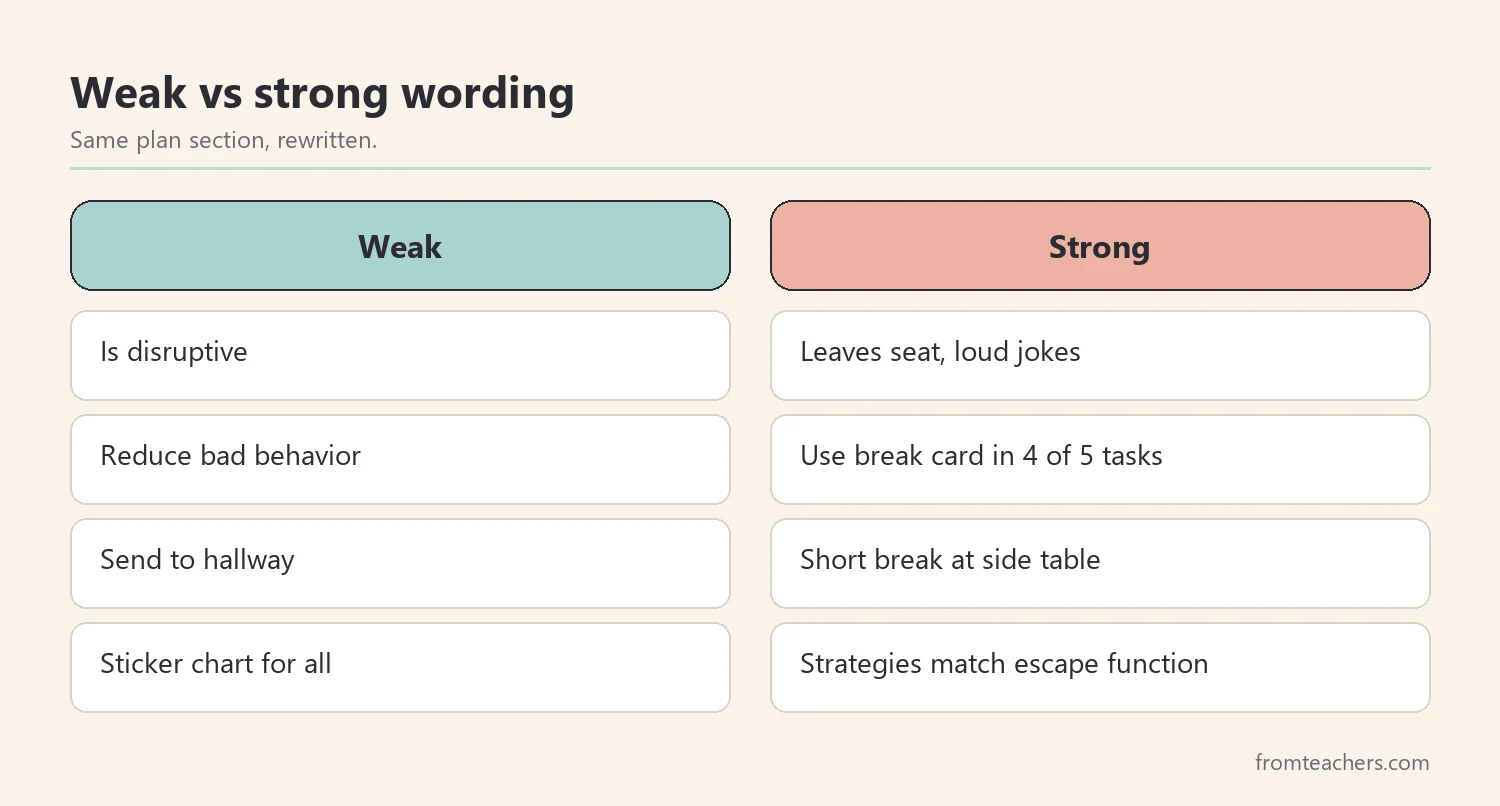
Behavior intervention plan mistakes usually start long before anyone notices them in the classroom. Picture Jordan, a sixth grader who leaves his seat and jokes loudly whenever a writing task appears. His team finished a careful functional behavior assessment (FBA) that pointed to escape from writing. Yet the plan they wrote says “Jordan will reduce disruptive behavior” and lists a sticker chart. Three weeks later, nothing has changed, and the team is frustrated.
This list is for first-year special education teachers, new behavior team members and general education teachers joining a BIP meeting for the first time. It covers ten common mistakes, in the order they tend to appear while a plan is written and used, with a fix for each one and a short example from Jordan’s team. By the end, you will be able to spot weak spots in a draft plan before it reaches the classroom.
Examples are fictional. Follow your district’s procedures, the student’s IEP and the guidance of your behavior specialist. This is guidance, not a diagnosis.
At a glance
- A behavior intervention plan (BIP) should grow directly out of the FBA, especially the function of the behavior.
- Vague behavior definitions and goals make plans impossible to follow or measure.
- Every plan needs a replacement behavior that meets the same need as the problem behavior.
- Strategies should cover setting events, antecedents, teaching and consequences.
- Plans need training, data and a review date, or they quietly stop being used.
How this list is ordered
We did not rank these behavior intervention plan mistakes by how common they are, because we have no reliable data on that. Instead, the list follows the order in which a plan is built and used: first the summary from the FBA, then the competing behavior pathway, then the intervention strategies, and finally training, data and review. As a result, you can hold the list next to a draft plan and check it section by section.
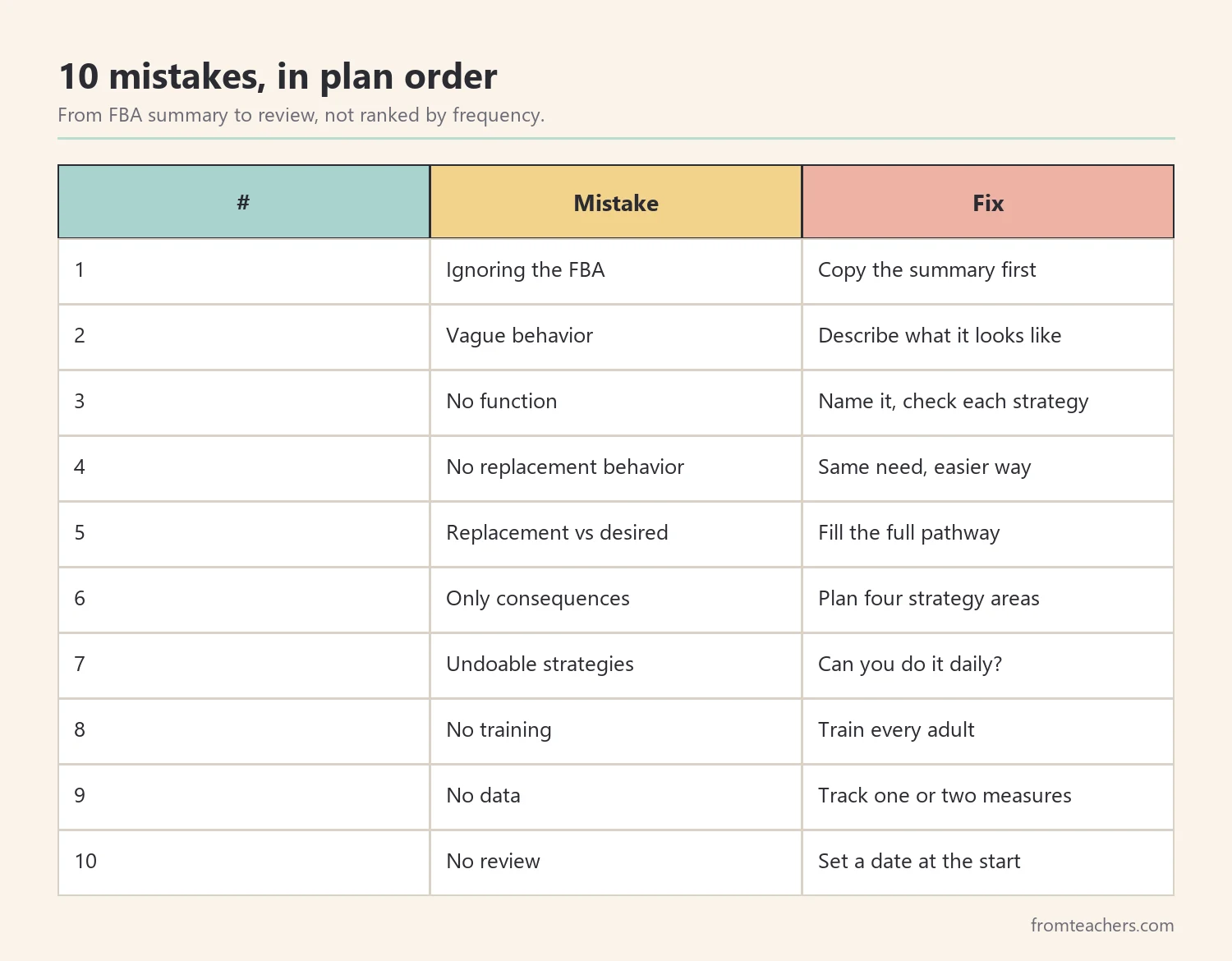
Under IDEA, IEP teams must consider positive behavioral interventions and supports when a student’s behavior gets in the way of learning. A BIP is one common way schools put that into writing. Figure 1 shows all ten mistakes with a quick fix for each.
1. Writing the plan without using the FBA
The first of the behavior intervention plan mistakes is starting from a blank page. Sometimes the FBA sits in a folder while the team writes strategies from habit or memory.
Why it matters: a plan that ignores the FBA often targets the wrong need. For example, a reward chart will not help much if the student is trying to escape a task he finds too hard.
Fix: copy the final summary statement from the FBA into the first section of the BIP, word for word, before writing anything else.
Example: Jordan’s team pasted their summary at the top: “During independent writing, when given a written task of more than a few sentences, Jordan leaves his seat and jokes loudly, which results in being sent to the hallway and avoiding the task.”
2. Defining the behavior vaguely
Next comes the definition. Words such as “disruptive,” “defiant” or “off task” mean different things to different adults.
Why it matters: if two adults cannot agree when the behavior happened, they cannot collect reliable data or respond consistently.
Fix: describe what the behavior looks and sounds like, so a substitute could recognize it. For instance, “leaves his assigned seat without permission and makes loud jokes that stop peers from working.”
3. Skipping the function
Every behavior serves a purpose for the student, such as getting attention, escaping a task, getting an item or activity, or meeting a sensory need. A plan that does not name the function is guessing.
Why it matters: strategies that fit one function can make another worse. Sending Jordan to the hallway, for example, gives him exactly what the behavior is trying to get: escape from writing.
Fix: state the function clearly in the plan and check every strategy against it.
4. Leaving out the replacement behavior
Many plans say what the student should stop doing but not what to do instead. Yet the need behind the behavior does not disappear.
Why it matters: without a replacement behavior that meets the same need, the student usually keeps using the old behavior, because it still works.
Fix: choose a replacement behavior that serves the same function and is easier than the problem behavior. For escape, that might be asking for a short break or for help.
Example: Jordan’s team chose “hands a break card to the teacher and takes a two-minute break at the side table.” It meets the same need, escape, in an acceptable way.
5. Confusing the replacement behavior with the desired behavior
A competing behavior pathway usually lists both. The desired behavior is the long-term goal, such as completing a writing task independently. The replacement behavior is the bridge, a quick and acceptable way to get the same result now.
Why it matters: jumping straight to the desired behavior asks for too much too soon.
Fix: fill in the full pathway: setting event, antecedent, problem behavior, consequence, function, replacement behavior and desired behavior. The Behavior Intervention Plan template with a competing behavior pathway lays out each of these boxes, with prompts so teams know what to write in each one.
6. Only planning consequences
Some plans are mostly a list of what happens after the behavior: warnings, loss of privileges, calls home. However, consequences are only one part of a strong plan.
Why it matters: prevention and teaching often change behavior faster than consequences alone.
Fix: include strategies in four areas: neutralizing setting events, changing antecedents, teaching skills and altering consequences.
| Area | Jordan’s strategy |
|---|---|
| Setting events | Check-in on mornings after a hard night |
| Antecedents | Shorter writing chunks, sentence starters |
| Teach behavior | Practice using the break card |
| Consequences | Break given when card used; no hallway exit |
7. Writing strategies nobody can do
A plan full of ideal strategies can collapse in a real classroom with 28 students. For example, “provide one-to-one support during all writing” may not be possible.
Why it matters: strategies that cannot be done consistently are not done at all.
Fix: ask each adult who will carry out the plan, “Can you do this every day?” Simplify until the answer is yes.
8. Skipping training
Often the plan is signed in a meeting and emailed to staff. Specials teachers, paraprofessionals and substitutes may never see it.
Why it matters: inconsistent responses across adults can keep a behavior going.
Fix: hold a short training, practice the key responses and give every adult a one-page summary.
9. Not collecting data
Without data, teams judge a plan by the worst day they remember. That can lead to dropping a plan that is actually working.
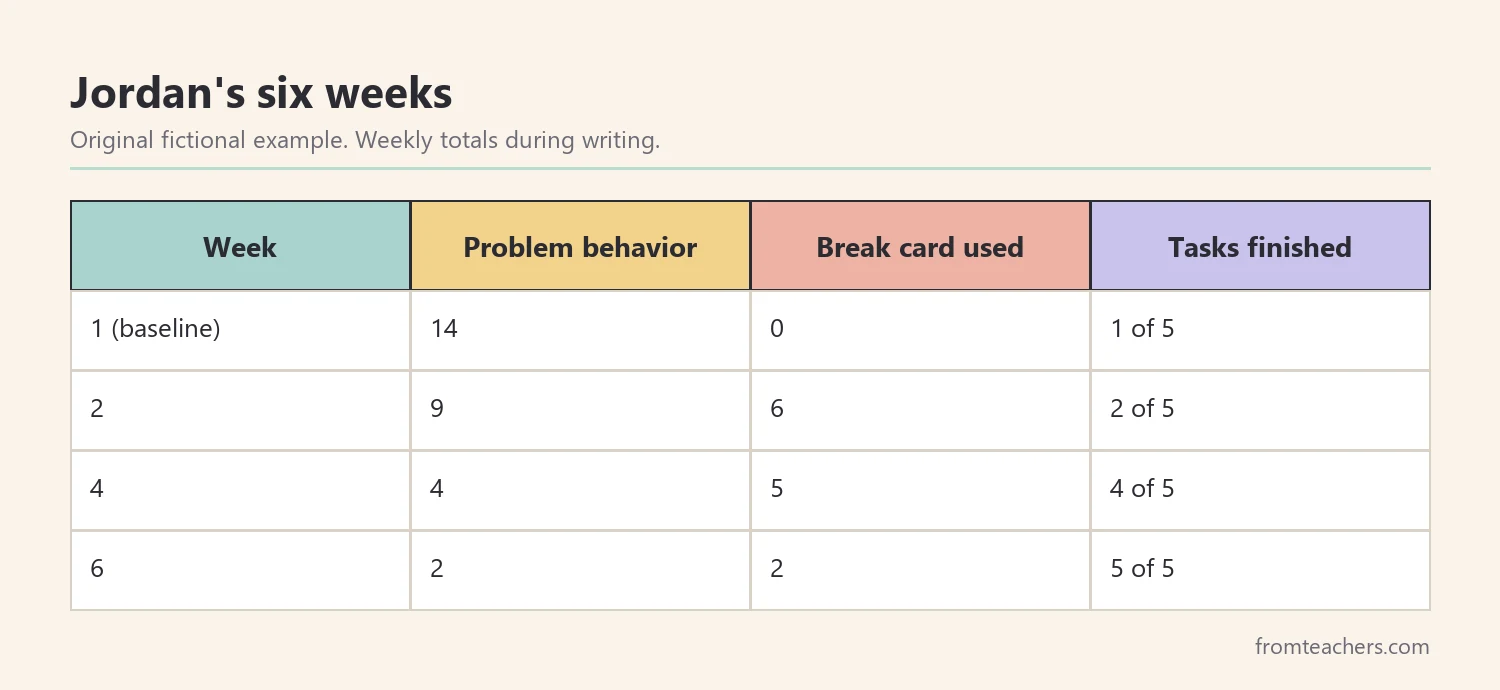
Fix: track one or two simple measures, such as the number of times the problem behavior happened and the number of times the replacement behavior was used.
Example: Jordan’s teacher tallied both each day. Figure 3 shows the problem behavior falling as break card use rose, and then break card use falling as writing tasks became easier.
10. Never reviewing the plan
Finally, a plan without a review date tends to fade or continue long after it stops fitting.
Fix: set a review date, often a few weeks after the plan starts, and decide in advance what the team will look at. Then adjust, fade supports or revisit the FBA.
Avoiding behavior intervention plan mistakes as a team
Most of these mistakes are not about knowledge. Instead, they happen because teams are busy, meetings are short and plans are written under pressure. A few habits make a big difference.
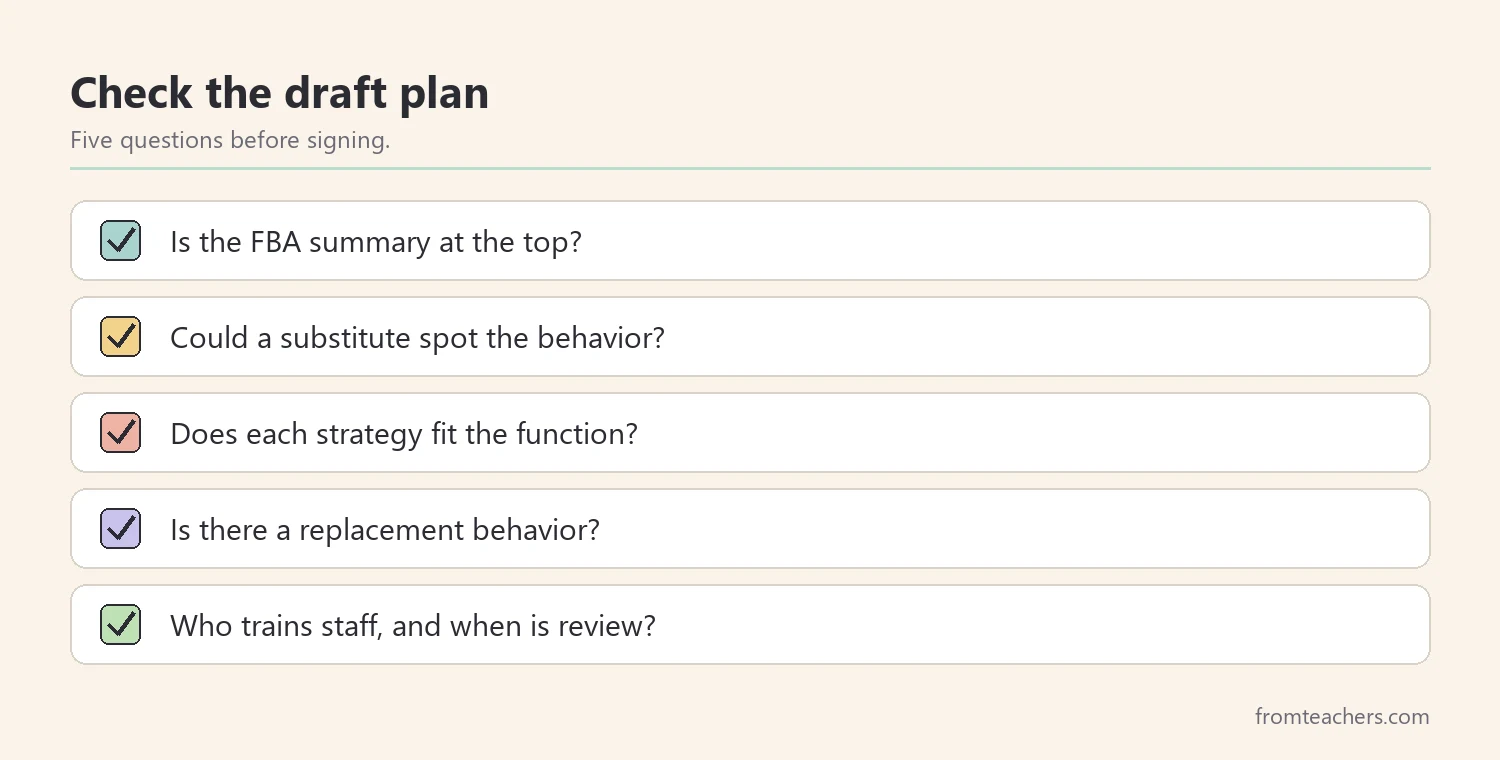
First, bring the FBA summary and data to the meeting, and project the draft plan so everyone sees the same page. Next, assign one person to read each strategy aloud and ask, “Does this match the function?” Then decide who will train staff, who will collect data and when the team will meet again.
Also, include the student and family where possible. Students can often explain what makes a task hard, and families may know which strategies work at home. Their input makes the plan more realistic and more likely to be followed.
In addition, keep the language respectful. A plan describes behavior and support, not a student’s character. Words like “manipulative” or “lazy” do not belong in a BIP, and they can shape how every adult reacts.
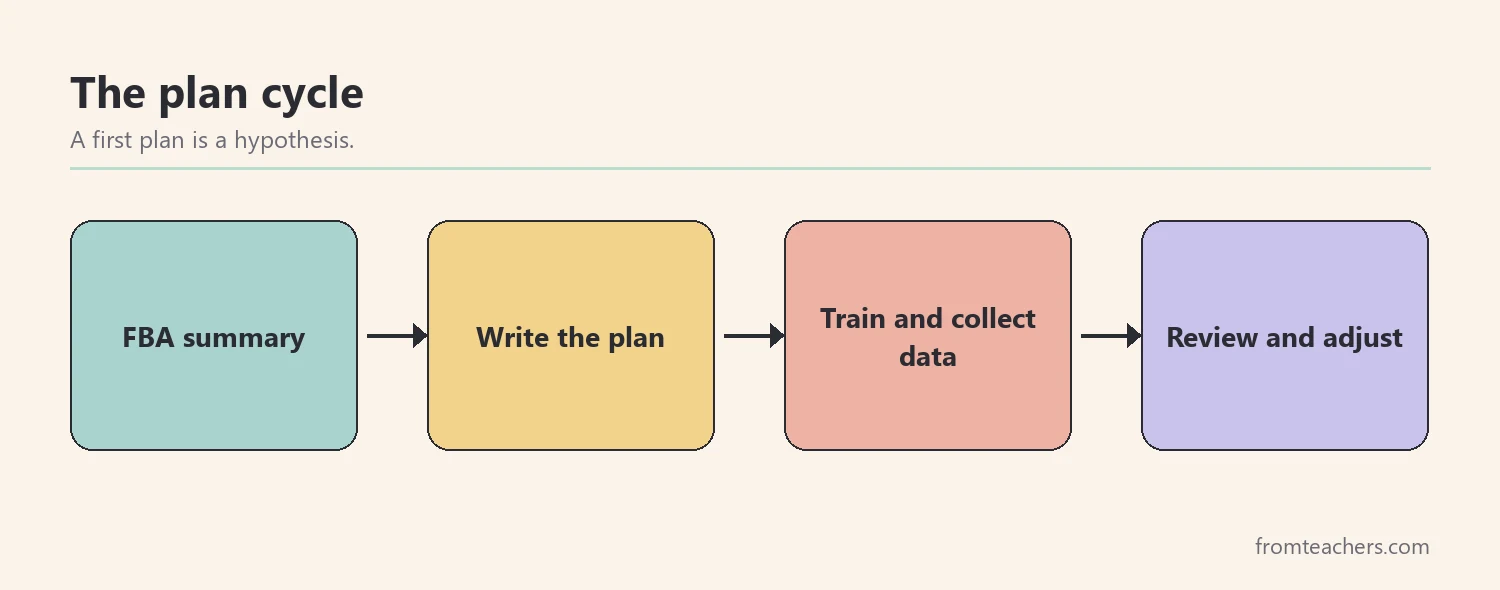
Finally, remember that a first plan is a hypothesis. If the data show no change after a fair trial, the team has learned something useful. Revisit the FBA, check whether the plan was carried out as written and adjust. Figure 5 shows the cycle.
Common mistakes and how to avoid them
- Copying a plan from another student. Fix: start from this student’s FBA every time.
- Using goals like “reduce disruptive behavior.” Fix: name the behavior, the measure and the target.
- Removing a student from tasks as the main response. Fix: check whether removal rewards an escape function.
- Training only the lead teacher. Fix: train every adult who works with the student.
- Waiting for the annual IEP to review the plan. Fix: set a short review date at the start.
Questions teachers ask about behavior intervention plan mistakes
What is the difference between an FBA and a BIP?
An FBA gathers information to understand why a behavior happens. A BIP uses that information to plan supports that prevent the behavior and teach better ways to meet the same need.
How long should a BIP be?
Long enough to be clear and short enough to use. Many teams find that a two-page plan plus a one-page staff summary works well.
Who should be at the BIP meeting?
Usually the IEP team, including the family, teachers who work with the student and a behavior specialist or school psychologist when available.
What if the behavior gets worse at first?
Sometimes a behavior increases briefly when it stops working. Keep collecting data and talk with your behavior specialist before changing the plan.
How often should we review a BIP?
Policies vary. Many teams set a first review a few weeks after the plan starts and then review regularly based on the data.
Related reading: Moving Beyond Shame and Behavior Charts, The Power of Data Tracking in Special Education, and Special Education Tracking Tools.
You may also need: Functional Behavior Assessment Summary Form, editable FBA template.
A companion resource for avoiding behavior intervention plan mistakes:

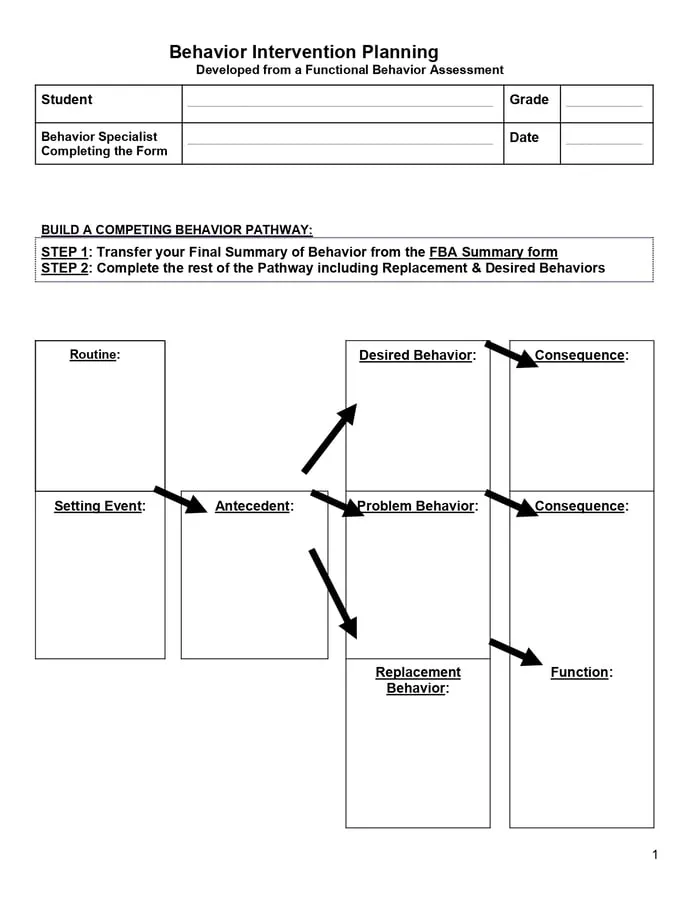
Behavior Intervention Plan (BIP) Template: Function-Based Strategies from FBA: a two-page template with space for the FBA summary, a full competing behavior pathway and intervention strategies in four function-based sections, with sentence starters and prompts.
Sources and scope
- Individuals with Disabilities Education Act (IDEA): the federal law that requires IEP teams to consider positive behavioral supports.
- IRIS Center: free modules on functional behavioral assessment and behavior support.
- Center on PBIS: resources on positive behavioral interventions and supports, including individual student plans.
- What Works Clearinghouse: practice guides on reducing behavior problems in the classroom.
This list explains common mistakes when writing and using behavior intervention plans in schools. It does not replace a functional behavior assessment, district procedures or the guidance of a qualified behavior specialist.
Key takeaways
- Most behavior intervention plan mistakes start when the plan drifts away from the FBA.
- Define the behavior clearly and name its function.
- Always include a replacement behavior that meets the same need.
- Plan for setting events, antecedents, teaching and consequences.
- Train every adult, collect simple data and set a review date.










Leave a Comment