

A sensory break schedule gives students planned regulation time before they reach overload, instead of waiting for a meltdown to signal the need. Picture a third grader who is fine at 9 a.m., fidgety by 10, and under his desk with his hands over his ears by 11. Every day, the adults respond after the crisis. Every day, learning stops for twenty minutes.
This guide shows teachers how to plan proactive sensory breaks around the school day, choose the right type of break for each moment, teach the routine, and use simple data to adjust the schedule. By the end, you will have a schedule template, a short list of break activities, and a way to tell whether the breaks are working.
Examples are fictional. Adapt to the student’s needs, the advice of the occupational therapist, and any supports in the student’s plan. This is guidance, not a diagnosis.
At a glance
- Schedule breaks before the times when overload usually builds.
- Match the break type to the need: calming, alerting, or organizing.
- Keep breaks short, predictable, and with a clear return to work.
- Teach the routine when the student is calm, not during a crisis.
- Track a few numbers for two weeks and adjust timing first.
1. Find the overload pattern before building a sensory break schedule
First, observe for a week before you schedule anything. Note the times of day when the student shows early signs of overload, such as covering ears, moving constantly, chewing clothing, withdrawing, or becoming irritable. Also note when the student seems calm and focused.
Many students show a pattern. Overload often builds after noisy or busy periods, such as assemblies, lunch, recess, or transitions, and during long seated tasks. A sensory break schedule works best when breaks come just before those predictable peaks.
Then, record what was happening in the room at each sign. Was it loud? Bright? Crowded? Was the student sitting still for a long time? These details help you choose the right type of break later.
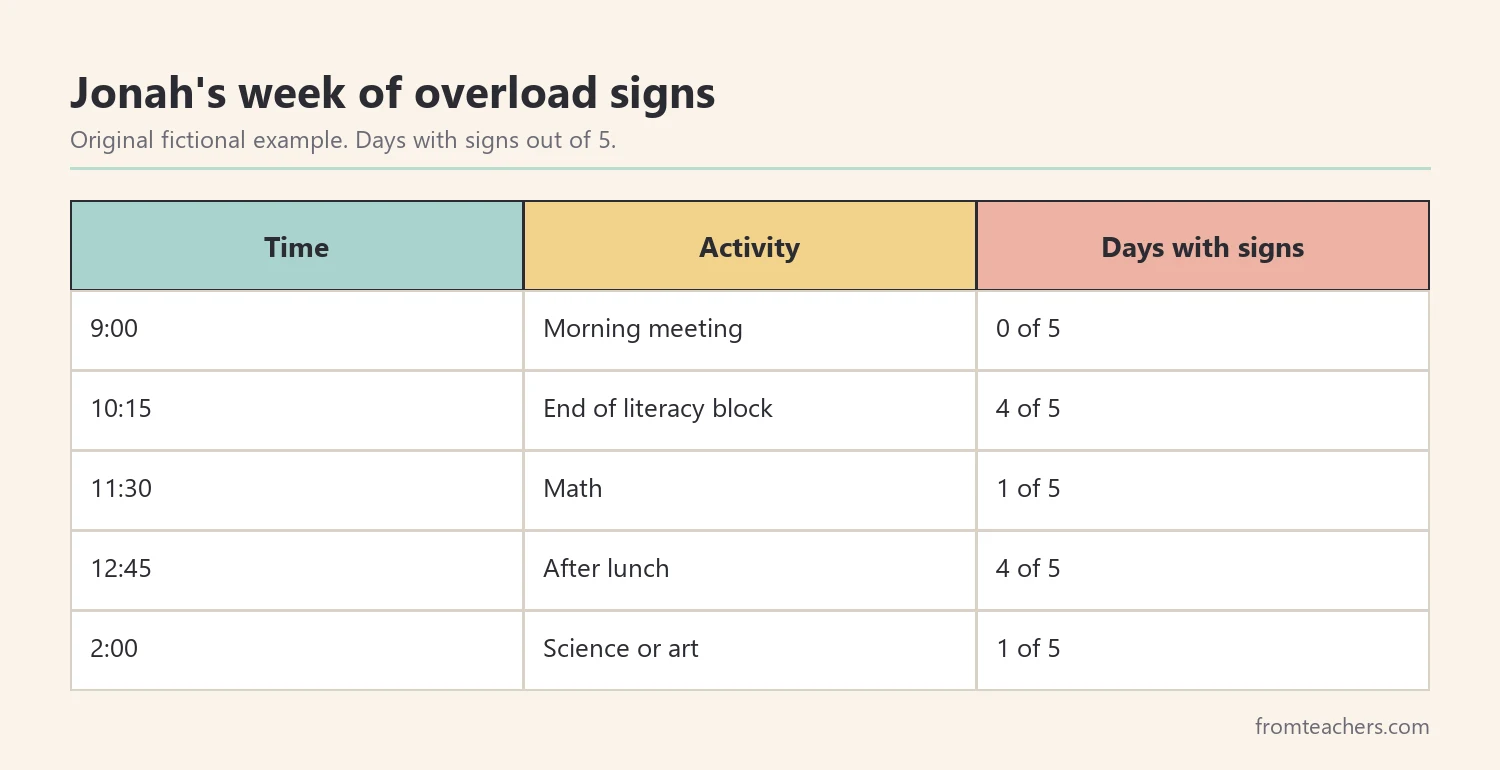
Jonah (fictional, grade 3) has sensory processing differences noted in his support plan. His teacher, Ms. Alvarez, tracked one week. Signs of overload clustered around 10:15 a.m., after a long literacy block, and around 12:45 p.m., after a loud lunch. On days with an assembly, the morning peak came earlier.
Also, talk with the student and the family. Many students can say what feels hard, such as “the lunch room is too loud.” Families can tell you what helps at home. The occupational therapist, if involved, can suggest specific strategies that fit the student’s profile.
2. Match each break to the need
Not every sensory break does the same job. Broadly, breaks can calm, alert, or organize. Choosing the right type for the right moment makes a sensory break schedule far more effective.
Calming breaks help a student who is overloaded or anxious. Examples include a quiet corner with dim light, noise-reducing headphones, slow breathing, or looking at a calm picture book. Alerting breaks help a student who is sluggish or under-responsive. Examples include a short walk, jumping, or a drink of cold water.
Organizing breaks often help both. Heavy work, such as carrying books to the library, pushing a cart, wall push-ups, or stacking chairs, gives deep pressure input that many students find regulating.
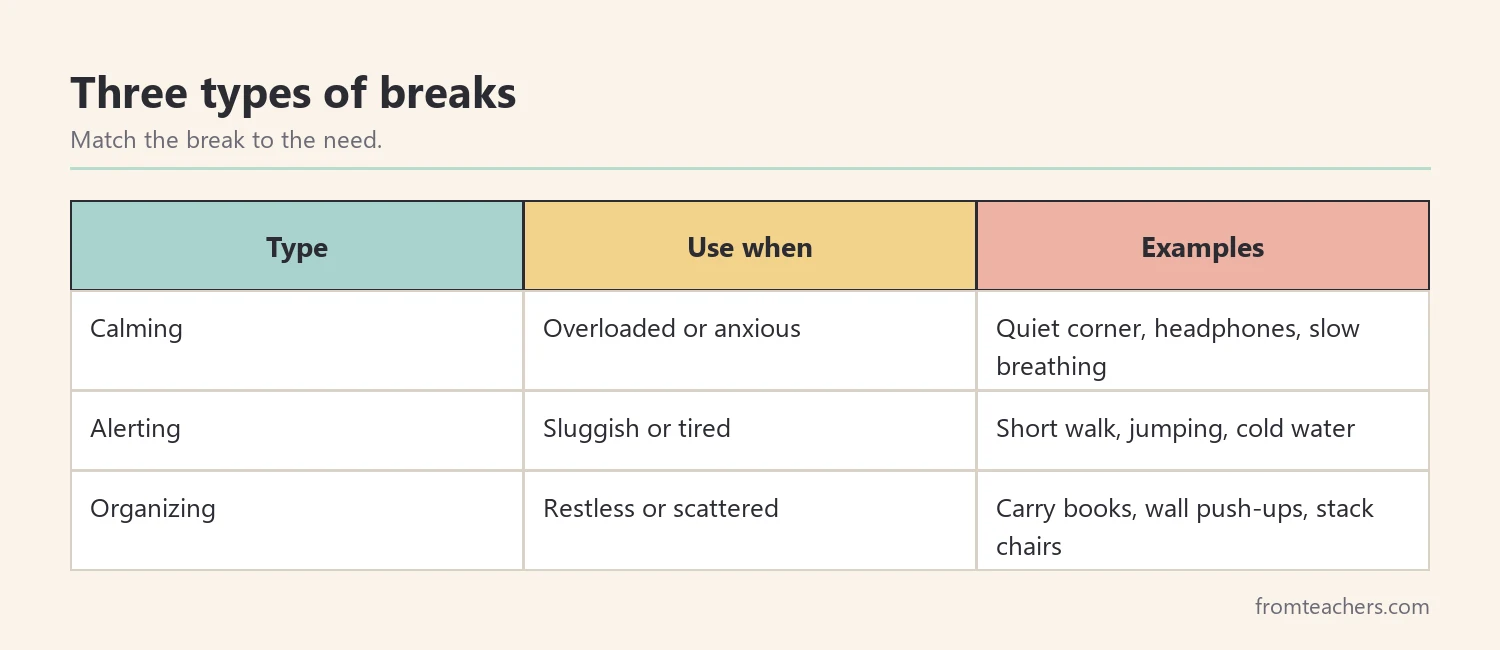
For Jonah, Ms. Alvarez chose an organizing break before the 10:15 peak, carrying the class book bin to the library, and a calming break after lunch, five minutes in a quiet corner with headphones. Both were short and both had a clear end.
For a fuller set of ideas, she used the SPD support toolkit with sensory spaces and calming strategies, which explains overlooked signs, classroom strategies, low-budget sensory-safe spaces, and calming techniques, with print-and-go tools.
Setting up a low-cost break space
A break space does not need special furniture. A quiet corner behind a bookshelf, a cushion, a pair of noise-reducing headphones, and a small basket of calming tools are often enough. Keep the space tidy and predictable, with the same items in the same places.
In addition, put a simple visual card in the space showing what to do there and how long to stay. A small sand timer or a visual timer helps students see the end of the break. When the space looks and works the same every day, the sensory break schedule feels safe and familiar.
Finally, avoid making the space too exciting. Bright toys and screens can turn a calming break into an alerting one. Save more active options, such as jumping or wall push-ups, for organizing or alerting breaks in another part of the room.
3. Build the sensory break schedule into the day
Next, write the breaks into the daily timetable. A sensory break schedule that lives only in the teacher’s head is easy to skip on a busy day. A written schedule, visible to the student and to support staff, is much more reliable.
Place each break five to ten minutes before a known peak. Keep breaks short, often three to five minutes, unless the occupational therapist recommends otherwise. Short breaks are easier to fit into lessons and easier to return from.
Then, add the breaks to the student’s visual schedule. A small icon for “break” between “reading” and “math” tells the student that relief is coming. For many students, simply knowing when the break will happen reduces stress.
In addition, plan the return. Every break should end with a clear signal, such as a timer, and a clear next step, such as “back to your seat and start question 1.” Without a planned return, breaks can grow longer and become a way to avoid work.
Ms. Alvarez added two fixed breaks to Jonah’s day and one flexible break card. The fixed breaks happened at 10:05 and 12:40. The flexible card let Jonah request one extra break each day by placing the card on her desk.
| Time | Break | Type | Return signal |
|---|---|---|---|
| 10:05 | Carry book bin to library | Organizing | Back by 10:10 |
| 12:40 | Quiet corner, headphones | Calming | Timer, 5 minutes |
| Any time, once | Break card request | Student choice | Timer, 3 minutes |
4. Teach the break routine
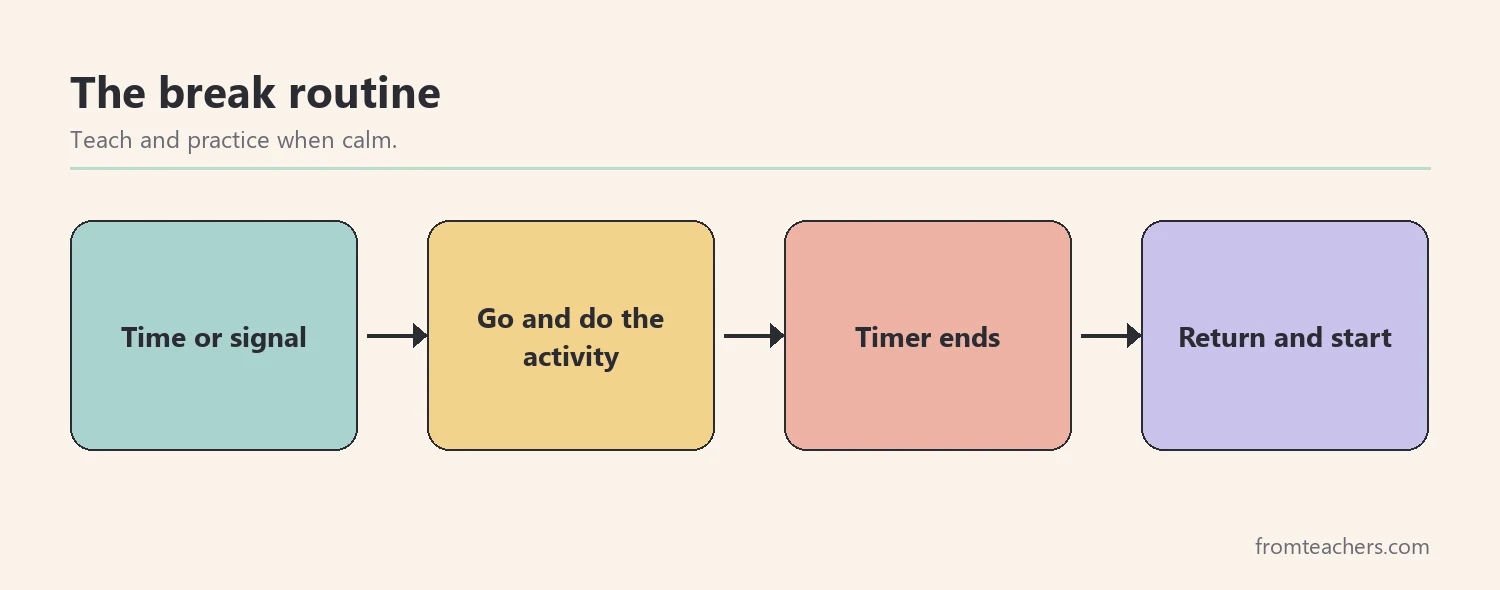
A break routine needs to be taught like any other routine. Teach it when the student is calm, not during a crisis. Practice the steps: notice the time or the signal, go to the break space, do the activity, hear the timer, return, and start the next task.
Use a short visual card for the steps. Many students benefit from seeing the sequence: “Go, do, timer, back, start.” Practice a few times when nothing is wrong, so the routine feels familiar on a hard day.
Then, teach the flexible break card. Show the student how to request a break quietly, and agree on how many requests are available. Praise appropriate requests warmly. Asking for a break is a self-regulation skill, and it deserves recognition.
Also, consider the rest of the class. Many teachers find that short movement breaks for the whole class reduce the attention on one student and help everyone. If only one student has breaks, explain to the class, in general terms, that different people need different things to learn well.
For Jonah, the first week had a few slow returns. Ms. Alvarez used a gentle script: “Timer’s done, back to question one.” By the second week, he usually returned within a minute of the timer.
Sharing the schedule with other adults
Students move between many adults during a school day. Therefore, share the sensory break schedule with paraprofessionals, specialist teachers, lunch staff, and substitutes. A one-page copy with times, break types, and the return signal is usually enough.
Moreover, agree on the same words for breaks and returns. If one adult says “break time” and another says “go chill,” a student may become confused. Consistent language across adults makes the routine predictable wherever the student is.
5. Track and adjust the sensory break schedule
After two weeks, check whether the sensory break schedule is helping. Track a few simple numbers each day: the number of overload incidents, the number of breaks used, and how long the student took to return to work.
Compare these numbers with the week before the breaks started. Fewer incidents and quick returns suggest that the schedule is working. If incidents still cluster at a certain time, adjust the timing first, since that is often the simplest fix.
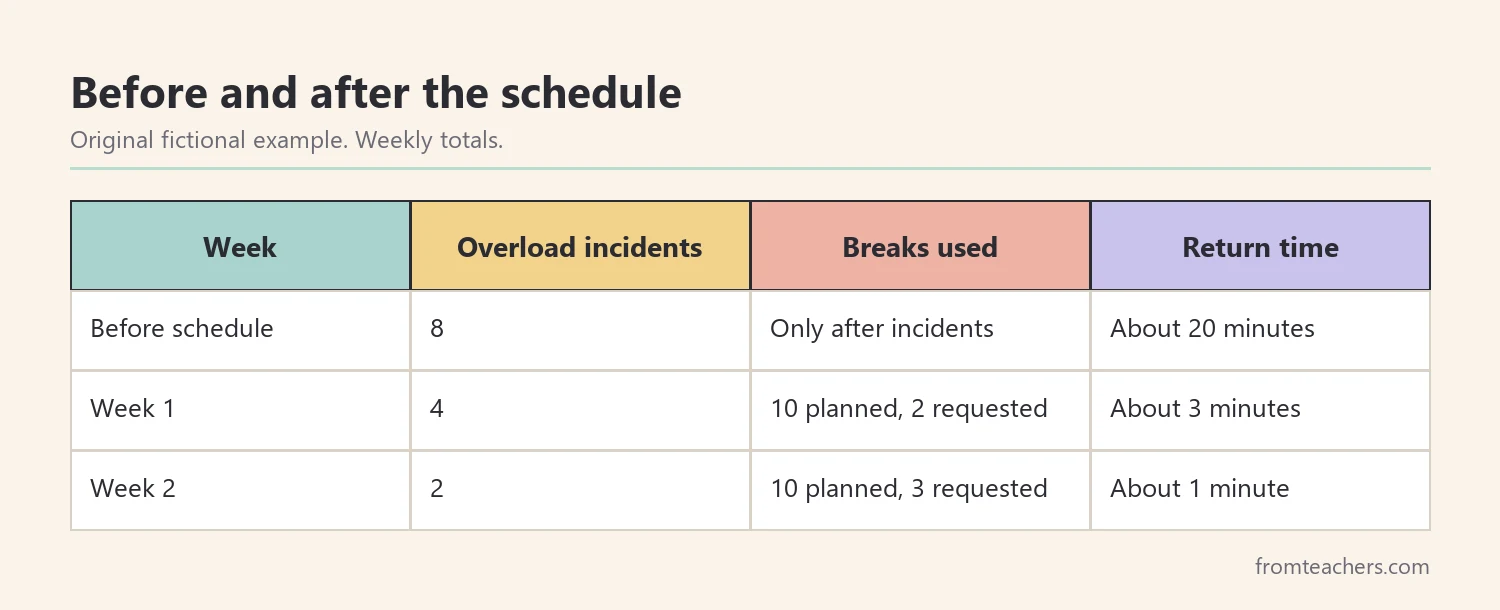
As Figure 4 shows, Jonah’s overload incidents dropped from most days to a few. However, assembly days were still hard. So, Ms. Alvarez added an extra calming break right after each assembly. Two weeks later, assembly days improved too.
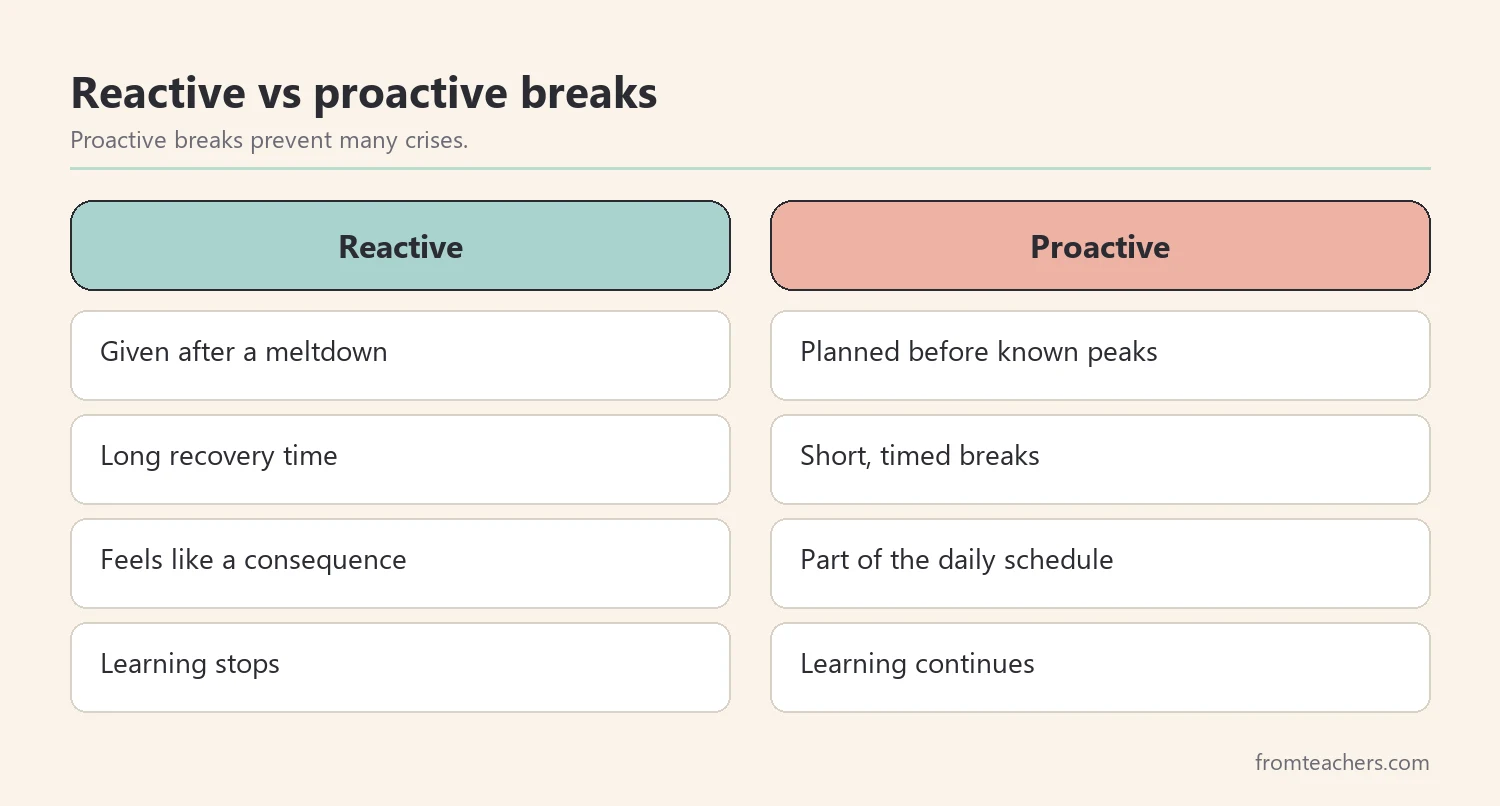
Next, compare reactive and proactive approaches with the team, using your own numbers as the starting point. Reactive breaks, given only after a meltdown, are sometimes necessary. Still, a proactive schedule usually means fewer crises and more learning time, which is the main goal.
Also, plan for gradual change over the year. As the student learns to notice early signs and request breaks independently, some fixed breaks may become flexible ones. For example, the 10:05 break might become “available if you need it.” Move slowly, one break at a time, and keep tracking. The aim is not to remove support quickly, but to help the student use it with growing independence, so the sensory break schedule becomes a skill the student owns.
Finally, share your data with the family and the occupational therapist at the next check-in or meeting. They may suggest new break activities, and the family may want to try similar breaks at home, especially before homework or after busy outings.
Common mistakes and how to avoid them
- Breaks only after meltdowns. By then, the student is already overloaded. Fix: schedule breaks before predictable peaks.
- The wrong type of break. An exciting break can make an overloaded student worse. Fix: match calming, alerting, or organizing input to the need.
- No clear return. Breaks that drift become avoidance. Fix: use a timer and a clear next step.
- Removing breaks as a punishment. Breaks are a support, not a reward. Fix: keep scheduled breaks even on difficult days.
- Never reviewing the sensory break schedule. Needs change over the year. Fix: check the numbers every few weeks and adjust.
Questions teachers ask about a sensory break schedule
How many breaks should a sensory break schedule include?
It depends on the student. Many teachers start with two or three short breaks placed before known peaks, then adjust based on data. The occupational therapist can give specific guidance.
Will breaks reduce learning time?
Short, planned breaks often increase learning time overall, because they prevent longer disruptions. Track incidents and time on task to see the effect for your student.
What if the student does not want to stop working?
That is a good sign. If a student is calm and focused, a scheduled break can sometimes be skipped or shortened. Keep the option available and watch for early signs later.
Can the whole class use sensory breaks?
Yes. Short whole-class movement or breathing breaks help many students and reduce attention on one child. Individual breaks can still be added for students who need more.
Where should the break space be?
Choose a spot that is calm, easy to supervise, and away from main traffic. A corner with a cushion, headphones, and a few calming tools is often enough. It does not need to be expensive.
Related reading: Managing Sensory Overload: Practical Strategies for Autism and ADHD, Understanding Autism ADHD Meltdowns: Signs and Support Strategies, and The Power of Data Tracking in Special Education.
You may also need: Sensory Break Ideas Poster | Sensory Choices for Self-Regulation.
A companion resource for a sensory break schedule:
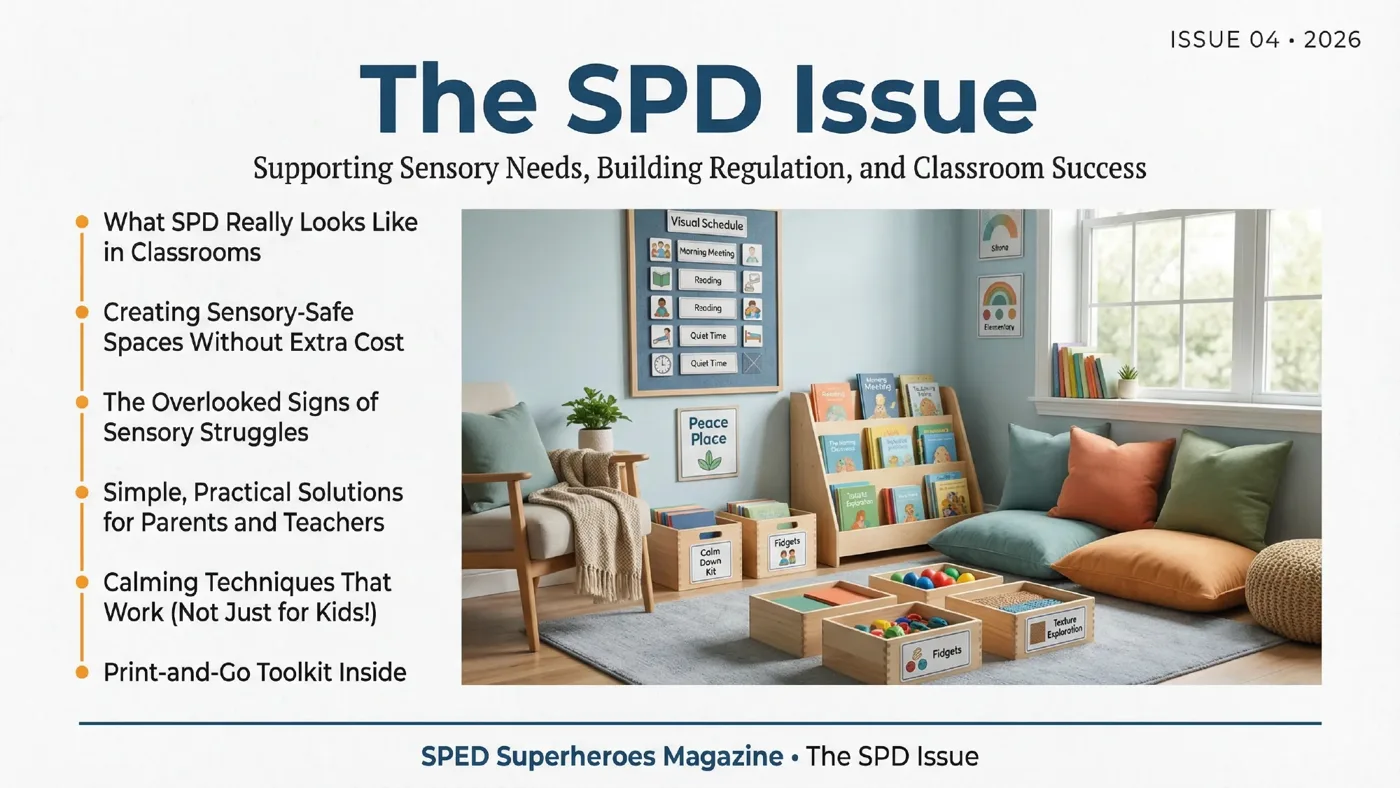
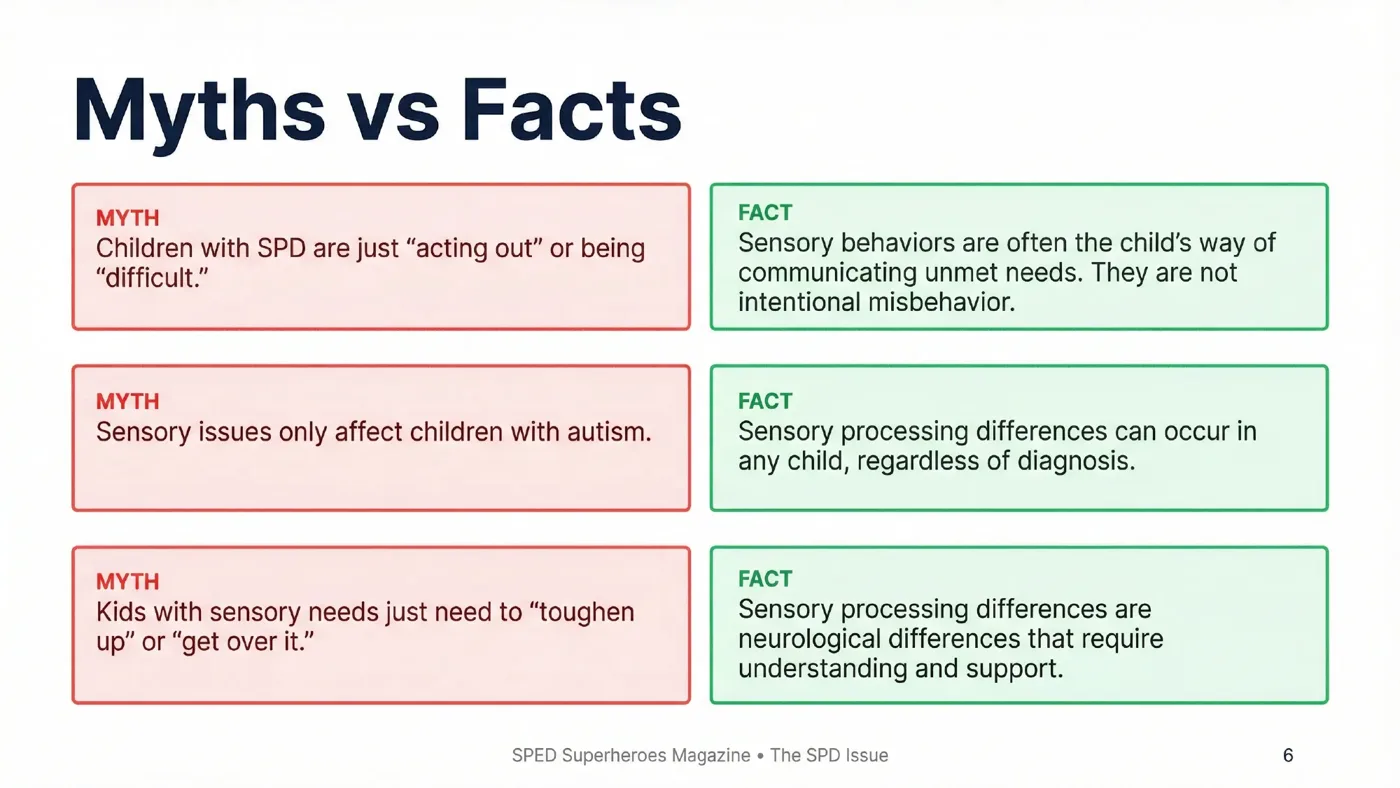
SPD Support Toolkit: Sensory Spaces & Calming Strategies: a 50-page guide on what sensory struggles look like in class, overlooked signs, classroom strategies, low-budget sensory-safe spaces, calming techniques, home strategies, and print-and-go tools.
Sources and scope
- American Occupational Therapy Association (AOTA): information on occupational therapy and sensory supports in schools.
- IRIS Center, Vanderbilt University: free modules on classroom environment and behavior support.
- Understood.org: practical articles on sensory processing challenges at school.
- CAST UDL Guidelines: a framework for flexible learning environments, including options for self-regulation.
This guide covers planning classroom sensory breaks. It does not diagnose sensory processing differences or replace advice from an occupational therapist or the student’s support team.
Key takeaways
- A sensory break schedule places short breaks before predictable overload peaks.
- Calming, alerting, and organizing breaks serve different needs.
- Written, visual schedules and a clear return keep breaks effective.
- Teach the routine when the student is calm.
- Simple numbers over two weeks show what to adjust, starting with timing.









Leave a Comment