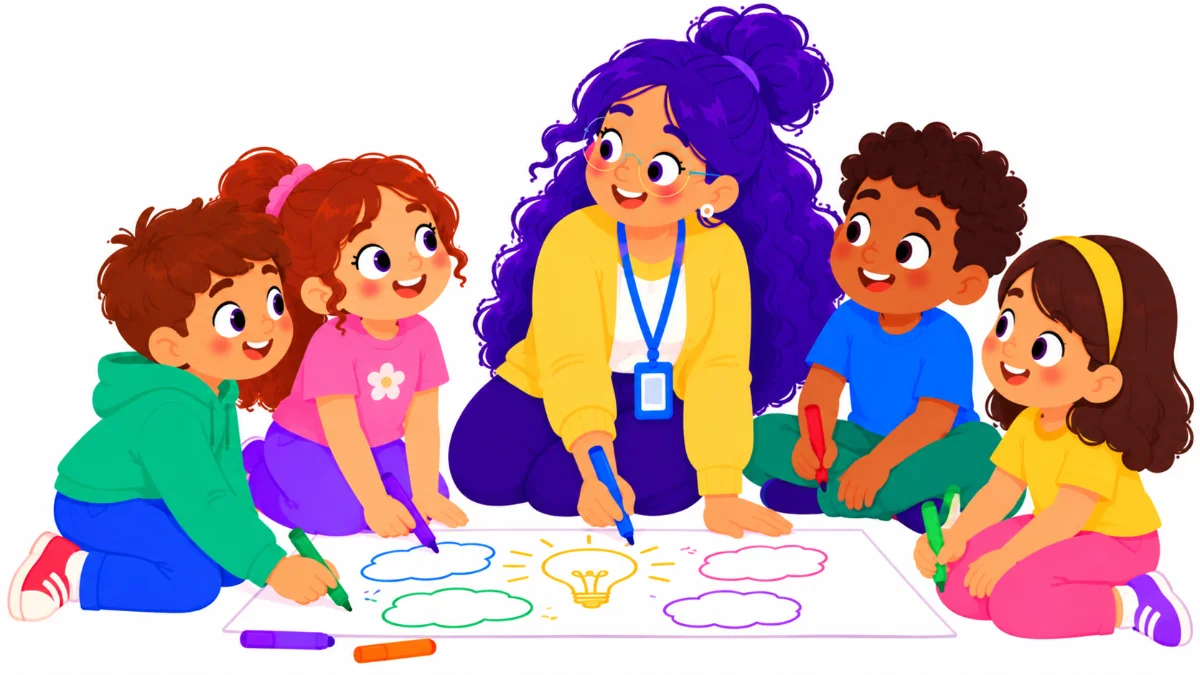

Classroom agreements turn a list of rules into a shared promise between the teacher and the students. Picture the second week of school: the rules are posted, yet the same reminders repeat all day, and students seem to follow them only when an adult is watching. Something is missing, and often it is ownership.
This guide walks you through five steps to build classroom agreements that students understand and keep: decide what the agreements are for, create them with students, write what the teacher agrees to do, teach them like a lesson, and review them when things go wrong. By the end, you will have a clear plan you can start next week.
Examples are fictional. Adapt to the student’s goals and agreed supports. This is guidance, not a diagnosis.
At a glance
- Agreements describe how a class wants to work together, not only what is forbidden.
- Students follow agreements more readily when they help write them.
- The teacher makes promises too, which builds trust and fairness.
- Agreements need teaching, practice, and visual reminders.
- Short, regular reviews keep the agreements alive all year.
1. Decide what your classroom agreements are for
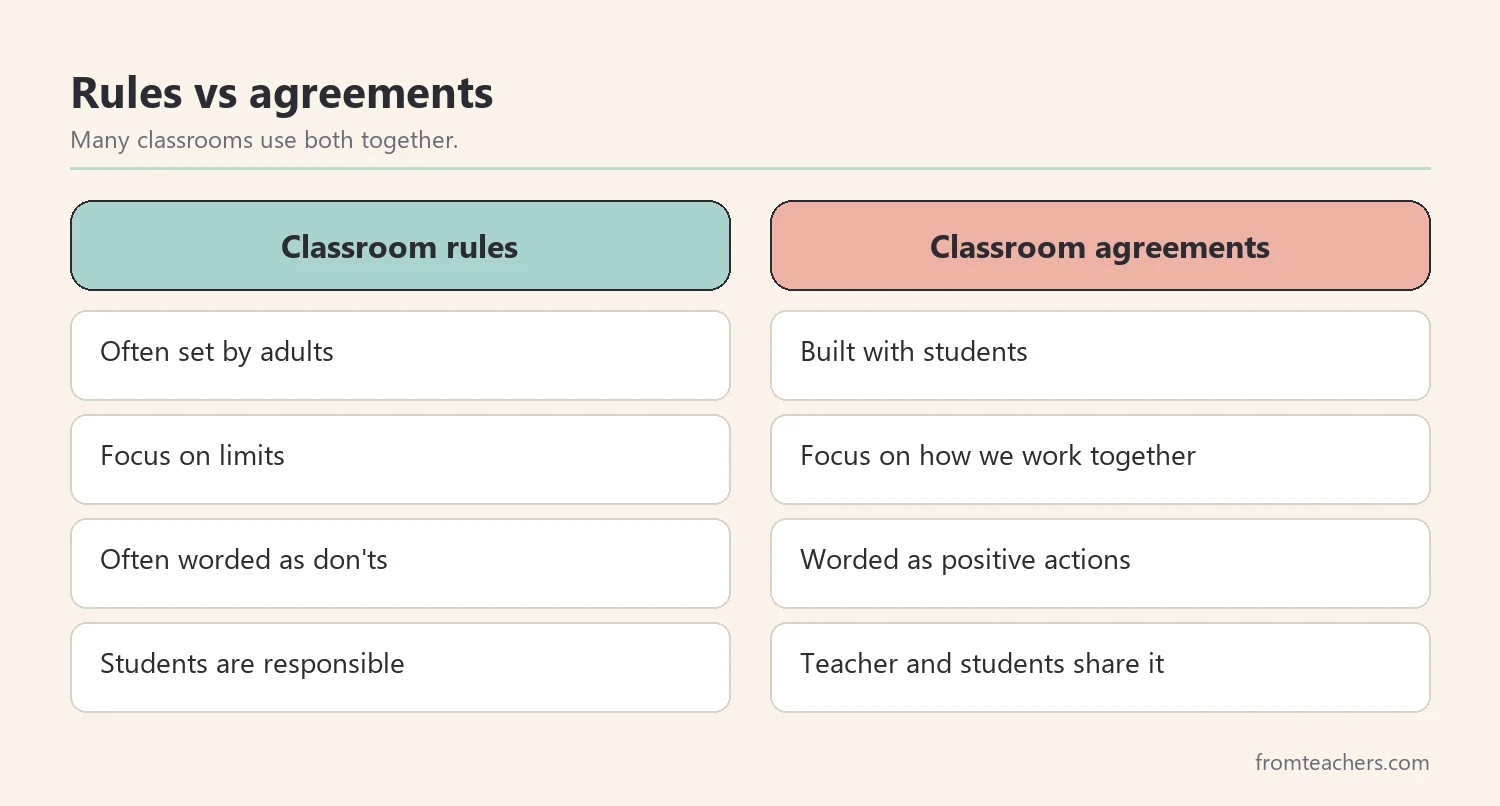
First, be clear about the purpose. Rules usually tell students what not to do. Classroom agreements describe how everyone in the room, adults included, will act so that learning feels safe, respectful, and supportive. That small shift changes the tone of the whole conversation.
Next, think about the problems you want to solve. Maybe transitions are noisy, or students rarely ask for help, or materials disappear. Write down three or four real moments from your first weeks. These moments will shape the agreements far better than a generic list copied from the internet.
Also, decide what stays non-negotiable. Safety expectations and school-wide policies do not go up for a vote. However, you can still explain them and invite students to describe what they look like in your room. Students accept limits more easily when they understand the reason behind them.
Keep the list short
In addition, keep the list short. Most classes work well with four to six classroom agreements per group. Long lists are hard to remember, and students may start to treat the poster as wallpaper. A short list that everyone knows by heart is worth more than a detailed one nobody reads.
Then, consider students with extra needs. Some learners benefit from icons, simple wording, or a personal copy on the desk. If a student has a behavior plan or accommodations, check that your classroom agreements line up with the supports already agreed by the team.
Worked example. Mr. Reyes teaches a fictional grade 3 class of 22 students. In week two, he lists four problem moments: shouting out answers, rushing to the carpet, leaving supplies on the floor, and students giving up quietly on hard tasks. He decides his classroom agreements should address respect, effort, routines, and responsibility.
2. Create classroom agreements with your students
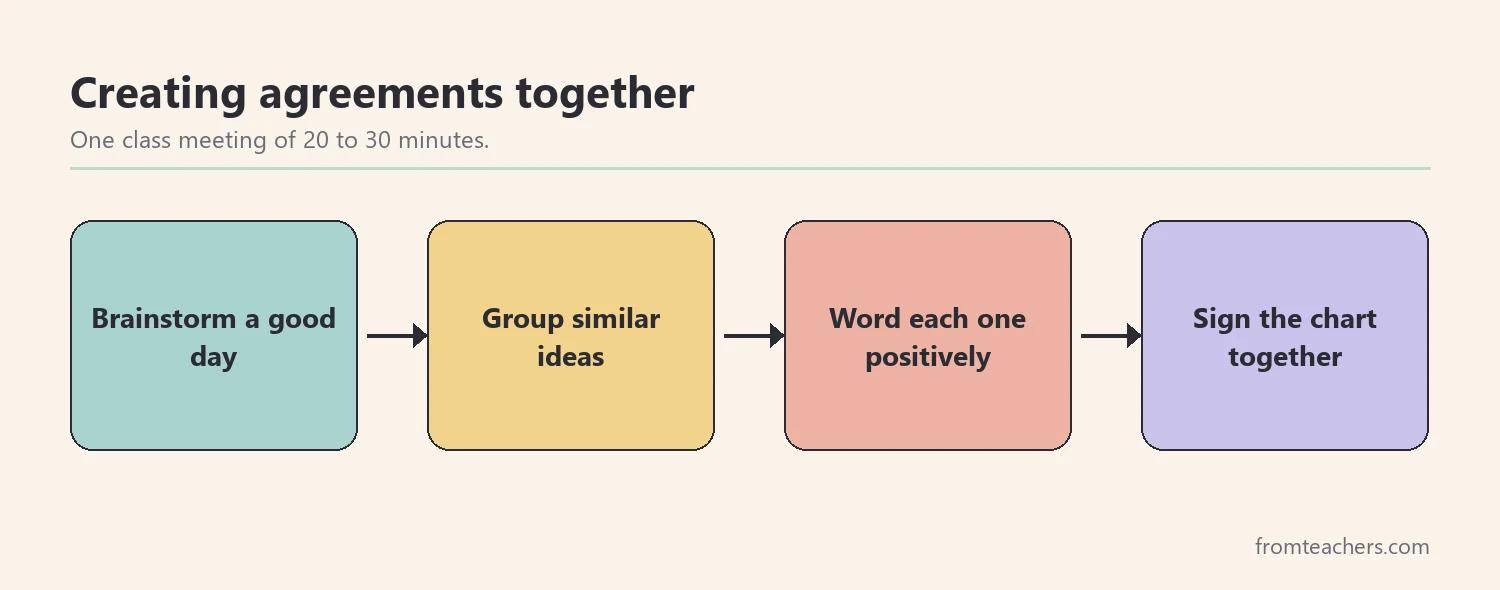
Next, bring students into the process. A simple class meeting of 20 to 30 minutes is usually enough. Start with one question: “What does a good day in our class look, sound, and feel like?” Let students share ideas while you record them on chart paper.
Then, group the ideas together. Many suggestions will overlap. “Don’t yell,” “use nice words,” and “listen when someone talks” can all fit under one heading such as Show respect. Grouping helps students see that their ideas count, even if the final wording is shorter.
Also, word every agreement positively. Instead of “No running,” write “Walk in the classroom.” Positive statements tell students what to do, which is easier to picture and easier to practice. For younger students, add a small drawing or icon next to each line.
Check understanding
In addition, check that every student can explain each agreement. Ask a few students to describe one in their own words or act it out. If they cannot, the wording is probably too abstract. Words like “be responsible” need concrete examples, such as “bring your materials” and “clean up your space.”
Finally, make it official. Many teachers invite students to sign the chart. A signature is not a contract in a legal sense, but it marks a shared commitment. Students who were absent can add their names later after a short conversation.
Worked example. Mr. Reyes collects 31 ideas from his students. After grouping, the class keeps five student agreements: show respect, try your best, follow classroom expectations, be responsible, and practice kindness. All 22 students sign the chart, including two who join after a quick one-on-one chat.
3. Write what the teacher agrees to do
Next, add your side of the promise. This is the step many teachers skip, and it is often the most powerful one. When students see that the adult also commits to specific actions, classroom agreements feel fair instead of one-sided.
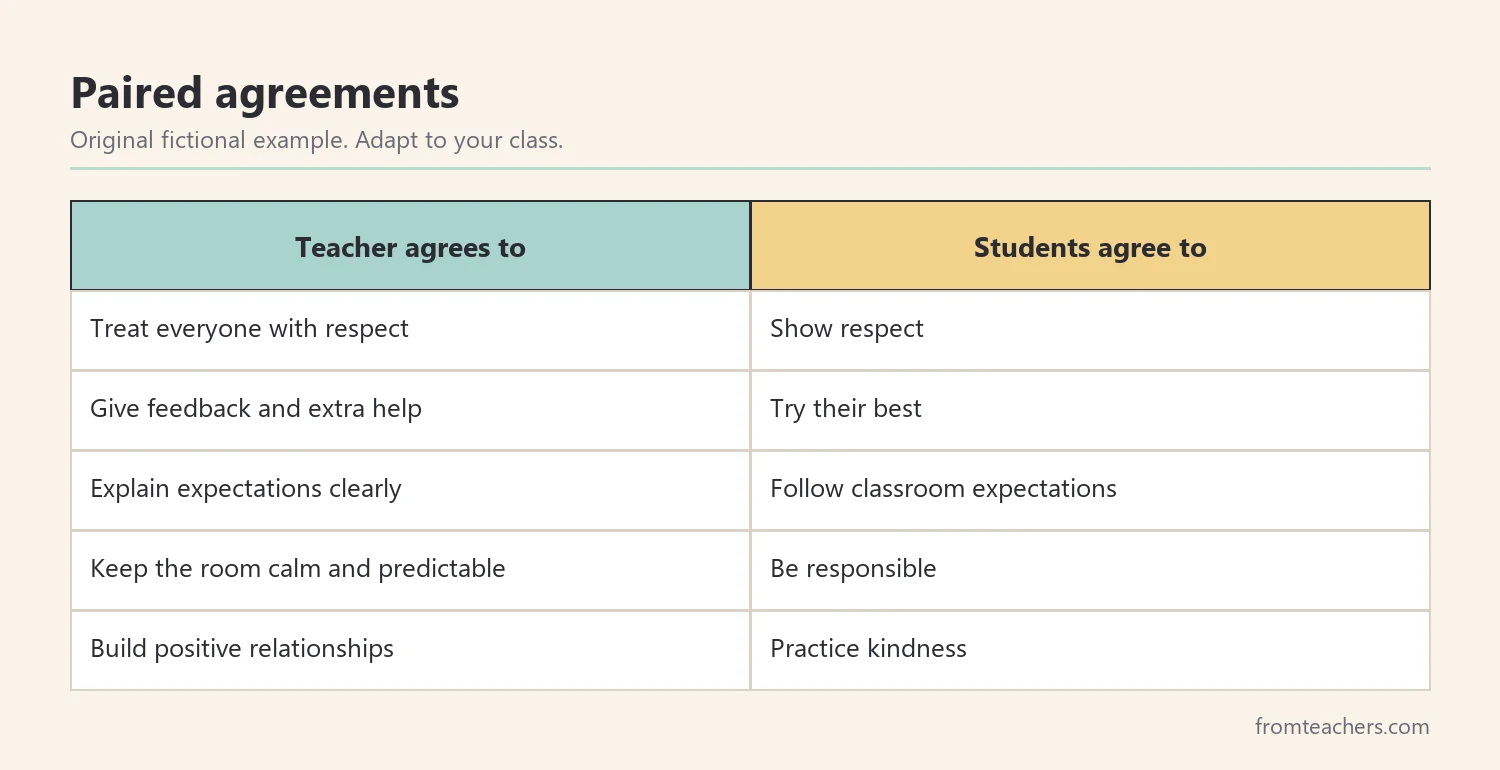
For example, a teacher might agree to create a safe and welcoming environment, listen and communicate clearly, support learning and growth, use fair and consistent expectations, and build positive relationships. Each one should include a short, observable description so students know what it looks like in practice.
Also, match teacher promises to student promises where you can. If students agree to show respect, you agree to treat every student with respect and keep a calm voice. If students agree to try their best, you agree to give helpful feedback and extra help when needed. These pairs make the partnership visible.
Add a clear visual
In addition, a clear visual helps. The teacher and student agreements poster sets out what teachers agree to do and what students agree to do side by side, with a shared goals section about learning together and solving problems calmly. Posting it near your meeting area gives everyone a common reference point.
Then, keep your promises realistic. Only commit to actions you can sustain on a busy day. If you promise to answer every question immediately, you will break that promise by lunchtime. Instead, promise to listen when students share worries and to come back to them when you can.
Worked example. Mr. Reyes writes five teacher agreements and reads them aloud. One student asks, “So you won’t yell either?” He answers, “That’s right. I agree to use a calm voice, and you can remind me kindly if I forget.” The class laughs, and the mood in the room shifts.
4. Teach classroom agreements like a lesson
Next, treat the agreements as content to teach, not a poster to hang. Students learn expectations the same way they learn math facts: through modeling, practice, and feedback. One reading on the first day is not enough.
First, model each agreement. Show what it looks like and what it does not look like. For “be responsible,” you might demonstrate putting supplies away carefully, then ask students to spot what changed. Short role-plays work well, especially for younger classes.
Also, practice during real routines. The best moments to practice classroom agreements are transitions, group work, and cleanup, since these are times when expectations slip. Before each routine, name one agreement to focus on. Afterward, ask students how it went.
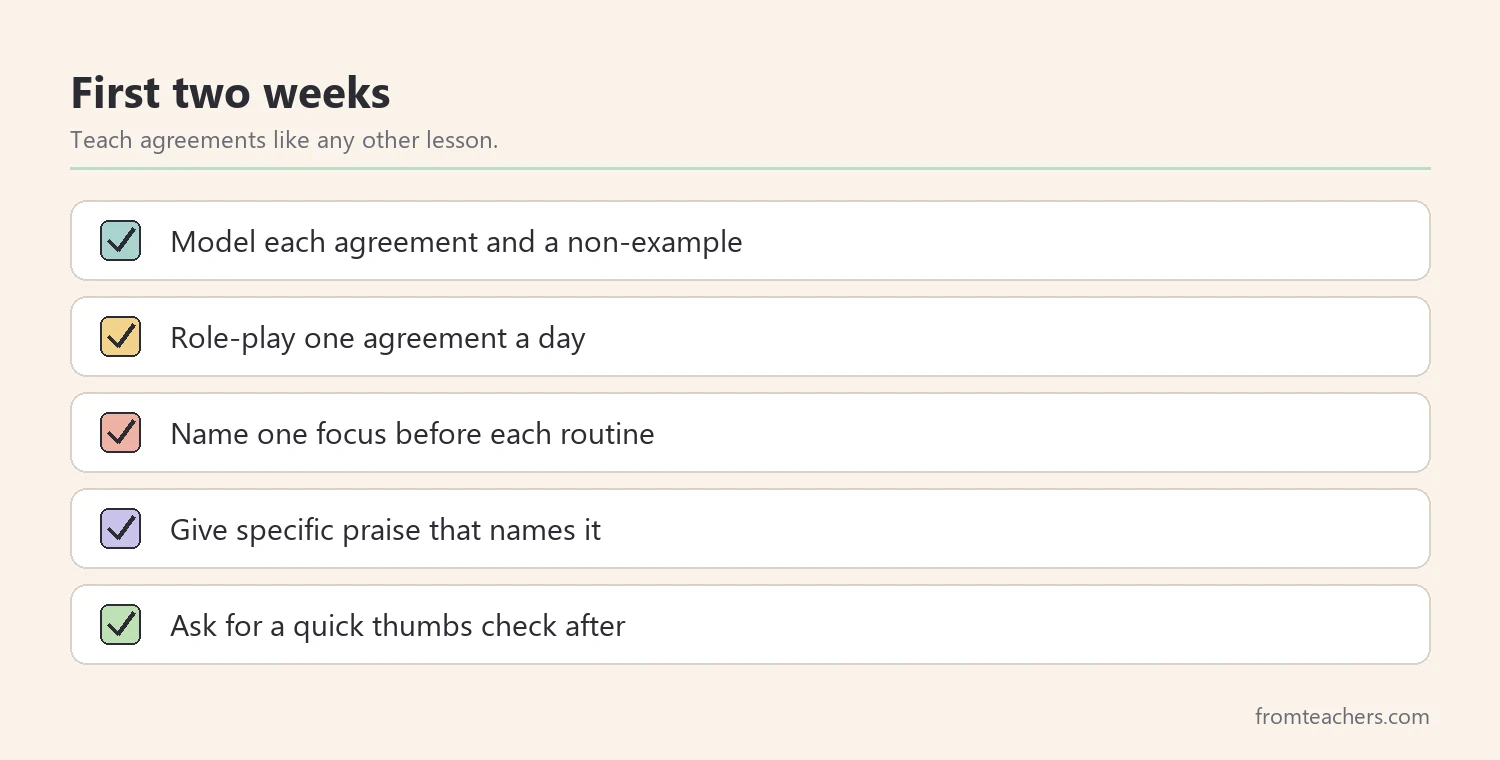
In addition, give specific praise. “Thank you for taking turns at the table, that is kindness and cooperation” teaches more than “Good job.” Specific feedback links the behavior to the agreement, so students learn the meaning behind the words.
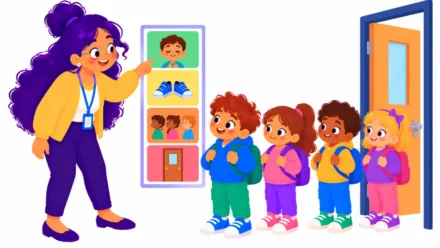
Meanwhile, plan for students who need more support. Some learners benefit from a personal checklist, visual reminders, or a quiet pre-teach before a busy routine. These supports are not special treatment. They help every student access the same shared agreements.
Worked example. For two weeks, Mr. Reyes focuses on one agreement before each transition. Before cleanup, he says, “Today we focus on being responsible.” After cleanup, students show a thumb up, sideways, or down. By day eight, cleanup takes noticeably less time, and fewer supplies are left on the floor.
5. Review and repair your classroom agreements
Finally, keep the agreements alive. Classroom agreements lose power when they are mentioned only after something goes wrong. A short weekly check-in, five to ten minutes, keeps them part of everyday class life.
First, ask simple questions. Which agreement did we keep well this week? Which one was hard? What could help? Students often suggest practical fixes, such as a timer for group work or a signal for quiet voices.
Also, use the agreements for repair, not punishment. When an agreement is broken, refer to it calmly: “Our agreement is to use kind words. What can you do now to fix this?” This keeps the focus on learning and relationships rather than shame.
In addition, revisit your own promises. Ask students whether you kept the teacher agreements. This can feel uncomfortable at first, yet it models honesty and accountability. It also shows students that classroom agreements apply to everyone.
Then, update the agreements when needed. After a long break, a new student joining, or a change in routines, take time to reteach. Small updates keep the list relevant without starting over.
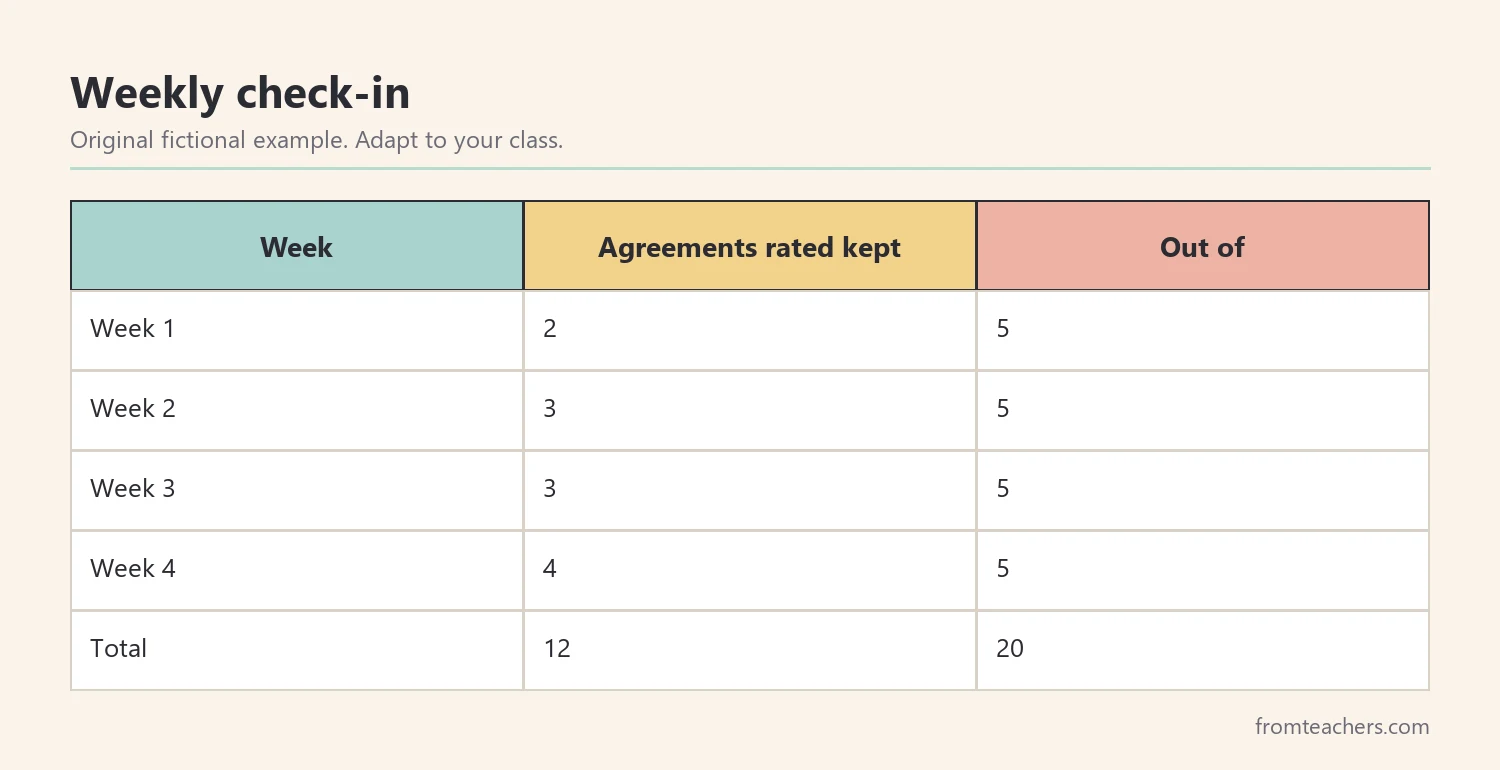
Worked example. Mr. Reyes tracks how many of his five agreements the class rates as kept each week. In week 1, the class rates 2 of 5 as kept. Week 2 brings 3 of 5. In week 3, 3 of 5. By week 4, it is 4 of 5. Over four weeks, that is 12 of 20 ratings marked as kept, and “try your best” becomes the focus for the next month.
Including families
Families can support classroom agreements at home. Send a short note or photo of the poster and invite families to ask their child which agreement they practiced today. This creates a shared language between school and home.
Also, ask families for input. Some families may share what helps their child feel safe or respected. That information can shape how you teach and model the agreements.
Common mistakes and how to avoid them
- Writing the list alone. Students feel no ownership. Fix: hold a short class meeting and build the list together.
- Too many agreements. Nobody remembers them. Fix: keep four to six per group.
- Negative wording. Students know what not to do but not what to do. Fix: rewrite each line positively.
- Only students make promises. It feels unfair. Fix: add clear teacher agreements.
- Teaching once and moving on. Agreements fade. Fix: practice during routines and review weekly.
- Using agreements as threats. Trust drops. Fix: refer to them calmly and focus on repair.
Questions teachers and parents ask about classroom agreements
Are classroom agreements the same as class rules?
Not exactly. Rules are usually set by adults and focus on limits. Agreements are created with students and describe how everyone, including the teacher, will act. Many classrooms use both, with school rules as the base.
What age is right for creating agreements with students?
Students of almost any age can contribute. Younger children may need picture prompts and simple choices, while older students can draft and debate wording. The process adapts to the group.
What if a student refuses to sign?
Do not force it. Have a private, calm conversation to understand the concern. Often the student needs time, a clearer explanation, or a small change in wording.
How often should we review classroom agreements?
A short weekly check-in works well for most classes. Also, reteach after long breaks, when new students arrive, or when routines change.
Can agreements support students with disabilities?
Yes, when they are accessible. Use visuals, simple language, and personal copies where helpful, and make sure the agreements fit any plans and accommodations already agreed by the student’s team.
Related reading: Moving Beyond Shame and Behavior Charts: Positive Alternatives for Effective Classroom Management, Essential Trauma-Informed Teaching Strategies for Modern Classrooms, and How Teachers Communicate With Parents in Special Education: Building a Strong Partnership.
A companion resource for classroom agreements:
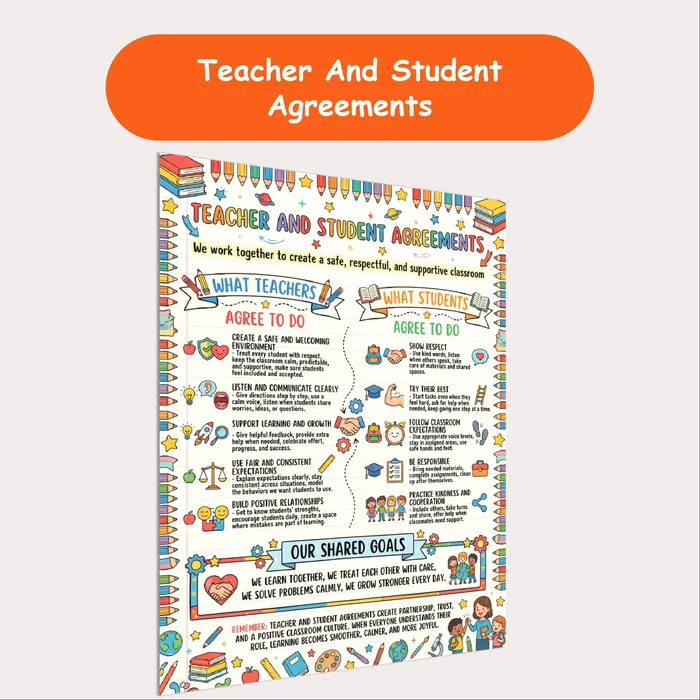
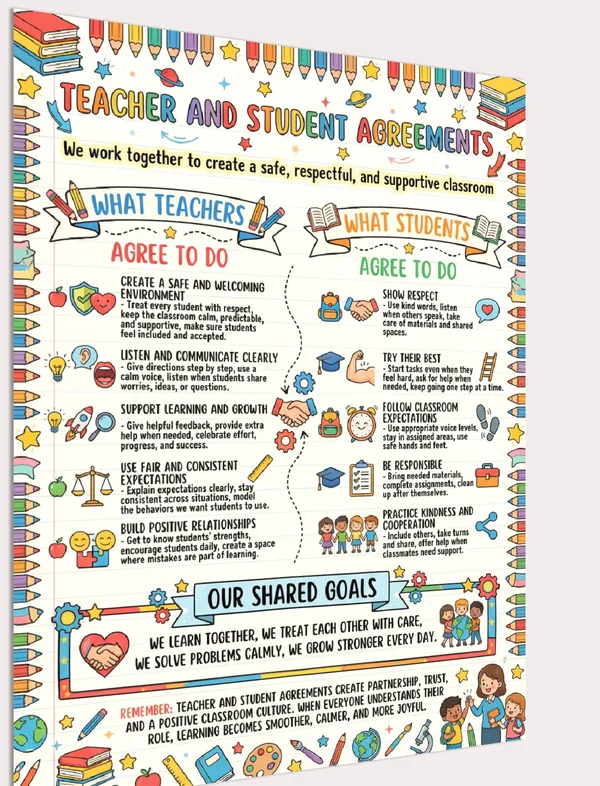
Teacher and Student Agreements Poster: a positive classroom community poster that shows what teachers agree to do and what students agree to do, framing expectations as a partnership for a safe, respectful, and supportive classroom.
Sources and scope
- Center on PBIS: information on positive behavioral interventions and supports, including teaching classroom expectations.
- IRIS Center, Vanderbilt University: free modules on classroom behavior management and routines.
- CASEL: resources on social and emotional learning and supportive classroom environments.
- Understood.org: family-friendly information on learning and thinking differences.
This guide covers everyday practice for building shared expectations in a classroom. It does not replace school-wide policies, individual behavior plans, or the decisions of a student’s support team.
Key takeaways
- Classroom agreements describe how everyone will work together.
- Build them with students and word them positively.
- Add teacher agreements so the partnership is fair.
- Teach, model, and practice them during real routines.
- Review weekly and use them for repair, not punishment.



Leave a Comment