

Whole body listening gives students a clear picture of what it means to be focused and ready to learn. Picture a first grader on the carpet during a read-aloud. She is wiggling, looking at the window, and twisting her shoelace. Then she answers the story question perfectly. Was she listening? Clearly, yes. She just listened in her own way.
This guide gives you five steps to teach whole body listening kindly and flexibly: understand what it is and is not, teach the eight parts, adapt the parts for each student, practice in real lessons, and reflect together. By the end, you will be able to use the idea as a supportive tool rather than a rigid set of rules.
Examples are fictional. Adapt to the student’s goals and agreed supports. This is guidance, not a diagnosis.
At a glance
- Whole body listening uses eyes, ears, mouth, hands, feet, body, brain, and heart to describe focus.
- It is a teaching tool, not a demand to sit perfectly still.
- Every student listens differently, so adapt the parts to each learner.
- Practice in short, real moments with quiet, positive prompts.
- Reflect with students on what helps them listen best.
1. Understand what whole body listening is and is not
First, know the idea. Whole body listening breaks the abstract skill of “paying attention” into concrete parts. Instead of saying “Listen!” an adult can point to a specific part, such as “ears ready” or “body facing.” This helps young learners, students with language needs, and students with attention differences understand what listening involves.
Next, understand the limits. Whole body listening does not mean sitting perfectly still. Some students listen better when they move, fidget, or look away. For example, many autistic students find eye contact uncomfortable or distracting, and they may listen more easily when they look elsewhere. Similarly, students with ADHD often focus better with a small movement outlet.
Also, think of the parts as tools, not tests. The goal is learning, not compliance. If a student understands the lesson while their feet bounce, their listening is working. Professional groups such as speech-language pathologists have encouraged flexible, student-centered use of the concept for this reason.
Then, set a kind tone from the start. Tell students that everyone’s body listens a bit differently, and that the class will find what works for each person. This message builds trust and makes it safe to ask for a tool.
Worked example. Ava is a fictional first grader. Her teacher, Mr. Hassan, notices that she wiggles during stories but usually remembers details. Before teaching whole body listening, he decides to focus on what helps Ava learn, not on how still she looks.
2. Teach the eight parts of whole body listening
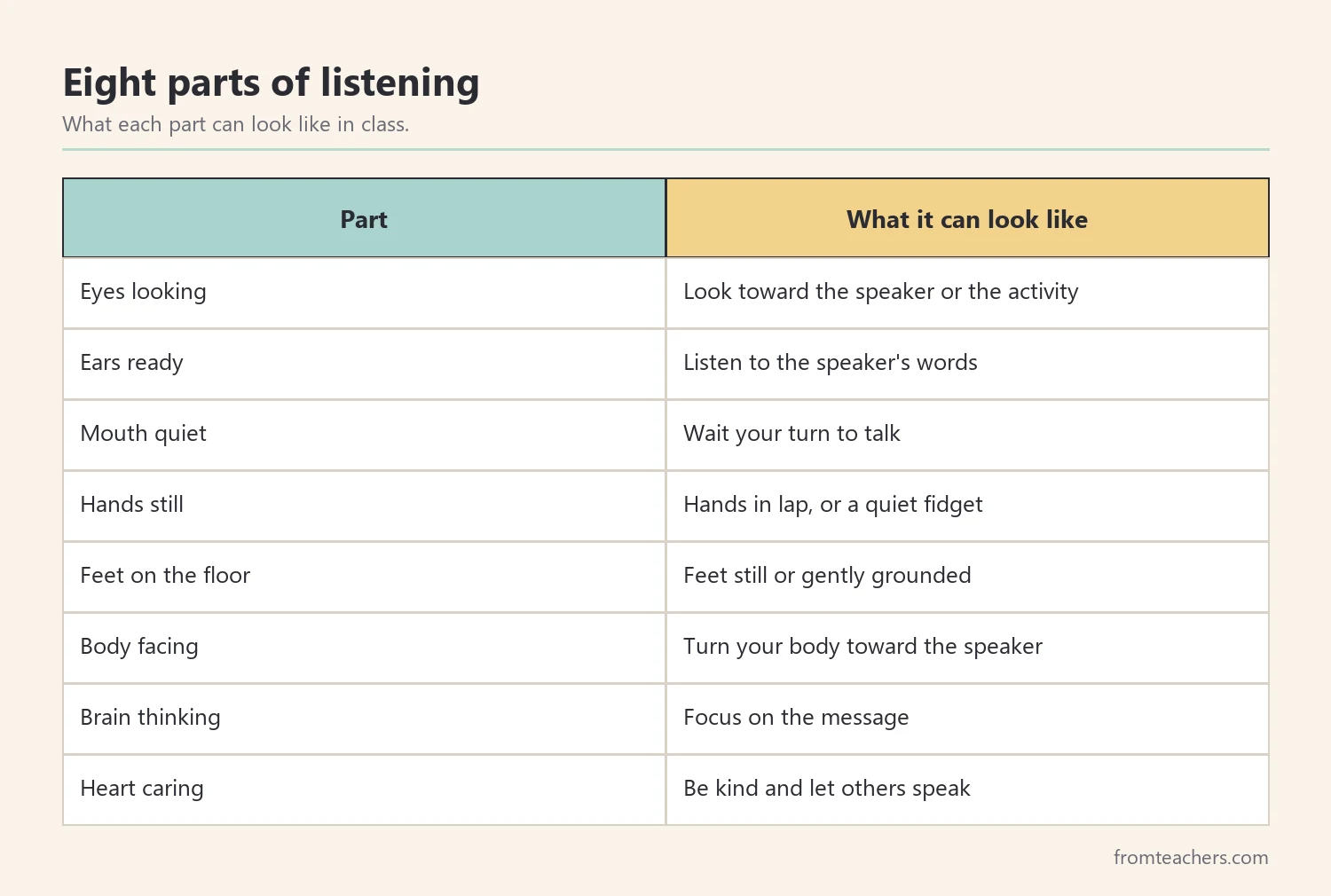
Now, introduce the parts one or two at a time. A common version uses eight parts. Eyes looking means looking toward the speaker or the activity. Ears ready means listening to the speaker’s words. Mouth quiet means waiting for a turn to talk. Hands still means keeping hands in the lap or on the desk, or holding a quiet fidget.
In addition, teach the other four. Feet on the floor means keeping feet still or gently grounded. Body facing means turning toward the speaker. Brain thinking means focusing on the message and making connections. Heart caring means being kind and letting others have their turn.
Also, explain why each part helps. “When our mouths are quiet, everyone can hear.” “When our brain is thinking, we remember more.” Reasons help students see listening as something useful, not just a rule.
For a clear visual, the Whole Body Listening poster shows students how to use their eyes, ears, mouth, hands, feet, body, brain, and heart to show they are focused and ready to learn. It suits special education, speech therapy, and general classrooms, and it gives the whole class one shared reference.
Moreover, plan the order. Many teachers start with the parts students can see easily, then add the thinking and caring parts later.
| Day | Parts taught | Quick practice |
|---|---|---|
| Monday | Eyes and ears | Look at the book during a story |
| Tuesday | Mouth and hands | Use a hand signal to ask for a turn |
| Wednesday | Feet and body | Turn to face a classmate who is sharing |
| Thursday | Brain and heart | Retell one idea and thank the speaker |
Then, model each part with a short role-play. Show a strong example and a gentle, funny non-example. Let students identify the part. Keep the mood light, because laughter helps memory and lowers anxiety.
Worked example. Mr. Hassan teaches two parts each day for a week. On Monday, the class learns eyes looking and ears ready. He models looking at the book during a story, then pretends to stare at the ceiling. The class giggles and shows him the right way.
3. Adapt whole body listening for each student
Next, personalize the parts. The poster gives a shared language, but each student may need a different version. A flexible plan keeps the idea helpful for students with sensory needs, motor needs, autism, ADHD, or anxiety.
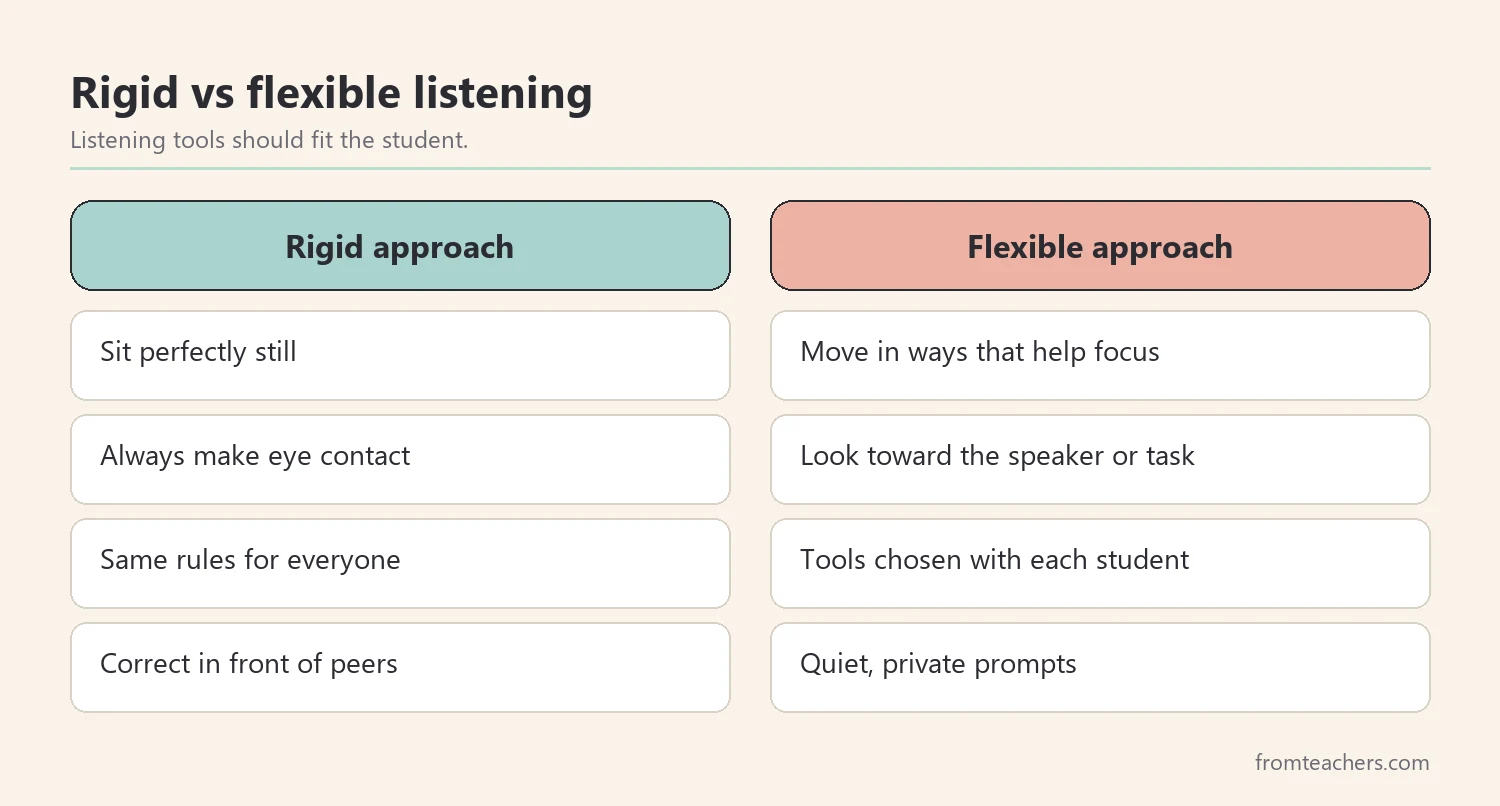
First, review eye contact carefully. “Eyes looking” can mean looking toward the speaker, the book, or the board. It does not have to mean looking into someone’s eyes. Make this clear to every adult in the room.
Next, offer movement options. A wobble cushion, a standing spot, a quiet fidget, or a resistance band on a chair can help some students focus. These tools support “hands still” and “feet on the floor” in a way that fits the student’s body.
Also, consider sensory needs. Some students listen better with a little distance from peers, at the edge of the carpet, or away from a noisy door. Others may need short breaks during long listening times. Small changes can make whole body listening possible for students who otherwise struggle.
Then, write a short individual plan. List the parts, the student’s version of each, and the tools that help. Share the plan with the family and other adults. If the student has an IEP, 504 plan, or therapy goals, work with the team so the plan fits those supports.
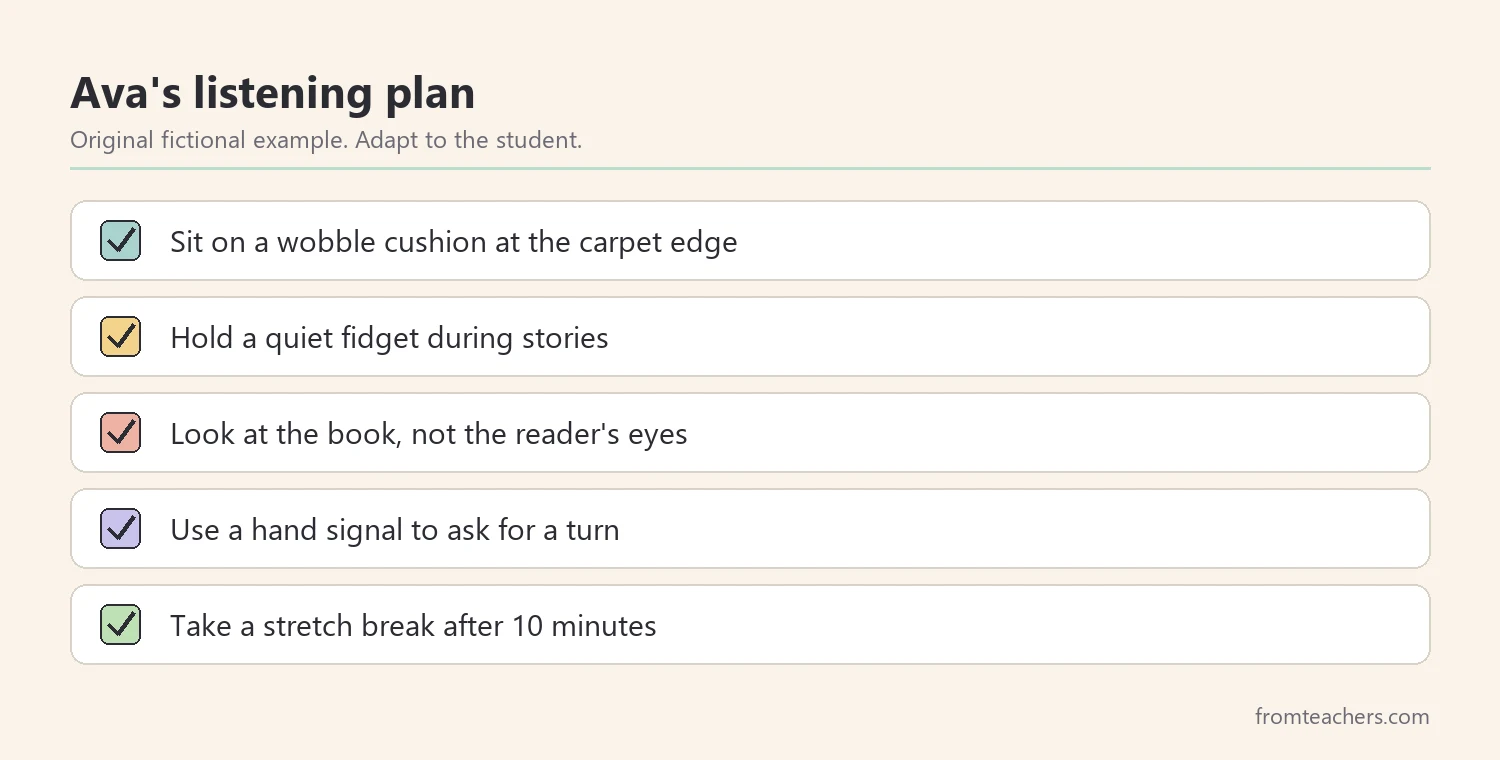
Worked example. Mr. Hassan and Ava create a listening plan together. She chooses a wobble cushion at the edge of the carpet and a quiet fidget for stories. They agree that she can look at the book instead of his face, and that she will take a short stretch break after ten minutes.
4. Practice whole body listening in real lessons
Now, bring the parts into daily routines. Practice works best in short, real moments: morning meeting, read-alouds, directions before an activity, or a classmate’s presentation. Each moment is a chance to use the shared language.
First, set a goal before the activity. “During this story, let’s focus on brain thinking. I’ll ask you one question at the end.” A single focus is easier than all eight parts at once.
Next, use quiet, positive prompts. Point to the part on the poster, use a hand signal, or give a gentle touch to the card on a student’s desk. Avoid calling out students in front of peers. Private prompts protect dignity and keep the lesson moving.
Also, notice success. Say, “I saw many bodies facing the speaker during sharing time. That helped our friends feel heard.” Specific praise shows students what to repeat. Moreover, it makes whole body listening feel like a shared class goal rather than a test.
In addition, try partner practice. Pair students and let one share a short idea while the other listens. Then the listener repeats one detail back. Partner practice turns listening into an active skill and gives every student a turn in a few minutes.
Then, keep listening times realistic. Young students and students with attention needs may not manage long stretches of listening. Break long talks into shorter parts, add movement breaks, and use visuals. Shorter, successful practice builds skill better than long, frustrating sessions.
Worked example. Before story time, Mr. Hassan says, “Today, let’s work on mouth quiet. Use your hand signal if you want a turn.” Ava raises her hand signal twice and waits. Afterwards, he tells her privately that waiting her turn helped her classmates hear the story.
5. Reflect on whole body listening and adjust
Finally, reflect with students. Ask, “Which part helped you listen today? Which part was hard?” Reflection builds self-awareness, which helps students choose their own tools later.
In addition, keep a light record. Count prompts during one routine, such as story time, for a few weeks. If prompts go down, the plan is working. If they stay high, change something: the seat, the tool, the length of the activity, or the type of prompt.
Also, remember the heart part. Heart caring reminds students that listening is about other people too. Talk about how it feels when someone listens to you. This links listening to kindness and belonging.
Next, invite students to teach the parts. A student who explains “body facing” to a younger class or a new classmate often understands it more deeply. Teaching others also builds confidence and leadership.
Then, share progress with families. Families can use the same words at home, for example during a bedtime story. Shared language helps students connect skills across settings.
Moreover, keep the focus on learning. Whole body listening is a helpful framework, but the real goal is understanding and participation. If a student is learning and taking part, small differences in posture or movement are not a problem.
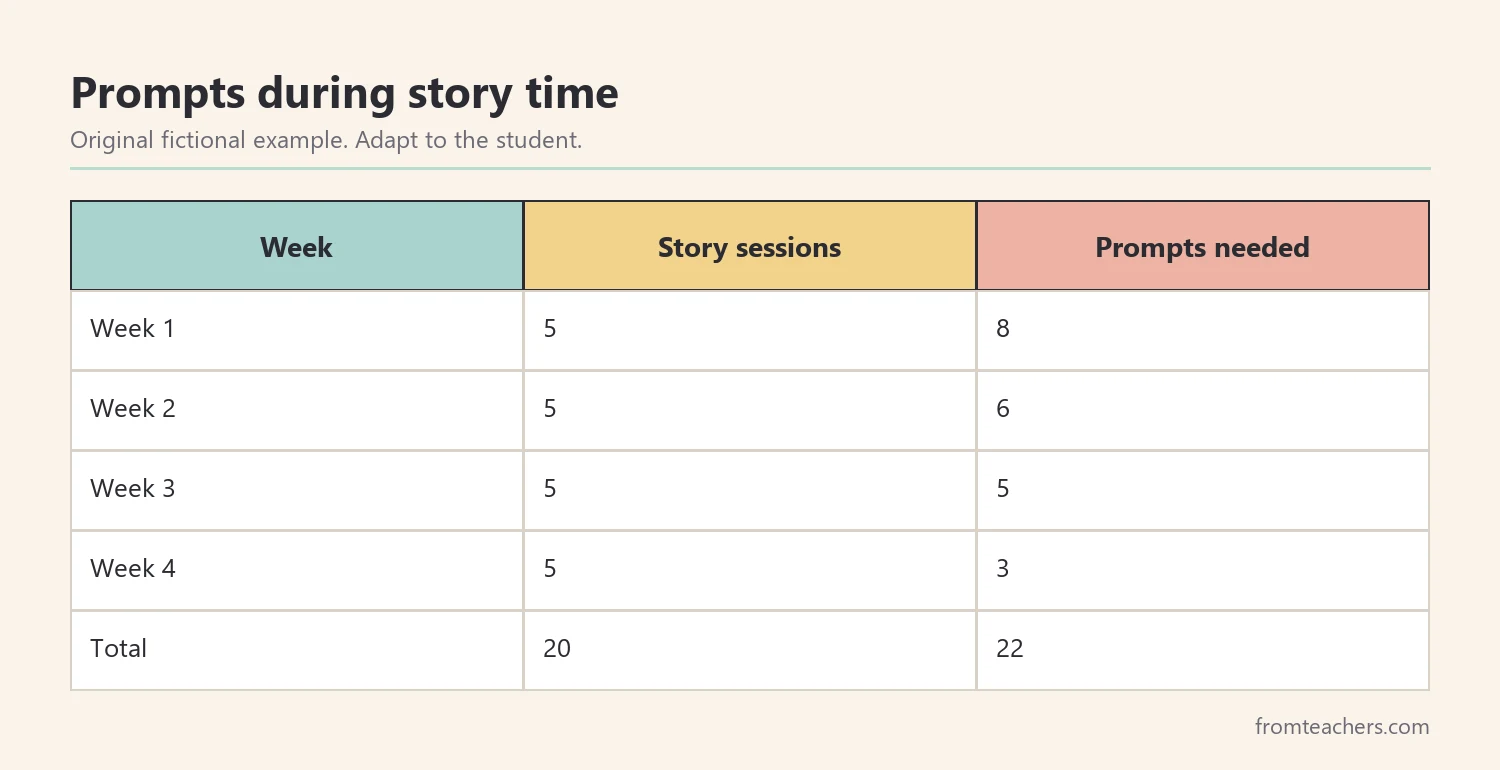
Worked example. Over four weeks, Mr. Hassan counts Ava’s prompts during five story sessions a week. She needs 8 prompts in week one, 6 in week two, 5 in week three, and 3 in week four, for 22 across 20 sessions. Ava says the wobble cushion helps most, so it stays in her plan.
A note for specialists. Speech-language pathologists, occupational therapists, and special education teachers can each add useful ideas to a listening plan. A therapist may suggest a seating option, a sensory tool, or a visual cue that fits the student’s goals. Bringing these views together keeps the plan practical and respectful.
Common mistakes and how to avoid them
- Demanding perfect stillness. Some students focus better with movement. Fix: allow tools such as fidgets and wobble cushions.
- Requiring eye contact. It can be uncomfortable or distracting. Fix: accept looking toward the speaker or the task.
- Using the poster as a punishment. Students start to dislike the idea. Fix: use quiet, positive prompts and praise.
- Teaching all eight parts at once. It overwhelms young learners. Fix: teach one or two parts at a time.
- One plan for everyone. Needs differ widely. Fix: write individual plans where needed.
Questions teachers and parents ask about whole body listening
Is whole body listening appropriate for autistic students?
It can be, when used flexibly. Avoid requiring eye contact or stillness, and adapt each part with the student. Work with the student, family, and support team to decide what helps.
What age is it for?
It is often used with young children and in special education and speech therapy. Older students can use a simpler version, focusing on a few parts that help them most.
Can fidgets really help listening?
For some students, yes. A quiet fidget can give the hands something to do so the brain can focus. Teach clear expectations for fidget use and watch whether it helps or distracts.
How do I prompt without embarrassing a student?
Use a hand signal, point to the poster, or tap a desk card. Private, quiet prompts keep the focus on learning and protect the student’s dignity.
Can families use this at home?
Yes. Families can use the same words during stories, meals, or conversations. Share the student’s individual plan so home and school stay consistent.
Related reading: Effective ADHD Classroom Strategies to Support Student Success, Managing Sensory Overload: Practical Strategies for Autism and ADHD, and 5 Practical Teaching Tips to Boost Classroom Focus and Learning.
A companion resource for whole body listening:
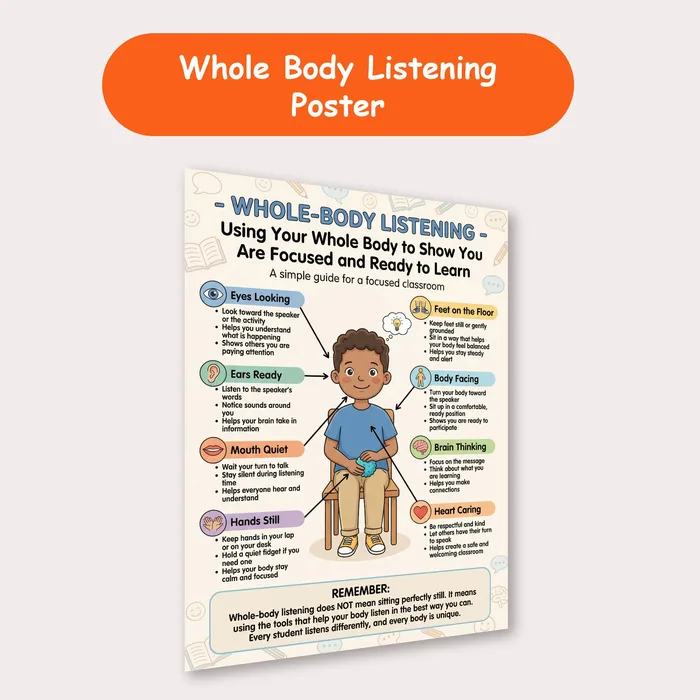
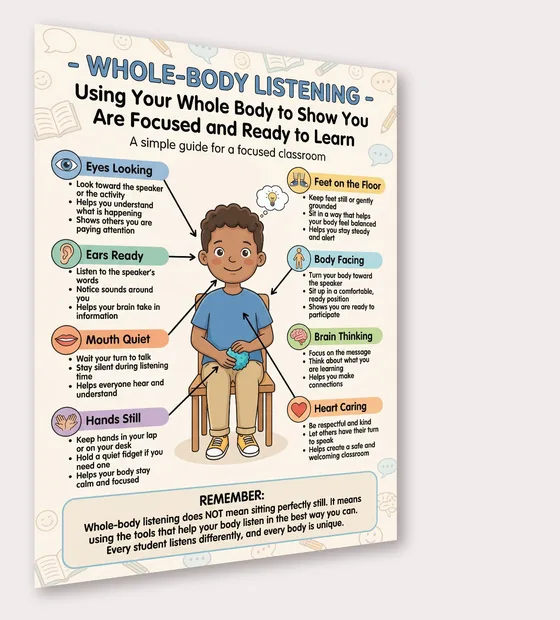
Whole Body Listening Poster: a clear listening skills poster that shows students how to use their eyes, ears, mouth, hands, feet, body, brain, and heart to show they are focused and ready to learn.
Sources and scope
- American Speech-Language-Hearing Association (ASHA): professional information on listening, language, and communication.
- IRIS Center, Vanderbilt University: free modules on classroom behavior and supports for students with disabilities.
- CAST UDL Guidelines: a framework for designing flexible learning for all students.
- Understood.org: family-friendly information on attention and learning differences.
This guide covers flexible classroom and home use of a common listening framework. It does not replace speech-language therapy, occupational therapy, evaluation, or the decisions of the student’s support team.
Key takeaways
- Use the eight parts as a shared language, not a test.
- Do not require stillness or eye contact.
- Adapt each part with the student and the team.
- Practice in short, real moments with quiet prompts.
- Reflect together and adjust the plan over time.








Leave a Comment