

Expected and unexpected behaviors give students a simple, shame-free way to talk about what helps a classroom feel safe, calm, and ready to learn. Picture a second grader who grabs the class tablet during centers. One adult says “Stop being bad.” Another says, “Grabbing is unexpected here. It makes others feel upset. Let’s ask for a turn.” Only the second response teaches a skill the child can use tomorrow.
This guide walks you through five steps: define the language, teach it with clear examples, explain why behaviors matter, practice in real routines, and respond to unexpected moments with support instead of punishment. By the end, you will have a full plan you can start this week.
Examples are fictional. Adapt to the student’s goals and agreed supports. This is guidance, not a diagnosis.
At a glance
- Expected behaviors help everyone learn, feel safe, and work together.
- Unexpected behaviors make that harder, but they are not “bad.”
- Teach the words with concrete, visual examples from your own routines.
- Always explain the why: how a behavior affects other people.
- Treat unexpected behavior as a signal for support, clarity, or regulation.
1. Define expected and unexpected behaviors in plain words
First, decide exactly what the two terms mean in your room. Expected behaviors are the actions that help people learn, feel safe, and work together. Unexpected behaviors are actions that make it harder for you or others to learn, feel calm, or stay safe. In fact, this framing comes from social thinking style teaching, and it shifts the talk away from “good” and “bad.”
Next, keep the definitions short enough for your youngest or most anxious learner. A child who is already overwhelmed cannot process a paragraph. Two sentences on a poster, repeated the same way by every adult, work far better than long lectures.
Also, connect the terms to place and time. Shouting is unexpected during silent reading, yet cheering may be expected on the playground. So, when you introduce expected and unexpected behaviors, always name the setting. This helps students understand that behavior depends on context, not on who they are as people.
Consider Leo, a fictional student in grade 2. Leo often calls out answers and leaves his seat to look at the fish tank. His teacher, Ms. Ortiz, does not tell him he is naughty. Instead, she says, “Calling out is unexpected during a lesson. Raising a hand is expected. It helps everyone get a turn.”
Finally, agree on the words as a team. The classroom teacher, the paraprofessional, specialists, and families should all use the same phrases. Consistent language reduces confusion, especially for students with autism, ADHD, or language delays.
| Term | Student-friendly meaning |
|---|---|
| Expected | Helps everyone learn, feel safe, and work together |
| Unexpected | Makes it harder to learn, feel calm, or stay safe |
| Context | Where we are and what we are doing right now |
2. Teach expected and unexpected behaviors with clear examples
Once the definitions are set, students need examples of expected and unexpected behaviors. Abstract words like “respect” mean little to many young learners. Concrete actions, shown side by side, make expected and unexpected behaviors easy to see and remember.
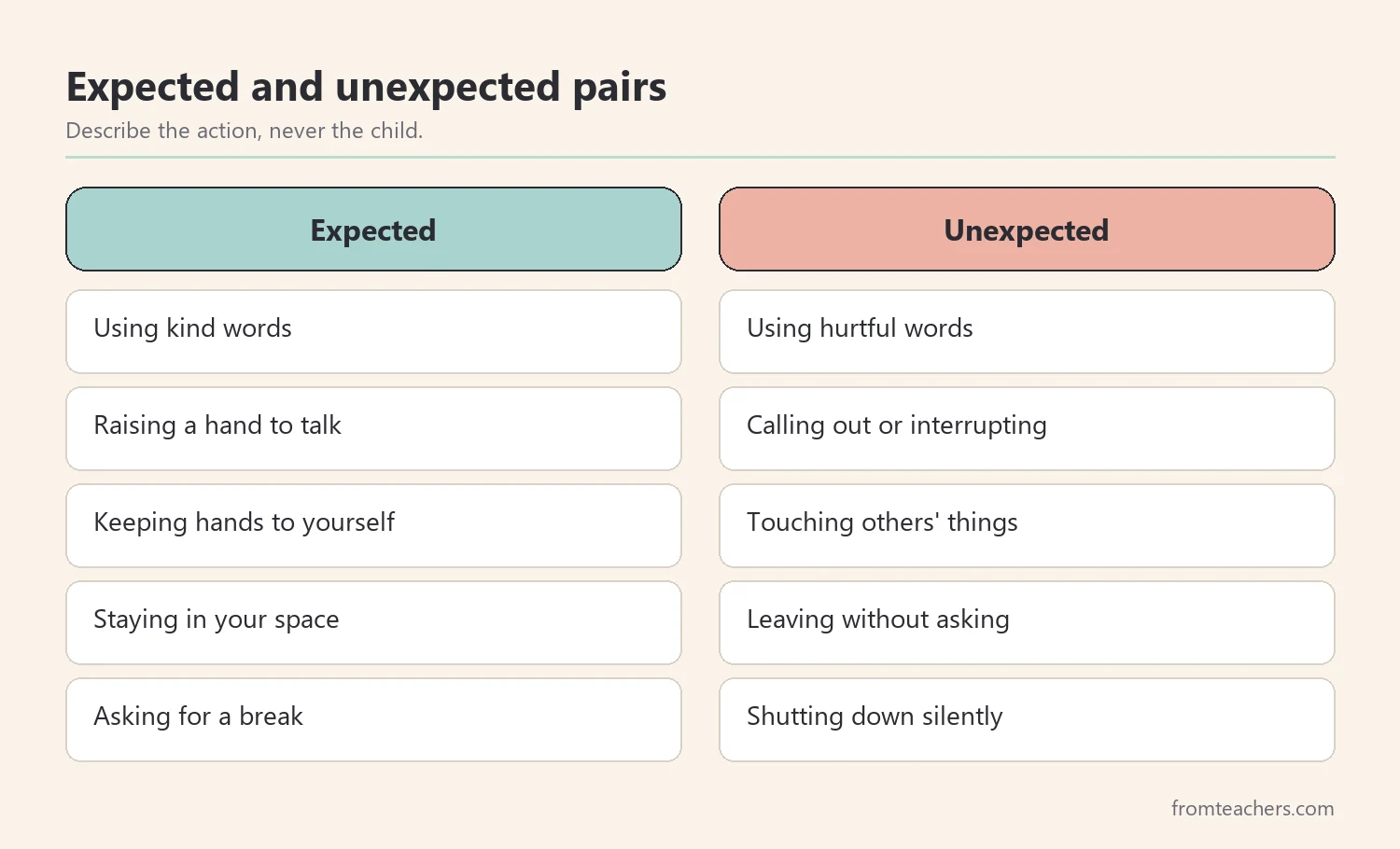
Start with a short list of everyday actions. Expected examples include using kind words, following directions the first time or asking for help, listening when others speak, keeping hands and body to yourself, trying your best even when it is hard, staying in your space unless given permission, taking turns, and using break cards or calm strategies when needed.
Then, pair each one with a matching unexpected action. Examples include interrupting or using hurtful words, ignoring directions, touching others’ belongings without permission, leaving the classroom unexpectedly, running or grabbing, being silly at unsafe times, and shutting down without asking for a break.
Add pictures to the words
In addition, use pictures. Many students read images faster than words. A visual poster with small icons next to each behavior gives a quick reference during busy moments. For instance, a ready-made expected vs unexpected behaviors poster places both columns side by side with simple illustrations, which saves you from drawing your own.
For Leo, Ms. Ortiz chose three pairs to teach first: raising a hand versus calling out, staying in his seat versus wandering, and asking for a break versus leaving the room. Three pairs were enough. She added more only after he could name these on his own.
Moreover, teach in short bursts. Five to ten minutes at morning meeting is plenty. Read one pair aloud, act it out, and ask students to show a thumbs up for expected and a thumbs sideways for unexpected. Keep the tone light and curious.
3. Explain why expected and unexpected behaviors matter
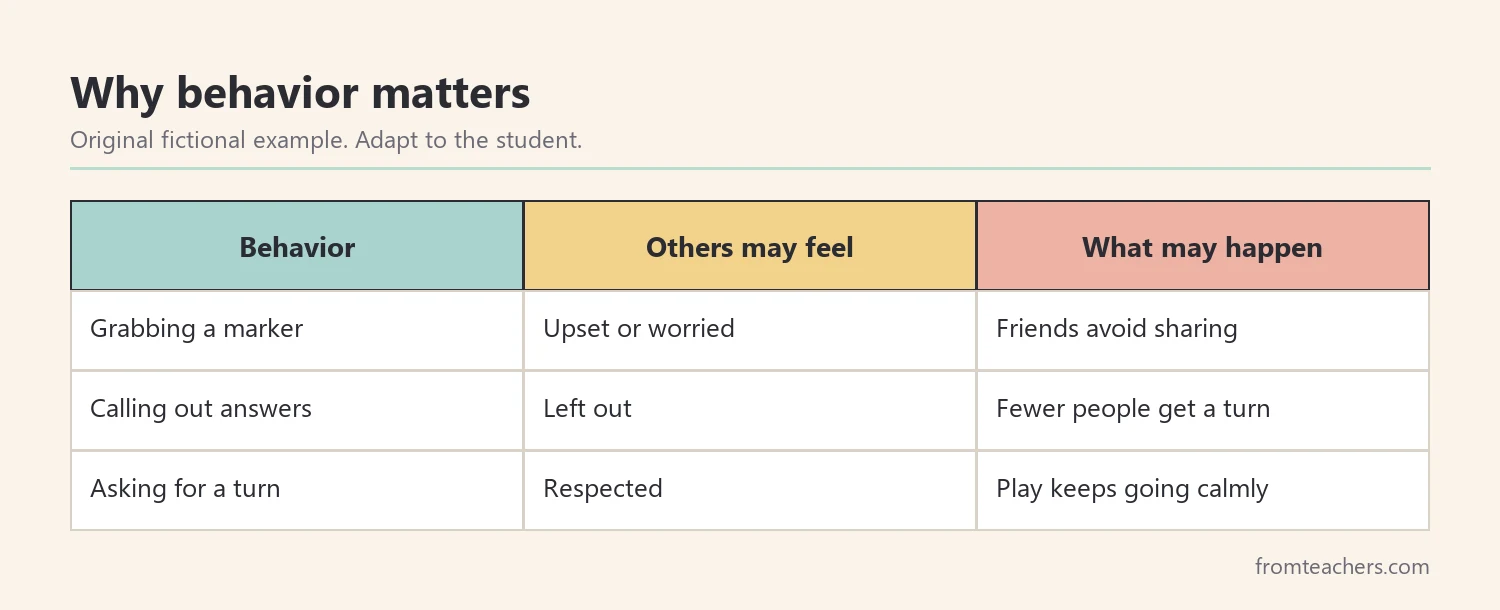
Students follow expectations more readily when they understand the reason behind them. So, after teaching examples, explain the effect each behavior has on other people. This is the heart of the approach.
Expected behaviors help the classroom feel predictable and comfortable. They show others that you are trying your best, making safe choices, and respecting the people around you. As a result, everyone can learn more easily.
By contrast, unexpected behaviors can make the room feel confusing, unsafe, or unpredictable. They can make it harder for the teacher to help you and harder for classmates to focus. Importantly, they also signal that a student might need support, a break, or clearer instructions.
Ask thinking-about-others questions
Next, use simple “thinking about others” questions. Ask, “How might your friend feel if someone took her marker?” or “What happens to the lesson when three people talk at once?” Let students answer in their own words. Accept gestures, pictures, or short phrases from students who need them.
For Leo, the turning point was the fish tank. Ms. Ortiz asked, “When you walk to the tank during math, what do the other kids look at?” Leo grinned and said, “Me.” That short exchange did more than any rule chart. He could see the effect on his classmates.
Finally, remind students that everyone does unexpected things sometimes, including adults. Model it: “I raised my voice just now. That was unexpected. I am going to take a breath and try again.” This keeps the language honest and safe.
4. Practice in real routines with cues
Knowing the words is not the same as using them under pressure. Therefore, practice expected and unexpected behaviors inside the routines where problems actually happen: transitions, centers, lining up, and group work.
Start with role-play, since acting out expected and unexpected behaviors makes them concrete. Ask two students to act out a short scene, such as sharing a glue stick. First, they act out the unexpected version, kept safe and silly. Then, they act out the expected version. The class names which was which and explains why.
Next, add a quiet cue. Point to the poster, tap a small card on the desk, or use a hand signal agreed in advance. Cues work best when they are private and calm. A public correction can feel like shame, which often makes unexpected behavior worse.
Praise expected behavior specifically
Also, praise expected behavior specifically, because noticing the positive side of expected and unexpected behaviors matters as much as correcting. “You kept your hands to yourself in line. That helped everyone get to lunch on time.” Specific feedback tells the student exactly what to repeat. General praise like “good job” carries far less information.
For Leo, Ms. Ortiz placed a small card on his desk with two pictures: a raised hand and a calling-out mouth with a line through it. When he started to call out, she tapped the card. Within two weeks, he often caught himself before she reached his desk.
Moreover, track progress lightly. A simple tally during one lesson each day is enough. Keep the record visible to you and, when helpful, to the student. Students often enjoy seeing their own growth.
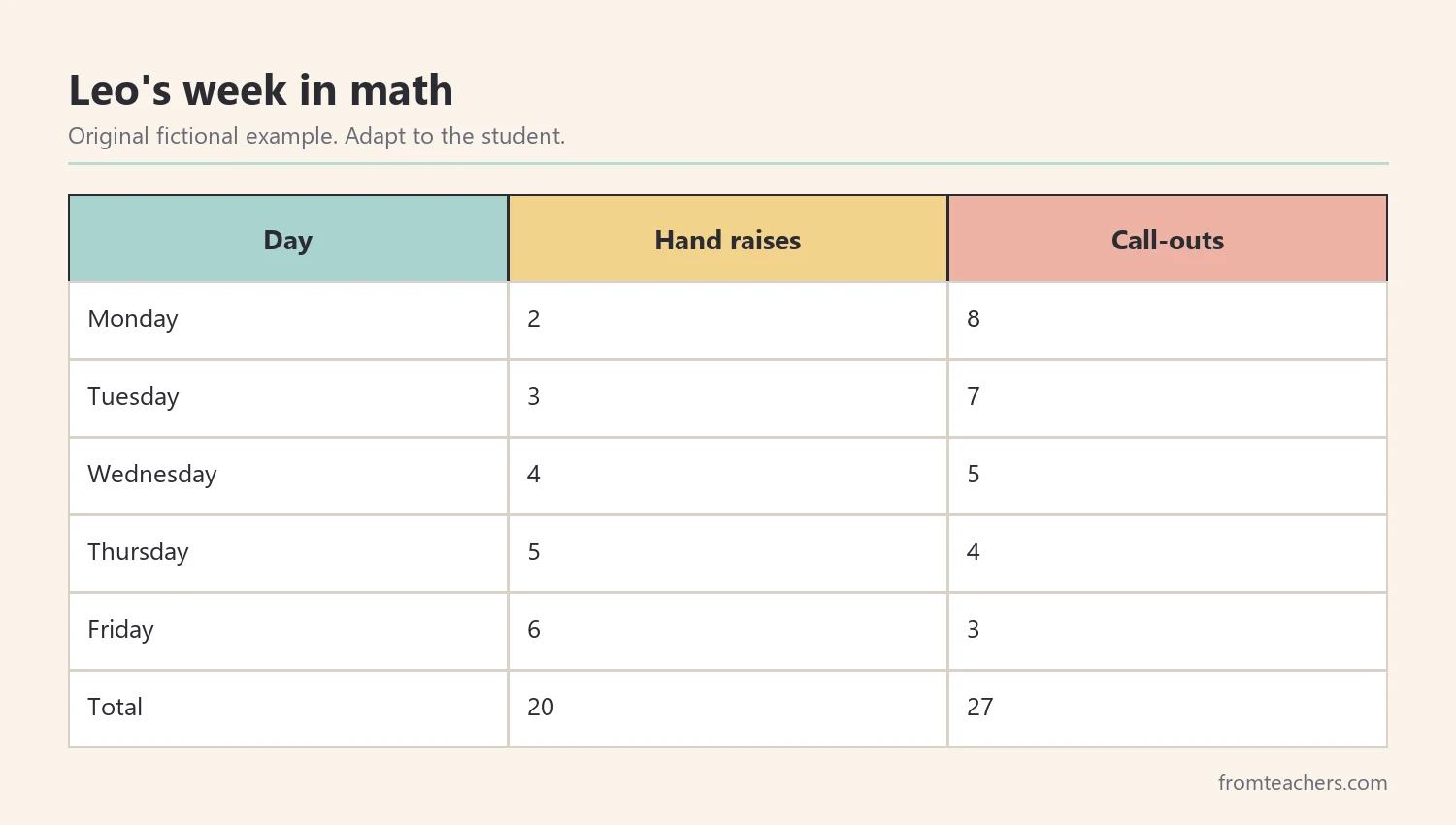
In Leo’s fictional tally, hand raises grew from 2 on Monday to 6 on Friday, while call-outs dropped from 8 to 3. Twenty hand raises and 27 call-outs across the week told the team the cue was helping, but practice still mattered.
5. Respond to unexpected behavior with support
This step matters most when you use expected and unexpected behaviors language every day. Unexpected behavior does not mean “bad.” It means a student needs support, clarity, or regulation. Every behavior is communication, and teaching expected behaviors is about building skills, not punishing mistakes.
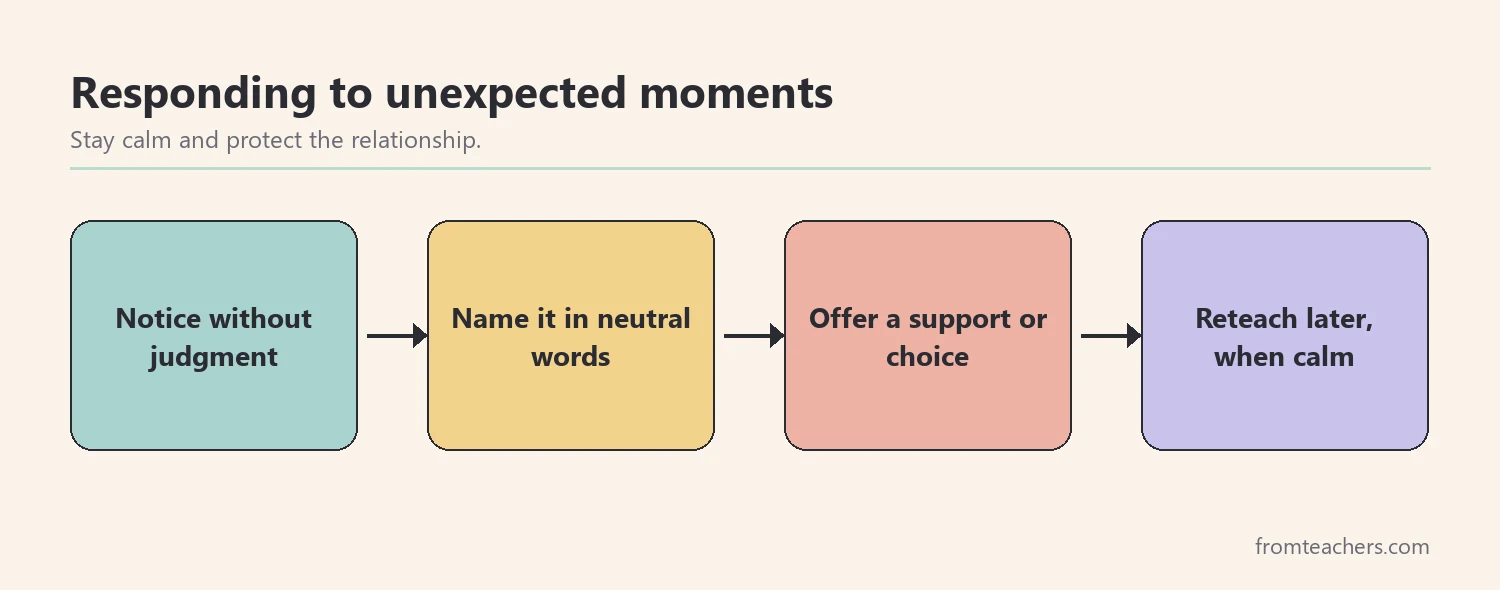
When unexpected behavior happens, follow a short, calm sequence. First, notice what happened without judgment. Then, name it in neutral words. Next, offer a support, such as a break card, a choice, or a quick reminder. Finally, reteach the expected behavior later, when the student is calm.
In addition, look for patterns. If a student shuts down every day during writing, the unexpected behavior may be signaling that the task feels too hard. If a student runs during transitions, the noise or crowding may be too much. Changing the environment or the task often works better than repeating the rule.
For example, Leo left his seat most often in the last ten minutes of math. Ms. Ortiz realized he was finishing early and had nothing to do. She added a short “done early” bin. His wandering dropped, and she did not need a single consequence.
Involve the wider team
Also, involve the wider team when patterns persist. A school psychologist, counselor, or behavior specialist can help with a more detailed look. Families can share what works at home. Together, you can decide whether expected and unexpected behaviors language is enough or whether a more formal plan is needed.
Next, write a short plan for the next month. List the two or three expected and unexpected behaviors pairs you will teach, the routine where you will practice each one, the cue every adult will use, and the day you will review your tally. A plan this small fits on an index card, yet it keeps the whole team aligned. Revisit it at the end of each week and swap in a new pair when students have mastered the old one. In this way, expected and unexpected behaviors become a living part of the classroom, not a poster that fades into the wall.
Finally, protect the relationship. Students learn best from adults who stay calm, kind, and predictable. Short, warm repair after a hard moment, such as “We are okay. Let’s try again,” keeps trust strong.
Common mistakes and how to avoid them
- Using the words as labels. “You are so unexpected” shames the child. Fix: describe the action, never the person.
- Skipping the why. Rules without reasons feel arbitrary. Fix: link each behavior to how others feel.
- Teaching too many pairs at once. Students lose track. Fix: start with two or three pairs from real problem routines.
- Correcting in public. Embarrassment fuels more unexpected behavior. Fix: use quiet, private cues.
- Ignoring the message behind the behavior. The same problem returns. Fix: look for patterns and adjust tasks or settings.
Questions teachers and parents ask about expected and unexpected behaviors
Is this the same as good and bad behavior?
No. The language focuses on effects and context, not on the child’s character. An action can be expected in one place and unexpected in another. That makes the conversation calmer and more useful.
What age is this approach best for?
Teaching expected and unexpected behaviors is common from preschool through upper elementary, and adapted versions work with older students too. Adjust the examples and vocabulary to the age and language level of your group.
Can parents use expected and unexpected behaviors at home?
Yes. Families can use the same words for routines like dinner, bedtime, and car rides. Shared language between school and home helps students transfer skills.
What if a student argues that a behavior is expected?
Listen first. Sometimes the student has a good point about context. Then, calmly explain how the behavior affects others in this setting, and offer a choice that meets the student’s need.
Does this replace a behavior plan?
No. It is a classroom-wide teaching approach. Students with ongoing challenges may need an individual plan developed by the school team with the family.
Related reading: Moving Beyond Shame and Behavior Charts: Positive Alternatives for Effective Classroom Management, Autism Social Skills Development: Practical Strategies for Growth, and Effective ADHD Classroom Strategies to Support Student Success.
A companion resource for expected and unexpected behaviors:
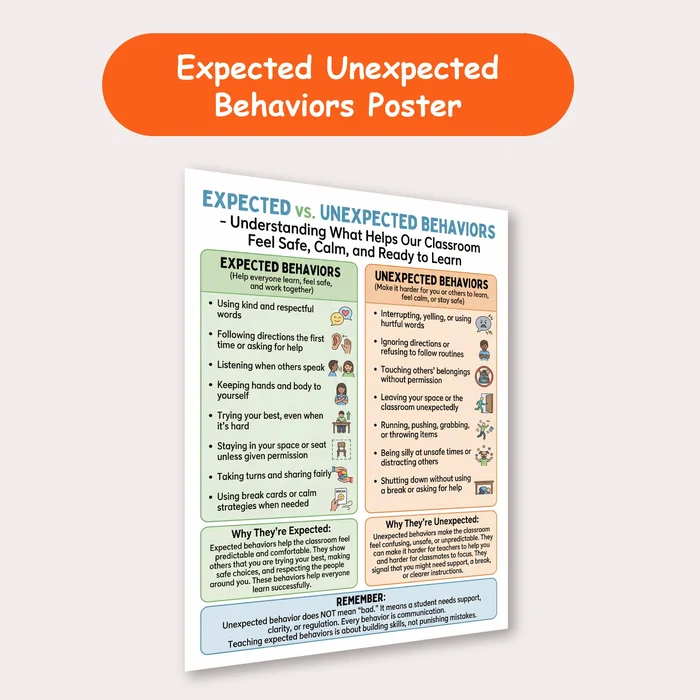
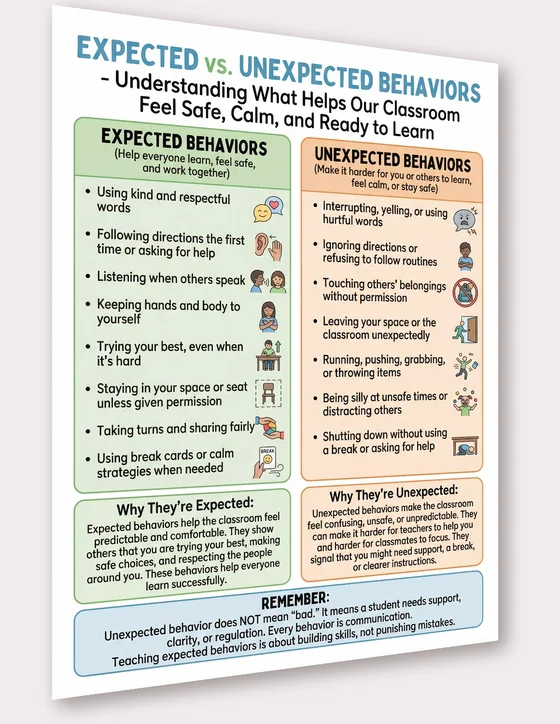
Expected vs Unexpected Behaviors Poster: a classroom behavior visual that shows, side by side, what helps the room feel safe, calm, and ready to learn, in a social thinking style for special education and inclusive classrooms.
Sources and scope
- Center on PBIS: information on positive behavioral interventions and supports in schools.
- IRIS Center, Vanderbilt University: free modules on classroom behavior management.
- CASEL: a framework for social and emotional learning in schools.
- IDEA, U.S. Department of Education: the law behind special education services and supports.
This guide covers everyday classroom teaching of behavior language. It does not replace a functional behavior assessment, an individual behavior plan, or the decisions of the student’s support team.
Key takeaways
- Define expected and unexpected behaviors in short, shared words.
- Teach with paired, visual examples from real routines.
- Explain how each behavior affects other people.
- Practice with role-play, private cues, and specific praise.
- Respond to unexpected behavior with calm support, not shame.







Leave a Comment