

Growth mindset self-talk is the set of short, hopeful sentences students use to keep learning when work feels hard. Picture a fifth grader staring at a fractions problem, pencil frozen, muttering, “I’m just not a math person.” A minute later, he could say something different: “I don’t get it yet, but I will. I can try a different strategy.” Same problem, very different next step.
This guide offers five practical steps to teach growth mindset self-talk: understand what it is and is not, match reminders to real situations, teach the language of “yet,” practice through modeling, and reflect on progress. By the end, you will be able to coach students through hard moments with words they can carry on their own.
Examples are fictional. Adapt to the student’s goals and agreed supports. This is guidance, not a diagnosis.
At a glance
- A growth mindset is about believing you can improve, not about being perfect.
- Self-talk turns that belief into words a student can use in the moment.
- Match reminders to common situations: stuck, frustrated, comparing, giving up.
- Pair every reminder with a real strategy, so effort leads somewhere.
- Model your own self-talk and track progress lightly.
1. Understand what growth mindset self-talk is
First, be clear on the idea. A growth mindset is the belief that abilities can develop through practice, good strategies, and support. A fixed mindset is the belief that abilities are set and cannot change much. The term is closely linked to the work of psychologist Carol Dweck, and it is widely discussed in schools.
Next, notice where self-talk fits. Beliefs are invisible, but words are not. Growth mindset self-talk is the voice students hear inside their heads when something goes wrong. When that voice says “I’ll never get this,” students tend to stop. When it says “I can learn from what didn’t work,” they tend to try again.
Also, be careful about what a growth mindset is not. It is not pretending to be happy. It is not “just try harder” with no help. A student who keeps trying the same failing strategy is not showing a growth mindset; they need a new tool. So, effort must always be paired with strategies and support.
A quick example
Consider Jonah, a fictional student in grade 5. Jonah reads well but avoids math. When a problem looks tricky, he says, “I’m dumb at this,” and puts his head down. His teacher, Ms. Bell, does not argue with the feeling. Instead, she plans to give Jonah new words and new strategies at the same time.
Finally, remember that everyone moves between mindsets. Adults do too. The aim is not to banish fixed thoughts forever. Rather, the aim is to help students notice them and choose a more helpful next sentence. That shift is the core of growth mindset self-talk.
| Idea | What it means in class |
|---|---|
| Growth mindset | I can improve with practice, strategies, and help |
| Fixed mindset | My ability is set, so struggle means I can’t |
| Self-talk | The words I say to myself in the moment |
2. Match growth mindset self-talk to real situations
General slogans are easy to forget. By contrast, a sentence tied to a specific moment is easy to recall. So, organize growth mindset self-talk around the situations students actually face.
Six situations come up again and again in classrooms: when something feels hard, when you feel stuck, when you want to give up, when you feel frustrated, when you compare yourself to others, and when you are ready to try again. Each one deserves its own short reminder.
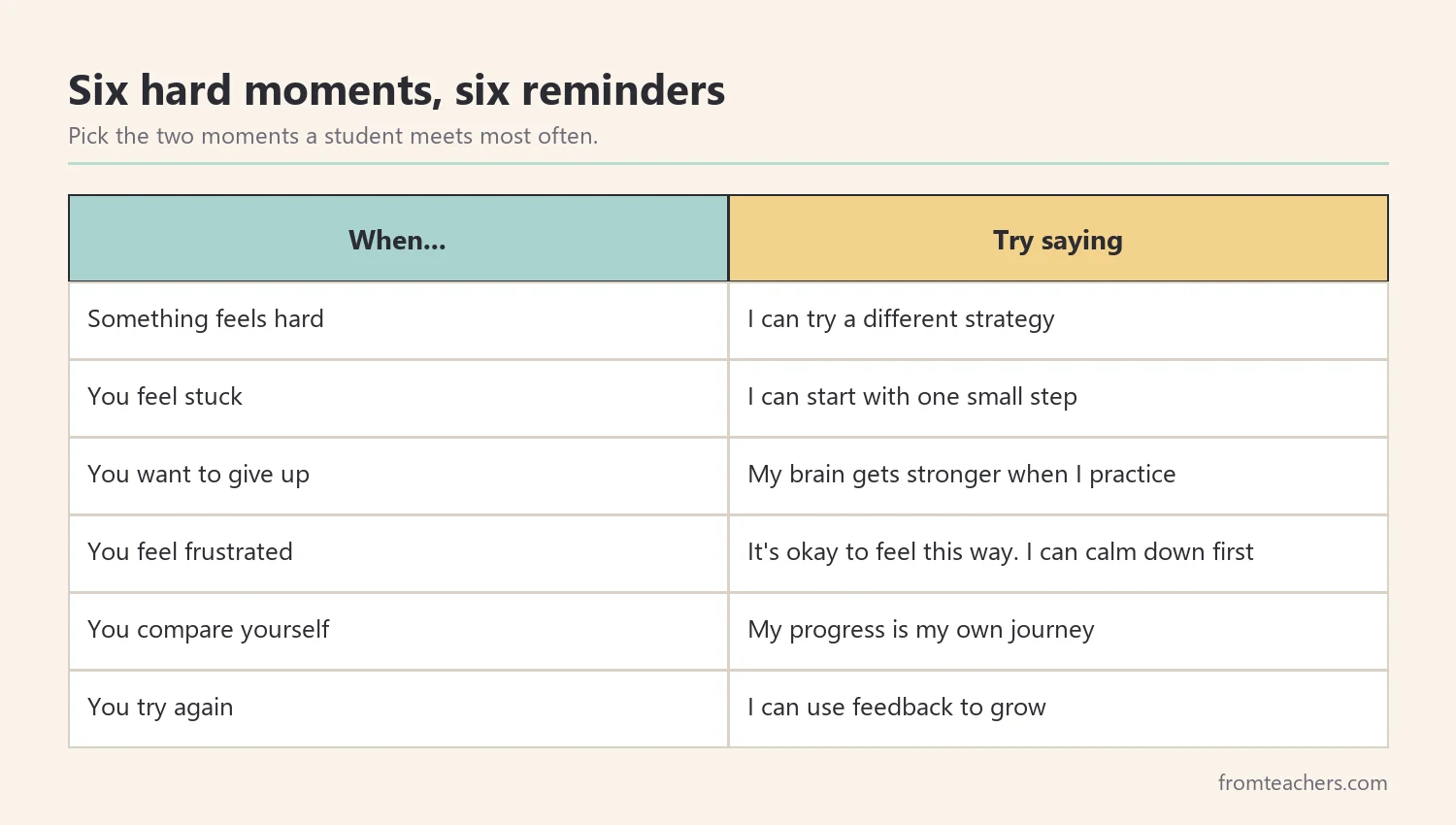
For example, when something feels hard, a student might say, “I can try a different strategy.” When stuck, “I can start with one small step.” On the edge of giving up, “My brain gets stronger when I practice.” When frustrated, “It’s okay to feel this way. I can calm down first.” When comparing, “Everyone learns differently. My progress is my own journey.” When ready to try again, “I can use feedback to grow.”
Put reminders where hard moments happen
Moreover, display the reminders where the hard moments happen. A visual near the math table or the writing center works better than a list in a folder. An illustrated growth mindset reminders poster that groups self-talk under these six situations gives students a quick place to look when they get stuck.
For Jonah, Ms. Bell picked two situations to start: “when something feels hard” and “when you want to give up.” These were the moments when he most often put his head down. She wrote the two reminders on a bookmark that lived in his math folder.
In addition, let students help choose. Ask, “Which of these sounds like something you would actually say?” Students who choose their own words use them more. A student who hates the word “brain” might prefer “I get better when I practice.”
3. Teach the language of “yet” and strategies
One small word does a lot of work in growth mindset self-talk: “yet.” “I can’t do this” sounds final. “I can’t do this yet” leaves the door open. Teaching students to add “yet” is a quick, concrete win.
Next, teach students to swap fixed phrases for growth phrases. Put both versions side by side so students can see the difference. Then, practice the swap with short examples from your own class.
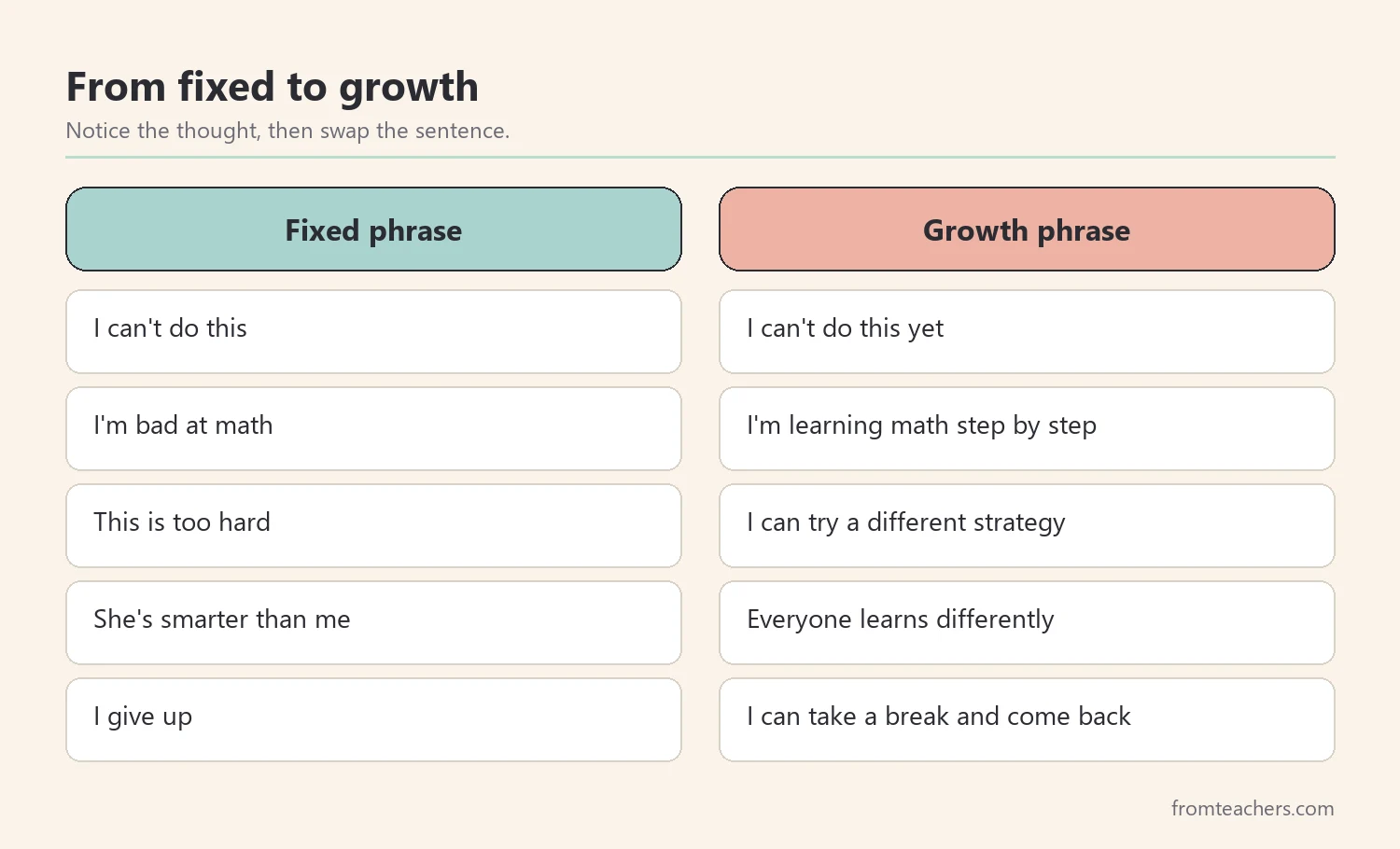
Also, connect every growth phrase to a strategy. “I can try a different strategy” only helps if the student knows some strategies. So, build a short list with the class: reread the problem, draw a picture, try an easier example, check a model, ask a friend, or ask the teacher. Self-talk opens the door, and strategies walk through it.
For Jonah, Ms. Bell made a two-column card. The left side said “I’m dumb at this.” The right side said “I don’t get it yet. I can draw it.” Underneath, she listed three fraction strategies: draw a bar, use fraction strips, or try a simpler number. When Jonah got stuck, he had both a sentence and a plan.
In addition, praise the process, not the person. “You tried drawing it, and that helped” teaches far more than “You’re so smart.” Process praise shows students exactly which actions led to progress, and it reinforces growth mindset self-talk with real evidence.
4. Practice growth mindset self-talk through modeling
Students learn self-talk by hearing it. Therefore, the most powerful teaching tool is your own voice. Think aloud when you face a challenge, and let students hear the shift from a fixed thought to a growth thought.
For example, while writing on the board, make a real or planned mistake. Then say, “Hmm, I got that wrong. My first thought is ‘I’m bad at this.’ But I can learn from what didn’t work. Let me check my steps.” This short moment shows students the whole process in under thirty seconds.
Next, teach a short in-the-moment routine. When a hard thought shows up, students notice it, pause and breathe, pick a reminder, and try a strategy. Four steps are easy to remember and easy to practice.
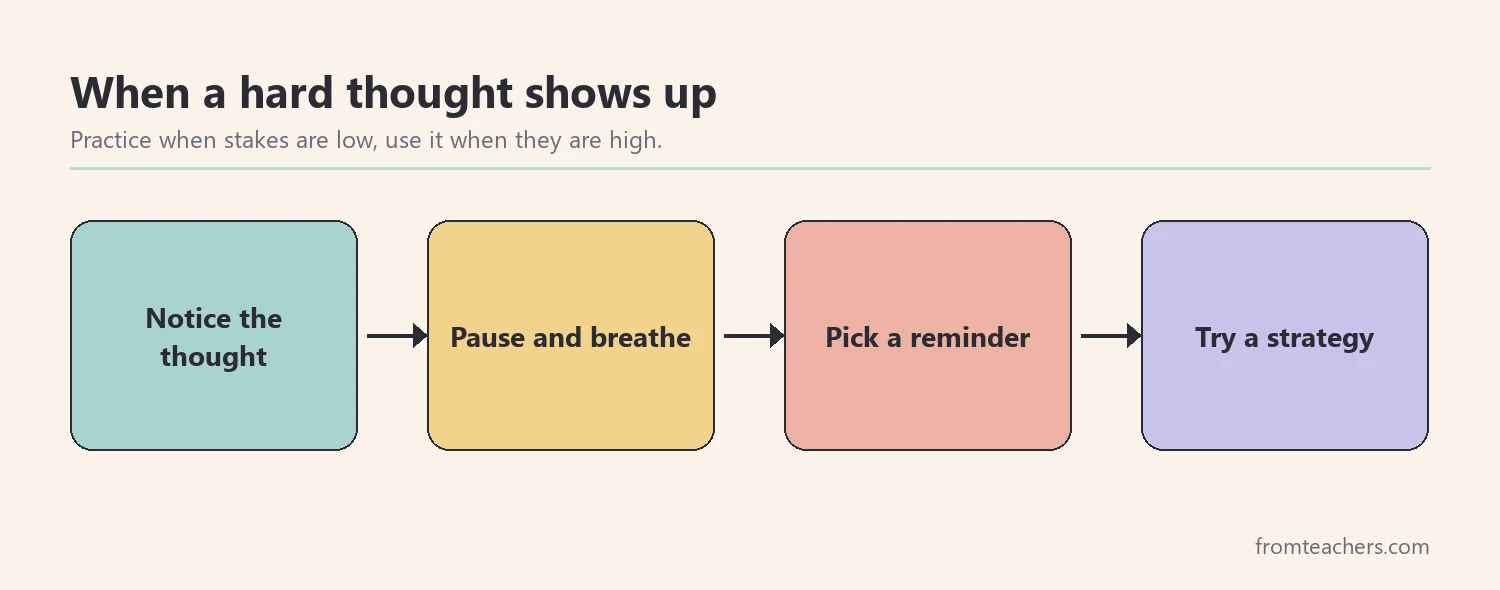
Practice when stakes are low
Then, practice the routine when stakes are low. Use quick puzzles, brain teasers, or tricky warm-up problems. Students rehearse growth mindset self-talk in a safe moment, so it is ready when real stress arrives.
For Jonah, Ms. Bell used a daily “tricky problem” warm-up. Each day, one problem was slightly too hard on purpose. Students wrote one self-talk sentence and one strategy before starting. After two weeks, Jonah wrote, “I can’t do it yet. I will draw it,” without looking at his bookmark.
Also, support students who need more help with feelings. Frustration can be intense, especially for students with ADHD, anxiety, or learning disabilities. “It’s okay to feel this way. I can calm down first” gives permission to regulate before trying again. Some students may need a short break or a calm space first.
Moreover, invite peers to model. Ask a student who just solved something hard, “What did you tell yourself?” Hearing growth mindset self-talk from a classmate often lands differently than hearing it from an adult.
5. Reflect and track growth
Finally, help students see their own progress. A growth mindset grows stronger when students have real evidence that practice works. So, build short reflection moments into the week.
Start with simple prompts: “What was hard this week?” “What did you tell yourself?” “What strategy helped?” Students can answer in a journal, on a sticky note, or out loud. Keep it to two or three minutes.
Then, track a few concrete signs. For example, count how often a student starts a hard task without help, uses a self-talk phrase, or asks for help instead of shutting down. A simple weekly record is plenty.
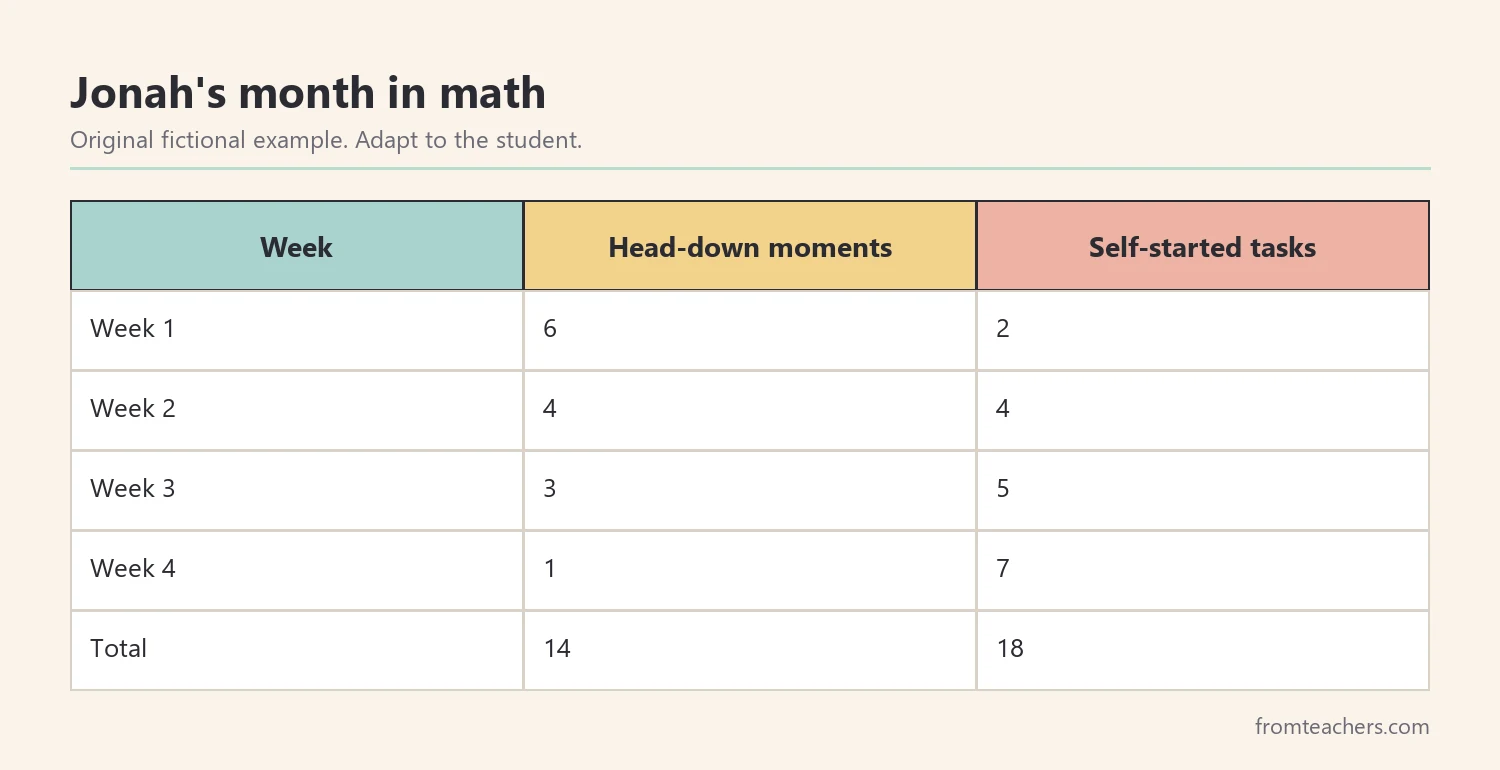
In Jonah’s fictional record, self-started tasks grew from 2 in week one to 7 in week four, for a total of 18. Head-down moments fell from 6 to 1, a total of 14. The numbers were not perfect, but they showed a clear direction, and Jonah could see it too.
Share the evidence with the student
In addition, share the evidence with the student. “Look, in week one you put your head down six times. This week, just once.” Moments like this make growth mindset self-talk feel true, because the student’s own record proves it.
Also, revisit the reminders every few weeks. As students grow, some sentences stop being useful because the moment no longer feels hard. That is a good sign. Replace those reminders with ones that fit new challenges, such as longer projects, tests, or group work. In this way, growth mindset self-talk keeps pace with the student instead of becoming background noise on the wall. Ask the student which reminder helped most this month, and write that answer down for the next planning meeting.
Lastly, include families. A short note explaining the six reminders lets parents use the same language during homework. Consistent words at school and home help students transfer the habit.
Common mistakes and how to avoid them
- Praising effort with no progress. Students feel stuck and patronized. Fix: pair effort with new strategies and support.
- Using slogans without situations. Students forget them. Fix: tie each reminder to a specific hard moment.
- Dismissing feelings. “Just think positive” shuts students down. Fix: name the feeling, then offer a helpful sentence.
- Only teaching, never modeling. Students rarely hear the process. Fix: think aloud about your own mistakes.
- Labeling students as fixed or growth. Labels stick and shame. Fix: talk about thoughts and actions, not identities.
Questions teachers and parents ask about growth mindset self-talk
Is growth mindset self-talk just positive thinking?
No. Positive thinking can ignore problems. Growth mindset self-talk admits that something is hard and then points toward a next step, such as a new strategy or asking for help.
What age is this best for?
Young children can learn short phrases like “I can’t do it yet.” Older students can work with longer reflections and strategy lists. Adjust the words to each student’s language level.
What if a student says, “But I really am bad at this”?
Acknowledge the feeling and add “yet.” Then, point to a small piece of evidence, such as a problem they solved last week. Small proof is more convincing than big promises.
Can this help students with learning disabilities?
It can support motivation, but it does not replace the accommodations, specialized instruction, or services a student needs. Self-talk works best when the student also has the right supports.
Should I correct a student’s negative self-talk?
Gently, yes, but avoid arguing. Repeat back what you heard, add a helpful version, and invite the student to try it. A calm swap works better than a lecture.
How long until I see a change?
It varies widely. Some students pick up a phrase in days, while others need many weeks of modeling and practice. Track small signs, and be patient.
Related reading: 5 Practical Teaching Tips to Boost Classroom Focus and Learning, Dyslexia Solutions in the Classroom: Evidence-Based Strategies for Success, and Bridging Gaps in Special Education: Practical Strategies for Teachers.
A companion resource for growth mindset self-talk:
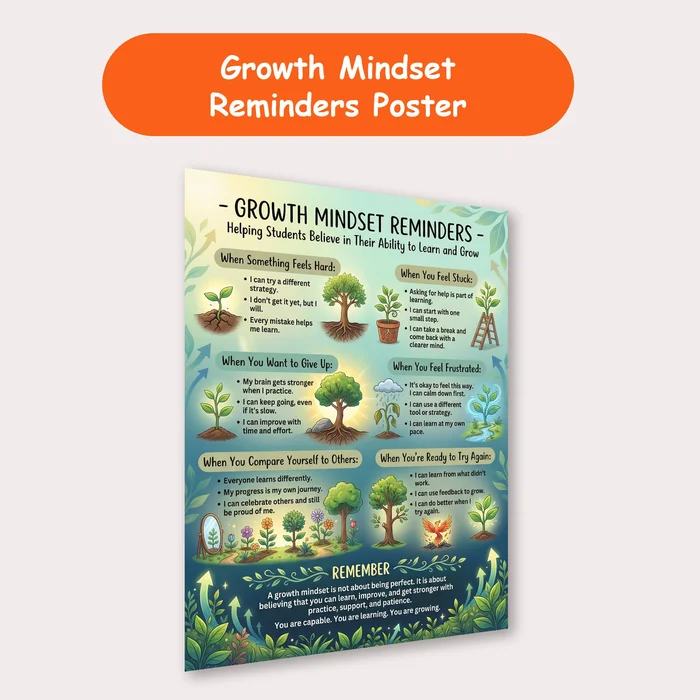
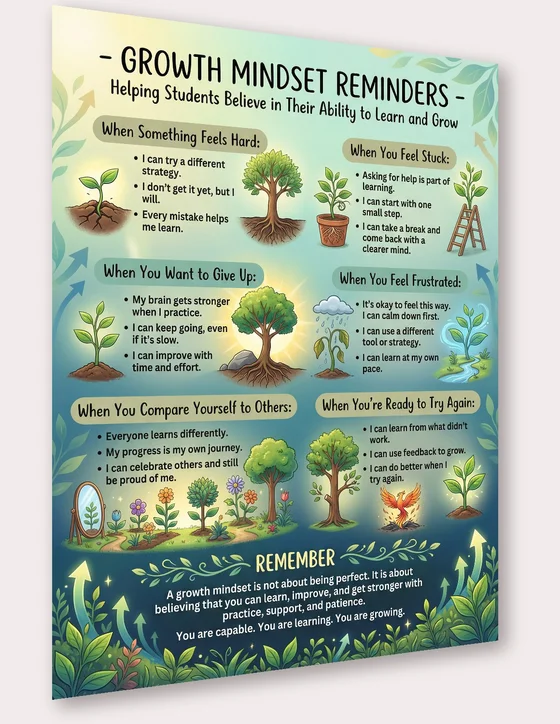
Growth Mindset Reminders Poster: a calm, illustrated poster with self-talk matched to six common situations, helping students believe in their ability to learn and grow in classrooms and resource rooms.
Sources and scope
- CASEL: a framework for social and emotional learning, including self-management and self-awareness.
- IRIS Center, Vanderbilt University: free modules on instruction and student motivation.
- Understood.org: information on learning and thinking differences, confidence, and frustration.
- Edutopia: classroom-focused articles on mindset, feedback, and engagement.
This guide covers everyday classroom and home use of self-talk for learning. It does not replace specialized instruction, accommodations, counseling, or the decisions of the student’s support team.
Key takeaways
- Growth mindset self-talk turns a belief in improvement into usable words.
- Match short reminders to six common hard moments.
- Teach “yet” and always pair self-talk with strategies.
- Model your own thinking aloud and practice when stakes are low.
- Track small signs of progress and share them with students and families.








Leave a Comment