
TOP 3
TEN-FRAME MATH TOOLS
Answer boards · Magnetic demonstration · Connecting trays

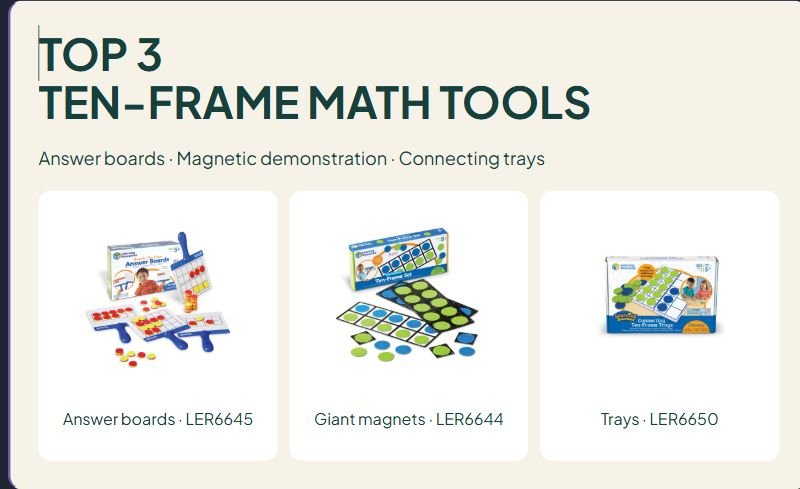
Answer boards · LER6645

Giant magnets · LER6644

Trays · LER6650
Affiliate disclosure: As an Amazon Associate I earn from qualifying purchases. Purchases through our links may earn a commission at no additional cost to you.
Ten-frame math tools put quantities into two rows of five, but the physical formats serve different lessons. Small answer boards can show individual responses, large magnetic frames can support a shared demonstration, and connecting trays give students a tabletop place to arrange counters.
This guide compares three Learning Resources sets using manufacturer information and the matching US listings. We have not tested magnet strength, cleaning, visibility, or durability. The numbers organize the comparison; they do not rank measured learning outcomes.
Three ten-frame math tools at a glance
| Set | Included working pieces | Useful setup | Main limitation |
|---|---|---|---|
| Answer Boards LER6645 | 4 double-sided boards; 100 magnetic counters | Individual or small-group responses | Four boards do not equip a whole class individually |
| Giant Magnetic Set LER6644 | 4 magnetic frames; 40 counters | A shared magnetic teaching surface | Needs a compatible magnetic surface |
| Connecting Trays LER6650 | 10 ten-frames; 5 five-frames; 150 counters | Tabletop work and connected arrangements | Loose pieces need a reset routine |
1. Magnetic Ten-Frame Answer Boards: see separate responses
The LER6645 set contains four magnetic write-and-wipe boards, 100 double-sided red/yellow foam magnetic counters, and a guide. Each board measures seven inches long by 6¼ inches high. One side shows a ten-frame; the reverse shows two ten-frames.
Advantage: Students can make a quantity on their own board and hold it up for discussion. The double-frame side gives a place to represent teen numbers without changing tools.
Limitation: The pack has four boards. For four learners representing quantities through twenty, allocating twenty counters to each uses eighty counters and leaves twenty spare. A thirty-student class would need a different sharing plan or more boards. Check whether markers are included in the exact bundle rather than assuming they come with every write-and-wipe product.
Manufacturer package details and photo source
2. Giant Magnetic Ten-Frame Set: model on a shared surface
The LER6644 set has four oversized magnetic frames, forty magnetic discs—twenty green and twenty blue—and an instruction guide. The frames and counters are designed for a compatible magnetic whiteboard or other suitable magnetic surface.
Advantage: A shared display lets the teacher move counters while the group explains the same arrangement. Two colors can distinguish the two parts of an addition example.
Limitation: This is a set of magnetic frames, not four individual answer boards. A nonmagnetic whiteboard will not provide the required support. Check visibility from the actual seats instead of assuming the word giant guarantees a clear view for everyone.
Manufacturer package details and photo source
3. Connecting Ten-Frame Trays: organize tabletop counters
The LER6650 pack includes ten ten-frame trays, five five-frame trays, 150 double-sided blue/green counters, and an activity guide. The trays connect to make larger arrangements. The manufacturer’s UK page lists each ten-frame tray at sixteen centimeters long by 6.5 centimeters wide; the US listing matches the model and package counts.
Advantage: The separate trays suit table groups and let students compare five-frames, ten-frames, and joined arrangements. They offer a different physical setup from holding up an answer board.
Limitation: Connecting does not mean magnetic. Plan how counters will be kept with each tray and check whether the joining action is comfortable for the intended users. The number of trays is not the same as the number of fully equipped individual stations; decide how many counters each activity needs.
Manufacturer package details and photo source
Choose ten-frame tools around the lesson
Decide who moves the counters
A demonstration set and an individual response set answer different questions. If one teacher models while students explain, start with a clear shared display. If you need to see each learner’s arrangement, give them separate working spaces. A mixed setup can use a shared model and a small number of individual boards during guided practice.
Check the whole arrangement
For a magnetic display, check the surface with a compatible magnet before ordering. For a desk, leave space for the frames, spare counters, and any written work. Try one typical task in the intended location. A tray that fits on a shelf may still feel crowded beside a workbook.
Plan quantity by activity
Count the number of simultaneous users and the largest quantity each will represent. A lesson through ten needs fewer working counters than a lesson through twenty. Include enough pieces for the actual task and keep spares separate. Comparing headline pack counts without this plan can lead to buying more loose pieces while still lacking enough boards.
Three lesson examples to try
Show seven in two ways
Place five counters in the top row and two in the bottom row. Ask how many spaces remain and how the rows help show seven. Then arrange seven counters differently and compare. The point is to explain the quantity and arrangement, not simply to copy the teacher’s pattern.
Build twelve with two frames
Fill one ten-frame and place two counters in the next. Ask what remains the same if the two extra counters move to different spaces in that second frame. Connect the display with the expression ten plus two. Use a clear gap between frames so the two groups remain easy to follow.
Make ten to explore seven plus five
Build seven in one frame and five in a second. Move three counters from the second frame to fill the first. There are now ten counters in the first and two in the second, so the same total is twelve. Ask the learner to explain why moving counters changes the arrangement without changing the total. These are teaching examples, not evidence that one commercial set produces better results.
Keep the materials manageable
Label a container with the model and the expected contents. For a small group, pre-portion only the counters needed for that activity. At the end, reset the frames and count the pieces back into the container. Follow the product’s care and age instructions. These sets are listed for ages five and up; the manufacturer warns about small parts on the answer-board and tray pages, including that they are not for children under three.
If grasping or moving the supplied pieces is difficult, review the activity with the staff supporting the learner. Enlarging a visual, changing the response method, or using fewer pieces may be more useful than buying a larger pack. Check any substitute counters for fit rather than assuming that every brand’s pieces will work with these frames.
For another way to build and compare quantities, see our math linking cube comparison. To organize station materials, compare teacher rolling carts.
What to look for in customer feedback
Read feedback for the exact model. Useful details include how the pieces behave on a particular surface, whether counters stay together during storage, board cleaning, and the ease of connecting trays. Comments about a large demonstration set may not apply to the small answer boards. We have not reproduced customer excerpts or assigned review scores.
Ten-frame questions
Are all whiteboards magnetic?
No. A write-and-wipe surface and a magnetic surface are different features. Verify the actual surface for the giant magnetic frames.
Can one frame show teen numbers?
A standard ten-frame has ten spaces. Use a second frame for the extra quantity; the answer boards provide a double-frame reverse side. Keep each space’s meaning consistent during the lesson.
Is the biggest pack always the better buy?
No. Compare the number of working spaces, counter type, display format, and simultaneous users. Four usable boards can suit one small group, while ten trays may suit a different station plan.
Which set should I shortlist?
Choose around the action you need: individual responses with the answer boards, shared magnetic modeling with the giant set, or tabletop arrangements with the connecting trays. Confirm the exact model and current package before ordering.








Leave a Comment