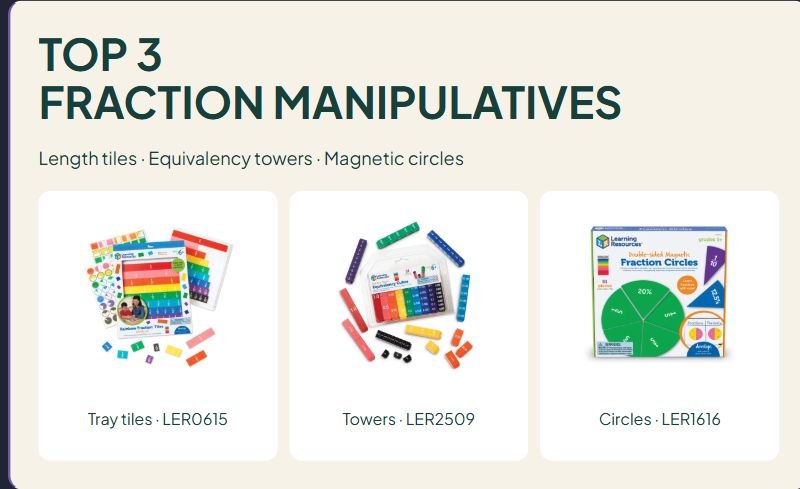

TOP 3
FRACTION MANIPULATIVES
Length tiles · Equivalency towers · Magnetic circles

Tray tiles · LER0615

Towers · LER2509

Circles · LER1616
Affiliate disclosure: As an Amazon Associate I earn from qualifying purchases. Purchases through our links may earn a commission at no additional cost to you.
Fraction manipulatives can show the same relationship through lengths, towers, or parts of a circle. The useful choice depends on the explanation you want students to make. A tray of tiles suits side-by-side comparisons, connecting towers add another way to build a whole, and magnetic circles can support a shared demonstration.
This guide compares three Learning Resources products using manufacturer information and matching US model numbers. We have not tested connector strength, magnetic grip, durability, or changes in student understanding. The order organizes the designs rather than ranking measured learning outcomes.
Three fraction manipulatives at a glance
| Model | Physical format | Useful comparison | Main check |
|---|---|---|---|
| Rainbow Tiles LER0615 | Length tiles with a storage tray | Align lengths against the same whole | Conflicting package counts; verify the current offer |
| Equivalency Cubes LER2509 | 51 connecting pieces labeled in three number forms | Fractions, decimals, and percentages | Exact equivalency version and connecting action |
| Magnetic Circles LER1616 | Nine complete circle models made from fraction pieces | Area parts and fraction-to-percentage relationships | Compatible magnetic board; nine circles does not mean nine loose pieces |
1. Rainbow Fraction Tiles with Tray: compare lengths
The LER0615 uses color-coded length pieces representing a whole, halves, thirds, fourths, fifths, sixths, eighths, tenths, and twelfths. A storage tray and activity guide are listed. The manufacturer and checked Amazon bullets describe fifty-four pieces, while Amazon’s details table says fifty-one. Confirm the actual seller’s package if the count matters.
Advantage: Lining up pieces from the same starting edge lets students compare lengths against a consistent whole. The tray provides a defined working and reset space.
Limitation: The inconsistent counts mean you should not plan a classroom allocation from a headline number alone. A tray also does not establish that pieces stay secured during carrying. Check the storage arrangement and current buying options for the exact LER0615 version.
Manufacturer details and photo source
2. Fraction Tower Equivalency Cubes: connect number forms
The LER2509 is a fifty-one-piece connecting set. The maker describes fractions, decimals, and percentages marked on three sides. The pieces represent a whole and parts in halves, thirds, quarters, fifths, sixths, eighths, tenths, and twelfths. Check Equivalency Cubes in the product name; the fraction-only version is a separate product.
Advantage: Students can build matching heights and turn pieces to connect a fraction with its decimal or percentage label. The physical connection can keep an assembled comparison together during discussion.
Limitation: Connecting and separating pieces may suit some users better than others. Check the actual action and label size. Printed number forms can support a discussion but do not explain equivalence on their own. Do not assume every decimal or percentage printed for a repeating value is exact.
Manufacturer details and photo source
3. Double-Sided Magnetic Fraction Circles: demonstrate parts of an area
The LER1616 set provides nine complete circle models: a whole and circles partitioned into halves, thirds, fourths, fifths, sixths, eighths, tenths, and twelfths. Fractions appear on one side and percentages on the reverse. The maker lists a 7½-inch diameter and an activity guide.
Advantage: A magnetic surface can keep a shared area model visible while a teacher rearranges parts or flips a piece to discuss its percentage. The circle layout offers a different representation from length tiles.
Limitation: These are magnetic demonstration pieces. Verify that the teaching surface attracts magnets, and check visibility from the intended seats. The nine-circle description refers to assembled wholes of different partitions, not a guarantee that the package has only nine separate pieces.
Manufacturer details and photo source
Start with a consistent whole
Before comparing fractions, identify which piece or completed shape represents one whole. Two half pieces from different-sized wholes need not have the same area or length. Use matched pieces within a model, align the starting edges for a length comparison, and explain what stays constant.
Compare one half and two fourths
Place a half-length beside two quarter-length pieces with the same starting edge. Ask what shows that they have equal total length. With circles, compare a half-circle area with two quarters of a same-sized circle. Connect the arrangement to the notation 1/2 = 2/4. Do not rely on matching colors as the explanation.
Build one in more than one way
Try a half and two quarters, then two thirds and two sixths. Ask the learner to explain how the pieces fill the same whole. If parts are missing or a task requires several copies of one fraction, check the available pieces before setting it for multiple groups at once.
Connect one half, 0.5, and 50 percent
Use the equivalency labels as a prompt rather than an answer to copy. Ask why half of a whole corresponds to fifty out of one hundred. Show the same relationship with an area or length arrangement. For values such as one third, distinguish an exact fraction from a rounded decimal or percentage printed for convenience.
Choose a workable classroom quantity
Decide whether one learner, a pair, or a teacher will handle each set. A pack with many small pieces can still contain only one complete row or circle of a particular denominator. Two groups doing the same task may both need the same fraction pieces at the same time. Prepare a sample activity and count by fraction type before buying in bulk.
Keep a contents card with each set and a place for parts waiting to be used. For tabletop tiles, leave enough space to align lengths without overlapping another group’s work. For connecting pieces, check whether the joining step distracts from the intended comparison. For magnets, test the actual board and plan a reachable working area.
Check notation and physical access
Look at how clearly the fractions are printed, including the fraction bar and denominator. Consider whether turning a piece changes its reading direction or hides a label. If someone has difficulty reading the pieces, provide an accessible written or spoken representation alongside the model. A larger demonstration format does not automatically solve every access need.
Use the product’s age and care instructions. The tile and tower manufacturer pages list ages six and up and warn about small parts, including that they are not for children under three. The circle listing also identifies ages six and up. Supervise and store the materials according to the exact package instructions.
For a different whole-number representation, compare our base-ten classroom sets. For counting and making ten, see the ten-frame tools guide.
Read feedback for the exact model
Practical feedback can clarify tray storage, connector fit, label visibility, and behavior on a named magnetic surface. Check whether the reviewer used the same product number and package. A comment about a fraction-only tower does not establish the labels supplied on the equivalency version. We have not reproduced customer excerpts or assigned review scores.
Fraction manipulative questions
Are circles better than strips?
They emphasize different representations. Strips show length relationships and common endpoints; circles show area parts of a whole. Choose the representation that fits the task, then connect it with written notation.
Does a larger denominator always mean a larger piece?
For unit fractions of the same whole, a larger denominator means a smaller piece: one eighth is smaller than one fourth. Keep the whole consistent when demonstrating this.
Can I combine pieces from different brands?
Do not assume their dimensions or colors match. A shared color does not guarantee equal size, the same value, or compatible connectors. Verify the actual whole and piece lengths before combining sets.
Which design should I shortlist?
Consider tray tiles for length comparisons, equivalency towers for connecting fraction, decimal, and percentage labels, and magnetic circles for a shared area model. Check exact contents and current buying options before ordering.










Leave a Comment