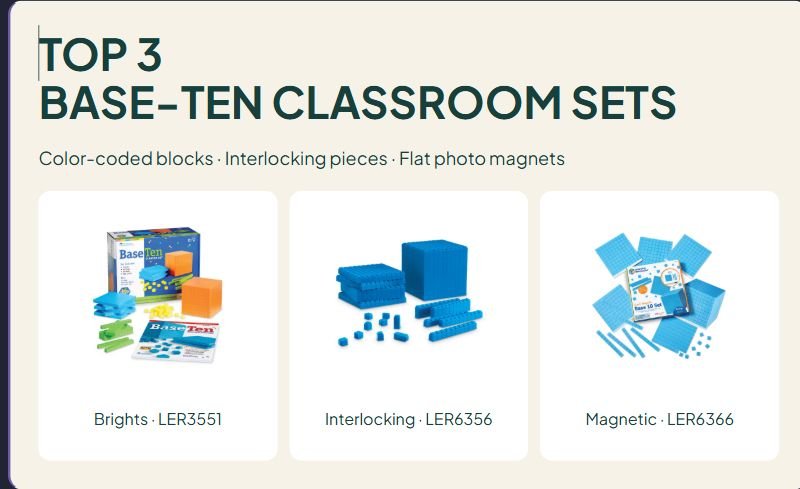

TOP 3
BASE-TEN CLASSROOM SETS
Color-coded blocks · Interlocking pieces · Flat photo magnets

Brights · LER3551

Interlocking · LER6356

Magnetic · LER6366
Affiliate disclosure: As an Amazon Associate I earn from qualifying purchases. Purchases through our links may earn a commission at no additional cost to you.
Base ten blocks for classrooms can support a tabletop lesson or a shared demonstration, but those setups need different materials. Color-coded solid pieces, interlocking blocks, and flat magnetic pictures are not interchangeable. Start with who will move the pieces and where the lesson will happen.
This guide compares three Learning Resources sets using manufacturer information and matching US listings. We have not tested durability, connector strength, cleaning, magnet performance, or learning outcomes. The order helps you compare formats rather than ranking measured quality.
Three base-ten sets at a glance
| Model | Format | Listed block contents | Main check |
|---|---|---|---|
| Brights! LER3551 | Color-coded plastic starter set | 100 units, 30 rods, 10 flats, 1 large cube | Exact package count; similar search descriptions differ |
| Interlocking LER6356 | Connecting plastic starter set | 100 units, 30 rods, 10 flats, 1 large cube | Connecting action and quantity per learner |
| Giant Magnetic LER6366 | Flat photo magnets for a shared surface | 100 units, 20 rods, 10 flats, 1 cube representation | Compatible magnetic surface; not solid blocks |
With a unit cube representing one, a rod represents ten, a flat one hundred, and the large cube one thousand. State that convention before beginning a task, particularly if the same materials are later used for a different mathematical model.
1. Brights! Base Ten Starter Set: distinguish the pieces by color
The LER3551 is a colored plastic set. Both the manufacturer page and the checked Amazon bullets list one hundred unit cubes, thirty rods, ten flats, one large cube, and a book. That is 141 blocks, with the book separate. The manufacturer lists ages six and up.
Advantage: The color differences offer an additional way to distinguish piece types while students arrange ones, tens, and hundreds on a table. This can suit a station where the blocks need to remain separate and easy to sort.
Limitation: The search summary we checked also used a 100-piece label. Confirm the package against LER3551 and its itemized contents before ordering. Do not assume every similarly named Brights classroom or starter bundle contains the same quantities.
Manufacturer specifications and photo source
2. Interlocking Base Ten Starter Set: compare connected quantities
The LER6356 includes 141 plastic pieces: one hundred units, thirty rods, ten flats, and one large cube. It also lists a ninety-six-page activity book. The maker describes washable plastic, an interlocking design, ages six and up, and small-group use with three or four students.
Advantage: Connecting pieces offers a way to build and compare grouped amounts instead of only placing loose pieces beside one another. That physical connection is the reason to consider this format over a color-coded set.
Limitation: Check how easily the intended users can connect and separate the pieces. The maker’s small-group description does not mean every learner receives a complete individual set. Cross-brand connector compatibility has not been verified; keep matched parts together.
Manufacturer specifications and photo source
3. Giant Magnetic Base Ten Set: move the model to a whiteboard
The LER6366 is a 131-piece magnetic demonstration set. The verified US listing specifies one hundred units, twenty rods, ten flats, and one cube representation. The pieces use photographs of base-ten blocks to represent three-dimensional forms on a flat surface.
Advantage: A teacher can leave a shared quantity visible while moving pieces to explain an exchange or compare two arrangements. The visual model can connect a tabletop task with a discussion at the board.
Limitation: These are flat magnetic representations, not a solid thousand cube and solid blocks for stacking. The surface must be suitably magnetic. Check sightlines and contrast from the actual seats; a product’s giant label does not guarantee readability for everyone.
Manufacturer specifications and photo source
Choose base ten blocks for the lesson you teach
Plan the working surface
Use a tray or clear area for solid pieces, with enough room to separate place-value columns. For magnets, check the actual board before purchasing. A dry-erase surface does not automatically attract magnets. Make sure the people who need to manipulate a model can reach its working area.
Count the pieces each activity needs
For four students each showing 234, you need eight flats, twelve rods, and sixteen units in total. Either 141-block starter set has enough of those listed pieces for that specific task. Four students each showing 999 would require thirty-six flats, which exceeds the ten supplied. Plan by the numbers students will model rather than by total pack size alone.
Make the units explicit
Introduce the names and values of the pieces, then ask students to explain a quantity using more than one arrangement. A column mat can help separate hundreds, tens, and ones, but the labels should not replace discussion of what the pieces mean. Avoid relying only on a color when identifying a value.
Two examples that reveal the buying trade-offs
Add 234 and 125
Build 234 with two flats, three rods, and four units. Build 125 beside it with one flat, two rods, and five units. Combine matching pieces: three flats, five rods, and nine units show 359. This example uses no exchange, so it is a manageable first check of the layout and the number of pieces available.
Subtract 17 from 32
Begin with three rods and two units. To remove seven units, exchange one rod for ten units, keeping the same total of thirty-two. You now have two rods and twelve units. Remove one rod and seven units; one rod and five units remain, showing fifteen. Ask why the exchange changed the representation without changing the starting amount.
Solid pieces allow a tabletop exchange that a student can handle. Magnetic pieces let a group follow the same exchange on a shared board. Choose the format based on that teaching action; neither layout removes the need to explain the relationship between the pieces and written notation. These are lesson examples, not evidence of tested product effects.
Set up a practical storage routine
Keep each model’s pieces in labeled compartments or separate bags. A contents card can list units, rods, flats, and the large cube or cube picture. Count pieces back by type after an activity. Follow the manufacturer’s care instructions rather than assuming all plastics and magnetic sheets tolerate the same cleaning method.
The manufacturer warns about small parts on all three product pages, including that they are not for children under three. The two solid starter pages specify ages six and up; check the exact package’s age guidance and supervision requirements. A lower age shown in a search filter should not replace the product’s instructions.
For quantity work in two rows of five, see our ten-frame math tools guide. For a different connecting-cube format, compare MathLink, Snap Cubes, and Unifix. Those sets serve different arrangements and are not assumed to connect with base-ten pieces.
What customer feedback should clarify
Look for the exact model, the age of the set, and the task being described. Useful details include how connections behave, whether magnetic sheets stay flat, how parts are stored, and how the product cleans. A review of a large classroom bundle may not describe a starter pack. We have not reproduced customer excerpts or assigned ratings.
Base-ten block questions
Does the largest piece always mean one thousand?
It does when the small unit cube represents one in the usual whole-number base-ten model. State your convention whenever the same pieces are used to represent another mathematical idea.
Can the magnetic set replace a solid set?
It can support a shared visual demonstration, but its flat pieces do not provide the same stacking, volume, or connecting experience as solid blocks. Select for the action students need to perform.
Should I buy several starter packs immediately?
First work through representative lesson quantities and count the pieces required for simultaneous users. A small pilot station can reveal whether you need more flats, more units, or simply a different sharing routine.
Which set should I shortlist?
Compare Brights for color-coded plastic pieces, Interlocking for connected tabletop work, and Giant Magnetic for a shared display. Confirm the exact model, listed contents, surface requirements, and current package before buying.






Leave a Comment