

Summer emotional regulation can be harder than parents expect. School ends, and with it go the bells, the visual schedule, the familiar teacher, and the predictable lunch at 11:30. In their place come long open days, heat, crowded pools, family trips, and changing plans. For many children with autism or ADHD, that loss of structure shows up as more meltdowns, more arguments, and more worry by the second week of break.
This guide gives families, caregivers, and summer staff a clear plan for the break. After reading, you will be able to rebuild a light daily rhythm, help the child name feelings, teach a few calming tools, plan for heat and crowds, and respond calmly when big feelings arrive.
Examples are fictional. Adapt to the child’s goals and agreed supports. This is guidance, not a diagnosis.
At a glance
- Summer removes much of the structure many children rely on to stay regulated.
- A light, visual daily rhythm restores predictability without filling every hour.
- Children regulate better when they can name feelings and know a few calming tools.
- Plan ahead for heat, noise, crowds, and travel, which are common summer triggers.
- Adults’ calm presence, called co-regulation, matters more than any single strategy.
1. Understand why summer is hard for regulation
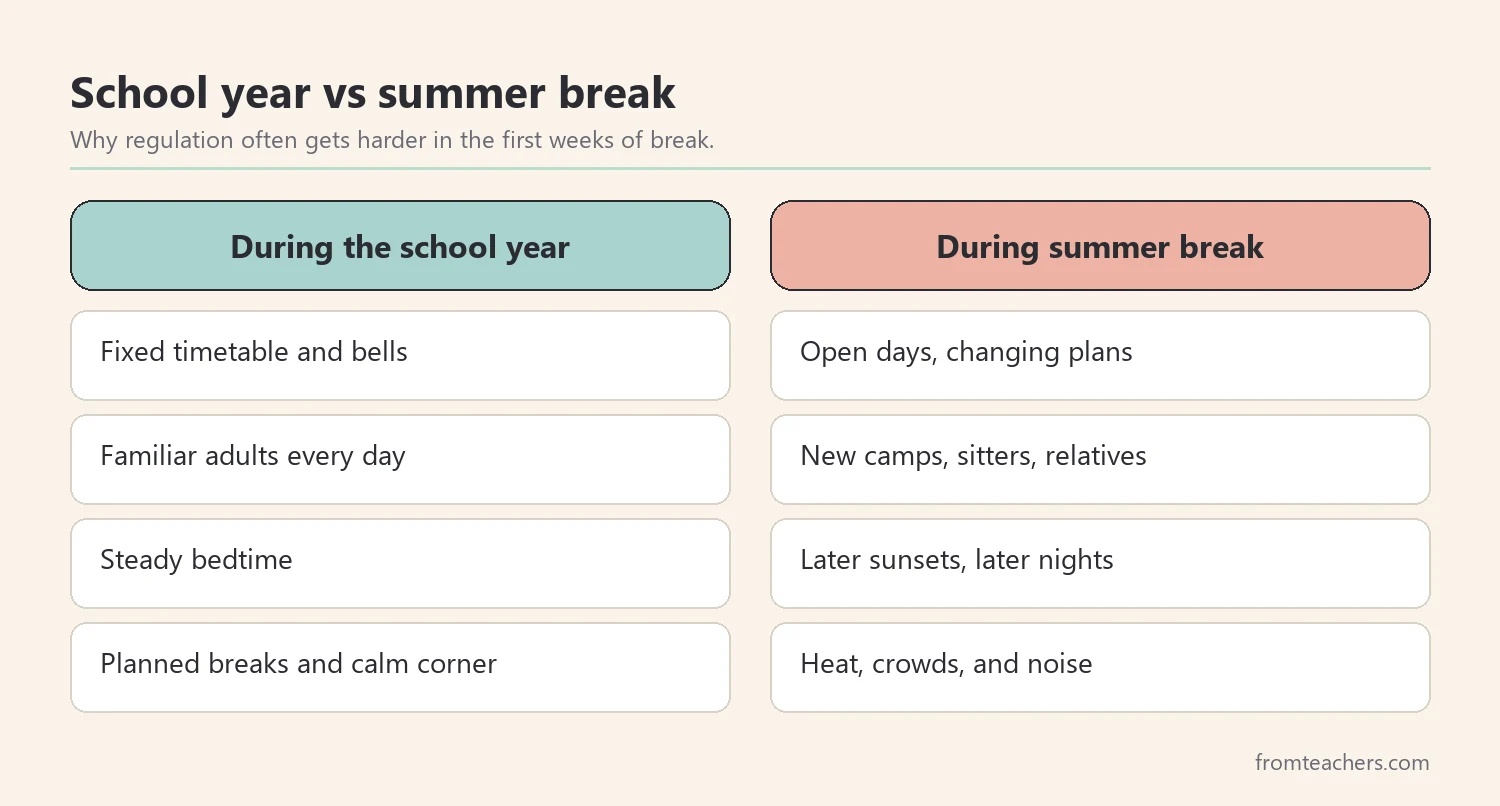
Emotional regulation is the ability to notice feelings and bring them back to a manageable level. For many autistic children and children with ADHD, this skill takes more effort, and it often depends heavily on outside structure. School provides a lot of that structure, even when the school day itself is tiring.
When summer starts, several supports disappear at once:
- Predictability: no fixed timetable, and plans can change daily.
- Sensory load: heat, sunscreen, swimsuits, loud pools, and fireworks.
- Sleep: later sunsets and later bedtimes.
- Social changes: new camps, new staff, visiting relatives.
- Transitions: many more unplanned switches between activities.
As a result, a child who seemed settled in June may struggle in July. That change does not mean the child has lost skills. Instead, it means the environment is asking more of the child while giving less support.
Worked example: Nora, age 8
Nora is autistic and has ADHD. During the school year, her mornings follow the same routine and she uses a calm-down corner in class. In the first two weeks of summer break, she has a meltdown almost every afternoon, often after the pool or when plans change. Her parents feel exhausted and unsure where to start.
2. Rebuild a light summer emotional regulation routine
The first step is to bring back predictability, without turning summer into school. A light rhythm with a few anchor points is enough for most children. Anchors are things that happen at about the same time every day, such as breakfast, a quiet time, outdoor play, dinner, and bedtime.
Make the routine visual. A simple picture schedule on the fridge, or a short list for older children, helps the child know what comes next. In addition, include a “change” symbol so the child can see when a plan is different, rather than being surprised.
Build in rest. Many children need a daily quiet block, especially after busy outings. Therefore, plan quiet time right after high-energy activities, not just before bed.
Also, involve the child in building the schedule. Let them choose some of the pictures, pick one special activity each week, or decide the order of two afternoon tasks. Children who help make the plan are usually more willing to follow it, and the choices give them a sense of control during a season of change.
Worked example: Nora’s summer anchors
| Time | Anchor |
|---|---|
| 8:00 | Breakfast and picture schedule check |
| 9:00 | Outdoor play or outing |
| 12:00 | Lunch |
| 1:00 | Quiet time: books, puzzles, headphones |
| 3:00 | Free play or short activity |
| 6:00 | Dinner |
| 8:00 | Bedtime routine |
Notice that the afternoon quiet time now comes right after the morning outing. That change alone reduced Nora’s afternoon meltdowns in the first week.
3. Help the child name feelings
Children regulate more easily when they can name what they feel. Naming turns a confusing body state into something that can be talked about and managed. Many children with autism or ADHD need direct teaching for this skill.
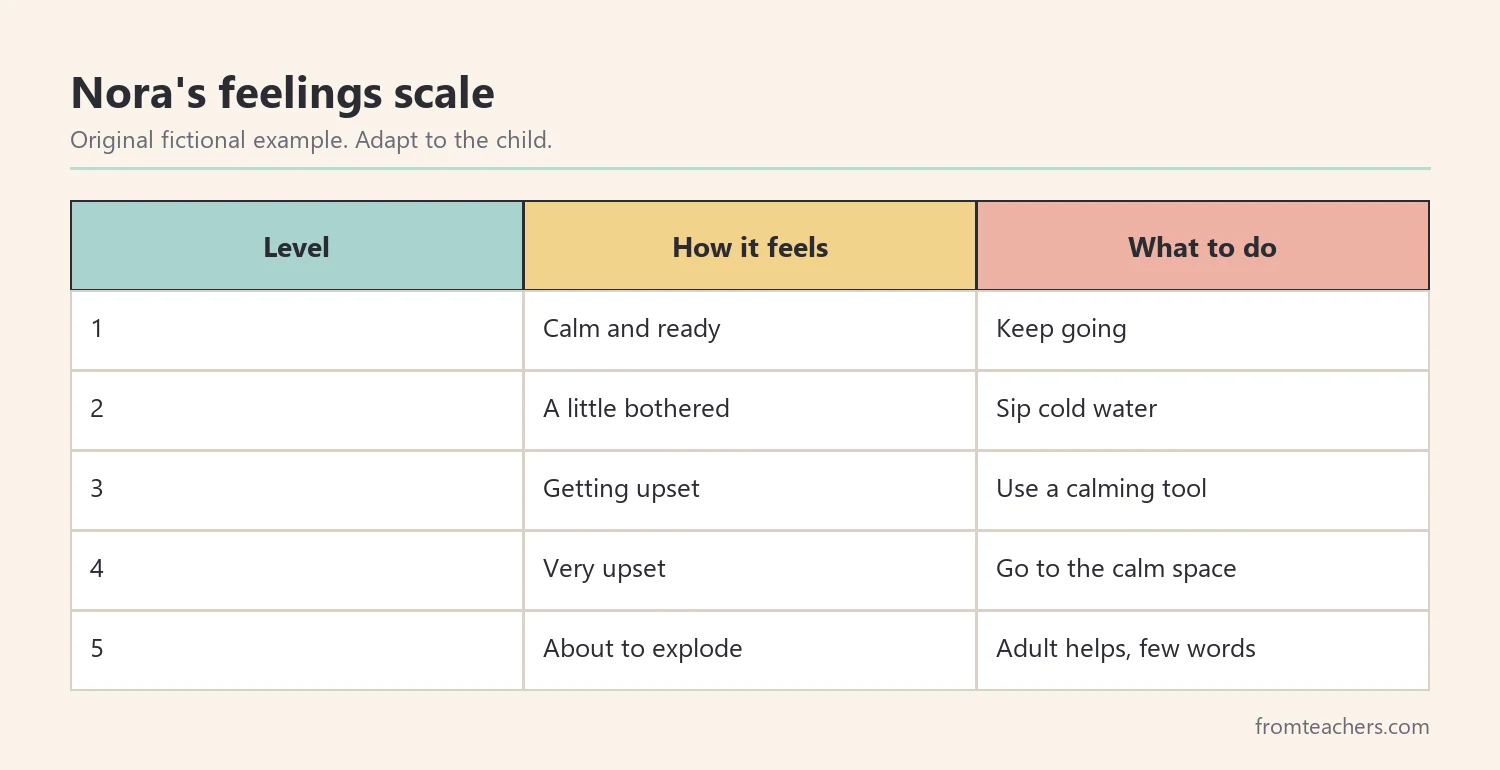
Start with a small number of feelings, such as happy, sad, angry, worried, and tired. Use pictures, colors, or a simple scale from 1 to 5. Then practice naming feelings at calm times, using books, shows, and everyday moments: “The girl in the story looks worried. What makes you think so?”
Some families use a color-based framework, such as the Zones of Regulation, to group feelings by energy level. Others prefer a simple feelings thermometer. Either way, the key is consistency: use the same words and pictures every day.
Moreover, link feelings to body signals. “When I am angry, my face gets hot and my hands get tight.” Children who notice early body signals can use a tool before the feeling becomes too big.
Worked example: Nora’s feelings scale
Nora’s parents made a five-step scale with faces from calm (1) to “about to explode” (5). Each morning, Nora points to her number. When she reaches 3, she knows it is time to use a calming tool. By the third week, she sometimes says “I’m at a 3” without being asked.
4. Teach a few calming tools for summer emotional regulation
A child does not need many strategies. Instead, three or four tools that are practiced often will work better than a long list. Practice them when the child is calm, so they are familiar when needed.
Useful tools include:
- Slow breathing: blowing bubbles, “smell the flower, blow out the candle,” or breathing while tracing a shape.
- Body-based calming: wall push-ups, a tight hug, or wrapping in a blanket.
- Sensory breaks: headphones, a cool drink, a shady spot, or a favorite fidget.
- A calm space: a quiet corner at home or a planned spot during outings.
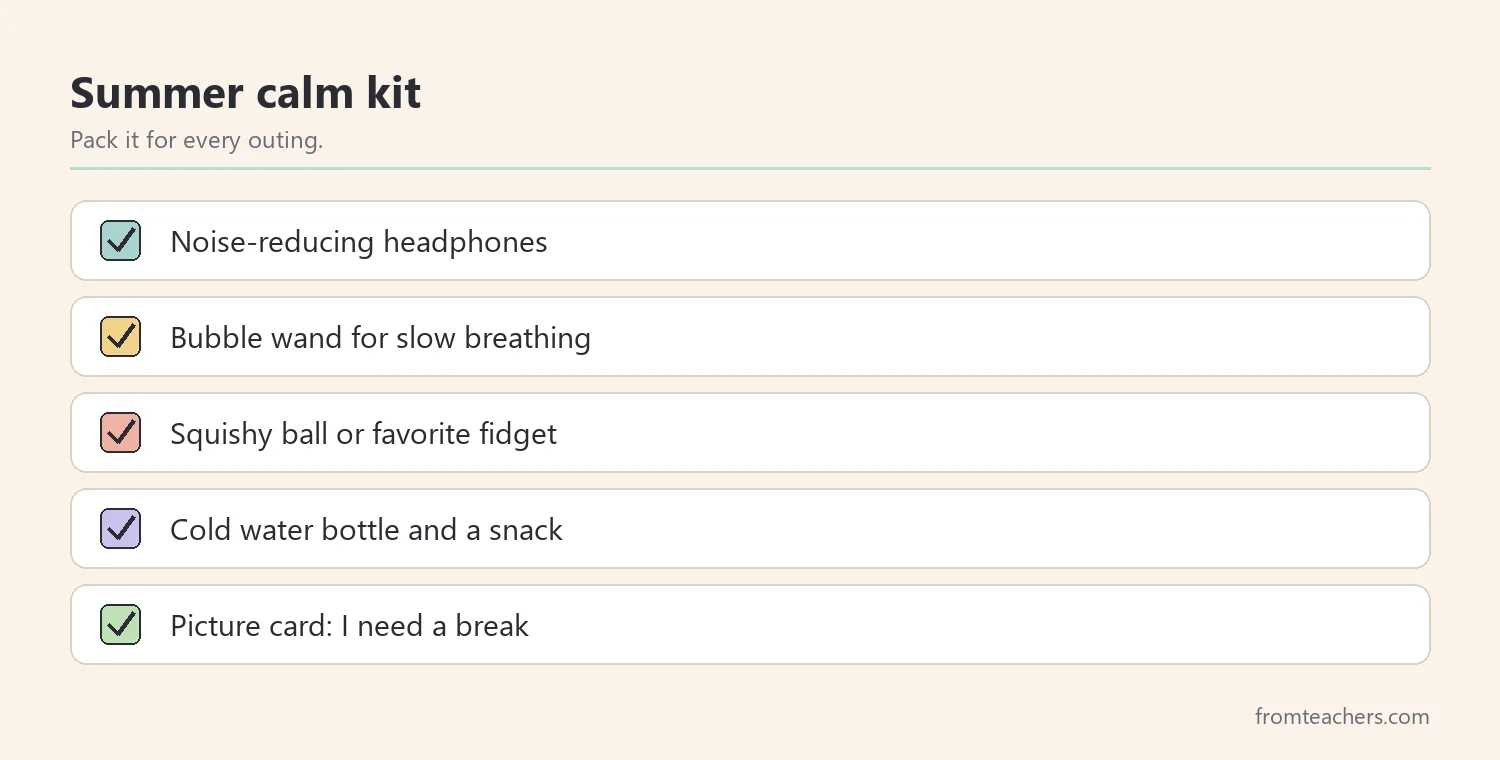
Choose tools that fit summer. For example, bubbles work well outdoors, and a cold water bottle helps on hot days. In addition, pack a small calm kit for outings with headphones, a fidget, water, and a snack.
For ready-made scripts, stories, and breathing activities, the summer emotional regulation guide for kids with autism and ADHD covers identifying emotions, breathing and body-based regulation, sensory regulation in summer, and managing anger and anxiety.
Worked example: Nora’s calm kit
Nora’s kit holds noise-reducing headphones, a bubble wand, a squishy ball, a cold water bottle, and a picture card that says “I need a break.” At the pool, when Nora feels herself reach a 3, she shows the card, and her dad walks with her to a shady bench for five minutes of bubbles.
5. Plan ahead for summer triggers
Many summer meltdowns are predictable. Heat, crowds, fireworks, long car rides, and late nights are common triggers. Therefore, plan for them in advance rather than reacting in the moment.
Practical steps:
- Preview: show photos or a short video of new places before you go.
- Time it: visit pools and parks at quieter hours.
- Set an exit plan: agree on a signal and a place to take a break.
- Protect sleep: keep bedtimes as steady as possible, even on vacation.
- Use a social story: for big events like a family trip, read a short story about what will happen.
Moreover, share the plan with other caregivers. Grandparents, camp staff, and babysitters can only help if they know the child’s tools and signals.
In addition, keep an eye on hunger and thirst. Hot days and busy outings make it easy to skip a snack or a drink, and a hungry, overheated child has far less patience. Regular water and snack breaks are one of the simplest tools for summer emotional regulation.
Worked example: Nora’s Fourth of July plan
Nora’s family knows fireworks are hard. They watch a short fireworks video at low volume during the week before. On the night, they sit at the edge of the crowd, Nora wears headphones, and her parents agree that she can go back to the car at any time. She stays for the first ten minutes, then chooses to watch the rest from the car window.
Finally, plan for the end of summer too. The return to school is another big transition. In the last two weeks of break, move bedtime and wake-up times gradually back toward the school schedule, visit the school building if possible, and read a short story about the first day. These small steps make the change back to school feel less sudden.
6. Respond to big feelings with co-regulation
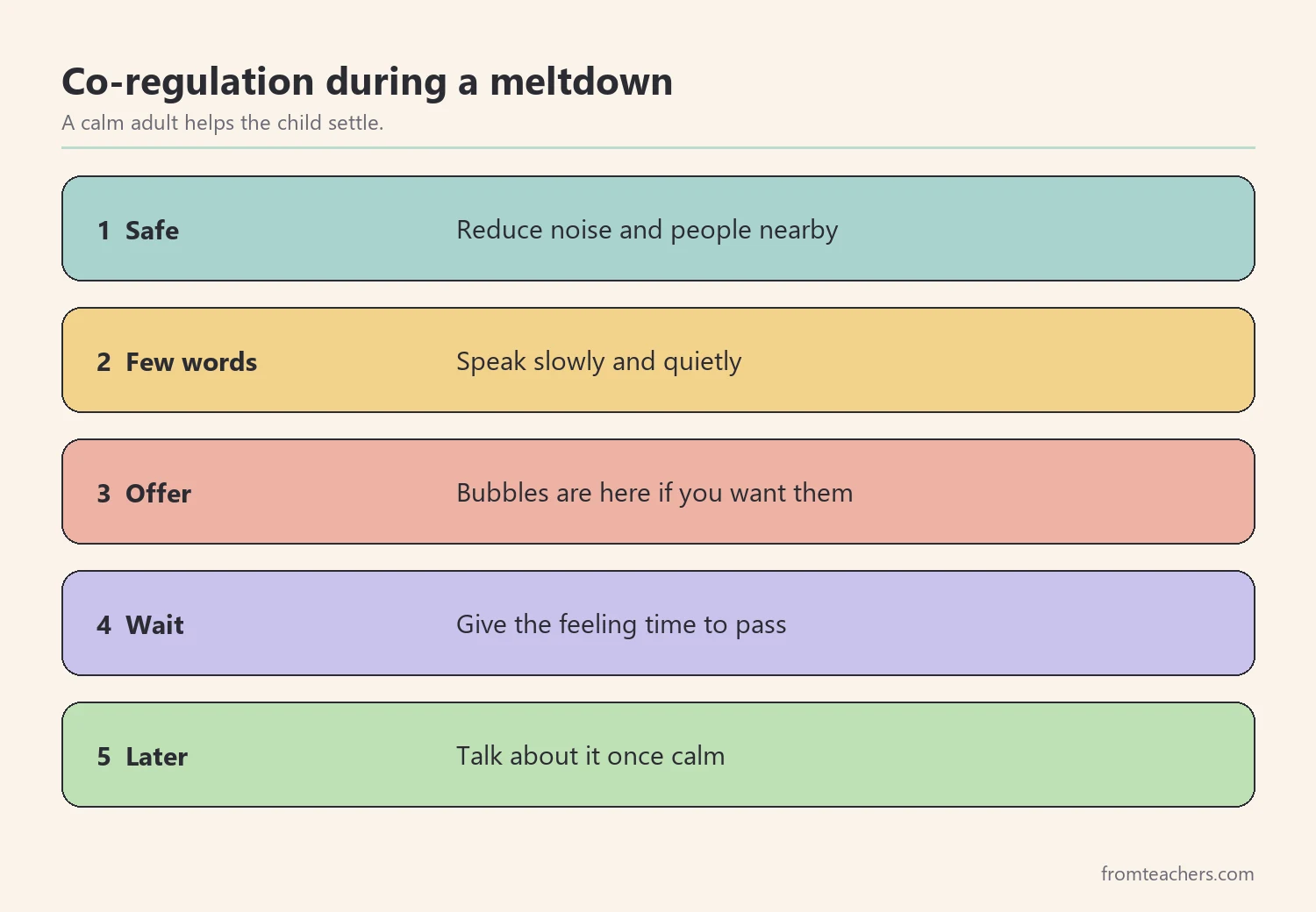
Even with good planning, big feelings will happen. In those moments, the child’s brain is in a stress state and cannot use new skills or long explanations. What helps most is a calm adult. This is called co-regulation: the adult’s steady voice and body help the child’s nervous system settle.
During a meltdown:
- Keep everyone safe and reduce noise and people.
- Use few words, spoken slowly and quietly.
- Offer a tool without demanding it: “Bubbles are here if you want them.”
- Wait. Give the feeling time to pass.
- Talk about what happened later, when the child is calm.
Afterward, reconnect. Once the child is calm, offer a hug, a drink, or a quiet activity together. Later still, talk briefly about what happened and what might help next time. Keep the conversation short and kind, and focus on the plan rather than on blame.
Adults need regulation too. If you notice your own frustration rising, take a slow breath before you respond. Summer is long, so plan breaks for yourself when possible, even if it is only ten quiet minutes while another adult takes over.
Worked example: tracking Nora’s afternoons
| Week | Afternoon meltdowns (of 7 days) | Calm afternoons |
|---|---|---|
| 1 | 6 | 1 |
| 2 | 4 | 3 |
| 3 | 3 | 4 |
| 4 | 2 | 5 |
With anchors, a feelings scale, a calm kit, and planned exits, Nora’s afternoons became steadier. Hard days still happened, but they were shorter and less frequent.
Common mistakes and how to avoid them
- Dropping all structure. Fix: keep a few daily anchors and a visual schedule.
- Teaching tools during a meltdown. Fix: practice at calm times so tools are ready later.
- Packing too much into each day. Fix: plan quiet time after busy outings.
- Surprise changes. Fix: show changes on the schedule and preview new places.
- Talking too much in the moment. Fix: use few words, stay close, and wait.
Questions teachers and parents ask about summer emotional regulation
Why does my child have more meltdowns in summer?
Summer often removes the routine, structure, and predictability many children rely on. Heat, noise, crowds, and late nights add stress. A light routine and planned breaks usually help.
Should we keep a strict schedule all summer?
Not necessarily. A few steady anchors, such as meals, quiet time, and bedtime, are usually enough. The rest of the day can stay flexible.
What is co-regulation?
Co-regulation is when a calm adult helps a child settle through a steady voice, presence, and body language. Children learn to regulate themselves through many experiences of being regulated with an adult.
How can summer camp staff help?
Share a one-page summary of the child’s triggers, signals, and calming tools. Ask staff to use the same words and offer the same breaks. A short chat at pickup about how the day went helps you adjust the plan at home.
When should we seek more help?
If meltdowns are very frequent, intense, or unsafe, talk with your child’s doctor, therapist, or school team. They can help you plan further support.
Related reading: Meltdowns vs Tantrums: The Difference, Understanding Autism and ADHD Meltdowns, and Managing Sensory Overload in Autism and ADHD.
A companion resource for summer emotional regulation:

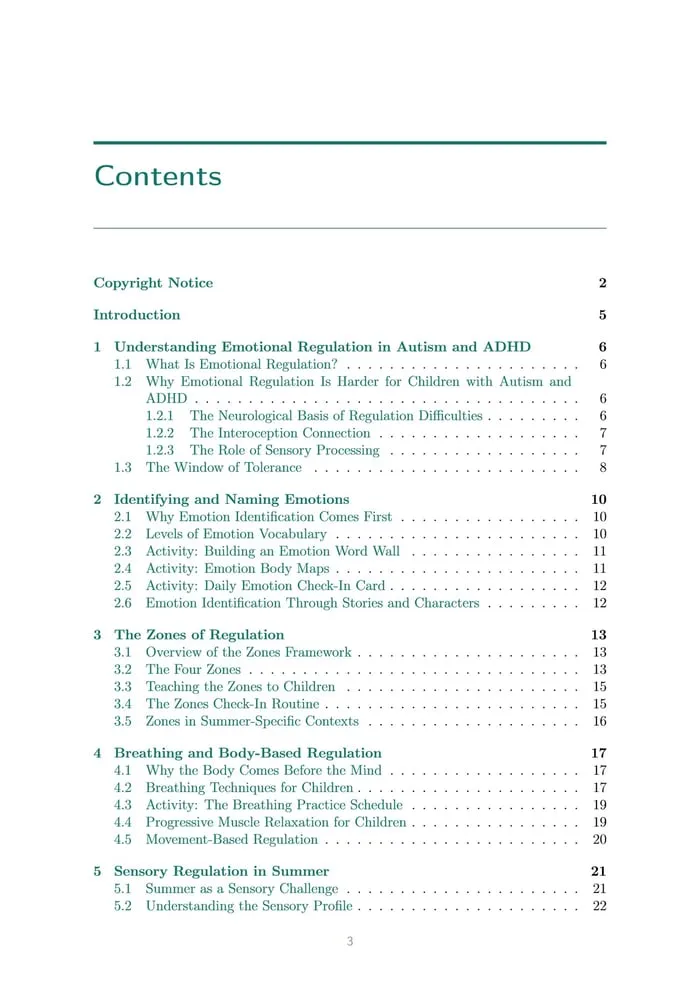
Summer Emotional Regulation Guide for Kids with Autism and ADHD: a 47-page guide for parents, caregivers, and summer staff covering naming emotions, the Zones of Regulation, breathing and body-based regulation, sensory regulation, anger, anxiety, a summer regulation schedule, scripts and stories, and adult co-regulation.
Sources and scope
- Centers for Disease Control and Prevention: Autism: general information for families about autism.
- Centers for Disease Control and Prevention: ADHD: information for families about ADHD.
- Understood.org: practical resources on emotions, routines, and learning differences.
- HealthyChildren.org (American Academy of Pediatrics): parent information on sleep, routines, and emotional health.
Scope: this guide offers everyday strategies for supporting regulation during summer break. It does not replace medical, psychological, or therapeutic care.
Key takeaways
- Summer removes structure, so expect more dysregulation at first.
- Keep a few visual daily anchors and plan quiet time after outings.
- Teach feelings words and a small set of calming tools at calm times.
- Plan for heat, crowds, fireworks, and travel in advance.
- Stay calm and use few words during big feelings.










Leave a Comment