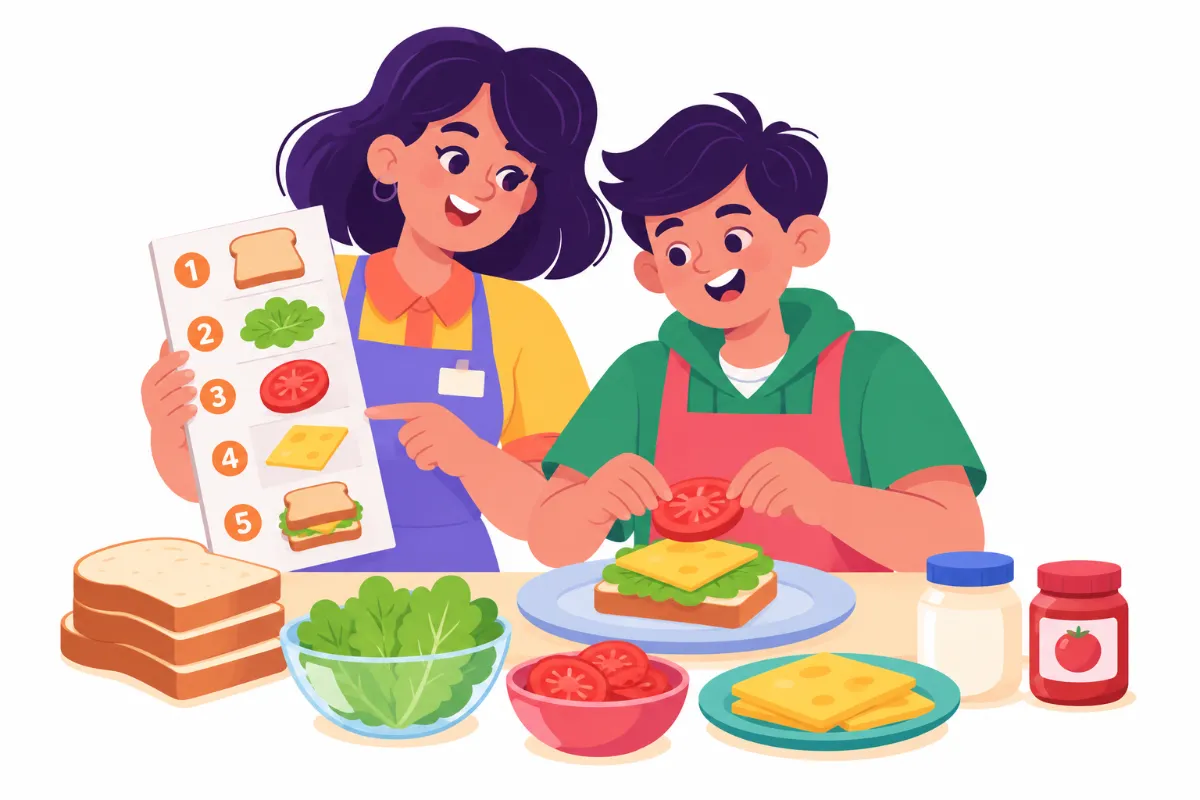

Independent living skills often get pushed aside by academic goals until the last year of school, when a family suddenly asks, “Will he be able to make his own lunch, do laundry, or ride the bus when he leaves?” At that point, there is a lot to teach and not much time. Starting earlier, with clear steps and steady practice, makes the move into adult life far less stressful for everyone.
This guide shows how to assess current skills, choose priorities with the student and family, break each skill into teachable steps, practice in real settings, and track progress toward independence. After reading, you will be able to build a practical plan that fits into transition planning and daily school routines.
Examples are fictional. Adapt to the student’s goals and agreed supports. This is guidance, not a diagnosis.
At a glance
- Assess what the student can already do at home, at school, and in the community.
- Choose a few priority skills with the student and family, based on their future goals.
- Break each skill into small steps and teach them with visual supports.
- Practice in real settings as soon as possible, not only in the classroom.
- Track independence step by step and fade adult help gradually.
1. Understand independent living skills in transition planning
Independent living skills are the everyday abilities people use to take care of themselves and their homes. They include personal hygiene, dressing, laundry, cooking, cleaning, managing money, using time, staying safe, and taking part in the community.
Under the Individuals with Disabilities Education Act, transition planning must begin by the IEP in effect when a student turns 16, and some states start earlier. When appropriate, the plan includes postsecondary goals related to independent living, along with education, training, and employment. As a result, these skills are not extras. They are part of the student’s legal plan for adult life.
Moreover, independence is not all or nothing. Some students will live fully on their own. Others will live with family or in supported settings, but still benefit from doing more for themselves. The goal is the most independence that fits the student’s life and wishes.
Worked example: Daniel, age 17
Daniel is in his second-to-last year of high school. He wants to live in a shared apartment with a friend after graduation. He is friendly and organized at school, but at home his parents still handle his laundry, meals, and money. His transition team decides to make home and money skills the focus this year.
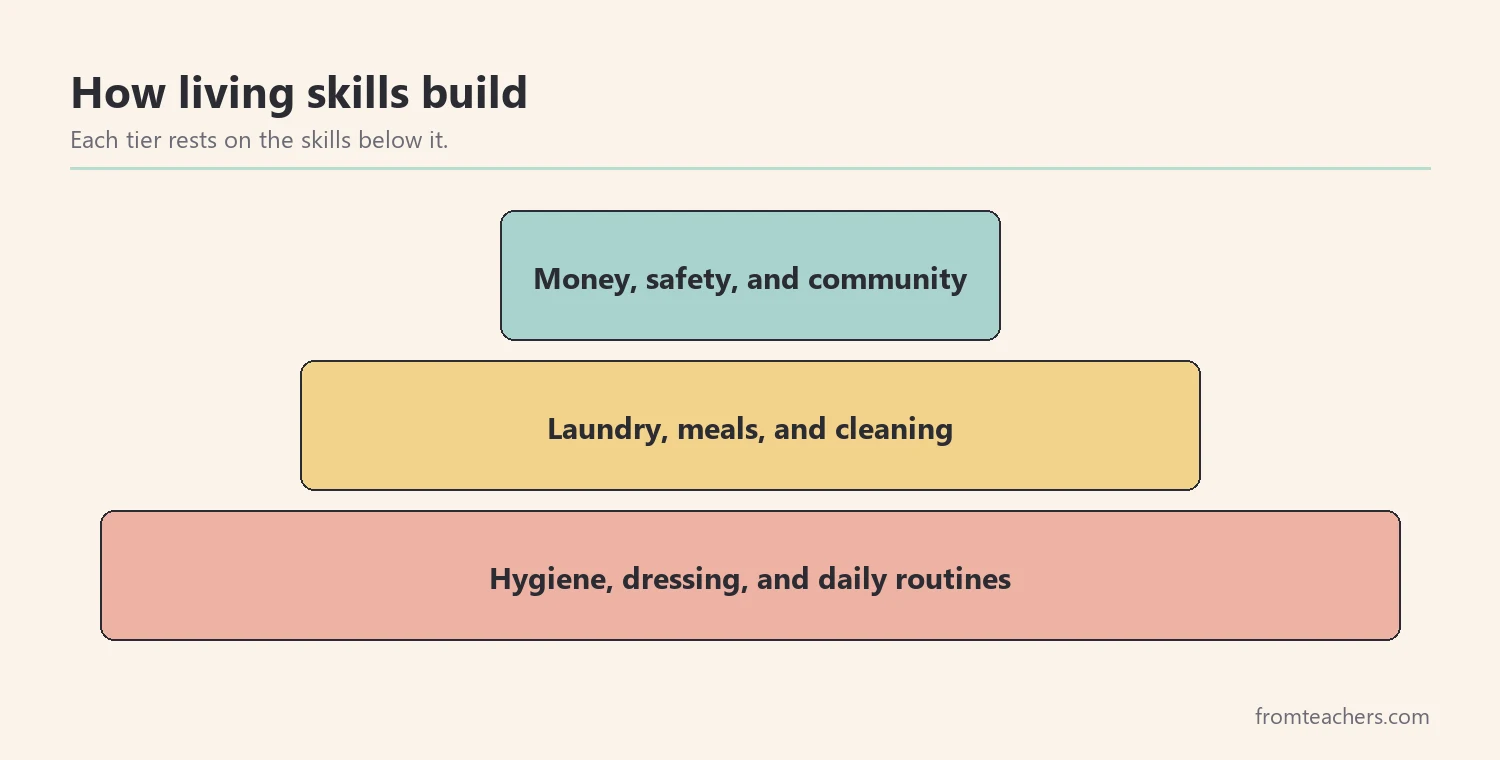
Equally, these skills support other transition goals. A young adult who can manage time, pack a lunch, and ride the bus is better prepared for college classes, job training, or work. In that sense, home skills and employment skills grow together, and progress in one area often helps the other.
2. Assess current skills across settings
Before teaching, find out what the student can already do. Ask the student, the family, and school staff, because skills often look different at home, at school, and in the community.
A simple assessment covers the main areas:
- Personal care: hygiene, dressing, grooming, and health routines.
- Home skills: laundry, cooking, cleaning, and basic home safety.
- Money: counting money, paying, budgeting, and spotting scams.
- Time and organization: using a schedule, calendar, timers, and to-do lists.
- Community: transportation, shopping, safety, and using services.
For each skill, rate the current level: does the student do it independently, with reminders, with partial help, or not yet? Next, ask the student which skills they want to learn. Their motivation will shape how quickly they progress.
Also, observe the student doing the task rather than relying only on reports. A parent might say a teen “can cook,” while in practice the teen can heat a frozen meal but not follow a recipe. Watching one real attempt gives a far more accurate starting point and shows exactly which steps need teaching.
Worked example: Daniel’s starting point
| Area | Skill | Current level |
|---|---|---|
| Personal care | Morning hygiene | Independent |
| Home skills | Laundry | Not yet |
| Home skills | Simple meals | With partial help |
| Money | Weekly budget | Not yet |
| Community | Bus to the store | With reminders |
Daniel’s hygiene is solid, so the team does not spend time there. Instead, they focus on the home and money skills he will need in a shared apartment.
3. Choose priorities with the student and family
No one can teach every skill at once. Therefore, choose two to four priorities for the year. Good priorities are skills the student needs soon, wants to learn, and can practice often.
Ask three questions for each possible skill:
- Will the student need this skill in their planned living situation?
- How often can they practice it at school and at home?
- Does the student care about learning it?
Write each priority as a clear, measurable goal. For example: “Daniel will complete a full load of laundry, from sorting to folding, using a picture checklist, with no adult prompts, in three of four weekly trials.”
In addition, agree on roles. The school might teach the steps, while the family provides real practice at home. When both settings use the same checklist, the student learns faster.
Finally, keep the student at the center of these decisions. Invite them to the planning meeting and ask what a good day in their future home looks like. Daniel, for example, said he wanted to “cook pasta for my friend without calling Mom.” That sentence became the motivation behind his meal goal.
Worked example: Daniel’s three priorities
| Priority | Why it matters | Where to practice |
|---|---|---|
| Laundry | Needed weekly in an apartment | School laundry room and home |
| Simple meals | Cook three dinners a week | Classroom kitchen and home |
| Weekly budget | Share rent and groceries | Math class and grocery trips |
4. Teach independent living skills in small steps
Large tasks such as “do the laundry” include many smaller actions. A task analysis breaks the task into clear, ordered steps, so the student learns one piece at a time. As a result, both the student and adults can see exactly which step needs more practice.
When you teach this way, follow a simple pattern:
- Model: show the whole task while naming each step.
- Guide: let the student do each step with support.
- Prompt less: move from physical help to a gesture, then to the checklist alone.
- Practice: repeat often, ideally on a set schedule.
Visual supports make a big difference. A picture checklist on the washing machine, a picture recipe card in the kitchen, or a simple budget sheet on the fridge gives the student a reminder without needing an adult. For more ready-to-use materials, a transition to adulthood guide for special education includes visual checklists, picture recipe cards, chore charts, and task analyses for multi-step jobs.
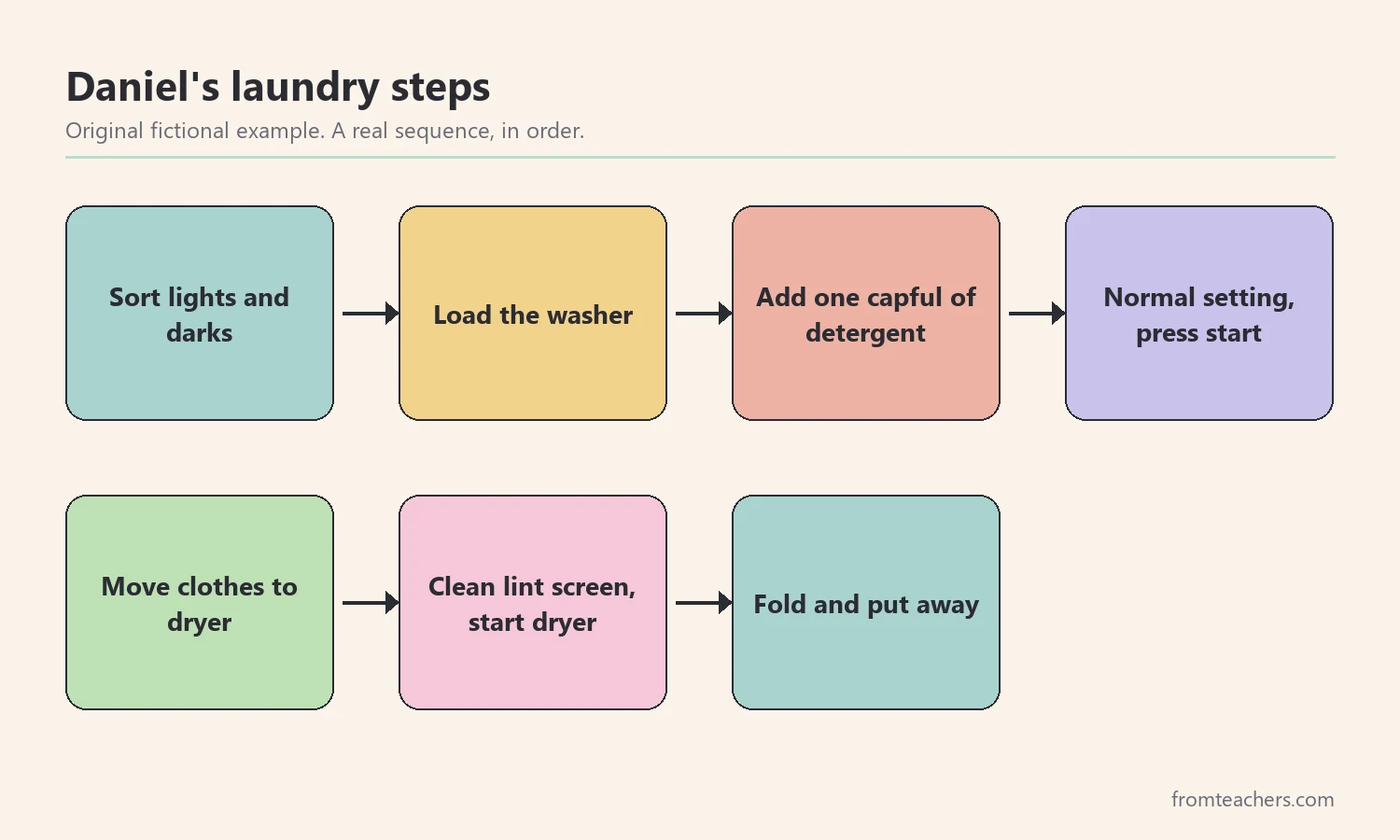
Worked example: Daniel’s laundry steps
- Sort clothes into lights and darks.
- Load one pile into the washer.
- Add one capful of detergent.
- Choose the normal setting and press start.
- Move clothes to the dryer when the washer stops.
- Clean the lint screen and start the dryer.
- Fold and put away clothes.
5. Practice in real settings
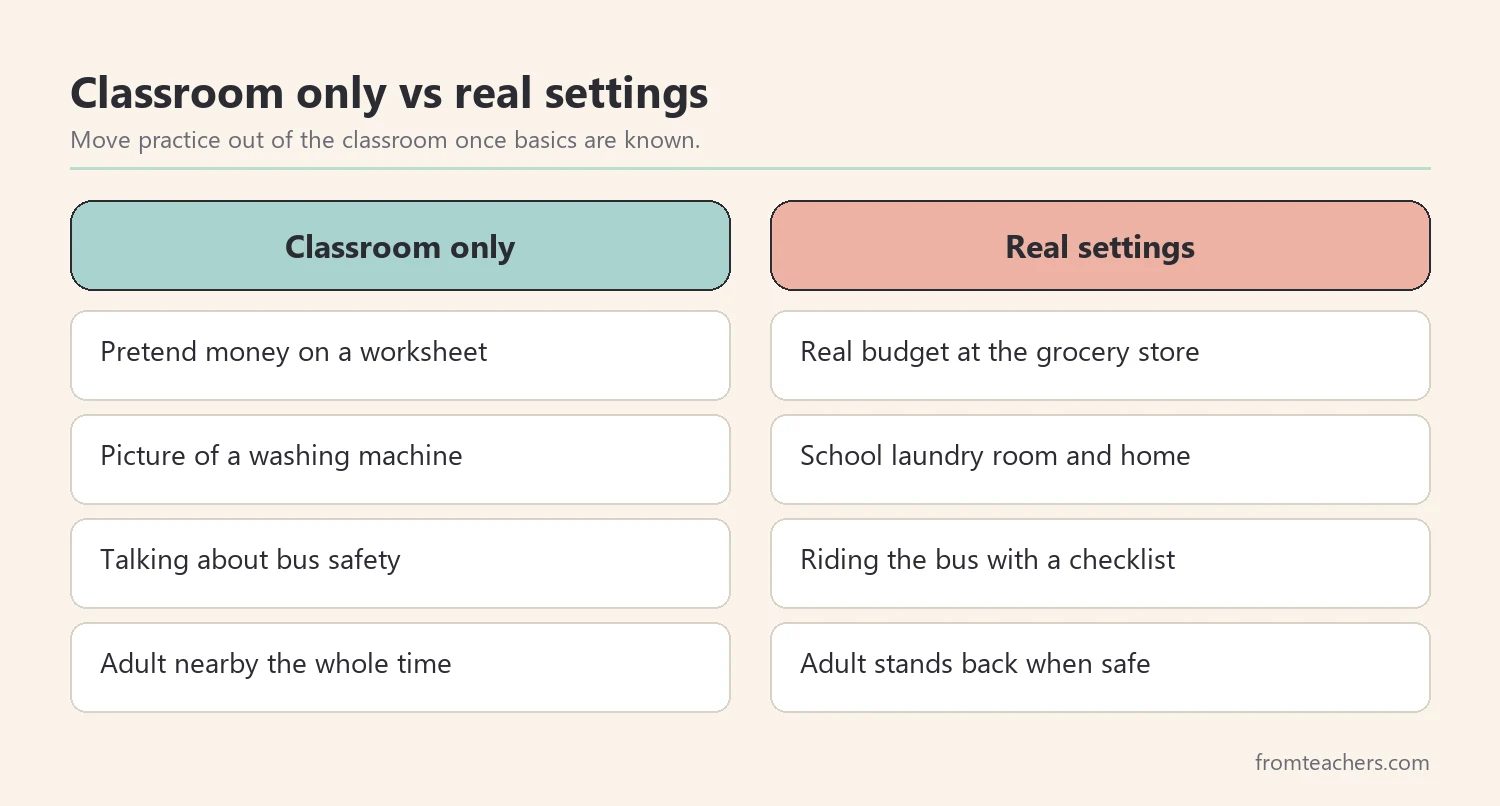
Skills learned only in a classroom often do not transfer to real life. Therefore, move practice into real settings as soon as the student understands the basic steps. The school laundry room, a real kitchen, a grocery store, and the city bus are all better teachers than a worksheet.
Plan community practice carefully:
- Preview the trip with pictures or a short video.
- Bring the same checklist the student uses at school.
- Keep adult help as quiet as possible, standing back when safe.
- Debrief afterward: what went well, and what was hard?
Safety is part of independence. Teach pedestrian safety, what to do if lost, how to carry an ID and emergency contact, and how to recognize scams. Role-play these situations at school first, then practice them during trips.
Moreover, practice at home matters most. Families can give the student real responsibility, such as cooking one dinner a week or managing a small grocery budget. Even short, regular jobs build confidence. For instance, a teen who takes out the recycling every Tuesday learns to track the day, remember the task, and finish it without being asked.
Worked example: Daniel’s grocery trip
Daniel plans three dinners, writes a shopping list, and sets a budget of $30. At the store, he finds his items with a picture list. His total comes to $26.50. He pays with $30 and checks that his change is $3.50. Back at school, he records the trip in his budget sheet.
Worked example: Daniel’s weekly money routine
Each Friday, Daniel reviews his budget sheet with his math teacher. He lists what he spent, compares it with his plan, and decides what to change next week. At first, the teacher reads each line with him. By the end of the semester, Daniel completes the review alone and only asks for help when something does not add up.
6. Track progress and fade support
Tracking shows which steps the student has mastered and which still need help. For each task analysis, record the level of support for every step: independent, gesture, verbal prompt, or physical help. Check weekly.
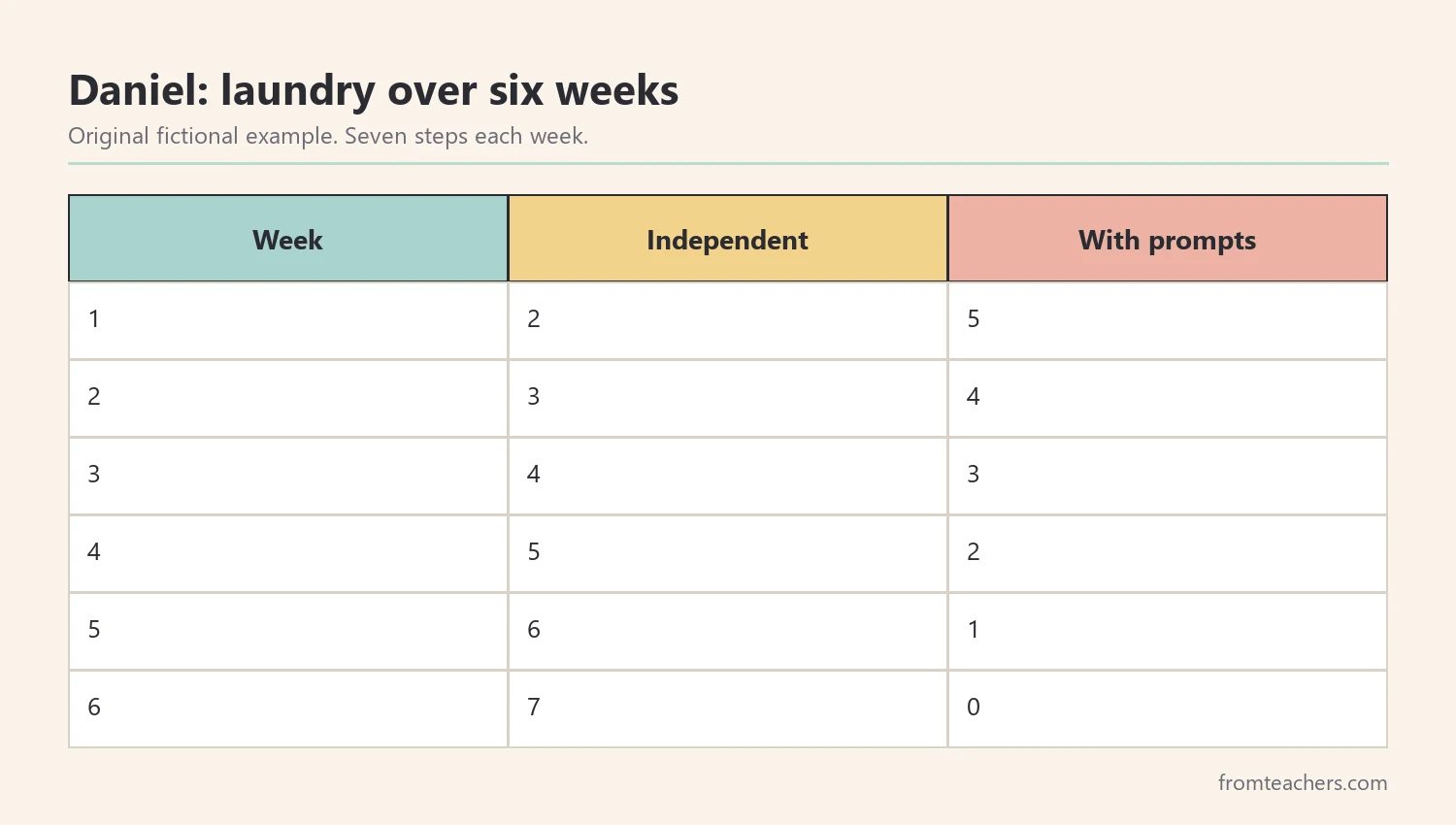
Worked example: Daniel’s laundry over six weeks
| Week | Steps independent (of 7) | Steps with prompts |
|---|---|---|
| 1 | 2 | 5 |
| 2 | 3 | 4 |
| 3 | 4 | 3 |
| 4 | 5 | 2 |
| 5 | 6 | 1 |
| 6 | 7 | 0 |
By week 6, Daniel completes all seven steps without prompts. The team then moves the checklist from the school laundry room to home, to make sure the skill works in a new place.
Fade support gradually. First remove physical help, then verbal prompts, and finally the checklist if the student no longer needs it. However, some students will always benefit from a checklist, and that is fine. Using a tool independently is still independence.
In addition, check generalization. A skill is truly learned when the student can do it in a new place, with different equipment, or with a different adult. Plan at least one such check before calling a goal complete.
Common mistakes and how to avoid them
- Starting too late. Fix: begin independent living goals early in high school, or sooner.
- Teaching only in the classroom. Fix: move practice into real settings once the basics are known.
- Too many goals at once. Fix: choose two to four priorities each year.
- Adults doing the hard steps. Fix: use task analysis to find and teach the exact step that is hard.
- Different methods at home and school. Fix: share one checklist across settings.
Questions teachers and parents ask about independent living skills
When should we start teaching independent living skills?
As early as possible. Young children can learn simple jobs such as sorting laundry or setting the table. Formal transition planning in the IEP begins by age 16 under federal law, and earlier in some states.
What if the student will live with family after school?
The skills still matter. Doing more for oneself builds confidence and reduces stress for the whole family, whatever the living arrangement.
How do I choose which skills to teach first?
Focus on skills the student will need soon, can practice often, and wants to learn. The student’s own goals for adult life are the best guide.
Can these skills be part of the IEP?
Yes. When appropriate, IEP transition plans include goals related to independent living, along with education and employment.
How can families help?
Give the student real jobs at home, use the same checklists as school, and let the student make small mistakes safely. Practice at home often has the biggest impact. Share quick photos or notes with the school so teachers know what is working.
Related reading: Transition to Adulthood, Workplace Readiness Skills, and Parent-Teacher Collaboration in Special Education.
A companion resource for independent living skills:
Transition to Adulthood: Independent Living Skills for Special Education: practical teaching strategies for hygiene, laundry, meal preparation, cleaning, personal and community safety, budgeting, time management, and community participation, with visual checklists, recipe cards, and chore charts.
Sources and scope
- Individuals with Disabilities Education Act (IDEA): federal requirements for transition planning in the IEP.
- National Technical Assistance Center on Transition: The Collaborative (NTACT:C): resources on secondary transition practices.
- IRIS Center, Vanderbilt University: modules on transition planning and evidence-based practices.
- Understood.org: family resources on planning for life after high school.
Scope: this guide covers teaching everyday living skills as part of school transition planning. It does not cover legal guardianship, benefits, or housing services, which families should explore with qualified advisors.
Key takeaways
- Daily living goals belong in transition planning, not as an afterthought.
- Assess skills across home, school, and community.
- Choose a few priorities with the student and family.
- Teach with task analysis and visual supports, then practice in real places.
- Track each step and fade support gradually.

Leave a Comment