

Sluggish cognitive tempo describes a pattern of daydreaming, mental fogginess, and slow processing that is often mistaken for ADHD. Picture a pleasant, quiet student who stares out the window during a lesson, starts the worksheet late, and finishes half of it by the bell. Nobody complains about her behavior, yet she is clearly not keeping up.
By the end of this guide, you will be able to recognize the signs of sluggish cognitive tempo, compare them with ADHD, record what you see in a useful way, choose classroom supports, and share concerns with families and professionals. One fictional student runs through every step, with short tables and figures you can adapt.
Examples are fictional. Adapt to the student’s goals and agreed supports. This is guidance, not a diagnosis.
At a glance
- Sluggish cognitive tempo centers on daydreaming, foggy thinking, and slow work, not restlessness.
- It is studied by researchers but is not a separate diagnosis in the main diagnostic manuals.
- Quiet students with these signs are easy to overlook, so structured observation matters.
- Simple supports, such as chunked tasks and check-ins, help many drifting students.
- Teachers describe and record; qualified professionals evaluate and diagnose.
1. Learn what sluggish cognitive tempo looks like
Researchers use the term sluggish cognitive tempo for a cluster of behaviors centered on slow, foggy thinking. In newer research, the same pattern is often called cognitive disengagement syndrome. Currently, it is not listed as a separate diagnosis in the main diagnostic manuals, but it remains an active area of study.
In class, the signs tend to look gentle rather than disruptive. For example, a student may:
- Daydream often or seem to “space out” during instruction.
- Appear confused, foggy, or lost in thought.
- Work slowly, even on tasks they clearly understand.
- Seem low in energy or sleepy during the day.
- Stay quiet and rarely interrupt or call out.
Because these students rarely cause trouble, their struggles can go unnoticed for years. Teachers often describe them as kind and cooperative, but “somewhere else.” In addition, sluggish cognitive tempo can affect friendships, since the student may miss quick jokes or turn-taking cues in group play.
Keep in mind that many other things can look similar. Poor sleep, worry, sadness, hearing or vision problems, and language differences can all cause a student to seem foggy. That is exactly why teachers describe what they see and leave the explanation to professionals.
Worked example. Lena, a fictional grade 4 student, is polite and well liked. Her teacher, Mr. Okafor, notices that she often looks out the window during math, needs directions repeated, and turns in reading responses that are correct but short. She never disrupts the class, so her report card comments have always said “a pleasure to teach.”
2. Compare sluggish cognitive tempo with ADHD in class
Sluggish cognitive tempo and ADHD can overlap, especially with the inattentive presentation of ADHD. However, the overall picture usually differs. ADHD tends to involve trouble sustaining attention, plus restlessness or impulsivity in some students. By contrast, sluggish cognitive tempo leans toward drowsiness, slowness, and drifting inward.
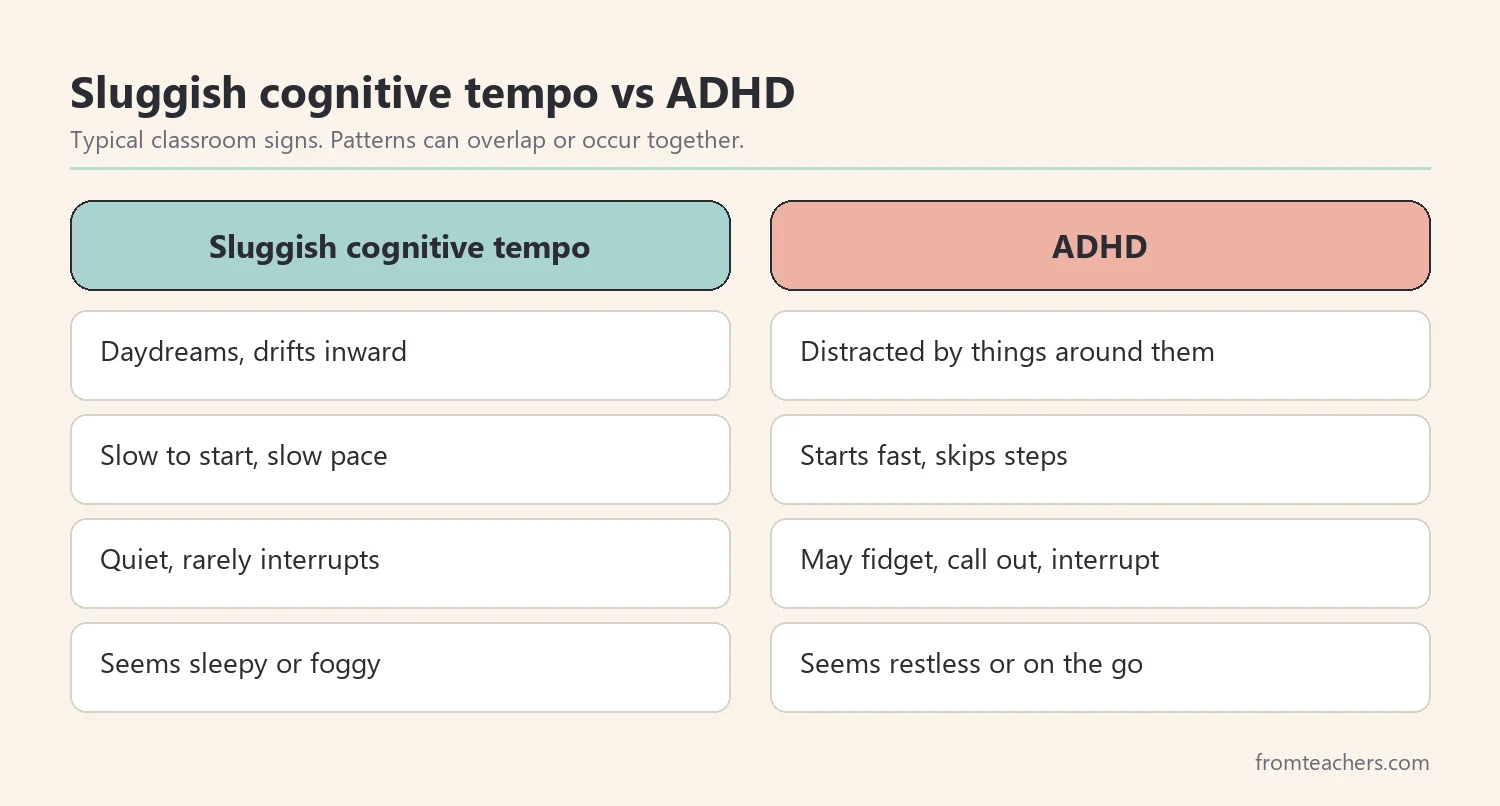
Also, the two can occur together. Some students show both patterns, which is one reason a careful evaluation by qualified professionals matters. Labels in a classroom conversation should stay descriptive, such as “slow to start” or “often drifts during lectures.”
| Moment | Sluggish cognitive tempo pattern | ADHD pattern |
|---|---|---|
| Lecture | Stares, drifts, quiet | Fidgets, talks, leaves seat |
| Independent work | Starts late, works slowly | Starts fast, skips steps |
| Group work | Passive, misses cues | Interrupts, rushes turns |
| End of day | Tired, foggy | Restless, easily distracted |
For a ready-made set of comparison tables, the Sluggish Cognitive Tempo vs ADHD behavior and response guide lays out behaviors such as daydreaming versus impulsivity and slow task completion versus restlessness, with suggested responses and outcomes.
Worked example. Mr. Okafor compares Lena with a classmate who has an ADHD plan. The classmate taps, calls out, and finishes early with careless errors. Lena, on the other hand, is silent, slow to begin, and accurate when she finishes. The contrast helps him describe Lena more precisely. Instead of writing “not paying attention,” he now writes “drifts during lectures, slow to start, accurate when finished,” which gives the family and the team a much clearer picture.
3. Observe and record sluggish cognitive tempo signs
Good notes turn a vague worry into useful information. Therefore, choose a short observation window, such as two weeks, and record the same few behaviors each day. Write what you see and when, not what you think the cause is.
Next, keep the log simple enough to finish in under a minute. Many teachers track three things: time to start a task, portion of the task completed, and how many times directions were repeated. Note the subject and time of day too, since sluggish cognitive tempo signs may shift across the day.
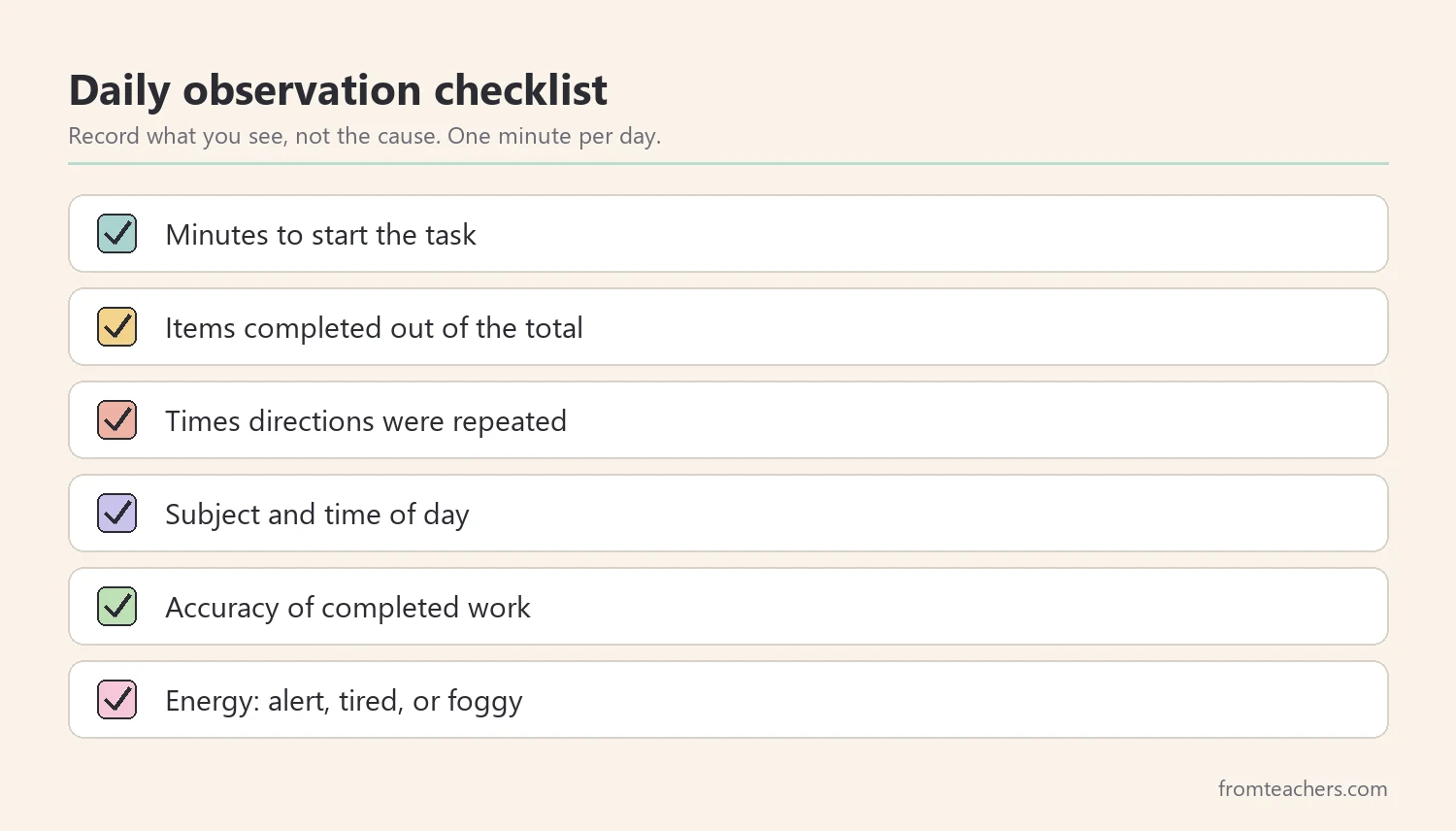
Worked example. Over five math lessons, Mr. Okafor records Lena’s start times and completed items on a 10-item practice set.
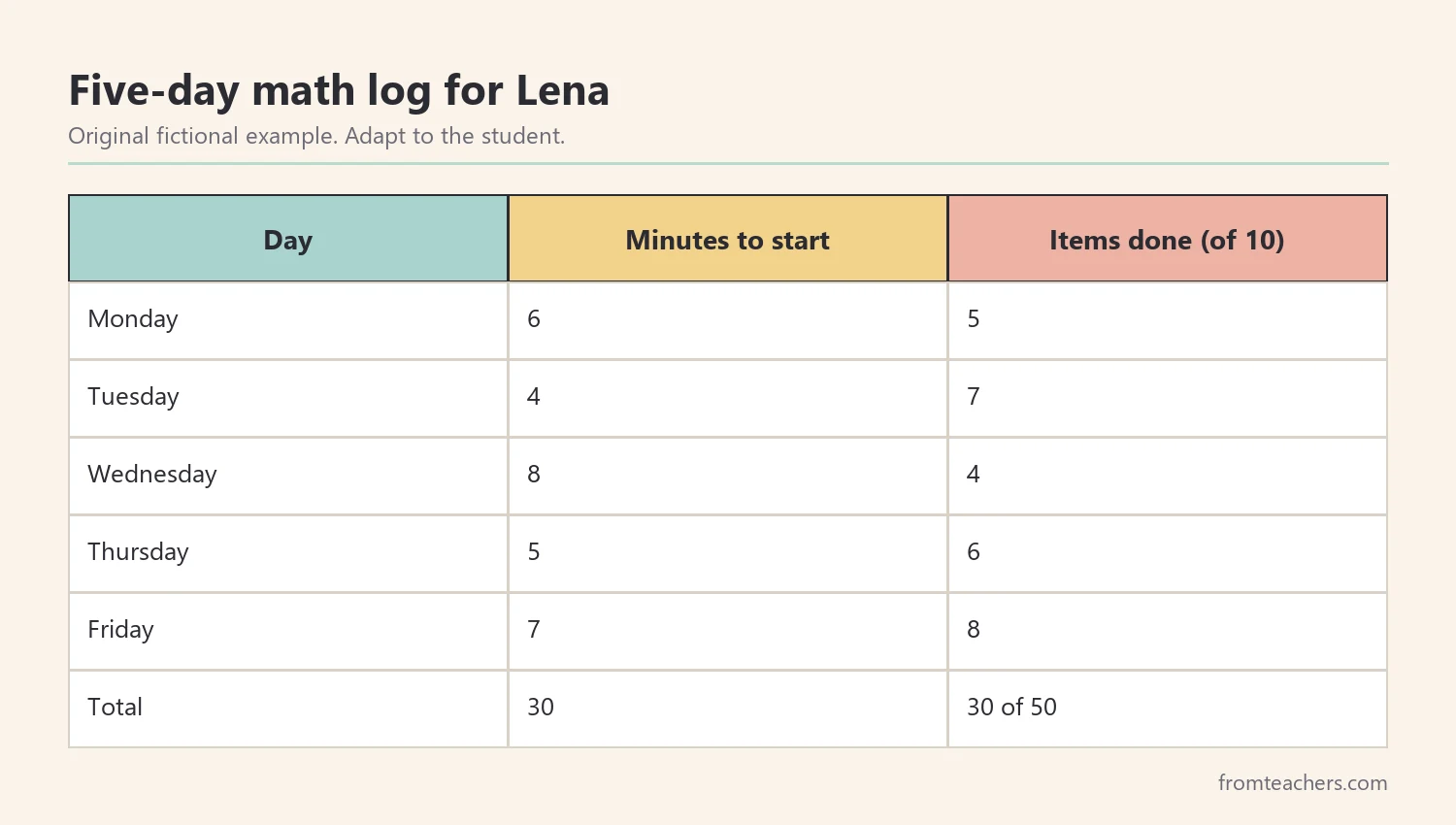
| Day | Minutes to start | Items done (of 10) |
|---|---|---|
| Monday | 6 | 5 |
| Tuesday | 4 | 7 |
| Wednesday | 8 | 4 |
| Thursday | 5 | 6 |
| Friday | 7 | 8 |
| Total | 30 | 30 of 50 |
He also notes that every completed item was correct. That detail matters: it suggests that pace and starting, rather than understanding, are the main barriers for Lena.
Meanwhile, avoid a few common traps. Do not record only on bad days, because that paints an unfair picture. Likewise, do not compare the student with the fastest child in the room. Instead, compare the student with their own earlier notes, and ask a colleague to observe once if you can, so you have a second view.
4. Use classroom supports for sluggish cognitive tempo
Most supports for slow-paced, drifting students are low cost and good for the whole class. Start with the basics that help everyone, then add targeted supports for the students who need more. Finally, reserve individual plans for students whose needs continue after these steps, and work through your school team.
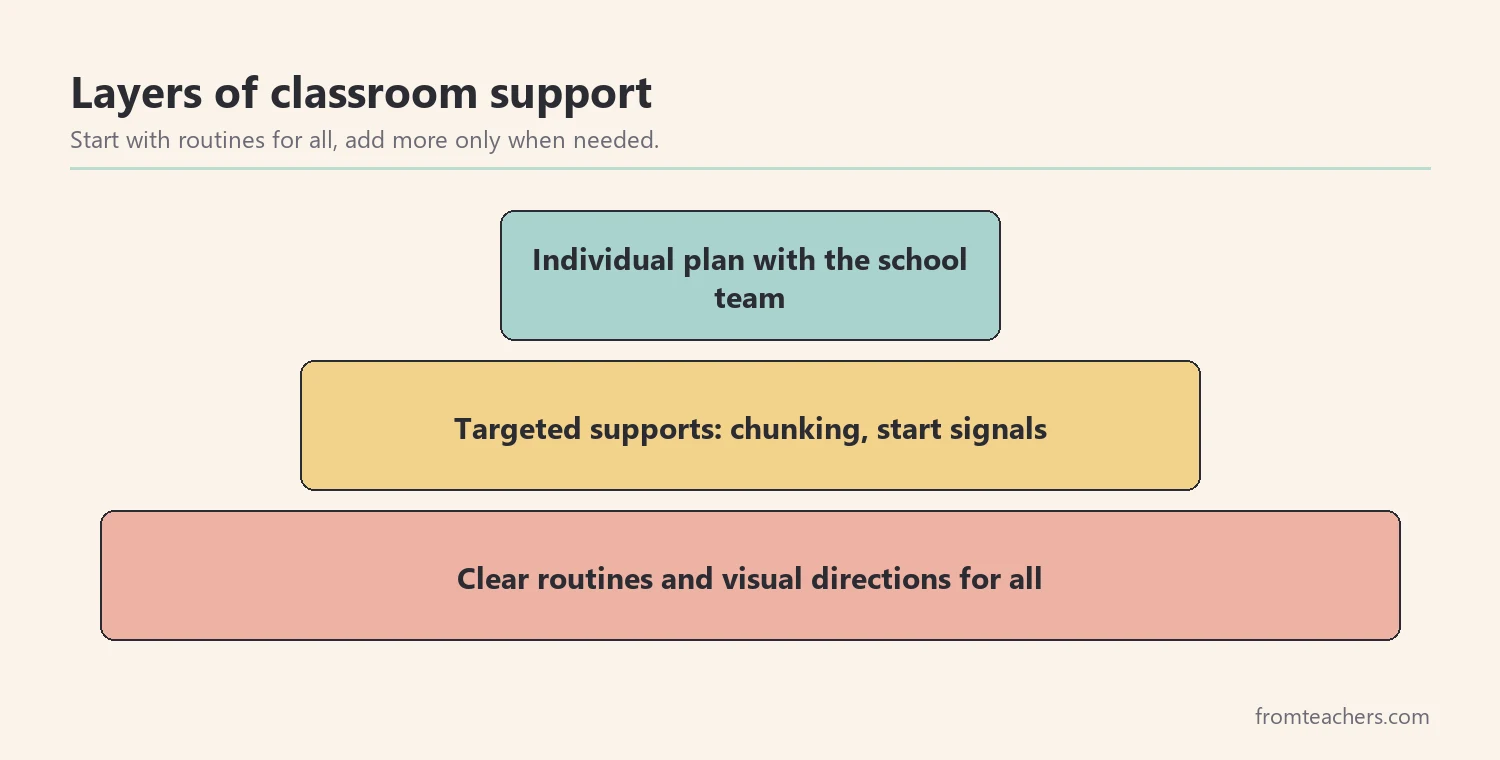
Useful supports include:
- Chunked tasks. Give five items at a time instead of a full page.
- Start signals. Check in privately within the first minute of independent work.
- Visual directions. Post the steps on the board or the desk.
- Movement breaks. Short, planned breaks can help students who seem sleepy.
- Extra time where fair. Focus grades on understanding, not speed, when the goal allows it.
- Seating. Seat the student near instruction and away from windows.
In addition, keep your tone warm. Students with sluggish cognitive tempo signs often hear “hurry up” all day. Praise for starting, not just finishing, builds momentum.
Worked example. Mr. Okafor gives Lena her practice in two strips of five items. He taps her desk and says “first one?” within a minute of independent work. After two weeks, his log shows she starts in about three minutes and completes 8 of 10 items on most days.
Supports at home
Parents can mirror the same ideas at home. For instance, break homework into short blocks with a timer, and keep the first task small so getting started feels easy. A steady bedtime routine also matters, because tiredness can make any student seem foggy.
In addition, agree on one shared signal between home and school, such as a sticky note that says “first step.” When the same cue appears in both places, the student learns it faster. Finally, celebrate effort and starting, not only finished pages.
5. Share concerns with families and professionals
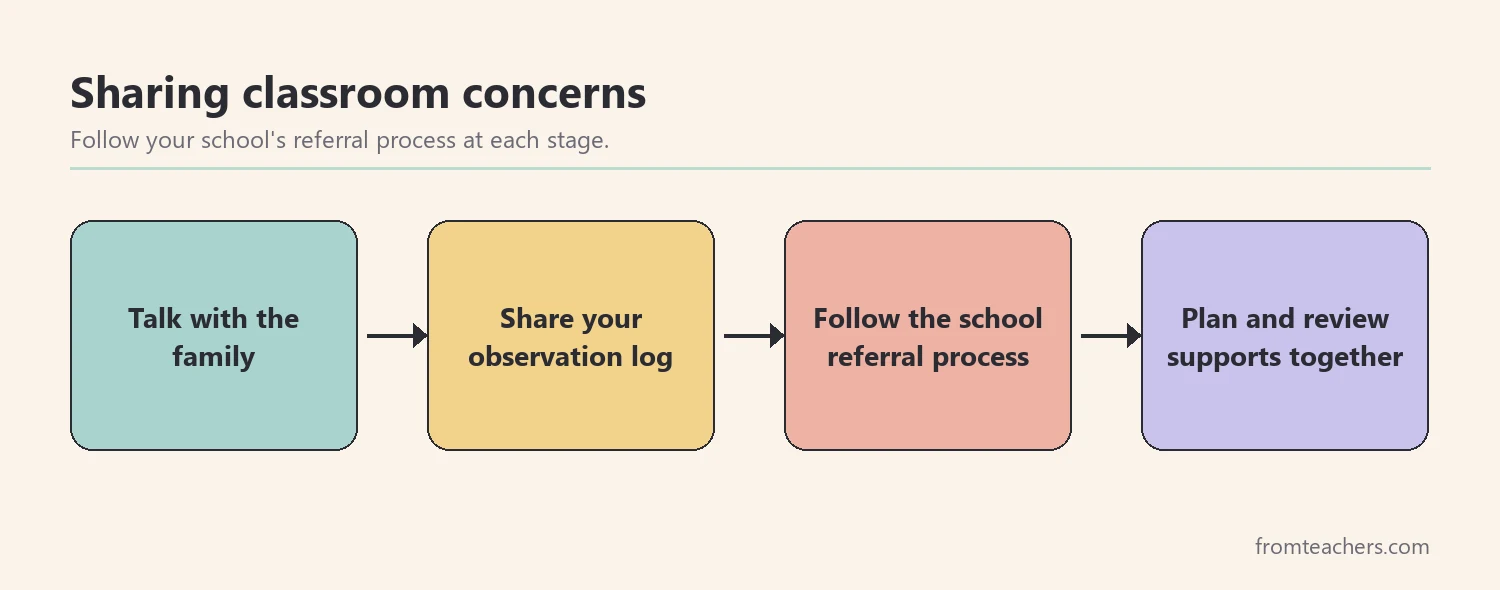
When classroom supports help only a little, it is time to share your notes. Begin with the family. Describe what you have seen, share the log, and ask what they notice at home, such as sleep, energy, and homework time.
Then, follow your school’s process for referrals. This might be a student support team meeting, a conversation with the school psychologist, or a suggestion that the family speak with their doctor. Professionals can explore sluggish cognitive tempo, ADHD, sleep, mood, or other explanations, and they decide on any diagnosis.
Sometimes a student already has an ADHD diagnosis, yet the usual supports do not seem to fit. In that case, share your observations with the family and the team without suggesting the diagnosis is wrong. Instead, describe what works and what does not. If professionals later identify both patterns, the student may need supports for each.
Worked example. Mr. Okafor meets Lena’s parents and shows them the five-day log. They mention that Lena often seems tired after school and takes a long time with homework. Together, they agree to request a student support team meeting, and the parents plan to raise the pattern at Lena’s next doctor visit.
6. Review progress and adjust
Support is not a one-time decision. Set a review date, such as four to six weeks after you start. Compare your new notes with your first log and ask which supports made a difference.
Next, keep what works and drop what does not. For example, if chunking helps but movement breaks do not, keep chunking and try another idea. Share the results with the family and the support team so everyone sees the same picture.
When a student has a formal plan, such as a 504 plan or an IEP, the review should follow that plan’s schedule and team process. Your classroom notes then become part of a bigger conversation, which is exactly where they are most useful.
Also, ask the student. Older students can often tell you what helps them “wake up” for a task. Their answers make supports more personal and more likely to stick.
Worked example. At the six-week review, Lena tells Mr. Okafor that the desk tap “helps me remember to start.” The team keeps chunked tasks and start check-ins, and adds a short stretch before math.
Common mistakes and how to avoid them
- Assuming a quiet student is fine. Fix: track work completion, not just behavior.
- Labeling the student. Fix: describe behaviors in plain words and leave diagnosis to professionals.
- Using only “hurry up” reminders. Fix: give clear start signals and shorter chunks.
- Treating every drifting student as ADHD. Fix: compare patterns carefully and share notes with the team.
- Grading speed when the goal is understanding. Fix: separate pace from mastery where the standard allows it.
Questions teachers and parents ask about sluggish cognitive tempo
Is sluggish cognitive tempo the same as ADHD?
No. The two can overlap and can occur together, but sluggish cognitive tempo is marked by daydreaming, fogginess, and slowness rather than restlessness or impulsivity. Only qualified professionals can sort out what is going on for a specific child.
Is sluggish cognitive tempo an official diagnosis?
Currently, it is not a separate diagnosis in the main diagnostic manuals. Researchers continue to study it, sometimes under the name cognitive disengagement syndrome. Families should discuss concerns with their doctor or a qualified evaluator.
Can a teacher identify sluggish cognitive tempo?
Teachers can notice and record the signs, which is very valuable. However, they should not diagnose. Instead, share clear observations with the family and the school team.
What classroom supports help most?
Chunked tasks, private start signals, visual directions, and planned movement breaks help many students. What works varies, so try one or two supports at a time and track the results.
What should parents do if they suspect a misdiagnosis?
Keep notes on what you see at home and ask the school for its observations. Then bring both to your child’s doctor or evaluator and ask about all possible explanations. Avoid stopping any treatment without medical advice.
Related reading: Effective ADHD Classroom Strategies, ADHD in Children: Classroom and Home Support, and 5 Teaching Tips to Boost Classroom Focus.
A companion resource for telling SCT and ADHD apart:
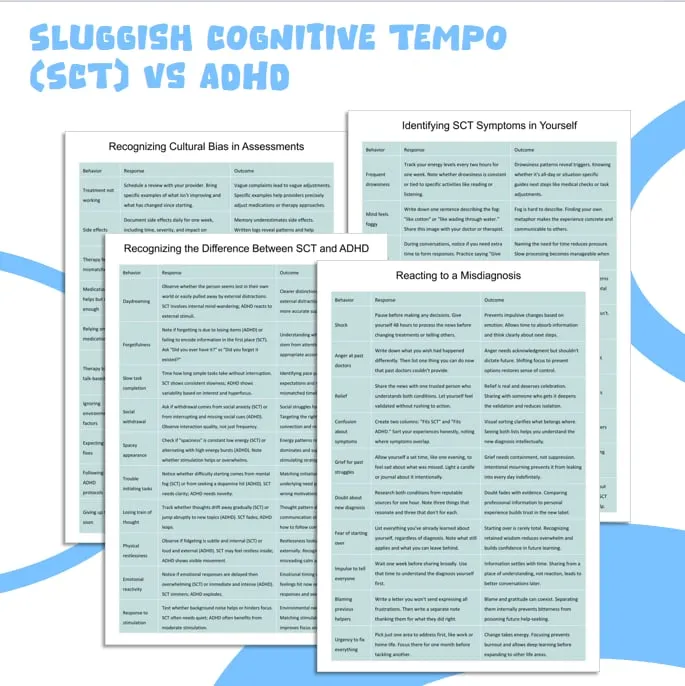
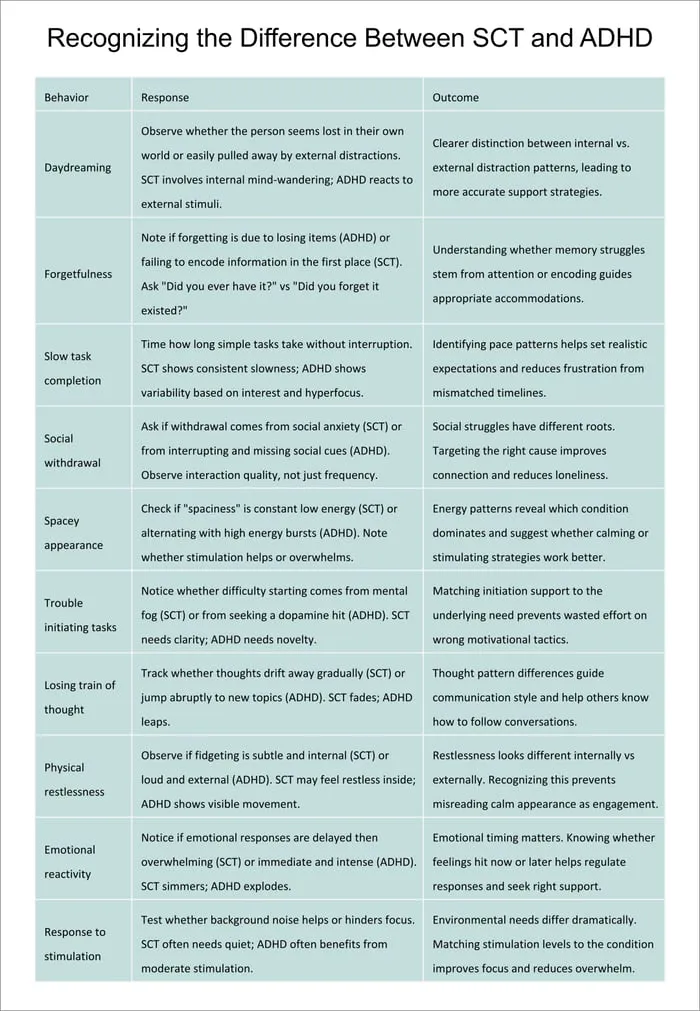
Sluggish Cognitive Tempo (SCT) vs ADHD: 12 pages of behavior, response, and outcome tables on telling the two apart, identifying SCT symptoms, responding to a misdiagnosis, and accepting a dual diagnosis.
Sources and scope
- CHADD: a national organization offering information and support on ADHD for families and educators.
- CDC: ADHD: public health information on ADHD symptoms, diagnosis, and treatment.
- National Institute of Mental Health (NIMH): research-based information on attention and mental health.
- Understood.org: practical guidance for families and teachers on learning and thinking differences.
- IRIS Center: free training modules on classroom supports and evidence-based practices.
This guide helps teachers and parents notice, describe, and support slow-paced, daydreamy students; it does not diagnose sluggish cognitive tempo or ADHD or replace evaluation by qualified professionals.
Key takeaways
- Sluggish cognitive tempo looks like daydreaming, fogginess, and slow work, not disruption.
- It can overlap with ADHD, so compare patterns carefully and stay descriptive.
- Short, consistent observation logs turn worries into useful information.
- Chunked tasks, start signals, and visual directions help many drifting students.
- Share notes with families and the school team; professionals handle diagnosis.






Leave a Comment