

Pragmatic language screening mistakes are easy to make in your first year as a school speech-language pathologist, because social communication changes so much with setting, partner and culture. Picture Ethan, age 9, referred because his teacher says he “doesn’t get conversations.” In a quiet therapy room, one-on-one with a friendly adult, he seems fine. On the playground, he talks about trains for ten minutes while peers drift away.
This list is for new SLPs, clinical fellows and graduate clinicians doing school screenings. It covers eight common pragmatic language screening mistakes, ordered from the easiest to fix to the habits that take practice. Each item explains the mistake, why it matters and a practical fix, with Ethan as the example throughout.
Examples are fictional. Adapt to the student’s goals and agreed supports. This is guidance, not a diagnosis.
At a glance
- Pragmatic skills vary by setting, so one quiet session is rarely enough.
- Rate observable behaviors, not general impressions.
- Use the same frequency scale across observers and settings.
- Consider culture, language background and age expectations.
- A screener guides next steps; it does not replace an evaluation.
How this list is ordered
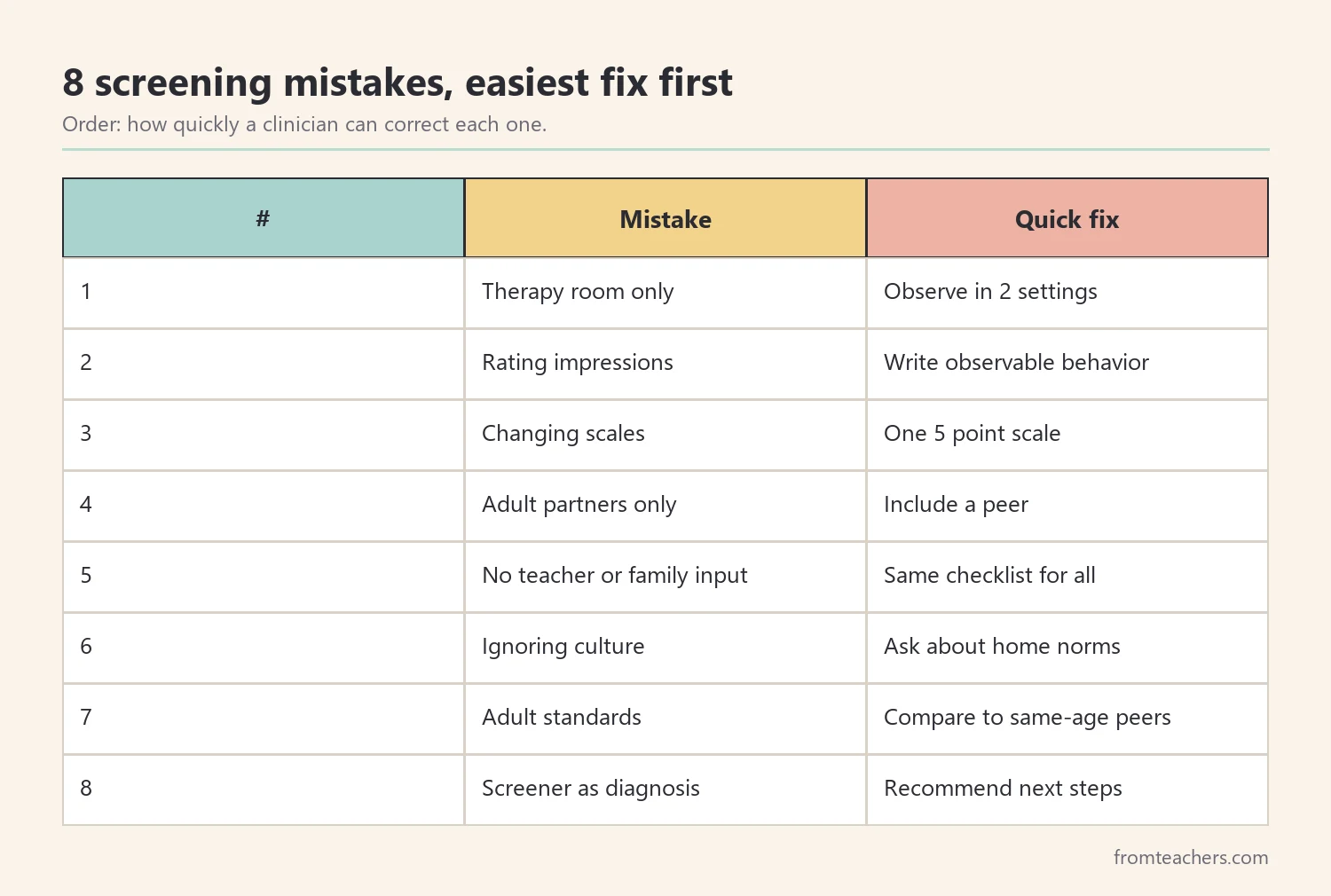
We ordered the eight pragmatic language screening mistakes by how quickly a clinician can correct them. The first three are changes you can make at your next screening. The middle three involve planning and collaboration. Last come two habits of interpretation that take time and supervision to build.
Pragmatic language is the social use of language: greeting, taking turns, staying on topic, reading facial expressions and adjusting to the listener. Because it lives in real interactions, screening it is different from screening vocabulary or articulation. Figure 1 lists each mistake with a quick fix.
1. Screening only in the therapy room
The therapy room is calm, predictable and run by a supportive adult. As a result, many students show their best pragmatic skills there, and their difficulties stay hidden.
Why it matters: the referral concern usually comes from busier settings, such as group work, lunch or recess.
The fix: observe in at least one natural setting, ideally two. Short visits to the classroom and the cafeteria often show more than a long room session.
Example: In the therapy room, Ethan greeted the SLP, Ms. Kim, and answered questions well. At lunch, she saw him interrupt peers repeatedly and miss their cues to change topic.
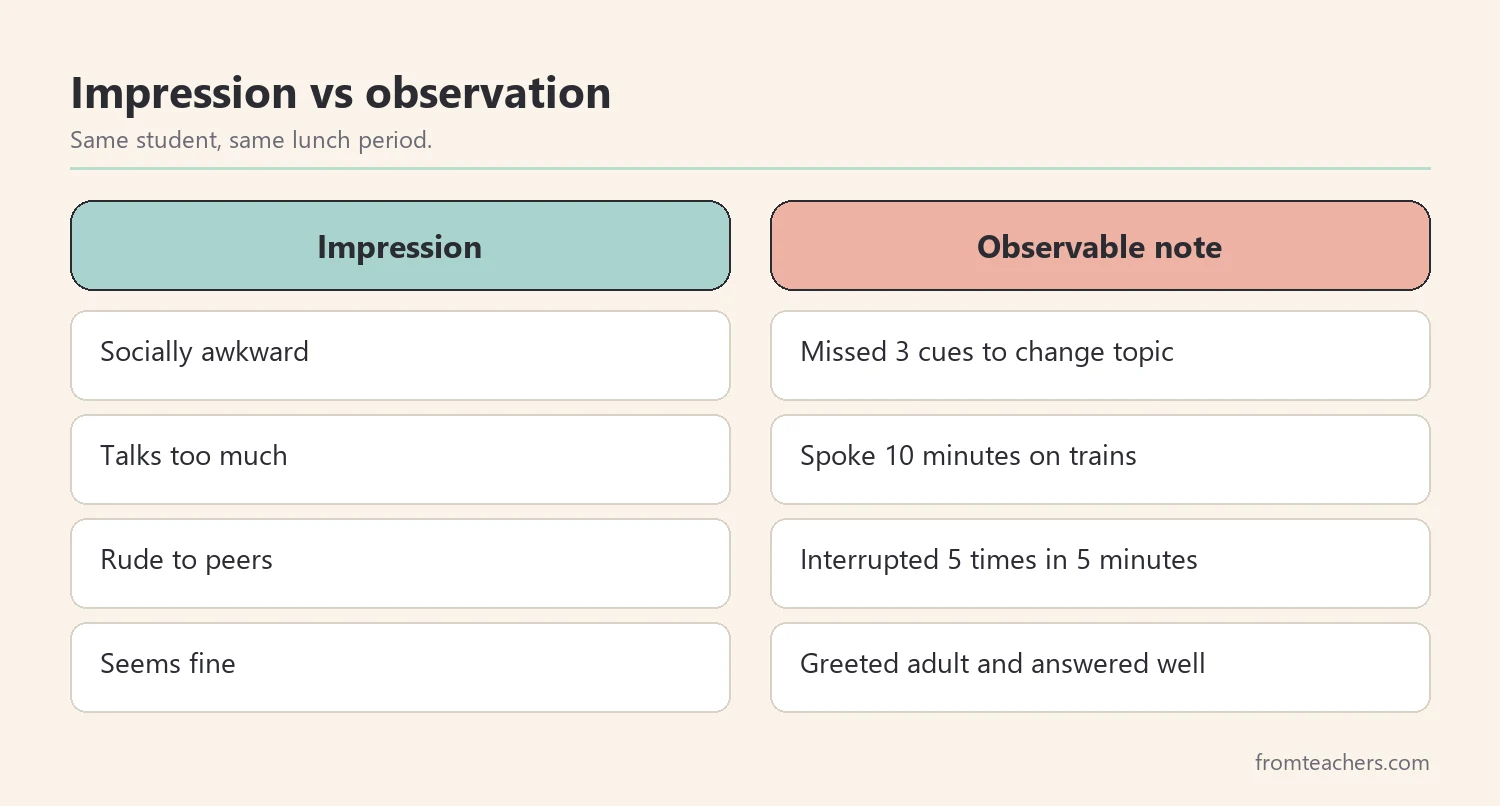
2. Rating impressions instead of behaviors
Notes such as “socially awkward” or “seems fine” are impressions. They are hard to compare, and they can sound judgmental in a report.
Why it matters: teams need to know exactly what the student does. Observable behaviors make goals and progress monitoring possible later.
The fix: write down what you see and hear: “Changed topic back to trains four times in five minutes.”
Example: Ms. Kim replaced “off topic a lot” with a count from her lunch observation. The teacher immediately recognized the pattern.
3. Using a different scale each time
Among the most common pragmatic language screening mistakes is changing the rating method between observations, such as yes or no one day and a five point scale the next.
Why it matters: inconsistent scales make it impossible to compare settings, observers or dates.
The fix: use one frequency scale for every skill and every observer, for example always, often, sometimes, rarely and never. Describe each skill the same way each time.
Example: Ms. Kim and Ethan’s teacher both used the same scale. Their ratings matched on most skills, which made the differences easier to discuss.
4. Forgetting the conversation partner
Pragmatic skills change with the partner. Many students do well with adults, who adapt to them, but struggle with peers, who do not.
Why it matters: a screening that only includes adult partners may underestimate the challenge.
The fix: note who the student is talking to during each observation, and include at least one peer interaction.
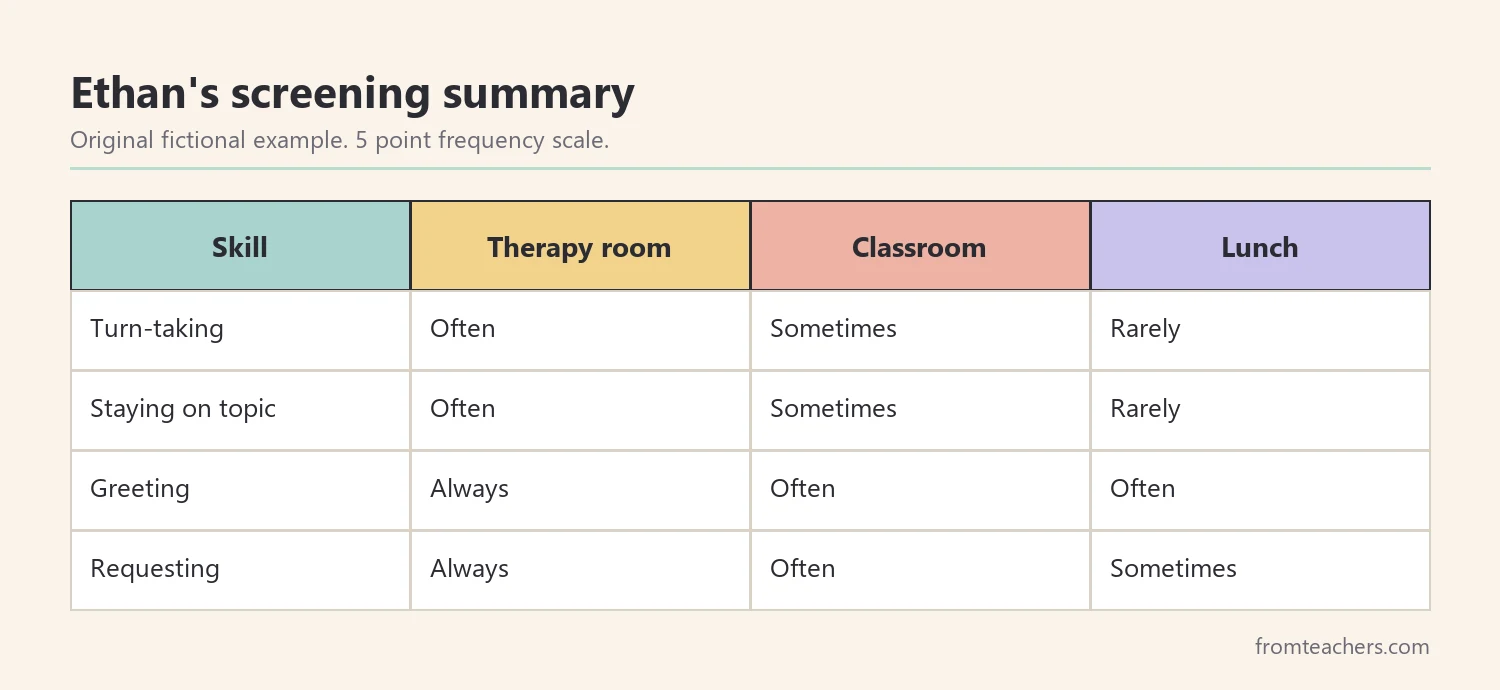
Example: Ethan’s turn-taking was rated often with adults and rarely with peers. That single contrast shaped the team’s next steps.
5. Not asking teachers and families
You see a student for minutes. Teachers and families see the student for hours, across many situations. Their input is essential.
Why it matters: some skills, such as greeting family friends or handling a disagreement with a sibling, are rarely visible at school.
The fix: give the teacher and family a short version of the same checklist, or ask the same questions in a brief interview. Then compare answers.
Example: Ethan’s mother reported he rarely asked others questions at home either. That matched the school observations.
6. Ignoring culture and language background
Pragmatic norms differ across cultures and families. Eye contact, turn length, directness and topic choice all vary. A behavior that looks unusual in one setting may be expected in another.
Why it matters: mistaking a cultural difference for a disorder is a serious error. ASHA guidance stresses culturally and linguistically responsive practice.
The fix: ask families about communication norms at home, and interpret skills such as eye contact with care. When a student is learning English, consider language background before drawing conclusions.
Example: Ms. Kim asked Ethan’s family about eye contact expectations. Because it was not a family difference for them, she kept it in her notes as a possible area to watch.
7. Comparing to adult standards, not age expectations
Young children interrupt, overshare and switch topics. That is normal development. Expecting adult conversational polish from a nine-year-old leads to over-identification.
Why it matters: pragmatic skills develop over childhood and adolescence. Judgments must fit the student’s age and peer group.
The fix: compare the student with same-age peers in the same setting. A quick observation of two typical classmates gives useful context.
Example: Ms. Kim noticed that several of Ethan’s peers also interrupted at lunch. However, none of them stayed on one topic as long, which kept the focus on topic maintenance.
8. Treating the screener as a diagnosis
Finally, the most serious of these pragmatic language screening mistakes is over-reading the result. A screener tells you whether more information is needed. It does not diagnose a disorder or decide eligibility.
Why it matters: formal decisions require a full evaluation that follows district procedures and state rules.
The fix: write a clear summary: what you observed, in which settings, and what you recommend next, such as monitoring, classroom strategies or a referral for a full evaluation. A structured pragmatic skills checklist with ten skill areas, a frequency scale and a recommendations section keeps that summary organized.
Example: Ms. Kim’s summary, shown in Figure 3, recommended a full evaluation discussion with the team rather than a label.
The ten skill areas most screeners cover
Most informal pragmatic screeners look at similar skills. The table below groups ten common areas and gives one observable example for each. Use it as a reminder of what to watch, not as a scoring key.
| Skill area | What to watch |
|---|---|
| Eye contact | Looks toward the speaker in a way that fits the setting |
| Facial expressions | Notices and responds to others’ expressions |
| Back-and-forth conversation | Answers and adds to what others say |
| Turn-taking | Waits and lets others speak |
| Staying on topic | Keeps to the shared topic |
| Transitioning topics | Changes topic smoothly |
| Requesting | Asks for help or items clearly |
| Greeting | Says hello and goodbye |
| Expressing needs | Says what they want or feel |
| Social norms | Follows unwritten rules of the setting |
Remember the cultural note from mistake 6, especially for eye contact and greetings.
A simple screening routine
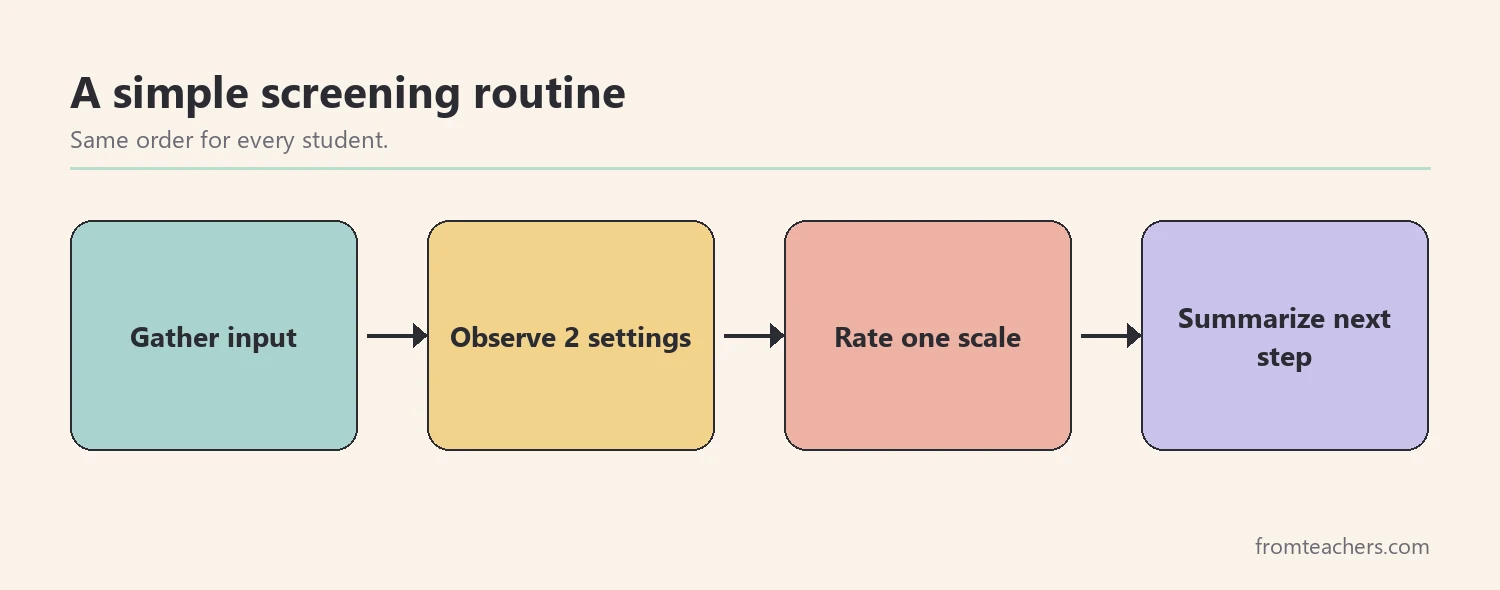
A consistent routine reduces most pragmatic language screening mistakes before they happen. Figure 4 shows a four-step sequence many school SLPs use in some form: gather input, observe in two settings, rate with one scale and summarize next steps.
Plan your observation times with the teacher. Lunch, recess, group work and transitions are rich settings. Also, keep observations short and frequent rather than long and rare, since students act differently when they notice an adult watching for a long time.
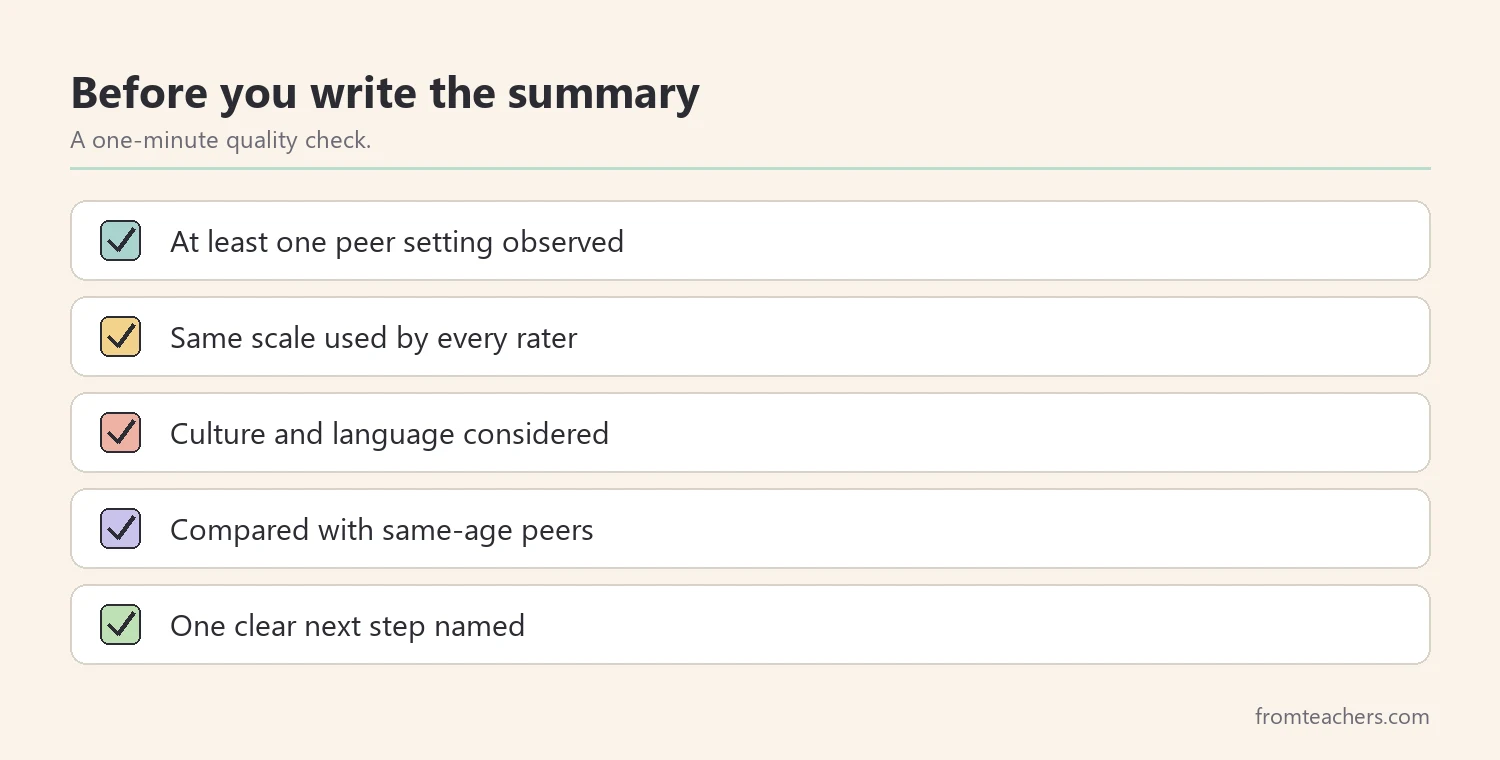
Before you write the summary, run through the five checks in Figure 5. They take a minute and catch most gaps.
Common mistakes in screening reports
- Using jargon. Fix: explain skills in plain words families understand.
- Listing only weaknesses. Fix: include strengths, such as Ethan’s rich vocabulary about trains.
- Leaving out settings. Fix: name where and with whom each observation happened.
- Vague recommendations. Fix: state one clear next step and who will do it.
- Forgetting dates and observers. Fix: record both on every form.
Questions new SLPs ask about pragmatic language screening mistakes
How many observations do I need?
There is no single number. Many clinicians aim for at least two settings, including one with peers, plus teacher and family input.
Can a teacher complete the checklist?
Yes, teachers often complete a version of the same checklist. Comparing their ratings with yours shows where views agree and differ.
What if the student does well in every setting I see?
Ask the referring adult when the concern happens, and try to observe then. If concerns remain unclear, monitoring may be the right next step.
Should I share the screener with the family?
Follow your district’s procedures. When results are shared, explain that a screener is not a diagnosis and describe the next step clearly.
How do I avoid bias in screening?
Learn about the student’s language and cultural background, compare with same-age peers and seek supervision or a second observer when unsure.
Related reading: Autism Social Skills Development, The Power of Data Tracking in Special Education, and How Parents and Teachers Can Team Up.
You may also need: Taking Turns in Conversation social story.
A companion resource for avoiding pragmatic language screening mistakes:
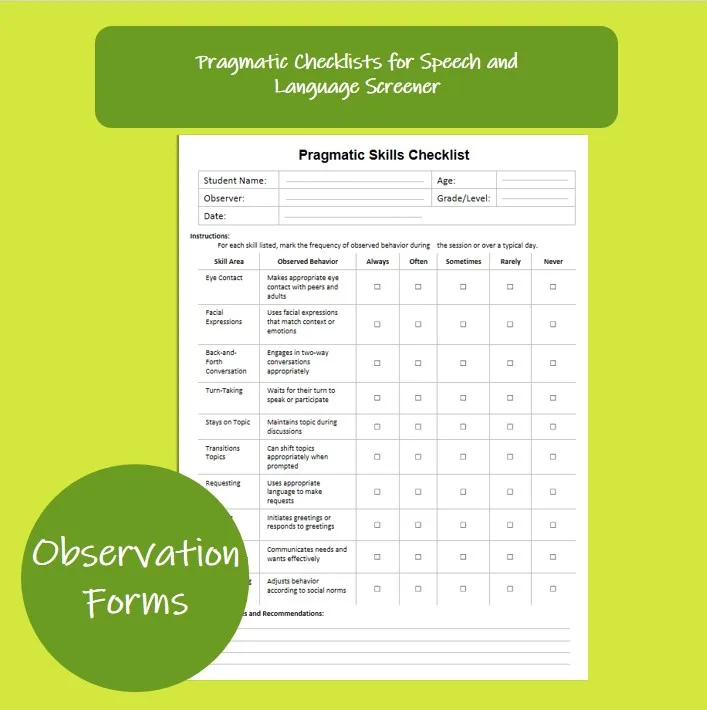
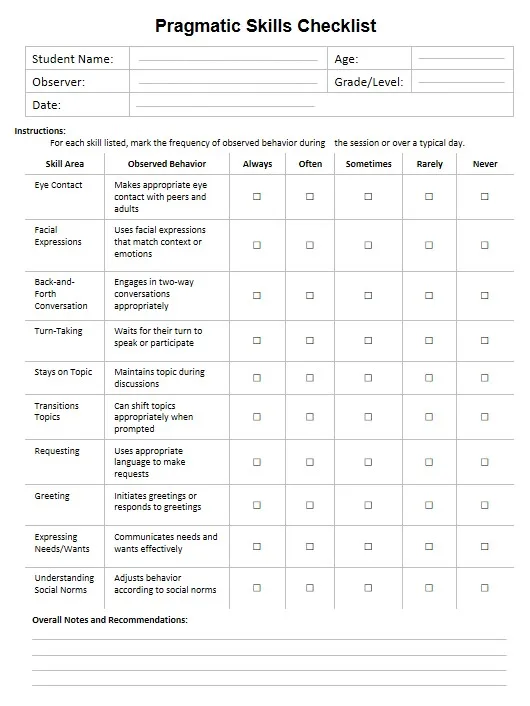
Pragmatic Skills Checklist Social Communication Screener for Speech Therapy: a one-page checklist with student, age, observer, grade and date fields, ten pragmatic skill areas from eye contact to understanding social norms, a behavior description for each, a five point frequency scale from always to never, and a notes and recommendations section.
Sources and scope
- American Speech-Language-Hearing Association (ASHA): professional guidance on social communication, pragmatic language and assessment practices.
- IRIS Center: free modules on supporting students with disabilities, including communication needs.
- Understood.org: plain-language articles on social communication differences for families and educators.
- Center for Parent Information and Resources: information on evaluations, eligibility and working with school teams.
This list covers informal pragmatic screening and observation in schools. A screener is not a diagnosis or a full evaluation; eligibility decisions follow your district procedures, state rules and professional standards.
Key takeaways
- Most pragmatic language screening mistakes come from too narrow a view of the student.
- Observe in natural settings, with peers as well as adults.
- Rate observable behaviors with one consistent scale.
- Respect cultural differences and age expectations.
- Use the screener to choose next steps, not to diagnose.










Leave a Comment