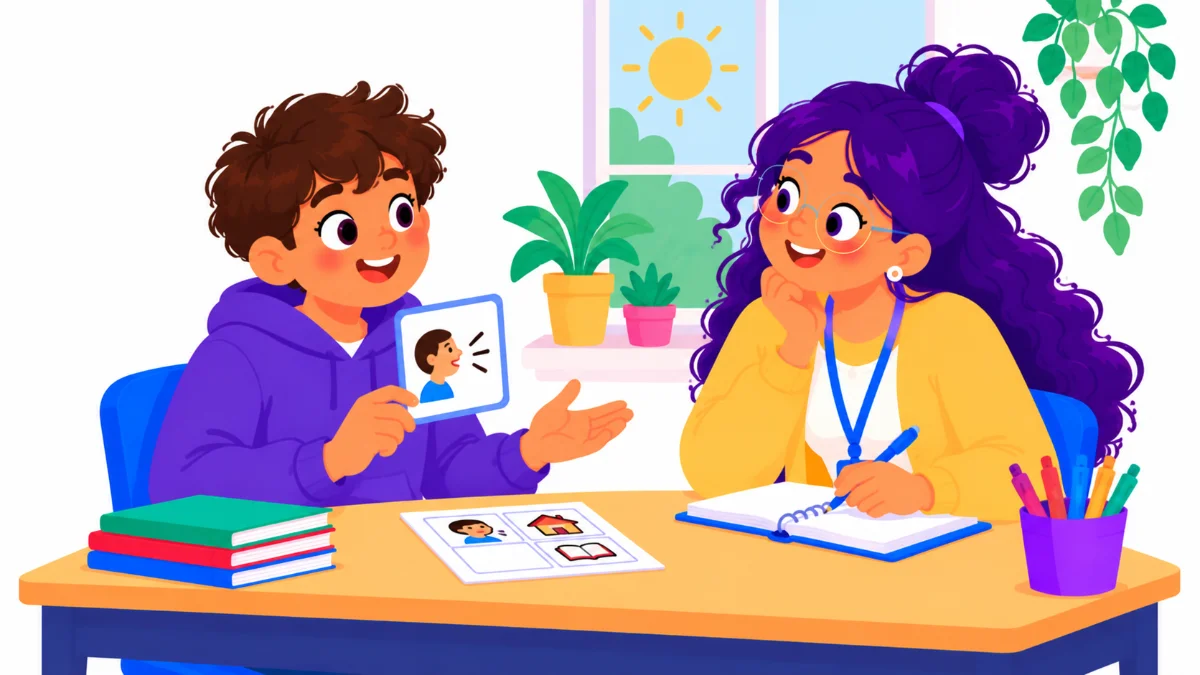

Neurodivergent self-advocacy means a student understands how their brain and body work and can ask for what they need, clearly and respectfully. Picture a ninth grader who has extended time on tests in her plan. A substitute hands out a quiz and says, “Ten minutes, everyone.” She knows she needs more time, but she freezes, says nothing, and leaves half the quiz blank.
This guide gives you five steps to build neurodivergent self-advocacy: help students understand their needs, name support, ask for clarity, explain accommodations, and speak up when something feels unsafe. By the end, you will have a clear path for teaching these skills from early grades through transition.
Examples are fictional. Adapt to the student’s goals and agreed supports. This is guidance, not a diagnosis.
At a glance
- Self-advocacy starts with understanding your own body, feelings, and needs.
- Students learn to name the kind of support that helps, not just “help.”
- Clear, respectful phrases make it easier to ask for clarity or a break.
- Explaining accommodations is a key skill for new teachers and later life.
- Every student needs a plan for reporting unsafe situations.
Before the steps, a word on approach. Neurodivergent students, including autistic students and those with ADHD, dyslexia, and other differences, often spend years being told what they need by others. Self-advocacy shifts that. The goal is not to make students fit in, but to help them understand themselves and get the support that lets them learn and feel safe.
1. Start neurodivergent self-advocacy with self-knowledge
First, start with self-knowledge. Students cannot ask for something they cannot name. So, teach them to notice signals in their body, feelings, and thinking. A tight chest, covered ears, or reading the same line over and over all carry information.
Next, link signals to meanings. “My shoulders are tight and my heart is fast” might mean “I’m overwhelmed.” “I keep rereading” might mean “I’m confused.” This link turns a vague bad feeling into a clear need.
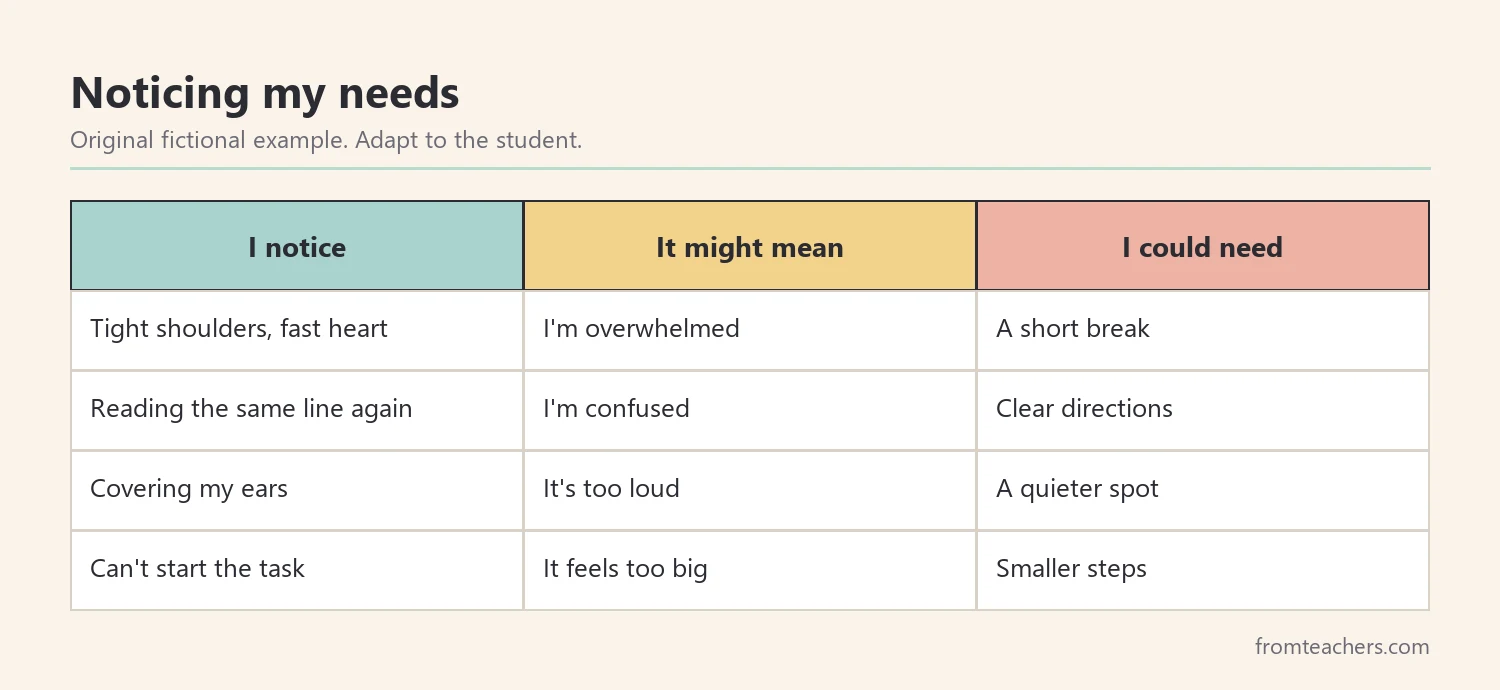
Also, help students think about what has helped before. A simple question, “What helped last time you felt like this?”, builds a personal list of strategies. Over time, students learn what works for them, not just what works for most people.
In addition, use strengths, not only challenges. Neurodivergent self-advocacy includes knowing what you are good at. A student who knows “I learn best from pictures” or “I focus well with music” has useful information to share.
Worked example. Priya is a fictional ninth grader. Her case manager, Ms. Carter, meets with her weekly. Together they make a short chart: “When I see a long test, my stomach hurts. That means I’m worried about time. What helps: knowing I have extended time.”
2. Identify the support you need
Next, move from “I need help” to “I need this kind of help.” General requests are hard for adults to act on. Specific requests get the right support faster.
For example, many students find it useful to think about five kinds of support: learning support, organization support, focus support, emotional support, and sensory support. Each has its own example requests.
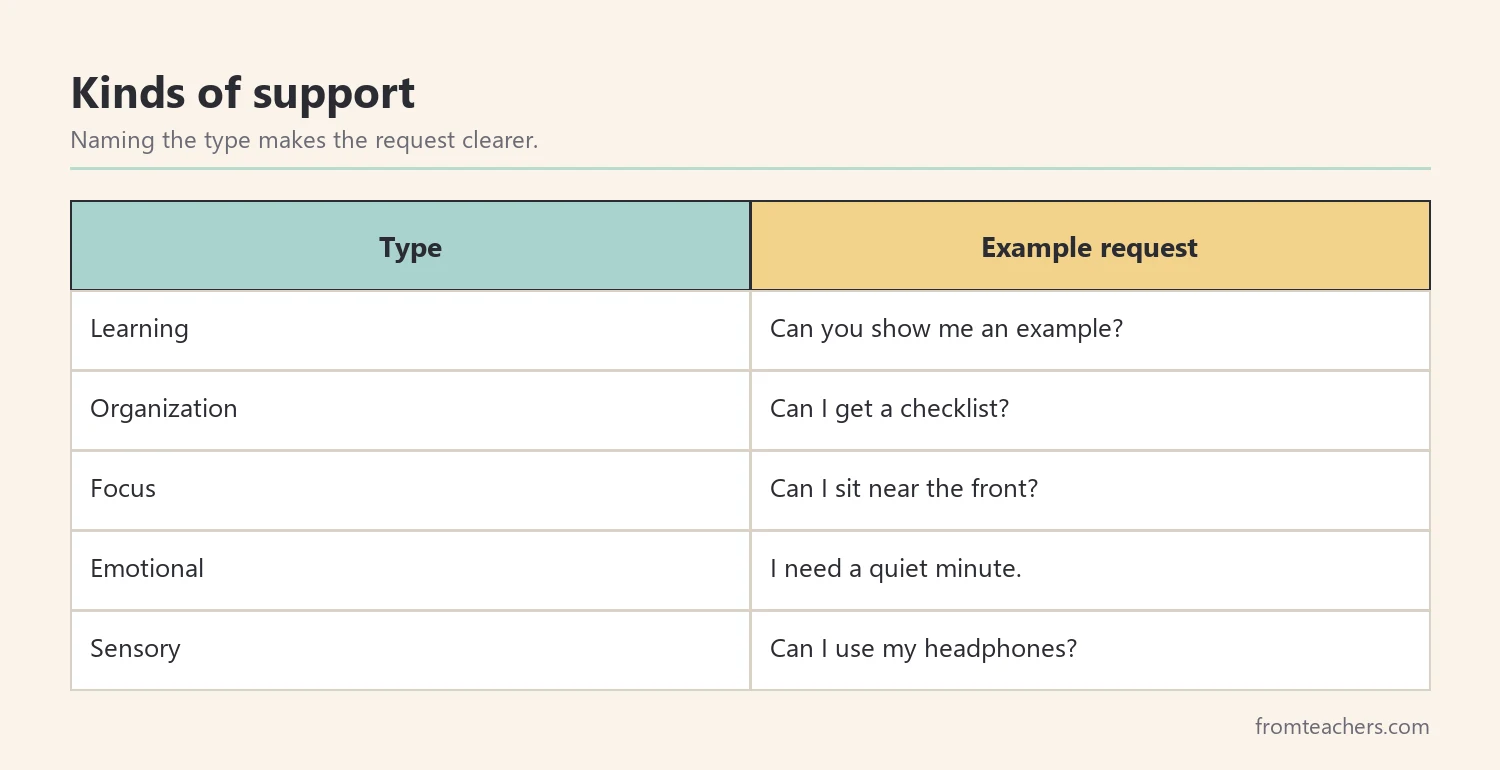
Also, teach a simple routine. Notice how you feel. Figure out what is going on. Check what helped before. Decide what kind of support you need. Then use clear words to ask. This routine is the backbone of neurodivergent self-advocacy.
In addition, keep visual supports nearby. Posters with numbered steps and phrases help students when they cannot think clearly. The self-advocacy poster set for neurodivergent students includes ten step-by-step guides with clear phrases, such as identifying what support you need and knowing when to ask for help.
Worked example. Ms. Carter asks Priya to look at the five kinds of support and choose which fits her test worry. Priya points to “learning” and “emotional.” She writes two requests on her card: “Can I confirm my extended time?” and “I need a quiet minute before I start.”
Building neurodivergent self-advocacy into daily routines
Self-advocacy grows fastest when it is part of ordinary days, not a special lesson once a term. So, look for small daily chances. Morning check-ins, the start of independent work, and the end of class are natural moments to ask, “What do you need right now?”
First, keep check-ins short. A quick rating, such as a number from one to five, followed by one need, takes less than a minute. Over time, these tiny moments build neurodivergent self-advocacy into a habit.
Also, accept every way of communicating. Some students speak, others point, type, or use AAC. Neurodivergent self-advocacy is about the message, not the method, so a typed “too loud” counts just as much as a spoken sentence.
In addition, notice when a student advocates without being asked. Thank them privately and act on the request when you can. Positive responses teach students that speaking up is worth the effort.
Finally, share these routines with other staff. When every adult uses the same check-in words, students practice neurodivergent self-advocacy across the whole day.
3. Ask for clarity and breaks respectfully
Next, teach the everyday requests that come up most often. Two of the most common are asking for clarification and asking for a break. Both are key parts of neurodivergent self-advocacy, and both are easier with practiced phrases.
First, teach clarification. Students notice when something is unclear: they feel lost, cannot start, or are not sure what the teacher wants. Then they use simple, respectful words: “Can you say that another way?”, “What is the first step?”, or “I don’t understand yet.” Saying “I don’t understand” is a skill, not a weakness.
Also, teach students to use their tools while they wait. Rereading directions, checking an example, or looking at a peer’s paper setup (not their answers) can help while the teacher is busy.
In addition, practice asking for a break. A calm phrase, such as “I need a short break, can I use my break card?”, is much easier for adults to respond to than walking out. Practice the phrase and the return routine when the student is calm.
Then, teach expressing discomfort. Some students need words for “This is too loud for me” or “This seat bothers me.” Expressing discomfort early often prevents a bigger problem later.
Worked example. In science class, Priya does not understand a lab direction. She remembers her card and quietly asks, “What is the first step?” The teacher shows her, and she starts the lab with her group.
4. Explain accommodations with confidence
Next, prepare students to explain their own accommodations. This is one of the most important parts of neurodivergent self-advocacy, especially in middle school, high school, and beyond. New teachers, substitutes, coaches, and later employers may not know what a student needs.
First, make sure the student knows their accommodations. Many students have plans they have never read. Go through the plan in plain language: “You get extended time. You can use headphones during independent work.”
Also, teach a short script. Name the support, explain briefly how it helps, say when it is needed, and thank the person. For example: “I have extended time on tests. It helps me show what I know without rushing. I’ll need it for today’s quiz. Thank you.”
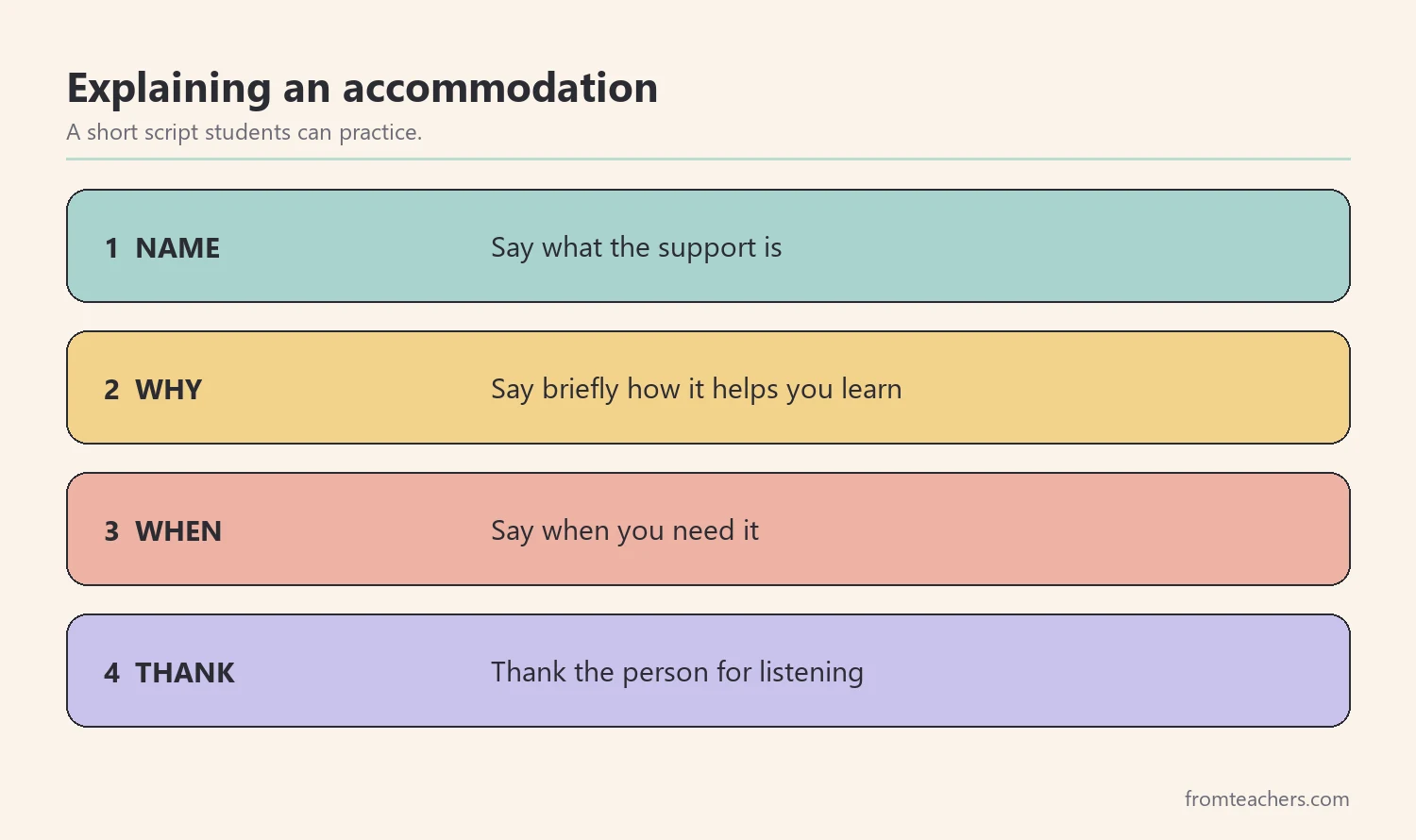
In addition, practice with role plays. Pretend to be a substitute or a new teacher. Let the student practice the script several times. Add a small challenge, such as a busy teacher, so the student learns to stay calm and repeat politely.
Meanwhile, involve students in their own planning meetings. Students who attend their IEP meetings and share their views get real practice in neurodivergent self-advocacy. Even a short statement, prepared in advance, is a strong start.
Worked example. Ms. Carter role plays the substitute moment with Priya. On the second try, Priya says, “Excuse me, I have extended time on quizzes. It helps me finish without rushing. Can I have it today?” A month later, she uses the same words with a real substitute.
5. Speak up for safety and track neurodivergent self-advocacy
Finally, every student needs a plan for unsafe situations. Neurodivergent students may find it harder to judge social risks or to speak under stress. A clear, practiced safety routine is essential.
First, teach the steps. Notice that something feels wrong. Move away if you can. Tell a trusted adult right away. Use clear, direct words, such as “Someone hurt me” or “I don’t feel safe.” If the first adult does not help, keep telling until someone does.
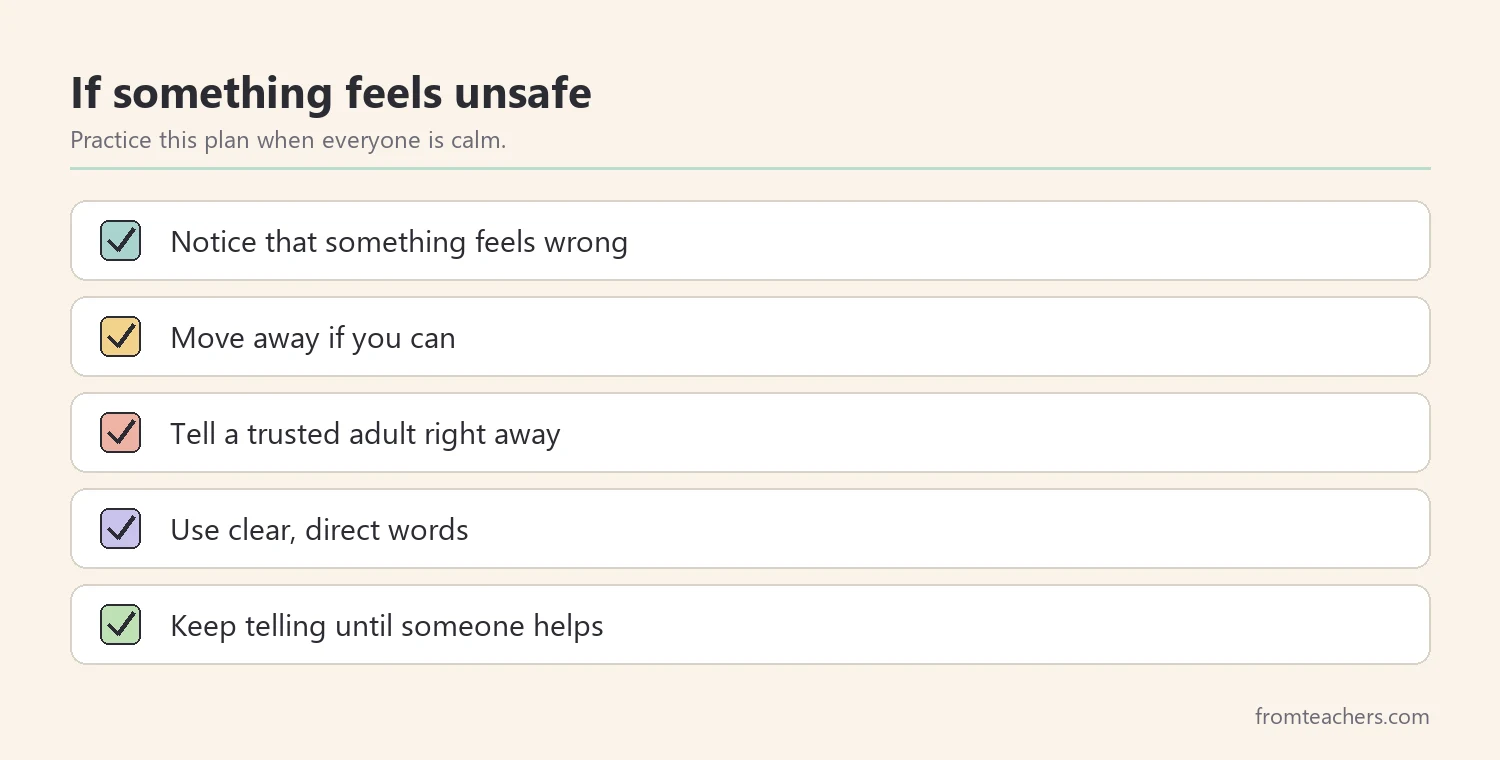
Also, help students name their trusted adults. A short list of two or three people at school and at home makes the plan concrete. Practice the steps when everyone is calm.
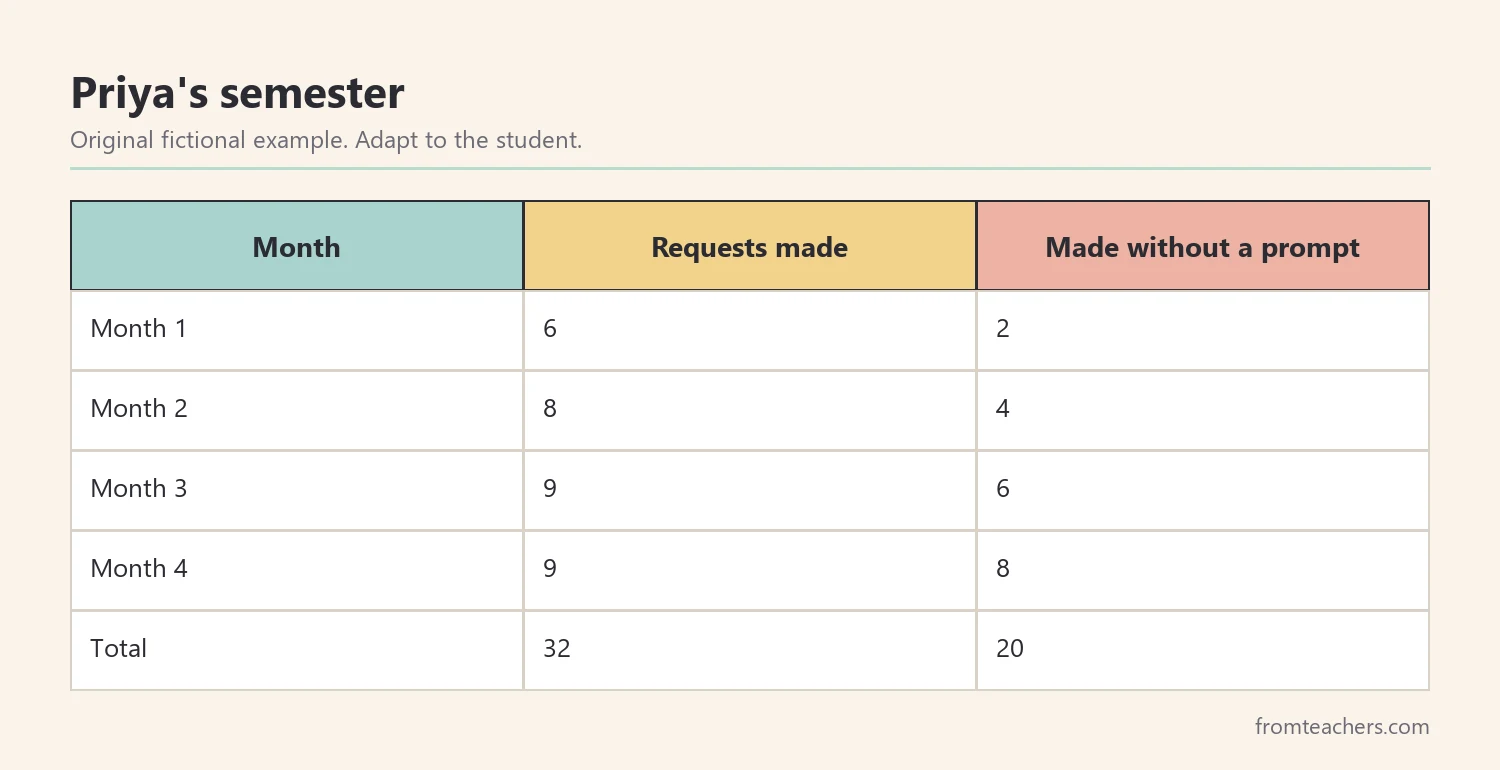
In addition, track growth in neurodivergent self-advocacy over time. Count how many requests a student makes and how many happen without an adult prompt. Over time, independent requests should grow.
Then, review progress with the student and family. Ask what feels easier now and what still feels hard. Update the plan and add new skills, such as choosing between options or making decisions.
Worked example. Ms. Carter tracks Priya over four months. Priya makes 6 requests in month 1, 2 without a prompt. In month 2, she makes 8, with 4 independent. In month 3, she makes 9, with 6 independent. In month 4, she makes 9, with 8 independent. Across the semester, that is 20 independent requests out of 32.
Neurodivergent self-advocacy and the move to adulthood
Self-advocacy becomes more important as students get older. In college, training programs, and jobs, students usually need to request their own supports. Practice in school builds the confidence to do this later.
Also, connect self-advocacy to transition planning. Many IEPs include transition goals for older students. Skills such as explaining accommodations, choosing between options, and asking for clarity fit naturally into those goals.
In addition, respect each student’s identity. Some students want to talk openly about being neurodivergent. Others prefer to focus only on the support they need. Both are valid. Neurodivergent self-advocacy is about the student’s choices, not ours.
Common mistakes and how to avoid them
- Speaking for the student. They miss the chance to practice. Fix: coach them to speak, with support.
- Vague requests. Adults cannot act on “I need help.” Fix: teach the five kinds of support.
- Students not knowing their plan. They cannot explain it. Fix: review accommodations in plain language.
- Practicing only in calm settings. Skills fade under stress. Fix: role play realistic challenges.
- Skipping safety. Students are left without a plan. Fix: teach and practice a clear safety routine.
- Ignoring identity. Students feel judged. Fix: let them choose how they describe themselves.
Questions teachers and parents ask about neurodivergent self-advocacy
When should students start learning self-advocacy?
Early. Young children can learn simple phrases like “I need a break.” Older students can learn to explain accommodations and join planning meetings. Adjust the skills to the student’s age and readiness.
Do students need to know their diagnosis to self-advocate?
Not necessarily. Students can learn to name their needs and the support that helps without discussing a diagnosis. Families and the team decide how and when to talk about diagnosis.
What if a student is too anxious to speak up?
Start with quieter options, such as a card or written note. Practice privately first, and respond warmly to every attempt. Confidence usually grows step by step.
Should students attend their IEP meetings?
Many teams encourage it, especially for older students, and students are typically invited when transition is discussed. Even a short prepared statement gives valuable practice.
How can families support self-advocacy at home?
Families can let children order food, ask questions at appointments, and explain what helps them. Using the same phrases at home and school strengthens the skill.
Related reading: Navigating the Path to Adulthood: Building Essential Life Skills, Accommodations vs Modifications in Special Education: The Difference Explained, and Understanding Autistic Burnout and School Exhaustion: Prevention and Support Strategies.
A companion resource for neurodivergent self-advocacy:
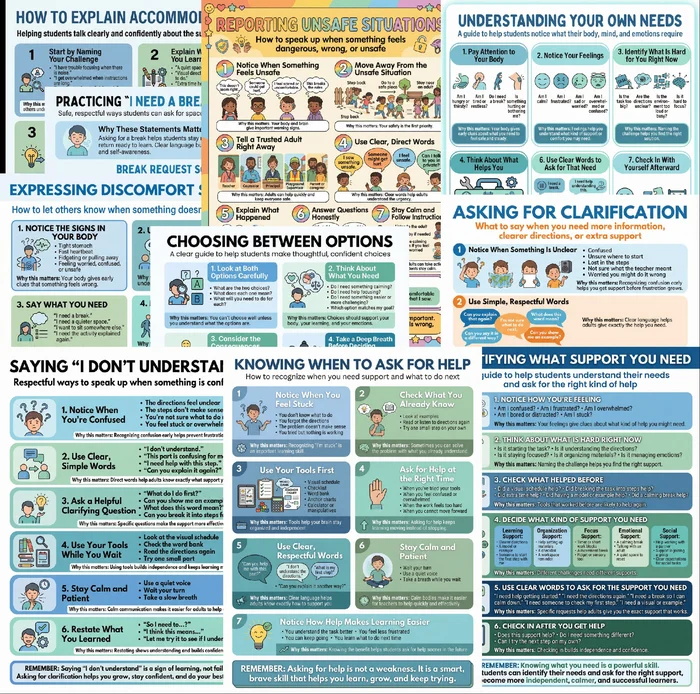
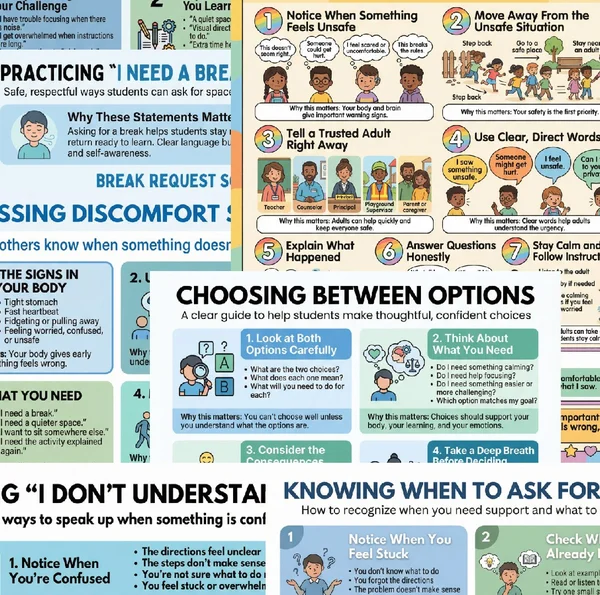
Self-Advocacy Skills for Neurodivergent Students: 10 Classroom Posters: a set of ten step-by-step guides with clear phrases that help neurodivergent students understand their needs and speak up for them. A practical special education visual support for IEP goals, transition skills, and daily classroom use.
Sources and scope
- IDEA, U.S. Department of Education: the law behind special education, IEPs, and transition services.
- IRIS Center, Vanderbilt University: free modules on student supports and transition.
- Center for Parent Information and Resources: information for families on special education and self-advocacy.
- Understood.org: family-friendly information on learning and thinking differences.
This guide covers everyday teaching of self-advocacy skills at school and home. It does not replace counseling, safeguarding procedures, or the decisions of the student’s IEP team.
Key takeaways
- Neurodivergent self-advocacy starts with understanding your own needs.
- Teach students to name the kind of support that helps.
- Practice phrases for clarity, breaks, and discomfort.
- Prepare students to explain their accommodations with a short script.
- Teach a safety plan and track independent requests over time.









Leave a Comment