

An accommodation review meeting is a short, focused check on whether the supports written in an IEP or 504 plan are actually helping in class. Picture February: a case manager asks a science teacher how extended time is going, and the answer is “Fine, I think.” Nobody is sure how often it was used, whether it helped, or whether the student even wants it. Months of the plan have passed on guesswork.
This guide is for case managers, special education teachers, and 504 coordinators. You will learn how to gather feedback from classroom teachers before the meeting, organize it, run a twenty-minute review, decide what to keep or change, and follow up so the plan keeps working.
Examples are fictional. Adapt to the student’s goals and agreed supports. This is guidance, not a diagnosis.
At a glance
- Collect structured feedback from each teacher before the meeting.
- Ask whether each accommodation was used, not only whether it worked.
- Include the student’s view on what helps.
- Keep the meeting short, with one decision per accommodation.
- Follow up with a clear plan and a date for the next check.
1. Schedule the accommodation review meeting at the right time
First, decide when to review. Many teams wait for the annual IEP meeting, but that can leave months of unchecked supports. A mid-year accommodation review meeting, or a check about six to eight weeks after a new plan starts, gives time to fix problems early.
Next, keep it small. The case manager, one or two general education teachers, and the family are often enough. The student can attend part or all of it, depending on age and comfort. A short, informal review does not replace the formal IEP or 504 meeting, and any changes to the plan itself must follow your district’s procedures.
Also, set a clear purpose. For example, “We will check each accommodation and decide whether to keep it, adjust it, or bring it to the full team.” A clear purpose keeps the meeting short and focused.
In addition, share the list of accommodations with every participant ahead of time. Teachers who see the exact wording from the plan can give more precise feedback, and families arrive knowing what will be discussed. This small step makes the accommodation review meeting feel organized and respectful of everyone’s time.
Daniel (fictional, grade 6) had a 504 plan with four accommodations: extended time on tests, preferential seating, a copy of class notes, and breaks when needed. His case manager, Mr. Hayes, scheduled a review in January with Daniel’s math and science teachers and his mother.
| When to review | Why |
|---|---|
| Six to eight weeks after a new plan | Catch early problems |
| Mid-year | Adjust before the second half |
| After a schedule or teacher change | Check supports still fit |
| When a concern is raised | Respond quickly |
2. Gather structured teacher feedback first
The most useful part of an accommodation review meeting happens before anyone sits down. Ask each teacher to complete a short feedback form one or two weeks ahead. Structured forms get far better information than a hallway question.
Good feedback forms ask a few direct questions: Which accommodations were implemented? How effective were they? How was the student’s engagement and focus? Did the accommodation help academic performance? What challenges came up? Are other supports needed?
A ready form saves you from building one. The classroom accommodation feedback form for IEP and 504 effectiveness tracking covers exactly these areas, with ratings of Very Effective, Somewhat Effective, Not Effective, or Did Not Use, plus space for behavior and engagement, academic impact, challenges, additional supports, and overall comments.
Also, make it easy for teachers. Send the form with a friendly note, a clear due date, and the student’s accommodations listed at the top. Busy teachers are more likely to respond when the form takes only a few minutes.
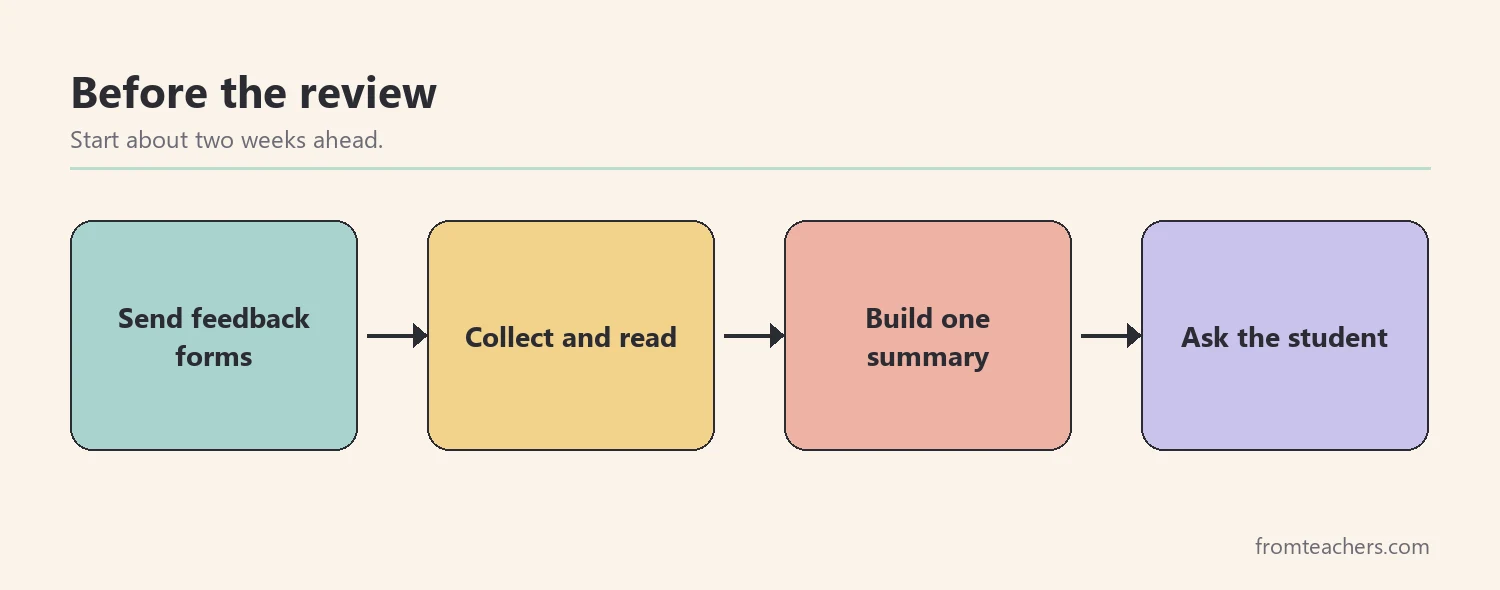
Moreover, ask teachers for one concrete example per accommodation. A sentence such as “He used extended time on the unit test and finished every question” is far more useful than a rating alone. Examples help the team picture what is really happening in class.
Mr. Hayes sent forms to Daniel’s math and science teachers two weeks before the meeting. Both returned them within a week, which gave him time to read and organize the feedback.
3. Organize the feedback into a simple summary
Once forms are back, combine them into one summary. A simple table with each accommodation, each teacher’s rating, and short notes lets everyone see patterns at a glance.
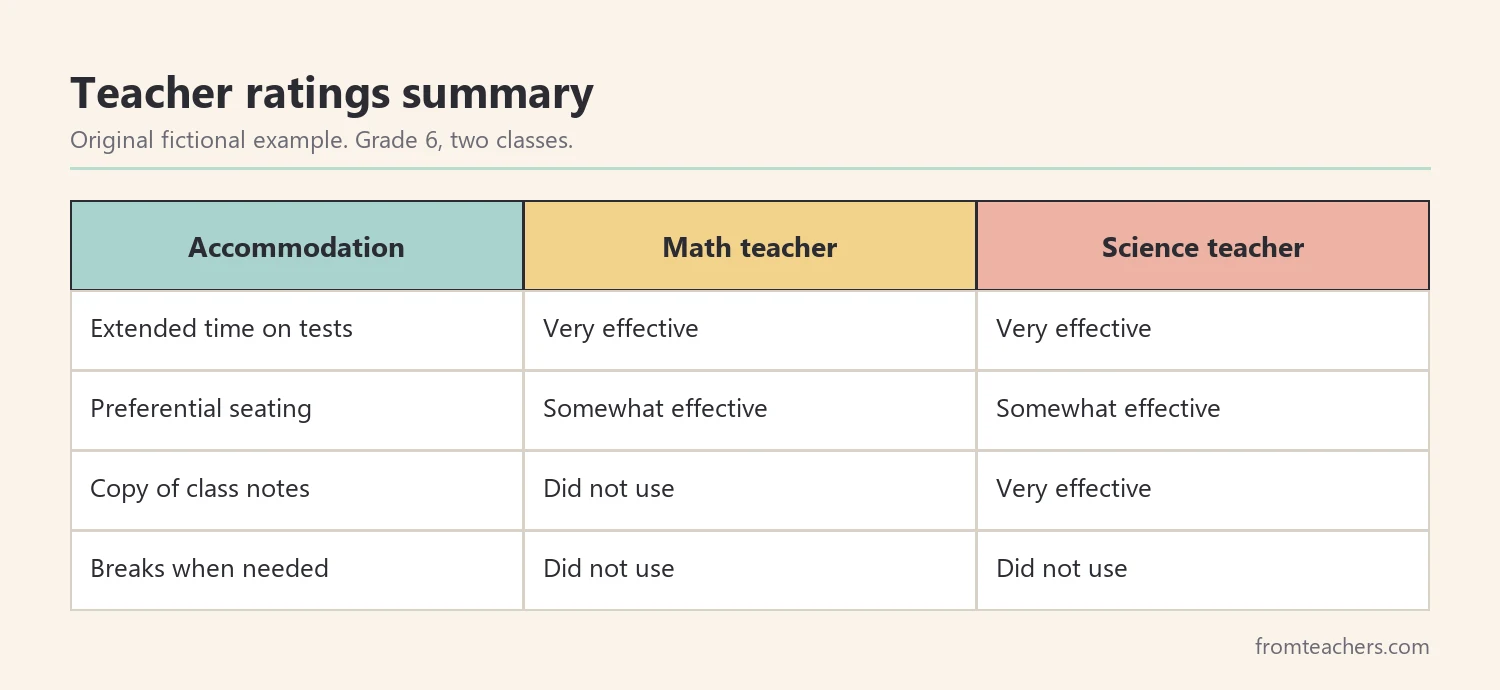
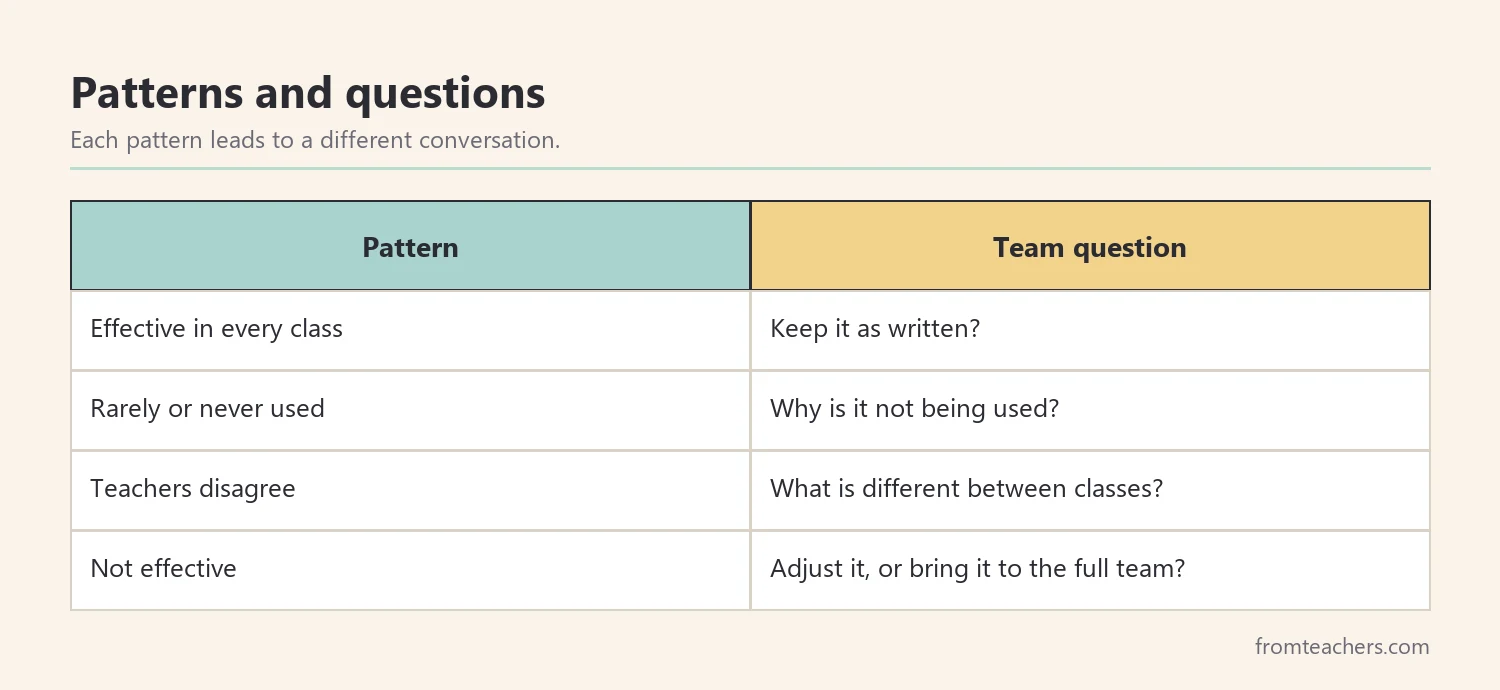
Next, look for three patterns. First, accommodations rated effective in every class. Second, accommodations that were rarely or never used. Third, accommodations where teachers disagree. Each pattern leads to a different conversation.
Also, pay special attention to “Did Not Use.” An accommodation that was not used tells you nothing about whether it works. It may mean the student did not want it, the teacher was unsure how to provide it, or the situation never came up. Ask why.
For Daniel, extended time was rated very effective in both classes. Class notes were helpful in science but not used in math. Breaks were not used in either class. Preferential seating was rated somewhat effective. That summary shaped the whole accommodation review meeting.
4. Include the student’s view
Students often know best what helps them. Therefore, ask the student before or during the review. Simple questions work well: Which supports help you most? Which ones do you not use, and why? Is there anything that would help more?
For younger students, a short picture survey or a conversation with a trusted adult works well. Older students can complete a brief written form or join the meeting for part of the time.
Also, listen for reasons behind non-use. Students sometimes avoid accommodations because they feel embarrassed in front of peers. For example, a student may not take breaks because leaving the room draws attention. That insight can lead to a quieter option, such as a break inside the room.
Daniel told Mr. Hayes he did not take breaks because “everyone looks at me when I leave.” He also said the math teacher already posted notes online, so he did not need a printed copy. These two comments explained most of the “Did Not Use” ratings.
Similarly, help the student understand each accommodation before asking about it. Some students do not know what “preferential seating” means or that they are allowed to ask for notes. A quick, plain explanation first leads to more honest answers during the accommodation review meeting.
In addition, involve the family. Parents can share what their child says at home about school supports. They may know about worries or successes that teachers do not see.
5. Run a focused twenty-minute review
With the summary and student input ready, the accommodation review meeting itself can be short. Twenty minutes is often enough. Use a simple agenda: welcome, strengths, review each accommodation, decisions, next steps.
Before you begin, name a timekeeper. A gentle two-minute warning near the end keeps the discussion moving and ensures every accommodation gets attention, not just the first one on the list.
Also, keep the printed summary table in front of everyone, so the discussion stays tied to the feedback rather than to memory.
Start with strengths. Share what is working well, with a specific example. This sets a positive tone and reminds everyone that the goal is the student’s success.
Next, go through each accommodation and make one of three decisions: keep it, adjust it, or bring it to the full team for a formal change. Write each decision down as you go.
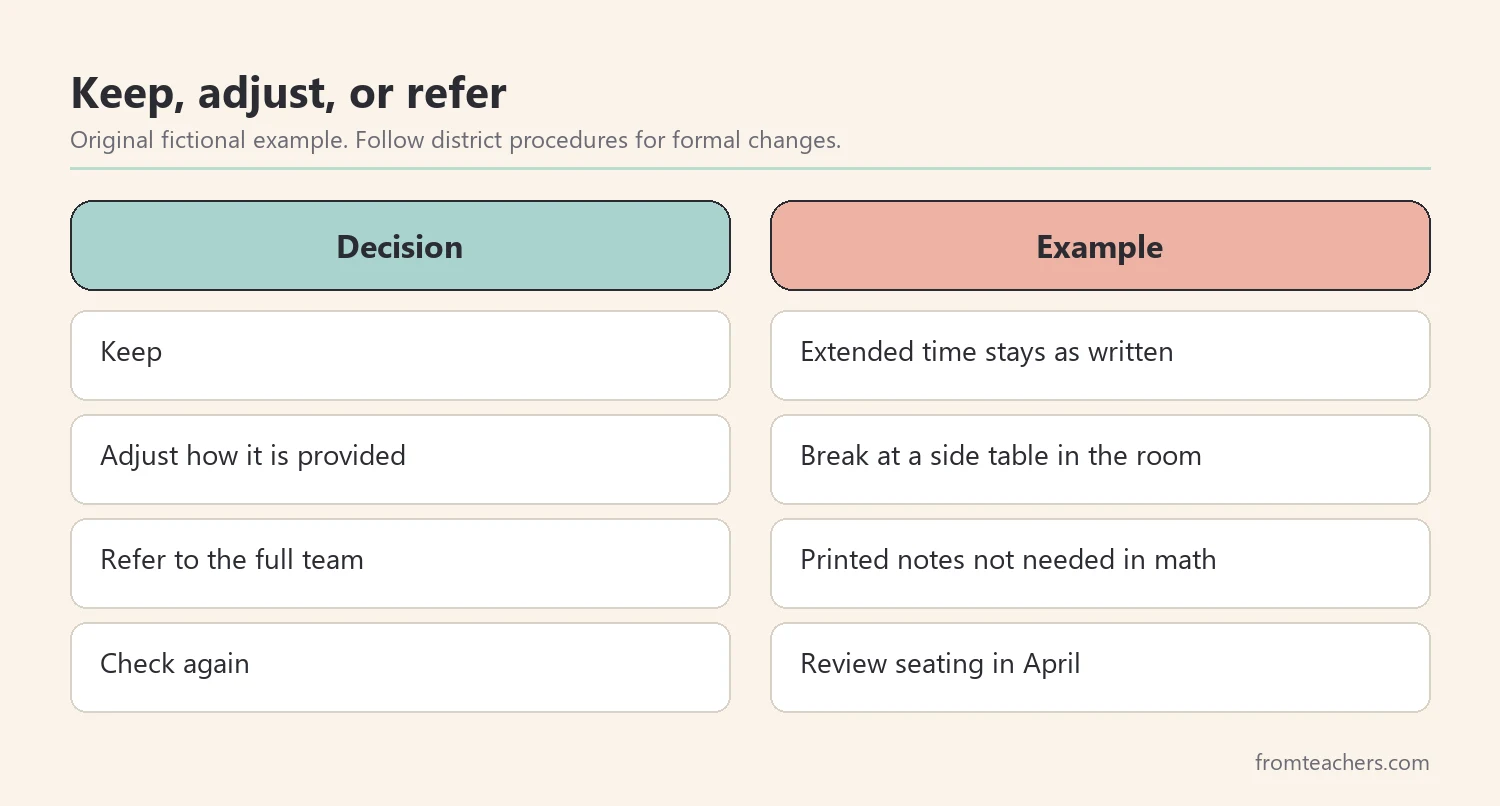
Also, separate informal adjustments from formal plan changes. Clarifying how a teacher provides an accommodation, such as giving a break pass to use at the desk, may be a simple implementation change. Adding or removing an accommodation usually requires the formal IEP or 504 process. Follow your district’s rules.
For Daniel, the team kept extended time and preferential seating. They adjusted breaks so Daniel could use a quiet signal and take a break at a side table inside the room. They noted that printed notes were not needed in math because notes were already online, and agreed to raise this at the next formal meeting.
| Agenda item | Time |
|---|---|
| Welcome and purpose | 2 minutes |
| Strengths | 3 minutes |
| Review each accommodation | 10 minutes |
| Decisions and next steps | 5 minutes |
6. Follow up after the accommodation review meeting
A review only helps if the decisions happen. So, send a short summary to everyone within a day or two. List each accommodation, the decision, who is responsible, and the date of the next check.
Next, check in with teachers after a couple of weeks. A quick message, such as “How is the in-room break working?”, keeps the adjustment on track and shows teachers that their feedback mattered.
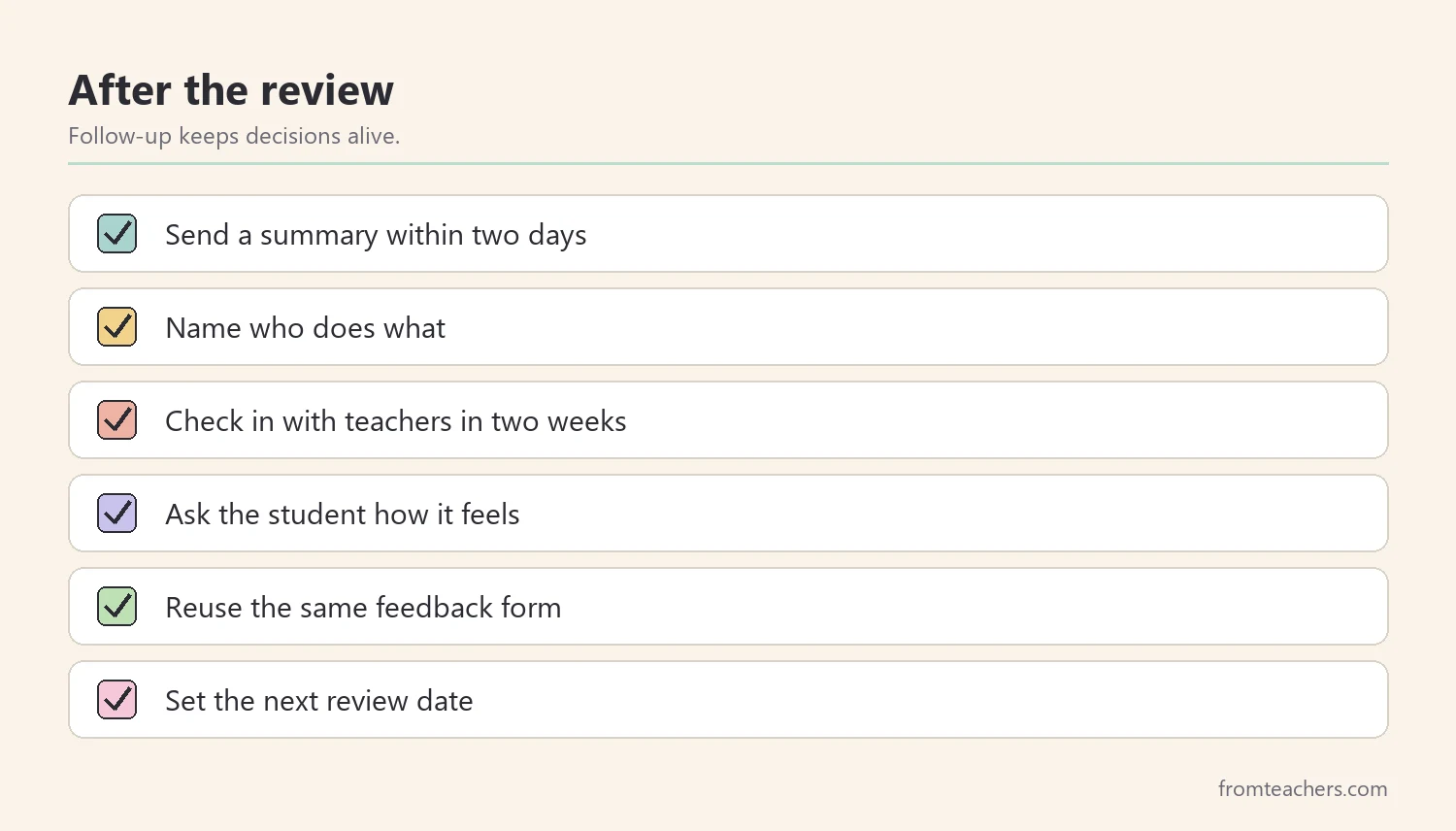
Also, repeat the feedback cycle. Using the same form again before the next review lets you compare ratings over time. If an adjusted accommodation moves from “Did Not Use” to “Somewhat Effective” or “Very Effective,” you have clear evidence that the change helped.
Also, keep all review summaries in one folder for each student. Over a year or two, that folder shows which supports have stayed useful and which have faded, which is valuable when the student moves to a new school or grade.
In addition, bring the summaries to the annual IEP or 504 meeting. A short history of feedback and decisions makes the formal meeting more efficient and grounded in real classroom information.
Three weeks after Daniel’s review, his science teacher reported that he had used the in-room break twice, quietly and without fuss. Daniel said it felt better than leaving. The next accommodation review meeting was set for April.
Common mistakes and how to avoid them
- Waiting for the annual meeting. Problems last for months. Fix: schedule a mid-year or early review.
- Asking “Is it working?” in the hallway. Answers are vague. Fix: use a structured feedback form.
- Ignoring “Did Not Use.” Non-use hides the real problem. Fix: ask why the accommodation was not used.
- Leaving out the student. Key reasons stay hidden. Fix: ask the student what helps and what does not.
- Changing the plan informally. It can break procedures. Fix: refer formal changes to the full team.
- No follow-up. Decisions fade. Fix: send a summary and check in within weeks.
Questions teachers and parents ask about an accommodation review meeting
Is an accommodation review meeting required by law?
Informal reviews are a good practice, not usually a separate legal requirement. Formal changes to an IEP or 504 plan must follow the procedures in IDEA, Section 504, and your district’s policies. Check with your coordinator.
How often should accommodations be reviewed?
Many teams review informally mid-year and whenever a concern comes up, in addition to the annual meeting. The right frequency depends on the student and how new the plan is.
What if teachers rate the same accommodation differently?
Differences are useful. They may show that the accommodation works better in some subjects, or that it is implemented differently. Discuss the details and look for what makes it work in one class.
Can parents request an accommodation review?
Yes, parents can ask the school to review how supports are working. Contact the case manager or 504 coordinator and share specific concerns or observations.
Should the student attend?
Often, yes, at least for part of the meeting. Students who understand and help choose their accommodations are more likely to use them. Adjust participation to the student’s age and comfort.
Related reading: Accommodations vs Modifications in Special Education, The Power of Data Tracking in Special Education, and Teacher-Parent Communication in Special Education.
You may also need: Classroom Observation Form for Special Education (SEN): 12 Daily Checklists.
A companion resource for your accommodation review meeting:
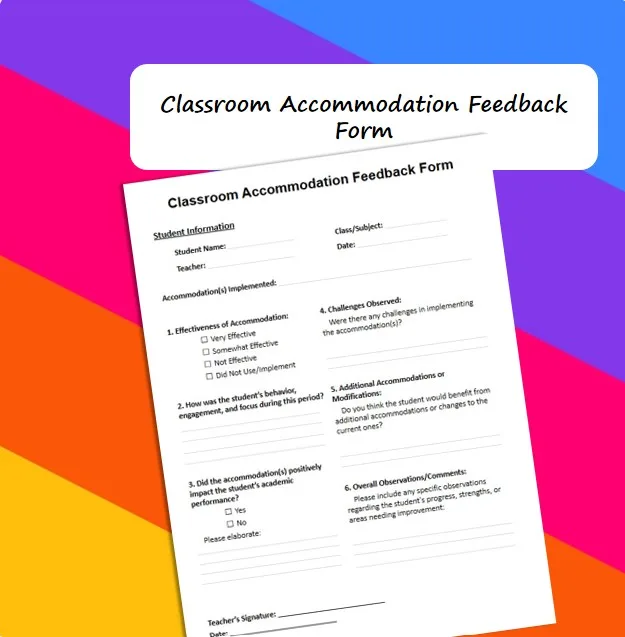
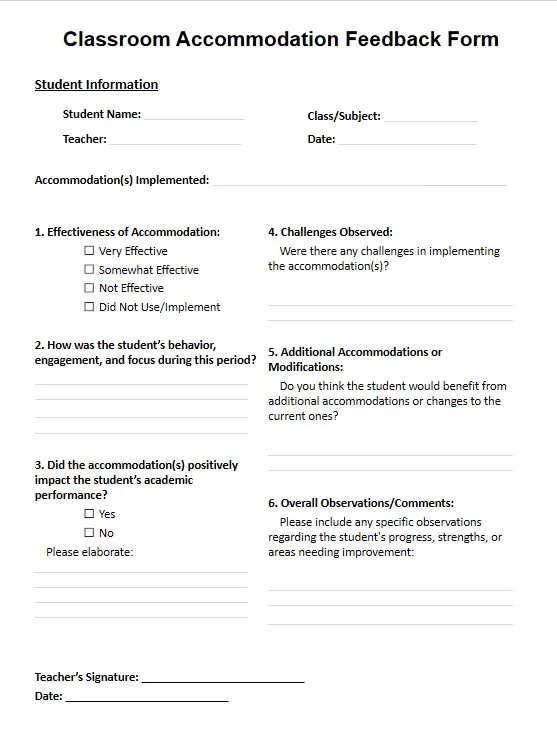
Classroom Accommodation Feedback Form IEP 504 Effectiveness Tracker: a one-page form where classroom teachers rate each accommodation from Very Effective to Did Not Use and note engagement, academic impact, challenges, and extra supports needed.
Sources and scope
- IDEA, U.S. Department of Education: federal guidance on IEPs, accommodations, and plan review.
- U.S. Department of Education: its Office for Civil Rights provides information on Section 504 and student rights.
- IRIS Center, Vanderbilt University: free modules on accommodations and their implementation.
- Understood.org: family-friendly explanations of IEP and 504 accommodations.
This guide covers informal reviews of how accommodations are working in class. It does not provide legal advice and does not replace formal IEP or 504 procedures for changing a plan.
Key takeaways
- An accommodation review meeting checks supports before small problems last all year.
- Structured teacher feedback, gathered ahead of time, makes the review fast and fair.
- “Did Not Use” ratings and the student’s view often reveal the real issue.
- Decide to keep, adjust, or refer each accommodation, following district procedures.
- Follow up with a summary, a check-in, and a date for the next review.










Leave a Comment