

When behavior plans fail, the signs usually show up on an ordinary Tuesday. The student who was making progress starts leaving the room again, the data sheet has gaps, and two adults are handling the same moment in two different ways. Everyone feels tired, and someone says the plan “just does not work for this kid.”
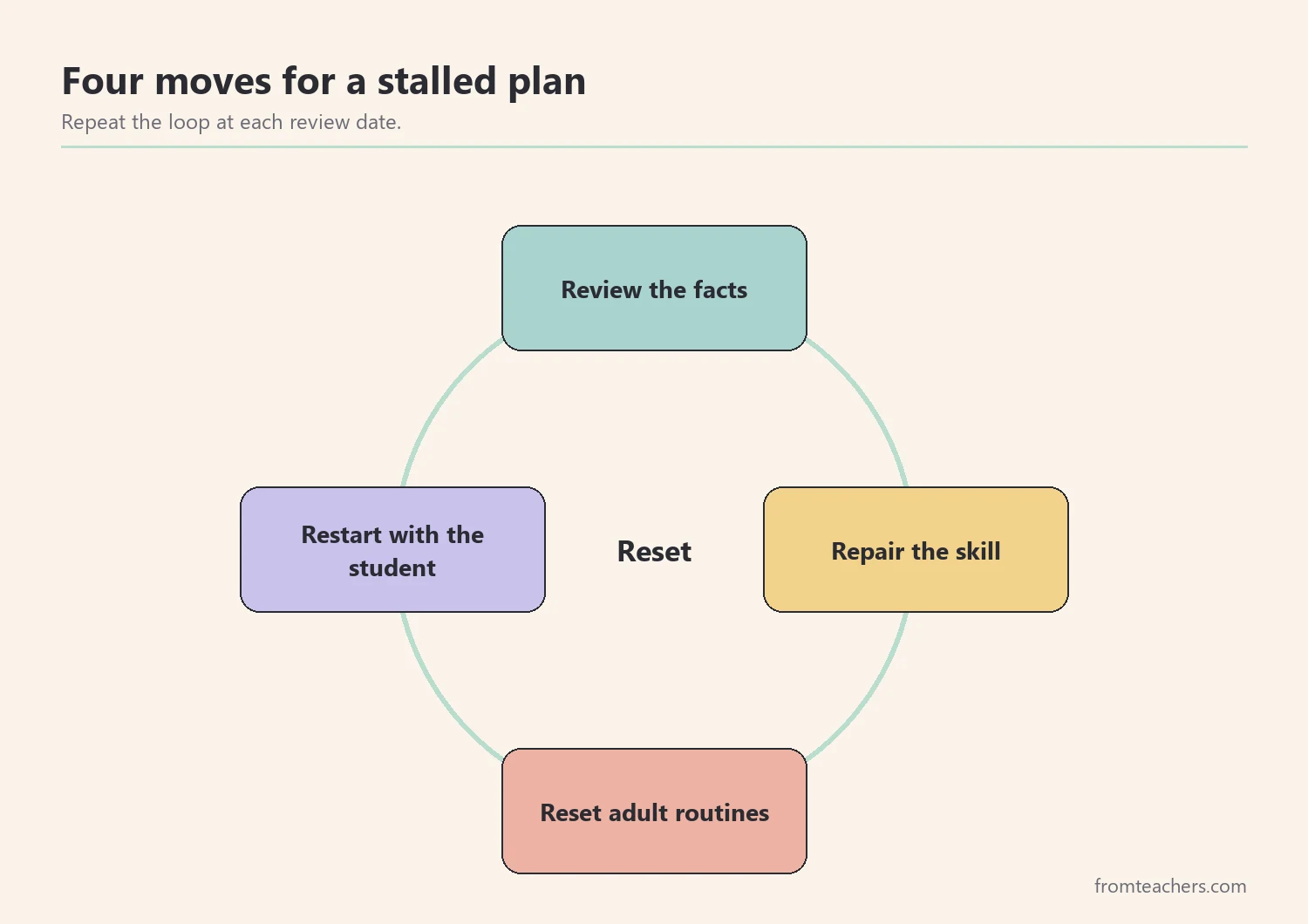
This guide walks you through a calm, five-step process for that moment. You will learn how to pause and look at the facts, find the exact point where the plan broke down, repair the replacement skill, reset reinforcement and staff routines, and restart the plan with the student involved. By the end, you will have a short, testable reset instead of a brand new plan written in a hurry.
Examples are fictional. Adapt to the student’s goals and agreed supports. This is guidance, not a diagnosis.
At a glance
- A plan that stops working is information, not proof that the student cannot change.
- Check the data and how the plan is actually used before changing anything.
- Most breakdowns come from a few common causes, such as a mismatched function or an untaught replacement skill.
- Teach the replacement behavior step by step, then make it pay off faster than the old behavior.
- Restart with dignity: involve the student, keep the plan small, and review on a set date.
1. Pause and gather the facts when behavior plans fail
First, slow down. When behavior plans fail, the urge is to add more rules or stronger consequences. However, a rushed change often repeats the same mistake with new paperwork. Give yourself one or two weeks to look at what is really happening.
Next, collect three kinds of information. You need the behavior data you already have, a few fresh observations, and a quick check on how the plan is being used by each adult. Write down what you see, not what you think it means.
Then, ask the people closest to the student. A paraprofessional, a specials teacher, and the family often notice patterns the case manager misses. In addition, ask the student, in a calm moment, what makes the hard part of the day hard.
| Question | Where to look |
|---|---|
| Did the behavior really increase? | Last 4 to 6 weeks of data |
| When and where does it happen now? | New ABC notes or observations |
| Is the plan used the same way by everyone? | Short staff check-in |
| Did anything change at school or home? | Family and staff notes |
Worked example. Jordan is a fictional student in grade 6. His plan targets leaving the classroom during independent writing. In September, he left the room on 2 of 10 writing blocks. In October, he left on 7 of 10. Before changing anything, his teacher looks at the October notes and sees that all 7 exits happened during long writing tasks after lunch.
In short, facts first. As a result, the rest of the reset targets the real problem.
Also, notice what still works. When behavior plans fail, they rarely fail completely. Jordan still writes well in the morning, so the team knows the plan has parts worth keeping.
2. Find the breakdown point
Once you have the facts, look for where the plan broke. Plans rarely fail everywhere at once. Instead, they usually break at one or two specific points, and finding those points is faster than rewriting everything.
Start with the most common causes. When behavior plans fail, teams often find one of these: the plan targets the wrong function, the replacement behavior was never really taught, the reinforcer stopped mattering, adults use the plan differently, or the skill works in one setting but not in others.
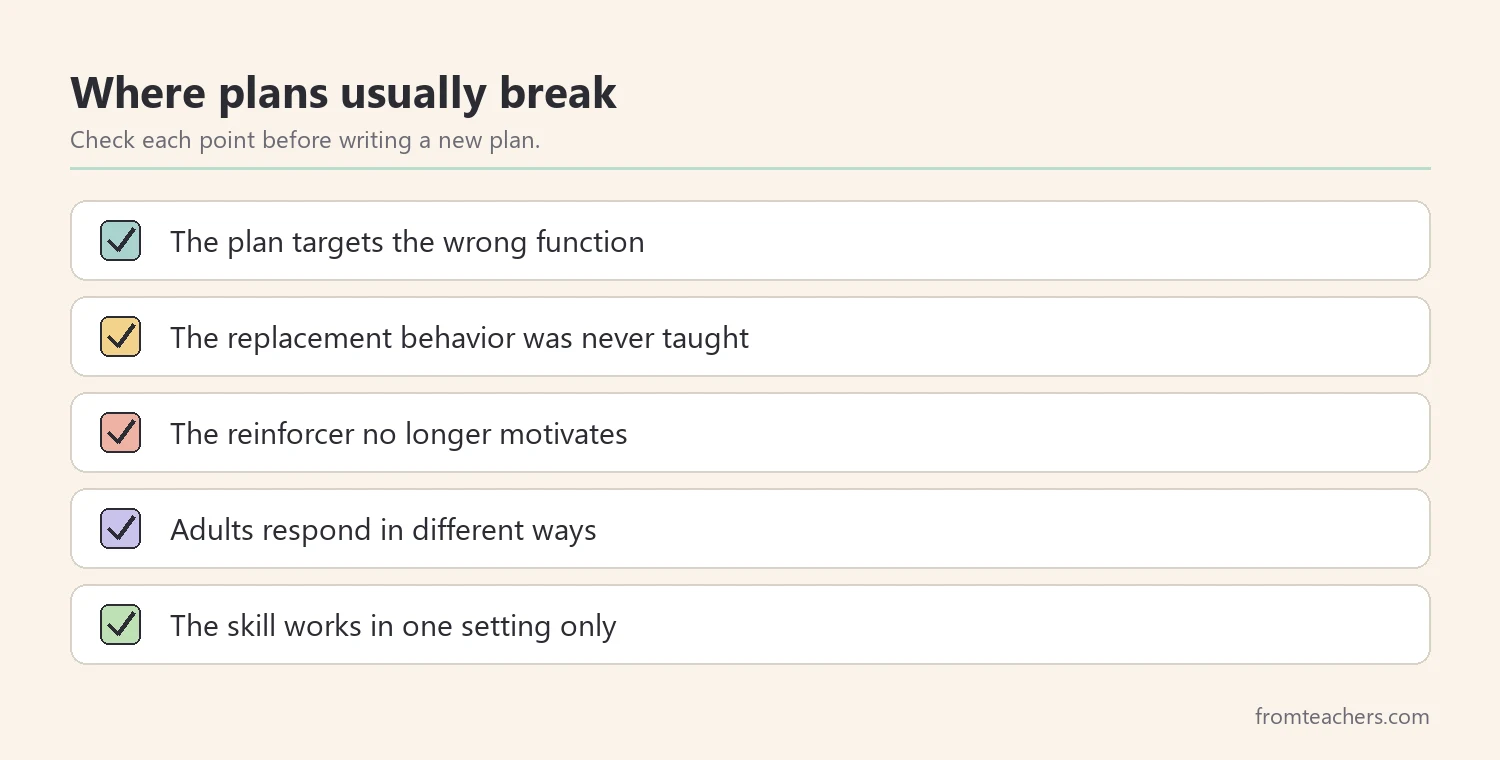
Also, match each possible cause to a piece of proof. For example, if you suspect inconsistent use, a short check-in where each adult describes their response will show it. If you suspect the reinforcer, ask the student to rank a few choices.
Worked example. Jordan’s team checks each cause. The function still looks like escape from long writing, so that part fits. However, staff responses differ: the morning aide sends Jordan for a walk when he asks for a break, and the afternoon aide tells him to finish first. Also, nobody has practiced the break request with him since September. The team now has two clear breakdown points: inconsistent responses and an untaught replacement skill.
Finally, write the breakdown points in one or two plain sentences. These sentences guide every change you make next.
For instance, a team might write: “The replacement skill was taught once and never practiced.” That single sentence points straight to the next step. Clear sentences like this are the fastest way forward when behavior plans fail, because they turn a vague worry into a specific job.
3. Repair the replacement behavior when behavior plans fail
A replacement behavior is the skill the student uses instead of the challenging behavior. It must meet the same need, and it must be easier than the old behavior. When behavior plans fail, this piece is often written on paper but never taught.
First, reframe the goal. “Stop leaving the room” tells the student what not to do. “Ask for a break with a card” tells him what to do. Goals that build a new skill are easier to teach, track, and celebrate.
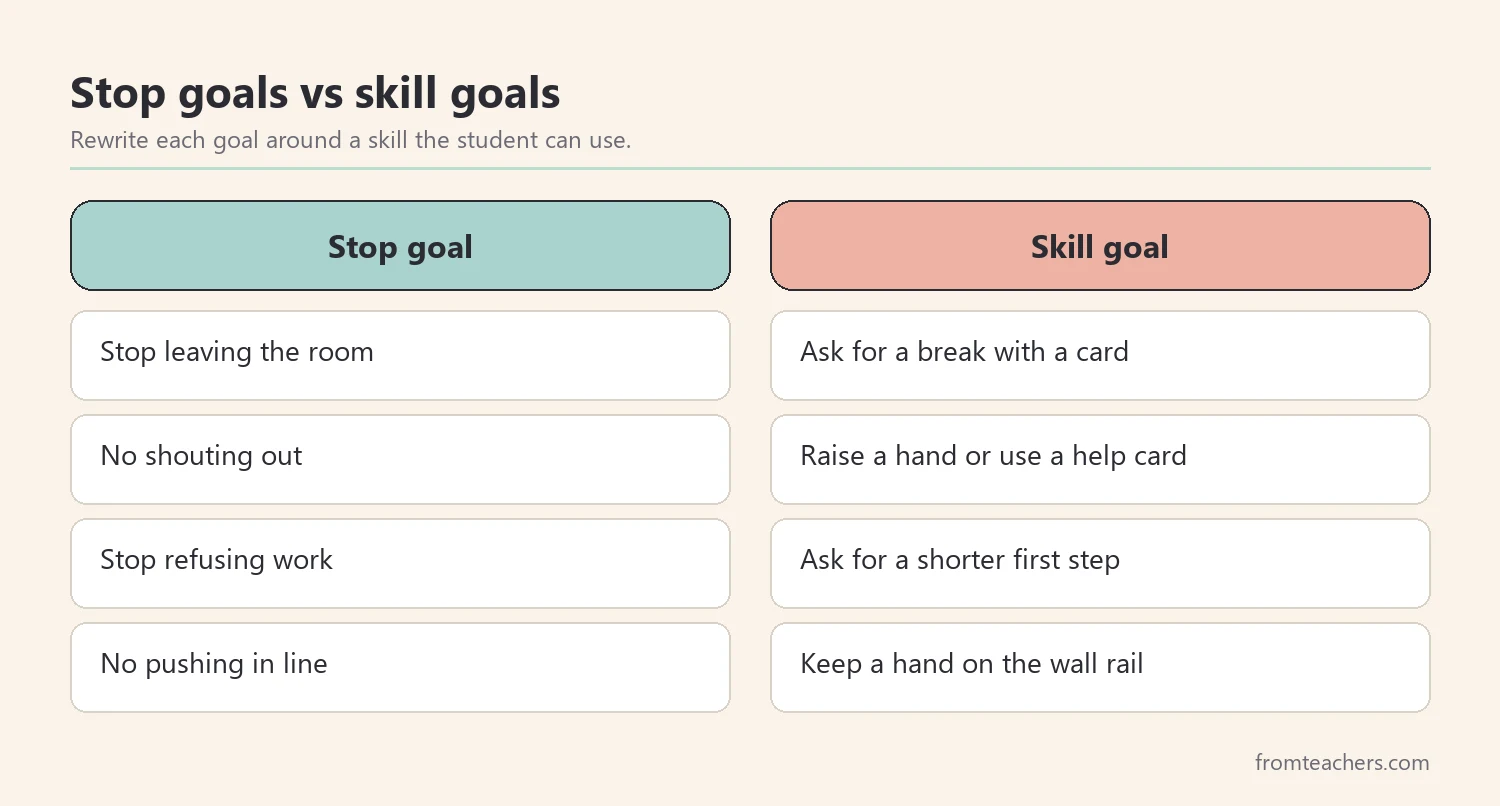
Next, break the skill into small steps and teach it directly. Use a short task analysis, model each step, practice in calm moments, and then practice in the real setting. A visual card on the desk can remind the student of the steps.
Then, track teaching, not just behavior. A replacement behavior teaching tracker from the When Behavior Plans Fail toolkit lets you see whether the skill was practiced this week, not only whether the problem behavior happened.
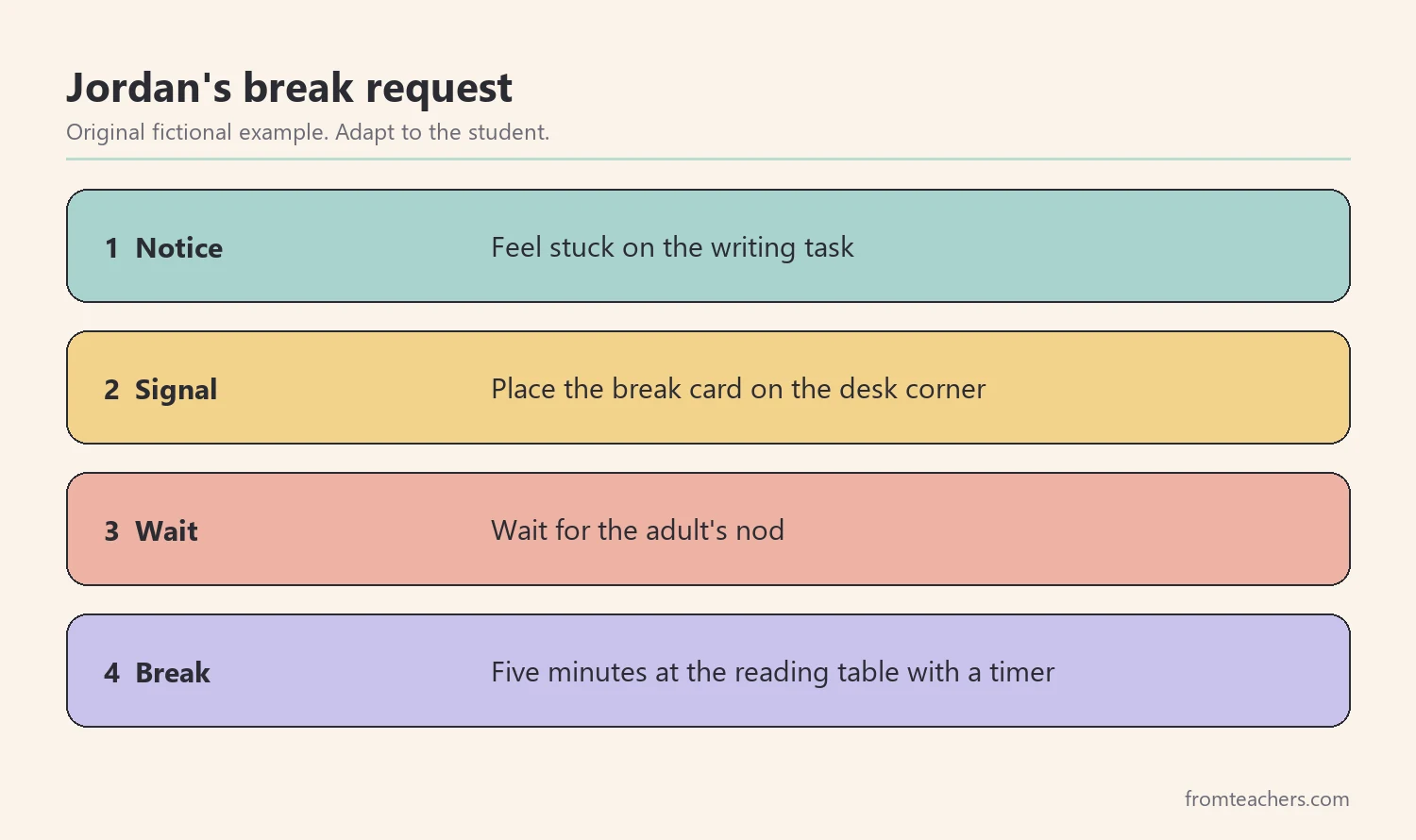
Worked example. Jordan’s teacher teaches a four-step break request: notice the stuck feeling, place the break card on the desk corner, wait for a nod, then take a five-minute break at the reading table with a timer. They practice it three times during a calm morning, then once at the start of each writing block.
Meanwhile, the teacher also shortens the first writing chunk to three sentences. In this way, the task that triggered the exits becomes easier to start, and the break card becomes a tool rather than an escape.
4. Reset reinforcement and staff routines
A replacement skill only sticks if it works better than the old behavior. If asking for a break takes longer than walking out, the student will keep walking out. Therefore, the new skill must pay off fast and every time at first.
Start by checking the reinforcer. What motivated the student in September may not matter in November. Offer a short menu and let the student choose. In addition, reinforce the replacement behavior right away, then slowly stretch the time as the skill becomes reliable.
Next, make the plan easy for adults. A plan that needs constant attention from one person will not last. Write a one-page summary with three parts: what to look for, what to say, and what to do. Then, review it with every adult in a ten-minute huddle.
Staff reset checklist
- Every adult can describe the replacement behavior in one sentence.
- Everyone uses the same words and the same response.
- The reinforcer was chosen or confirmed by the student this month.
- The plan fits into the real schedule, including afternoons and specials.
- One person owns the data sheet and one date is set for review.
Worked example. Jordan’s team writes one response for every adult: “I see your card. Take five minutes, then we come back to sentence one.” Jordan picks a reinforcer from a short menu: five minutes of drawing at the end of the day if he uses the card instead of leaving. Both aides practice the response together, so mornings and afternoons now look the same.
As a result, the plan becomes something staff can actually carry out on a busy day.
Remember that when behavior plans fail, adults are often running on empty too. A reset that respects staff time is far more likely to last than one that asks for heroic effort.
5. Restart with dignity and track the reset
Restarting is not starting over from zero. It is a fresh agreement built on what everyone learned. When behavior plans fail, students often feel they have failed too, so the restart conversation matters.
First, meet with the student in a calm moment. Keep it short and respectful. Explain what will change, why, and what he can expect from adults. Then, ask for his ideas and include at least one of them. Students follow plans they helped shape.
Next, track a small set of numbers for four weeks. Count the target behavior, the replacement behavior, and whether the plan was used as written. These three numbers tell you whether the reset is working or needs another adjustment.
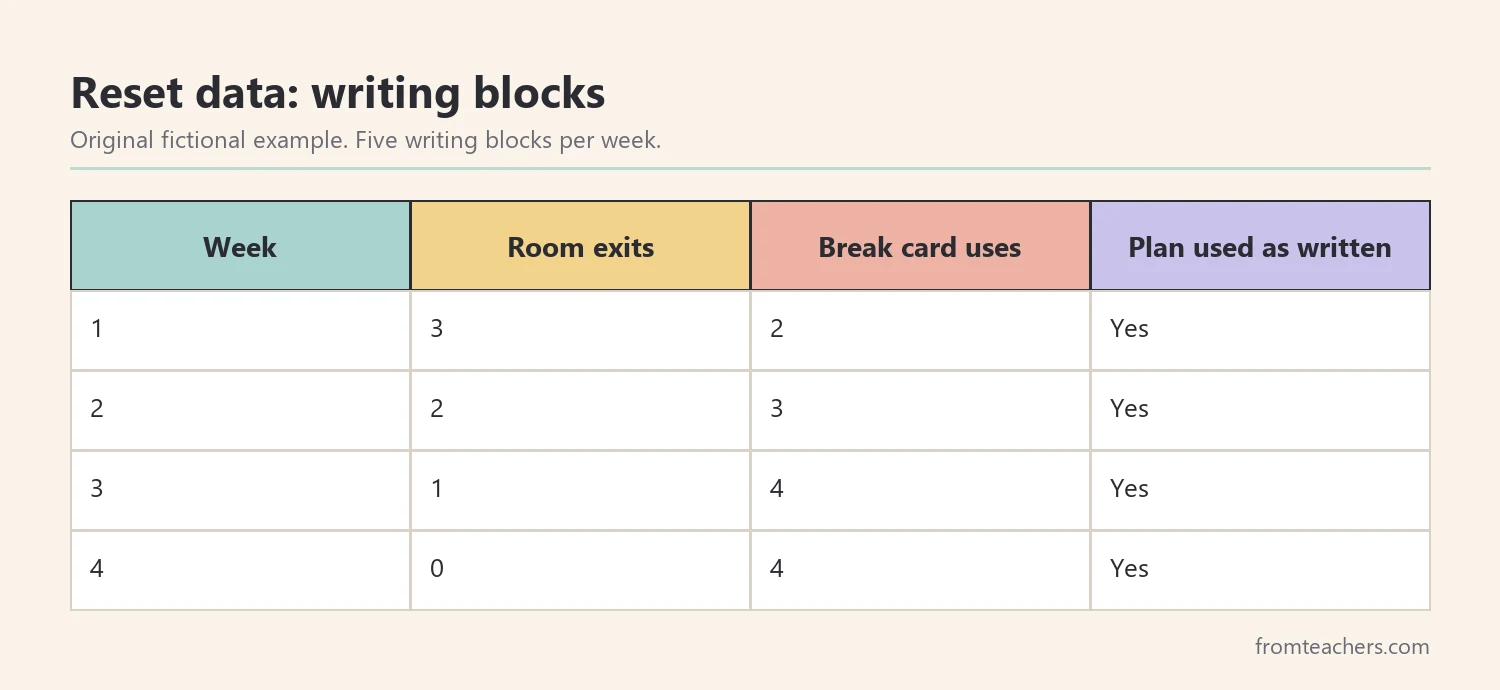
Worked example. Jordan’s writing blocks happen five times a week. In week 1 of the reset, he leaves the room 3 times and uses the break card 2 times. In week 2, he leaves 2 times and uses the card 3 times. By week 4, he leaves 0 times and uses the card 4 times. Each week, exits and card uses together never exceed the five writing blocks, and the team can see the new skill replacing the old one.
Finally, set a review date before you leave the meeting. A plan with a review date is a plan someone will check.
At the review, look at all three numbers together. If the target behavior drops but the plan was rarely used as written, the change may come from something else. On the other hand, if the plan was used well and nothing changed, return to step 2. This is the honest way to learn from what happens when behavior plans fail, rather than guessing.
Common mistakes and how to avoid them
- Adding consequences first. Stronger consequences rarely fix a skill gap. Instead, find the breakdown point and teach the missing skill.
- Writing a new plan from scratch. A full rewrite throws away what worked. Even when behavior plans fail, some pieces usually still help. Keep the parts that fit and repair only what broke.
- Tracking only the problem behavior. If you never count the replacement skill, you cannot see progress. Track both, plus how the plan was used.
- Skipping the staff huddle. Different responses from different adults confuse the student. A ten-minute huddle with one shared script fixes most of this.
- Restarting without the student. A plan done to the student feels like punishment. Involve the student and use at least one of their ideas.
Questions teachers and parents ask about when behavior plans fail
How long should we wait before deciding a plan is not working?
Give a plan enough time to be used as written, often several weeks. If the data show no change and the plan was used consistently, it is time to review. If the plan was not used consistently, fix that first.
Should we do a new FBA when behavior plans fail?
Sometimes. If the behavior now looks different, happens in new places, or seems to serve a new purpose, the team may decide a new functional behavior assessment is needed. That decision belongs to the student’s team and follows your school’s procedures.
What if the family sees the problem differently?
Listen first and share the data you have. Families are partners when behavior plans fail, not observers. Families often notice changes in sleep, health, or routines that explain a shift at school. Agree on one small goal both home and school can support.
Is it normal for behavior to get worse before it gets better?
A short increase can happen when an old behavior stops working the way it used to. However, the team should watch closely and keep everyone safe. If the increase continues, review the plan with the team.
How do we keep the reset from failing too?
Keep the plan short, train every adult, and set a review date. Track whether the plan was used as written. Small, regular reviews catch problems early, before they become another failure.
Related reading: Moving Beyond Shame and Behavior Charts: Positive Alternatives for Effective Classroom Management, The Power of Data Tracking in Special Education, and Meltdowns vs Tantrums: A Guide to Understanding and Responding.
A companion resource for when behavior plans fail:
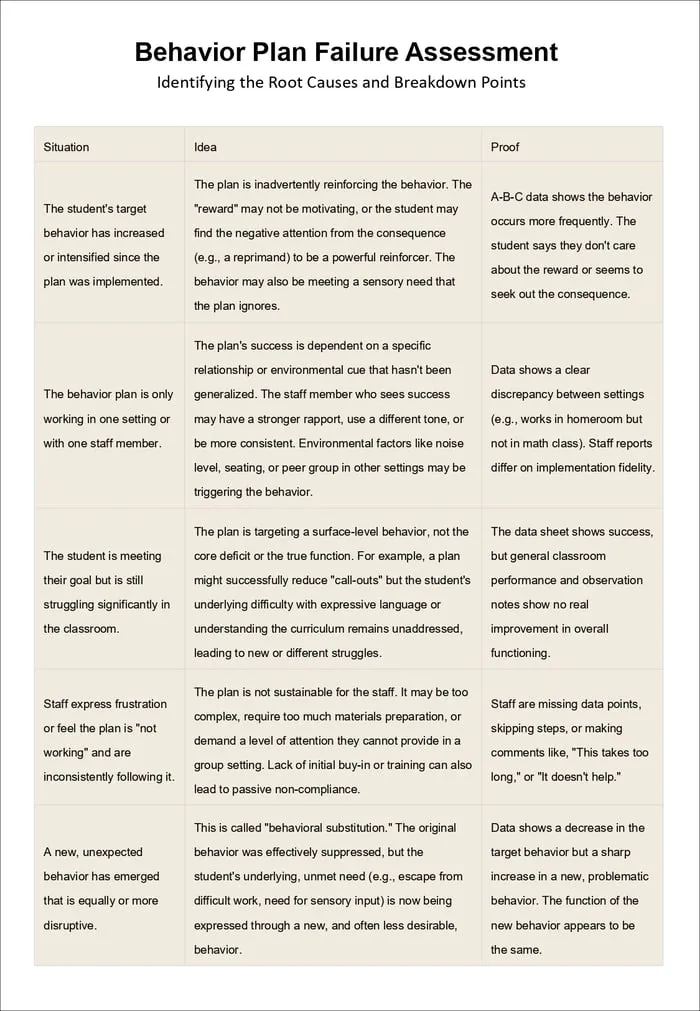
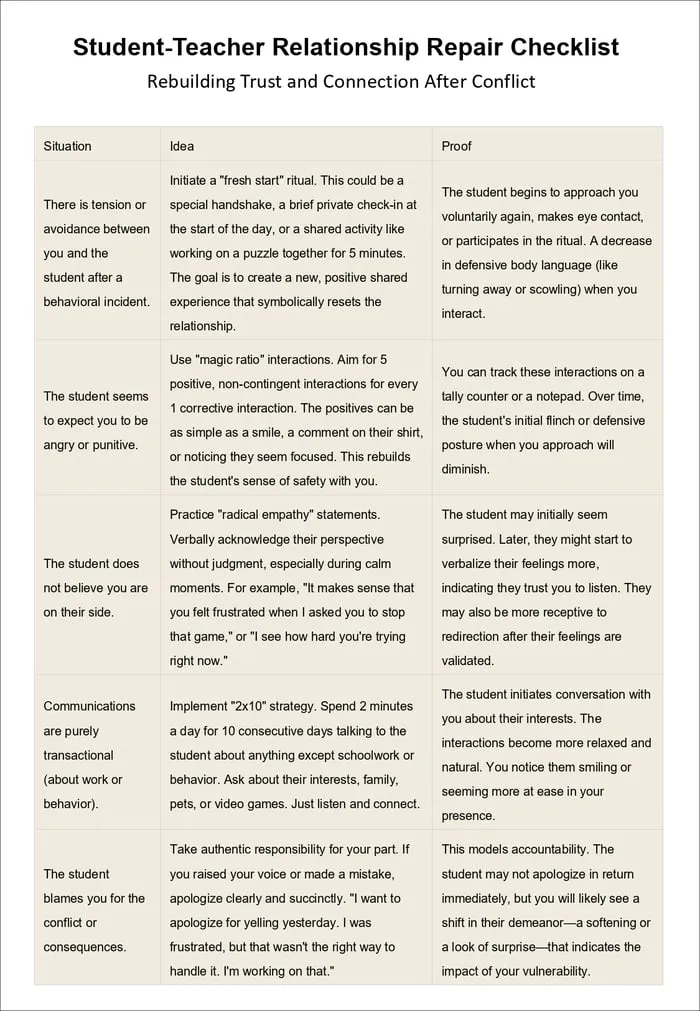
When Behavior Plans Fail: Repair, Reset, and Starting Over with Dignity: a 12-page printable toolkit with a behavior plan failure assessment, a replacement behavior teaching tracker, and guidance on inconsistent implementation, reinforcers, generalization, and reframing goals around new skills.
Sources and scope
- IRIS Center, Vanderbilt University: free modules on functional behavior assessment, behavior support, and classroom routines.
- Center on PBIS: resources on positive behavioral interventions and supports at school.
- IDEA, U.S. Department of Education: the law behind special education services, IEPs, and behavior supports.
- Understood.org: practical articles for families and teachers on behavior and learning differences.
This guide covers practical steps for reviewing and restarting a classroom behavior plan. It does not replace a formal functional behavior assessment, legal advice, or clinical support, which belong to qualified professionals and the student’s team.
Key takeaways
- When behavior plans fail, gather facts before changing anything.
- Look for the specific breakdown point instead of rewriting the whole plan.
- Teach the replacement behavior directly and make it pay off fast.
- Give every adult the same short script and a shared data sheet.
- Restart with the student involved and set a review date.







Leave a Comment