
Fun geography activities can rescue a lesson that is sliding toward a blank map and a long list of capitals. Picture a fifth grader who memorized twenty countries for Friday’s quiz, then cannot find half of them on the map the next Monday. The names went in, but nothing held them there.
This guide gives you a five-step plan that turns countries into places students remember. You will learn how to hook students with a mystery, give each country a personality, play quick map games, build short country stories, and review in a way that makes learning last. Each step works for a classroom, a small group, or a homeschool table.
Examples are fictional. Adapt to the student’s goals and agreed supports. This is guidance, not a diagnosis.
At a glance
- Start with a mystery so students want to find the answer on the map.
- Give each country a personality: a nickname, a job, and a catchphrase.
- Use short games that make students locate, compare, and explain.
- Let students build a small story or travel page about one country.
- Review in short bursts over several weeks, not one big test.
1. Hook students with fun geography activities that start as a mystery
First, give students a reason to look at the map. A mystery creates that reason. Instead of announcing “Today we learn about Brazil,” show three clues and let students guess the country.
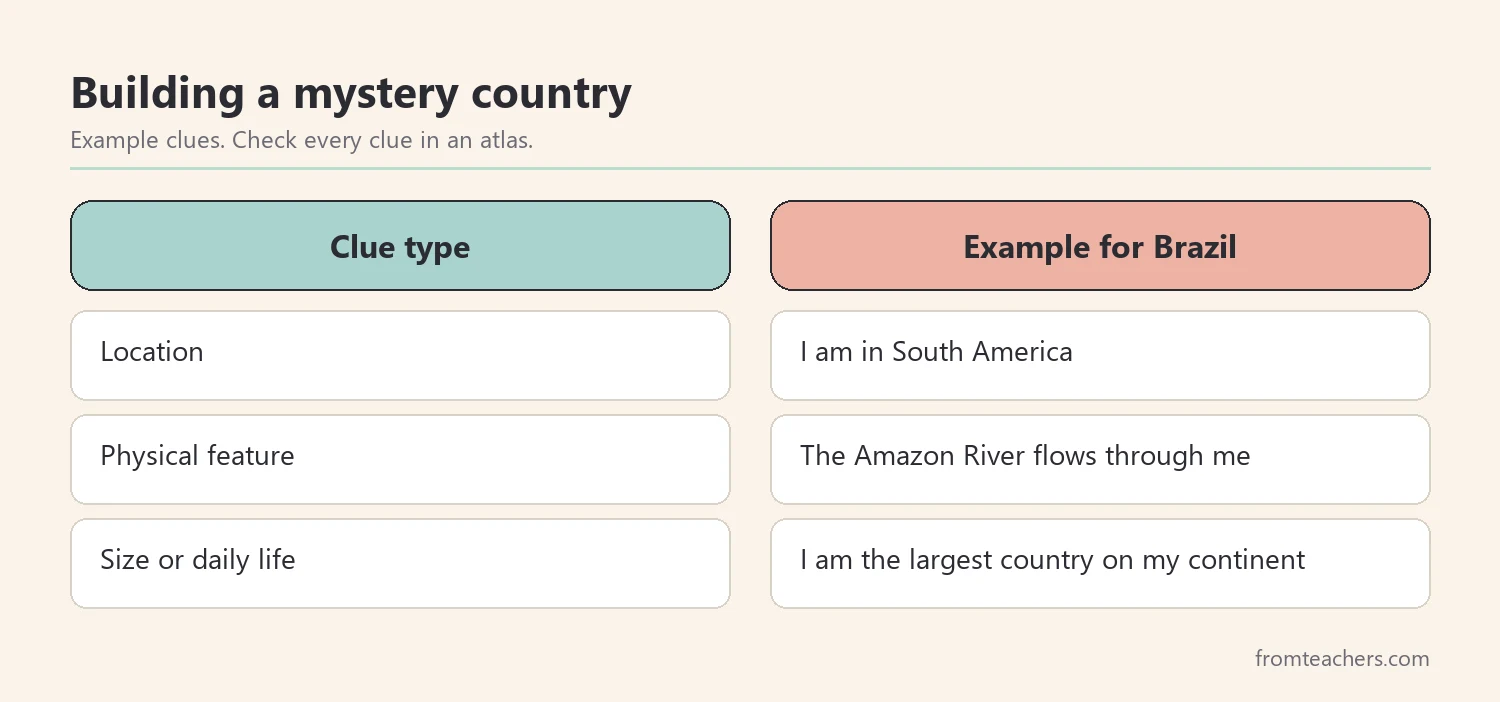
Good clues mix the map with everyday life. For example, a clue might name the continent, a large river or mountain range, and a food or sport the country is known for. Then, students work in pairs to narrow down the options using a world map or a globe. Finally, reveal the answer and point to it together.
Also, rotate who writes the clues. After a few rounds, students can write mystery clues for each other, which is one of the most fun geography activities because it asks them to think like the teacher. Writing a fair clue requires checking the map carefully.
Keep clues accurate and simple. Use facts you have checked in a reliable atlas or reference, and avoid clues that depend on stereotypes. A good clue should help students locate the country and learn something real about it.
Mystery country checklist
- One location clue, such as the continent or a neighbor.
- One physical clue, such as a river, desert, or mountain range.
- One culture or daily life clue, checked for accuracy.
- A map or globe for every pair.
- A reveal moment where everyone points to the answer.
Worked example. Noah is a fictional student in grade 5 who tunes out during map work. His teacher shows three clues: “I am in South America. The Amazon River flows through me. I am the largest country on my continent.” Noah and his partner check the map, argue for a minute, and then shout “Brazil!” Noah finds Brazil again at the end of class without help.
In short, a mystery turns the map from a worksheet into a puzzle. Students look closely because they want to win.
2. Turn countries into characters with fun geography activities
Next, give each country a personality. People remember characters far more easily than lists. So, when a country has a nickname, a job title, and a catchphrase, students have a hook to hang facts on.
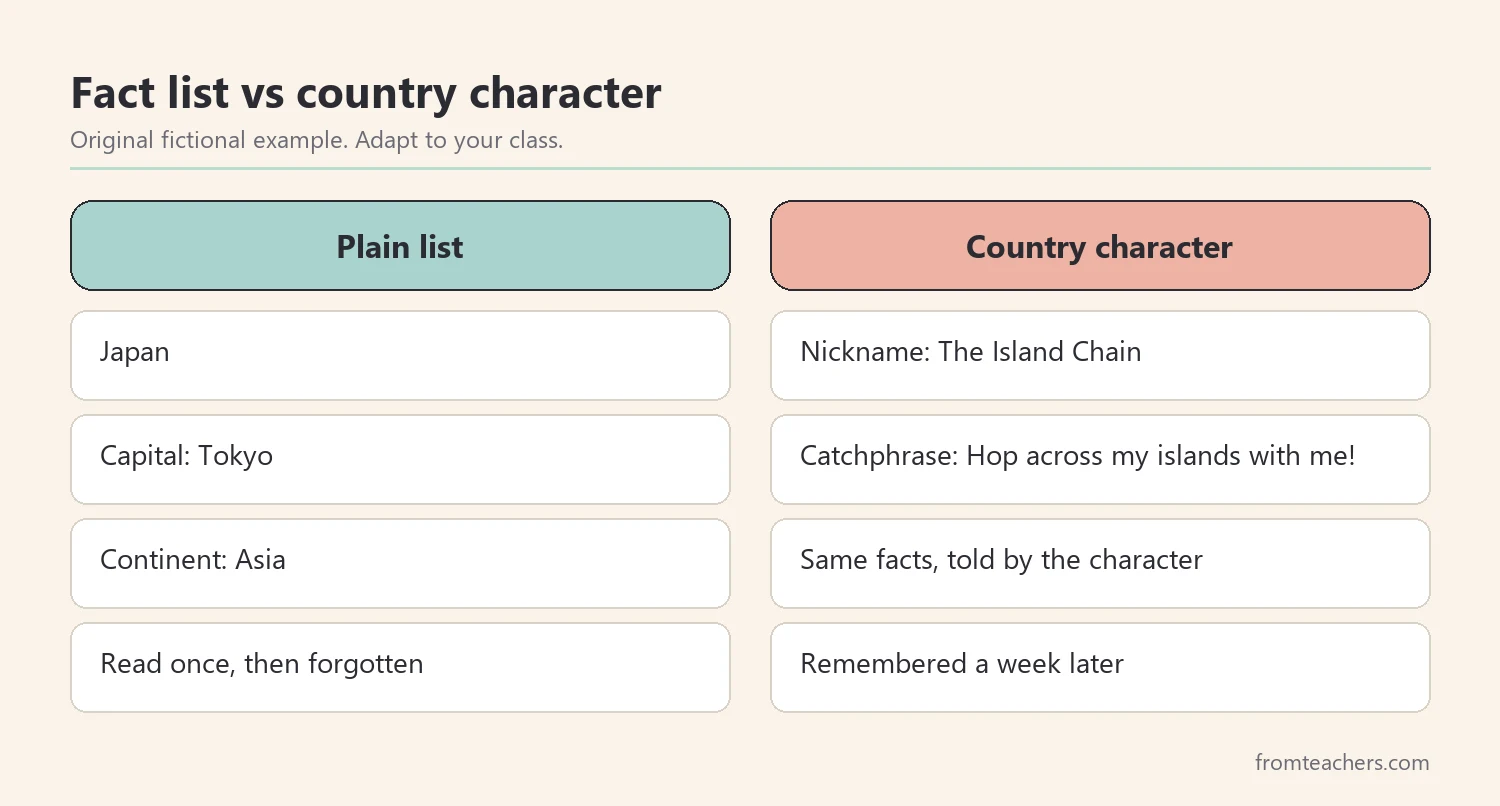
Start by modeling one country yourself. Choose a nickname linked to a real feature, a job title that fits what the country is known for, and a short first person catchphrase. Then, add two or three real facts, such as the capital and the continent. Finally, ask students what else the character might say.
After that, let students create their own country characters. Give them a simple template and a short list of reliable sources. The personality should always grow from real facts, not from jokes about people. Talk about this openly, because respectful humor is part of good geography teaching.
| Part | What it does | Example idea |
|---|---|---|
| Nickname | Links to a real feature | “The Island of Music” |
| Job title | Shows what the country is known for | “Music Ambassador” |
| Catchphrase | One memorable first person line | “Come and hear my songs!” |
| Real facts | Capital, continent, one more fact | Checked in an atlas |
If you want ready-made characters for every country, the If Countries Were Humans country profile slides give each of the 195 countries a nickname, a job title, a catchphrase, the capital, the continent, and real facts, so you can model the idea in minutes.
Worked example. Noah picks Japan. He writes the nickname “The Island Chain,” lists Tokyo as the capital and Asia as the continent, and adds one fact about its many islands. His catchphrase is “Hop across my islands with me!” When the class plays a review game a week later, Noah remembers Japan’s capital first.
As a result, these fun geography activities give every country a face. Facts stick to the face.
3. Play quick map games with fun geography activities
Once students know a few characters, make them move. Fun geography activities do not need to be loud or complicated.
Short games keep energy high and ask students to use what they know. The best map games take five to ten minutes and need almost no setup.
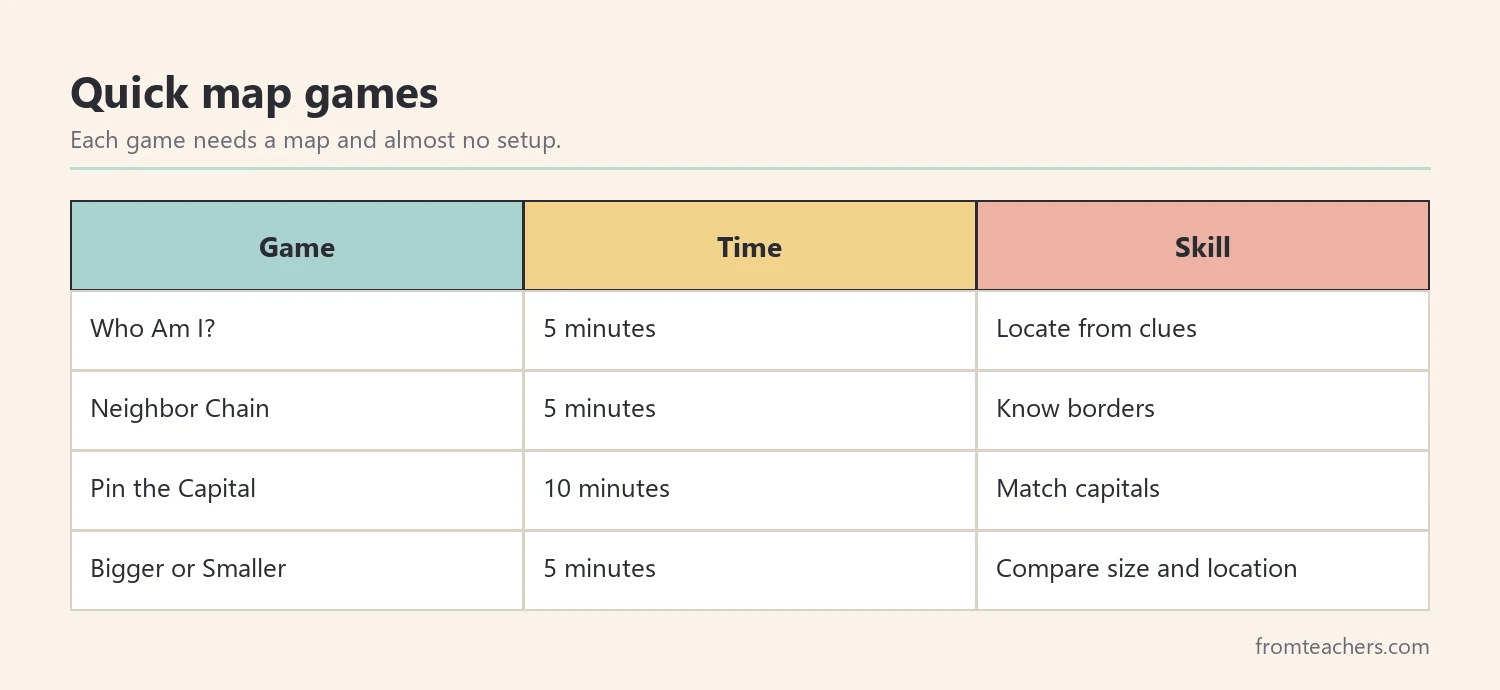
Try “Who Am I?” first. One student reads a character’s catchphrase and one clue, and the class finds the country on the map. Then, try “Neighbor Chain”: a student names a country, and the next student must name a country that shares a border with it. In addition, “Pin the Capital” asks teams to place capital cards on a large map in a set time.
Also, mix in comparison questions. For example, “Which is larger, Canada or Mexico?” or “Which of these countries touches the ocean?” Comparison makes students look at the whole map, not one country at a time.
| Game | Time | Skill |
|---|---|---|
| Who Am I? | 5 minutes | Locate a country from clues |
| Neighbor Chain | 5 minutes | Know borders |
| Pin the Capital | 10 minutes | Match capitals to countries |
| Bigger or Smaller | 5 minutes | Compare size and location |
Worked example. Noah’s class plays three games on Wednesday: Who Am I? for 5 minutes, Neighbor Chain for 5 minutes, and Pin the Capital for 10 minutes. That is 20 minutes of practice in all. Noah’s team places 8 of 10 capitals correctly, and he explains how he used the Japan character to remember Tokyo.
Afterward, ask one or two students to explain a tricky answer, such as how they knew which countries share a border. Explaining slows the game down for a moment, but it shows the whole class a strategy they can borrow next time. It also rewards careful thinking, not only speed.
Therefore, games turn recall into action. Students practice without feeling like they are studying.
4. Build short country stories from fun geography activities
Next, ask students to go deeper on one country. A short story or travel page lets them connect places, people, and facts in their own words. This is where memory turns into understanding.
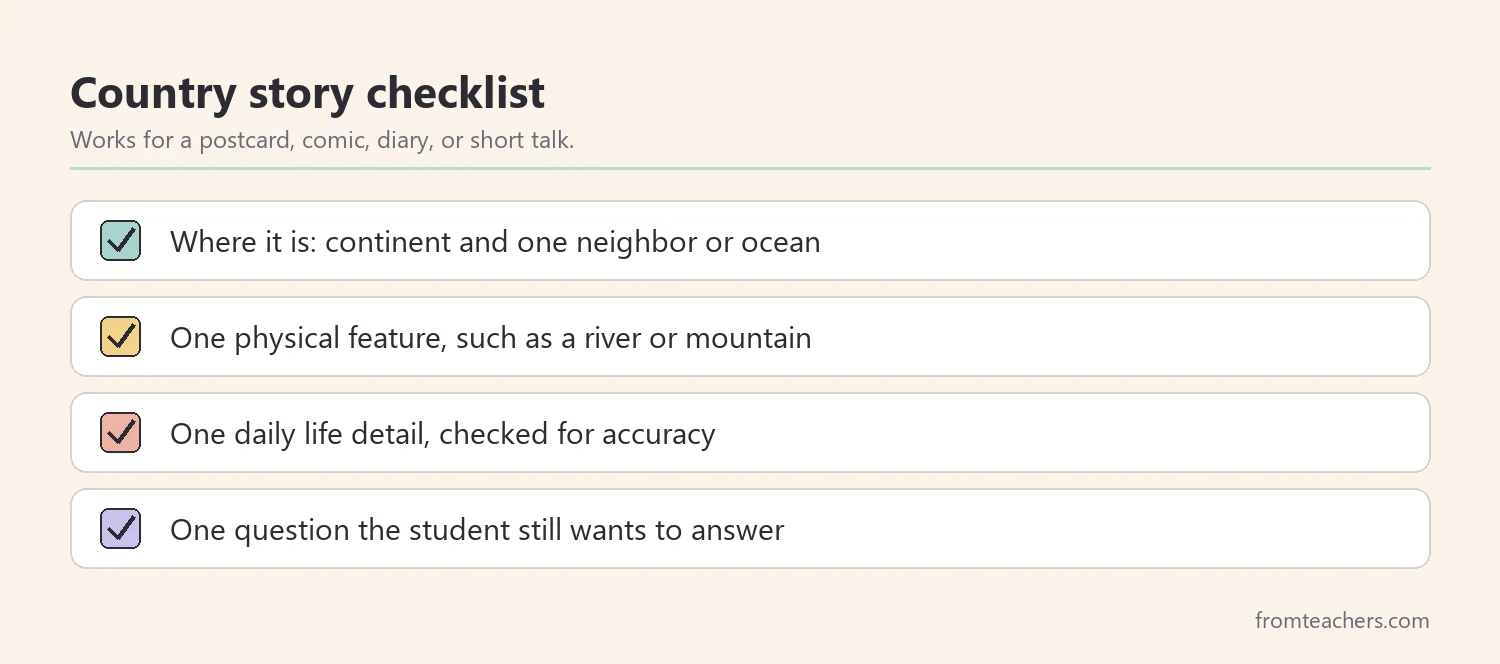
Give a clear structure. A strong country story includes where the country is, one physical feature, one daily life detail, and one question the student still has. Then, let students choose the format: a postcard, a short comic, a travel diary entry, or a one-minute talk.
Then, connect the story to the earlier steps. Students can reuse the character they created in step 2 and the facts they practiced in the map games. Linking fun geography activities this way means nothing is learned once and dropped.
In addition, support students who find writing hard. Offer sentence starters, picture choices, or a recording option. The goal is to show geography understanding, so the format should not block a student who knows the content.
Country story checklist
- Where it is: continent and one neighbor or ocean.
- One physical feature, such as a river, mountain, or desert.
- One daily life detail, checked for accuracy.
- One question the student still wants to answer.
Worked example. Noah writes a postcard “from” Japan. He describes hopping between islands, names Tokyo, mentions that Japan is in Asia, and asks, “How do people travel between the islands?” His postcard covers all four checklist parts. He reads it aloud to a partner, who adds Japan to her own map.
In other words, fun geography activities become meaningful when students explain a place to someone else.
5. Review fun geography activities over time
Finally, plan review so learning lasts. A quick review keeps fun geography activities from being a one-week event and helps students carry countries into later units, like history or science, where the same places appear again. One big test at the end of a unit often leads to quick forgetting. Short reviews spread over several weeks work better for most students.
Use two or three minutes at the start of a lesson for these fun geography activities. For example, show one catchphrase and ask students to name and locate the country. Then, add a quick neighbor or capital question. Also, return to older countries every week, not only the newest ones.
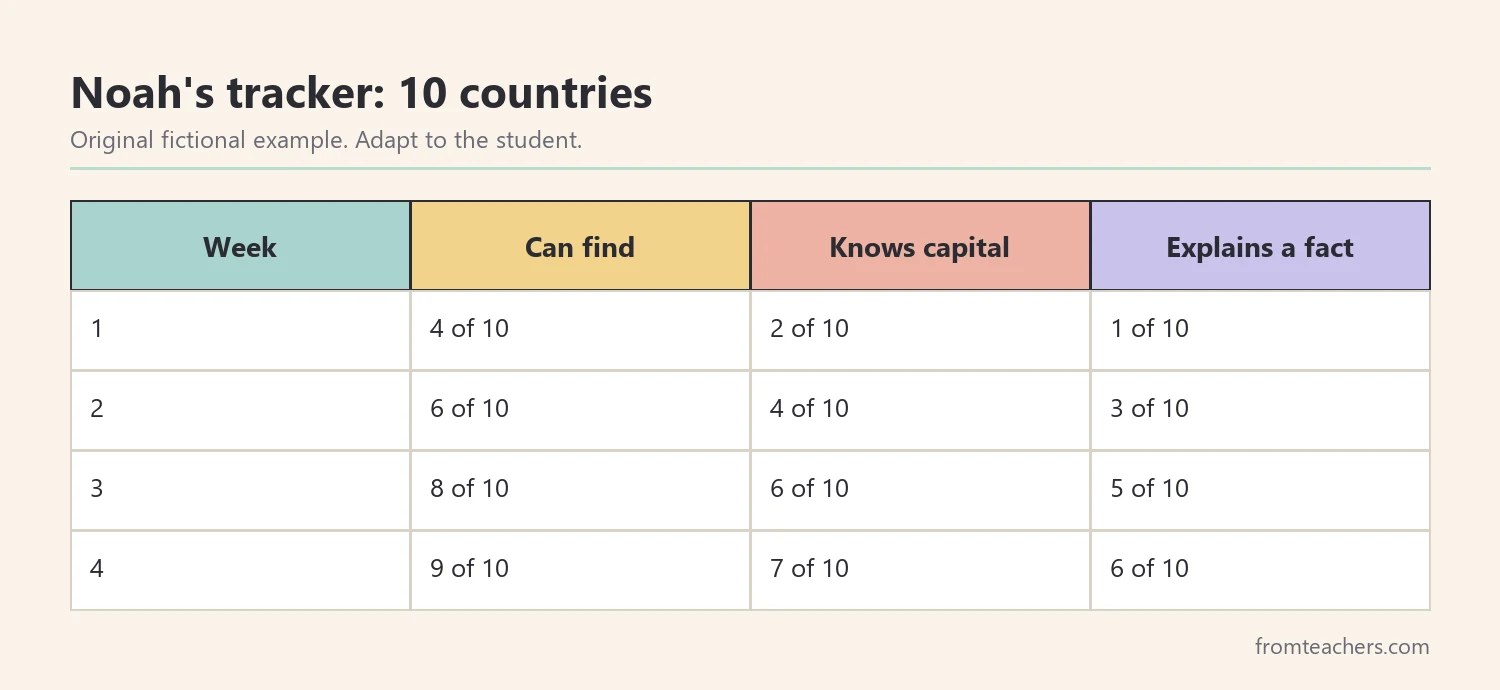
In addition, let students track their own progress. A simple chart with country names and three columns, “I can find it,” “I know the capital,” and “I can explain one fact,” gives students a clear picture of what they know. Students enjoy watching the checks grow.
Worked example. Noah tracks 10 countries over four weeks. In week 1, he can find 4. By week 4, he can find 9, which leaves 1 still to practice. He names the capital for 7 of the 10 and explains one fact for 6 of them. His teacher uses the chart to choose the next week’s mystery countries.
In the end, review is where fun geography activities turn into long-term memory.
Common mistakes and how to avoid them
- Starting with a long list. Lists fade fast. Fix: open fun geography activities with a mystery and add countries a few at a time.
- Humor based on stereotypes. It teaches the wrong lesson and can hurt students. Fix: build personalities from real places, features, and facts.
- Unchecked facts. Errors spread quickly in games. Fix: check facts in a reliable atlas or reference before using them.
- Games that only reward speed. Some students stop trying. Fix: mix team games with explain-your-answer moments.
- Reviewing only new countries. Older ones are forgotten. Fix: return to earlier countries every week.
- Making writing the only option. It hides what some students know. Fix: offer drawing, speaking, or recording.
Questions teachers and parents ask about fun geography activities
What age are these fun geography activities for?
Most of these ideas fit upper elementary and middle school. Younger students can do the mystery and character steps with fewer countries. Older students can research deeper and write longer stories.
How many countries should students learn at once?
Start small, with a few countries per week. Fun geography activities work best with a manageable set. Then, keep reviewing earlier countries as you add new ones. Steady, connected learning usually beats a long list.
Can I use fun geography activities at home?
Yes. A world map on the fridge, a weekly mystery country, and a short game at dinner work well. In addition, families can link countries to foods, books, or relatives’ stories.
How do I keep country characters respectful?
In fun geography activities, base every character on geography, history, or culture facts, and avoid jokes about how people look or speak. Talk about this with students before they create their own characters.
How do I assess learning without a big test?
Use the tracker, short review questions, and the country story from your fun geography activities. Together, they show whether students can locate, name, and explain. That gives a clearer picture than a single score.
Related reading: Learning Styles Student Success Guide, 5 Practical Teaching Tips to Boost Classroom Focus and Learning, and Homeschooling vs. Public Schooling: Which Educational Path Is Right for Your Child?
A companion resource for fun geography activities:
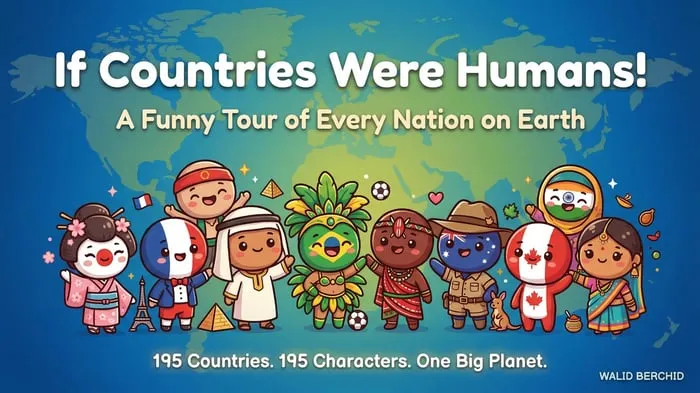
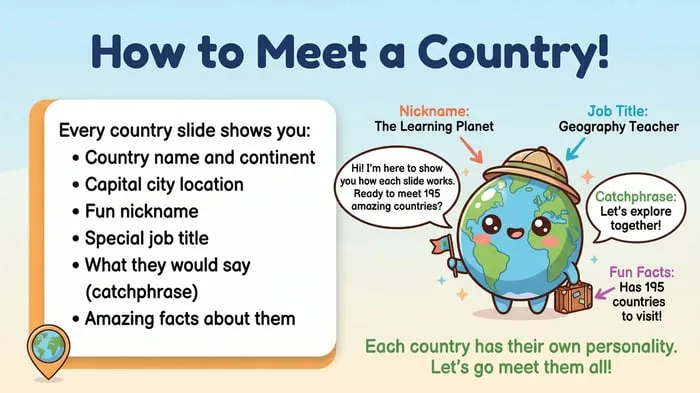
If Countries Were Humans!: 195 country profile slides, each with the country name, continent, and capital, plus a nickname, a job title, a first person catchphrase, real facts, and a Did You Know section.
Sources and scope
- National Geographic Education: free maps, activities, and background for geography teaching.
- National Council for Geographic Education: a professional organization for geography educators.
- National Council for the Social Studies: guidance and resources for social studies teaching.
- The World Factbook: a reference for checking country facts such as capitals and geography.
This guide covers engaging classroom and home activities for learning world countries. It does not replace a full geography curriculum or your local standards, so check facts and requirements before teaching.
Key takeaways
- Fun geography activities work best when they start with a mystery.
- Country characters give facts a memorable face.
- Short map games practice locating, comparing, and explaining.
- Country stories turn memory into understanding.
- Short, spread-out review makes learning last.
Leave a Comment