
Conflict resolution for students often begins with a simple misunderstanding. Picture two sixth graders working on a group poster. One says, “I’ll handle the title,” and the other hears, “You can’t be trusted with it.” Within minutes, one is shouting and the other has shut down. Neither meant harm, but both feel hurt.
This guide gives you a five-step process to teach students how to clear up misunderstandings calmly: pause first, say what was misunderstood, correct false assumptions, find where the confusion started, and own their part. By the end, you will have scripts, examples, and a simple way to practice so students can handle more of these moments on their own.
Examples are fictional. Adapt to the student’s goals and agreed supports. This is guidance, not a diagnosis.
At a glance
- Most peer conflicts start with a misunderstanding, not bad intent.
- Students need to calm down before they can talk it through.
- Short, respectful scripts help students say what they mean.
- Finding where the confusion started takes blame out of the talk.
- Owning one’s part honestly is different from over-apologizing.
1. Pause before conflict resolution for students begins
First, teach that no one solves a conflict while upset. When students feel hurt or accused, their words come out sharp and they stop listening. A short pause gives both sides time to cool down before they talk.
Next, give students a clear pause routine. It can be as simple as: stop talking, take three slow breaths, and say, “I need a minute, then I want to talk.” Practice this when everyone is calm, so it feels familiar during a real conflict.
Then, agree on a signal and a place. Some classes use a hand sign that means “pause,” and a quiet table where students can talk once they are ready. This makes conflict resolution for students a normal part of the day, not a punishment.
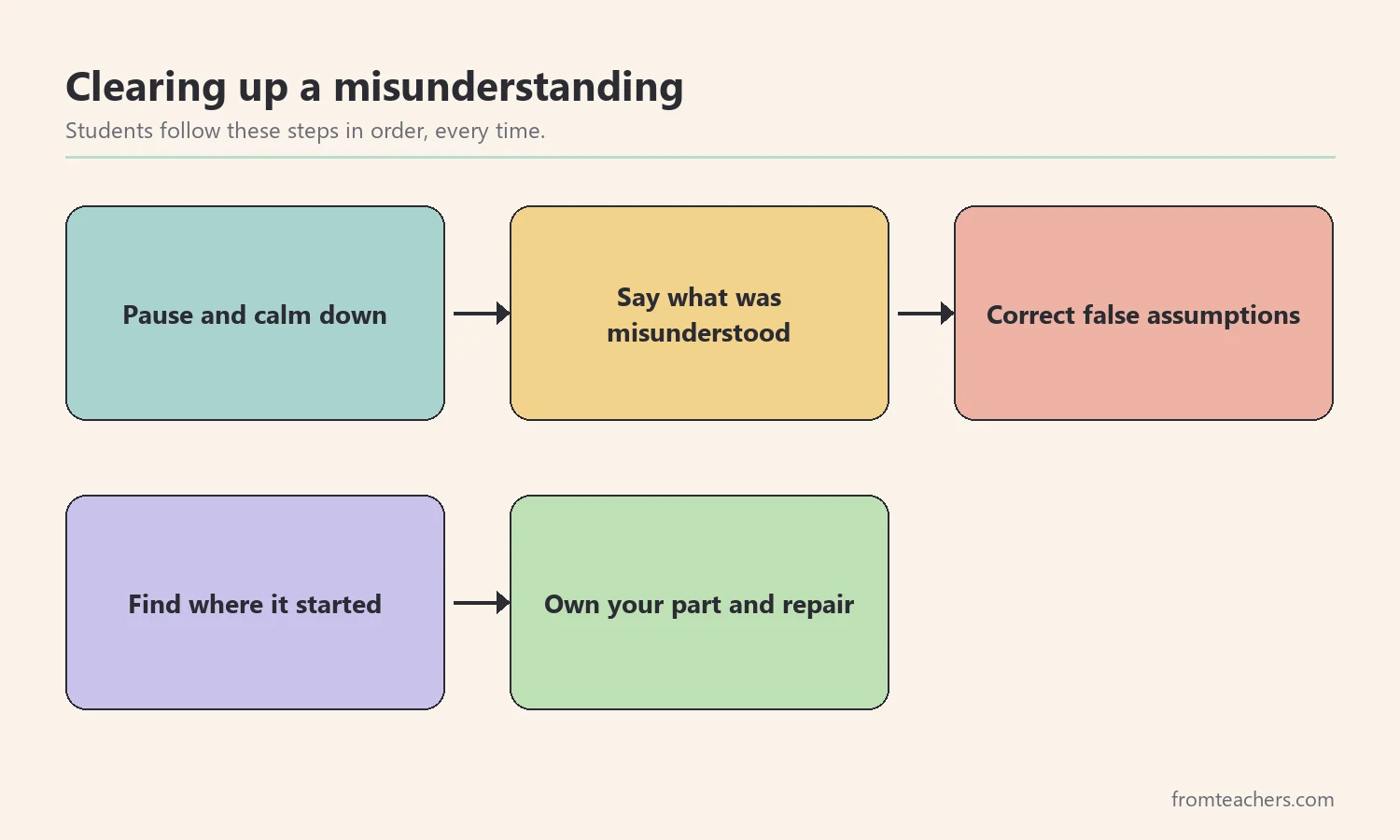
Worked example. Jada is a fictional student in grade 6. During a group project, she hears her partner Omar say, “I’ll do the title, it needs to look good.” Jada feels insulted and snaps, “Fine, do it all yourself.” Her teacher gives the pause signal. Both students take a few breaths at their desks, then move to the quiet table five minutes later.
Also, model the pause yourself. When a lesson gets noisy or a plan falls apart, say out loud, “I’m going to take a breath before I answer.” Students learn conflict resolution for students far more from what adults do in the moment than from a poster on the wall.
In short, the pause does not solve the problem. However, it makes solving it possible.
2. Say what was misunderstood: a core conflict resolution for students skill
Once calm, the student who feels misunderstood needs to say so clearly, without attacking. Many students either stay silent or accuse. Neither helps. A simple script gives them a middle path.
Teach a sentence frame like: “When you said ___, I thought you meant ___. Is that what you meant?” This names the words, shares the feeling, and invites the other person to explain. Moreover, it turns an accusation into a question.
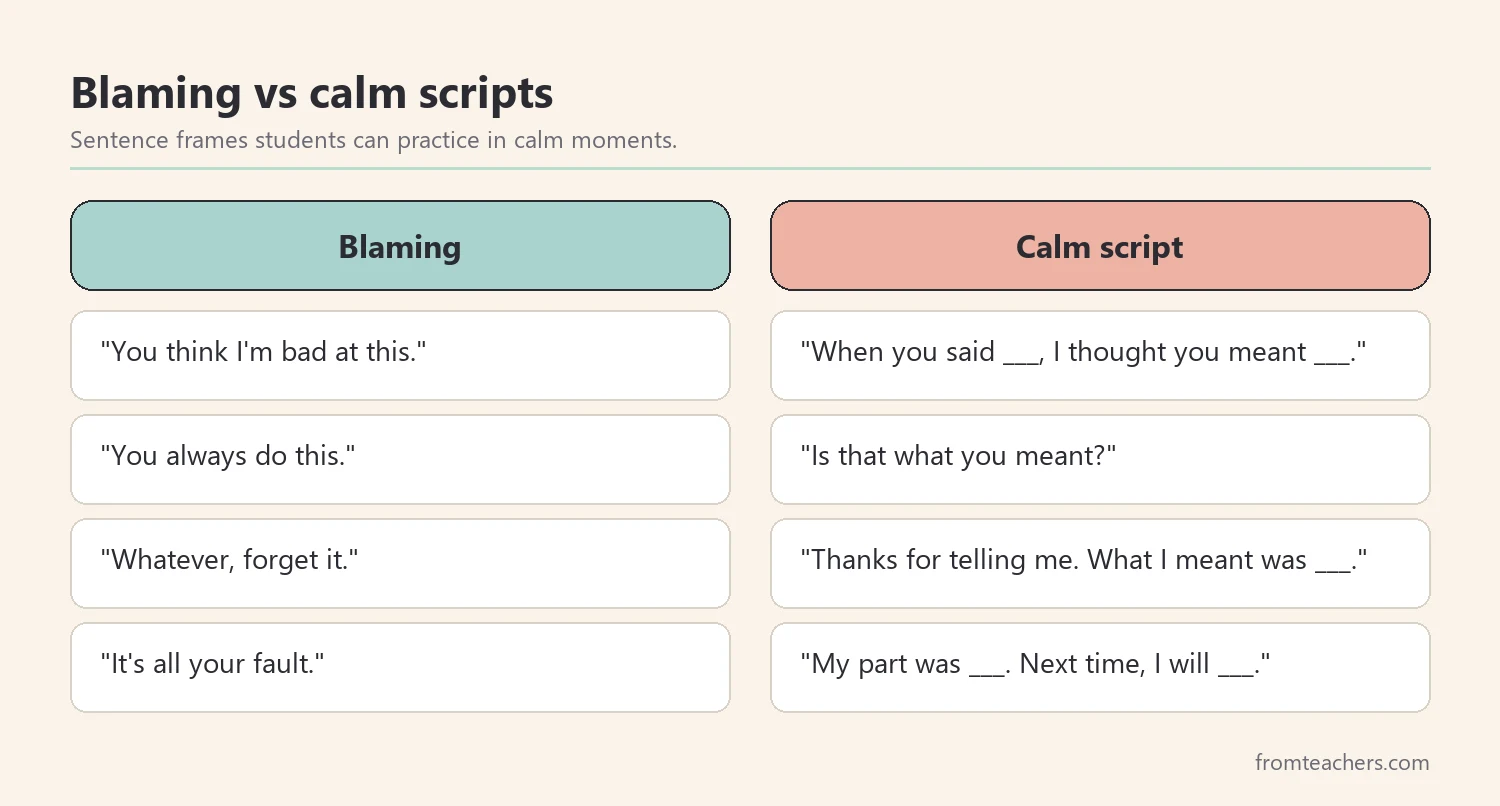
Also, teach the listener’s part. When a peer says they felt misunderstood, the listener answers first with “Thanks for telling me,” then explains. This keeps the talk respectful, even when the listener feels defensive.
Worked example. At the quiet table, Jada says, “When you said the title needs to look good, I thought you meant my writing looks bad. Is that what you meant?” Omar looks surprised. He says, “Thanks for telling me. No, I meant I like doing bubble letters and I wanted to help.”
Keep the frames visible. A small card on each desk or a poster near the quiet table reminds students of the words when emotions are high. Over time, many students stop needing the card, because the phrases become their own.
As a result, the real problem, a mix-up about meaning, is now on the table, and both students can see it.
3. Teach conflict resolution for students: correct false assumptions
A false assumption is a guess treated like a fact. “She ignored me on purpose” or “He thinks I’m dumb” are common examples. Students often act on these guesses without checking them, and the conflict grows.
Teach students to notice the guess and check it. One useful frame is: “I assumed ___. I want to check: did you mean ___?” When the other person is the one making the assumption, a calm correction works: “I can see why you thought that. What I meant was ___.”
Structured practice helps here. A set of calm scripts for correcting false assumptions, laid out as Problem, Fix, and Benefit tables, lets students see the situation, the words to use, and why the words help.
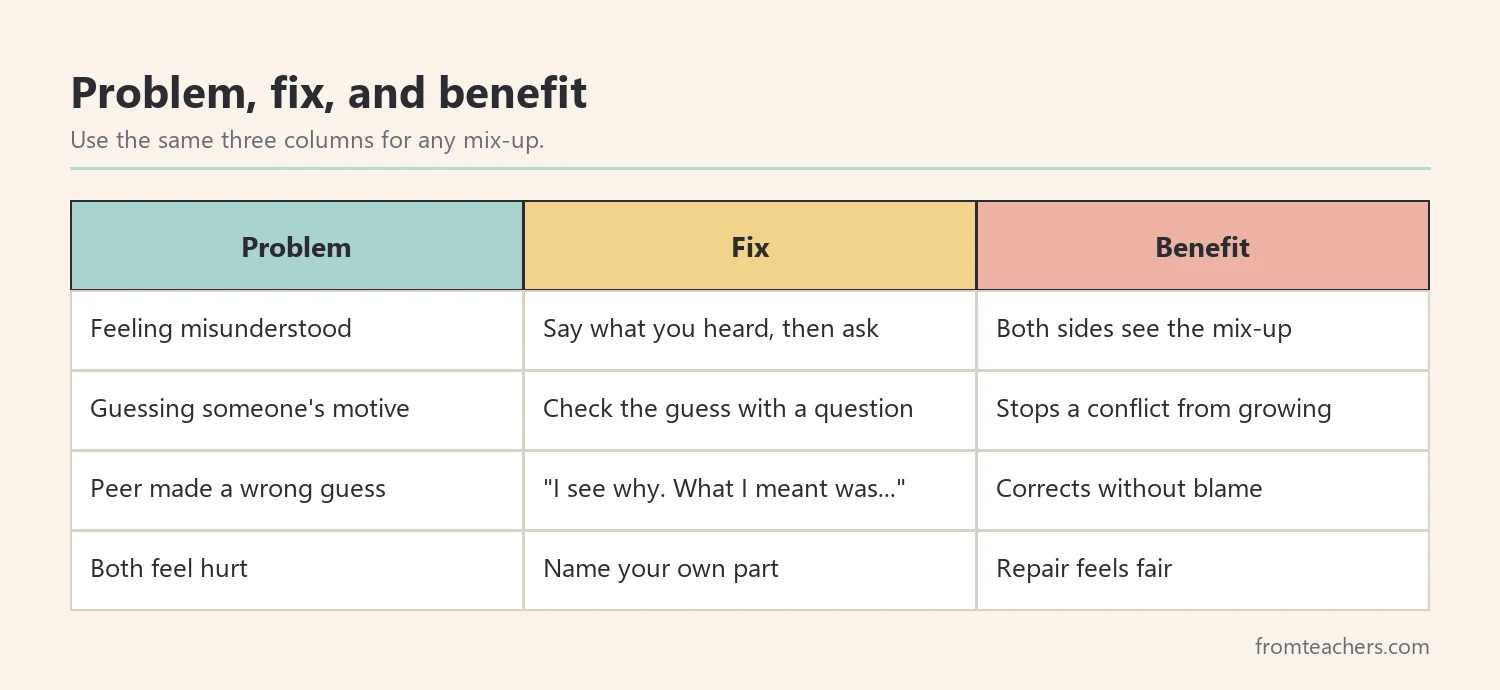
Worked example. Later in the week, Jada sees Omar laughing with two classmates and assumes they are laughing about her poster. Instead of confronting him, she uses the frame: “I assumed you were laughing about our poster. Were you?” Omar explains they were laughing at a video from lunch. Jada says, “Okay, thanks. I just wanted to check.”
Moreover, help students notice the clues that a guess may be wrong. A short message, a missing emoji in a group chat, or a busy face in the hallway can all look like rejection when they are not. Teaching students to ask “What else could this mean?” builds the habit of checking before reacting, which sits at the heart of conflict resolution for students.
To practice, run a weekly ten-minute role-play. Write three short situations on cards, such as a friend who did not save a seat or a partner who changed the plan without asking. Pairs pick a card, act out the assumption, and then use the checking frame. Afterward, ask the class which words helped most. Short, regular practice like this makes conflict resolution for students feel routine rather than dramatic.
In other words, checking a guess takes a few seconds and often prevents a much bigger conflict.
4. Find where the confusion started in conflict resolution for students
Next, help students trace the misunderstanding back to its start. This is a key part of conflict resolution for students, because it moves the focus from “who is wrong” to “what went wrong.” Students feel less defensive when the problem is the confusion, not the person.
Teach three simple questions: “What was said?”, “What did each of us hear?”, and “Where did the meaning change?” Students answer them together, often on paper or a whiteboard. Many times, they find the confusion started with unclear words, a tone that was misread, or missing information.
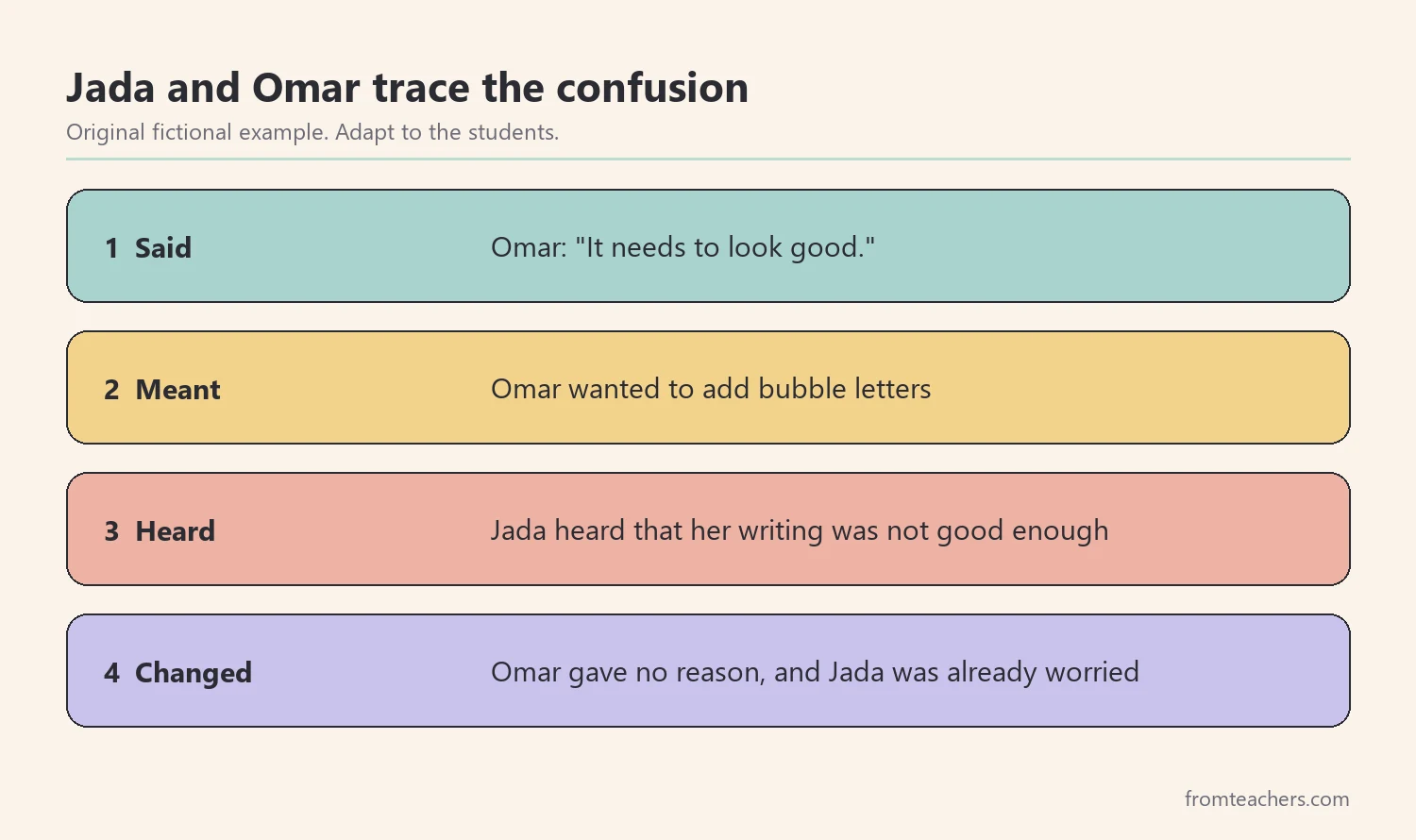
Worked example. Jada and Omar write out what happened. Omar said, “It needs to look good.” Omar meant, “I want to make it fun with bubble letters.” Jada heard, “Your work is not good enough.” They agree the meaning changed because Omar did not say why he wanted the title. Jada also notes she was already worried about her handwriting that day.
| Question | Omar | Jada |
|---|---|---|
| What was said? | “It needs to look good.” | “It needs to look good.” |
| What did each hear or mean? | I want to add bubble letters | My writing is not good enough |
| Where did it change? | No reason given | Already worried that day |
Furthermore, students often notice that both sides played a part. That discovery leads naturally to the last step.
5. Own your part and repair
Finally, teach students to take honest responsibility for their share of the confusion. This is different from taking all the blame or apologizing for everything. A clear frame is: “My part was ___. Next time, I will ___.”
Some students over-apologize to end the conflict quickly. Others refuse to own anything. Both get in the way of real repair. Show students that owning one part is fair and strong, and that the other person can own their part too.
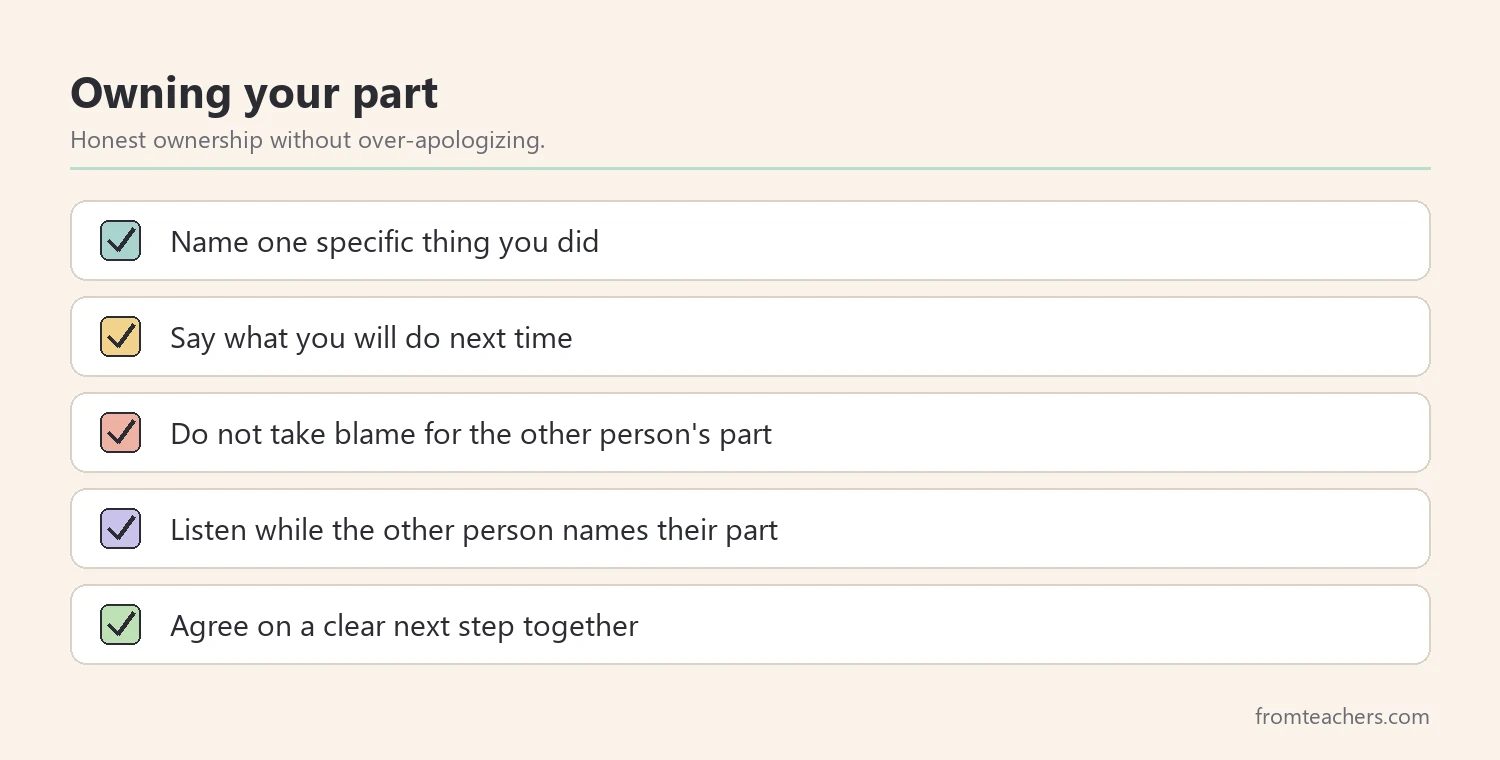
Worked example. Omar says, “My part was not explaining why I wanted the title. Next time, I will say what I mean.” Jada says, “My part was snapping before I asked. Next time, I will check first.” They agree Omar will do the bubble letters and Jada will write the facts. Their teacher notes the talk took about ten minutes with no adult stepping in after the pause.
Notice, too, that repair looks different for different students. Some are ready to work together again right away, while others need a little distance first. Both are fine. The key part of conflict resolution for students is that each person leaves knowing the misunderstanding has been cleared up and what will happen next.
Then, close the talk with a clear next step. Students agree on who does what, or on how they will check in next time. A short handshake, a thumbs up, or a simple “We’re good” helps both students feel the conflict is truly over.
Over time, track how often students resolve conflicts on their own. A simple tally of “solved with an adult” and “solved without an adult” each week shows whether conflict resolution for students is taking hold in your room.
| Week | Conflicts | Solved with adult | Solved without adult |
|---|---|---|---|
| 1 | 6 | 5 | 1 |
| 2 | 5 | 3 | 2 |
| 3 | 6 | 3 | 3 |
| 4 | 5 | 2 | 3 |
In this fictional class record, the total number of conflicts stays about the same, but more of them are solved without an adult each week. That shift is the real goal of conflict resolution for students: not zero conflicts, but more skill in handling them.
Common mistakes and how to avoid them
- Talking while students are still upset. Fix: use the pause routine first, every time.
- Deciding who is right too quickly. Fix: guide students to find where the confusion started.
- Forcing an apology. Fix: ask each student to name their own part instead.
- Teaching scripts only during conflicts. Fix: practice the frames in calm moments with role-plays.
- Accepting over-apologizing. Fix: help students name one specific part, not everything.
- Using these steps for bullying. Fix: treat repeated, one-sided harm as a safety issue and follow school procedures.
Questions teachers and parents ask about conflict resolution for students
What age is right for these steps?
The steps work for upper elementary and middle school students, with simpler wording for younger children. Younger students may need more adult guidance and shorter scripts. Older students can use the frames on their own after practice.
Is this the same as handling bullying?
No. These steps are for misunderstandings between peers with roughly equal power. Bullying involves repeated, one-sided harm and needs adult action and your school’s procedures. Never ask a student who is being bullied to “work it out” with the other student.
How do I practice without a real conflict?
Use short role-plays with made-up situations, such as a mixed-up message or a group project mix-up. Students practice the scripts in pairs, then switch roles. This builds the skill before they need it.
What if one student refuses to talk?
Give more time and offer a written option, such as filling in the sentence frames on paper. Some students need a second pause. If the refusal continues, an adult can help guide the talk or check in with each student separately.
How can parents support conflict resolution for students at home?
Parents can use the same sentence frames during sibling or family disagreements. When a child feels misunderstood, they can practice saying what they heard and asking what was meant. Using the same language at home and school helps the skill stick.
Related reading: Moving Beyond Shame and Behavior Charts: Positive Alternatives, Building Stronger School Counseling Programs, and Essential Trauma-Informed Teaching Strategies for Modern Classrooms.
A companion resource for conflict resolution for students:
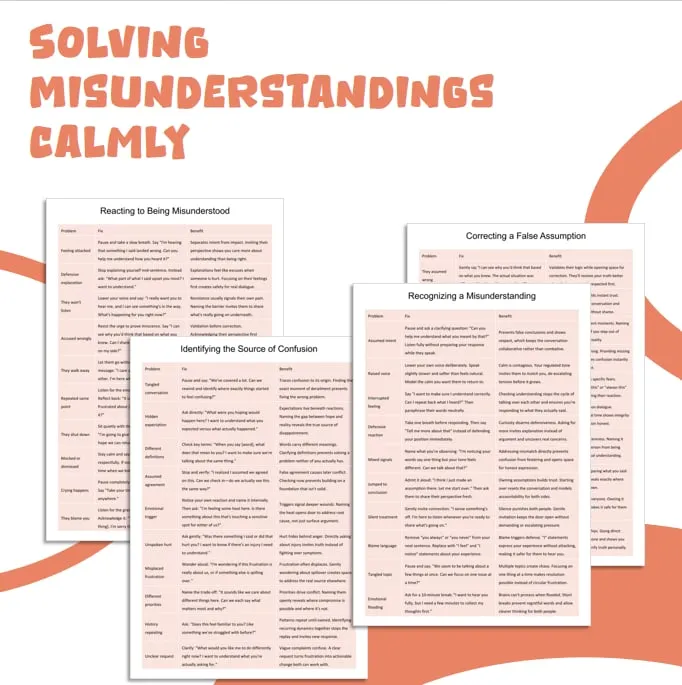
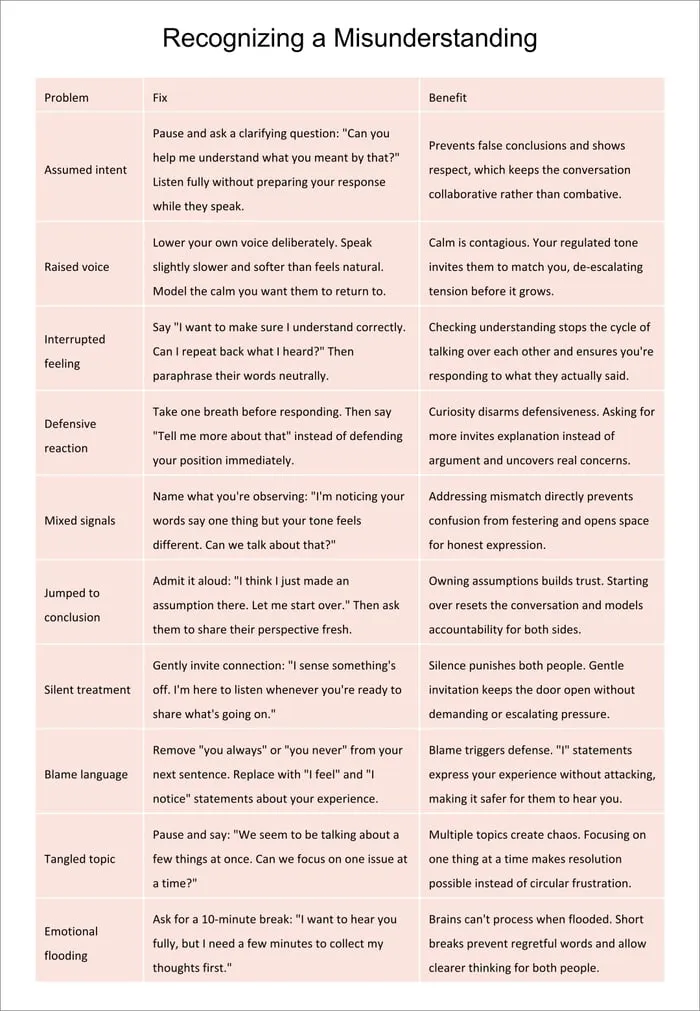
Solving Misunderstandings Calmly: 12 pages of Problem, Fix, and Benefit tables with calm scripts for being misunderstood, correcting false assumptions, finding the source of confusion, and accepting responsibility without over-apologizing.
Sources and scope
- CASEL: a widely used framework for social and emotional learning, including relationship skills.
- American School Counselor Association (ASCA): resources on the role of school counselors in student well-being.
- StopBullying.gov: U.S. government information on the difference between conflict and bullying, and how adults can respond.
- American Psychological Association: general information on emotions, stress, and relationships.
This guide covers teaching students to resolve everyday peer misunderstandings. It does not cover bullying, safety threats, or serious behavior concerns, which require adult action and school procedures.
Key takeaways
- Conflict resolution for students starts with a calm pause.
- Sentence frames help students say what they heard and ask what was meant.
- Finding where the confusion started takes blame out of the conversation.
- Honest ownership of one’s part leads to real repair.
- Track conflicts solved without an adult to see if conflict resolution for students is working.
Leave a Comment