

Co-regulation for teachers starts with a simple and uncomfortable truth: students notice your stress before they notice your words. Picture a third-grade classroom at 2:15 on a Friday. One student is crying under a table, two others are arguing about a pencil, and the teacher feels her jaw tighten and her voice rise. Nobody in that room is calm, and the adult is the only one who can change that first.
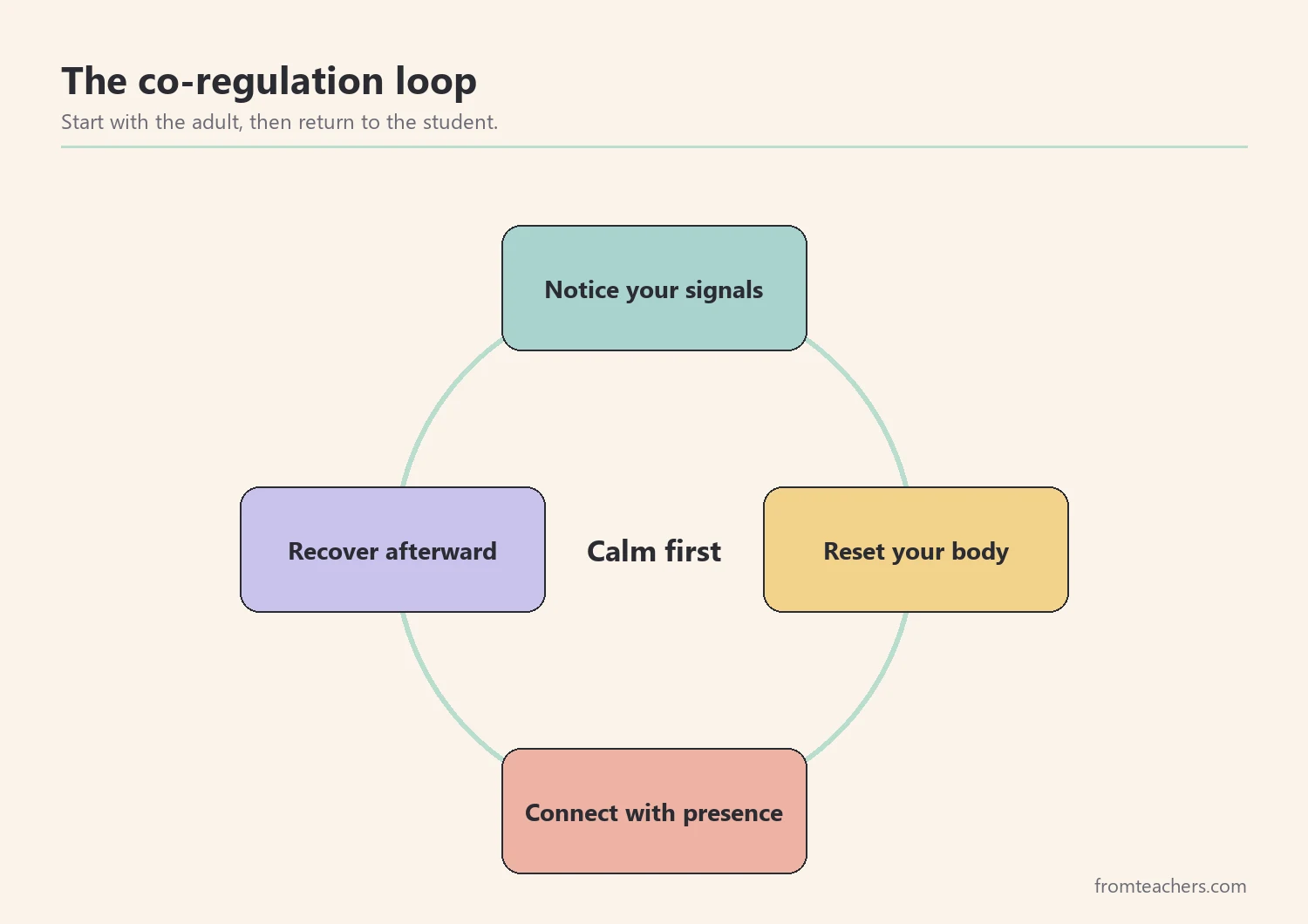
This guide gives you a five-step routine for the moments when you feel overwhelmed too: notice your own signals, reset your body quickly, offer presence instead of fixing, let your voice and body carry the message, and recover afterward. By the end, you will have a small, repeatable plan rather than a promise to “stay calm no matter what.”
Examples are fictional. Adapt to the student’s goals and agreed supports. This is guidance, not a diagnosis.
At a glance
- In co-regulation for teachers, students often borrow the adult’s calm before they can find their own.
- Your own early stress signals are the first thing to track, not the student’s behavior.
- A short body reset can happen in under a minute, in front of the class.
- Being present matters more than fixing the problem in the moment.
- Recovery after a hard moment is part of the job, not an extra.
1. Notice your own stress signals first
Co-regulation for teachers begins with awareness of your own state. When a student falls apart, attention naturally jumps to the student. However, the adult’s body is already reacting: a faster heartbeat, a tight chest, a louder voice, or an urge to take control. If you can catch those signals early, you have more choices.
The first tool in co-regulation for teachers is a short list. Start by listing three to five signals that show up when you feel stressed at school. Keep them concrete and physical. For instance, “I clench my jaw,” “I talk faster,” or “I start pacing near the door.” Then, for one week, make a small tally mark whenever you notice one of them.
The goal is not to judge yourself. Instead, you are building an early warning system. Many teachers find that their signals appear at predictable times, such as transitions, the end of the day, or after a difficult conversation.
Worked example. Ms. Okafor teaches third grade. She writes down four signals: tight jaw, fast speech, standing over students, and checking the clock. Over five school days she tallies 12 signals in total: 3 on Monday, 2 on Tuesday, 2 on Wednesday, 1 on Thursday, and 4 on Friday. Most of them happen during the afternoon transition to centers.
| Day | Signals noticed | When |
|---|---|---|
| Monday | 3 | Centers transition |
| Tuesday | 2 | Lunch line |
| Wednesday | 2 | Centers transition |
| Thursday | 1 | Dismissal |
| Friday | 4 | Centers transition |
As a result, she now knows exactly when to plan a reset, rather than hoping to stay calm all day.
2. Reset your body: co-regulation for teachers in under a minute
In co-regulation for teachers, the body comes before the words. Once you notice a signal, the next move is a short physical reset. You do not need to leave the room or pause the lesson for long. In fact, a visible reset can model regulation for the whole class.
Choose one routine and practice it on calm days, so it is available on hard days. A simple version has four parts: plant your feet, lower your shoulders, take one slow breath with a longer exhale, and soften your face. Altogether, this takes about 30 to 60 seconds.
Some teachers also use a quiet cue word, such as “slow,” written on a sticky note near the board. The word is a reminder for the adult, not an instruction to students. Similarly, holding a cup of water or sitting down at student level can help the body settle.
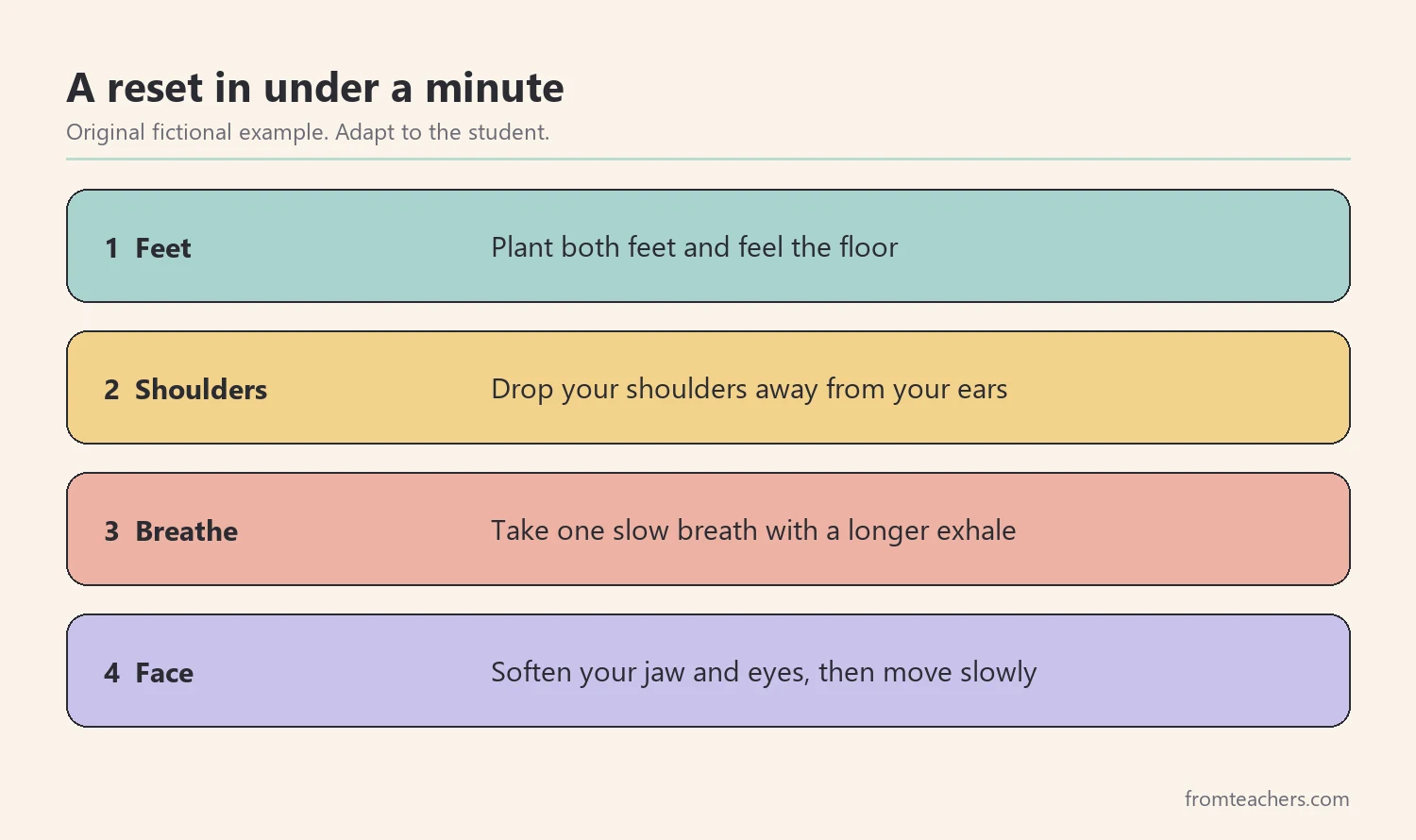
Worked example. On Monday, Ms. Okafor notices her jaw tighten as centers begin. She stops near her desk, feels her feet on the floor, drops her shoulders, and lets out one long breath. Then she relaxes her face and walks slowly to the student who is upset. The reset takes less than a minute, yet her voice is noticeably lower when she arrives.
Above all, keep this practical. Co-regulation for teachers does not require a perfect meditation habit. It requires one reliable move you can make while still on duty.
3. Offer presence instead of fixing
When a student is overwhelmed, the urge to fix the problem is strong. We want the crying to stop, the argument to end, and the lesson to continue. Still, a student in a big emotion often cannot use reasoning, choices, or consequences until their body has settled.
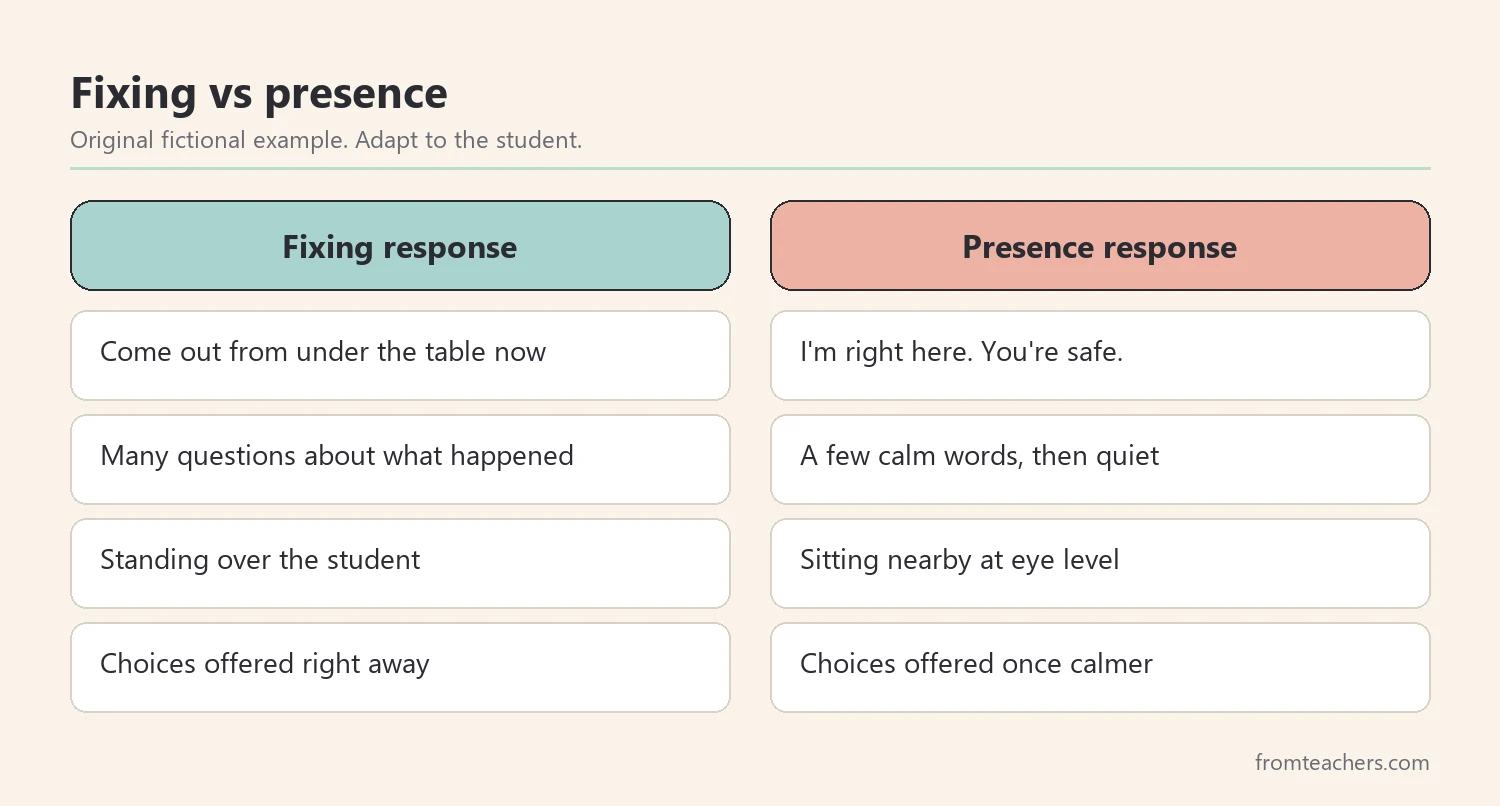
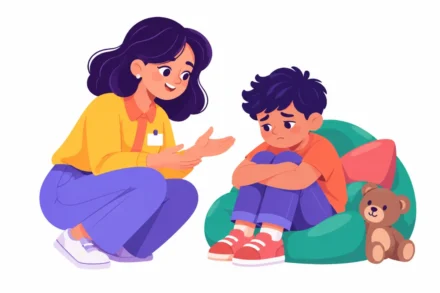
Therefore, shift the goal of co-regulation for teachers from “solve this now” to “be here with this student.” A helpful inner phrase is “I can’t fix this, but I can be here.” Sit or crouch nearby, use few words, and let silence do some of the work. Your steady presence is the message.
It also helps to notice the urge to control. When you feel a strong need to make a student comply immediately, that urge is often a sign of your own rising stress. In that moment, return to step 2 before saying anything else.
For a deeper look at this idea, the How to Co-Regulate When You’re Overwhelmed Too visual guide explores the power of presence and the urge to control in short illustrated slides.
Worked example. Theo, one of Ms. Okafor’s students, is under a table after losing a game. Instead of asking him to come out, she sits on the floor a short distance away and says, “I’m right here. You’re safe.” She waits. After a few minutes, Theo moves closer, and only then does she offer a choice: water or a drawing pad.
4. Co-regulation for teachers: let your voice and body carry the message
In practice, co-regulation for teachers happens mostly beyond words. Students read tone, volume, facial expression, posture, and distance long before they process sentences. That is why the same words can calm one student and escalate another.
Consider four simple adjustments. First, lower your volume and slow your pace. Second, get below or level with the student’s eyes instead of standing over them. Third, keep your hands relaxed and visible. Fourth, use short phrases with pauses between them.
| Signal | Raises tension | Supports calm |
|---|---|---|
| Voice | Loud and fast | Low and slow |
| Position | Standing over | At eye level, to the side |
| Words | Many questions | A few short phrases |
| Face | Tight, frowning | Soft, neutral |
Meanwhile, remember that you will not get this right every time. If you notice your voice rising, you can simply pause, breathe, and start the sentence again more slowly. Students benefit from seeing an adult repair a moment, too.
Worked example. When two students argue about a pencil, Ms. Okafor walks over slowly, crouches between their desks, and says, “Two friends. One pencil. Let’s think.” Her short phrases and calm face lower the volume at the table before any solution is discussed.
5. Recover and refill after hard moments
Finally, co-regulation for teachers includes what happens after the moment passes. A difficult interaction can stay in the body for the rest of the day. If you move straight into the next task, the stress often spills into the next hard moment.
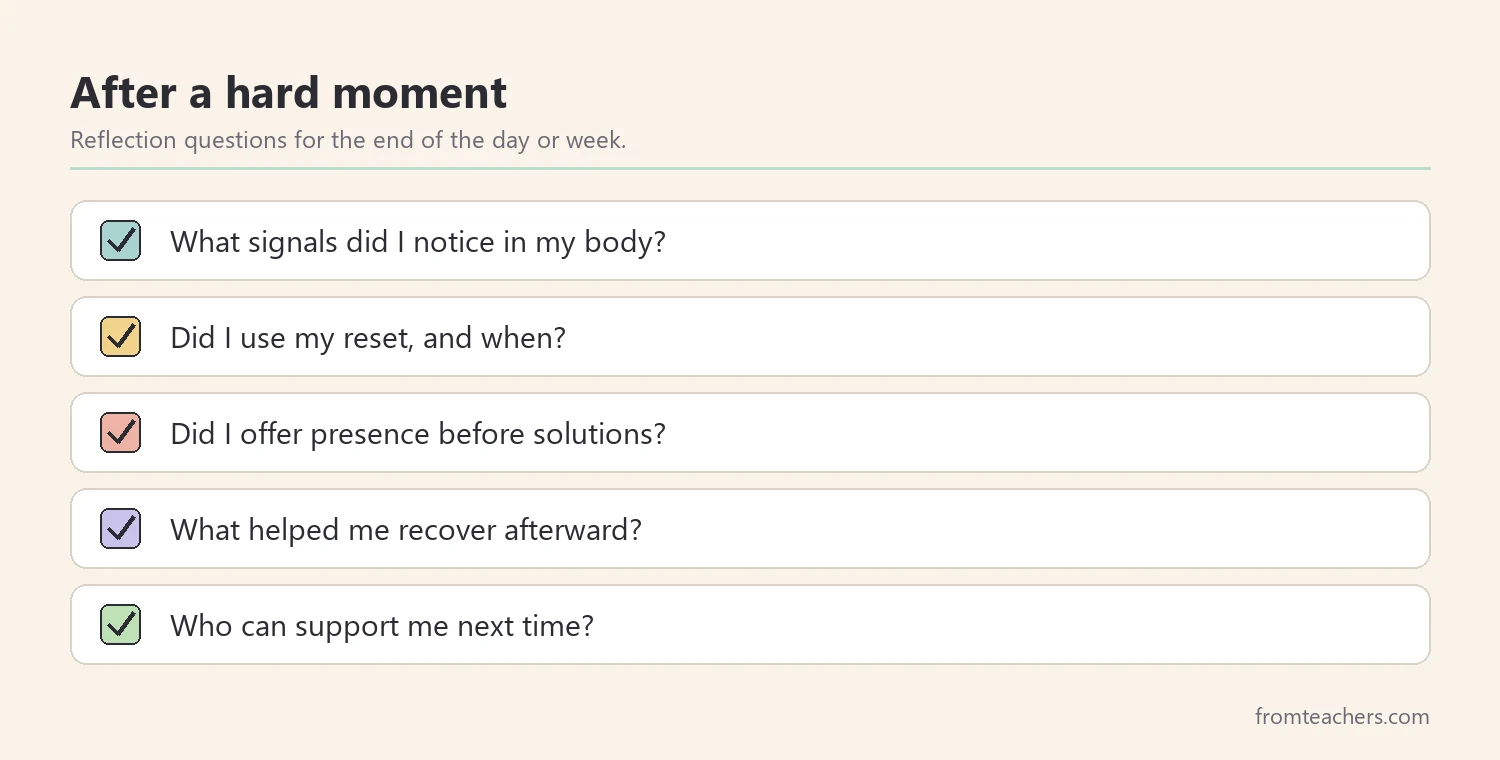
Plan a short recovery step for yourself. It might be a two-minute walk during a prep period, a glass of water, a quick note to a trusted colleague, or a few slow breaths before the next lesson. Equally important, name the feeling honestly: “That was hard, and I felt overwhelmed.” Feeling depleted is normal in this work.
In addition, review your week once, because co-regulation for teachers improves with reflection. Look at your tally of stress signals and your resets. Which moments went better? Which ones need a different plan or more adult support?
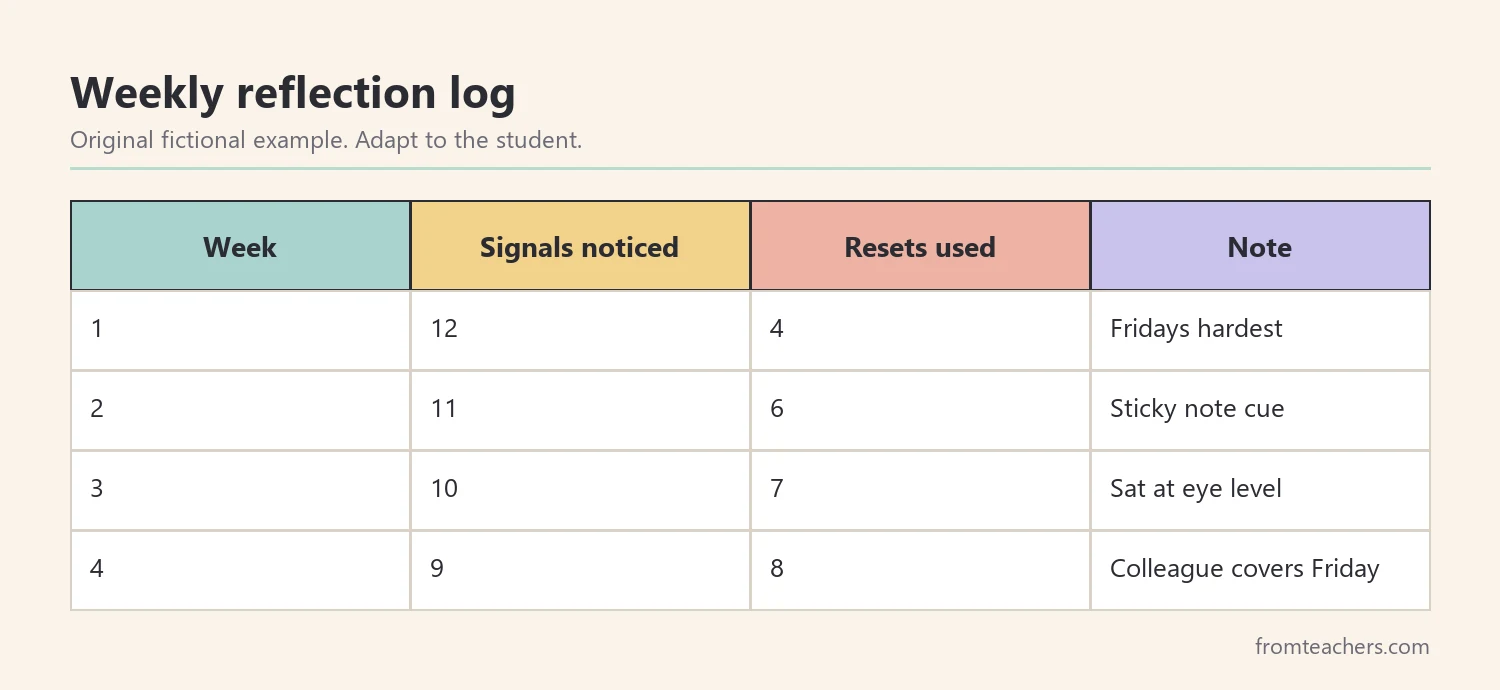
Worked example. Over four weeks, Ms. Okafor tracks how many stress signals she notices and how many times she uses her reset. In week 1 she notices 12 signals and resets 4 times. By week 4 she notices 9 signals and resets 8 times. The signals have not disappeared, but she now responds to most of them. She also asks a colleague to cover the start of centers on Fridays.
Building co-regulation for teachers into the school week
Individual effort helps, but co-regulation for teachers works best when the school day is designed to support it. A tired adult in an unplanned moment has fewer options than a supported adult with a plan. For this reason, small team agreements can make a large difference.
| Team agreement | What it looks like |
|---|---|
| Tap-in, tap-out | A nearby adult covers for two minutes on request |
| Shared cue word | Staff use the same calm phrase with students |
| Hard-moment check-in | A colleague asks “How are you?” after a tough incident |
| PD reflection time | Staff discuss co-regulation for teachers in short sessions |
For example, Ms. Okafor’s grade-level team agrees on a simple tap-in signal. When one teacher feels close to the edge, she sends a short message, and a neighbor steps in for two minutes. Nobody needs to explain or apologize. As a result, teachers reset before stress spills over onto students.
In the same way, leaders can treat co-regulation for teachers as a staff skill rather than a personal trait. Short, regular PD conversations, shared language, and honest check-ins help adults feel less alone with hard days.
Common mistakes and how to avoid them
- Waiting until you feel calm to start. Fix: use your reset while you still feel stressed. It works as a starting point, not a reward.
- Talking too much during a meltdown. Fix: use a few short phrases and allow silence.
- Treating co-regulation as a technique to make students comply. Fix: aim for safety and connection first, then problem solving later.
- Skipping your own recovery. Fix: plan two minutes after hard moments, just as you would plan a lesson.
- Going it alone. Fix: agree with colleagues on who can step in when you need a short break.
Questions teachers and parents ask about co-regulation for teachers
What is the difference between co-regulation and self-regulation?
Self-regulation is a person calming and organizing themselves. Co-regulation is when a calm adult helps a child settle through presence, tone, and support. Children usually need many experiences of co-regulation before self-regulation becomes easier.
Can I co-regulate when I am stressed myself?
Yes, though it takes a deliberate step. Notice your signals, use a short body reset, and lower your expectations for the moment. You do not need to feel perfectly calm to offer a steadier presence than the student has right now.
How long does co-regulation take?
It varies, and co-regulation for teachers is not a timed task. Some students settle within a few minutes, while others need longer and a quieter space. Patience and consistency matter more than speed.
Is co-regulation only for special education classrooms?
No. Co-regulation for teachers applies to any classroom, any grade, and any school role, including counselors and support staff. Every student benefits from calm adults.
What if a student is unsafe?
Follow your school’s safety plan and the student’s agreed supports first. Co-regulation still matters during and after a safety response, but it does not replace established procedures.
Related reading: Meltdowns vs Tantrums: A Guide to Understanding and Responding, Essential Trauma-Informed Teaching Strategies for Modern Classrooms, and Moving Beyond Shame and Behavior Charts: Positive Alternatives for Effective Classroom Management.
A companion resource for co-regulation for teachers:
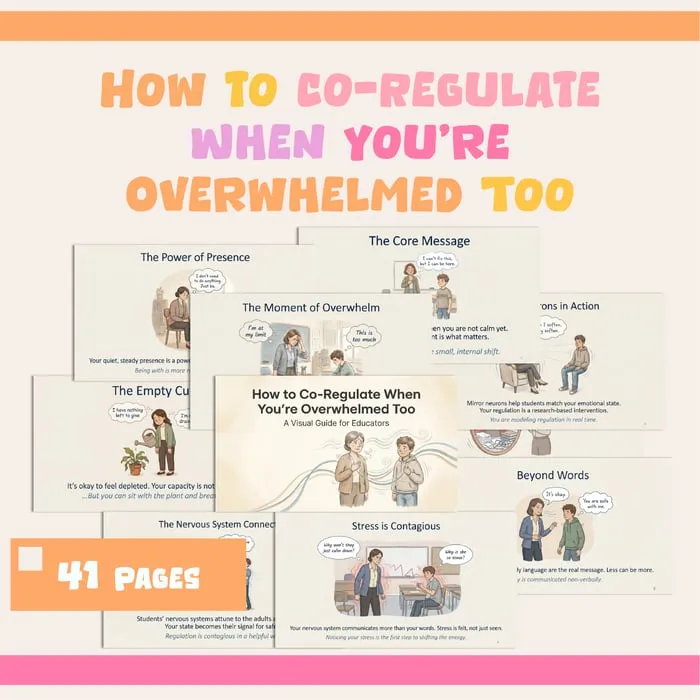
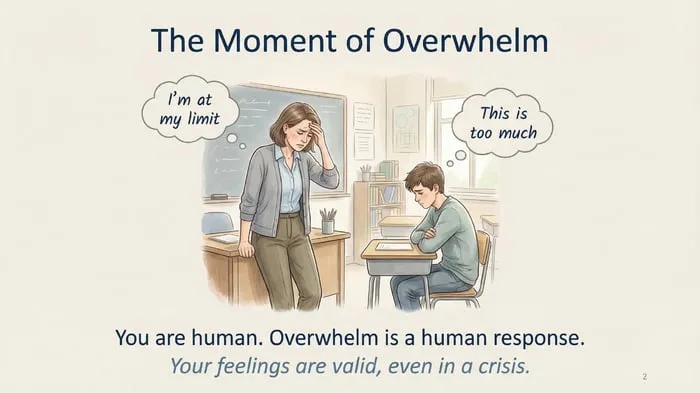
How to Co-Regulate When You’re Overwhelmed Too: A Visual Guide for Educators: 41 illustrated slides on the nervous system connection, the empty cup, the power of presence, the urge to control, and body language and tone, in a low-text format for staff PD or self-paced reflection.
Sources and scope
- CASEL: frameworks and resources on social and emotional learning, including adult social and emotional competence.
- Center on the Developing Child at Harvard University: plain-language explanations of stress, relationships, and child development.
- National Association for the Education of Young Children (NAEYC): guidance on supportive relationships and responsive teaching.
- Yale Center for Emotional Intelligence: research and programs on emotions in schools for students and educators.
This guide covers everyday strategies teachers can use to stay steadier during hard classroom moments. It does not cover crisis intervention, mental health treatment, or professional support for burnout, which should come from qualified professionals and school procedures.
Key takeaways
- Your calm is a classroom tool, and noticing your own signals comes first.
- One short, practiced body reset is more useful than a long list of ideas.
- Presence often helps more than fixing while emotions are high.
- Voice, posture, and distance carry most of the co-regulating message.
- Recovery and team support keep co-regulation for teachers sustainable.







Leave a Comment