

Evaluating classroom accommodations is how you find out whether a support written in a plan is actually helping a student during real lessons. Picture a student whose plan lists extended time, noise-reducing headphones, and a slant board. The headphones stay in the desk, the extra time is rarely used, and nobody is sure whether the slant board makes any difference.
This guide works like a short course. By the end, you will be able to list each accommodation with a clear purpose, decide what to watch for, observe and record in a structured way, rate effectiveness honestly, and review patterns with the team so supports can be adjusted. Examples are fictional. Adapt to the student’s goals and agreed supports. This is guidance, not a diagnosis.
At a glance
- Evaluating classroom accommodations starts with knowing what each support is supposed to do.
- Decide in advance what you will look for, so observations stay focused.
- Record whether the accommodation was used, how well it worked, and what happened to engagement and work.
- Look at several observations before deciding, not one good or bad day.
- Share findings with the team and the family, and adjust through the proper process.
1. Start evaluating classroom accommodations with a clear purpose
First, list every accommodation in the student’s IEP or 504 plan. Next to each one, write in plain words what it is meant to help with. Without a purpose, you cannot judge whether a support is working.
For example, “extended time” might be there because the student writes slowly and runs out of time on tests. “Headphones” might be there because noise makes it hard to focus during independent work. Each purpose points to something you can observe.
Meet our fictional student, Ava, grade 5. Ava’s plan lists three accommodations. Her teacher writes a short table so every adult knows why each support exists and what success would look like.
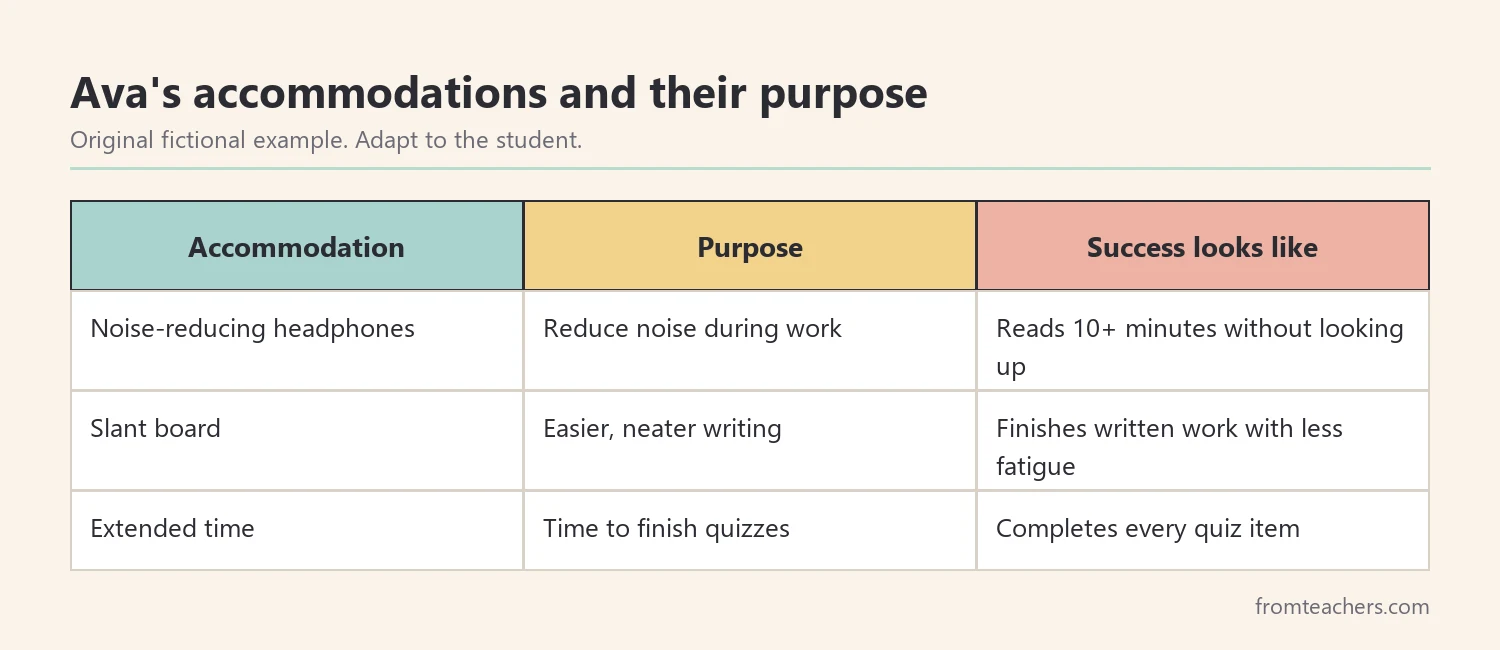
Also, check that every adult knows the plan. Specialists, aides, and substitutes may not have read the full document. A one-page summary like Ava’s table makes the plan usable in daily lessons.
Finally, remember the difference between accommodations and modifications. Accommodations change how a student learns or shows learning, while modifications change what the student is expected to learn. Evaluating classroom accommodations means checking access, not lowering the goal.
In addition, note when each accommodation should apply. Some supports are meant for every lesson, while others apply only to tests, writing tasks, or noisy activities. Writing this down early prevents confusion later, because evaluating classroom accommodations only makes sense during the moments they were designed for.
2. Decide what to observe
Next, choose what you will watch for during each observation. If you try to notice everything, you will remember little. Therefore, pick a few focused questions linked to each accommodation’s purpose.
Good observation questions are concrete. Was the accommodation available? Did the student use it? What happened to focus, engagement, and behavior? Did the student finish the task or show what they know?
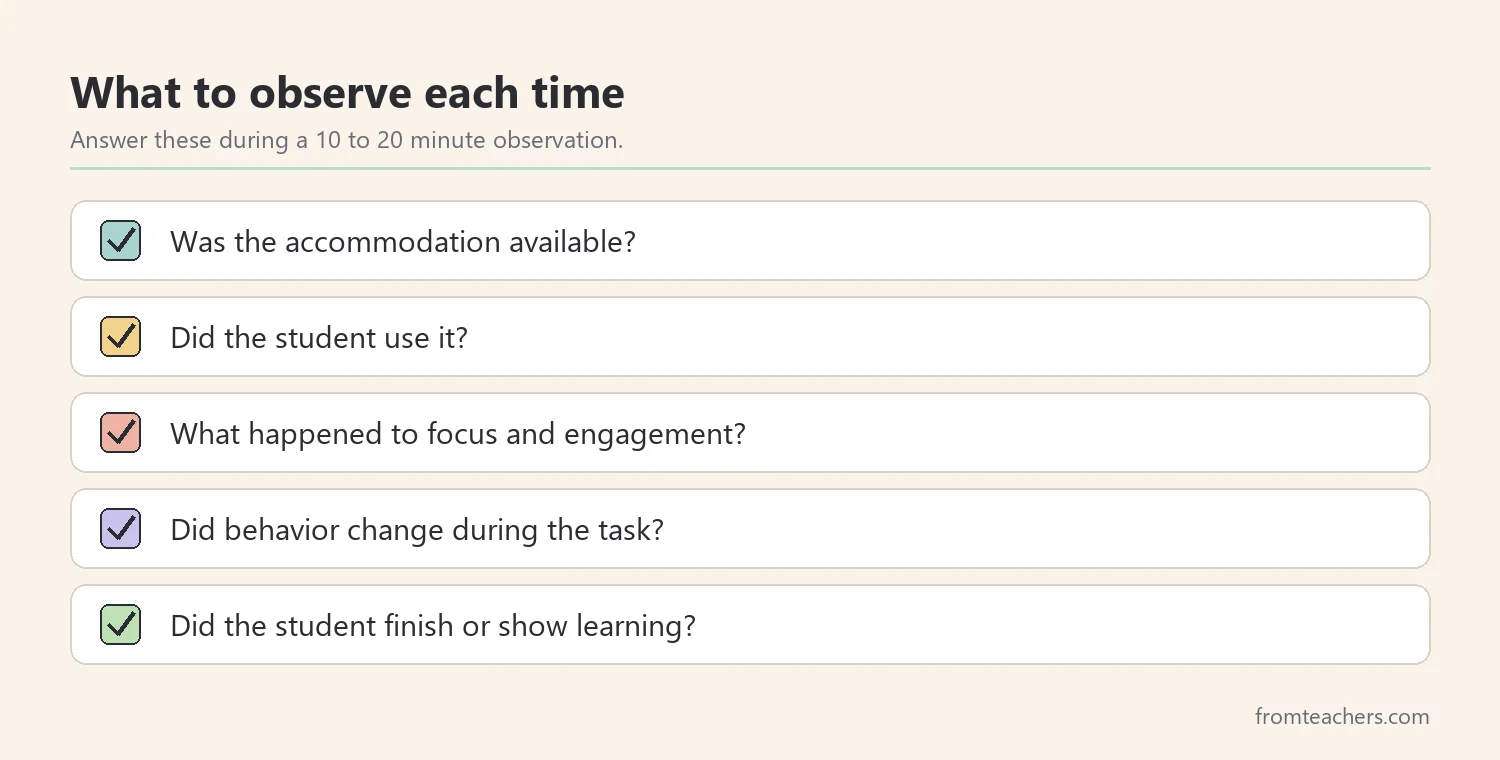
In addition, choose the right moments. Observe during the activities where the accommodation matters. For Ava, headphones matter during independent reading and math practice, so that is when her teacher watches. Extended time matters on quizzes, so quiz days are on the schedule too.
Moreover, plan how long each observation will last. Ten to twenty minutes during the relevant activity is often enough. Short, regular observations are more practical than rare, long ones, and they make evaluating classroom accommodations part of normal teaching rather than an extra project.
Also, consider a quick baseline. If possible, note how the student does on a similar task without the support, or before it was introduced. For Ava, her teacher recalled that before headphones, Ava usually looked up from her reading every minute or two when the room was busy. That simple comparison gives later observations a clear reference point.
3. Observe and record on a structured form
Now, observe and write down what you see. A structured form helps, because it asks the same questions each time. That consistency makes it much easier to compare observations later.
A useful form includes the student’s name, class, teacher, and date; which accommodations were in place; an effectiveness rating for each; notes on behavior, engagement, and focus; whether there was an academic impact; challenges observed; and ideas for additional accommodations or changes. A short section for overall comments ties it together.
If you want a ready-made version of this structure, the classroom accommodation feedback form for teachers is a fillable PDF with sections for effectiveness ratings, behavior and engagement, academic impact, challenges, and next steps.
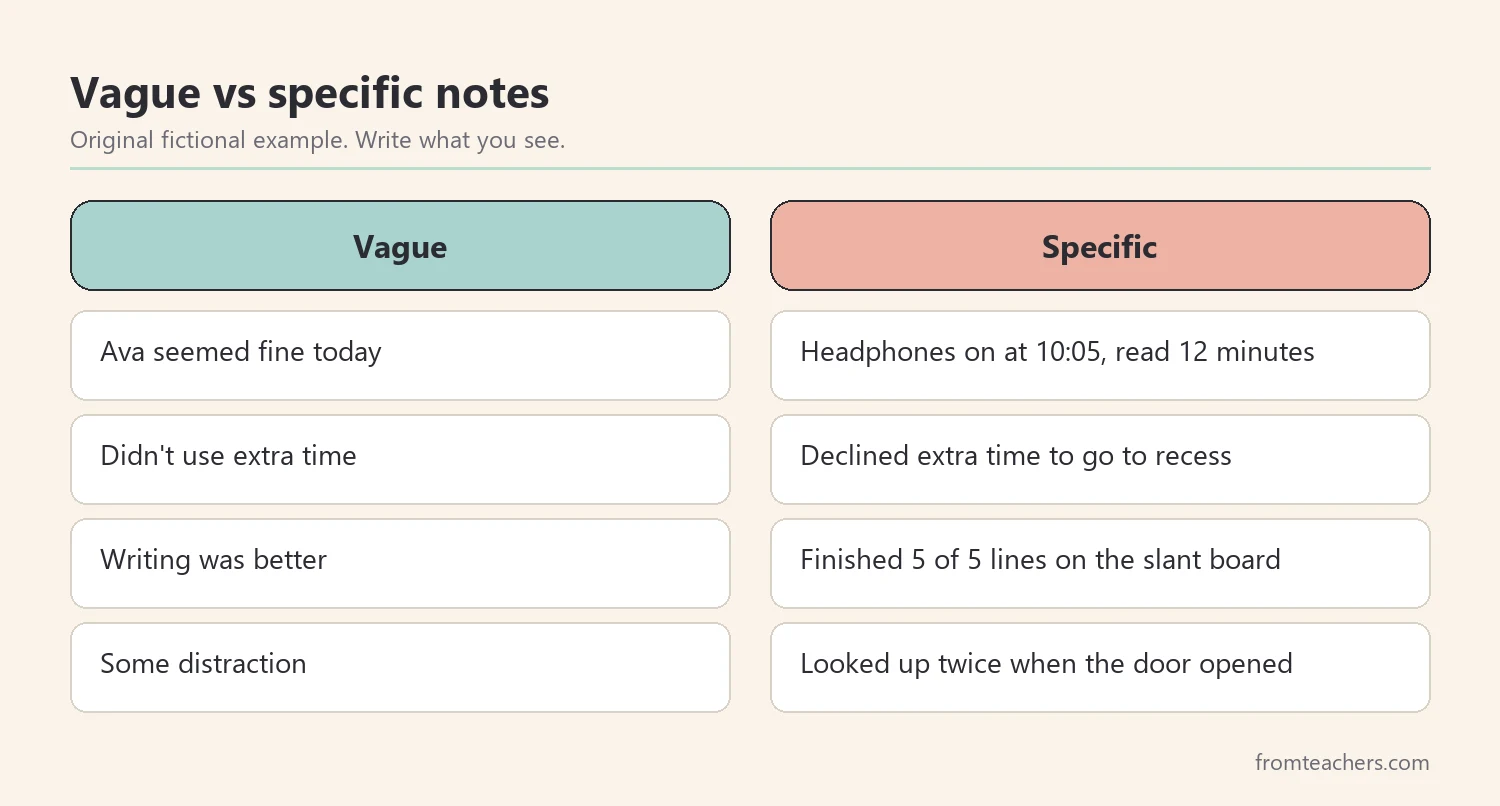
Also, write what you see, not what you assume. “Ava put on headphones at 10:05 and read for 12 minutes without looking up” is far more useful than “Ava seemed fine today.” Specific notes protect the student and help the team make fair decisions.
Furthermore, record when an accommodation was not used, and why if you know. Was it unavailable, forgotten, or declined by the student? Each reason leads to a different fix. Honest records are the backbone of evaluating classroom accommodations.
Finally, complete the form soon after the observation, ideally the same day. Details fade quickly, and a form filled out days later tends to be vague. Many teachers keep a few blank copies on a clipboard so evaluating classroom accommodations fits into the normal flow of the day.
4. Rate effectiveness when evaluating classroom accommodations
After each observation, give each accommodation a simple rating. A scale from “very effective” to “not effective,” plus “not used or not implemented,” keeps ratings quick and comparable. The last option matters, because a support that was never used cannot be judged as ineffective.
Then, answer one question about academic impact: did the accommodation help the student complete work or show learning? A yes or no, with a sentence of explanation, is enough.
For Ava, her teacher recorded four observations over two weeks. Headphones were used in all 4 sessions and rated effective or very effective each time. The slant board was used in 3 of the 4 sessions and rated somewhat effective. Extended time was used in only 1 of 4 sessions, because Ava did not want to stay behind while classmates went to recess.
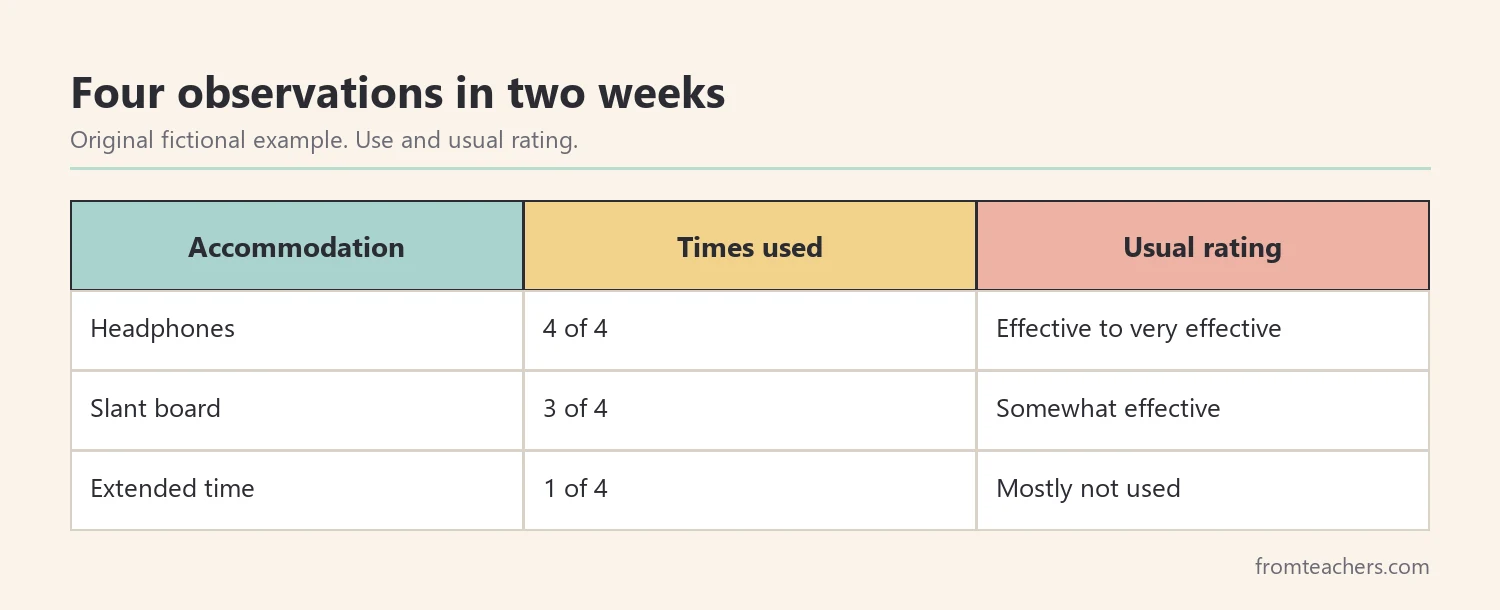
Notice what this summary tells the team. The headphones clearly help. The slant board may help a little, so it is worth more observation. Extended time is not the problem; the way it is delivered is. That insight only appears when you look at use and effectiveness together.
In addition, avoid rating too early. One great day or one bad day can mislead. Evaluating classroom accommodations over several observations gives a fairer picture.
Moreover, keep the scale consistent across adults. If one aide uses “very effective” for any calm session and another uses it only for outstanding work, the ratings cannot be compared. A short conversation about what each rating means keeps evaluating classroom accommodations fair and reliable.
5. Review patterns and adjust with the team
Next, bring your records for evaluating classroom accommodations to the team. Look for patterns across observations rather than single moments. Ask what is working, what is not being used, and what might need to change.
A simple review cycle keeps this manageable: plan the observation, observe, rate, and adjust. Then repeat. Each round makes the student’s supports a little more accurate.
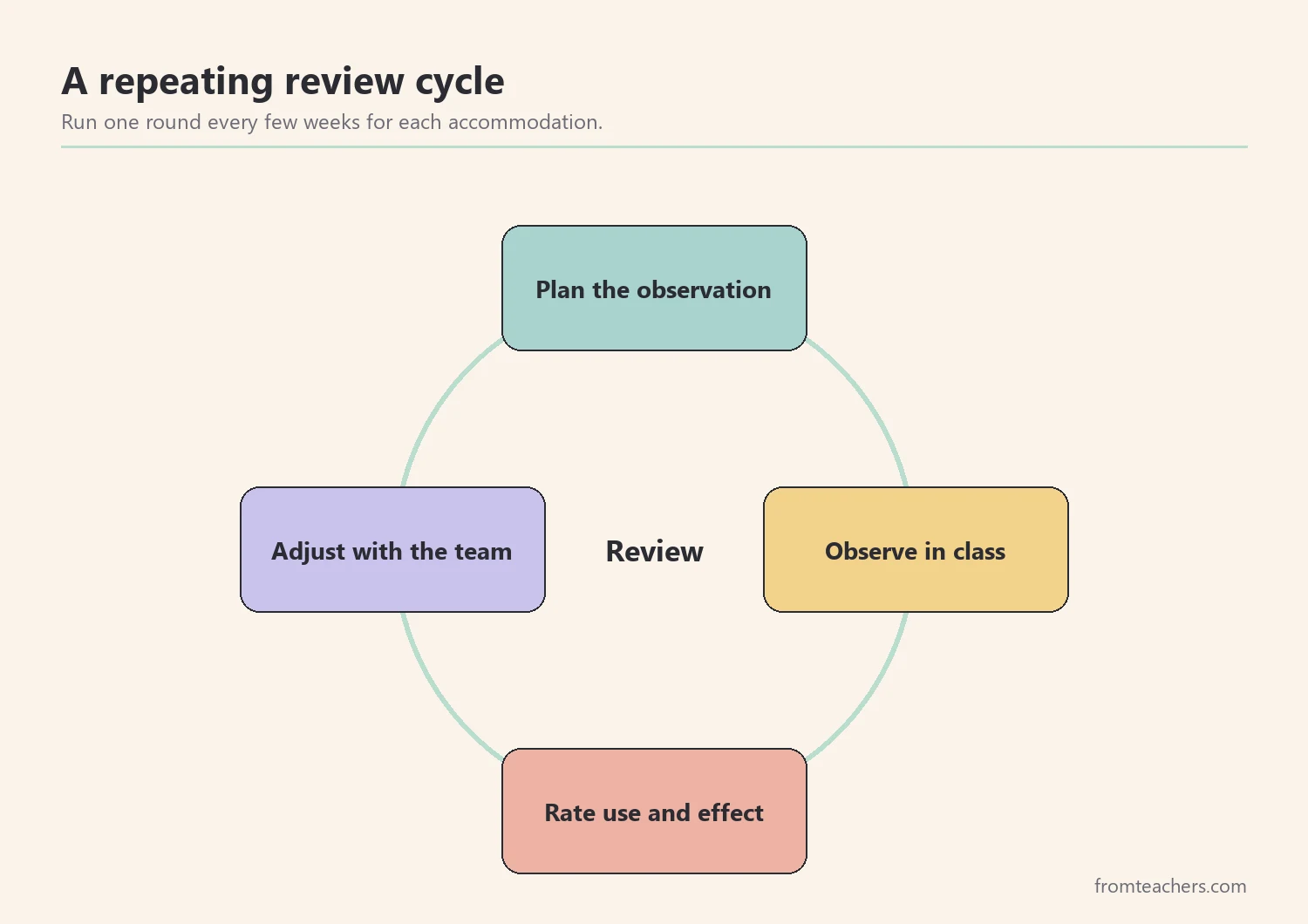
For Ava, the team discussed extended time. Instead of keeping her in during recess, they agreed to try finishing quizzes the next morning in a quiet corner during independent reading. They also agreed to keep observing the slant board for two more weeks before deciding.
Also, include the student. Ask what helps and what feels awkward. Students often explain the real barrier quickly, as Ava did about recess. Their voice makes supports more likely to be used.
Finally, follow your school’s process for formal changes. Teachers can gather evidence and suggest adjustments, but changes to an IEP or 504 plan are made by the team through the proper process. Good records make those conversations clearer and faster, which is one of the main benefits of evaluating classroom accommodations regularly.
6. Share findings with families and staff
Then, share what you learned. Families want to know whether supports are helping, and other staff need to know what is changing.
Keep updates short and specific. For example: “Ava’s headphones are helping her read independently for longer. We are trying a new way to give her extra quiz time and will check again in two weeks.” That message explains the finding, the change, and the next check.
In addition, ask families what they see at home. Do similar supports help with homework? Does the student talk about any supports at school? Their answers add another useful view to evaluating classroom accommodations.
Meanwhile, keep records organized. A folder per student with dated forms makes it easy to prepare for meetings, track changes over the year, and hand information to next year’s teacher.
Finally, plan the next review date before the meeting ends. A clear date keeps evaluating classroom accommodations ongoing rather than a single event, and it shows the family that the team will keep checking whether supports are helping.
Also, when a student moves to a new teacher or a new school year, pass along a short summary: which supports helped most, which were rarely used and why, and what is still being tested. That handoff saves the next teacher weeks of guesswork and keeps the student from starting over. For Ava, a half-page summary with her four-observation table would give next year’s teacher a clear starting point on day one.
Common mistakes and how to avoid them
- Mistake: Listing accommodations without a purpose. Fix: write what each support is meant to help with and what success looks like.
- Mistake: Judging a support that was never used. Fix: record use separately from effectiveness, and find out why it was not used.
- Mistake: Vague notes like “did fine.” Fix: write specific, observable details with times and actions.
- Mistake: Deciding after one observation. Fix: look at several observations over a few weeks.
- Mistake: Leaving the student out. Fix: ask the student what helps and what feels awkward.
- Mistake: Changing the plan informally. Fix: share evidence with the team and follow the school’s process for changes.
Questions teachers and parents ask about evaluating classroom accommodations
How often should teachers evaluate classroom accommodations?
Many teams find short, regular observations work best, for example a few times over several weeks for each support. Before plan meetings, a quick review of recent records is especially helpful.
Who should be involved in evaluating classroom accommodations?
Classroom teachers, special educators, aides, and specialists can all observe. The student and family add important views. Decisions about formal changes belong to the IEP or 504 team.
What if a student refuses an accommodation?
Record it and gently ask why. Often the support feels embarrassing or inconvenient. Changing how it is offered, as with Ava’s quiz time, may solve the problem.
Is it okay to remove an accommodation that is not working?
Share your evidence with the team instead of removing it on your own. The team can decide whether to adjust, replace, or remove a support through the proper process.
Can parents ask for an evaluation of their child’s accommodations?
Yes. Parents can ask the school how supports are being used and whether they are helping. They can also request a team meeting to discuss changes.
Related reading: Accommodations vs Modifications in Special Education: The Difference Explained, Special Education Accommodation and Modification Tracker, and The Power of Data Tracking in Special Education.
A companion resource for evaluating classroom accommodations:
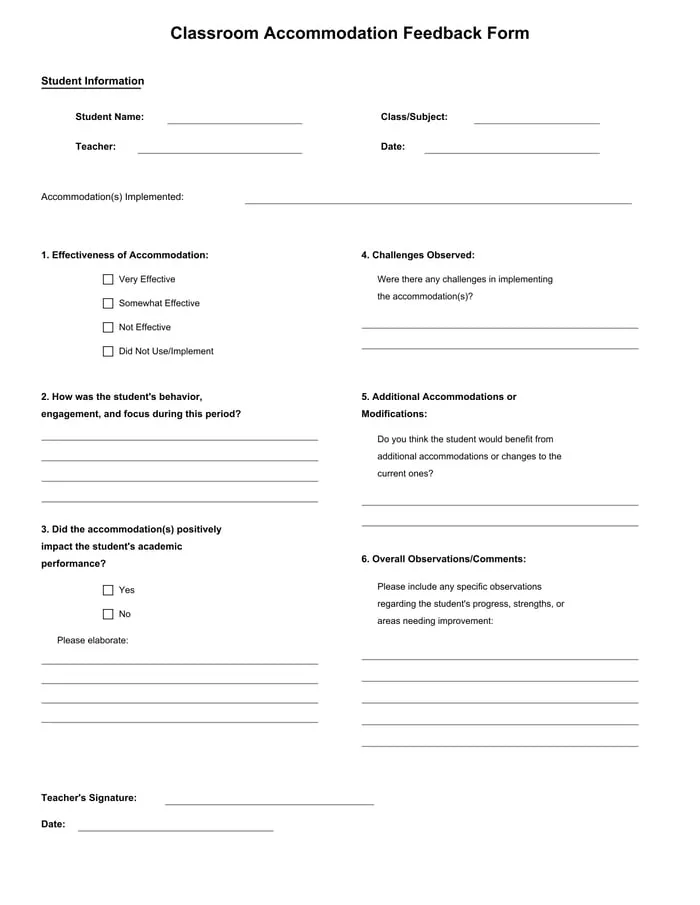
Classroom Accommodation Feedback Form for Teachers: a fillable PDF for recording which accommodations were implemented, effectiveness ratings, behavior and engagement, academic impact, challenges, additional accommodations, and overall comments with a signature line.
Sources and scope
- IDEA, U.S. Department of Education: the law behind special education services, IEPs, and team decisions.
- IRIS Center, Vanderbilt University: free modules on accommodations and supporting students with disabilities.
- Understood.org: practical articles for families and teachers on accommodations and learning differences.
- CAST: information on Universal Design for Learning and flexible access to learning.
This guide covers practical classroom observation and review of accommodations. It does not cover legal advice, formal evaluations for eligibility, or the official process for changing an IEP or 504 plan, which belong to the school team.
Key takeaways
- Evaluating classroom accommodations starts with a clear purpose for each support.
- Plan focused observation questions and observe during the activities that matter.
- Record use and effectiveness separately, with specific notes.
- Look for patterns across several observations before deciding.
- Share findings with the student, family, and team, and adjust through the proper process.










Leave a Comment