

AAC in the classroom often looks like this: a student’s communication device sits in its case on a shelf while the class talks about a story. The adults mean well, but the device only comes out during speech sessions or when the student needs to ask for a snack. Meanwhile, a whole morning of conversation passes without her voice in it.
This guide shows you how to make augmentative and alternative communication part of every lesson. By the end, you will be able to set up easy access, model language on the device yourself, move beyond requests, teach peers to join in, and track progress with the speech-language pathologist and the family.
Examples are fictional. Adapt to the student’s goals and agreed supports. This is guidance, not a diagnosis.
At a glance
- Keep the AAC system within reach all day, not only during therapy.
- Model on the device yourself, the same way you model reading by reading aloud.
- Teach more than requests: commenting, asking, and joking matter too.
- Show classmates how to talk with an AAC user, not for her.
- Agree on a few core words with the SLP and family, then track how they are used.
1. Make AAC in the classroom available all day
A student cannot use a voice she cannot reach. Therefore, the first step is simple but powerful: the communication system goes everywhere the student goes, and it is always on, charged, and open.
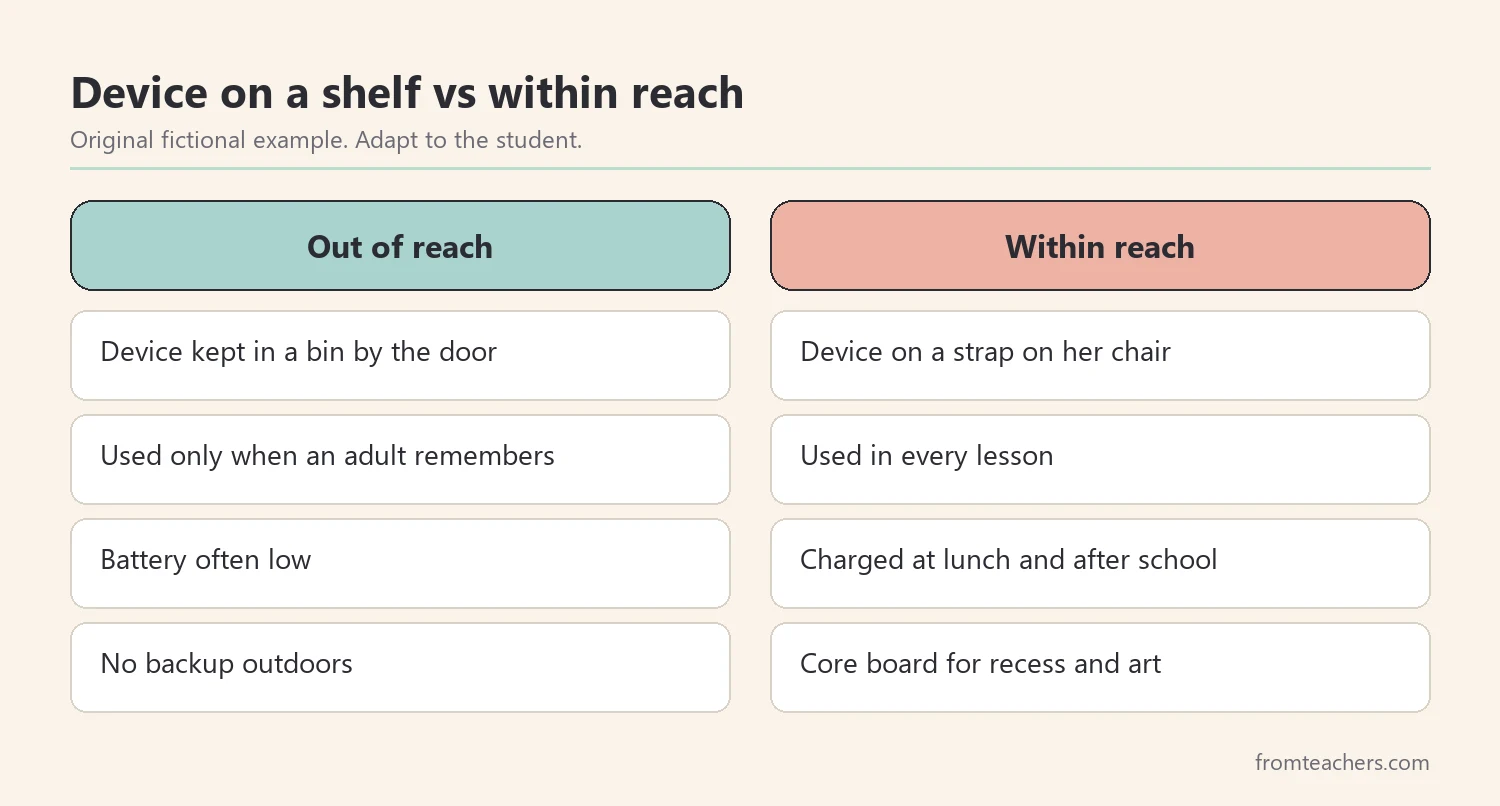
Consider Maya, a fictional second grader who uses a high-tech speech-generating tablet with a core word layout. At the start of the year, her device lived in a bin near the door. As a result, she used it only when an adult remembered to bring it over.
Her team made three small changes. First, they added a strap so the device could hang on her chair. Next, they set a charging routine at lunch and after school. Finally, they put a low-tech core board on each table as a backup for recess, art, and wet activities.
| Setting | Main system | Backup |
|---|---|---|
| Desk and carpet | Tablet on chair strap | Core board on table |
| Art and science | Tablet in a clear cover | Laminated core board |
| Recess | Tablet in a carry bag | Keyring with key words |
| Lunch | Charging at the station | Table core board |
Notice that Maya is never without a way to speak. That is the core idea behind AAC in the classroom: access first, then teaching.
Put this step into practice
Also, check the basics every morning. Is the volume up? Also, is the battery charged? Is the main page open, not a game or a settings screen? A thirty-second check prevents many lost opportunities. Put it on a sticky note by the door so any adult can run it, because reliable access is the quiet foundation of AAC in the classroom.
In addition, think about physical access. Some students point with a finger, others use a stylus, a keyguard, or eye gaze. Work with the SLP and occupational therapist so the setup fits the student’s body and the furniture in your room.
2. Model AAC in the classroom like you model reading
Children learn to talk by hearing thousands of words before they say many of their own. Similarly, AAC users need to see their system used by others before they use it fluently. This is often called aided language modeling.
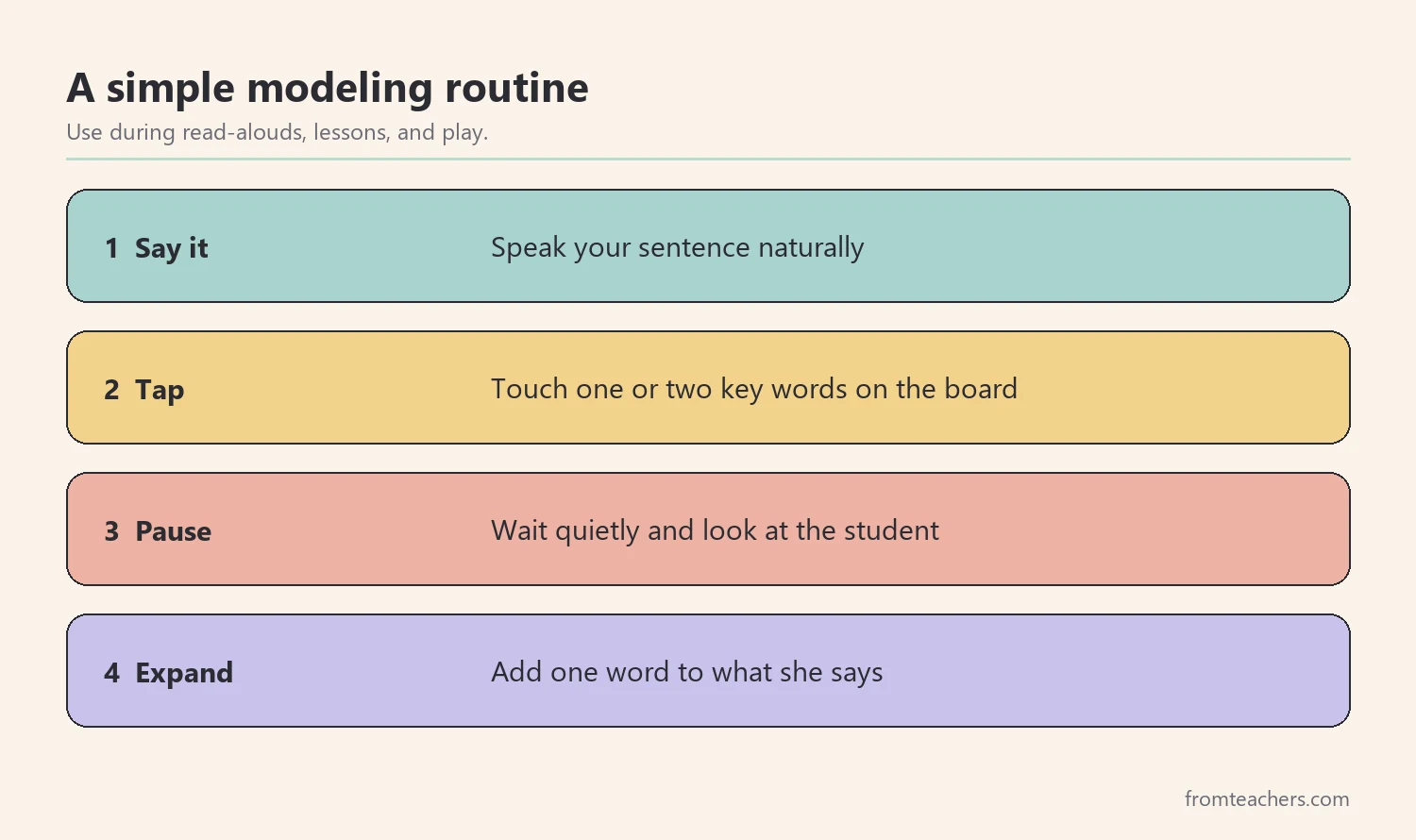
In practice, modeling means that while you speak, you also touch key words on the student’s device or a matching core board. You do not need to tap every word. Instead, tap one or two important words in each sentence. Even a few modeled words per minute add up across a school day, and that steady exposure is what makes AAC in the classroom feel natural rather than special.
For example, during a read-aloud, Maya’s teacher says, “The dog is big. Look, he wants to go out.” She taps “big,” “look,” “want,” and “out” on a core board on her lap. However, she does not ask Maya to copy her. She simply shows how the words work.
A quick classroom example
Here are a few rules that make modeling easier:
- Model without expecting. Do not demand that the student repeat you. Modeling is input, not a test.
- Go one step beyond. If the student uses one word, model two. If she says “go,” you might model “go out.”
- Use real moments. Model during lessons, transitions, play, and lunch, not only in drills.
- Keep your own board. A printed copy of the student’s layout lets you model without taking her device.
Over time, adults who model AAC in the classroom notice something important. The student starts to find words faster, because she has seen where they live many times.
If you want ready-made ideas, the AAC in the Classroom support magazine explains aided language modeling and peer modeling in plain, teacher-friendly language, with ways to fit them into everyday routines.
3. Teach AAC in the classroom beyond requests
Many AAC users learn to ask for food, toys, or a break, and then progress stops. However, real communication includes much more: commenting, asking questions, sharing opinions, protesting, joking, and telling stories.
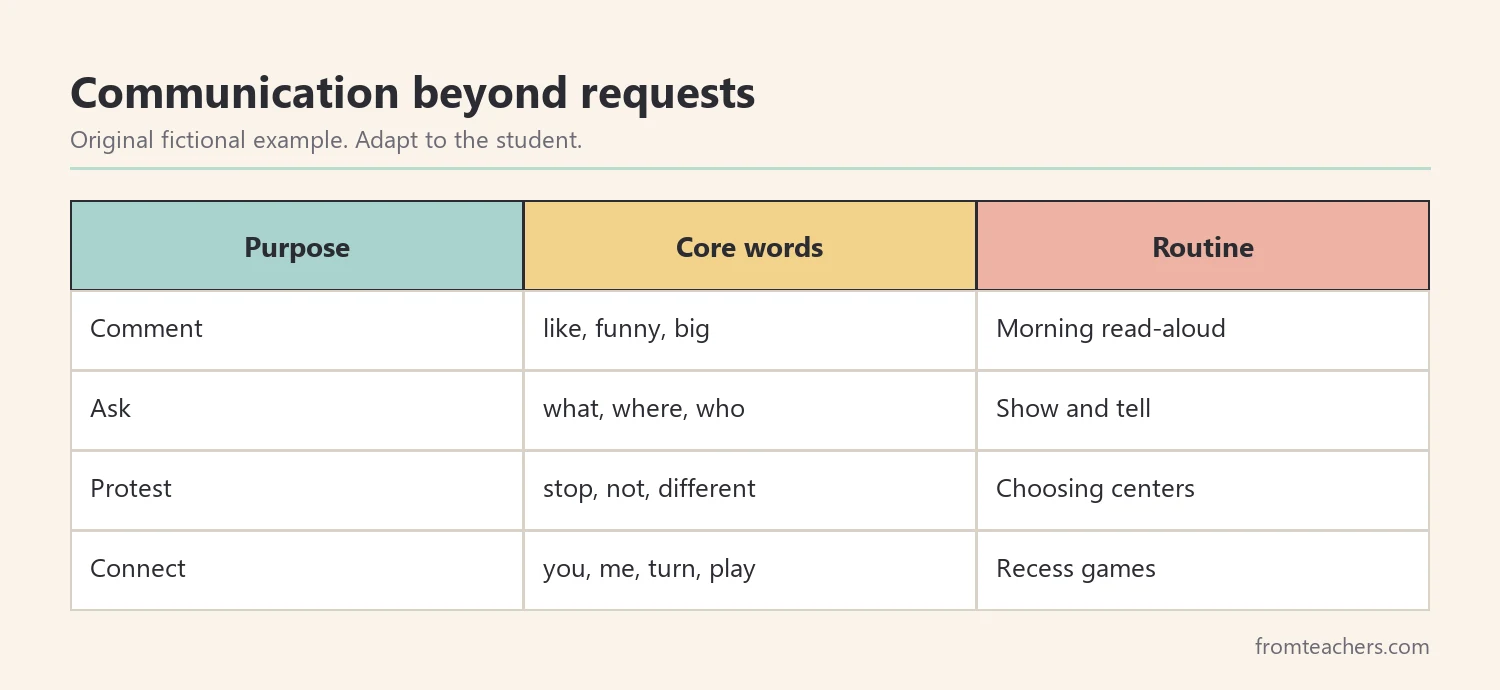
To move beyond requests, plan for different communication purposes during the day. Maya’s team chose four purposes and linked each to a routine she already enjoys.
| Purpose | Core words | Routine |
|---|---|---|
| Comment | like, funny, big | Morning read-aloud |
| Ask | what, where, who | Show and tell |
| Protest | stop, not, different | Choosing centers |
| Connect | you, me, turn, play | Recess games |
Notice that these words are mostly core words. Core words are small, flexible words that work in many situations, such as “go,” “more,” “not,” and “like.” Because they work everywhere, they give the student more power than a page of nouns.
Next, create natural reasons to use each purpose. For instance, the teacher “forgets” a step in a routine so Maya can say “not that.” Or she holds up a strange picture so Maya can comment “funny.” These small setups invite language without pressure. In addition, they make AAC in the classroom part of ordinary fun instead of a separate lesson, which keeps motivation high for the student and her peers.
Make it stick
Also, accept every attempt. If Maya taps “like” during a story, respond as if she spoke: “You like the dog! Me too.” This shows her that her words have real effects on people.
Finally, remember that AAC in the classroom also supports literacy. Many core word strategies work for the whole class, for example, writing a shared sentence with “I like” or “I see.” In this way, the AAC user and her peers learn the same words together.
4. Teach peers to support AAC in the classroom
Classmates are powerful communication partners. Yet many children do not know how to talk with a friend who uses a device. Some wait in silence, some answer for her, and some move on to someone faster.
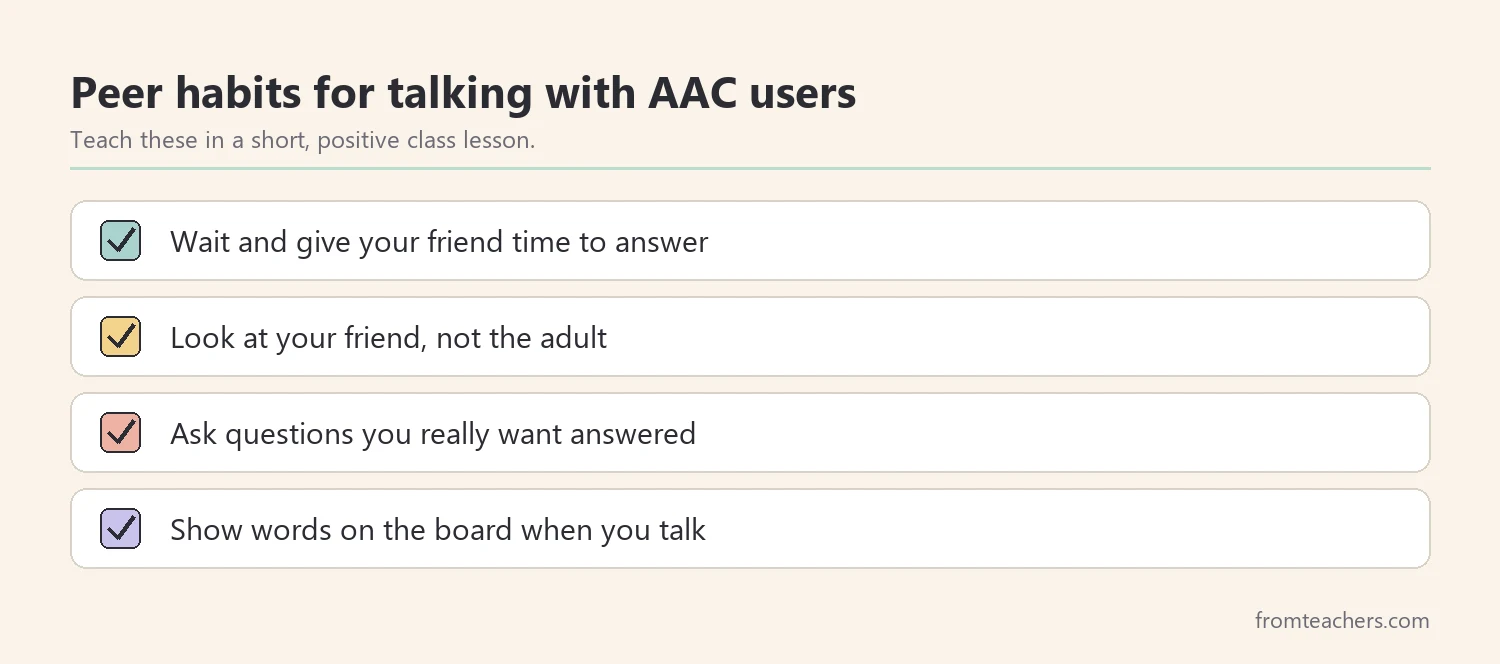
Therefore, teach peers a few clear habits. Keep the lesson short and positive, and frame AAC as one more way people talk, like sign language or writing.
- Wait. Give your friend time to find her words. Count to ten in your head.
- Look. Watch her face and her device, not the adult.
- Ask real questions. Ask things you actually want to know, like “Which game?”
- Use her device too. Show her words on the board when you talk.
For Maya, the teacher picks two peer buddies each week. During centers, the buddies play a short turn-taking game using the words “my turn,” “your turn,” and “go.” Over time, Maya starts to use “your turn” on her own to invite friends to play. Small games like this show how peers can carry AAC in the classroom into recess, lunch, and group projects.
Moreover, peer support reduces adult hovering. When a paraprofessional steps back and lets classmates take the lead, Maya gets more natural conversation and more chances to practice.
What this looks like day to day
Also, invite peers to try the device or a core board. When classmates understand how it works, they are less likely to treat it as a toy and more likely to treat it as their friend’s voice. This shared understanding is one of the quiet strengths of AAC in the classroom.
5. Track and review AAC in the classroom with the team
Progress with AAC can be slow, so it helps to track a few simple measures. As a result, the team can see small gains that might otherwise go unnoticed.
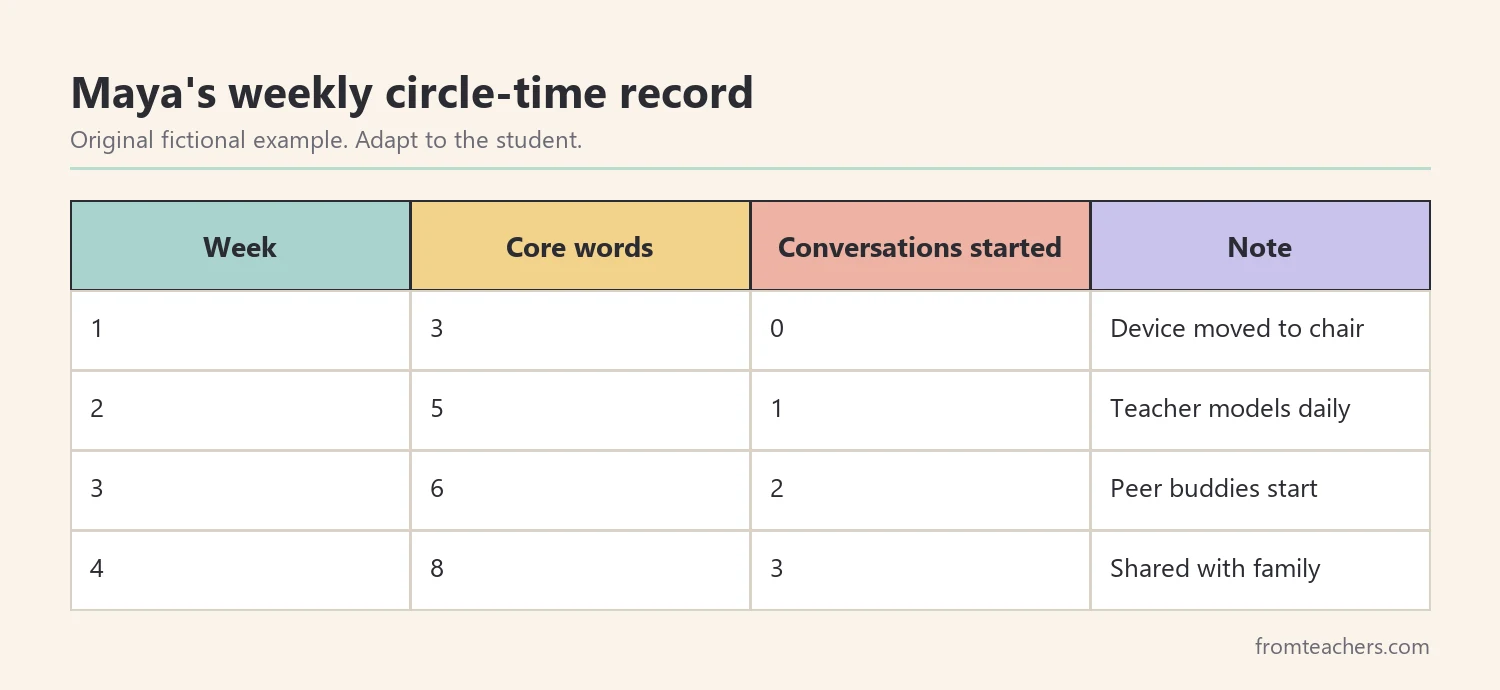
Choose one or two things to count. For example, Maya’s team tracks how many different core words she uses on her own during a 20-minute morning circle, and how many times she starts a conversation without a prompt.
| Week | Different core words | Started a conversation | Note |
|---|---|---|---|
| 1 | 3 | 0 | Device moved to chair |
| 2 | 5 | 1 | Teacher models daily |
| 3 | 6 | 2 | Peer buddies start |
| 4 | 8 | 3 | Shared with family |
Over four weeks, Maya started six conversations on her own (0, 1, 2, and 3), and her word variety grew from 3 to 8. These are fictional numbers, but they show the kind of steady change a team can look for.
Then, review every three to four weeks with the SLP, the classroom assistant, and the family. Make sure everyone uses the same system and the same core words. Bring the weekly record, a short video clip if the family agrees, and one question you want answered. If home uses a different layout or different symbols, agree on one shared approach.
Moreover, ask the student. Maya can rate activities with “like” and “not like” on her device. Her answers help the team choose motivating routines and remind everyone that AAC in the classroom is about her voice, not adult convenience.
Common mistakes and how to avoid them
- Keeping the device out of reach. AAC in the classroom fails quickly without access. Fix: attach it to the chair or desk and plan a backup for every setting.
- Testing instead of modeling. Fix: model key words often and avoid “Show me” or “Say it” drills.
- Only teaching requests. Fix: plan routines for commenting, asking, protesting, and connecting.
- Adults speaking for the student. Fix: wait, look at her, and give real time to respond.
- Different systems at home and school. Fix: agree on one layout and a shared core word list with the SLP and family.
Questions teachers and parents ask about AAC in the classroom
Will using AAC stop my child from learning to speak?
This is a very common worry. Professional groups such as ASHA share information about AAC and spoken language development that can help families think it through. Your child’s SLP is the best person to talk with about your specific concerns and goals.
Do I need special training to model AAC?
No. You can start today by tapping one or two key words while you talk. A printed copy of the student’s layout makes it easy, and the SLP can show you where words are located.
Is low-tech AAC as useful as a tablet?
Both have a place. Low-tech boards are quick, cheap, and work at recess or near water. High-tech devices offer voice output and many more words. Many students use both across the day.
How long until we see progress?
It varies widely from student to student. Some show new words within weeks, while others need many months of steady modeling. Tracking small measures helps the team notice gains along the way.
How can general education teachers support AAC in the classroom?
Keep the device within reach, model a few core words during lessons, and give the student time to answer. Also, include her in group work and class discussions like any other student. Small habits like these make a big difference.
Related reading: Best Assistive Technology for Special Education Classrooms, Boost Access and Independence: An Assistive Technology Toolkit for Special Education, and Autism Social Skills Development: Practical Strategies for Growth.
A companion resource for AAC in the classroom:
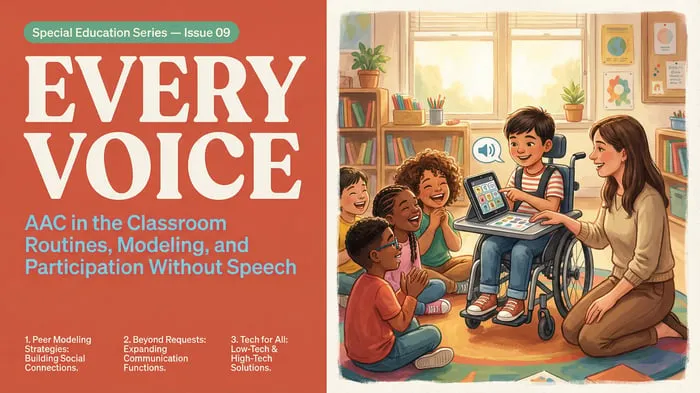
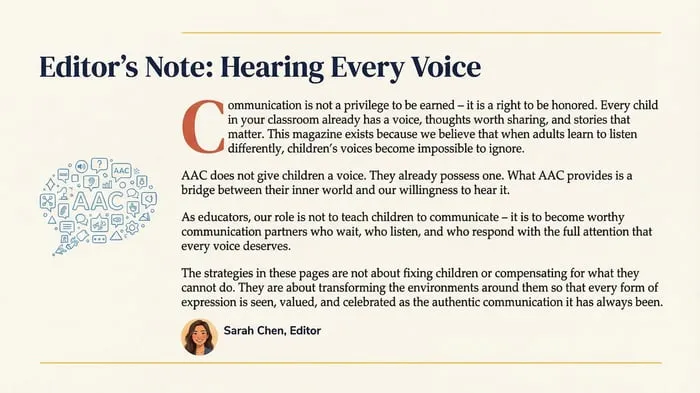
AAC in the Classroom: Every Voice Support Magazine: a magazine-style guide covering peer modeling, aided language modeling, moving beyond requests, low tech and high tech tools, core word literacy, and collaboration with SLPs, families, and assistants.
Sources and scope
- American Speech-Language-Hearing Association (ASHA): professional information on augmentative and alternative communication.
- IRIS Center, Vanderbilt University: free modules on evidence-based practices for students with disabilities.
- International Society for Augmentative and Alternative Communication (ISAAC): an international organization focused on AAC.
- IDEA, U.S. Department of Education: the law behind special education services, including assistive technology.
This guide covers everyday classroom practices for supporting students who use AAC. It does not cover device selection, assessment, or therapy goals, which belong to the SLP and the student’s team.
Key takeaways
- AAC in the classroom starts with all-day access to a charged, open system.
- Model key words on the device without demanding a response.
- Plan routines for commenting, asking, protesting, and connecting.
- Teach peers to wait, look, and talk with the AAC user directly, so AAC in the classroom becomes a shared habit.
- Track a few simple measures and review them with the SLP and family.









Leave a Comment