

IEP meeting phrases matter most in the moment a parent says, “He is not making any progress,” while the data on the table shows something different. The room goes quiet. Whatever you say next can either build trust or start a defensive back-and-forth that lasts the rest of the meeting.
This guide gives you a practical, step-by-step approach to the language you use at the IEP table. By the end, you will be able to open a meeting warmly, share data clearly, respond to strong emotions, handle disagreement without losing the team, and close with a plan everyone understands.
Examples are fictional. Adapt to the student’s goals and agreed supports. This is guidance, not legal advice.
At a glance
- Prepare a few key phrases before the meeting, not during it.
- Open with the student’s strengths and the parent’s knowledge of their child.
- Share data in plain words, with one clear example.
- Validate feelings first, then return to evidence and options.
- Close by summarizing decisions, owners, and dates.
1. Prepare your IEP meeting phrases before the meeting
Under pressure, most people fall back on habits. If your habit is to defend, explain, or rush, that is what will come out when emotions rise. Preparing IEP meeting phrases in advance gives you calmer habits to fall back on.
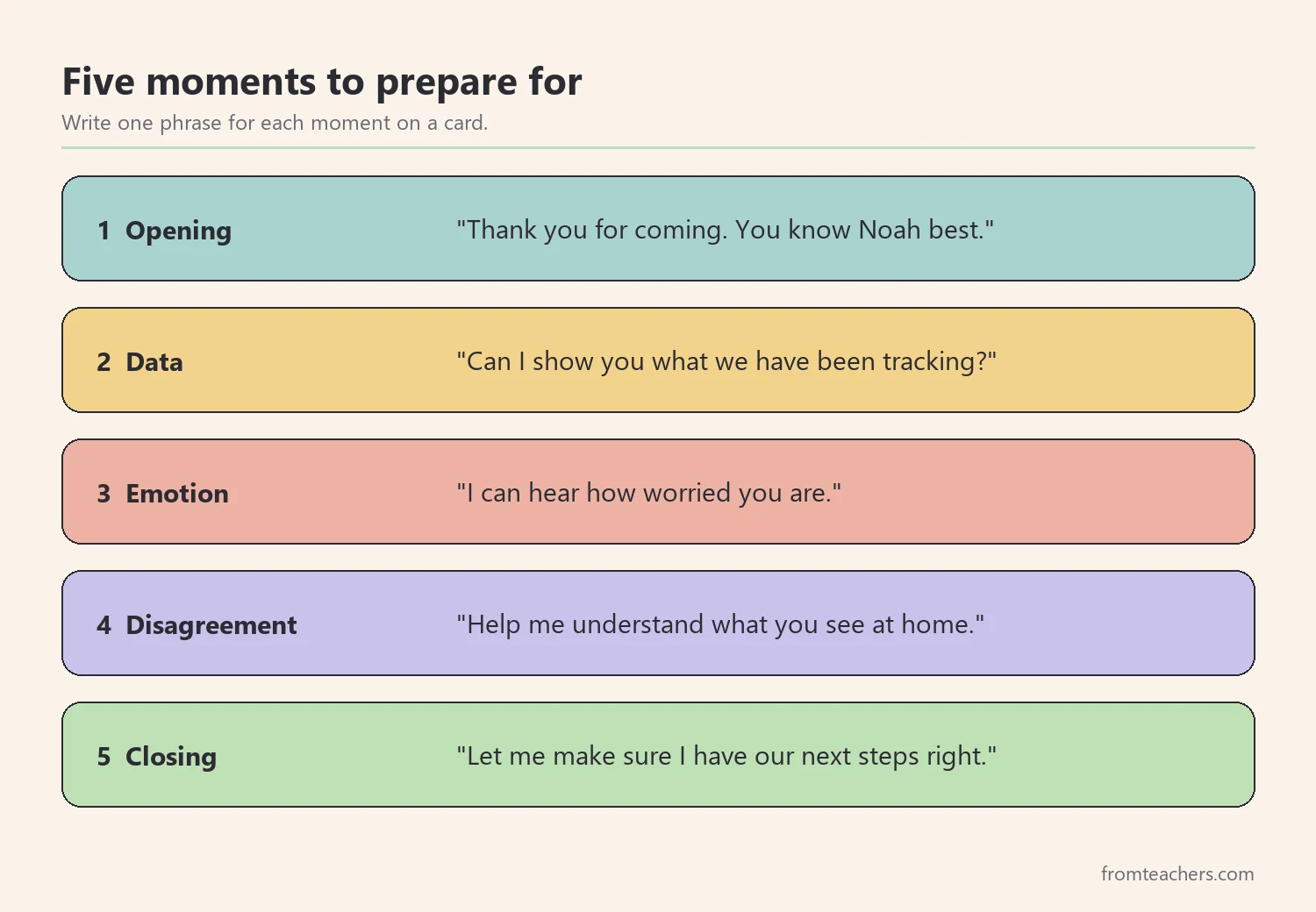
First, review the student’s present levels, goals, and recent data. Note one or two clear strengths and one area of concern. Next, think about what the family may be worried about. A quick phone call or note a few days before the meeting can surface those concerns early. Then, write three to five phrases on a card: one for opening, one for sharing data, one for strong emotions, one for disagreement, and one for closing.
In addition, plan the room. Sit beside the parent if you can, have copies of any data you will discuss, and make sure the parent knows who everyone at the table is. Small choices like these lower tension before anyone speaks.
Here is our fictional example. Ms. Patel is a special education teacher. Noah is in grade 3, and his IEP includes a reading fluency goal. His mother, Mrs. Reyes, has emailed that she feels Noah is “falling further behind.” Ms. Patel prepares this card.
| Moment | Prepared phrase |
|---|---|
| Opening | “Thank you for coming. You know Noah best.” |
| Data | “Can I show you what we have been tracking?” |
| Emotion | “I can hear how worried you are.” |
| Disagreement | “Help me understand what you are seeing at home.” |
| Closing | “Let me make sure I have our next steps right.” |
Practice saying your IEP meeting phrases aloud once or twice. Words that feel natural in your own voice come out more easily when the room is tense, and they sound less like a script.
As a result, Ms. Patel walks in with a plan for the hardest moments, not just the agenda.
2. Open with IEP meeting phrases that build partnership
The first two minutes set the tone. Parents often arrive expecting bad news, especially if past meetings were hard. A warm, specific opening tells them they are a member of the team, not an audience.
Start with thanks and a strength. Make the strength specific, so it sounds real. “Noah is kind” is fine. “Noah helped a new classmate find the library on his own last week” is better. Next, invite the parent’s view early: “Before we look at anything, what would you most like to talk about today?” Write down what they say where they can see it.
Then, explain the agenda in one or two sentences and ask if anything should be added. Finally, remind everyone of the shared goal. A simple line works: “We all want Noah to grow as a reader and feel good about school.”
Useful opening IEP meeting phrases include:
- “Thank you for making time today. Your insight about Noah matters to us.”
- “Here is something we have really enjoyed seeing this term.”
- “What is most on your mind as we start?”
- “If anything is unclear, please stop me. There are no silly questions here.”
Good opening IEP meeting phrases share one quality: they hand the parent a voice early. When families speak in the first five minutes, they are more likely to stay engaged for the rest of the meeting.
In Noah’s meeting, Mrs. Reyes says her main concern is reading at home: Noah avoids it and gets upset. Ms. Patel writes “reading at home” at the top of the agenda. Mrs. Reyes visibly relaxes, because her concern is now on the table in writing.
3. Share data clearly and kindly
Data can calm a meeting or inflame it, depending on how it is shared. Charts full of jargon can feel like a wall. Plain words, one clear picture, and a real example help parents see what the numbers mean.
First, ask permission: “Can I show you what we have been tracking?” Second, explain what the measure is in one sentence. Third, show the trend, not just the latest number. Fourth, connect it to something the parent recognizes, such as a book Noah reads at home. Then, pause and ask what they think.
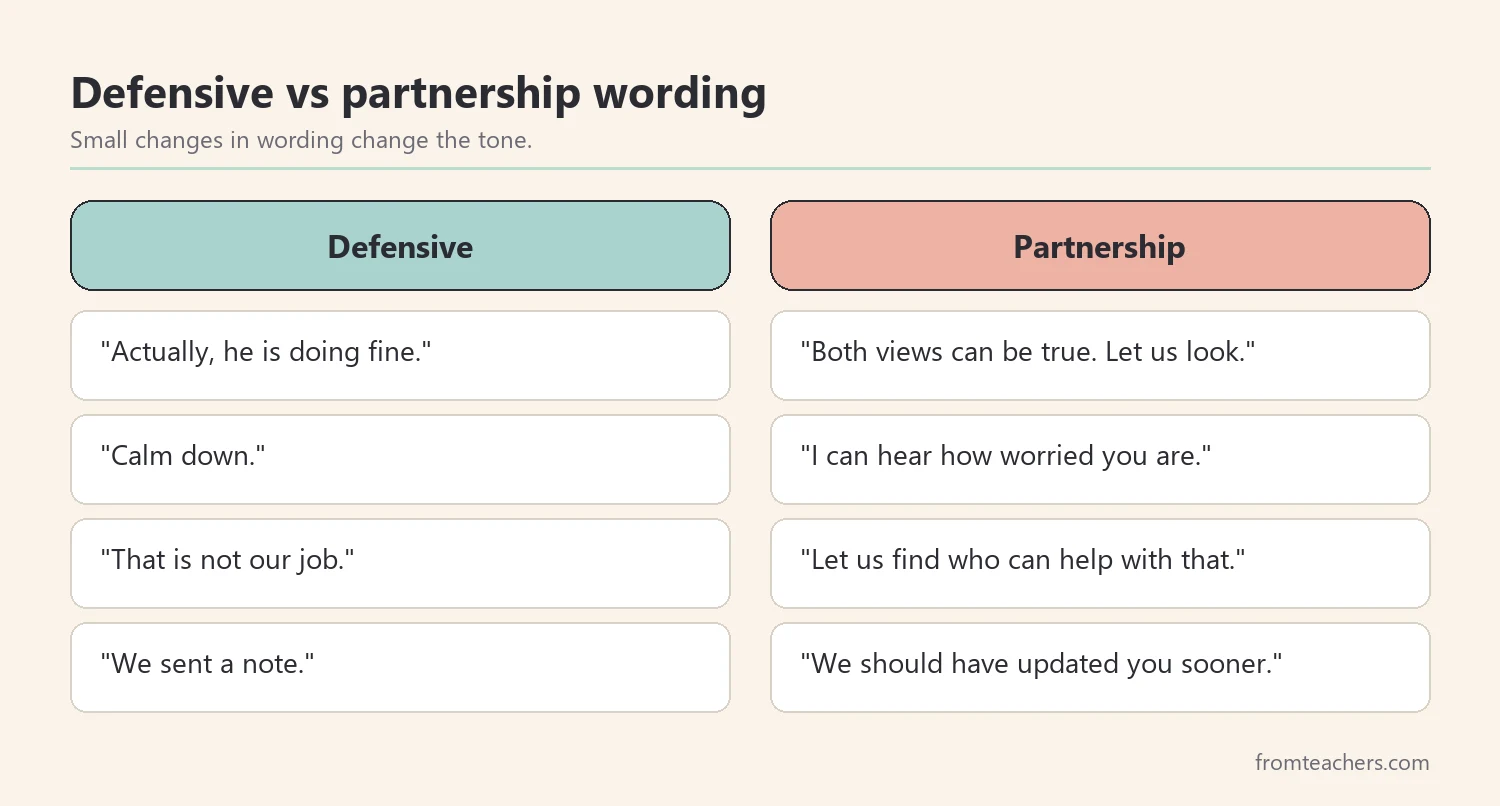
When a parent’s view does not match the data, avoid “Actually, he is doing fine.” Instead, hold both views: “You are seeing real frustration at home, and here at school we are also seeing some growth. Both can be true. Let us look at it together.”
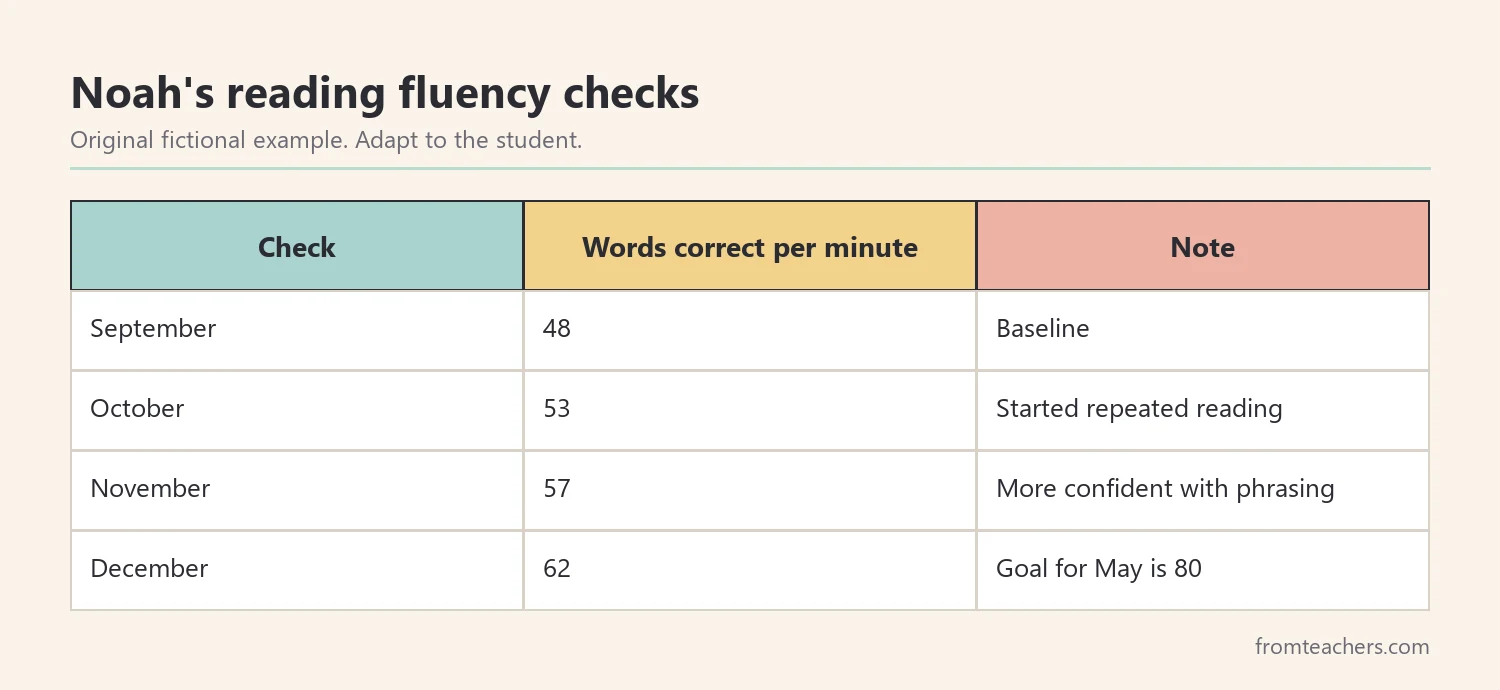
Ms. Patel shows Noah’s words correct per minute on grade-level passages, checked every two weeks.
| Check | Words correct per minute | Note |
|---|---|---|
| September | 48 | Baseline |
| October | 53 | Started repeated reading |
| November | 57 | More confident with phrasing |
| December | 62 | Goal for May is 80 |
Notice that clear IEP meeting phrases about data avoid labels like “low” or “behind” on their own. Instead, they describe where the student started, where they are now, and where the goal sits.
She explains: “Noah has gained 14 words per minute since September. He still has 18 to go to reach his May goal, so we are on track but not finished.” The numbers add up, and the message is honest.
Sometimes the best way to prepare these explanations is to rehearse with ready-made language. A parent-teacher IEP meeting communication guide with Prompt, Tactic, and Goal tables gives you respectful scripts for moments like an inaccurate perception of progress.
4. Use IEP meeting phrases for strong emotions and disagreement
Strong emotions at an IEP meeting are normal. Parents love their children and may carry years of worry into the room. Teachers care deeply too. The goal is not to avoid emotion but to respond in a way that keeps everyone working together.
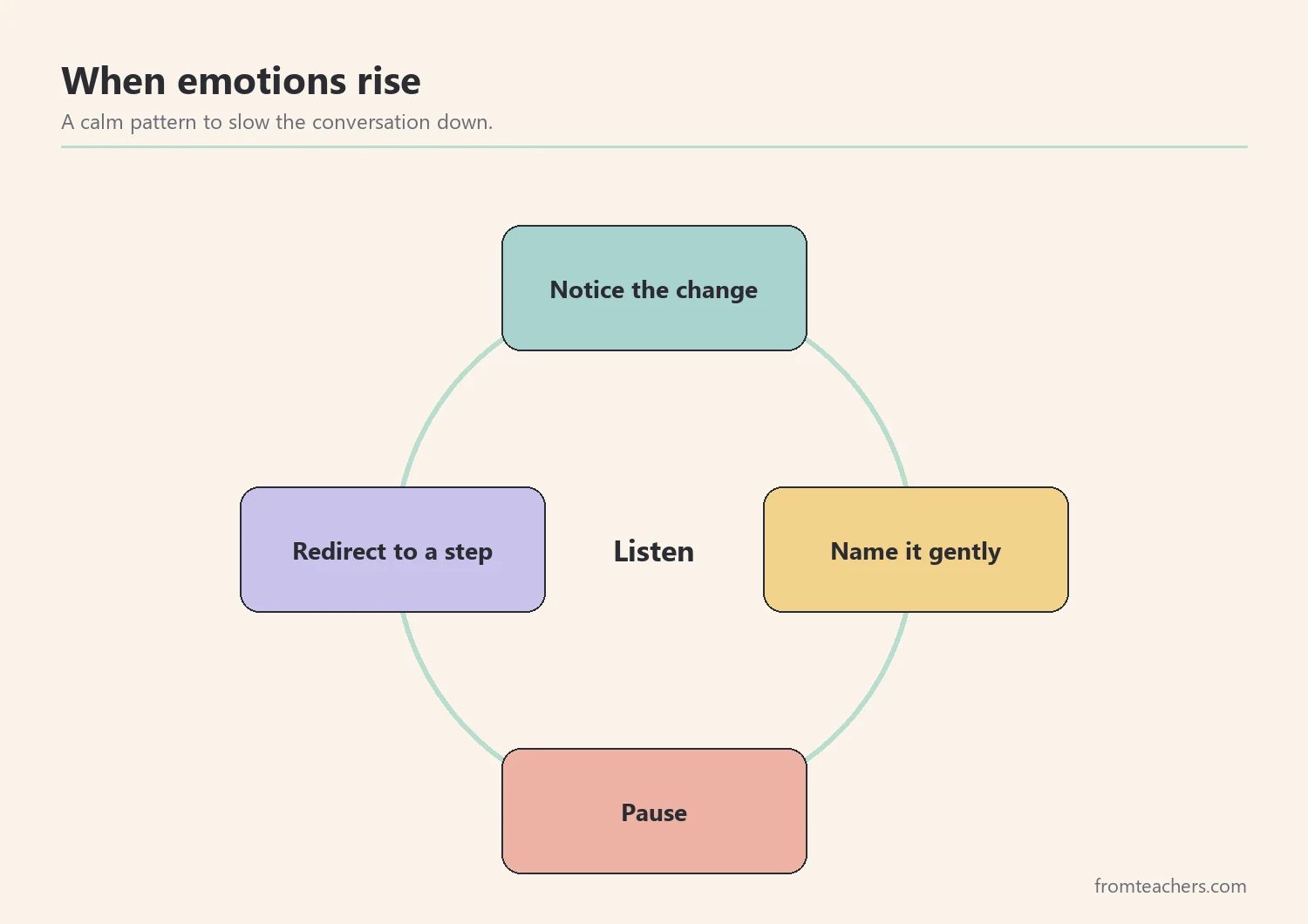
When emotions rise, follow a simple pattern: notice, name, pause, and redirect. First, notice the change in tone or body language. Next, name it gently: “This is a lot to take in.” Then, pause. Silence gives people a moment to settle. Finally, redirect to the shared goal or a concrete next step.
For disagreement, curiosity is your strongest tool. Ask what the parent is seeing, and listen fully before you answer. Then, look for the part you agree on and build from there. If you made a mistake, such as a missed update, own it briefly and say what you will do differently.
| Situation | Phrase that helps |
|---|---|
| Parent is upset | “I can hear how worried you are about Noah.” |
| Parent disagrees with data | “Help me understand what you are seeing at home.” |
| Communication gap | “You are right, we should have updated you sooner.” |
| Stuck on one issue | “Can we note this and come back to it after the goals?” |
In Noah’s meeting, Mrs. Reyes becomes tearful when describing homework time. Ms. Patel says, “I can hear how hard evenings have been.” She pauses, then asks, “Would it help if we planned reading at home together today?” Mrs. Reyes nods. The conversation moves from conflict to problem solving.
It also helps to agree on IEP meeting phrases as a team before the meeting. When the general education teacher, specialist, and administrator use similar calm language, the parent hears one consistent message instead of several competing ones.
Above all, never use IEP meeting phrases as a script to shut down concerns. Parents can tell when words are a technique. Use them to slow down and genuinely listen.
5. Close with IEP meeting phrases that confirm next steps
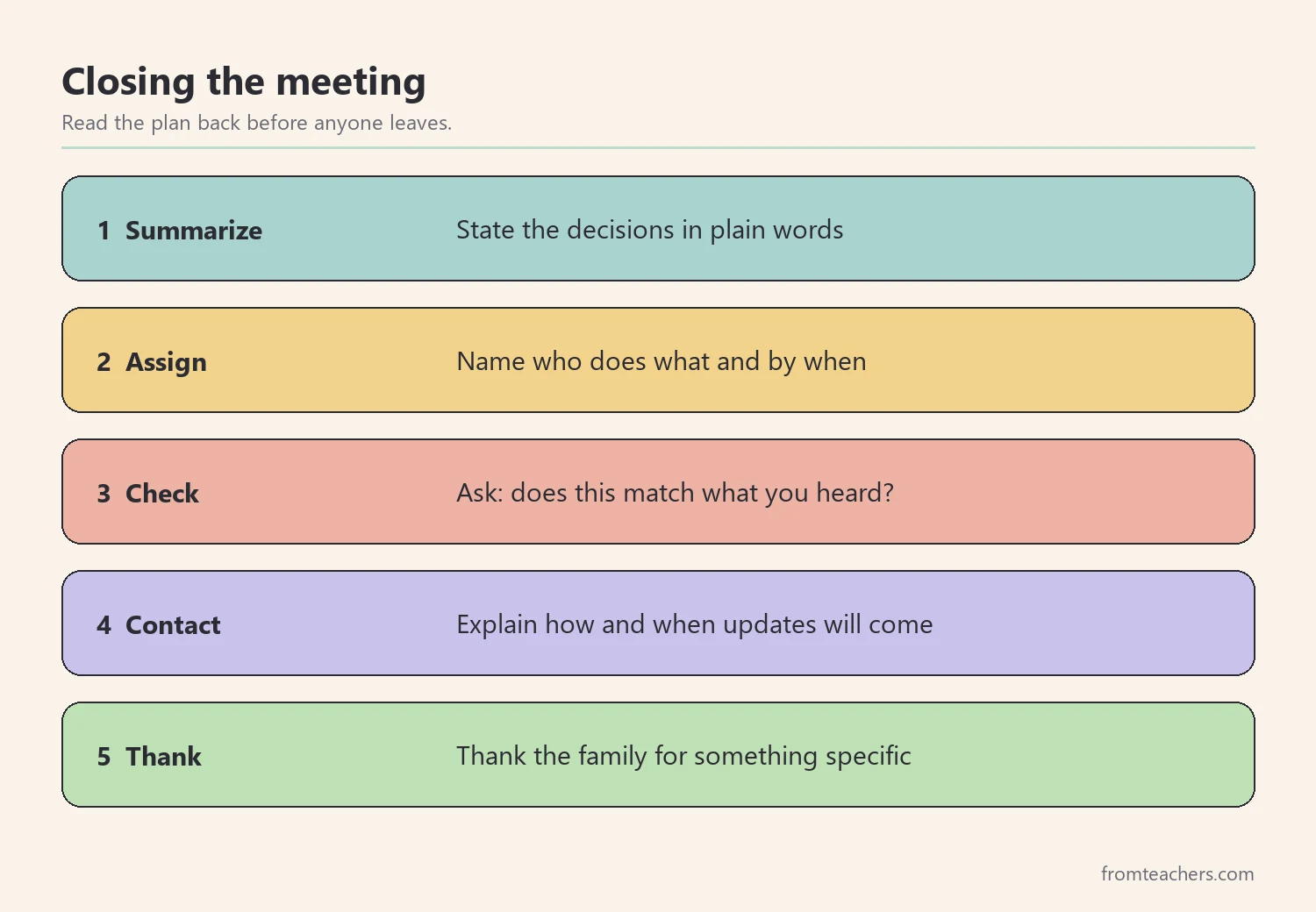
Many meetings end with a rush to the door. Afterward, people remember different things, and trust slips. A clear close protects the relationship and the student’s plan.
First, summarize what was decided in plain language. Second, name who will do what and by when. Third, ask the parent if the summary matches their understanding. Then, explain how and when they will hear from you next. Finally, thank them again, specifically.
Useful closing IEP meeting phrases include:
- “Let me make sure I have our next steps right.”
- “Does this match what you heard?”
- “I will send a short update every two weeks on Fridays.”
- “Thank you for sharing what evenings look like. It helps us plan.”
For Noah, the team agrees on three actions.
| Action | Who | When |
|---|---|---|
| Send home short decodable books | Ms. Patel | Every Monday |
| Ten-minute shared reading at home | Mrs. Reyes | Four nights a week |
| Fluency update email | Ms. Patel | Every other Friday |
Within a day or two, send a short written summary using the same words you used at the table. Consistent IEP meeting phrases in writing remind everyone what was agreed and give the family something to refer back to.
Ms. Patel reads the table aloud and asks, “Does this match what you heard?” Mrs. Reyes adds one note: Wednesday is soccer night, so home reading will skip Wednesdays. The plan is adjusted on the spot, and everyone leaves with the same picture.
Over time, keep a small personal bank of IEP meeting phrases that worked well for you. Add to it after each meeting, and share the best ones with colleagues who are new to the role.
Common mistakes and how to avoid them
- Leading with problems. Fix: open with a specific strength and the parent’s priorities.
- Using jargon. Fix: explain every measure in one plain sentence.
- Correcting the parent directly. Fix: hold both views and look at the evidence together.
- Talking through emotion. Fix: notice, name, pause, then redirect.
- Ending without a summary. Fix: read back actions, owners, and dates before anyone leaves.
- Reciting phrases like a script. Fix: use prepared words to slow down, then listen genuinely.
Questions teachers and parents ask about IEP meeting phrases
Can parents use IEP meeting phrases too?
Yes. Parents can prepare phrases such as “Can you show me the data behind that?” or “What would this look like in the classroom?” Clear questions help every member of the team.
What if a parent becomes angry?
Stay calm, lower your voice, and name the feeling without judging it. Offer a short break if needed. If the meeting cannot continue productively, it is reasonable to agree on a time to reconvene.
Should I bring printed data to the meeting?
Generally, yes. A simple printed graph or table lets the parent look closely and take it home. Send it a few days ahead when possible, so there are no surprises.
How do I disagree with a parent respectfully?
Start by naming what you agree on. Then share your view with evidence and ask for theirs. Disagreement is part of the IEP process, and the law gives families formal options if agreement is not reached.
Are there phrases I should avoid?
Some IEP meeting phrases do more harm than good. Avoid absolutes like “He always” or “He never,” and avoid “Calm down.” Also avoid promising services that the team has not agreed on. Specific, honest language builds trust over time.
Related reading: How Teachers Communicate With Parents in Special Education, How Parents and Teachers Can Team Up for Special Education Success, and The Power of Data Tracking in Special Education.
A companion resource for IEP meeting phrases:
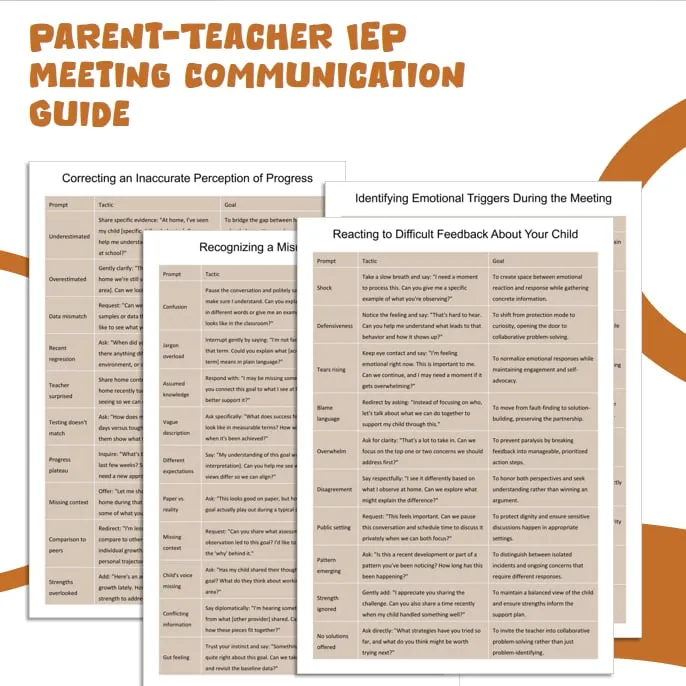
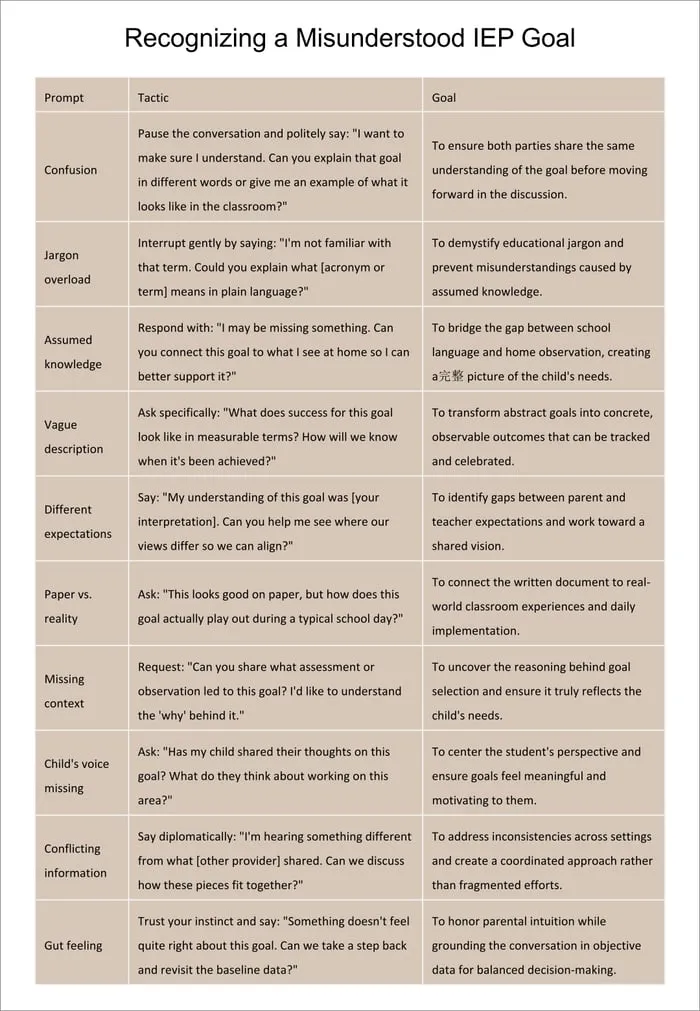
Parent-Teacher IEP Meeting Communication Guide: 12 pages of Prompt, Tactic, and Goal tables with respectful scripts for inaccurate progress perceptions, emotional triggers, difficult feedback, and accepting responsibility for communication gaps.
Sources and scope
- IDEA, U.S. Department of Education: the law behind special education services, IEPs, and parent participation.
- IRIS Center, Vanderbilt University: free modules on IEPs and collaborating with families.
- Center for Parent Information and Resources: a hub for parent training and information centers across the U.S.
- Understood.org: practical articles for families and teachers about IEP meetings.
This guide covers communication habits for IEP meetings. It does not cover legal rights, dispute resolution procedures, or eligibility decisions, which families and schools should review with their state’s guidance and qualified advisors.
Key takeaways
- Prepare IEP meeting phrases for five predictable moments before you walk in.
- Open with a specific strength and the parent’s priorities.
- Share data in plain words and show the trend.
- Notice, name, pause, and redirect when emotions rise.
- Close by reading back actions, owners, and dates.










Leave a Comment