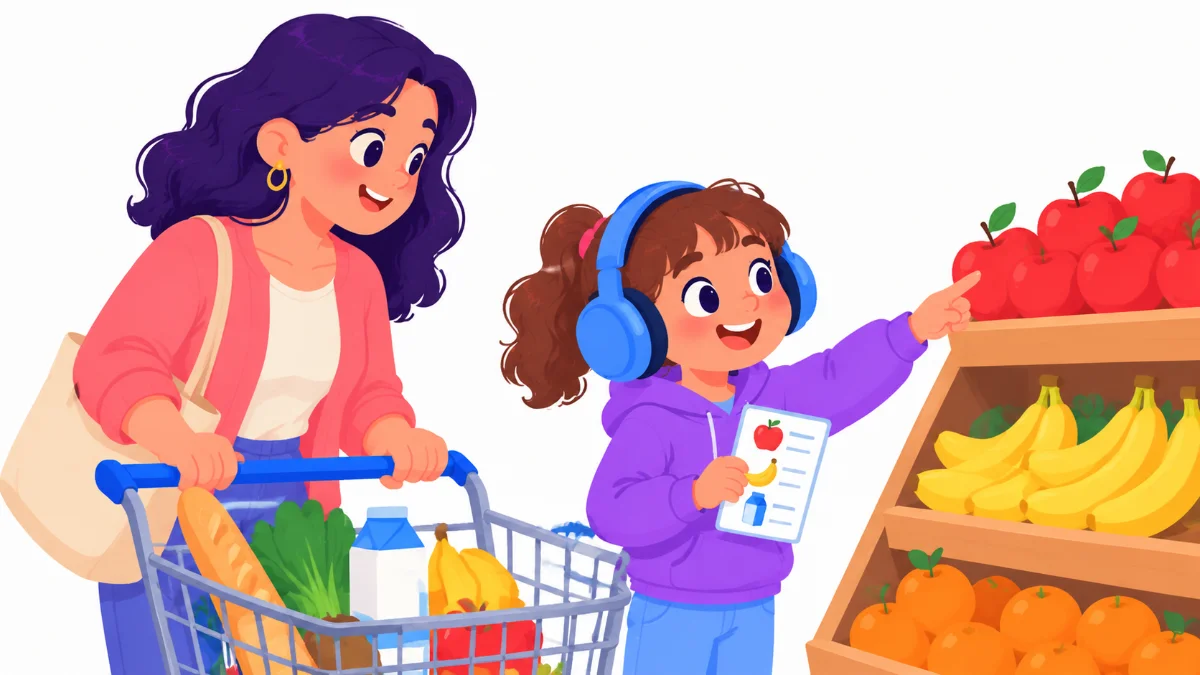

Sensory friendly grocery shopping can sound impossible when your child melts down as soon as the automatic doors open. Bright lights, beeping scanners, crowded aisles, cold freezer air and strong smells all hit at once. Picture Lena and her son Sami, age 5, who is very sensitive to noise. Their weekly shop often ends with Sami on the floor near the checkout and Lena abandoning a half-full cart.
This list is for parents and caregivers of children roughly 3 to 7 years old who find stores overwhelming, whether or not they have a diagnosis. It gives twelve easy tips for sensory friendly grocery shopping, ordered from the ones that need no planning to the ones that need a little preparation. Each tip includes why it helps and how Lena and Sami used it. Pick two or three to start.
Examples are fictional. Adapt to the student’s goals and agreed supports. This is guidance, not a diagnosis.
At a glance
- Stores combine noise, light, crowds and smells, which can overwhelm sensitive children.
- Short, quiet trips work better than long, busy ones.
- Headphones, a picture list and a job give your child control.
- Plan a calm exit before you need it.
- Practice and praise build tolerance over time.
How these tips are ordered
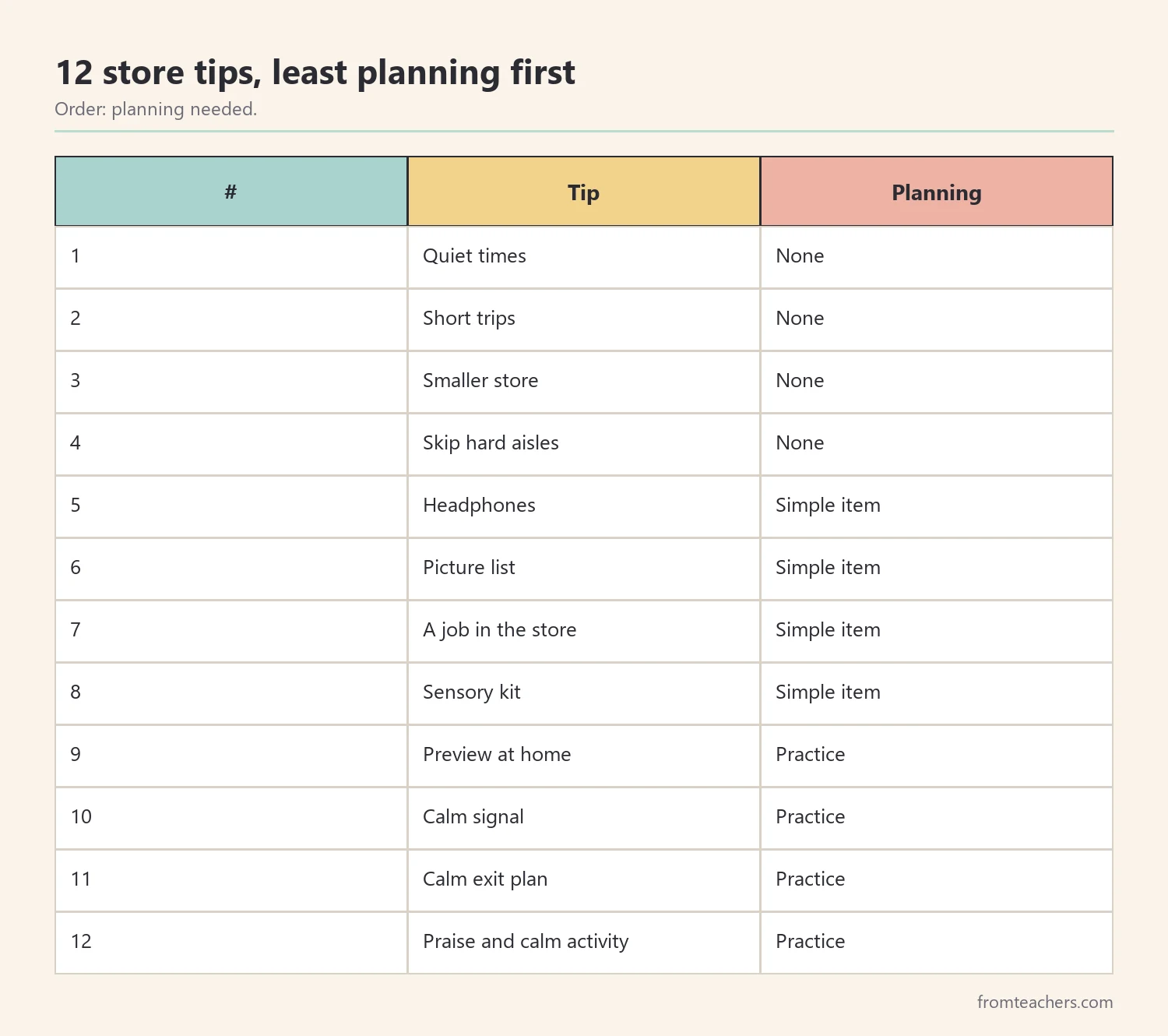
We ordered the twelve tips by how much planning they need. Tips 1 to 4 need no materials. Tips 5 to 8 need simple items, such as headphones or a picture list. Also, tips 9 to 12 need some practice or preparation at home.
Every child is different. Some are over-responsive to sound or light, while others seek movement and touch. Watch your child and adjust. Figure 1 shows the full list.
Before your next trip, spend a minute thinking about what usually goes wrong. Is it the noise at the entrance, the wait at the checkout, the freezer aisle or simply the length of the trip? Then choose the tips that target that moment. Also, consider your own stress level. Children often pick up on a parent’s tension, so a plan that makes you calmer helps your child too.
1. Shop at quiet times
Why it helps: fewer people means less noise, shorter lines and more space.
Try this: early mornings or mid-week evenings are often quieter. Some stores offer sensory-friendly or quiet hours; ask your local store.
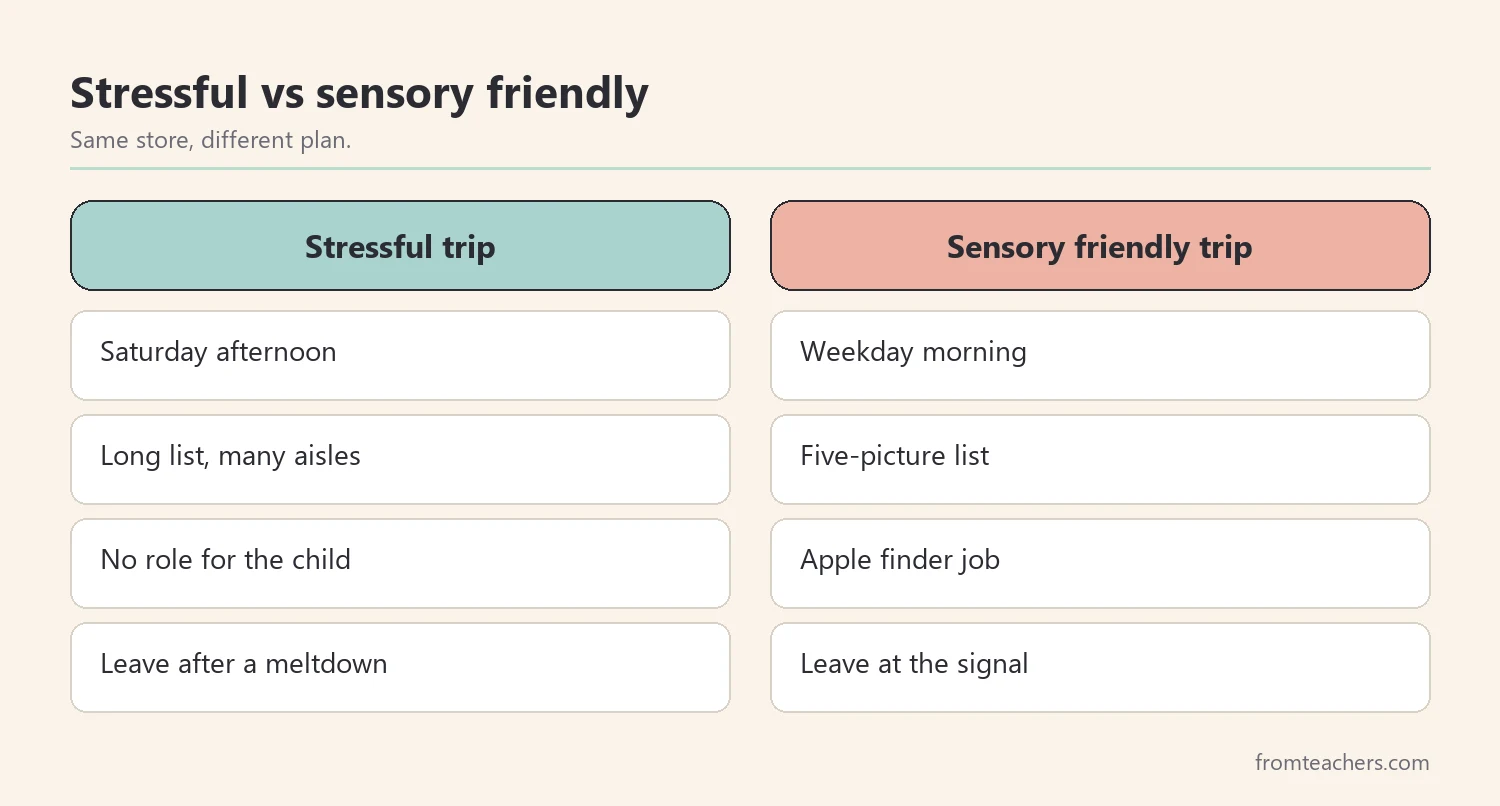
Example: Lena switched from Saturday afternoon to Tuesday at 8 a.m. The store was half empty, and Sami stayed calm for the whole trip.
2. Keep trips short
Why it helps: tolerance often runs out after a certain time. A short trip ends before that point.
Try this: buy a few items with your child and do the big shop alone or online when possible.
Example: Lena made 15-minute trips with Sami for fresh food and ordered heavy items for delivery.
3. Choose a smaller store
Why it helps: smaller stores often have less noise, fewer aisles and less visual clutter.
Example: Sami did better at a small neighborhood market than at the large supermarket with music and announcements.
4. Skip the hardest aisles
Why it helps: many children find certain areas hard, such as cold freezer aisles, strong-smelling cleaning products or the noisy bakery.
Try this: notice which areas trigger distress and plan a route that avoids them.
Example: Sami covered his nose in the cleaning aisle every time. Lena now picks those items up alone.
5. Bring noise reducing headphones
Why it helps: headphones can soften beeps, announcements and crowd noise for children sensitive to sound.
Try this: practice wearing them at home first, so they feel familiar and comfortable.
Example: Sami chose blue headphones and practiced wearing them during cartoons. In the store, he wore them from the door to the car.
6. Use a picture shopping list
Why it helps: a visual list shows how long the trip will be and when it ends. Crossing items off gives a sense of progress.
Example: Sami’s list had five pictures: apples, bread, milk, yogurt, bananas. When the last one was crossed off, he knew it was time to pay.
7. Give your child a job
Why it helps: jobs give children a sense of control and something to focus on besides the noise.
Try this: holding the list, finding items, pushing a small cart or putting items on the belt.
Example: Sami became the “apple finder.” He proudly chose four apples and counted them into the bag.
8. Pack a small sensory kit
Why it helps: familiar comfort items help regulate when the store becomes too much.
Try this: a fidget, a chewy item if your child uses one, a favorite small toy, sunglasses for bright lights and a snack.
Example: Lena keeps a small pouch in the car with a squeeze ball, sunglasses and crackers. Sami asks for the squeeze ball near the checkout.
9. Preview the trip at home
Why it helps: knowing what will happen reduces anxiety.
Try this: look at photos of the store, talk through the steps or play “store” at home with a toy cart.
Example: Lena and Sami played store with cereal boxes and a toy scanner. Sami practiced the “beep” sound until it felt funny instead of scary.
10. Practice a calm signal and script
Why it helps: a simple signal helps your child tell you “this is too much” before a meltdown.
Try this: agree on a hand signal or a short phrase like “break please.” Practice at home. A guide like the SPD guide for parents and teachers includes a student section on communicating needs and self-regulation, which helps children learn this skill.
Example: Sami taps his headphones twice when he needs a break. Lena then steps with him to a quiet corner near the entrance.
11. Plan a calm exit
Why it helps: knowing you can leave reduces stress for both of you.
Try this: park near the exit, keep the cart light and be ready to leave items behind if needed. Some stores will hold a cart briefly if you ask.
Example: Once, Sami became overwhelmed by a fire alarm test. Lena walked out with him calmly, sat in the car for ten minutes and came back for the last two items.
12. End with praise and a calm activity
Why it helps: ending positively builds good memories of the store and makes the next trip easier.
Try this: praise specific actions, then give quiet time at home.
Example: Lena says, “You found all the apples and wore your headphones the whole time.” At home, Sami gets twenty minutes with his building blocks.
A sample trip plan
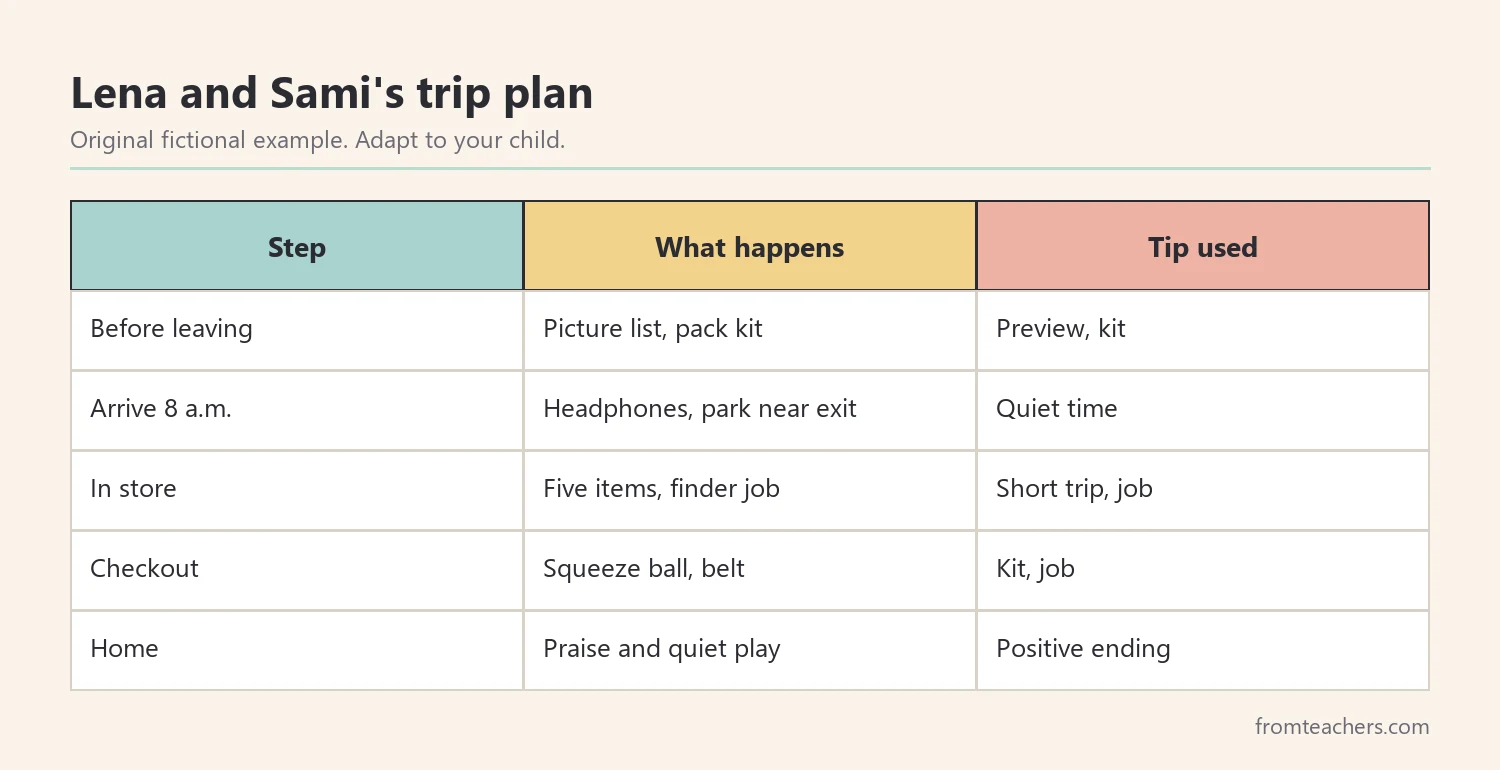
The table below shows Lena’s plan for a short trip. It combines several tips for sensory friendly grocery shopping into one routine. Times are a fictional example.
| Step | What happens | Tip used |
|---|---|---|
| Before leaving | Look at picture list, pack kit | Preview, kit |
| Arrive 8 a.m. | Headphones on, park near exit | Quiet time, exit plan |
| In store | Five items, apple finder job | Short trip, job |
| Checkout | Squeeze ball, place items on belt | Kit, job |
| Home | Praise and quiet play | Positive ending |
Building tolerance over time
Many children become more comfortable with stores through short, positive, repeated visits. Figure 4 shows a gradual approach: start with a very short visit, then slowly add time or items as your child succeeds.
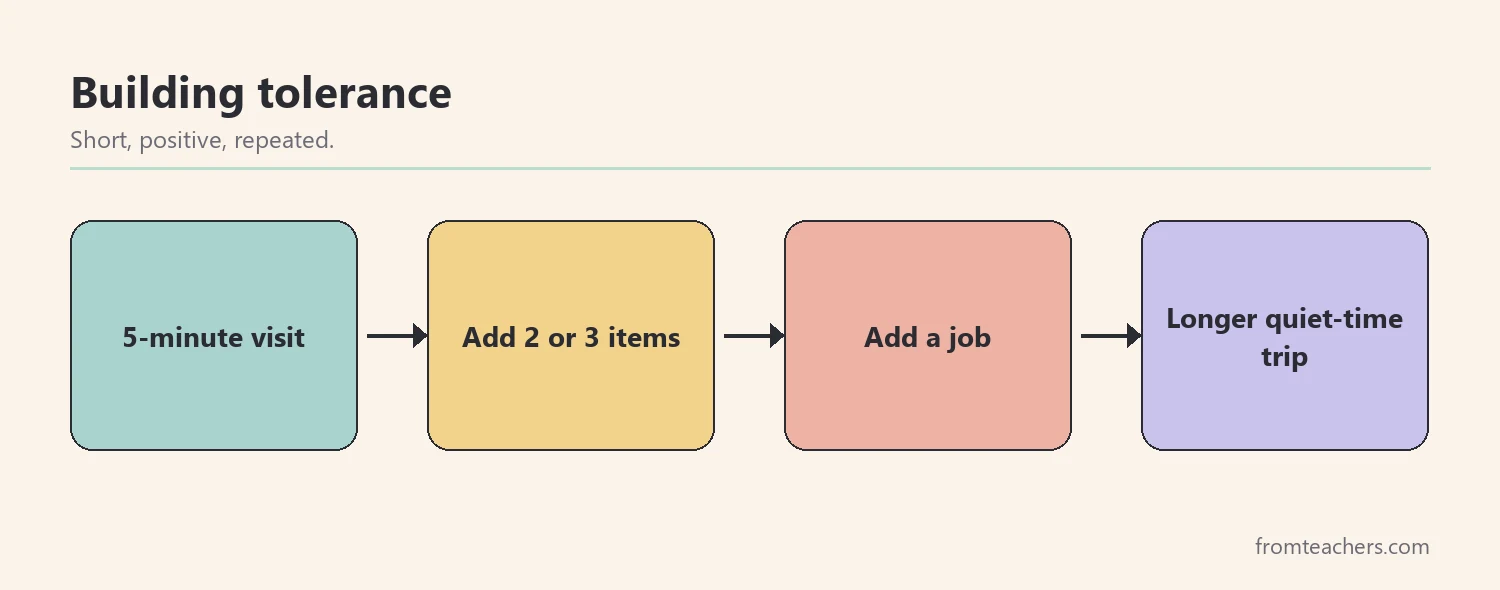
Progress is rarely a straight line. Tired days, illness or a new store can bring setbacks. When that happens, go back to a shorter trip and build again. Also, talk with an occupational therapist if store visits remain very hard, since they can suggest strategies that fit your child’s specific sensory profile.
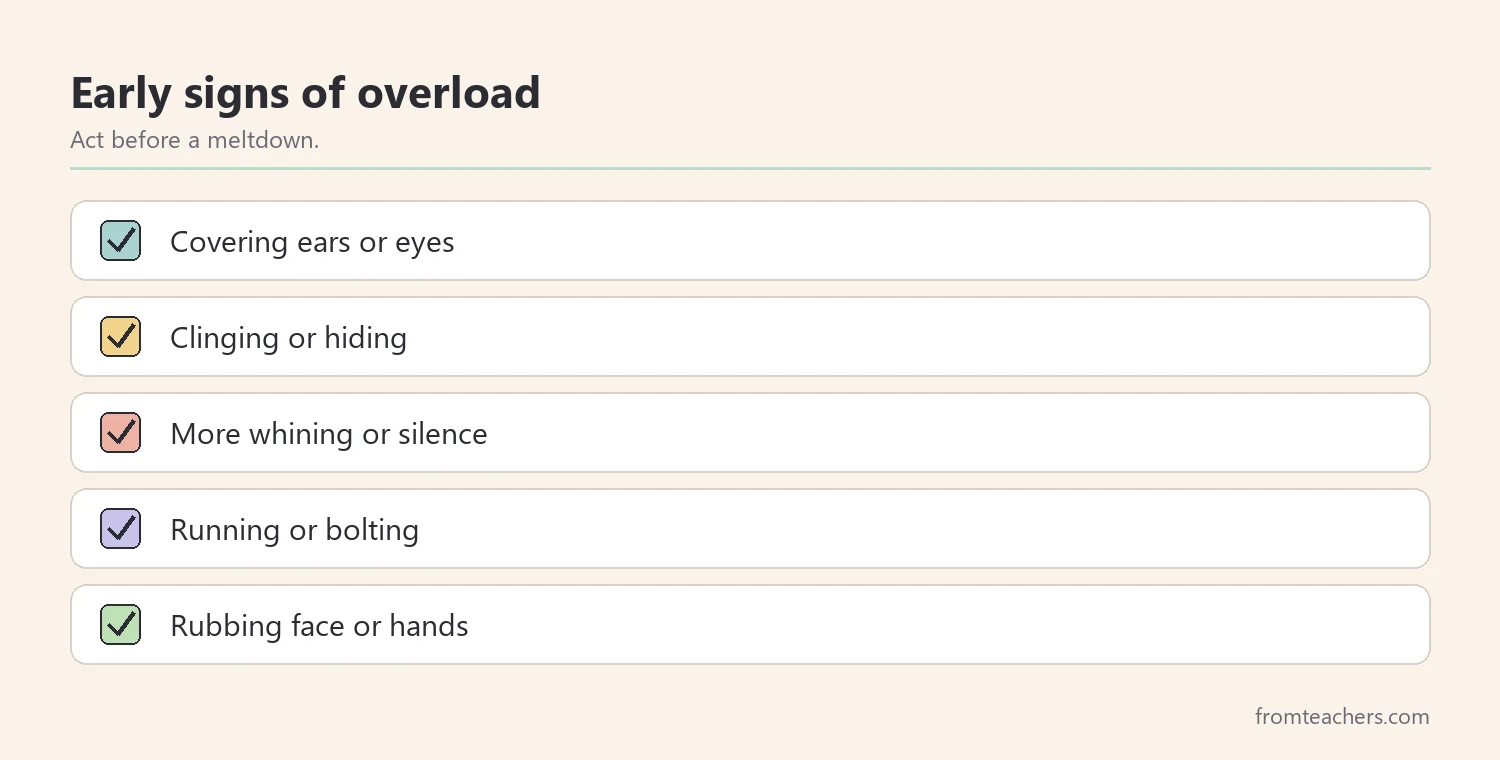
Figure 5 lists signs that your child is reaching their limit, so you can act before a meltdown.
Involving siblings and other adults
Store trips often include siblings, grandparents or a partner. Share the plan with everyone, so the child hears the same words and sees the same routine. Siblings can help too, for example by being the “list reader” while your child is the “finder.” If another adult is shopping with you, decide in advance who will step out with the child if a break is needed.
Common mistakes on store trips
- Shopping when everyone is tired or hungry. Fix: go after a snack and rest.
- Long trips with many stops. Fix: one store, a few items.
- Introducing headphones for the first time in the store. Fix: practice at home first.
- Waiting too long to leave. Fix: watch early signs and use the exit plan.
- Worrying about strangers’ looks. Fix: focus on your child; you know what they need.
Questions parents ask about sensory friendly grocery shopping
Should I avoid taking my child to stores entirely?
Sometimes a break helps, especially during hard periods. However, short, positive practice trips often build tolerance over time.
Do I need a diagnosis to use these tips?
No. Many children find stores overwhelming. These tips are general and can help any child who struggles.
What if my child seeks sensory input, like touching everything?
Give safe input: pushing the cart, carrying a heavy bag or holding a fidget. Jobs that involve movement often help.
How do I handle a meltdown in the store?
Stay calm, reduce talking and move to a quieter space or the car. Talk about it later, when your child is calm.
Are sensory-friendly store hours common?
Some stores offer them, but availability varies. Ask your local stores directly.
Related reading: Managing Sensory Overload in Autism and ADHD, Meltdowns vs Tantrums, and Understanding Autism and ADHD Meltdowns.
You may also need: SPD Support Toolkit: Sensory Spaces and Calming Strategies.
A companion resource for sensory friendly grocery shopping:
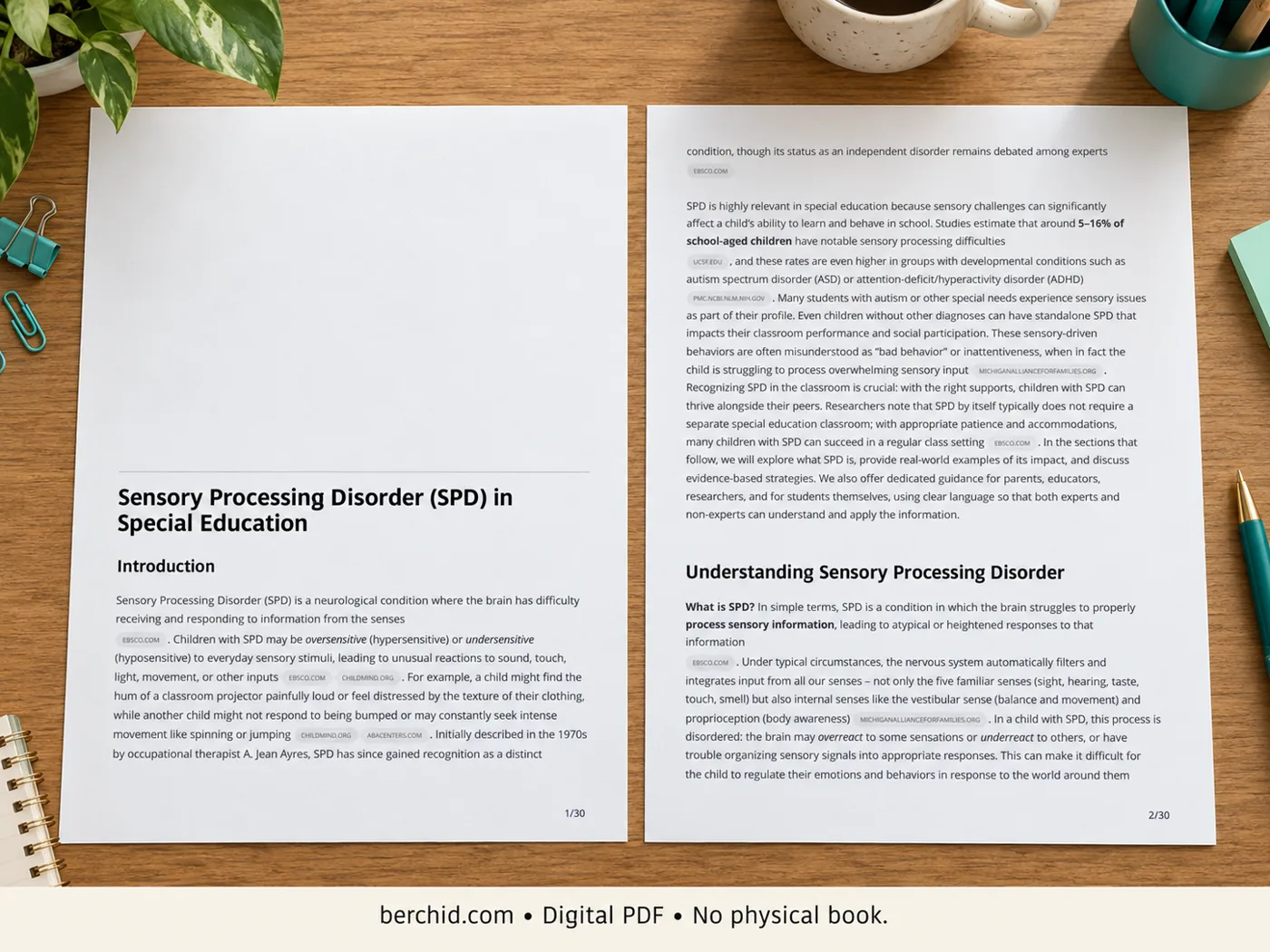
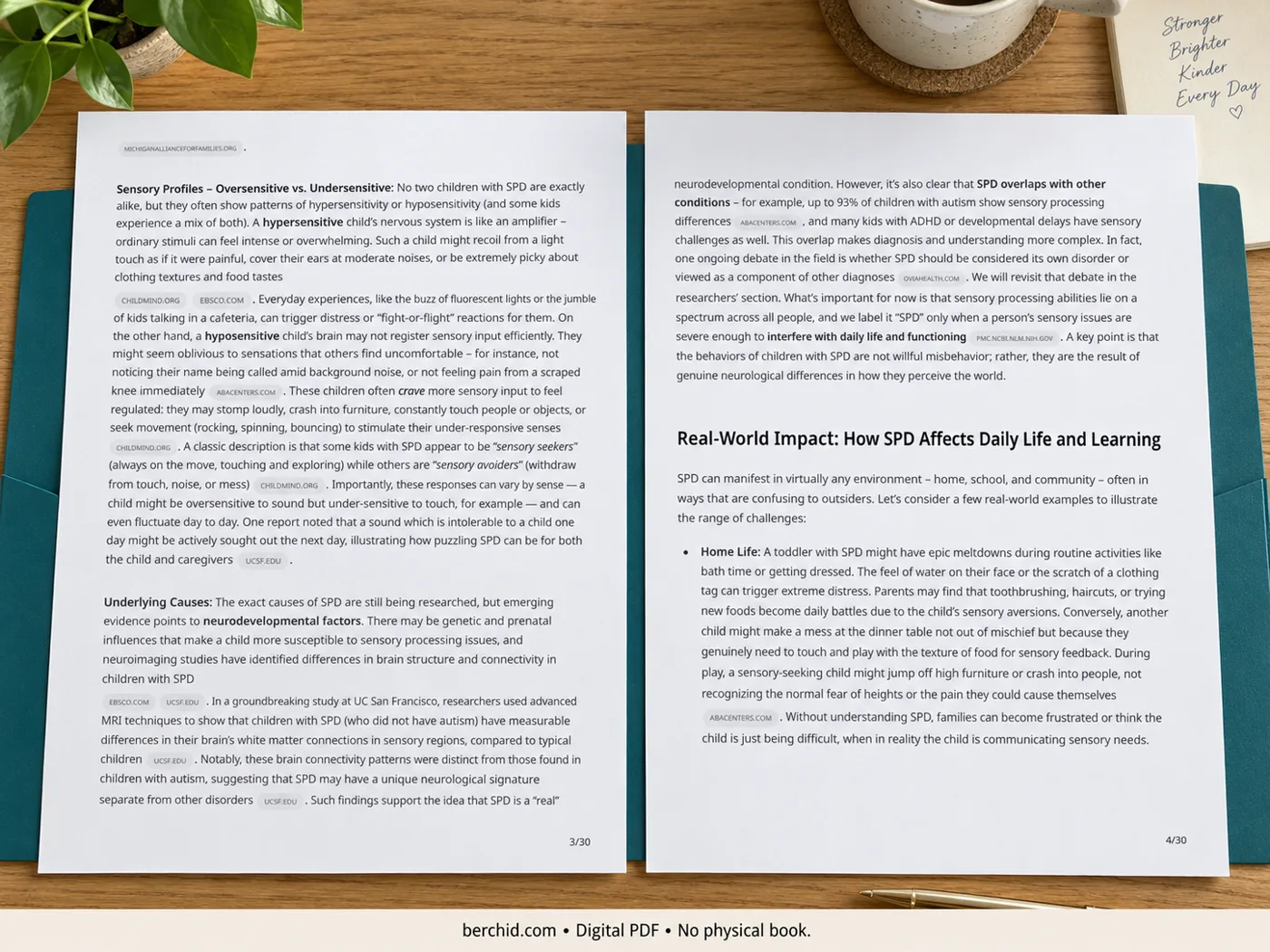
Sensory Processing Disorder (SPD) Guide: Strategies for Parents & Teachers: a 30-page guide covering hypersensitive and hyposensitive profiles, a parent section on sensory-friendly routines, calming spaces at home and sensory input in everyday activities, an educator section on classroom adjustments and IEP or 504 supports, a research summary and a student section on deep breathing, sensory toolkits and communicating needs.
Sources and scope
- American Occupational Therapy Association (AOTA): information on occupational therapy, including support for sensory and daily living challenges.
- Understood.org: plain-language articles for parents on sensory processing challenges.
- National Institute of Mental Health: Autism Spectrum Disorder: an overview that includes sensory differences commonly reported in autism.
- Center for Parent Information and Resources: information for families on supports and services for children with disabilities.
These tips are general ideas for families. They do not diagnose sensory processing differences or replace advice from an occupational therapist, pediatrician or your child’s care team.
Key takeaways
- Sensory friendly grocery shopping starts with quiet times and short trips.
- Headphones, a picture list and a job give your child control.
- Pack a small sensory kit and practice a calm signal at home.
- Plan a calm exit before you need it.
- End with praise and build tolerance slowly.



Leave a Comment