
Paleoanthropology vocabulary for kids can make a human evolution unit feel much easier. Paleoanthropology is the study of human origins through fossils, tools and other evidence, and its long words can stop a curious student cold. Picture Sara, age 12, reading her science chapter at the kitchen table. She likes the story of early humans, but words like “hominin,” “bipedalism” and “radiometric dating” make her give up halfway down the page.
This list is for parents of students ages 11 to 13 who want to help with homework without being science experts. It ranks twelve key words from the most familiar to the most advanced, with a plain definition, an example and a quick memory trick for each. Sara appears as the fictional example, so you can see how a few minutes a night builds confidence.
Examples are fictional. Adapt to the student’s goals and agreed supports. This is guidance, not a diagnosis.
At a glance
- Learn a few words at a time, not all twelve at once.
- Break long words into parts kids can recognize.
- Connect each word to a picture or an example.
- Use the words in short conversations at home.
- Check definitions against museum sources.
How we ranked these words
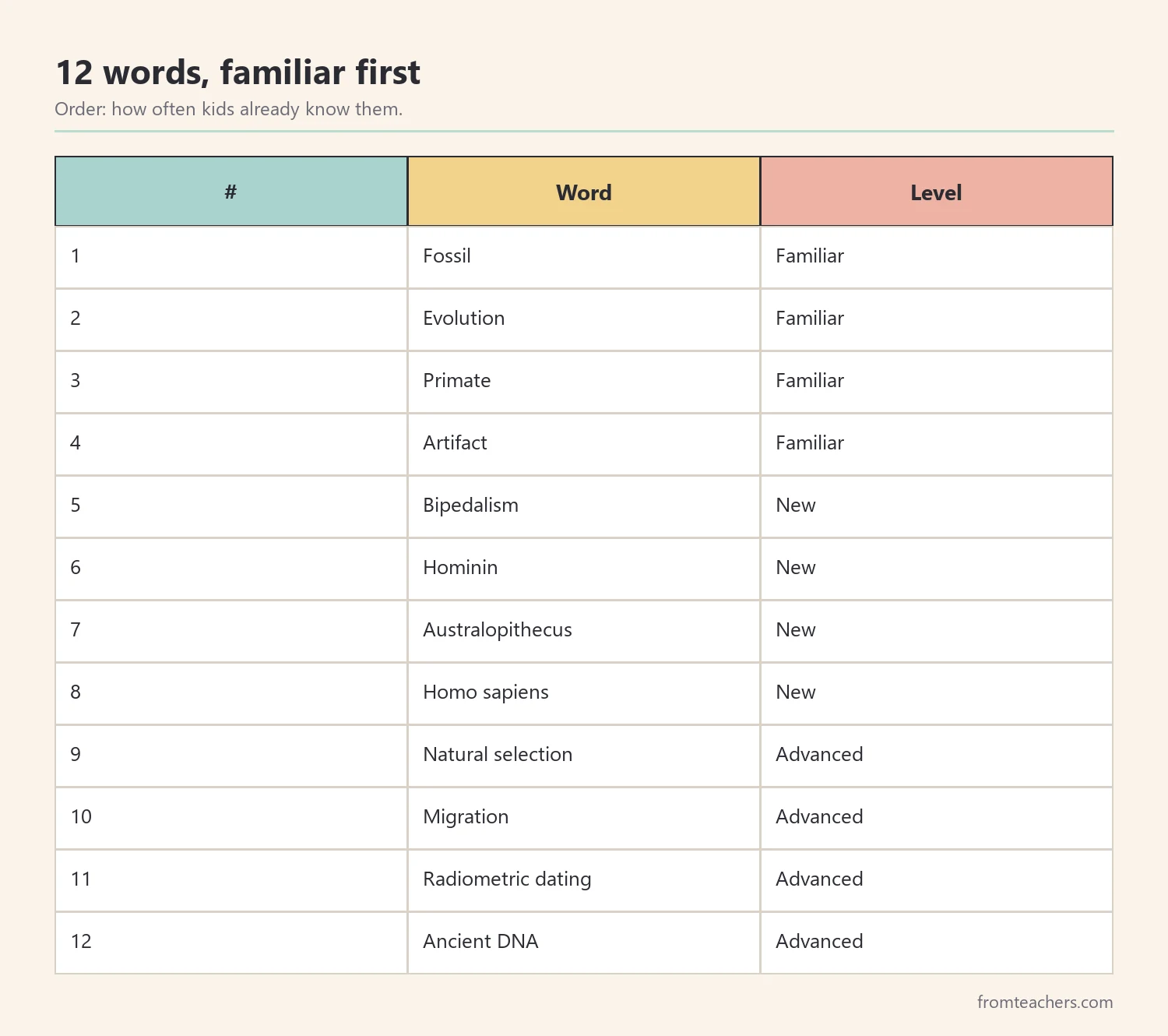
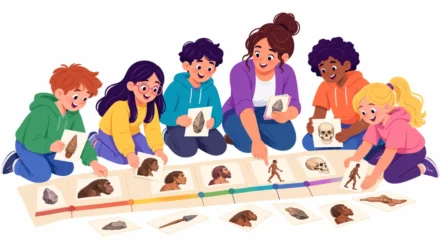
We ranked the twelve words from the most familiar, which many kids already half know, to the most advanced, which appear later in most units. Start at the top and add two or three words a night. Figure 1 shows the ranking.
Each word includes a simple definition, an example and a memory trick. Many long science words are built from smaller parts, so breaking them apart is one of the best ways to make paleoanthropology vocabulary for kids less scary.
1. Fossil
Meaning: the preserved remains or traces of a living thing from long ago, such as bones, teeth or footprints.
Memory trick: footprints count too. A fossil is not only bones.
Example: Sara learned that fossil footprints at Laetoli, in Tanzania, show that early humans walked on two legs.
2. Evolution
Meaning: change in living things over many generations.
Memory trick: think “slow change over a very long time,” not change in one lifetime.
Example: Sara explained to her dad that evolution does not happen to one person, but across a population over time.
3. Primate
Meaning: the group of mammals that includes lemurs, monkeys, apes and humans.
Memory trick: primates usually have grasping hands and forward-facing eyes. Look at your own hands.
Example: Sara listed the primates she had seen at the zoo.
4. Artifact
Meaning: an object made or used by people, such as a stone tool.
Memory trick: “art” is in artifact. People made it.
Example: Sara compared a fossil, which was once alive, with an artifact, which was made by someone.
5. Bipedalism
Meaning: walking upright on two legs.
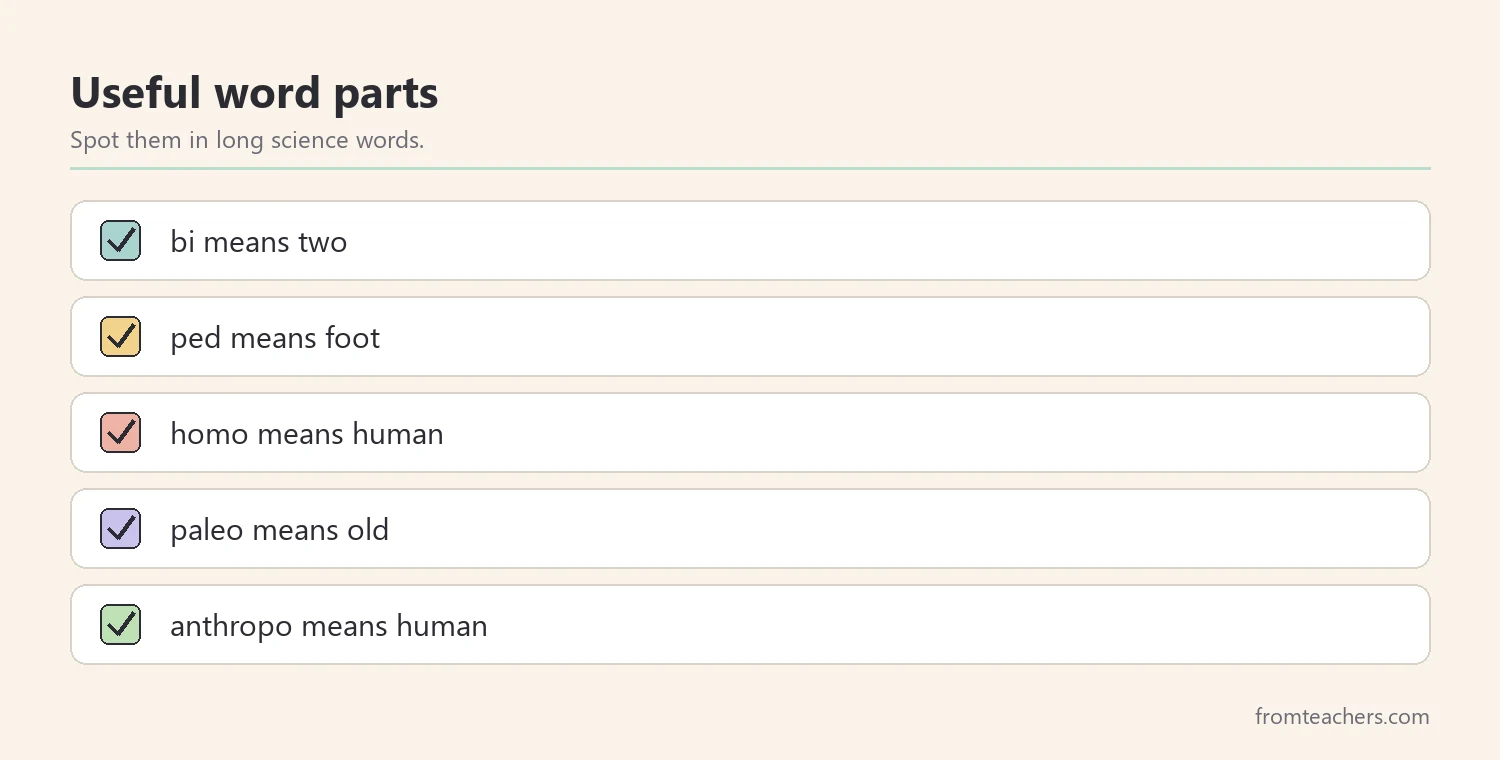
Memory trick: “bi” means two, like bicycle, and “ped” means foot, like pedal.
Example: Sara walked across the kitchen and said, “I’m being bipedal.”
6. Hominin
Meaning: the group that includes modern humans and extinct species more closely related to us than to chimpanzees.
Memory trick: “homo” is Latin for human. Hominins are our close human family.
Example: Sara drew a small family tree with hominins on one branch and chimpanzees on another.
7. Australopithecus
Meaning: a group of early hominins that walked on two legs but had small brains. The famous fossil “Lucy” belongs to this group.
Memory trick: “australo” means southern, and “pithecus” means ape: “southern ape.”
Example: Sara learned that Lucy was found in Ethiopia and lived over three million years ago.
8. Homo sapiens
Meaning: the scientific name for modern humans.
Memory trick: “sapiens” means wise. It is our own species.
Example: Sara wrote “Homo sapiens” on a sticky note and put it on the mirror.
9. Natural selection
Meaning: the process where living things with traits that help them survive and reproduce pass those traits on more often.
Memory trick: nature “selects” the traits that work best in an environment.
Example: Sara explained it with a made-up example of beetles whose color helps them hide from birds.
10. Migration
Meaning: movement from one region to another. Many scientists describe the spread of early modern humans from Africa to other continents, often called “Out of Africa.”
Memory trick: birds migrate, and so did early humans, but over thousands of years.
Example: Sara traced migration arrows on a world map in her textbook.
11. Radiometric dating
Meaning: methods scientists use to estimate the age of rocks and some remains by measuring the slow change of certain natural elements.
Memory trick: think of a natural clock that ticks very slowly inside rocks.
Example: Sara learned that scientists often date the rock layers around fossils, not just the fossils themselves.
12. Ancient DNA
Meaning: genetic material recovered from very old remains, which helps scientists study relationships between groups.
Memory trick: DNA is like an instruction book. Ancient DNA is a very old copy.
Example: Sara read that studies of ancient DNA suggest some modern people carry small amounts of Neanderthal DNA. A full human evolution scientific guide for ages 11 to 13 explains this and the other words in context, with a glossary at the end.
A sample practice tracker
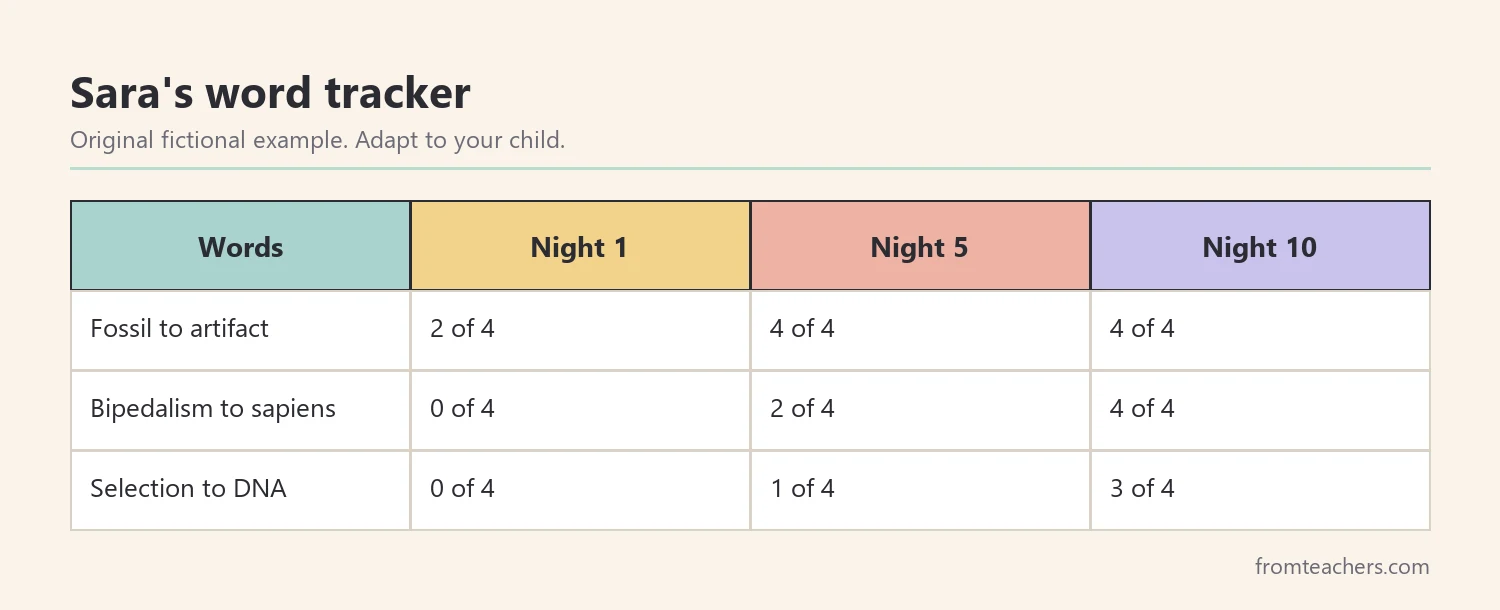
A simple tracker helps kids see their progress. The table below shows Sara’s fictional results over two weeks of short practice. It shows the format only.
| Words | Night 1 | Night 5 | Night 10 |
|---|---|---|---|
| Fossil to artifact | 2 of 4 | 4 of 4 | 4 of 4 |
| Bipedalism to Homo sapiens | 0 of 4 | 2 of 4 | 4 of 4 |
| Natural selection to ancient DNA | 0 of 4 | 1 of 4 | 3 of 4 |
A five-minute nightly routine
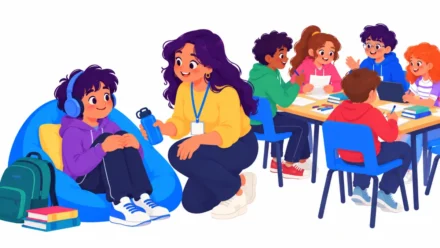
Short, regular practice works better than one long session before the test. Figure 4 shows a simple routine.
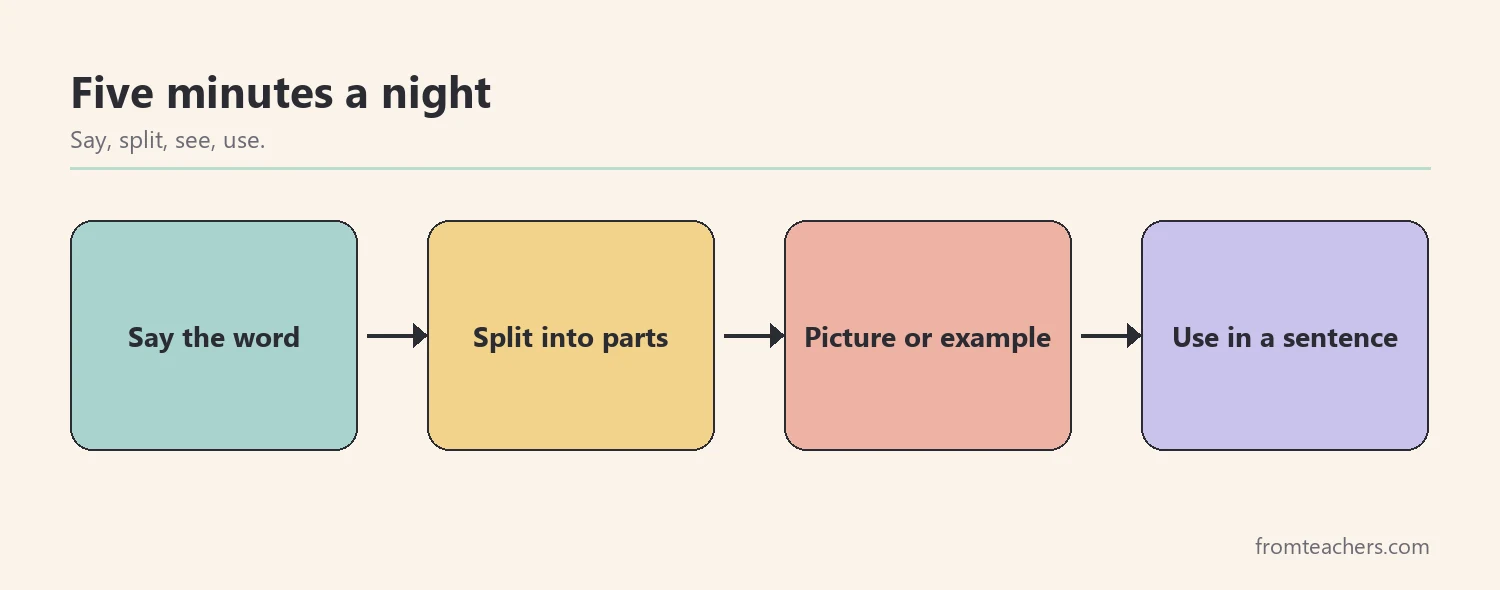
Say the word, break it into parts, connect it to a picture and use it in a sentence. Then review the earlier words quickly. Kids often enjoy quizzing their parents, too, which is a fun way to check understanding.
Making the words stick
Paleoanthropology vocabulary for kids sticks best when it is used, not just memorized. Try asking one question at dinner, such as “Was Lucy bipedal?” or “Is a stone tool a fossil or an artifact?” These quick questions take seconds and give real practice.
Also, try drawing. Many kids remember “bipedalism” better after drawing footprints, or “hominin” after sketching a family tree. Drawing turns a long word into a picture the brain can hold.
Finally, visit a museum website or a natural history museum if you can. Seeing real skulls, tools and footprints connects the words to evidence and makes the unit feel like a story instead of a list.
Words that often get mixed up
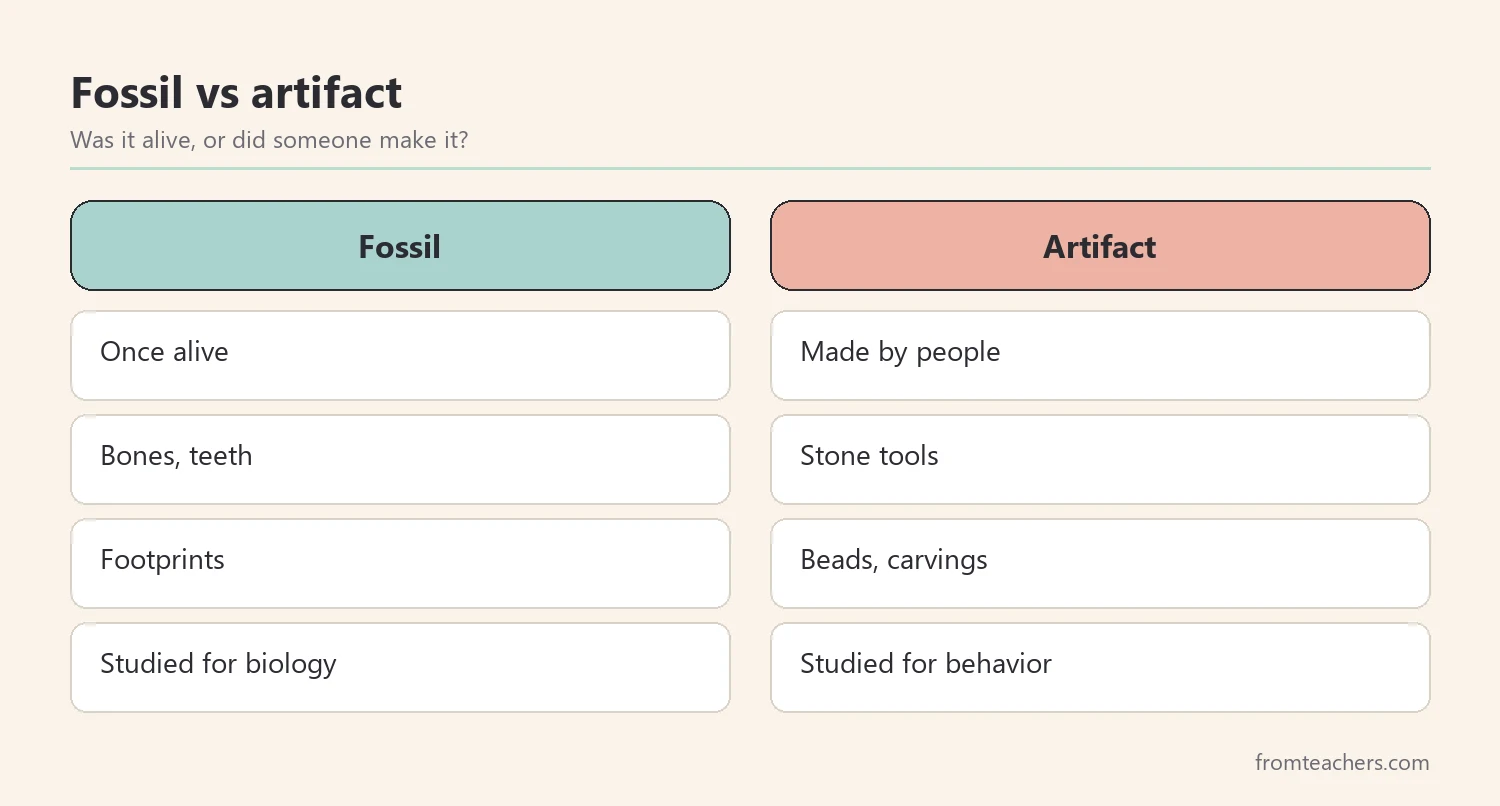
A few pairs of words confuse many students, so it helps to compare them side by side. “Fossil” and “artifact” is the most common pair, as Figure 2 shows. Another is “evolution” and “natural selection.” Evolution is the overall change over generations, while natural selection is one of the main processes that drives it.
“Migration” and “evolution” can also blur together, because both involve change over long periods. Migration is about moving to new places, while evolution is about changes in traits. Early humans did both, which is why textbooks often discuss them in the same chapter.
A short writing task to check understanding
Once your child knows six or more words, try a short writing task. Ask them to write a five-sentence “museum label” for an imaginary fossil display, using at least four words from the list. For example: “This fossil footprint shows bipedalism. It was made by a hominin…”
The task takes about ten minutes and shows whether your child can use the words correctly, not just recognize them. Read the label together and celebrate the words used well. If a word is used incorrectly, look back at its definition and memory trick, then try one new sentence together.
Common mistakes and how to avoid them
- Memorizing all twelve at once. Fix: two or three words a night.
- Definitions without examples. Fix: add a picture or a real fossil example.
- Mixing up fossil and artifact. Fix: ask, “Was it alive, or did someone make it?”
- Treating evolution as a ladder. Fix: draw a branching tree, not a straight line.
- Only reviewing before the test. Fix: practice a little every night.
Figure 5 lists word parts that unlock many science terms.
Questions parents ask about paleoanthropology vocabulary for kids
Do I need a science background to help?
No. Simple definitions, examples and curiosity are enough. Learning together can be fun.
What is the difference between hominin and hominid?
Hominid is a broader group that includes great apes. Hominin is the narrower group of humans and our closest extinct relatives. Textbooks sometimes differ, so check the term your child’s book uses.
Did humans evolve from chimpanzees?
No. Humans and chimpanzees share a common ancestor that lived millions of years ago, which is different from one evolving from the other.
How many words should my child learn?
Follow the unit’s word list. The twelve here cover many common terms in middle school units.
What if my child finds the topic sensitive?
Listen respectfully and focus on what scientists study and the evidence they use. Family values can be discussed at home.
Related reading: Learning Styles Student Success Guide, Dyslexia Solutions in the Classroom, and 5 Practical Teaching Tips to Boost Classroom Focus.
You may also need: Dinosaurs: The Complete Student Field Guide.
A companion resource for parents helping with a human evolution unit:
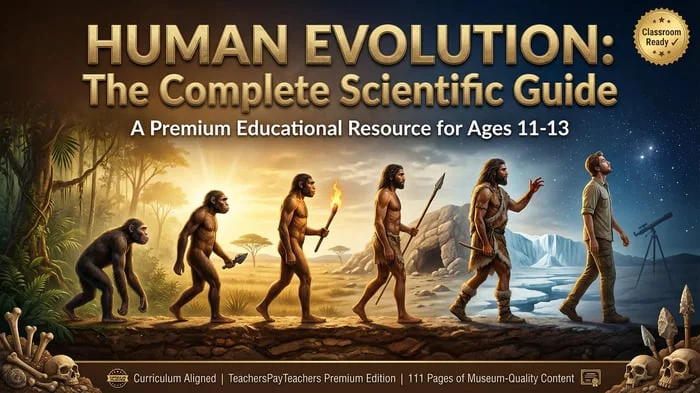
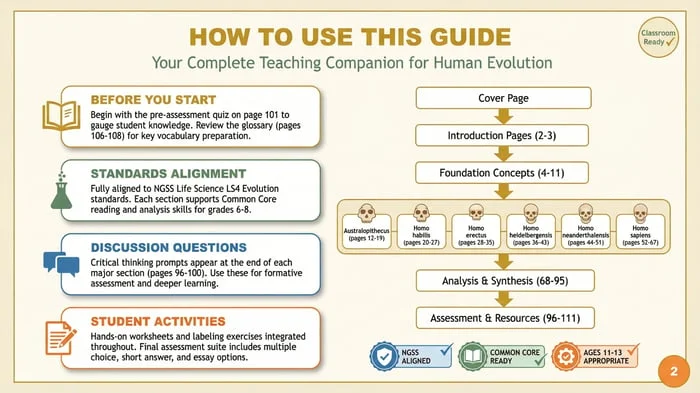
Human Evolution: The Complete Scientific Guide: 111 pages for ages 11 to 13 covering natural selection, the human family tree, six hominin species from Australopithecus afarensis to Homo sapiens, the Out of Africa migration, fossil dating methods, ancient DNA and what makes us human, with discussion questions, a student assessment quiz and a glossary aligned to NGSS Life Science standards and Common Core reading skills for grades 6 to 8.
Sources and scope
- Smithsonian Human Origins Program: information on human evolution, fossils and early human species.
- Natural History Museum, London: articles on human evolution and fossil discoveries.
- University of California Museum of Paleontology: educational pages on fossils, geologic time and evolution.
- National Science Teaching Association: resources for science learning at school and home.
This guide gives simple definitions for family learning. Scientific understanding of human origins grows as new fossils are found, so check recent museum sources for updates.
Key takeaways
- Paleoanthropology vocabulary for kids is easier in small, regular doses.
- Break long words into parts, like bi, ped and homo.
- Connect every word to a picture, example or real fossil.
- Use the words in quick conversations and drawings at home.
- Check definitions against museum sources as science grows.

Leave a Comment