

Sensory overload in middle school often looks different from the covered ears and tears people expect in younger children. Twelve-year-olds work hard to hide it. Picture Jordan, age 12, in a seventh grade science lab: chairs scraping, a fan humming, the smell of vinegar and twenty conversations at once. Jordan goes quiet, pulls up a hood and stops working. A teacher might read that as defiance or boredom.
This list is for middle school teachers in any subject. It describes seven signs of sensory overload in middle school students, ordered from the easiest to notice to the ones most often mistaken for something else. Each sign comes with why it happens, what it can look like in class and a calm response, with Jordan as the example. These are signs to notice, not a diagnosis.
Examples are fictional. Adapt to the student’s goals and agreed supports. This is guidance, not a diagnosis.
At a glance
- Middle schoolers often mask sensory distress to fit in with peers.
- Hallways, cafeterias, labs and gyms are common trigger points.
- Overload can look like defiance, boredom or anxiety.
- Calm, private responses work better than public corrections.
- Share patterns with families and the school occupational therapist.
Why middle school is a hot spot
Middle school brings more of everything: more classes, more transitions, louder hallways, bigger cafeterias and labs with new smells and sounds. At the same time, students care deeply about how peers see them. As a result, many students who struggle with sensory input try to hide it until they cannot.
We ordered the seven signs by how easy they are to notice. The first three are visible. The last four are often misread as behavior or attitude. Figure 1 lists them in order.
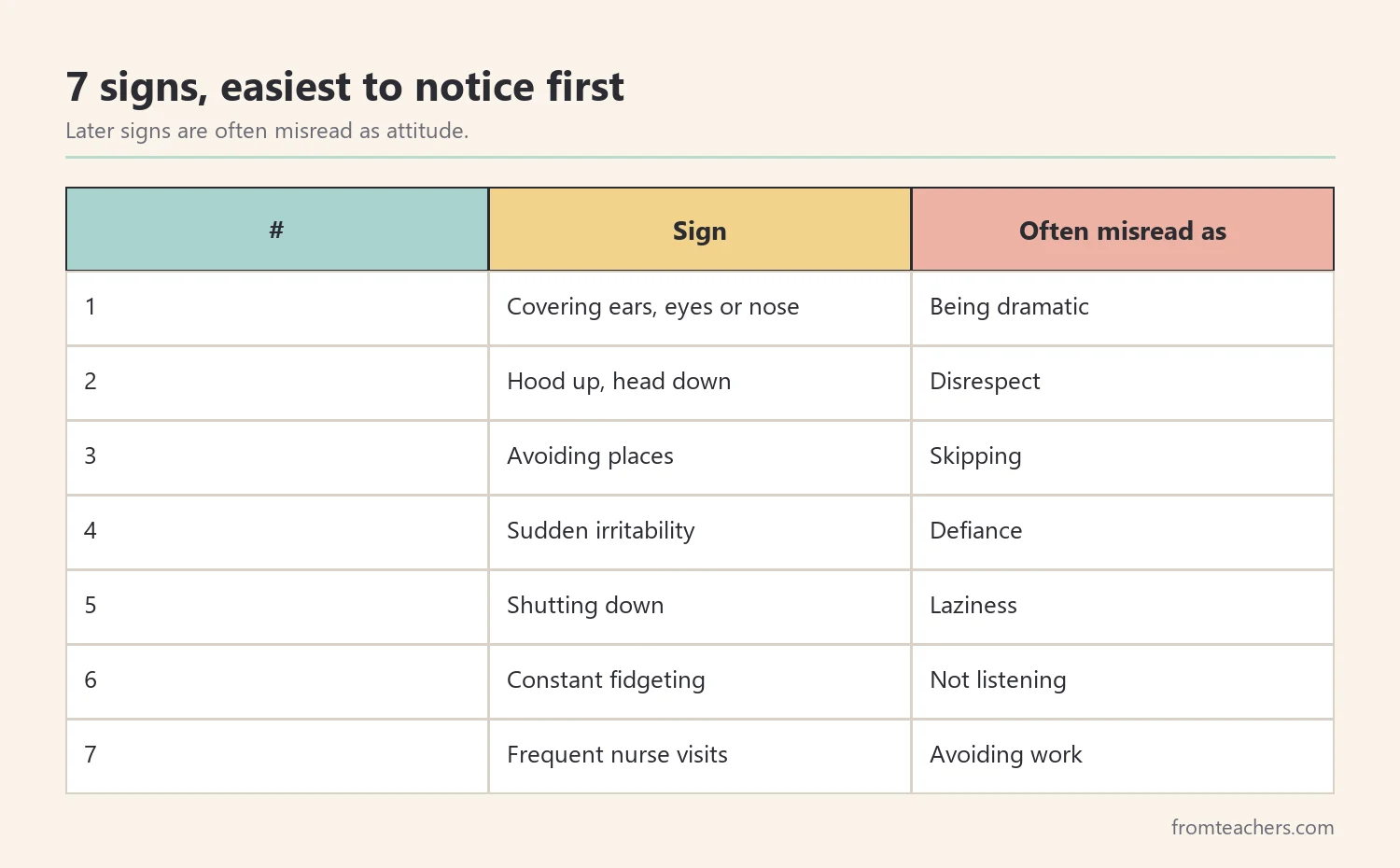
1. Covering ears, eyes or nose
What it looks like: hands over ears during fire drills or assemblies, squinting under bright lights, pulling a shirt over the nose in the cafeteria or lab.
Why it happens: some students are more sensitive to sound, light or smell, and protective gestures are an automatic response.
Calm response: offer an option privately, such as sitting near the door, wearing headphones during independent work or stepping out briefly before a drill if your school plan allows.
Example: Jordan pulled his sleeve over his nose during a vinegar experiment. His teacher, Mr. Shah, moved his group’s station next to the open window for the next lab.
2. Hood up, head down, headphones on
What it looks like: a student hides under a hood, puts their head on the desk or asks repeatedly to wear earbuds.
Why it happens: these are common ways older students reduce input without drawing attention.
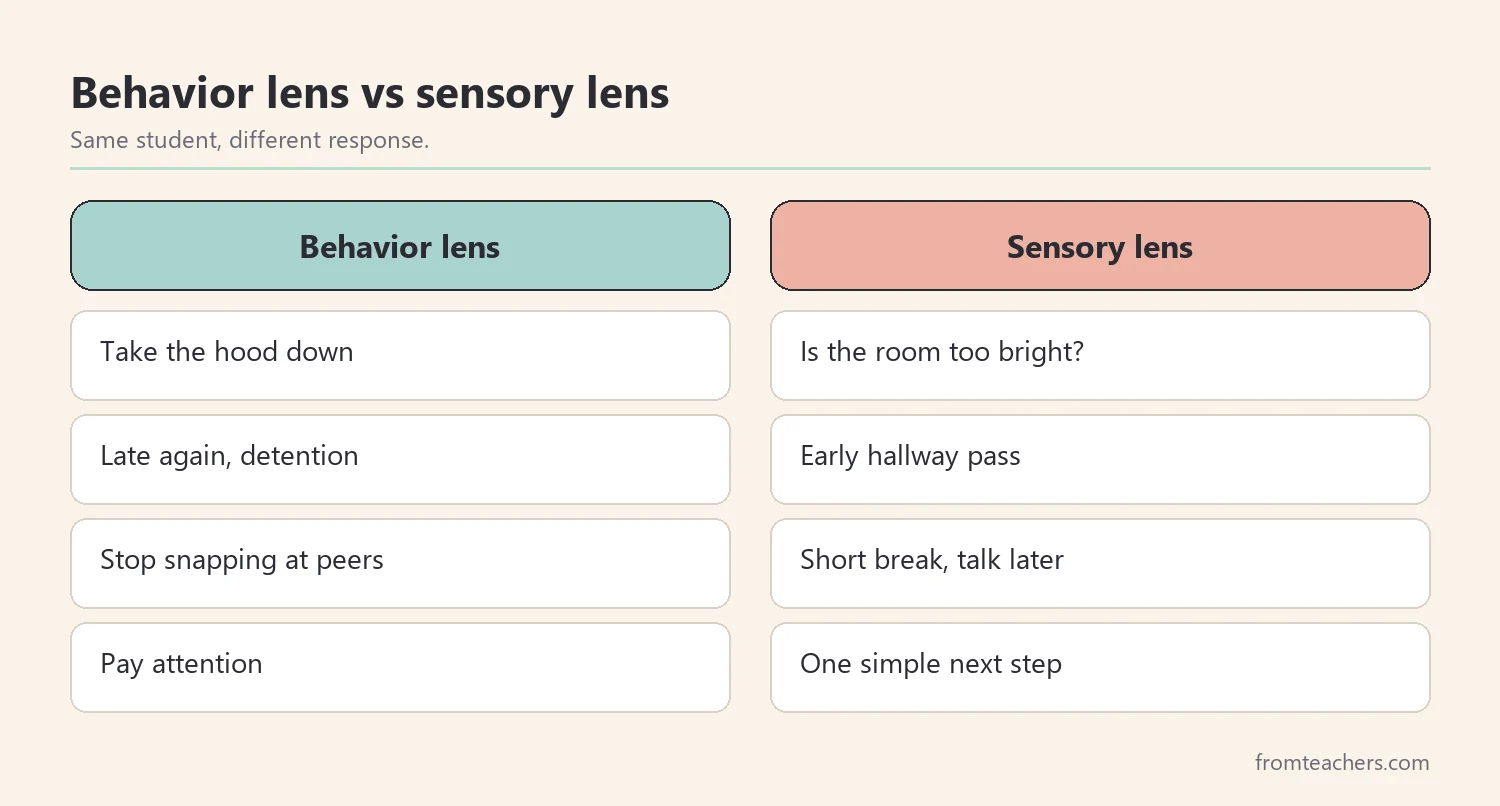
Calm response: before enforcing a dress or device rule, ask privately, “Is the room too loud or bright right now?” Work with the team on an agreed option.
Example: Mr. Shah asked Jordan quietly after class. Jordan admitted the lab fan “felt like it was inside my head.” They agreed he could use foam earplugs during noisy labs.
3. Avoiding certain places
What it looks like: eating lunch in the library, arriving late to avoid crowded hallways, asking to skip assemblies or “forgetting” gym clothes.
Why it happens: avoidance is a simple way to stay away from overwhelming spaces.
Calm response: notice patterns before treating them as discipline issues. A pass to leave class one minute early can reduce hallway stress.
Example: Jordan was late to science three times in a week. The cause was the crowded hallway outside the gym. An early pass solved the lateness.
4. Sudden irritability or snapping at peers
What it looks like: a usually calm student snaps, argues or reacts strongly to a small bump or comment, often late in a busy day.
Why it happens: sensory input builds up. By sixth period, a small extra trigger can tip a student over.
Calm response: lower your voice, reduce demands and offer a short break before discussing behavior. Talk about what happened later, in private.
Example: Jordan snapped at a partner during a group project after a loud assembly. Mr. Shah gave him five minutes in the hallway quiet spot first, then they talked.
5. Shutting down or “zoning out”
What it looks like: the student stops responding, stares, stops writing or gives one-word answers.
Why it happens: some students respond to overload by withdrawing rather than reacting. This is easy to mistake for daydreaming or lack of effort.
Calm response: check in quietly, reduce noise and lights if you can and give one simple next step instead of a full set of directions.
Example: During a loud film clip, Jordan stopped taking notes. Mr. Shah lowered the volume and handed him a written copy of the three key points.
6. Constant fidgeting or seeking movement
What it looks like: tapping, rocking, chewing pencils, standing up often or pressing hard on surfaces.
Why it happens: some students seek extra input to regulate themselves. Others move more when they feel overloaded.
Calm response: offer acceptable outlets, such as a fidget tool, a standing spot or a quick errand. The school occupational therapist can suggest options that fit the student.
Example: Jordan began chewing his hoodie strings during tests. With his family’s input, the team agreed on chewing gum during tests, which the school allowed for him.
7. Physical complaints and frequent nurse visits
What it looks like: headaches, stomachaches or tiredness, especially on assembly days or before PE.
Why it happens: sustained sensory stress can be exhausting, and some students describe it as feeling sick. Of course, physical complaints can also have medical causes, so never assume.
Calm response: take complaints seriously, follow your school’s health procedures and share patterns with families and the nurse.
Example: Jordan’s nurse visits clustered on Tuesdays, which were his PE and lab days. Sharing that pattern helped his family and the school team plan supports.
Where signs tend to show up
Sensory overload in middle school often follows the timetable. The table below shows where Mr. Shah noticed Jordan’s signs over two weeks. The data is fictional and only shows a simple way to track.
| Setting | Signs noticed | Times in 2 weeks |
|---|---|---|
| Science lab | Covering nose, shutdown | 4 |
| Hallway | Late arrival | 3 |
| Cafeteria | Avoided, ate in library | 5 |
| Assembly | Irritability afterward | 2 |
| Quiet classroom | None noticed | 0 |
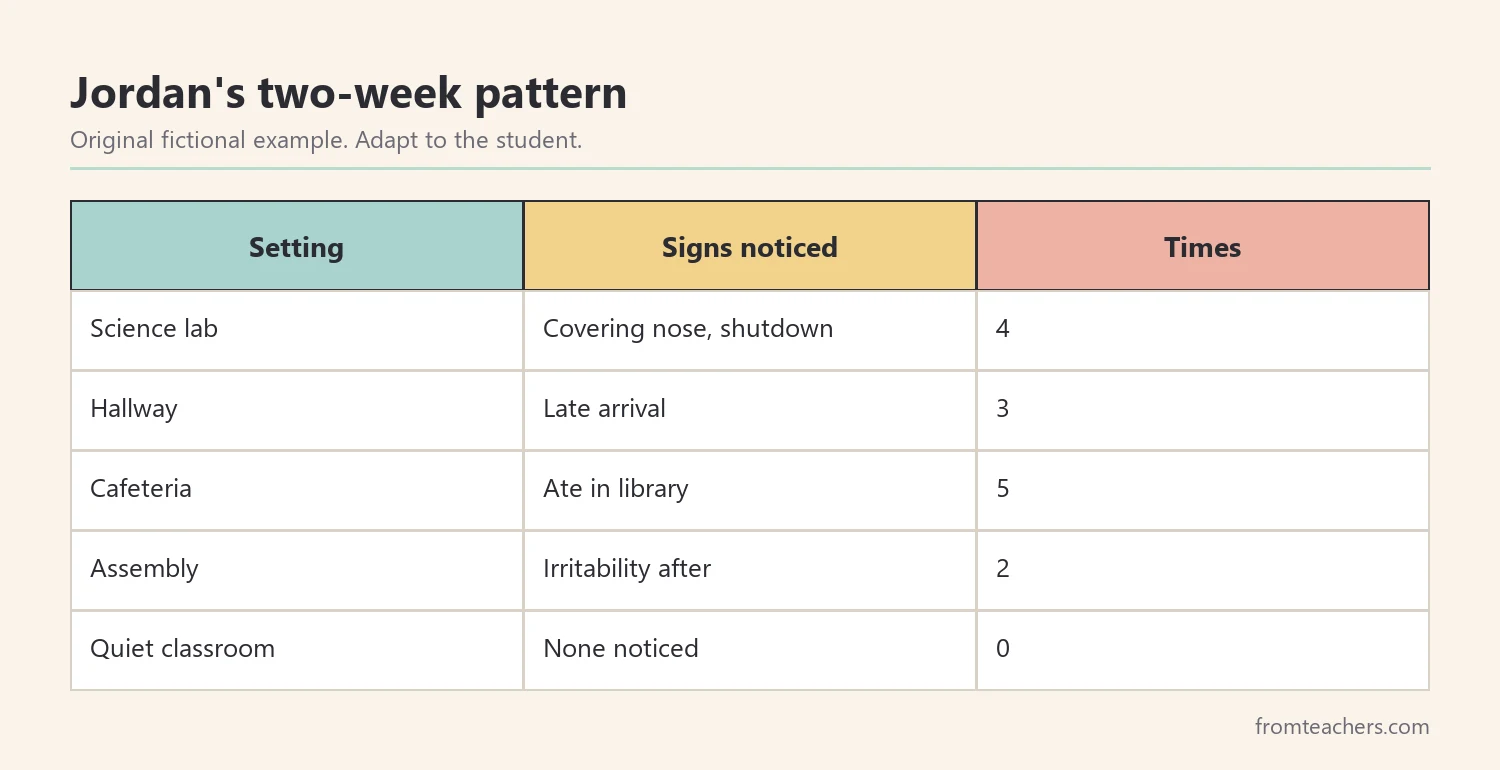
Notice the last row. Jordan showed no signs in quiet rooms. That contrast is important evidence that the environment, not motivation, was the main factor.
What to do after you notice a pattern
One sign on one day tells you little. A pattern across days and settings is worth acting on. Figure 4 shows a simple response sequence.
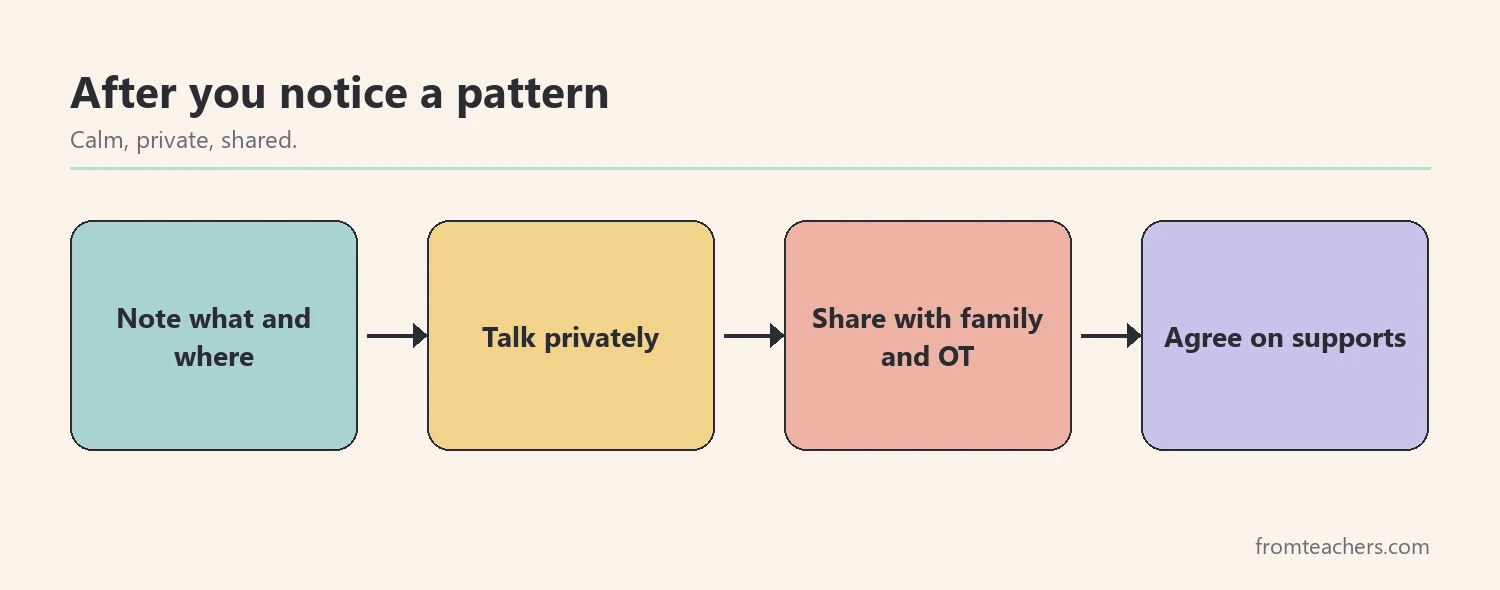
First, note what you see and where. Second, talk privately with the student, using neutral words like “too loud” or “too much.” Third, share the pattern with the family and the case manager or school occupational therapist. Fourth, agree on supports and, when needed, formalize them through an IEP or 504 plan. A guide like the SPD guide with sections for parents, teachers and students helps everyone use the same language across home and school.
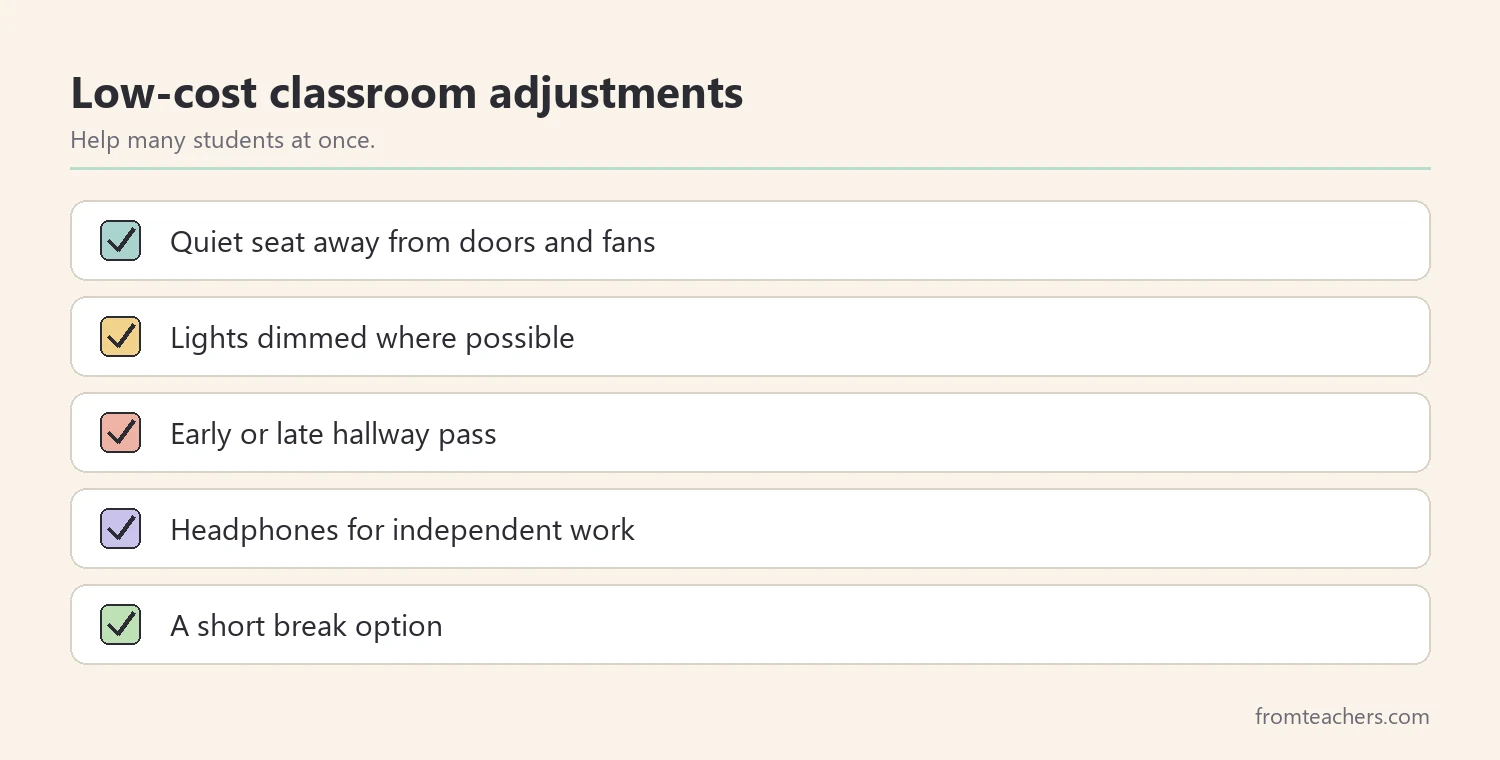
Figure 5 lists simple classroom adjustments that often help many students at once.
Talking with the student
Many twelve and thirteen year olds do not have words for what they feel. They may say “I’m fine” or “this class is annoying” when they mean the room is too much. Give them simple, neutral words to use, such as “too loud,” “too bright” or “I need two minutes.” Then agree on a quiet signal, like a card on the desk or a hand on the chin, so they can ask for a break without speaking in front of peers.
Also, invite the student to help design supports. Ask, “What helps when the lab gets loud?” Students who help choose a support are more likely to use it. Jordan chose earplugs and a seat by the window himself, and he used both without reminders.
Finally, check in again after two or three weeks. Needs change with schedules, seasons and new classes, so treat supports as a plan to review, not a permanent label.
Common mistakes teachers make
- Correcting in public. Fix: talk privately; middle schoolers are very sensitive to peer attention.
- Assuming defiance. Fix: ask what the student is experiencing first.
- Removing all challenge. Fix: adjust the environment while keeping learning goals.
- Labeling the student. Fix: describe what you see; leave diagnosis to qualified professionals.
- Working alone. Fix: share patterns with the family and support staff.
Questions teachers ask about sensory overload in middle school
Is this only for students with autism or ADHD?
No. Sensory sensitivities are common in autism and ADHD, but other students can also experience overload. Respond to what you see, not to a label.
How do I tell overload from avoidance of work?
Look at patterns. If problems happen mainly in loud or busy settings and disappear in quiet ones, the environment is a strong clue.
Can I allow headphones if school rules forbid devices?
Talk with your administrator and the student’s team. Many schools allow noise reducing headphones as an agreed support.
Should I tell the class why a student has a support?
No. Supports are private. You can explain that different people need different tools, without naming anyone.
Who can evaluate sensory needs at school?
Often the school occupational therapist, as part of an evaluation agreed by the team and the family.
Related reading: Managing Sensory Overload in Autism and ADHD, Understanding Autistic Burnout and School Exhaustion, and Understanding Autism and ADHD Meltdowns.
You may also need: SPD Support Toolkit: Sensory Spaces and Calming Strategies.
A companion resource for understanding sensory overload in middle school:
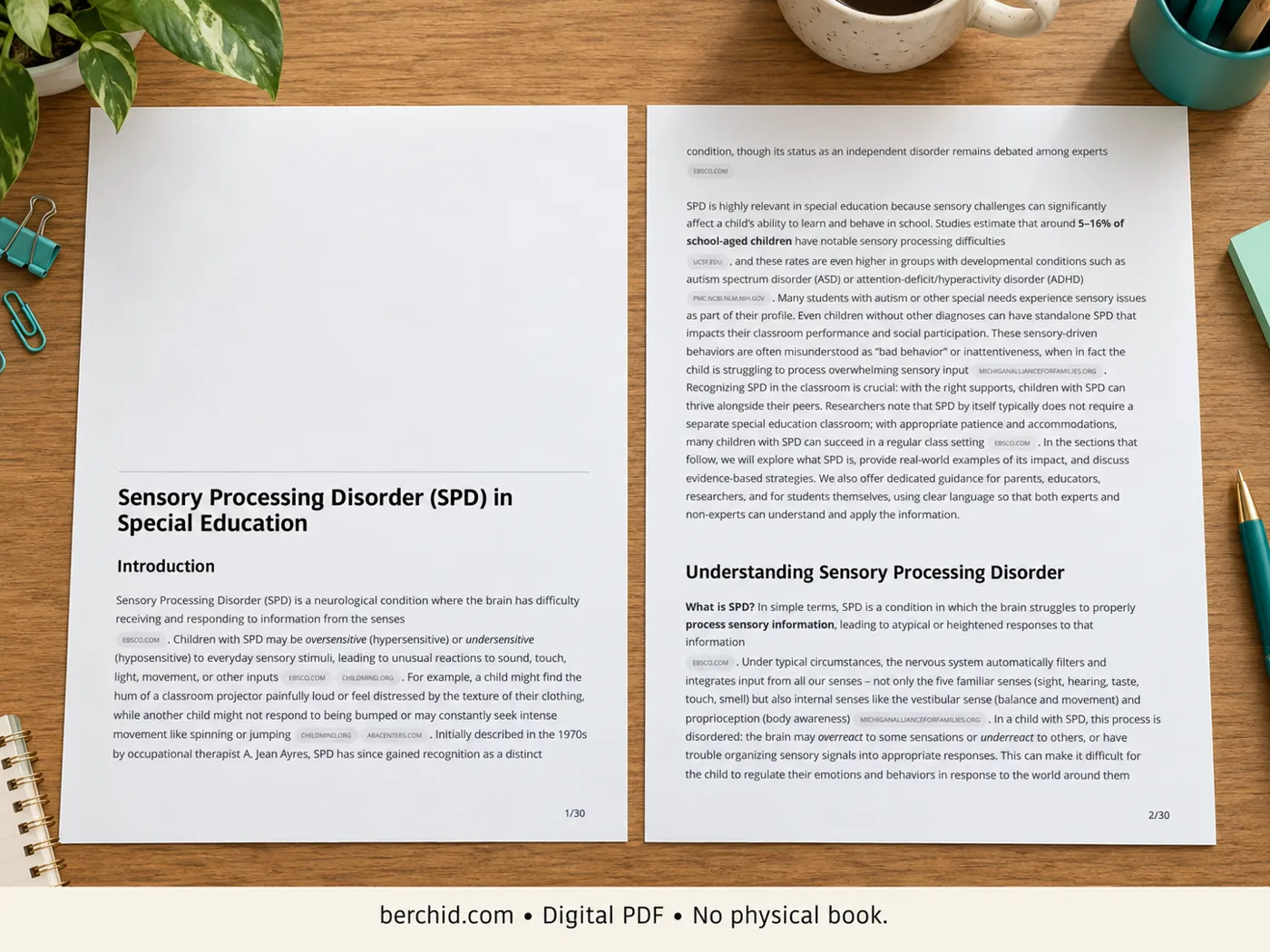
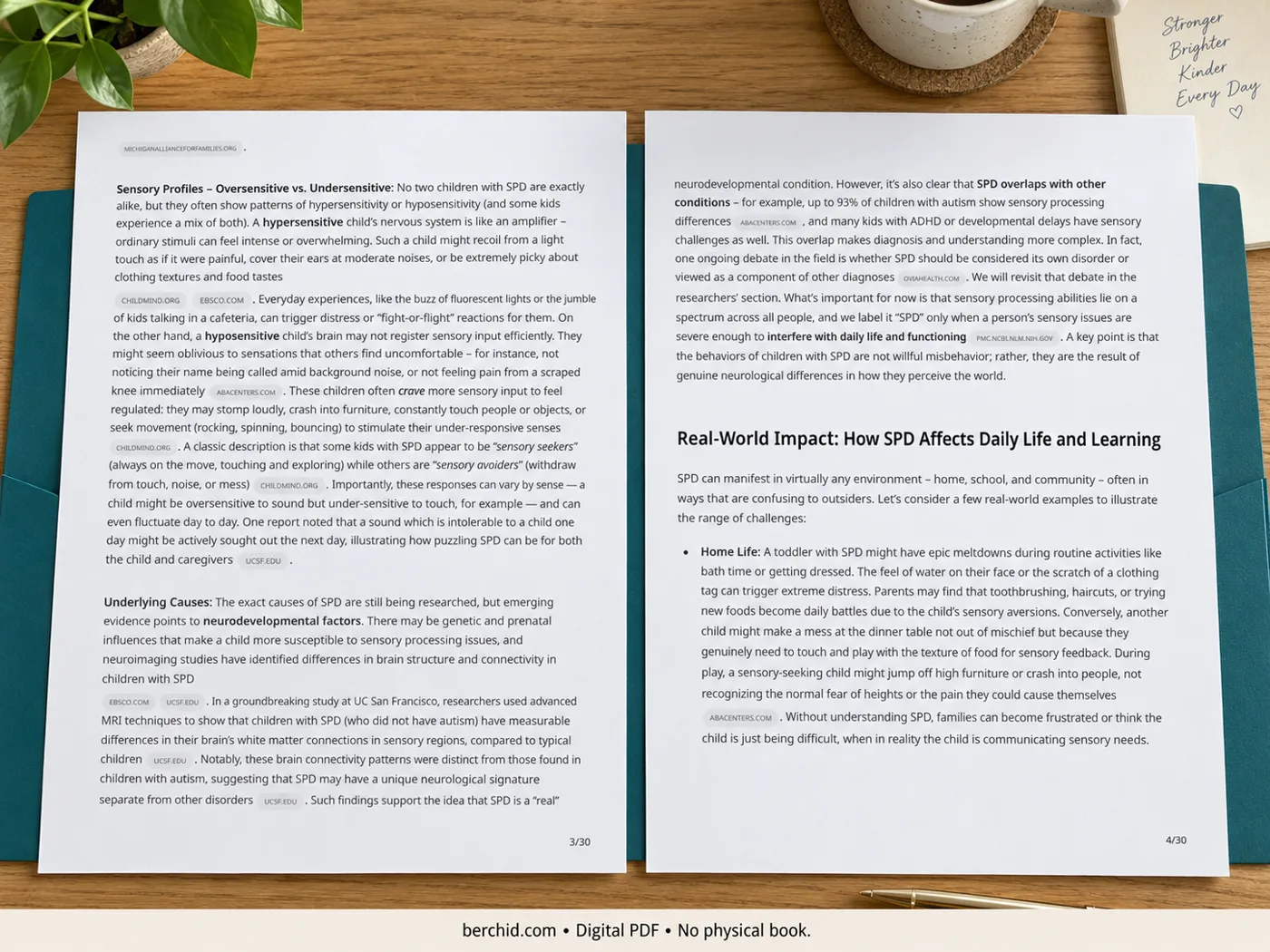
Sensory Processing Disorder (SPD) Guide: Strategies for Parents & Teachers: a 30-page guide with an overview of hypersensitive and hyposensitive profiles, a parent section on routines and calming spaces, an educator section on classroom adjustments, sensory breaks, accommodations across art, music, PE, lunch and recess and IEP or 504 supports, a research summary and a student section on self-regulation.
Sources and scope
- American Occupational Therapy Association (AOTA): information on occupational therapy and sensory-based supports in schools.
- Understood.org: plain-language articles on sensory processing challenges for families and teachers.
- Center for Parent Information and Resources: information on IEPs, 504 plans and working with school teams.
- National Institute of Mental Health: Autism Spectrum Disorder: an overview that includes sensory differences commonly reported in autism.
This list helps teachers notice and respond to possible signs of sensory overload in school. It is not a diagnostic checklist. Sensory processing disorder is not a separate diagnosis in every medical manual, so talk with families, the school occupational therapist and the student’s care team about evaluation.
Key takeaways
- Sensory overload in middle school is often hidden or misread as attitude.
- Look for patterns across settings, especially labs, hallways and cafeterias.
- Respond privately and calmly before addressing behavior.
- Small environmental changes often help many students.
- Share patterns with families and the school team.








Leave a Comment