

Self-advocacy role play scenarios give transition age students a safe place to practice conversations they will soon face alone, at college, at work and at the doctor’s office. Picture Andre, an eighteen year old with a learning disability who will start a part time job and a community college course next fall. In class he knows his accommodations by heart, yet when his teacher asks him to explain them to a pretend manager, he freezes.
This list is for transition teachers, special education case managers and job coaches who work with students aged 16 to 21. It ranks eight scenarios from the lowest stakes to the highest. Each scenario includes the situation, a short script outline, what the student practices and how Andre handled it. You will also find a practice plan and a simple way to track growth across the semester.
Examples are fictional. Adapt to the student’s goals and agreed supports. This is guidance, not a diagnosis.
At a glance
- Practice makes real conversations feel familiar.
- Start with low stakes situations and build up.
- Give students a simple script, not a speech.
- Rehearse responses to a no, not only to a yes.
- Debrief every role play with one strength and one next step.
How we ranked these scenarios
We ranked the eight self-advocacy role play scenarios from the lowest stakes to the highest. Scenarios 1 to 3 involve familiar people and everyday requests. Scenarios 4 to 6 involve new adults, such as instructors and managers. Then, scenarios 7 and 8 involve disagreement or unfair treatment, which are the hardest to practice. Figure 1 shows the full order.
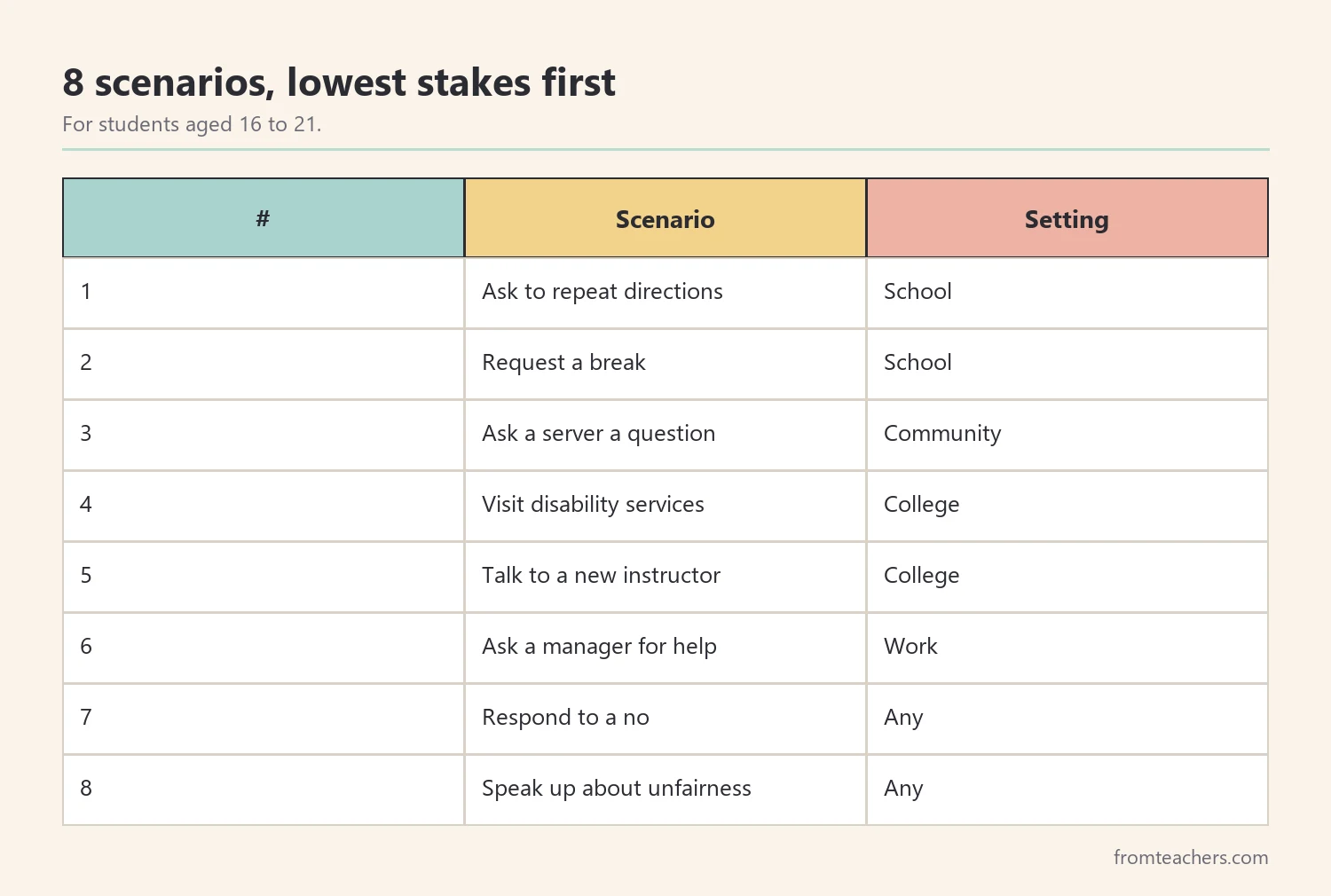
Each scenario uses the same basic script: say what is happening, say what you need and ask a clear question. Students can adapt the words, but the structure stays the same.
1. Asking a teacher to repeat directions
Situation: the student missed part of the directions in class.
Script outline: “I missed the second step. Could you repeat it or write it down?”
What it practices: a simple, polite request with a familiar adult.
Example: Andre started here. He said the line quietly the first time, then clearly the second.
2. Requesting a break when overwhelmed
Situation: the student feels stressed during a long task.
Script outline: “I need a five minute break, then I will come back and finish.”
What it practices: naming a need and offering a plan.
Example: Andre practiced adding “then I will finish,” which made the request sound responsible.
3. Ordering at a restaurant with a question
Situation: the student needs to ask about a menu item or ask the server to read options aloud.
Script outline: “Could you tell me what comes with this?”
What it practices: speaking up in the community with a stranger.
Example: Andre, who finds dense text hard to read quickly, practiced asking the server to describe the specials.
4. Talking to a college disability services office
Situation: the student visits the disability services office to ask about accommodations.
Script outline: “I have a learning disability. In high school I had extended time and notes. What do I need to request accommodations here?”
What it practices: describing a disability and past supports to a new office. After high school, students usually need to request accommodations themselves.
Example: Andre brought a short list of his supports. His teacher played the coordinator and asked follow-up questions.
5. Explaining a need to a new instructor
Situation: the student meets a college instructor during office hours.
Script outline: “I have an accommodation letter for extended time on tests. When is a good time to plan for the first exam?”
What it practices: being proactive instead of waiting for a problem.
Example: Andre practiced handing over a pretend letter and asking about the first test date.
6. Asking a manager for a workplace adjustment
Situation: the student needs written task lists at a new job.
Script outline: “I work best with written instructions. Could I get a checklist for closing tasks?”
What it practices: framing a need around doing the job well. Students can choose how much to share about their disability.
Example: Andre decided not to mention his diagnosis and focused on what helps him work well. His teacher discussed with him that this choice is his to make.
7. Responding when a request is refused
Situation: an instructor or manager says no.
Script outline: “I understand. Can we find another way? If not, who else could I talk to about this?”
What it practices: staying calm and knowing the next step.
Example: This was the hardest scenario for Andre. After three rounds, he could stay calm and ask who to contact next.
8. Speaking up about unfair treatment
Situation: the student believes they were treated unfairly because of their disability.
Script outline: “I felt that what happened was not fair. I would like to talk about it with someone who can help.”
What it practices: naming a concern, staying safe and seeking support from the right people.
How to run it: keep it calm and general, and connect it to who the student can contact. The Self-Advocacy Skills intervention toolkit for students with disabilities includes guides on responding to unfair treatment, handling difficult conversations with teachers or employers and understanding rights, each in a step by step format you can turn into a role play.
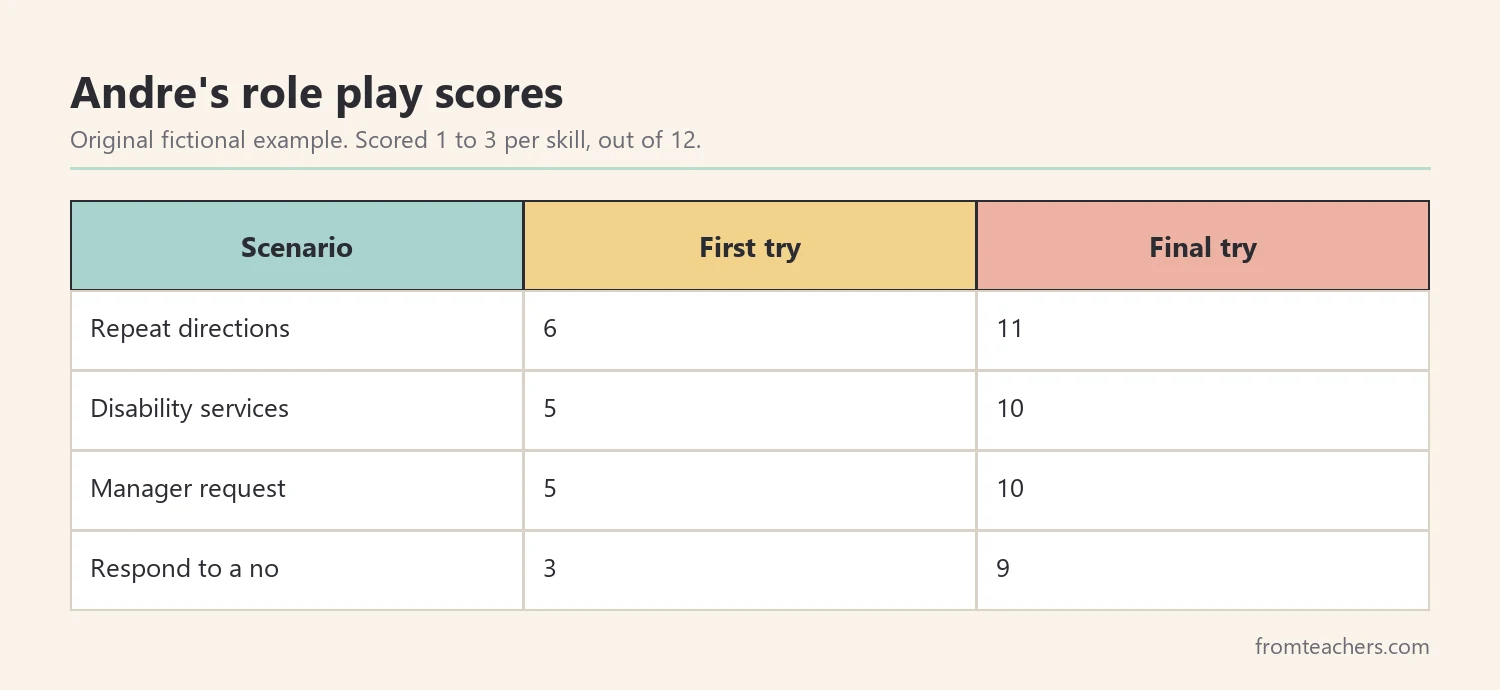
Example: Andre practiced telling a trusted adult about a pretend situation and asking for help. Figure 2 shows his progress across the eight scenarios.
Low stakes versus high stakes practice
Students need both kinds of practice, in the right order. Figure 3 compares them.
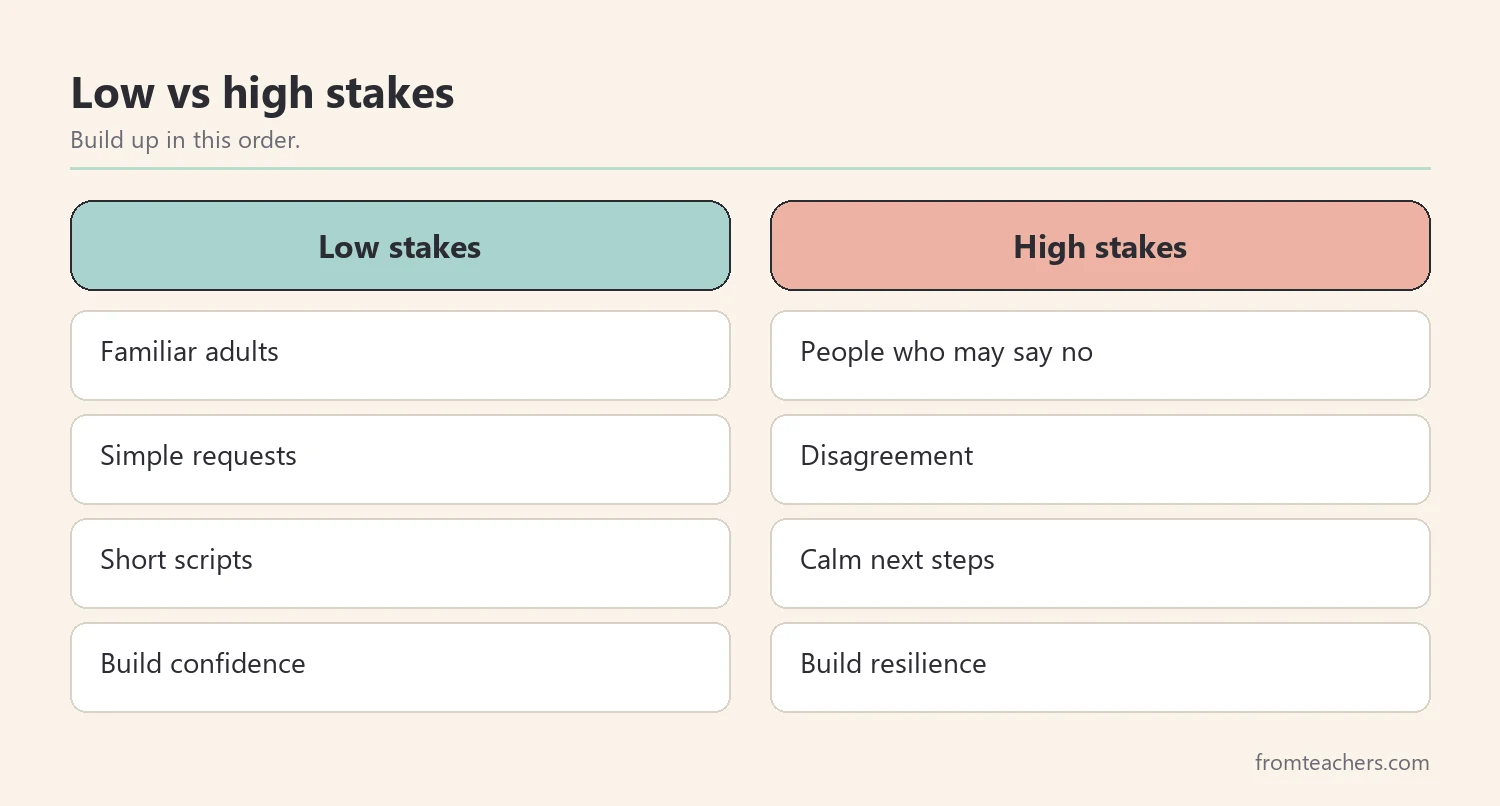
| Scenario type | Who is involved | Main skill |
|---|---|---|
| Low stakes | Familiar adults | Clear, polite requests |
| New adults | Instructors, managers | Explaining needs |
| High stakes | People who say no | Staying calm, next steps |
A simple role play routine
Self-advocacy role play scenarios work best with a short, repeatable routine. Figure 4 shows the four steps Andre’s class used each time.
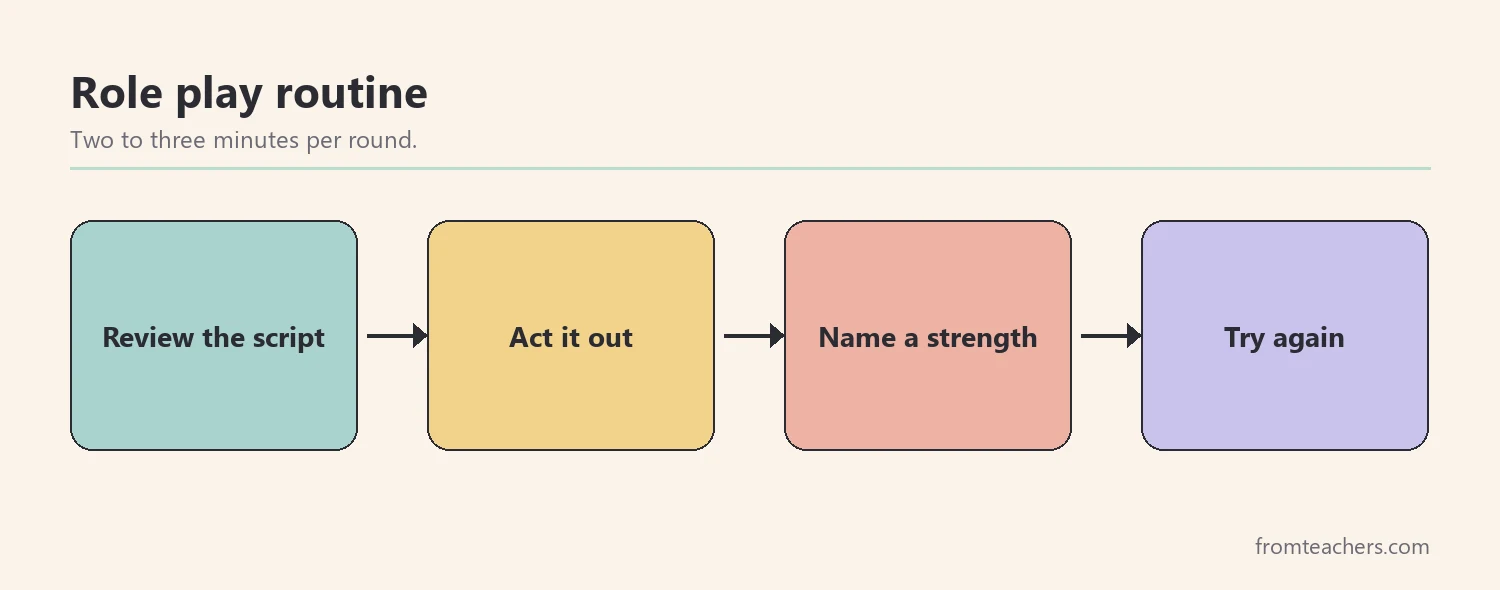
First, review the script outline together. Then the teacher or a peer plays the other person while the student practices. Afterwards, the class names one strength and one thing to try next time. Finally, the student tries again with the feedback.
Keep each role play short, about two to three minutes. Several short rounds are more useful than one long performance.
Making practice feel safe
Role play can feel exposing, especially for students with anxiety. Let students choose whether to practice in front of the class, in a small group or one to one with an adult. In addition, allow written scripts at first and fade them as confidence grows.
Use realistic but fictional situations. Students should never be asked to act out personal or painful experiences unless they choose to, and only with appropriate support.
Andre began with one to one practice with his teacher. By the end of the semester, he volunteered to role play the manager conversation in front of the class.
Tracking growth across the semester
Use a simple rubric to track how students handle each scenario: clear request, calm tone, a question and a next step. Score each from 1 to 3. Figure 5 lists the five checks Andre’s teacher used after each role play.
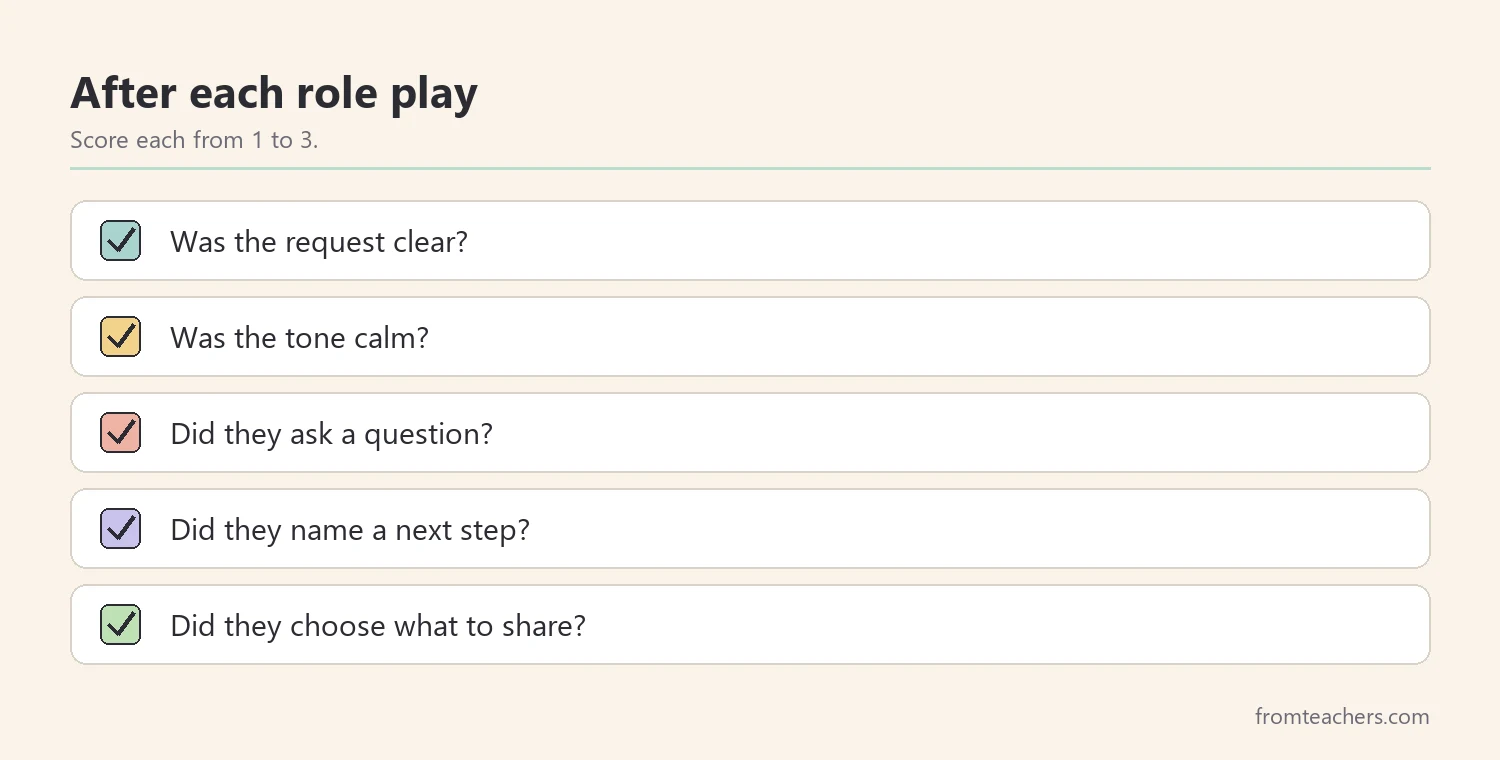
Share progress with students. Seeing their scores rise is often more motivating than any reward.
Involving families and community partners
Practice in the classroom is a strong start, but real confidence grows when students try their skills in real places. Ask families to set up small, safe chances at home and in the community. For example, a parent can let the student call to book their own haircut or ask a pharmacist a question while the parent waits nearby.
Community partners can help too. Some transition programs invite local employers or college staff to play the manager or coordinator in a role play. Hearing feedback from a real manager often feels more meaningful to students than feedback from their teacher.
Before any real world try, review the script and agree on a backup plan, such as a phrase to use if the student feels stuck. Afterwards, debrief just as you would in class.
Andre’s mother let him call the community college himself to ask about the disability services office hours. He reported back proudly that the call took less than three minutes and that he remembered every part of the script.
Common mistakes and how to avoid them
- Starting with high stakes scenarios. Fix: build up from familiar, easy requests.
- Writing long speeches. Fix: use a three part script outline.
- Only practicing a yes. Fix: rehearse responses to a no.
- Forcing disclosure. Fix: let students decide what to share.
- Skipping the debrief. Fix: name one strength and one next step every time.
Questions teachers ask about self-advocacy role play scenarios
How often should students practice?
Short weekly practice works well. Many teachers run one or two scenarios each week across a semester.
Should students disclose their disability in every scenario?
No. Disclosure is a personal choice. Teach students what options they have and let them decide.
Can peers play the other role?
Yes, once students are comfortable. Peers often enjoy playing the manager or instructor.
What if a student refuses to role play?
Offer alternatives, such as writing the script, watching a model or practicing one to one.
How do role plays connect to the IEP?
Many transition plans include self-advocacy goals. Role play data can show progress toward those goals.
Related reading: Transition to Adulthood, Building Workplace Readiness, and Accommodations vs Modifications.
You may also need: Workplace Readiness and Soft Skills for Special Needs.
A companion resource for teachers using self-advocacy role play scenarios:
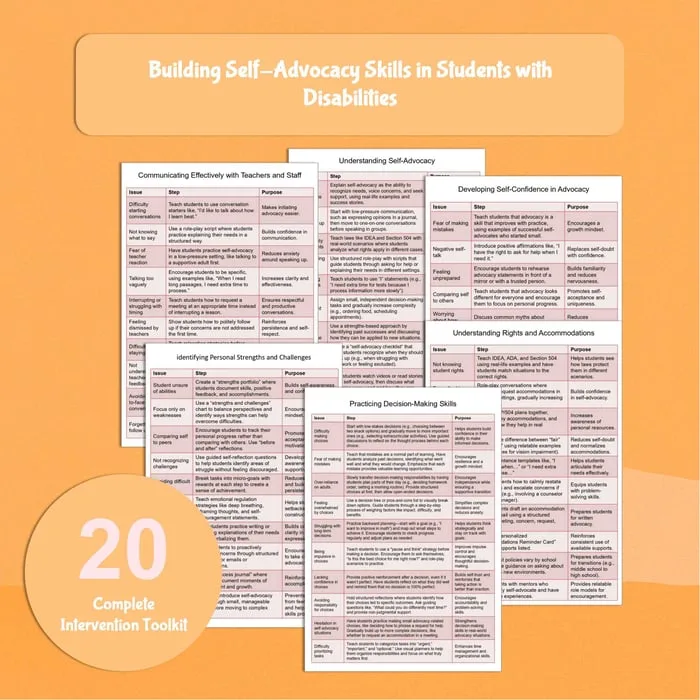
Self-Advocacy Skills for Students with Disabilities: SPED Intervention Toolkit: twenty intervention guides covering topics such as understanding rights and accommodations under IDEA, ADA and Section 504, communicating with teachers and staff, advocating in medical or therapy settings, handling difficult conversations with teachers or employers, responding to unfair treatment, managing anxiety and advocating for independence, each in the same Issue, Step, Purpose format.
Sources and scope
- Center for Parent Information and Resources: information on transition planning and student involvement in IEPs.
- ADA.gov (US Department of Justice): official information about the Americans with Disabilities Act.
- PACER Center: parent and youth resources on transition and self-advocacy.
- National Center for Learning Disabilities: resources on rights, transition and self-advocacy for young adults.
This list covers practice scenarios for students aged 16 to 21 in transition programs. It does not give legal advice; questions about specific rights should go to the school team, disability services offices or qualified advisors.
Key takeaways
- Self-advocacy role play scenarios prepare students for real conversations.
- Start with low stakes requests and build to harder ones.
- Use a short three part script outline.
- Practice responding to a no, not just a yes.
- Debrief, track progress and respect choices about disclosure.


Leave a Comment