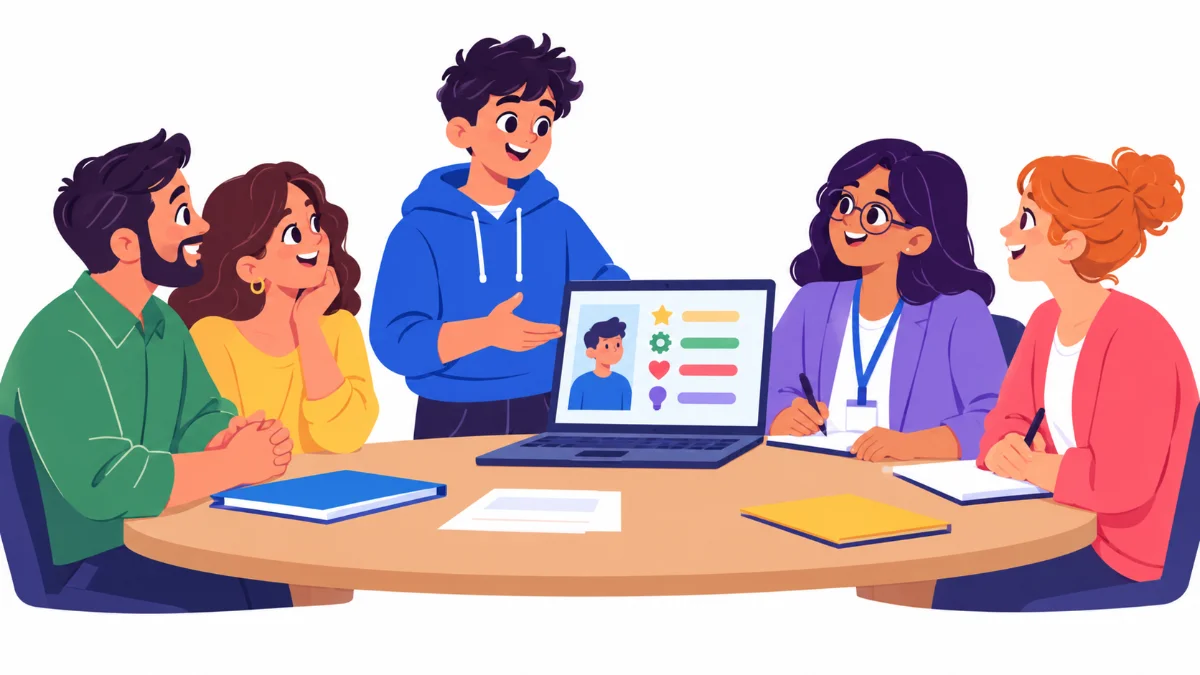

Self-advocacy IEP goals give high school students a written, measurable path toward speaking up for themselves before they leave school. Picture a grade 10 IEP meeting. Dev has extended time and notes provided in his plan, yet his English teacher has never heard him ask for either. When the case manager asks Dev what helps him learn, he says, “I don’t know. Whatever you guys decide.”
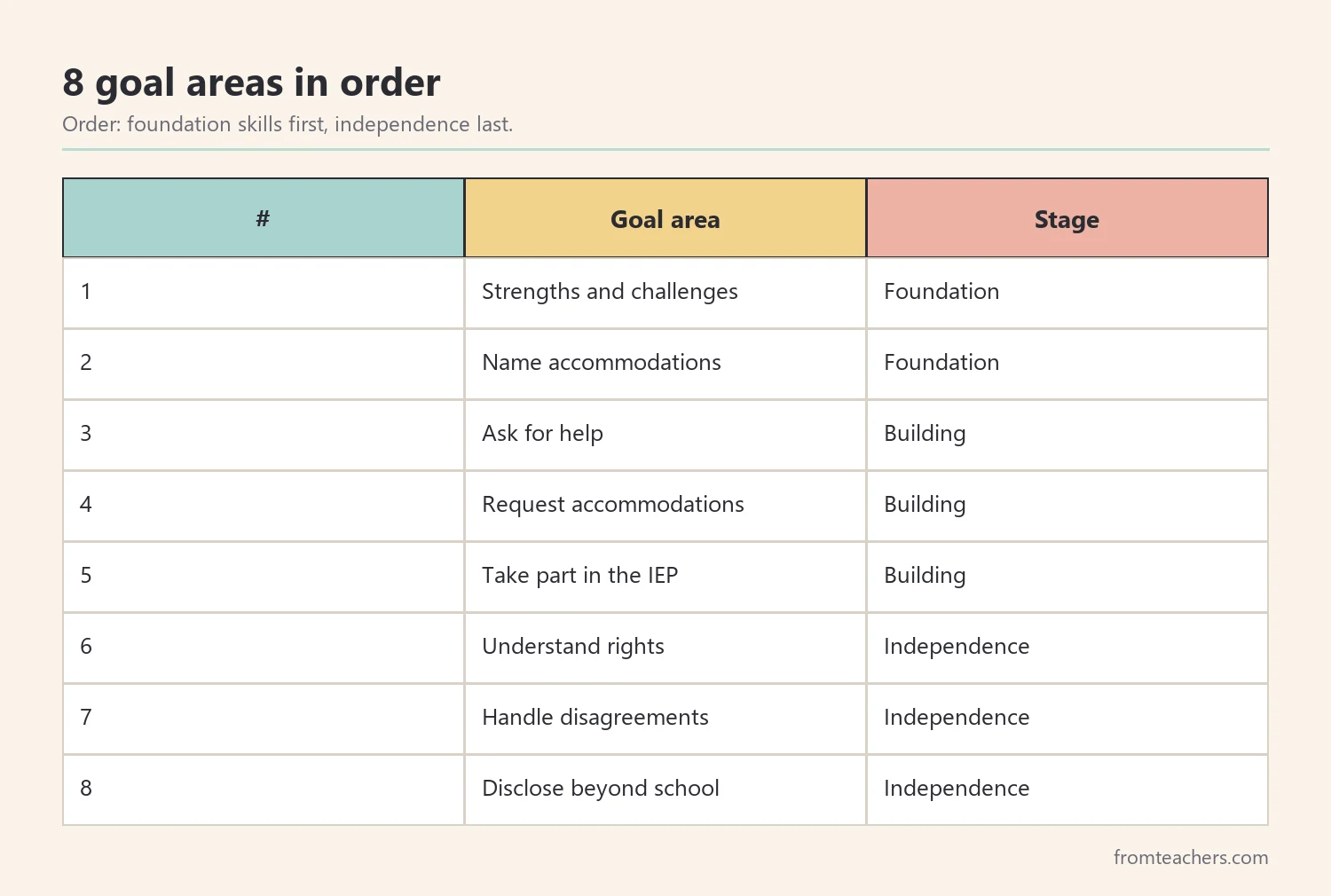
That answer is common, and it is a signal. After high school, students usually must disclose a disability and request accommodations themselves, at college or at work. This list offers eight example goal areas, ordered from foundational skills to the most independent ones, with sample goal wording, simple ways to measure progress, and classroom practice ideas. By the end, you will be able to draft goals that fit your student’s present levels.
Examples are fictional. Adapt to the student’s goals and agreed supports. IEP goals must be based on the student’s own data and written by the IEP team. This is guidance, not legal advice.
At a glance
- Order goals from foundation to independence.
- Start with strengths, challenges and knowing accommodations.
- Each goal needs a condition, a behavior, a criterion and a measure.
- Track requests with a simple teacher log and student self-ratings.
- Connect goals to transition planning and involve the student.
How we ordered these goals
We did not rank the goals as “best,” because the right goal depends on the student. Instead, we ordered them by one stated rule: from foundational skills that most students need first to independent skills that build on them. A student who cannot yet name their strengths and challenges is not ready to request accommodations at a job interview.
Each example follows a common goal pattern: condition, behavior, criterion, and measurement. Change the numbers and settings to match the student’s baseline data.
The ready-made option: a self-advocacy intervention toolkit
Writing self-advocacy IEP goals is one step. Teaching the skills behind them is another. The self-advocacy skills intervention toolkit for students with disabilities includes twenty intervention guides on topics such as understanding self-advocacy, understanding rights and accommodations including IDEA, ADA, and Section 504, communicating with teachers and staff, identifying strengths and challenges, decision-making, handling disagreements, setting goals, managing anxiety, and asking for help without embarrassment. Each page names a common issue, a step-by-step strategy, and the purpose behind it.
As a result, every goal on this list has matching lessons you can use in a resource period or advisory.
1. Describing strengths and challenges
The skill: the student can explain, in their own words, what they do well and what is hard for them in school.
Sample goal: “Given a structured interview, Dev will describe two academic strengths and two challenges related to his disability in 4 of 5 opportunities, as measured by a teacher checklist.”
How to practice: use strengths inventories, short reflection sheets, and role play: “Tell me about yourself as a learner.”
Example: Dev first said “I’m bad at reading.” After practice, he said, “I understand ideas well, but reading long texts takes me longer.”
2. Naming accommodations and why they help
The skill: the student knows their accommodations and can explain how each one helps.
Sample goal: “Dev will name each accommodation in his IEP and explain how it supports his learning, with 80% accuracy across three probes per quarter.”
How to practice: make an accommodation card with each support and a sentence about why it helps. Review it before each class.
Example: Dev’s card listed “extended time: I read slowly, so I need more time to show what I know” and “notes provided: I can listen instead of copying.” He kept the card in his binder and checked it before tests.
3. Asking for help in class
Among self-advocacy IEP goals, this one often shows quick, visible progress.
The skill: the student asks a teacher for help or clarification when stuck.
Sample goal: “When presented with an unclear task, Dev will ask the teacher a clarifying question within five minutes in 4 of 5 observed opportunities.”
How to practice: teach a simple script: “Can you explain step 2 again?” Practice in a small group first, then in class.
Example: Dev used a sticky note signal at first, then moved to asking aloud by week four.
4. Requesting an accommodation from a teacher
The skill: the student initiates an accommodation request, instead of waiting for an adult to offer it.
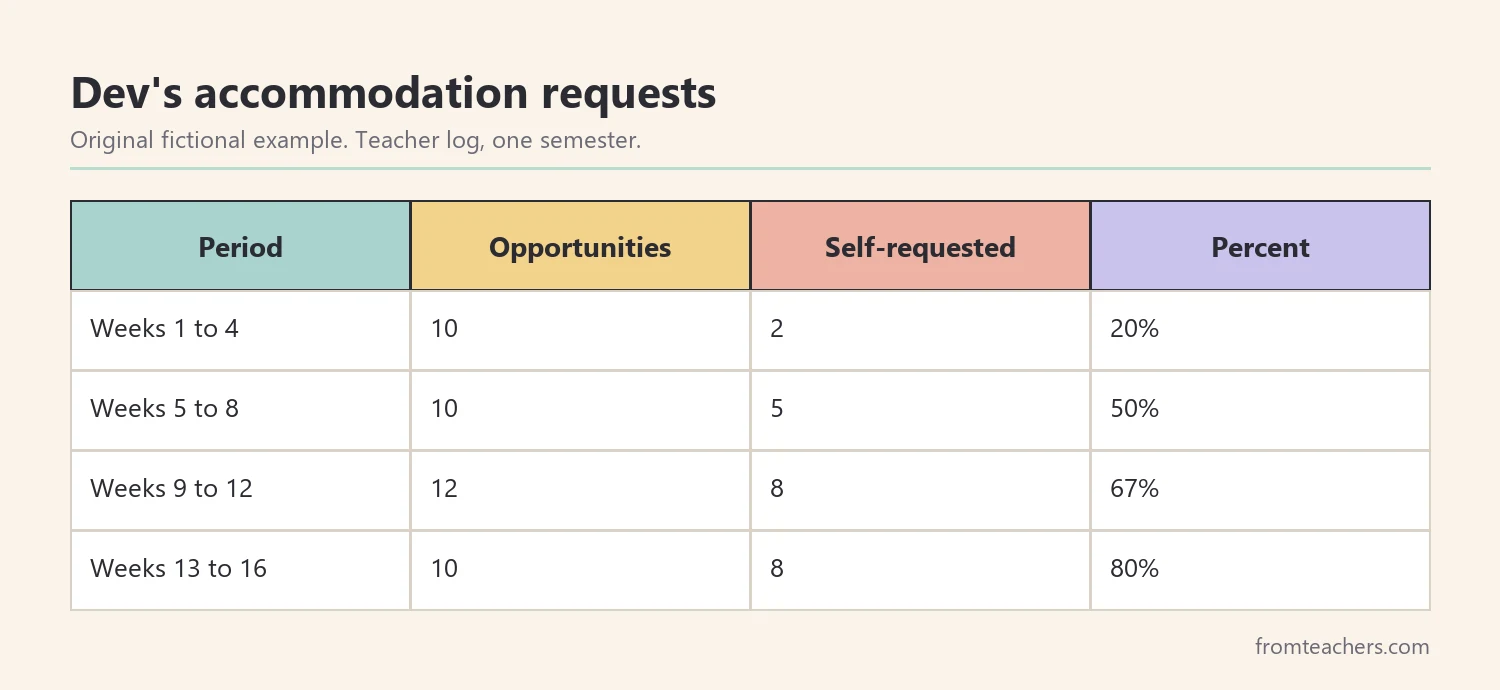
Sample goal: “Dev will independently request his extended time or notes accommodation before or during assessments in 80% of opportunities across two consecutive grading periods, as recorded on a teacher log.”
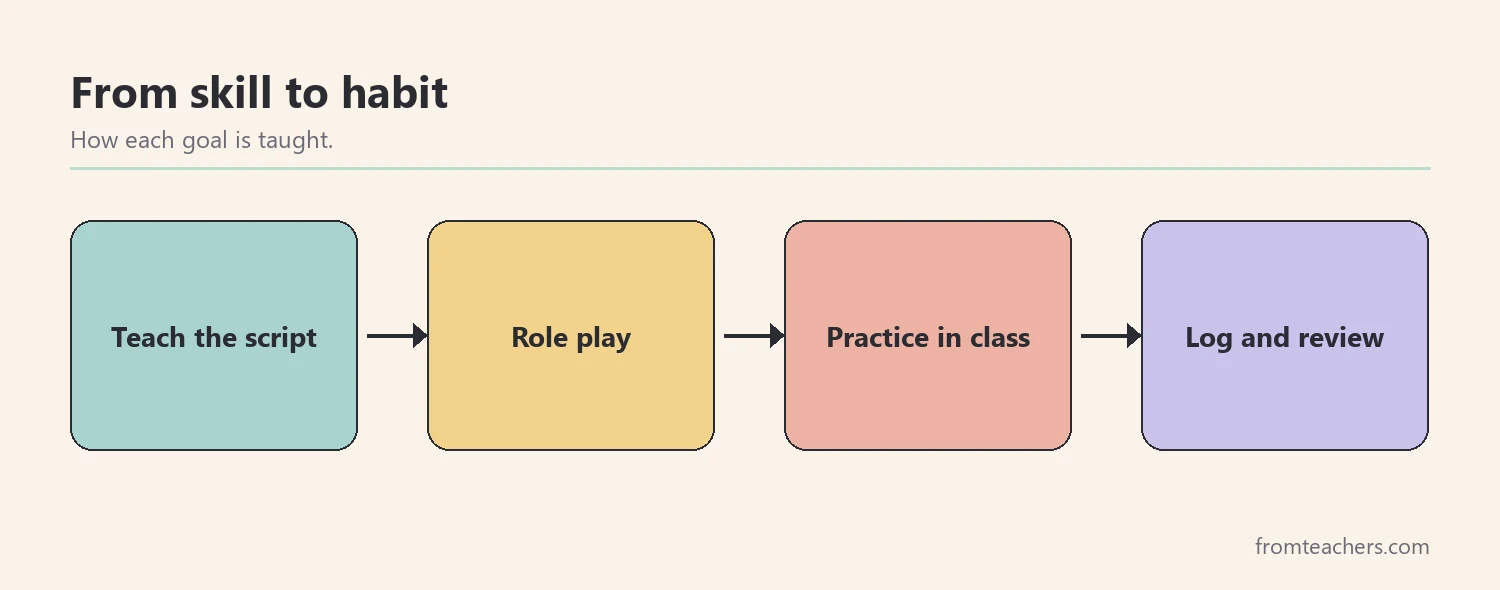
How to practice: role play short requests, then practice with a supportive teacher. Track requests on a simple log.
Example: Dev practiced the line “I have extended time on tests. Can I finish in the resource room after class?” with his case manager three times. The first real request was to his most supportive teacher, which made the second request, in English, much easier.
5. Participating in the IEP meeting
The skill: the student takes part in their own IEP meeting, sharing strengths, needs, and goals.
Sample goal: “With a prepared outline, Dev will present his strengths, challenges, and one postsecondary goal during his annual IEP meeting.”
How to practice: help the student prepare a short slide or note card. Practice with the case manager before the meeting.
Example: Dev presented three slides at his annual review. His parents said it was the first time they heard him describe his learning so clearly.
6. Understanding rights
The skill: the student understands basic rights under IDEA, Section 504, and the ADA, and how they change after high school.
Sample goal: “Dev will explain two differences between disability supports in high school and in college or the workplace, with 80% accuracy on a teacher-made quiz.”
How to practice: use plain-language resources and compare a high school IEP with a college disability services process.
Example: Dev’s class visited a community college website and found the disability services page. He noticed that students must contact the office and provide documentation themselves, which surprised him and made the goal feel real.
7. Handling disagreements respectfully
The skill: the student responds calmly when a request is denied or questioned, and follows up appropriately.
Sample goal: “In role play and real situations, Dev will use a three-step disagreement script (state the need, listen, propose a solution) in 3 of 4 opportunities.”
How to practice: rehearse common scenarios, such as a teacher forgetting an accommodation, and plan who to contact next.
Example: in one role play, a “teacher” said there was no time for extended testing that day. Dev calmly restated his need, listened, and suggested finishing at lunch. Then he named his case manager as the next contact if the problem happened again.
8. Disclosing and requesting supports beyond school
The skill: the student practices disclosure and accommodation requests for college, training, or work.
Sample goal: “Dev will role play disclosing his disability and requesting one workplace or college accommodation in 3 of 4 practice sessions, using a self-created script.”
How to practice: connect with transition planning. Practice with mock interviews and college disability office scenarios.
Example: Dev wrote a short script for a part-time job interview, including when he might mention his needs and what accommodation could help him learn new tasks. He practiced it with a job coach during a mock interview.
Measuring self-advocacy IEP goals
Self-advocacy can feel hard to measure, but simple tools work. First, use a short checklist during observed opportunities. Next, keep a teacher log of requests. Then add student self-ratings, so the student also reflects on progress.
Collect data at a steady rhythm, for example every two weeks. Figure 4 shows Dev’s requests for accommodations over one semester, recorded by his teachers.
Connecting goals to transition planning
IDEA requires transition planning in the IEP by age 16, and many states start earlier. Self-advocacy fits naturally there, because students will need these skills in college, training, or work. The National Technical Assistance Center on Transition offers resources on this topic.
In addition, involve the student when writing these goals. Ask, “Which of these skills would help you most next year?” A goal the student helped choose is more likely to matter to them.
| Grade | Typical focus |
|---|---|
| 9 | Strengths, challenges, accommodations |
| 10 | Asking for help, requesting supports |
| 11 | Leading parts of the IEP, rights |
| 12 | Disagreements, disclosure beyond school |
This sequence is only a guide. Some students are ready for later skills earlier, while others need more time on the foundations.
Writing tips for strong goals
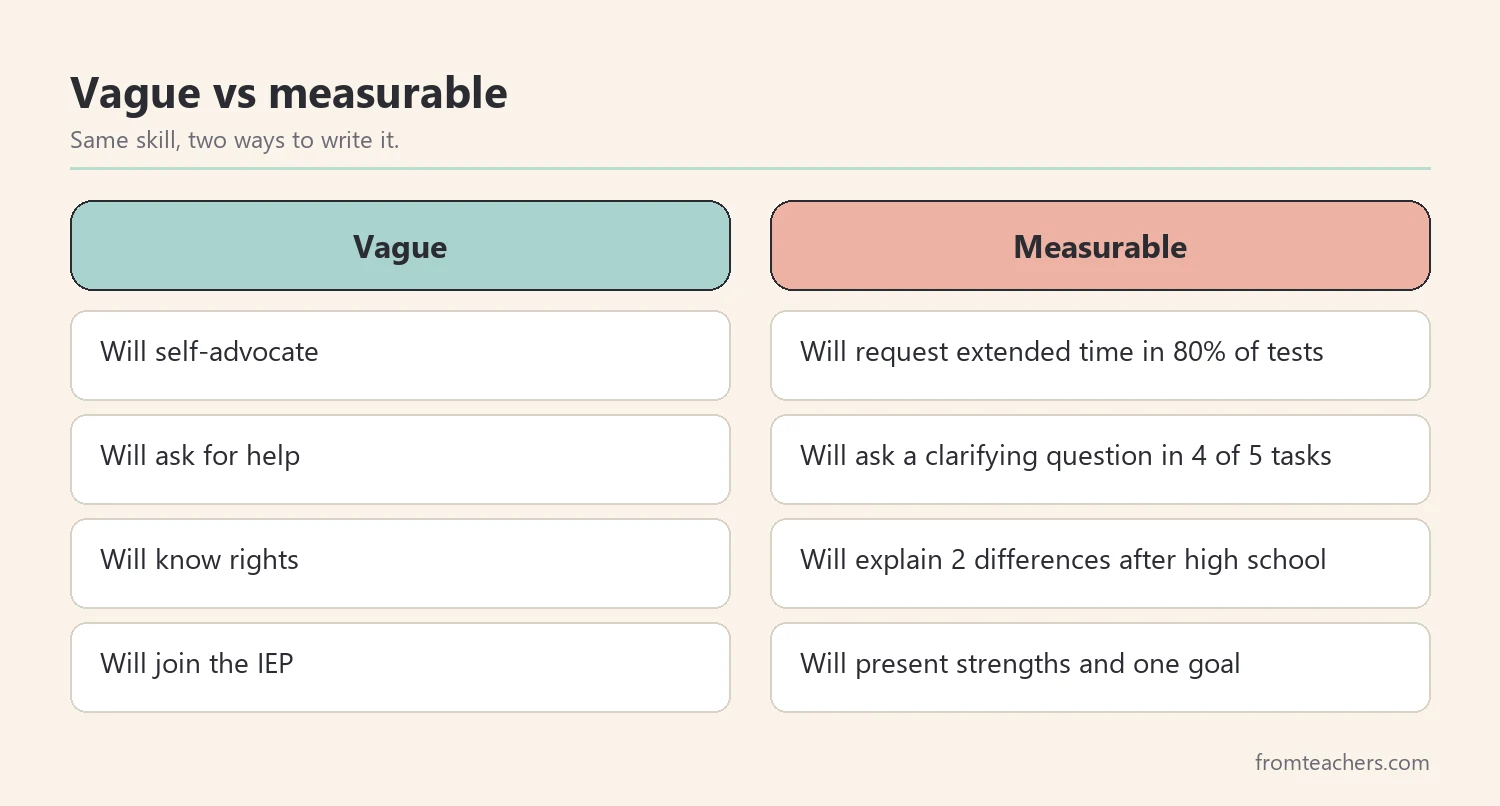
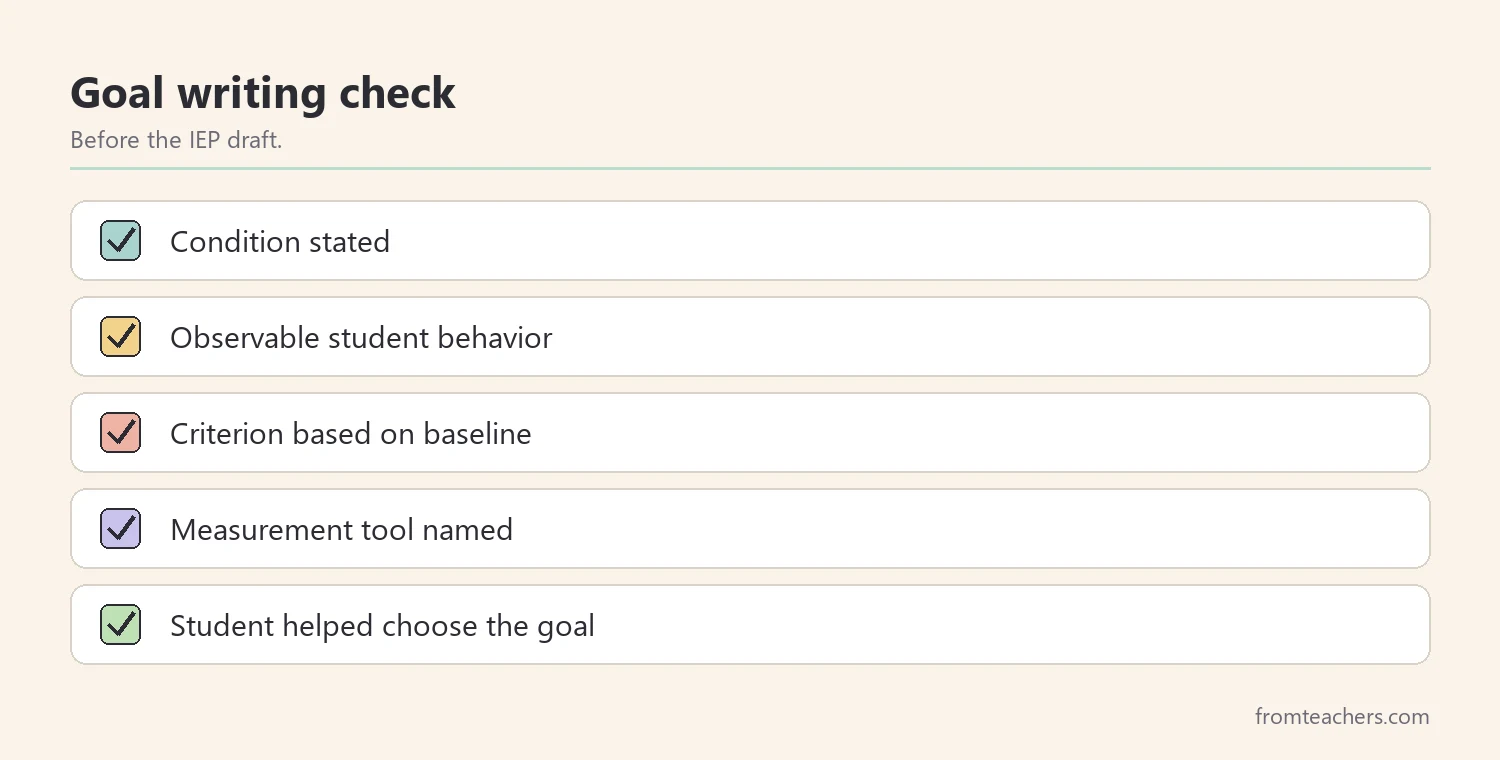
Strong goals are specific, measurable, and realistic. First, describe the condition, such as “when given an unclear task” or “during assessments.” Next, name an observable behavior, like “will ask a clarifying question,” not “will advocate better.” Then set a criterion based on baseline data. Finally, state how progress will be measured.
Also, avoid goals that depend on other people’s behavior. “Teachers will provide notes” is an accommodation, not a student goal. The goal should describe what the student will do.
In addition, keep the number of self-advocacy goals manageable. One or two well-chosen goals per year, practiced often, usually lead to more growth than a long list that no one has time to teach. Review progress at each reporting period and adjust when the student masters a skill early.
Common mistakes and how to avoid them
- Vague goals like “will self-advocate”: name a specific, observable behavior.
- No baseline: collect a few data points before setting a criterion.
- Jumping to advanced skills: start with strengths and accommodations.
- Writing goals without the student: invite the student into goal planning.
- No practice time: schedule lessons and role play, not just data checks.
Questions teachers and parents ask about self-advocacy IEP goals
At what age should self-advocacy goals start?
Self-advocacy can start in elementary school with simple skills, such as asking for help. In high school, goals usually become more formal and connected to transition planning.
Can self-advocacy be part of a transition goal?
Yes. Many teams connect self-advocacy to postsecondary goals, especially for students planning college or employment.
How do I measure progress fairly?
Use observable opportunities, such as assessments or unclear tasks, and record whether the student used the skill. Add student self-ratings for reflection.
What if the student is anxious about speaking up?
Start with low-pressure options, such as written requests or signals, then build to spoken requests. Teach coping strategies alongside the skill.
Should parents be involved?
Yes. Parents can practice scripts at home and encourage the student to speak for themselves at appointments and meetings.
Related reading: navigating the path to adulthood, building workplace readiness skills, accommodations vs modifications.
A companion resource for self-advocacy IEP goals:
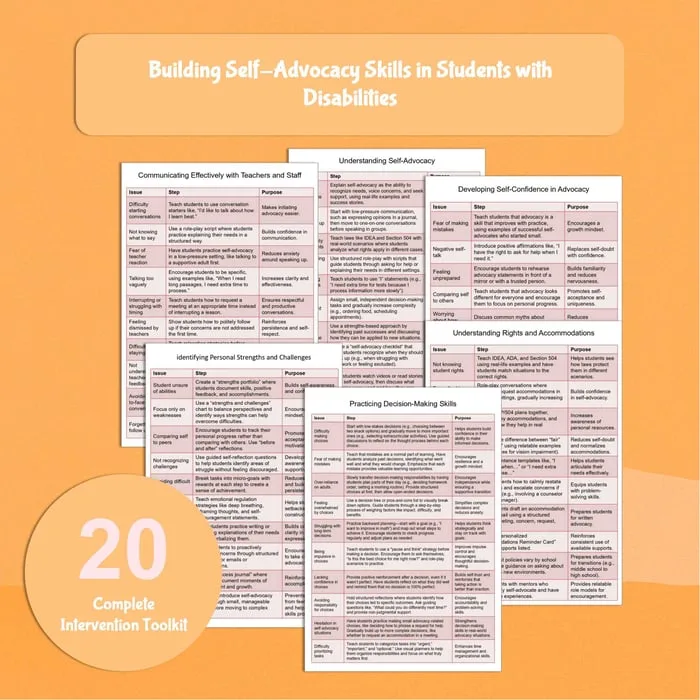
Self-Advocacy Skills for Students with Disabilities: SPED Intervention Toolkit: twenty intervention guides on self-advocacy, rights and accommodations under IDEA, ADA and Section 504, communicating with staff, strengths and challenges, decision-making, disagreements, goal setting, anxiety and asking for help, each with a strategy and its purpose.
You may also need: Classroom Accommodation Feedback Form IEP 504 Effectiveness Tracker.
Sources and scope
- National Technical Assistance Center on Transition: resources on transition planning and self-determination.
- Center for Parent Information and Resources: plain-language information on IEPs and transition.
- Wrightslaw: information on IDEA, Section 504 and IEP goals.
- National Center for Learning Disabilities: resources on self-advocacy for students with learning disabilities.
This list offers example goal areas and wording for high school students. It does not provide legal advice; actual IEP goals are written by the IEP team from the student’s own data.
Key takeaways
- Self-advocacy IEP goals prepare students to request supports after high school.
- Start with strengths, challenges, and knowing accommodations.
- Build toward requests, IEP participation, rights, and disclosure.
- Write specific, measurable goals based on baseline data.
- Involve the student and connect goals to transition planning.



Leave a Comment