

Indoor movement games for preschoolers can rescue a rainy Tuesday, a snow day or a long afternoon when outdoor play is off the table. Picture Ms. Ortiz’s class of sixteen four-year-olds at 10:30 on a wet morning: the blocks are flying, two children are racing laps around the tables, and Theo, who walks with a walker, is watching from the edge of the rug.
This list is for preschool teachers, assistants and parents who need active play inside. It ranks ten games by how quickly you can set them up, from zero-prep games to ones that need a few minutes and simple materials. Each game includes the gross motor skills it builds, how to adapt it so every child can join, and a quick example from Ms. Ortiz’s room.
Examples are fictional. Adapt to the student’s goals and agreed supports. This is guidance, not a diagnosis.
At a glance
- Young children need to move throughout the day, and indoor time counts too.
- The best indoor games need little space, little setup and clear, simple rules.
- Every game on this list can be adapted for children with different motor abilities.
- Short, frequent movement bursts often work better than one long session.
- Safety comes first: clear the floor, set boundaries and keep groups small.
How this list is ranked
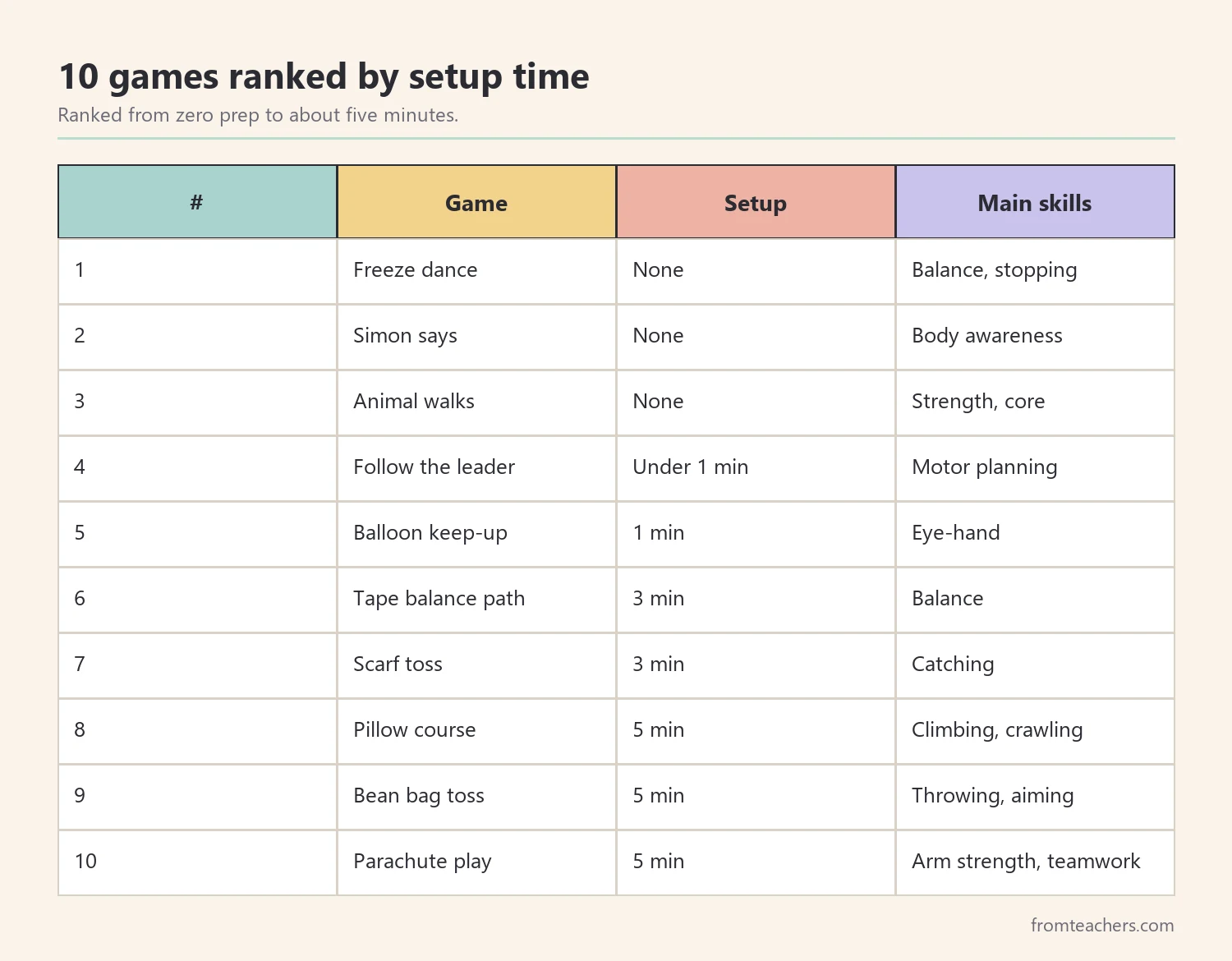
We ranked these games by one clear criterion: setup time. Games at the top need no materials and start in under a minute. Games lower on the list need a few minutes and simple items, such as tape, pillows or scarves. We did not rank them by which is “best for development,” because that depends on the child and the goal.
The Physical Activity Guidelines for Americans recommend that preschool-aged children be physically active throughout the day. Indoor movement games for preschoolers help you keep that going when the weather does not cooperate. Figure 1 shows all ten games with setup time and skills.
1. Freeze dance
Setup: none, just music. Skills: balance, body control, listening.
Play music, children dance, and when the music stops, everyone freezes. Freeze dance is a classic for good reason: it is simple, fun and builds stopping control.
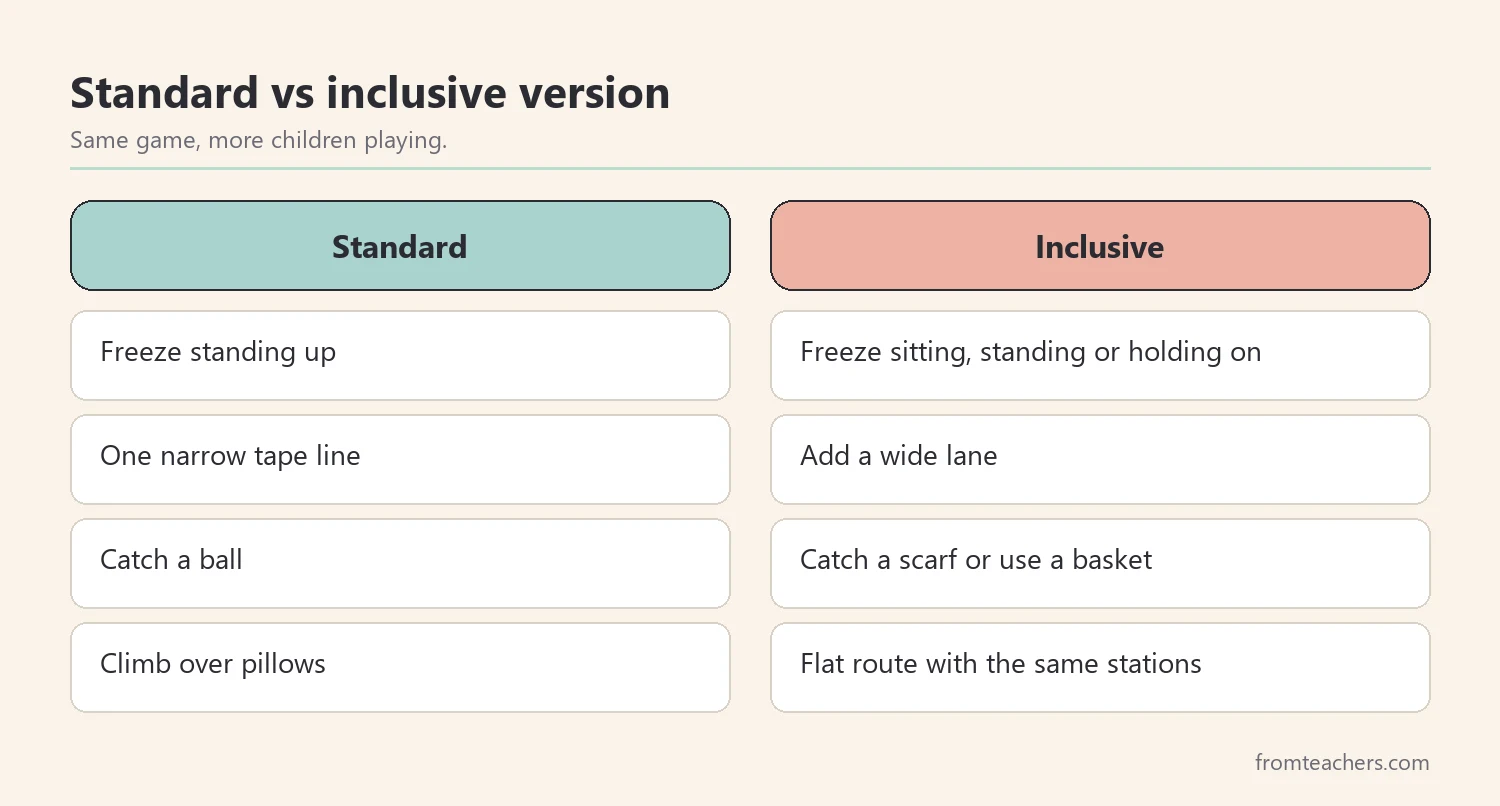
Adapt it: children can freeze sitting, standing or holding a support. Theo freezes holding his walker, and his “statue pose” gets the biggest cheer.
Example: Ms. Ortiz uses freeze dance as a two-minute reset after circle time. Children return to the rug calmer than before.
2. Simon says with big movements
Setup: none. Skills: body awareness, imitation, coordination.
Use big actions, such as “Simon says reach to the sky,” “touch your toes” or “march in place.” Skip the “you’re out” rule at this age, so everyone keeps moving.
Adapt it: offer seated versions of each action, such as arm circles instead of jumping jacks.
3. Animal walks
Setup: none. Skills: strength, core, coordination.
Children move like animals across the room: bear crawl, frog jump, crab walk, penguin waddle. Animal walks are one of the most popular indoor movement games for preschoolers because children love to pretend.
Adapt it: let children choose an animal that fits their body. A child who uses a wheelchair can be a “fast turtle” or a “flying bird” with big arm movements.
Example: Theo chose “elephant,” swinging one arm like a trunk while he walked. Two classmates copied him.
4. Follow the leader
Setup: under a minute. Skills: imitation, motor planning, turn-taking.
One child leads the group around the room with a movement, such as tiptoeing or marching, and everyone copies. Then switch leaders.
Adapt it: give shy children a picture card of a movement to choose from, so leading feels easier.
5. Balloon keep-up
Setup: one minute, a few balloons. Skills: eye-hand coordination, reaching, tracking.
Children work together to keep a balloon from touching the floor. Balloons move slowly, which gives every child time to react.
Adapt it: children can tap with hands, elbows, a paper plate or a pool noodle. Seated players are just as important as standing ones.
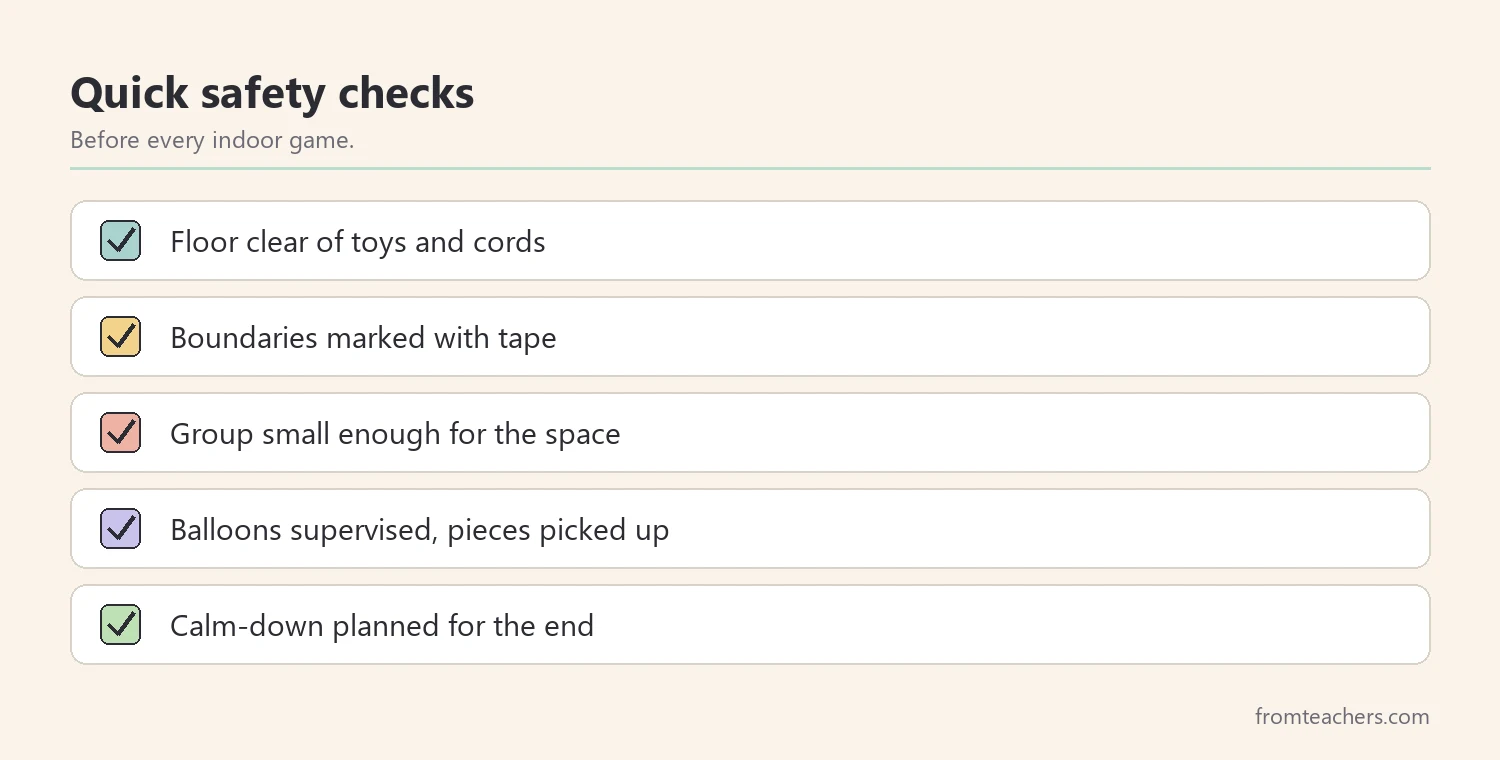
Safety: balloons can be a choking hazard. Supervise closely and pick up any broken pieces right away.
6. Tape line balance path
Setup: three minutes, painter’s tape. Skills: balance, foot placement, focus.
Make straight, zigzag and curvy lines on the floor. Children walk along them forward, sideways or heel-to-toe.
Adapt it: make one path wider, using two parallel lines, so children with walkers or less stable balance can follow it too.
Example: Ms. Ortiz made a “river” path with a wide lane. Theo crossed it every time, and soon others asked to try the wide lane too.
7. Scarf toss and catch
Setup: three minutes, light scarves. Skills: catching, tracking, coordination.
Scarves float slowly, which makes them easier to catch than balls. Children toss the scarf up, clap and catch it.
Adapt it: children can catch with two hands, one hand or a basket. The Gross Motor Skills inclusive activities guide has a full object control section and group inclusive games built for mixed ability groups, so you can extend this idea over several weeks.
8. Pillow obstacle course
Setup: five minutes, pillows, cushions, a tunnel or table. Skills: climbing, crawling, motor planning.
Create a short course: crawl under a table, step over pillows, walk around a chair. Keep it short so children can repeat it many times.
Adapt it: offer two routes: one with climbing and one flat route with the same “stations.”
9. Bean bag target toss
Setup: five minutes, bean bags and baskets or hoops. Skills: throwing, aiming, eye-hand coordination.
Children toss bean bags into baskets at different distances. Count together for a quick math link.
Adapt it: let children choose their distance and throw from sitting or standing.
10. Parachute play
Setup: five minutes, a play parachute or large sheet. Skills: arm strength, teamwork, rhythm.
Children hold the edge and make “waves,” lift it high or bounce soft balls on top. It is a great whole-group game because everyone does the same thing at the same time.
Adapt it: children can hold the parachute from a chair or with a looped handle. Theo held his section from a chair and called “Up!” for the whole class.
Matching the game to the moment
Not every game fits every part of the day. Some games wake children up, while others help them settle. Therefore, it helps to choose a game by what the group needs right now, not only by what is fun.
| Moment | Group needs | Good choices |
|---|---|---|
| After arrival | Wake up, connect | Follow the leader, Simon says |
| After circle time | Release energy | Freeze dance, animal walks |
| Before lunch | Focus, then calm | Bean bag toss, tape path |
| After rest | Gentle start | Scarf toss, parachute waves |
For example, Ms. Ortiz noticed that freeze dance right before lunch made the line to the sink wild. Consequently, she moved it to after circle time and used the slower tape path before lunch. The line became calm again within two days.
Also, think about the children who need more or less movement. Some children seek a lot of input and benefit from heavier games, such as animal walks or pushing a laundry basket of bean bags across the room. Others feel overwhelmed by noise and crowds and do better with scarves or the balance path at the edge of the group. Offering two choices at the same time lets every child find a comfortable level.
Finally, link movement to learning when it fits. Children can hop to a letter on the floor, toss bean bags at numbered baskets or walk the tape path while counting steps. These short links keep the energy up and give extra practice without feeling like a lesson.
Planning the day with indoor movement games for preschoolers
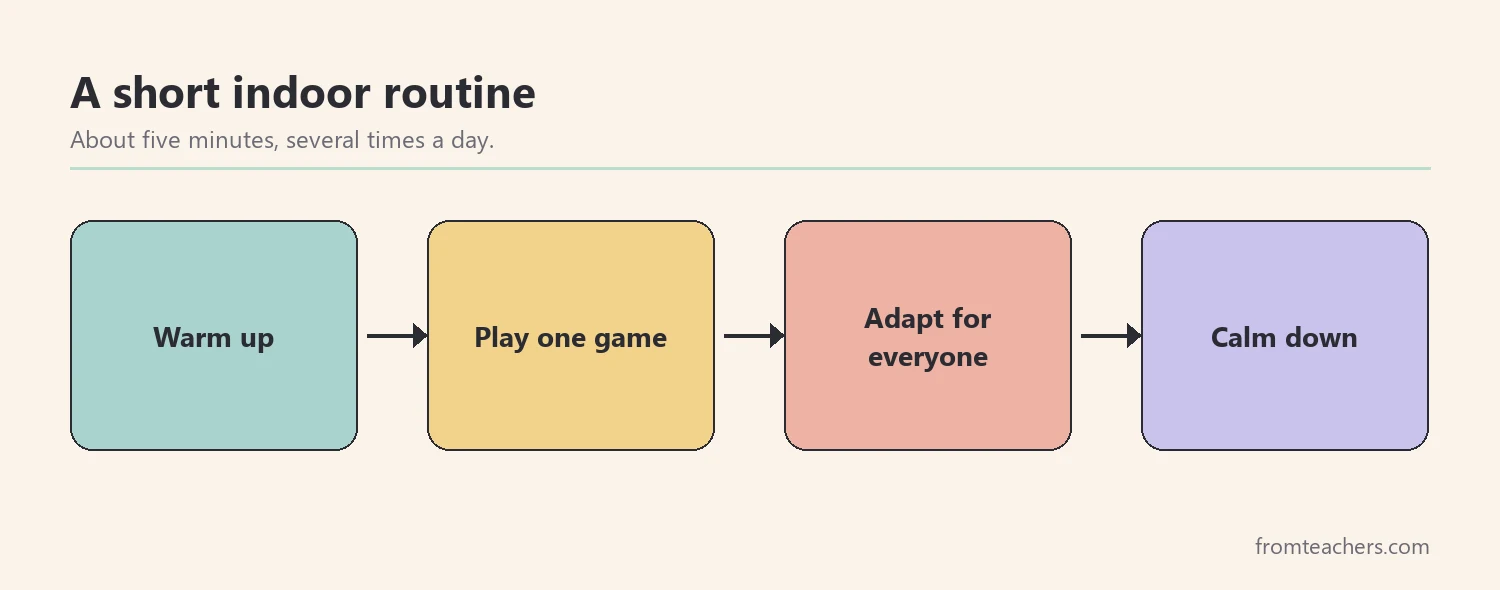
A long indoor day goes better with short, planned bursts of movement. For example, Ms. Ortiz uses a five-minute game after arrival, after circle time, before lunch and after rest. Each game is short, predictable and ends with a calm-down, such as slow breathing or a quiet song.
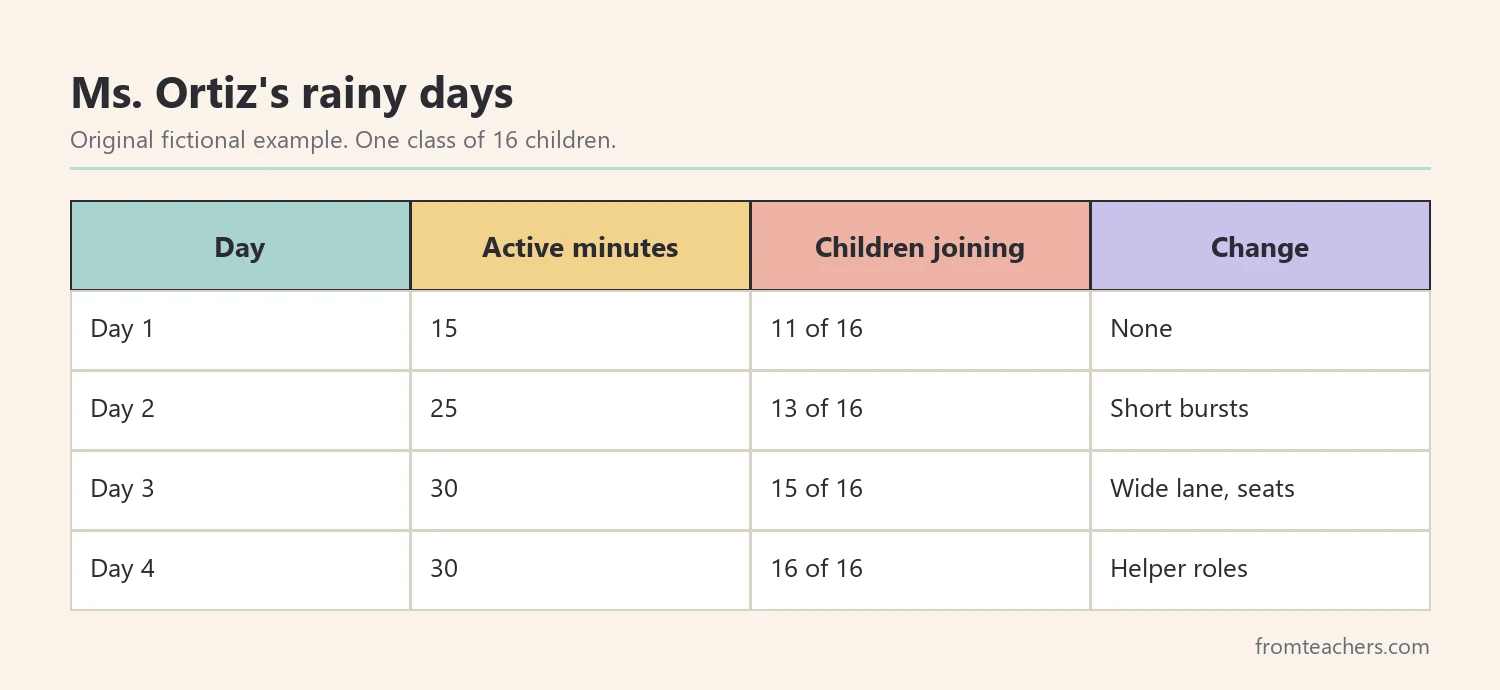
Also, notice who joins and who watches. A simple tally, like the one in Figure 3, shows whether a change helps more children take part. On her first rainy day, Theo joined two games. After adding wide paths and seated options, he joined all of them.
In addition, rotate the games. Children love favorites, yet new games build new skills. Keep two or three favorites each week and add one new game.
Next, think about space. You do not need a gym. Pushing tables to the walls and marking a clear area with tape is often enough. Keep the number of children moving at one time small if the room is tight, and let others cheer or take turns as “game helpers.”
Finally, share ideas with families. Many of these games, such as freeze dance and animal walks, work well in a small living room and give parents a ready answer on rainy weekends. Figure 4 lists quick safety checks, and Figure 5 shows a simple routine.
Common mistakes and how to avoid them
- Elimination rules. Fix: keep everyone moving; skip “you’re out.”
- Too many children at once. Fix: use small groups or take turns in a tight room.
- Adding adaptations as an afterthought. Fix: plan an inclusive version before you start.
- No calm-down at the end. Fix: finish with slow breathing or a quiet song.
- Using movement only as a reward. Fix: plan it into the day for every child.
Questions teachers and parents ask about indoor movement games for preschoolers
How much active play do preschoolers need?
National guidelines recommend that preschool-aged children be physically active throughout the day. In practice, that means many short chances to move, both indoors and outdoors.
What if a child refuses to join?
Offer a helper role, such as music controller or counter, and invite them again later. Many children join once they have watched a few rounds.
How do I include a child with a physical disability?
Plan seated, supported or wider versions of each game, and ask the child’s physical or occupational therapist for ideas. Make the adaptation part of the game for everyone.
Are these games safe in a small room?
Yes, with care. Clear the floor, set boundaries, keep groups small and choose slower games, such as scarves and balloons.
Can parents use these games at home?
Absolutely. Freeze dance, animal walks and pillow courses work well in a living room with little or no equipment.
Related reading: Special Education Strategies, 5 Teaching Tips for Classroom Focus and Learning, and How Parents and Teachers Can Team Up.
You may also need: Move, Groove, Play: Gross Motor Games for Kids.
A companion resource for indoor movement games for preschoolers:
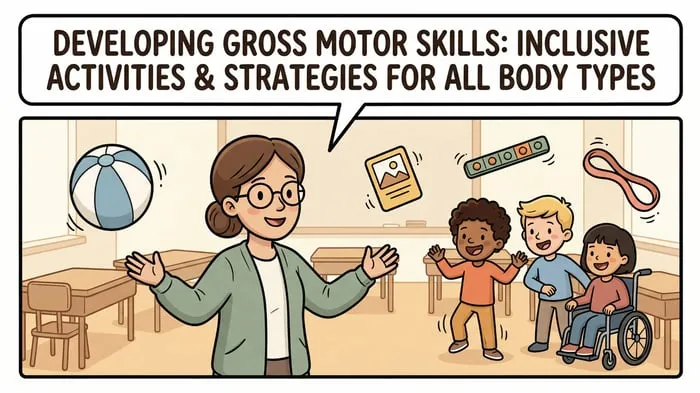

Gross Motor Skills: Inclusive Activities for All: a 50-page visual guide covering balance and coordination, strength and core, moving your body, object control, group inclusive games, and a review with goal setting, built for mixed ability groups.
Sources and scope
- Physical Activity Guidelines for Americans (ODPHP): national physical activity recommendations, including for preschool-aged children.
- National Association for the Education of Young Children: resources on play and developmentally appropriate practice.
- HealthyChildren.org (American Academy of Pediatrics): parent information on active play and child development.
- SHAPE America: resources on physical education and active play for children.
This list offers indoor active play ideas for children aged about 3 to 5. It does not replace advice from a physical or occupational therapist about a specific child’s motor needs.
Key takeaways
- Indoor movement games for preschoolers keep children active when outdoor play is not possible.
- Start with zero-prep games, such as freeze dance and animal walks.
- Plan an inclusive version of every game before you begin.
- Use short, frequent bursts with a calm-down at the end.
- Track who joins to see whether your changes include more children.


Leave a Comment