

Homework accommodations for learning disabilities can make the difference between an evening of practice and an evening of tears. Picture a fourth grader with a specific learning disability in reading and writing. In class, she has audiobooks and extra time. At home, she faces the same worksheet as everyone else, with no support, and a twenty-minute task stretches past an hour.
This guide is for parents and teachers who want homework to match the supports a student already has at school. It shows how to find where homework breaks down, choose fair accommodations for reading, writing, and math, agree on them with the school, and check that they are working. By the end, you will have a short homework plan you can share and review.
Examples are fictional. Adapt to the student’s goals and the supports in the student’s IEP or 504 plan. This is guidance, not a diagnosis.
At a glance
- Homework should practice the target skill, not punish the disability.
- Find the exact barrier: reading the task, writing the answer, or the math itself.
- Match each barrier to an accommodation the student already uses in class.
- Agree on the plan in writing with the teacher.
- Track time and independence for a few weeks, then adjust.
1. Find where homework breaks down
First, watch a few homework sessions closely. Instead of asking “Is homework hard?”, ask “Which part is hard?” For a student with a learning disability, the barrier is often not the skill being practiced but something around it.
For example, a math worksheet may be hard because of long word problems the student cannot decode. A science question may be hard because writing a full paragraph by hand takes enormous effort. In both cases, the student may understand the content but cannot show it.
Then, note three things for each session: how long it took, how many times the student needed help, and which part caused the help. These notes make homework accommodations for learning disabilities specific instead of general.
Mia (fictional, grade 4) has a specific learning disability in reading and written expression. Her mother, Ms. Novak, watched four evenings. Reading the directions and writing sentence answers took most of the time. Math facts were fine; math word problems were slow because of reading.
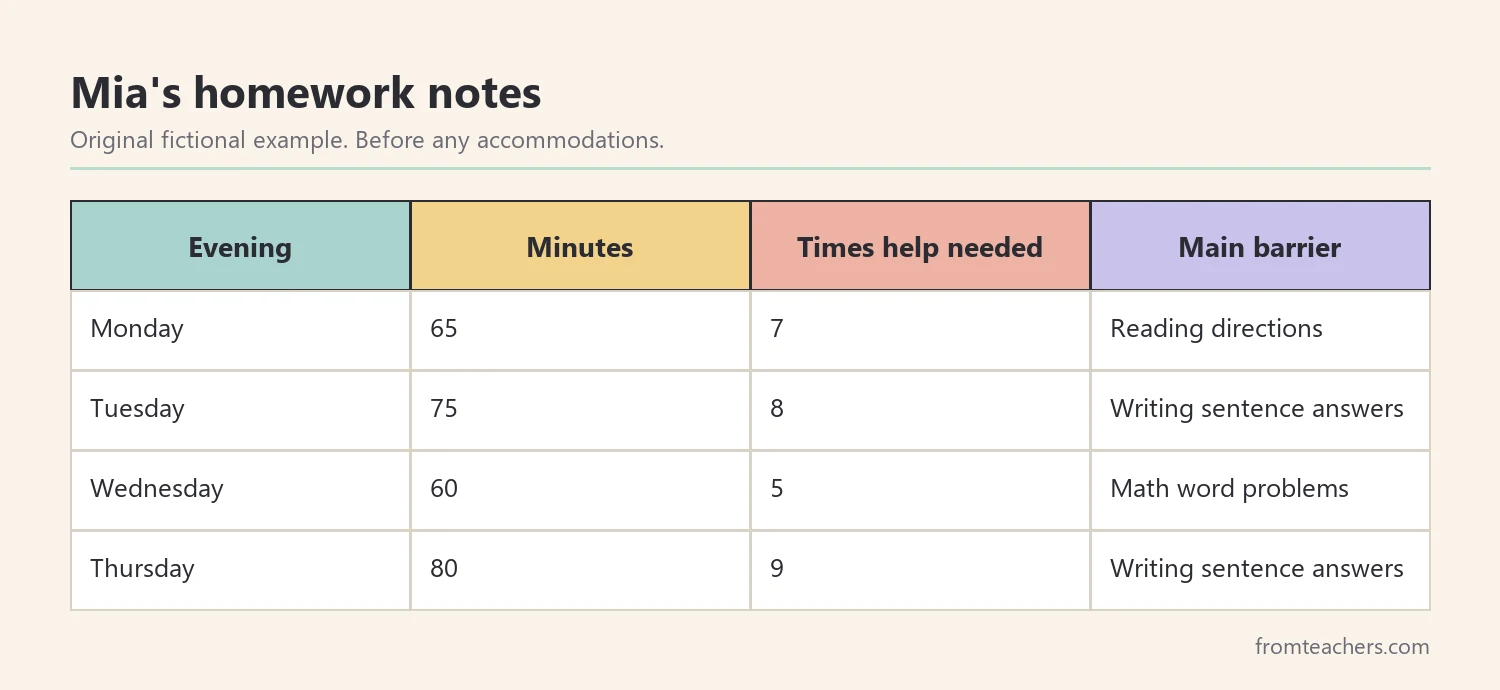
Also, separate “won’t” from “can’t.” A student who avoids homework may be tired, discouraged, or simply unable to do part of it without support. Your notes usually show which it is, and they help adults respond with support rather than frustration.
2. Choose reading and writing homework accommodations
Next, match each barrier to an accommodation. The best homework accommodations for learning disabilities are usually the same ones the student already uses at school. Consistency helps the student, and it makes the plan easy for the teacher to approve.
For reading barriers, common options include reading directions aloud, audio versions of texts, shorter reading passages that still practice the skill, or highlighting key words in the instructions. If the goal is comprehension, the student can listen instead of decoding. If the goal is decoding practice, keep the reading but reduce the amount.
For writing barriers, options include dictating answers to an adult or a speech-to-text tool, answering in bullet points or short phrases, using a word bank, or typing instead of handwriting. If the goal is spelling practice, keep the spelling but reduce other writing.
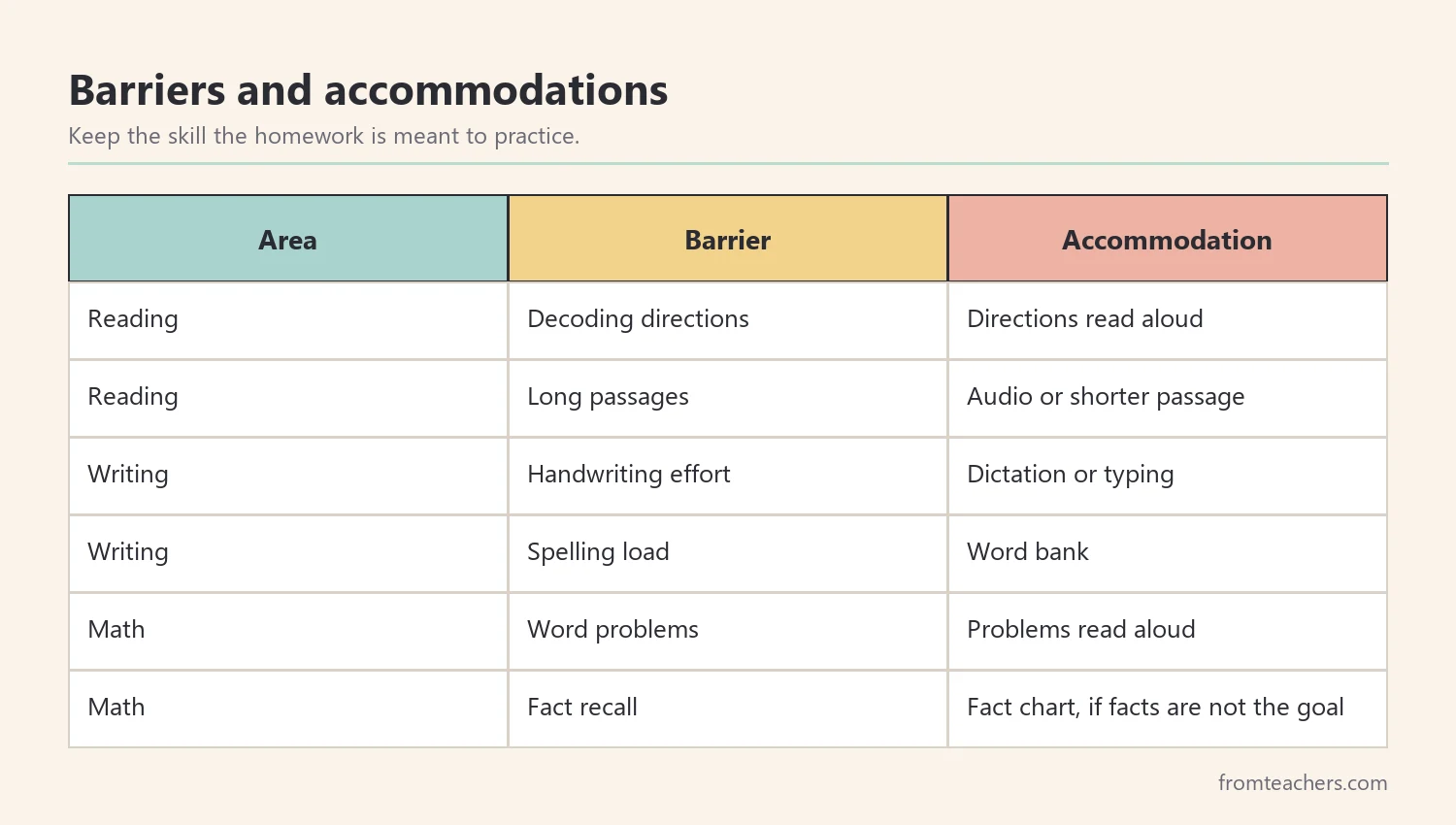
For a structured menu, Ms. Novak and Mia’s teacher used the SLD support toolkit with reading, writing, and math accommodations, which has separate sections for each area, an accommodations menu, a home support section, and printable tools.
For Mia, the team chose three changes: directions read aloud by a parent, dictation for written answers longer than one sentence, and a word bank for spelling-heavy tasks. Her reading practice stayed, but with shorter passages.
Setting up home so accommodations are easy to use
Accommodations only help if they are ready when homework starts. Therefore, prepare a small homework kit: headphones for audio texts, a device with speech-to-text, printed word banks, graph paper, and any math tools the student uses at school.
In addition, agree on who does what at home. If a parent reads directions aloud, decide whether that happens at the start of each task or only when the student asks. Clear roles prevent arguments and help the student know what to expect.
Finally, keep the same order every night. For example, read all directions first, then do tasks that need an adult, then tasks the student can do alone. A steady routine makes homework accommodations for learning disabilities feel like a normal part of the evening rather than special treatment.
3. Plan math homework accommodations for learning disabilities
Math deserves its own look. Some students have a specific learning disability in math, while others struggle with math homework because of reading or writing. The accommodations differ, so identify which one applies.
If the barrier is reading, read word problems aloud or provide them in audio. If the barrier is writing, allow answers on graph paper, larger boxes, or orally. If the barrier is the math itself, such as fact recall or number sense, options include a fact chart for problems that are not about facts, fewer problems of the same type, or concrete materials such as counters or a number line.
In addition, protect the goal. If the homework is about fact fluency, a fact chart defeats the purpose. If the homework is about solving multi-step problems, a fact chart lets the student focus on the reasoning. Every math accommodation should keep the main skill of the assignment.
Mia’s math homework accommodations for learning disabilities were simple: word problems read aloud, and answers to “explain your thinking” questions given orally and written down by a parent. Her fact practice stayed independent, because she was strong in that area.
| Math homework goal | Barrier | Fair accommodation |
|---|---|---|
| Solve word problems | Reading | Read problems aloud |
| Explain reasoning | Writing | Oral answer, adult scribes |
| Multi-step problems | Fact recall | Fact chart allowed |
| Fact fluency | Fact recall | Fewer facts, no chart |
4. Agree on the plan with the school
Next, put the plan in writing and share it with the teacher. A short, one-page homework plan avoids confusion about who did what and why. It also protects the student from losing marks for using supports that were agreed.
The plan should list the subject, the barrier, the accommodation, and who provides it. In addition, include a note about time. Many teams agree on a reasonable homework time limit, after which the parent writes down what was finished and the student stops.
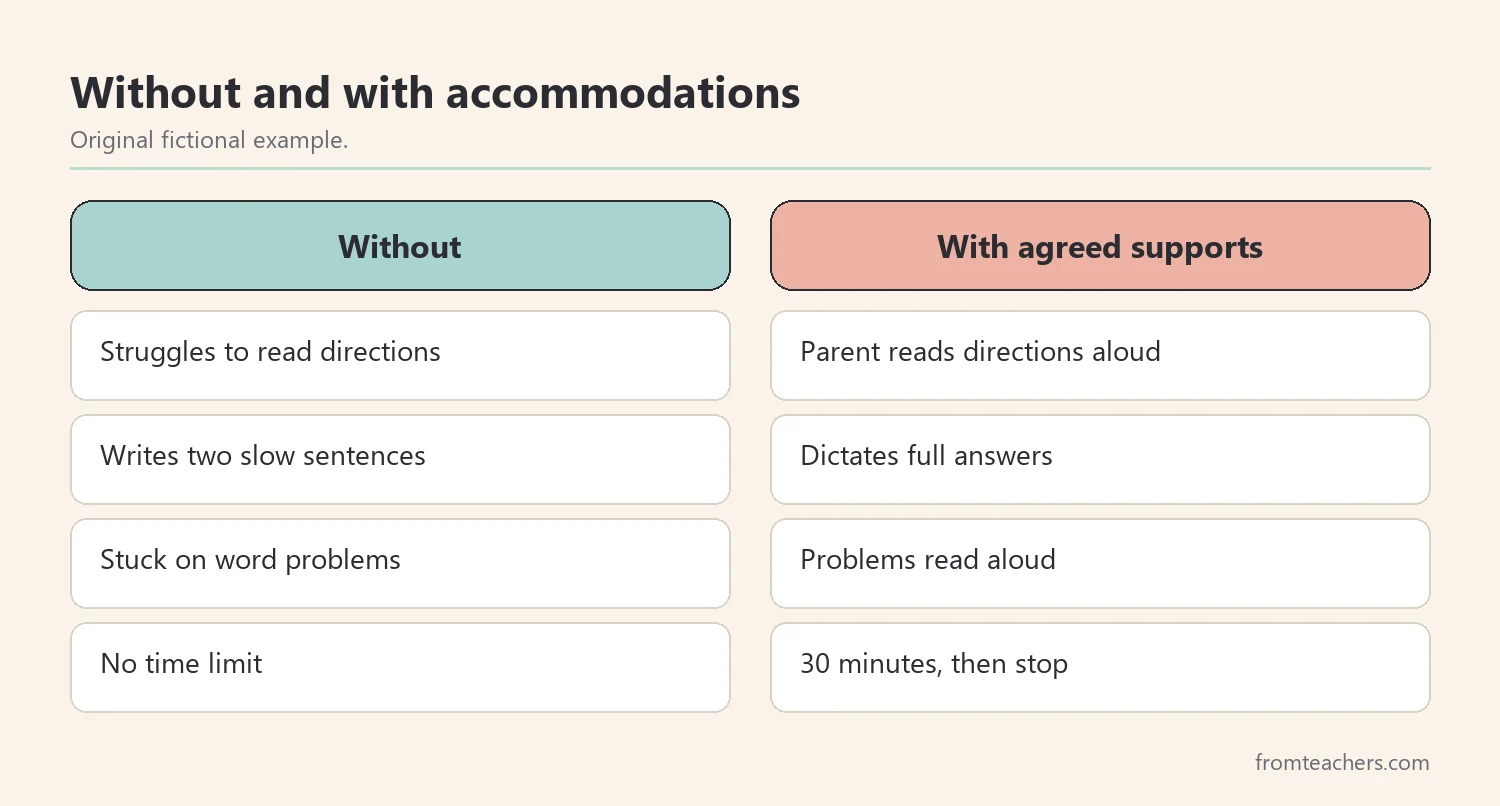
Then, check whether these homework accommodations for learning disabilities should be added to the IEP or 504 plan. Some teams include homework supports formally; others agree on them informally with the teacher. Either way, write them down so that a new teacher or a substitute can follow the plan.
Ms. Novak met with Mia’s teacher for fifteen minutes. They agreed on the three reading and writing accommodations, the math adjustments, and a 30-minute time limit on school nights. The teacher added a small “A” next to accommodated assignments so everyone knew the work had been done with agreed supports.
Also, keep the student in the loop from the very first meeting. Explain the plan in simple, positive words: “These tools help you show what you know.” Students who understand why they have supports are more likely to use them without feeling embarrassed.
Keeping communication short and regular
Homework plans work best when home and school talk briefly and often. A short weekly note works well, such as “Homework took about 35 minutes most nights; writing is still slow.” The teacher can reply with any changes in upcoming assignments.
Moreover, tell the teacher when something works especially well. Positive feedback helps teachers know which supports to keep using in class, too.
5. Track and adjust the homework plan
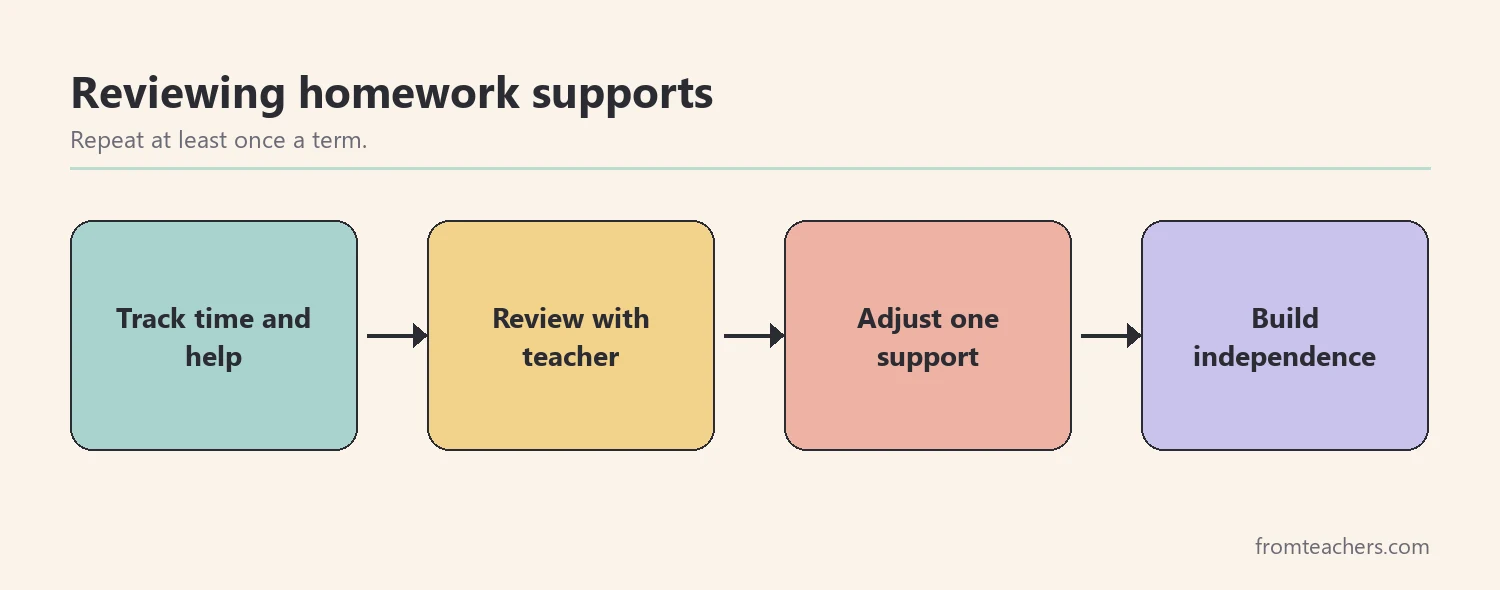
After the plan starts, track a few simple measures for three or four weeks. Note the time homework took, the number of times the student needed help, and how much was finished within the time limit.
Then, review the numbers with the teacher, ideally at the end of each two-week block. Good signs include shorter homework time, fewer requests for help, more work completed, and calmer evenings. If one area still causes trouble, adjust that accommodation only.
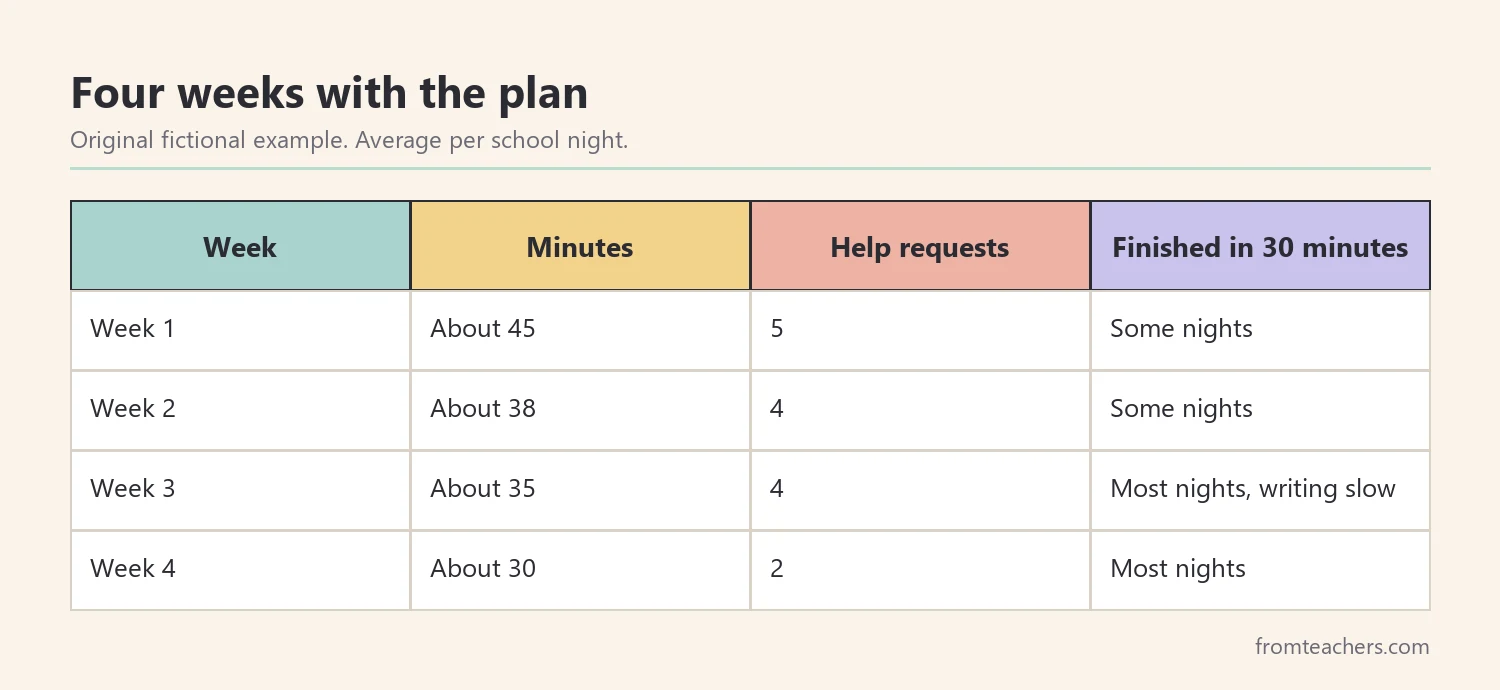
As Figure 4 shows, Mia’s homework time dropped from about 70 minutes to about 30, and help requests fell. In week 3, writing tasks were still slow. So, the team added a short word bank to writing assignments, and by week 4 she finished most homework within the time limit.
In addition, look for chances to build independence. As Mia became confident with dictation, she started using a speech-to-text tool herself rather than dictating to her mother. Over time, the best homework accommodations for learning disabilities move from adult support toward tools the student controls.
Moreover, celebrate progress with the student. Point to the numbers: “Remember when homework took more than an hour? This week it took about thirty minutes.” Seeing concrete progress builds confidence, which matters a great deal for students who have struggled with schoolwork for years. It also reminds the student that homework accommodations for learning disabilities are tools for success, not signs of failure.
Finally, review the plan at least once a term. Assignments, teachers, and the student’s skills all change, sometimes quickly within a single year. A short review keeps the plan fair and up to date.
Common mistakes and how to avoid them
- Giving the same accommodation for every task. Different tasks have different barriers. Fix: match each accommodation to a specific barrier.
- Removing the skill being practiced. A spell-checker on a spelling assignment defeats the purpose. Fix: protect the learning goal of each task.
- Informal help with no record. Teachers may not know how much support was given. Fix: write the plan down and mark accommodated work.
- No time limit. Endless homework exhausts the student and the family. Fix: agree on a reasonable limit with the teacher.
- Never reviewing the plan. Needs change over time. Fix: track simple measures and review each term.
Questions parents and teachers ask about homework accommodations for learning disabilities
Are homework accommodations for learning disabilities fair to other students?
Yes. Accommodations change how a student accesses or shows learning, not what they are expected to learn. They give the student a fair chance to practice the same skills.
Do homework accommodations need to be in the IEP?
Not always, but it can help. Some teams write homework supports into the IEP or 504 plan, while others agree on them with the teacher. Writing them down somewhere makes them easier to follow.
Is it cheating if a parent scribes answers?
Not if it is agreed and the parent writes exactly what the student says. Scribing removes the handwriting barrier while keeping the student’s own thinking.
What if the teacher does not agree?
Share your notes on time and help needed, and ask which supports from class could also apply to homework. If agreement is still hard, ask for a meeting with the IEP or 504 team.
How can I tell if an accommodation is helping?
Compare simple measures before and after: homework time, help needed, and work completed. If they improve and the learning goal is still practiced, the accommodation is doing its job.
Related reading: Accommodations vs Modifications in Special Education, Dyslexia Solutions in the Classroom, and Special Education Accommodation and Modification Tracker.
You may also need: My Homework Routine: 12-Step Visual Cards Free.
A companion resource for homework accommodations for learning disabilities:


SLD Support Toolkit: Reading, Writing & Math Accommodations: a 50-page guide with separate sections and accommodations menus for reading, written expression, and math, plus classroom systems, a home support section, and printables.
Sources and scope
- Individuals with Disabilities Education Act (IDEA): federal information on specific learning disabilities, IEPs, and accommodations.
- IRIS Center, Vanderbilt University: free modules on accommodations and supporting students with learning disabilities.
- Understood.org: family-friendly articles on homework, accommodations, and learning differences.
- Learning Disabilities Association of America: information and resources for families and educators.
This guide covers informal homework planning between families and teachers. It does not replace evaluation, eligibility decisions, or legal advice, which follow your district’s procedures.
Key takeaways
- Homework accommodations for learning disabilities remove barriers while keeping the learning goal.
- Specific notes show whether reading, writing, or math is the real barrier.
- Using the same supports as in class keeps things consistent and easy to approve.
- A written plan with a time limit protects the student and the family.
- Simple tracking and termly reviews keep the plan working.










Leave a Comment