

Puberty for autistic teens can bring a lot of questions, and many of them never get asked out loud. Picture a thirteen-year-old who suddenly refuses to use the school changing room. Adults call it avoidance. In fact, the strong smell of body spray, a new feeling of sweat, and nobody explaining what is happening have all piled up at once.
This guide shows you how to support a young person through puberty in five practical steps. By the end, you will be able to explain body changes in clear, concrete words, protect privacy, adjust care tasks for sensory needs, build routines that fit the young person’s day, and review progress together, at their own pace.
Examples are fictional. Adapt to the student’s goals and agreed supports. This is guidance, not a diagnosis.
At a glance
- Explain changes early, in clear and concrete words.
- Treat privacy and consent as part of the teaching.
- Separate the sensory problem from the care task, then adjust.
- Build one routine at a time, with steps, supplies, and a backup.
- Review together and include the young person’s own view.
1. Explain puberty for autistic teens in clear, concrete words
First, explain what is happening, and explain it early. Many autistic young people find unexpected change stressful. A body that changes without warning can feel confusing or even frightening. Knowing what to expect gives the young person time to prepare.
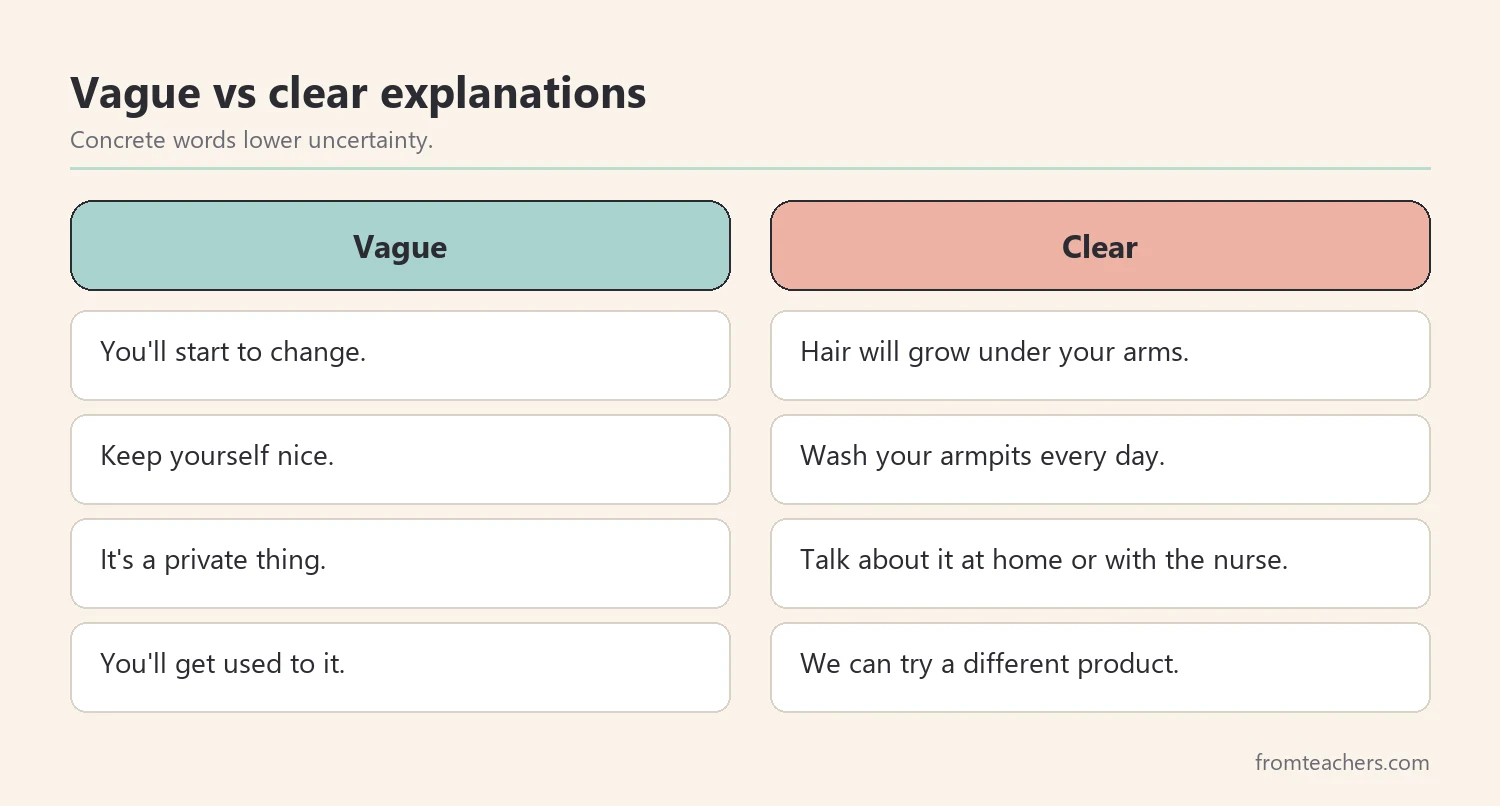
Use concrete language. “You’ll start to change” is vague. “Hair will grow under your arms, and your sweat will start to smell stronger” is clear. In addition, use correct body words. Polite hints and nicknames often create more confusion, and they make it harder to ask for help later.
Also offer information in more than one form. Some teens prefer reading on their own. Others want pictures, a short list, or a calm conversation. Let the young person choose, and let them come back to it many times. One big talk is rarely enough.
Finally, ask what the young person wants. “Would you like an answer, or would you like me to sit with you?” is a respectful question. Sometimes a teen wants facts. Sometimes they just want company while they think.
Consider Kai, a fictional thirteen-year-old autistic student in grade eight. Kai likes facts and lists. His mother and the school nurse agreed on a short written list of changes he could read in private, with a note saying he could ask either of them anything.
| Choice | Kai’s version |
|---|---|
| Format | Short written list |
| Where to read it | His bedroom |
| Who to ask | Mom or the school nurse |
| When | Any time, no deadline |
2. Protect privacy and respect the teen’s choices
Next, make privacy part of the plan. Puberty is personal, and autistic teens deserve the same privacy as anyone else. Talking about body changes in a busy room, or in front of classmates, can cause real embarrassment.
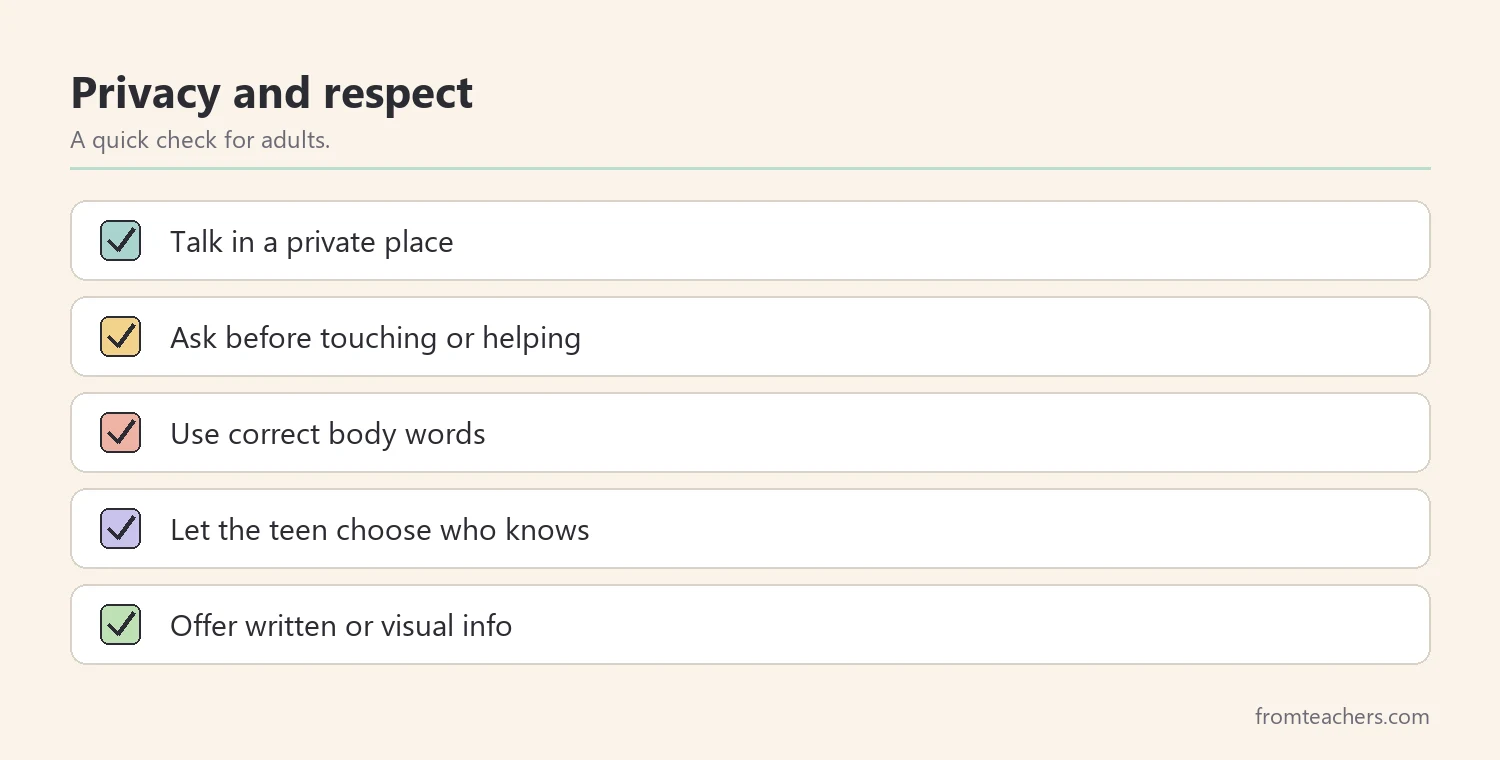
Choose a private place for conversations. Ask before touching, helping, or checking anything. Let the young person decide who knows about their questions, within safety limits. For example, a teen might be comfortable with a parent and the nurse knowing, but not a classroom aide.
In addition, teach privacy rules directly. Which topics are for home or for a trusted adult? Which places are private? Many autistic young people appreciate clear, written rules about this, because unwritten social rules can be hard to guess.
Also give the young person a way to ask for privacy. A short phrase such as “Can we talk about this somewhere private?” is useful. Practice it once or twice so it is ready when needed.
In Kai’s case, he asked that only his mother and the nurse discuss body changes with him. His teacher respected this. When Kai had a question at school, he asked to see the nurse instead of raising it in class.
Families and schools also need to agree on what is shared between them. A short, private note can cover the words the young person uses, the adults they trust, and any adjustments that help, such as changing in a separate space. Keep that note limited to what each adult actually needs to know. Then review it each term, because a teen’s comfort and preferences often change over time.
Respecting these choices builds trust. As a result, the young person is more likely to come back with the next question instead of keeping it to themselves.
3. Adjust care tasks for sensory needs
Now look at personal care through a sensory lens. Supporting puberty for autistic teens often means noticing that the task is not the problem. The sensation is. A teen who refuses deodorant may not object to being clean at all. The cold spray or strong scent may simply be unbearable.
Separate the task from the difficult sensation. Ask, “What part is uncomfortable?” Then look for an adjustment that keeps the task but changes the sensation. For instance, an unscented roll-on instead of a spray, a handheld shower head instead of an overhead one, or soft clothing with labels removed.
Make a simple comfort check you can repeat. Name the activity or place, note what presses, rubs, hurts, or feels difficult, write one adjustment to try, and record what changed after trying it. Keep it practical and private. The young person can answer by talking, drawing, or pointing.
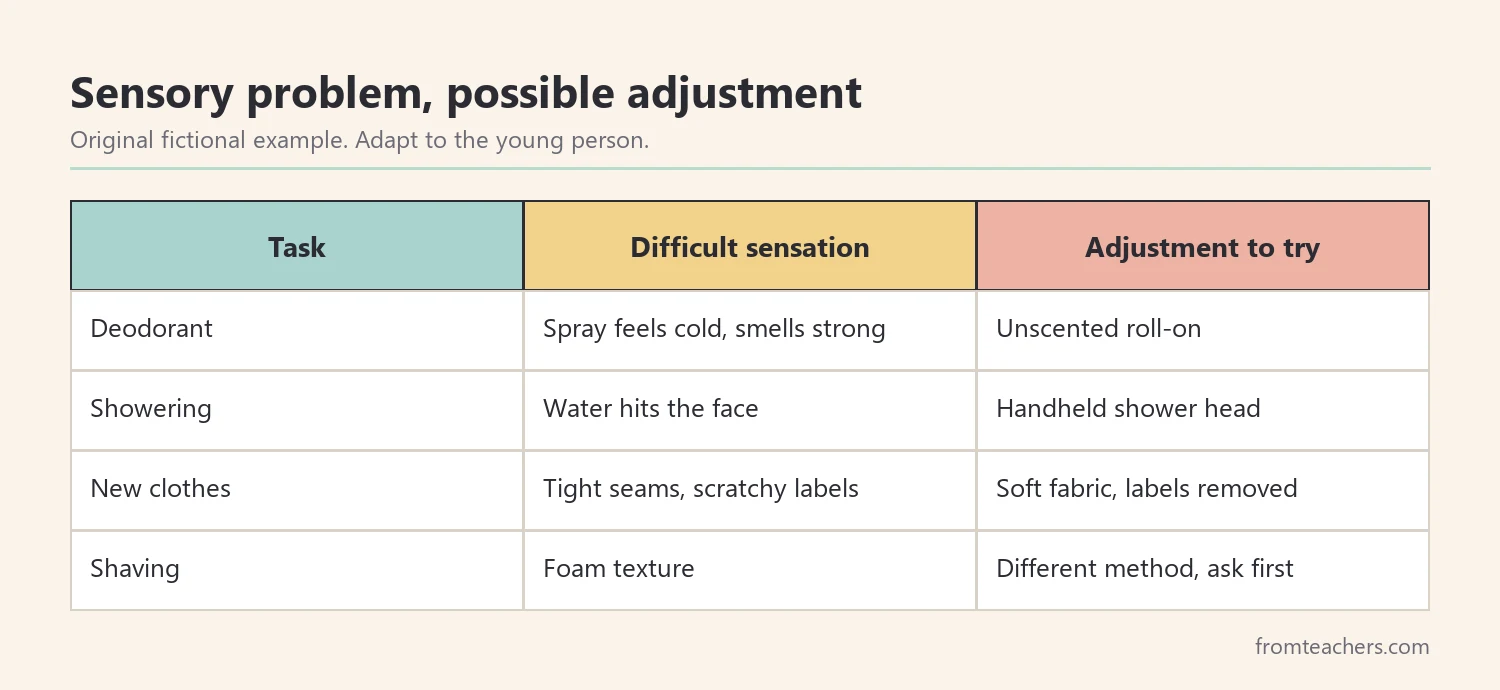
For example, Kai disliked the smell of body spray in the changing room. He also found the school towels rough. His comfort check named the changing room, listed “strong smell” and “rough towel,” and suggested bringing his own soft towel and asking the teacher about reducing spray use. The towel helped right away.
Importantly, take ongoing discomfort seriously. If an adjustment does not help, or if a sensation looks like pain, itching, or irritation, involve the family and a health professional. Persistent pain needs a health assessment, not just a new routine. Also, when choosing any new product, follow the label and ask a pharmacist or clinician if you are unsure about safety.
4. Build a routine that fits the teen’s day
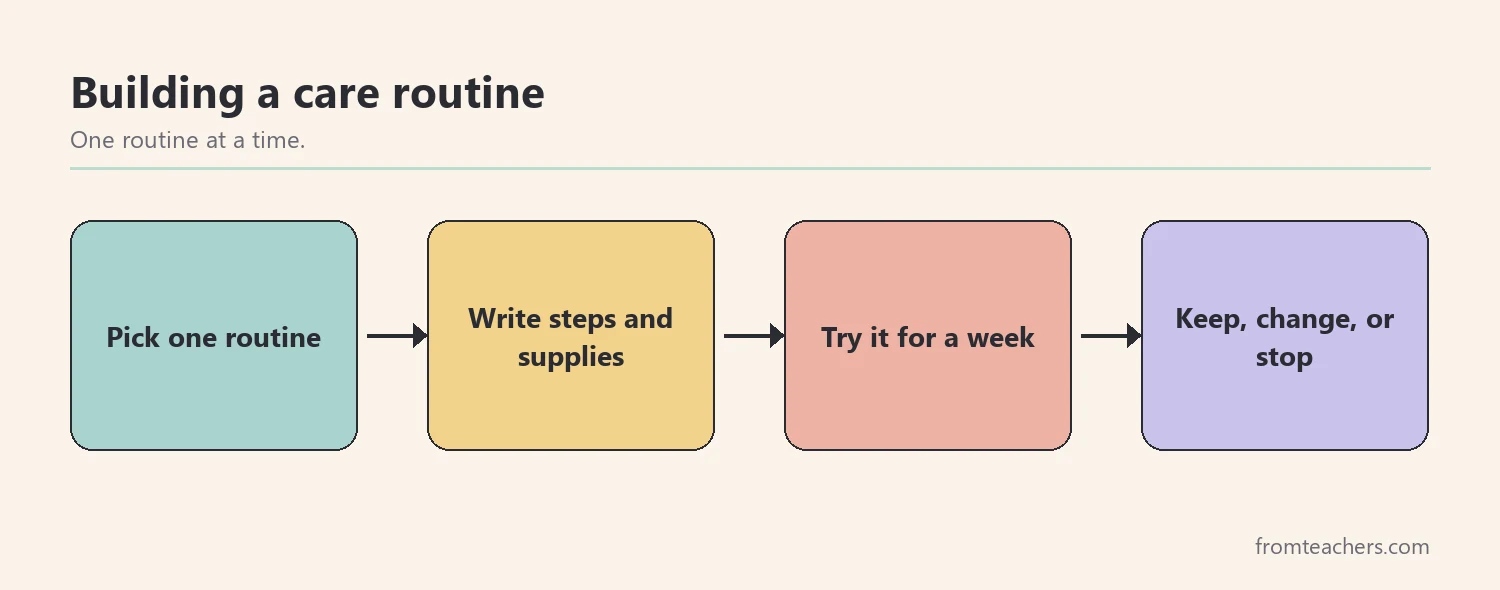
Next, build care routines one at a time. Washing, getting dressed, brushing teeth, using new products, and packing supplies can all become routines. Trying to change everything at once is overwhelming. Instead, pick one routine, make it workable, and then move on.
Write the routine with the young person. Note when it happens, the steps in their own order, the supplies and help they need, and what to do if something is difficult or unavailable. Pictures can replace words for some teens. In addition, leave room for a pause and a backup.
Remember that a routine is not a behavior score. If it keeps failing, look at practical causes: time, access to supplies, pain, sensory discomfort, or understanding. Then change the plan together. The autism and puberty guide with fillable routine pages includes a page for exactly this kind of planning, plus a product trial page for testing new items.
Kai chose his morning routine first. He wrote five steps: shower, dry with his own towel, unscented deodorant, clean clothes from a set drawer, and pack a spare shirt. His backup was “If I run late, deodorant and clean shirt only.” Having a shorter version ready meant a busy morning did not become a failure.
Test new products the same way. Try one item at a time, for a few days, and note what the young person noticed about the feel, smell, and fit. Then decide together whether to keep it, change it, or stop. Testing one thing at a time makes it easy to see what helped. Moreover, it gives the teen a clear say in what goes on their body.
| Routine part | Kai’s version |
|---|---|
| When | Weekday mornings |
| Steps | Five, written as a list |
| Supplies | Soft towel, roll-on, spare shirt |
| Backup | Deodorant and clean shirt only |
5. Review puberty for autistic teens together
Finally, review progress with the young person, not about them. Ask, “Which part became easier, and which part still needs a different approach?” This question keeps the focus on the plan rather than on the teen’s effort.
Keep a light record. Note how many steps the teen completes alone, how many prompts they need, and how they rate the routine themselves. Their own rating matters. A routine that adults call successful but the teen finds exhausting is not finished yet.
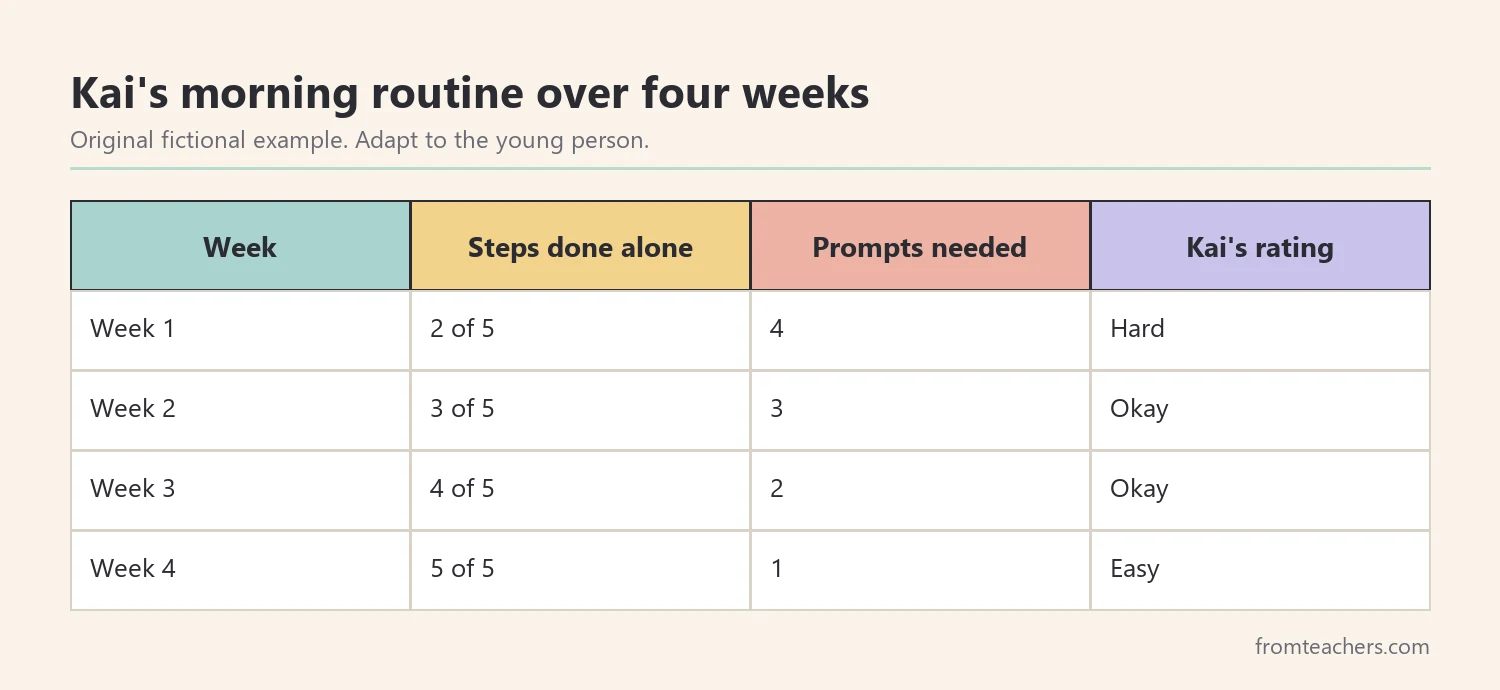
Over four weeks, Kai moved from two steps alone to all five, and his own rating changed from “hard” to “easy.” His mother then asked what routine he wanted to work on next. Kai chose packing his gym bag.
Also look at the whole picture when something goes wrong. Puberty is not the explanation for every difficult day. School demands, friendships, sleep, pain, sensory load, and changing expectations can all play a part. Ask what happened before deciding why, and look for practical changes first.
Celebrate small wins along the way. Finishing a routine on a hard morning, asking a question in private, or trying a new product are all real steps. Naming them, briefly and privately, helps the young person see their own progress.
In addition, remind the young person that their experience counts. Someone else’s favorite product or routine does not have to be theirs. Growing up looks different for everyone, and a plan that fits their body and their day is the right plan.
Common mistakes and how to avoid them
- Waiting too long to explain. Changes that arrive without warning can be frightening. Instead, explain early and come back to the topic many times.
- Using vague words. Hints and nicknames create confusion. Instead, use correct body words and concrete examples.
- Treating refusal as defiance. Often the issue is a sensation, not the task. Instead, ask what part is uncomfortable and try one adjustment.
- Changing every routine at once. Too many changes overwhelm the young person. Instead, build one routine, make it work, then move on.
- Ignoring privacy. Public conversations about body changes cause embarrassment and silence. Instead, talk in private and let the teen choose who knows.
Questions teachers and parents ask about puberty for autistic teens
When should we start talking about puberty for autistic teens?
Before the changes begin is usually best, so the young person has time to prepare. Start with simple, concrete facts and add detail over time. Follow the young person’s questions and pace.
What if the teen does not want to talk about it?
Respect that, and offer other formats. Some teens prefer reading on their own or looking at a guide in private. Let them know who they can ask, and leave the door open.
Who should lead these conversations at school?
That depends on school policy and the family’s wishes. Often a school nurse, counselor, or trusted teacher works with the family. Agree on roles so the young person hears consistent information.
How do we handle strong sensory reactions to hygiene products?
Identify the specific sensation, such as smell, temperature, or texture, then try one alternative at a time. Keep notes on what helps. Ask a pharmacist or clinician if you are unsure whether a product is safe or suitable.
Can the same approach work for teens who use AAC?
Yes. Use pictures, symbols, and the teen’s communication system for questions, routines, and privacy requests. Plan any new vocabulary with the people who support that system.
Related reading: Dignity in Daily Care: Respectful Approaches to Toileting and Personal Hygiene for Older Autistic Students, Managing Sensory Overload: Practical Strategies for Autism and ADHD, and Navigating the Path to Adulthood: Building Essential Life Skills.
A companion resource for puberty for autistic teens:

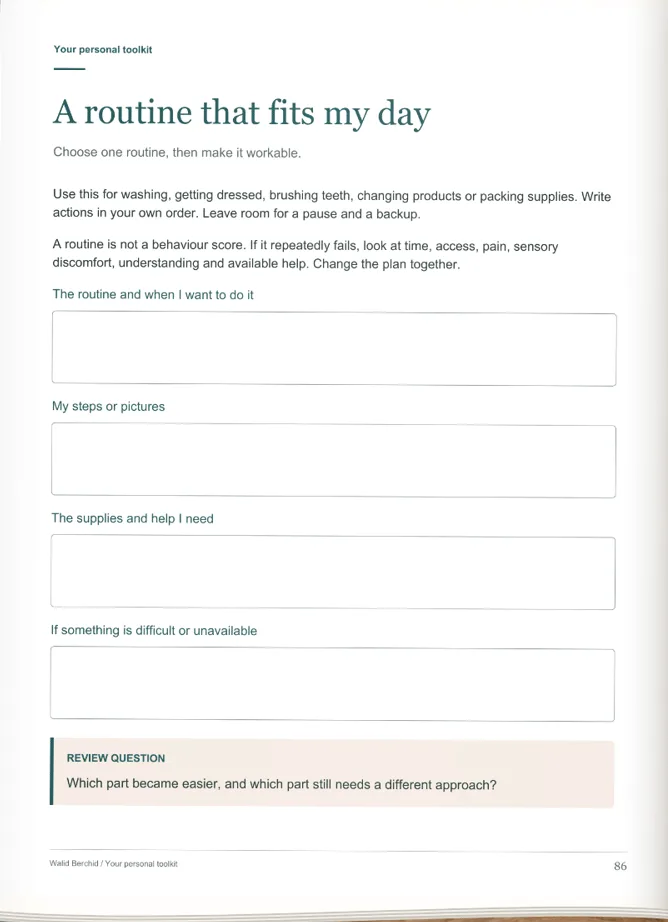
Growing Up, Your Way: Autism and Puberty Guide: a warm, practical guide by Walid Berchid that helps autistic young people understand puberty, care for their changing bodies, express their needs, and build confidence at their own pace, as a printable and fillable PDF.
Sources and scope
- Centers for Disease Control and Prevention (CDC): general information on autism for families and educators.
- IRIS Center, Vanderbilt University: free modules on autism, visual supports, and teaching routines.
- Understood.org: family-friendly information on sensory needs and growing independence.
- Individuals with Disabilities Education Act (IDEA): official information on special education and transition planning.
This guide covers everyday, respectful support for body changes and personal care at home and at school. It does not replace medical advice, health assessments, sex education programs, or the decisions of the young person’s family and support team.
Key takeaways
- Supporting puberty for autistic teens starts with clear, early, concrete explanations.
- Privacy and consent are part of the teaching from day one.
- Separate the sensory problem from the care task, then try one adjustment.
- Build one routine at a time, with a backup for hard days.
- Review with the young person and value their own rating.









Leave a Comment