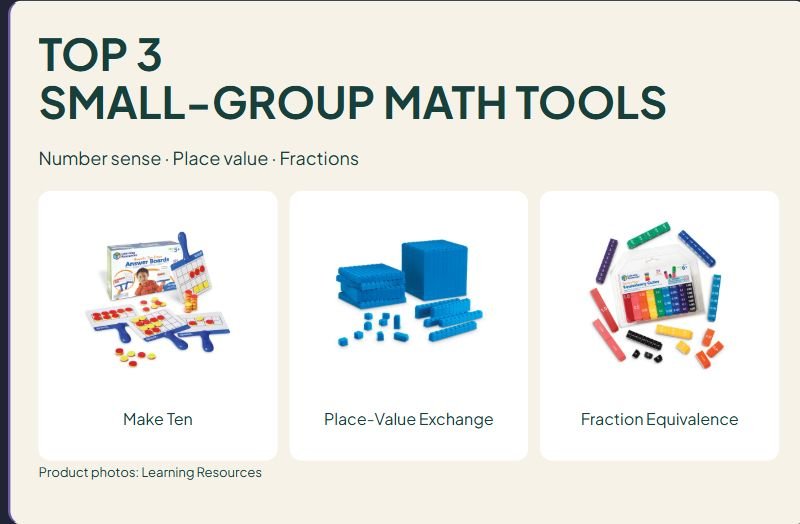

TOP 3
SMALL-GROUP MATH TOOLS
Number sense · Place value · Fractions

Make Ten

Place-Value Exchange

Fraction Equivalence
Product photos: Learning Resources
Affiliate disclosure: As an Amazon Associate I earn from qualifying purchases. Purchases through our links may earn a commission at no additional cost to you.
Small-group math tools earn their place when they help a student explain an idea. A tray full of manipulatives is not a lesson plan. Before choosing supplies, finish this sentence: “I want students to show why…” Then select a representation that makes that relationship visible.
This guide organizes three previously researched Learning Resources products around different mathematical jobs. Ten-frame answer boards can organize quantities around ten; base-ten blocks distinguish place-value units; fraction towers compare equal parts of a consistent whole. They are alternatives for different lessons, not three interchangeable products or a shopping list everyone needs to complete. We have not tested them with students or measured learning outcomes.
Choose the representation before the product
| Lesson question | Example tool | What to keep explicit | Purchase check |
|---|---|---|---|
| How does filling ten help with 7 + 5? | Magnetic Ten-Frame Answer Boards LER6645 | The ten spaces and the second group of counters | Four boards are not a full-class set |
| Why does 23 + 18 require regrouping? | Interlocking Base Ten Starter Set LER6356 | A rod represents ten unit blocks | Count available units and rods for each learner |
| Why is one half equal to two quarters? | Fraction Tower Equivalency Cubes LER2509 | Every compared tower uses the same whole | Fraction parts are not generic whole-number counting cubes |
A student may work with any of these concepts at a different point from classmates. Match the task to the current explanation you are seeking. The manufacturer's age labels and small-parts warnings still apply; they are not a guarantee that a particular lesson is appropriate for every child.
1. Ten-frame boards for explaining a make-ten strategy
Learning Resources LER6645 includes four magnetic write-and-wipe boards and 100 red/yellow double-sided foam magnet counters. Each board has one ten-frame on one side and two on the other. The manufacturer labels the set ages five and up. This is a compact response-board format, distinct from a large teacher demonstration set.
An example lesson: Ask a learner to represent 7 + 5. Put seven counters in the first frame and five in the second. Ask, “How many spaces are empty in the first ten?” Move three of the five counters to fill it. The arrangement now shows ten and two, while the total remains twelve. Write 7 + 5 = 10 + 2 = 12 beside the model.
What to listen for: “I moved three to make ten, and there were two left.” If the child can only announce twelve, ask them to point to the two groups in the rearranged display. The counters support the explanation; they do not demonstrate understanding on their own.
Buying advantage and limitation: Four boards can support four individual responses in a small group. They do not give every student in a full class a board. Check whether you already have counters and usable ten-frame mats before buying another complete set. Keep the magnetic counters within the intended supervised activity and follow the small-parts warning.
2. Base-ten blocks for explaining an exchange
The LER6356 Interlocking Base Ten Starter Set contains 100 unit pieces, 30 rods, ten flats and one large cube, plus a listed 96-page activity book. The manufacturer identifies ages six and up and describes use with three or four students. A starter set's total piece count does not tell you whether each child can build your chosen numbers simultaneously.
An example lesson: Model 23 as two tens and three ones, and 18 as one ten and eight ones. Combine the pieces to show three tens and eleven ones. Exchange ten of those ones for one ten rod, leaving four tens and one one: 41. Record the exchange in writing while the pieces are still visible.
What to listen for: “Ten ones have the same value as one ten.” Ask whether the total changed during the exchange and how the learner knows. Avoid describing the step only as moving a digit; link the written representation to the value represented by the blocks.
Buying advantage and limitation: These pieces distinguish ones, tens and larger units physically, which is useful for this particular model. They are not all identical counting cubes. Before planning four simultaneous versions of the same problem, count the required pieces per student and multiply by four. Do not assume the manufacturer’s small-group description covers every task or number you might choose.
3. Fraction towers for explaining a shared whole
LER2509 Fraction Tower Equivalency Cubes are a 51-piece set representing a whole and several fractional divisions. The cubes carry fraction, decimal and percentage labels; the manufacturer lists ages six and up. This is the equivalency-cube product, not an unlabeled fraction tower or a separate activity kit.
An example lesson: Start with one whole tower. Build one half and compare its height with two quarters aligned at the same baseline. Keep the reference whole visible. Ask what stays the same when one half is replaced by two quarters, then record 1/2 = 2/4.
What to listen for: “The pieces cover the same part of the same whole.” Counting two pieces versus one piece is not enough: the pieces are different sizes. Follow with a drawing that preserves the common whole so the written equality refers to the same relationship as the towers.
Buying advantage and limitation: The labeled pieces provide several representations on the same tool. Those labels can also reveal an answer before a learner has explained it. Decide whether to use the marked side during the task. Do not combine unrelated brands or assume any two tower pieces connect or share the same whole length.
Build a small-group kit without buying everything
Start with one recurring lesson
Choose a task you expect to teach again, then check the materials already available. A printed ten-frame and existing counters may be enough for a make-ten discussion. Base-ten pieces or fraction towers serve different purposes, so adding them should follow a real lesson need. Compare the exact product to an existing workable alternative before ordering.
Plan the turns and the quantities
Decide whether students will build individual models, work in pairs or discuss a shared example. Write down how many boards and pieces the task needs. A four-student group does not always require four complete retail kits, but sharing one model may hide whether every learner can represent the idea independently. Choose the arrangement intentionally.
Connect objects, drawings and notation
Leave the model visible while students sketch or write. Ask them to identify what each drawn mark or number represents. If the written response does not match the objects, return to that connection before adding a new tool. This is a planning suggestion, not a claim that purchasing a manipulative improves outcomes by itself.
Reset the kit for the next group
Give each product a labeled storage space and count the working materials before and after the activity. Separate damaged or missing pieces from the lesson plan rather than substituting an object with a different mathematical meaning. Keep the manufacturer's age, care and small-parts guidance with the kit.
Questions before buying
Should I buy all three products for the same group?
Only if you have a clear use for each representation. These examples address different relationships, and students do not need all three tools on the table at once. A focused purchase may be more useful than a larger mixed kit with no planned tasks.
Are these the best products for every learner?
This guide does not establish a universal ranking or recommend a specific intervention. It compares three identifiable formats and shows how a teacher might plan a task around each one. Use the student's current work, school guidance and the exact activity requirements to choose the materials.
Why are there no star ratings or customer quotes?
We have not captured an authorized, product-specific customer excerpt for this guide. No ratings, classroom testing or learning results are invented. Product specifications and the worked mathematical examples support the comparison; individual classroom suitability still needs your judgment.
For alternatives within the place-value role, compare our base-ten block sets. Choose the representation before the bundle size.





Leave a Comment