
TOP 3
CLASSROOM DICE FORMATS
Dot patterns · Nested dice · Different shapes

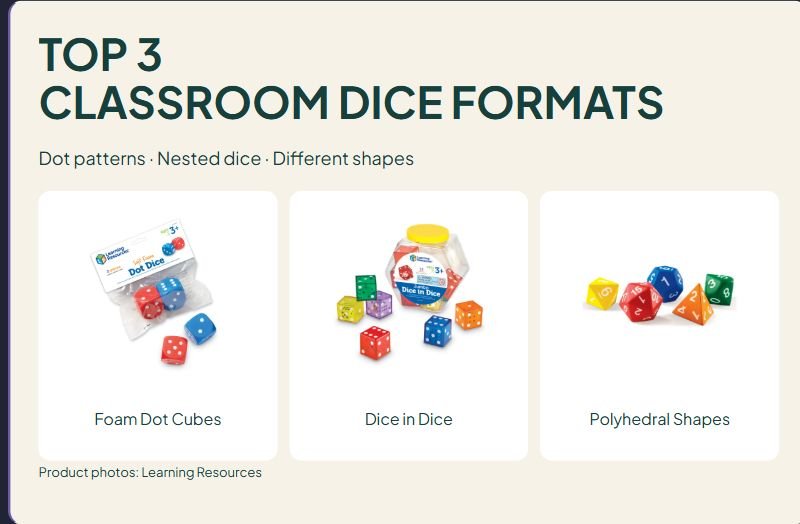
Foam Dot Cubes

Dice in Dice

Polyhedral Shapes
Product photos: Learning Resources
Affiliate disclosure: As an Amazon Associate I earn from qualifying purchases. Purchases through our links may earn a commission at no additional cost to you.
Classroom dice are easier to choose when you start with the numbers students need to read and the explanation you want them to give. Two dot cubes, a die inside another die and a collection of differently shaped numbered dice create different activities. A larger piece count does not make them interchangeable.
This comparison covers three Learning Resources formats: Foam Dot Dice LER2228, Jumbo Dice in Dice LER7699 and Jumbo Foam Polyhedral Dice LER7694. We have not tested their rolling fairness, sound levels or long-term durability. The lesson examples below are original planning suggestions, not reports of classroom testing.
Quick comparison of classroom dice formats
| Detail | Foam Dot Dice LER2228 | Jumbo Dice in Dice LER7699 | Foam Polyhedral Dice LER7694 |
|---|---|---|---|
| Manufacturer set contents | Two foam dot cubes | Twelve nested dice, storage tub | Five foam polyhedral dice |
| Representation | Dot patterns | Inner and outer die | Numerals on different shapes |
| Stated individual size | 1.75-inch cubes | 3 cm dice | Approximately 3 inches |
| Manufacturer age guidance | 3+ | 3+; small-parts warning | 6+ |
| Useful starting question | How many dots altogether? | Which result is inner, and which is outer? | Which outcomes can this die produce? |
Dimensions in a shipping or product-information table may describe the package rather than one die. Use the manufacturer's individual-die description when planning desk space, and verify the selected retail quantity before ordering.
1. Foam Dot Dice: two cubes for visible quantities
LER2228 contains two dense foam dot dice. Learning Resources describes cubes measuring one and three-quarter inches each and lists them for ages three and older. The manufacturer describes foam as a quieter alternative to traditional dice; we have not measured the sound difference on classroom tables.
Why consider it: Dot patterns let students connect a visible quantity with a spoken number or written numeral. Two cubes provide a straightforward starting point for addition without introducing several unfamiliar shapes at the same time.
Limitation: A two-die set does not supply several independent pairs. Decide whether the class will share one demonstration, use stations or work in separate pairs. Foam construction also does not establish that a die is silent, indestructible or suitable for every learner's handling needs.
Choose it when: The activity depends on counting or recognizing dot quantities, and you have planned how the two dice will be shared.
2. Jumbo Dice in Dice: two results in one contained object
LER7699 places a smaller white die inside a colorful transparent outer die. The manufacturer describes twelve dice in the set, each measuring three centimeters, with a storage tub. It lists ages three and older and a small-parts choking warning for children under three.
Why consider it: The inner and outer result can support an activity that needs two identified values. The nested construction keeps those two dice together, which changes handling compared with distributing two separate cubes.
Limitation: Students must distinguish and read both results. Plan a clear inner-first or outer-first rule before using subtraction or another order-dependent task. The contained format does not prove that the two outcomes are independent or that every possible pair appears equally often. We have not tested its probability distribution.
Choose it when: You want two separately identified results per object and have checked that students can read the inner die through the outer one.
3. Jumbo Foam Polyhedral Dice: different numbers of faces
LER7694 contains five foam dice with four, eight, ten, twelve and twenty sides. Learning Resources describes an approximate three-inch size, includes an activity guide and lists ages six and older. These are different shapes with different possible outcome sets, rather than five identical six-sided cubes.
Why consider it: The range of shapes gives a reason to compare which numbers can appear and to organize observed results. Choose one die at a time before asking students to compare two formats.
Limitation: A polyhedral set is not a direct replacement for a game that requires several matching six-sided dice. Check the markings and how the result is read on each shape before assigning an activity. We have not established equal rolling probabilities, and the foam material does not remove the need for supervised use and appropriate space.
Choose it when: Different possible outcomes are part of the lesson, rather than simply a way to obtain two familiar dot quantities.
Three original lesson-planning examples
Represent an addition in more than one way
With dot cubes, ask a student to describe an illustrative roll of three and five as both visible groups and the equation 3 + 5 = 8. Another student can explain a counting-on strategy or draw the quantities. The dice supply the values; the explanation is the learning evidence. These example values are hypothetical, not a claim about a recorded roll.
Make the order rule explicit
For nested dice, establish that the outer result is read first. If the hypothetical outer result is five and the inner result is two, the subtraction sentence is 5 – 2 = 3. Reversing the roles changes the task. If learners are working only with nonnegative differences, explicitly use larger minus smaller instead of quietly changing the rule after a roll.
Separate theoretical possibilities from observations
For polyhedral dice, list the markings students actually see before collecting a small sample of rolls. Compare the observed counts without claiming that a short run proves fairness. A discussion of equally likely outcomes needs stated assumptions; it should not be inferred from the product's shape or a handful of classroom results.
What to check before buying
Count the working groups
For a hypothetical four-station activity requiring two separate dot cubes at each station, eight cubes are needed. One two-cube pack supplies one such station. The twelve nested dice serve a different format: each object contains two results. Count the equipment for the actual task rather than comparing headline piece totals alone.
Plan rolling and retrieval space
Choose a clear working area and establish where a valid roll must land. If you introduce a tray or mat, check its fit and handling in your setting. This guide does not verify compatibility with a particular tray or promise that an accessory prevents all dropped dice.
Check visibility and directions
Demonstrate the markings from the distance students will use them. Decide who rolls, who reads, who records and when roles change. For nested dice, check both inner and outer visibility. For polyhedral dice, show how to identify the result on each shape before the activity begins.
Questions before buying
Are foam dice silent?
The manufacturer describes noise-reducing foam construction, but we have not measured these products. Surface, rolling method and handling will affect a classroom experience. Avoid treating a material description as a measured sound guarantee.
Can nested dice replace every two-dice activity?
They can provide two results, but the reading demands and handling differ from separate cubes. Verify that the activity's number range, ordering rule and any probability assumptions fit the format. Physical containment alone is not evidence of independence.
Are customer ratings included?
No customer excerpts have been verified and authorized for these exact offers. This comparison uses identifiable manufacturer information and original planning examples without inventing ratings, testing or classroom outcomes.
For another way to make quantities visible during explanations, compare our math linking cubes. Choose the representation for the task rather than collecting tools with overlapping purposes.





Leave a Comment