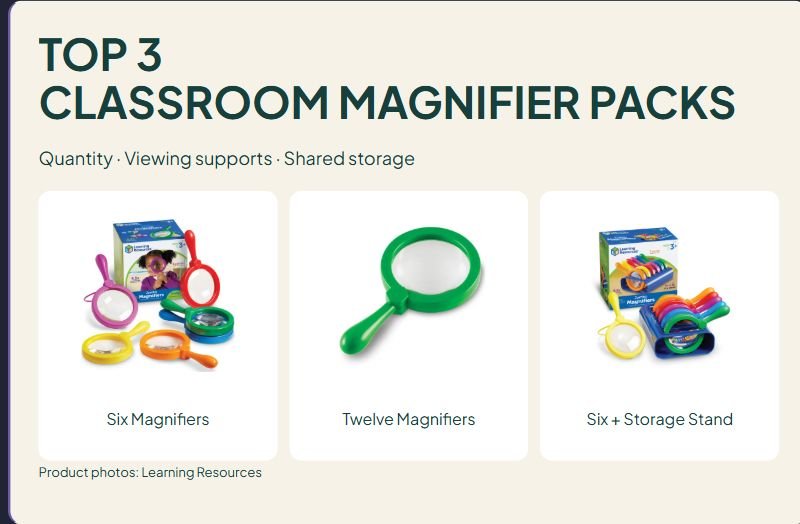

TOP 3
CLASSROOM MAGNIFIER PACKS
Quantity · Viewing supports · Shared storage

Six Magnifiers

Twelve Magnifiers

Six + Storage Stand
Product photos: Learning Resources
Affiliate disclosure: As an Amazon Associate I earn from qualifying purchases. Purchases through our links may earn a commission at no additional cost to you.
A classroom magnifier gives learners a reason to look closely before describing an object. Choosing a class supply is partly about how many children will observe at once, but storage and hands-free positioning matter too. A pack for a six-child science station solves a different quantity problem from a supply shared by a whole class.
This guide compares three related Learning Resources packages. The six-pack and twelve-pack provide different quantities, while the six-magnifier stand bundle adds shared storage. The manufacturer's pages describe individual viewing supports as well, so a shared storage stand should not be confused with the flip-out support on a magnifier itself.
This is a comparison of manufacturer information and lesson-planning considerations. We have not tested optical clarity, scratch resistance, stability or measured magnification. These are classroom observation tools, and the order does not rank tested learning outcomes.
Compare the package options
| Package | Model | Documented contents | Practical use | Main check |
|---|---|---|---|---|
| Jumbo Magnifiers, Set of 6 | LER2774 | Six magnifiers with built-in viewing supports | A six-learner station or shared small-group work | Verify exact lens specifications on the selected package |
| Jumbo Magnifiers, Set of 12 | LER2775 | Twelve magnifiers in six colors, two of each; storage box | More simultaneous observation tools | Twice the quantity does not establish stronger magnification |
| Jumbo Magnifiers with Stand | LER2884 | Six magnifiers plus a shared storage stand | An organized science-center supply | Storage stand and individual viewing supports serve different jobs |
All three manufacturer item headers list ages 3+. Follow the exact product's setup, care and supervision instructions when planning an activity.
1. Jumbo Magnifiers, Set of 6: a smaller group supply
The LER2774 contains six jumbo magnifiers. The manufacturer describes large handles, acrylic lenses and built-in supports for hands-free viewing. The set is intended for observing objects such as leaves, rocks, fabric and other suitable classroom specimens.
Reasons to choose it: Six tools can give each learner in a six-person group an individual turn without passing one magnifier around. The built-in supports provide an alternative to holding the lens during every observation. A smaller working supply can fit a science station that serves groups in rotation.
Limitations: Six magnifiers do not supply a class of twenty-four with independent tools at the same time. The primary description reviewed does not state the same detailed lens dimensions and magnification value shown for the twelve-pack. Do not transfer specifications solely because the products look related. Check the exact package if lens size or stated power affects the purchase.
Try this activity: Give each learner a leaf or a safe fabric sample. Ask them to describe it before using the magnifier, then record one additional detail visible through the lens. Compare observations rather than treating the tool as a way to guess the object's name quickly.
2. Jumbo Magnifiers, Set of 12: a larger shared supply
The LER2775 contains twelve magnifiers in six colors, with two of each color, and a storage box. The manufacturer specifies plastic lenses with a 4-inch diameter, stated 4.5× magnification and flip-out supports. Its description gives an overall magnifier length of 8 inches.
Reasons to choose it: Twelve units support more simultaneous observations than a six-pack. A class of twenty-four could work in twelve pairs if sharing is part of the lesson. The storage box gives the supply a defined return location.
Limitations: A twelve-pack increases the number of tools; it does not by itself increase optical performance. The stated 4.5× value is a manufacturer specification, not a result of our measurements. Paired work also means taking turns at the lens, so it is different from one tool per learner.
Try this activity: Ask partners to examine the same suitable specimen in turn. One describes a detail while the other sketches or records it, then they swap roles and check whether the description is specific enough to recognize. Keep the specimen stable so differences in handling do not distract from the comparison.
3. Jumbo Magnifiers with Stand: six tools with shared storage
The LER2884 includes six magnifiers and a shared storage stand. The manufacturer lists oversized plastic lenses with stated 4.5× magnification, chunky handles and individual flip-out supports for viewing. The shared stand is intended to organize the magnifiers between activities.
Reasons to choose it: A defined place for each tool can support a take-one, return-one science-center routine. The set keeps the quantity at six while adding a shared organizer. Individual viewing supports provide a separate way to position a lens during suitable desk work.
Limitations: This bundle still contains six observation tools, not twelve. The organizer should not be counted as a separate magnifier or assumed to hold specimens for viewing. We have not tested the stand's stability, the effort required to deploy each support, or performance on a particular tabletop.
Try this activity: Begin with all six magnifiers in their storage locations. Assign a working surface, let learners choose one tool and return it after recording an observation. Include checking that the tool is back in its proper place as part of cleanup, without making a timed race out of handling it.
Choose quantity from the activity
Count how many learners must observe at the same moment. For twenty-four students working independently, six magnifiers require rotations or sharing. Twelve can serve twelve pairs, but each partner still needs an opportunity to use the lens. Choose the response format before comparing pack totals.
Think about the specimen supply too. A magnifier for every learner is less useful if everyone is waiting for one leaf or rock. Prepare enough appropriate objects or design roles that keep both partners involved. A recording task can give observation a purpose, but avoid making handwriting the only way a child can report a finding.
Plan the return routine. A shared stand keeps tools arranged differently from a storage box. Check available shelf space and whether the setup works for the people using it. A visible organizer can make missing items easier to notice, but it does not guarantee that pieces cannot be misplaced.
Check viewing setup and specifications
Start with a stable surface and a suitable object. Let learners move the lens or object gradually to find a clear view, following the package instructions. An image that looks blurry at one distance does not establish that a different pack or stronger magnification is needed.
Check whether a child can hold the handle and position the lens comfortably. If handling distracts from observation, an individual support or help from a partner may make the activity more workable. The physical task of positioning a tool should not be treated as a direct measure of scientific understanding.
Compare the exact model numbers. These packages are related, but the reviewed pages do not document every specification in the same way. A stated value on one page is not a substitute for confirming the product and package being ordered. Likewise, the manufacturer's durability wording is not a classroom test result from this guide.
Make observations more specific
Ask learners to say what they see before explaining why they think it looks that way. A statement such as a leaf has fine lines is an observation; a claim about what every line does needs another kind of evidence. Keep that distinction clear without turning a short exploration into a memory quiz.
Use comparisons carefully. Two pieces of fabric may differ in thread spacing, color and texture. Choose one visible feature to compare at a time and give learners a way to record it through speech, drawing, pointing or writing. Revisit the object without the magnifier to connect the close-up view with the whole item.
For outdoor sessions, use appropriate specimens and follow product instructions for handling, storage and supervision. A large classroom lens does not turn every unfamiliar object or living creature into a suitable hands-on specimen.
Frequently asked questions
Are these three unrelated magnifier designs? No. They are related package options in one product family. This guide focuses on quantity, documented specifications and storage arrangements.
Does with stand mean only that package supports hands-free viewing? No. The six- and twelve-pack descriptions also mention built-in or flip-out viewing supports. The LER2884 package additionally includes a shared storage stand.
Is twelve better than six? Only if the larger quantity fits your activity. The number of magnifiers does not establish a difference in optical quality.
Have the stated magnification values been tested for this guide? No. Values are attributed to manufacturer descriptions. Verify the exact package specifications before choosing a tool for a particular observation task.
For keeping printed observation prompts visible at a science station, see our classroom pocket chart comparison. Match the display to the size of the cards and the working area.







Leave a Comment