
TOP 3
MAGNETIC LETTER SETS
Lowercase · Uppercase · Mixed-case foam

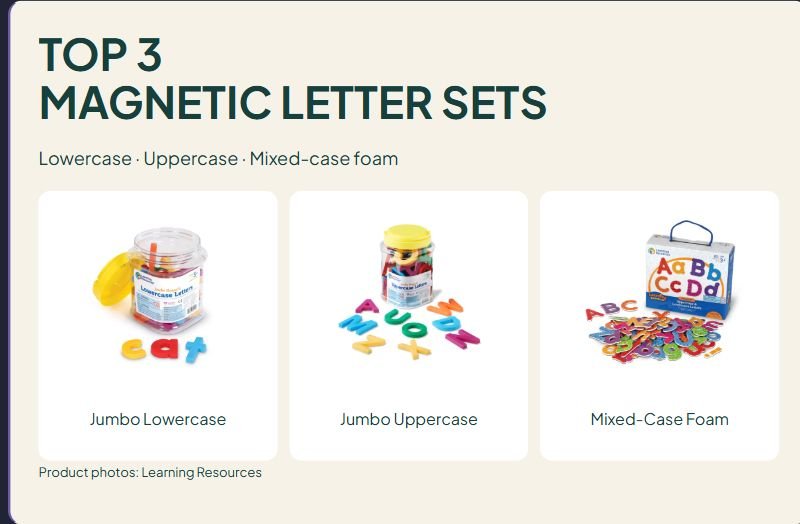
Jumbo Lowercase

Jumbo Uppercase

Mixed-Case Foam
Product photos: Learning Resources
Affiliate disclosure: As an Amazon Associate I earn from qualifying purchases. Purchases through our links may earn a commission at no additional cost to you.
Magnetic letters let a child move one letter at a time when matching symbols or building a word. But a useful set needs the right letter forms, enough copies for the task and a surface that actually attracts magnets. A larger total is less helpful if it leaves a learner without the repeated letter needed to finish a word.
This comparison covers three Learning Resources formats: forty jumbo lowercase plastic letters, forty jumbo uppercase plastic letters, and a mixed-case foam set. It uses manufacturer descriptions, not hands-on testing. We have not measured magnetic strength, wear or reading progress, and the order is not a ranking of tested learning results.
Compare the three formats
| Product | Model | Verified format | Practical purpose | Main check |
|---|---|---|---|---|
| Jumbo Lowercase Magnetic Letters | LER0451 | Forty plastic lowercase letters, extra vowels and consonants, storage container | Lowercase letter recognition and word building | Manufacturer item header lists ages 5+ despite younger-age marketing elsewhere |
| Jumbo Uppercase Magnetic Letters | LER0450 | Forty plastic uppercase letters, about 2 inches tall, extra vowels and common consonants, handled container | Capital-letter recognition and matching | Does not supply lowercase forms |
| Magnetic Uppercase & Lowercase Letters | LER7725 | Uppercase and lowercase magnetic foam letters | Case matching and mixed-case activities | Count and individual letter dimensions not established by the reviewed primary description |
1. Jumbo Lowercase Magnetic Letters: a lowercase working set
The LER0451 contains forty plastic lowercase letters. The manufacturer lists extra vowels and consonants for spelling, along with a storage container. Its item header says ages 5+, although other marketing copy mentions toddlers and younger learners. Use the specific product labeling and exact package instructions when choosing an age-appropriate tool.
Reasons to choose it: A lowercase-only supply can keep a word-building task consistent. Extra letters support more combinations than a single alphabet alone, depending on the actual duplicate distribution. A container gives the pieces a place to return after practice.
Limitations: Forty letters do not mean forty complete alphabets, and the description captured for this comparison does not list every duplicate. Check the words you plan to build before assuming two learners can construct them simultaneously. Jumbo is a product description, not proof that every learner can handle or read the pieces comfortably. Do not treat broad marketing language about size as a replacement for the small-parts warning.
Try this activity: Choose a short word using letters and sound relationships the learner has already practiced. Build cat, then change only the first letter to make mat. Ask which letter changed, which sounds stayed the same and how to read the new word. Use the letter set as a tool within the lesson rather than expecting it to teach the sequence by itself.
2. Jumbo Uppercase Magnetic Letters: a capital-letter format
The LER0450 also contains forty plastic letters with extra vowels and common consonants. The manufacturer describes letters about 2 inches tall and a storage container with a handle. Its item header lists ages 3+ and the page warns that small parts are unsuitable for children under 3.
Reasons to choose it: Uppercase pieces suit matching capital forms, alphabet activities and building a name in capitals when that matches the task. The stated size gives a more concrete purchasing detail than the word jumbo alone. A handled container can make moving the supply between work areas easier.
Limitations: It is an uppercase set, so it cannot by itself support matching each capital with its lowercase partner. The manufacturer's claim of a strong hold is not a measurement from our testing and does not mean the letters stick to every refrigerator or every metal surface. Verify the intended surface and the product's condition under its instructions.
Try this activity: Select a few capitals the learner knows, then match them to printed lowercase forms. Discuss a pair with noticeably different shapes, such as A and a. Use the letter forms your learning materials show, since a printed font can represent a letter differently from a molded piece.
3. Mixed-Case Foam Magnetic Letters: both forms in one product
The LER7725 contains uppercase and lowercase magnetic foam letters. The manufacturer describes crush-resistant foam for matching, sorting and early spelling activities. Its header lists ages 3+ and a small-parts warning applies.
Reasons to choose it: Both cases are supplied within the same product family, making case matching a straightforward activity to plan. Foam offers a different material from the jumbo plastic sets. A learner can arrange symbols physically while explaining the relationship between the two forms of a letter.
Limitations: The reviewed primary page does not establish the pack count, complete duplicate distribution or individual letter dimensions. Do not carry the forty-piece count or 2-inch measurement over from either jumbo plastic set. Soft material is not evidence that an item is appropriate for a child who mouths small objects, and we have not tested foam wear or magnetic attachment.
Try this activity: Put a small group of capitals on one side of the work surface and matching lowercase letters on the other. Have the learner explain each match, then build one familiar word in the case normally used in the accompanying reading activity. Limit the number of choices if searching through the whole supply distracts from the intended task.
What to check before buying magnetic letters
Start with the lesson rather than the largest pack. A capital-matching activity needs different pieces from a lowercase word-building task. If you need both cases, either confirm that one product includes them or plan for compatible sets without assuming their dimensions match.
Count repeated letters in the actual words you want learners to build. A word such as mom requires two copies of m. Several students building the same word at once need several copies of every required letter. The total number of pieces does not establish those quantities.
Check the letter shapes. Look at forms such as a and g, and compare them with your printed materials. A different form can be discussed, but it should be a planned part of the lesson rather than an unexpected source of confusion.
Confirm the surface. A whiteboard may accept dry-erase writing without being magnetic. A refrigerator's outer finish also does not guarantee that the selected location attracts magnets. Use a suitable surface described by the product instructions, and leave enough room to keep words on a clear line.
Finally, plan storage. Sort pieces by letter or keep a contents record if finding duplicates is a recurring problem. Check and maintain the set according to its instructions, and supervise use according to the age labeling and the learner's needs. None of these products should be described as suitable for children under 3 on the basis of general toddler marketing.
Keep the letters connected to meaningful instruction
Moving letters can make a change visible, but the physical action is not the whole reading lesson. Choose words and patterns that fit the learner's current instruction. Ask what changed, what stayed the same and how the written form connects to the spoken word.
Avoid treating color as the explanation. These product descriptions do not establish a consistent vowel-versus-consonant color system across all three sets. Use the letter itself and the intended task rather than assuming a particular color carries a phonics rule.
Use short sequences with a clear purpose. Matching a few known letters, building one word and changing one part can give a more focused activity than spreading every piece across a table. If handling a piece is difficult, let the learner point, choose between alternatives or direct a partner while still making the language decision.
Common questions
Which set has both uppercase and lowercase letters? The LER7725 description explicitly includes both. The two jumbo sets are separate lowercase-only and uppercase-only products.
Do forty letters cover every spelling activity? No. Required duplicates depend on the words and the number of learners. Check the exact contents rather than relying only on the total.
Will the letters stick to any whiteboard? No. Confirm that the surface attracts magnets and is suitable for the product. A writing surface and a magnetic surface are different properties.
Are the jumbo sets suitable for toddlers? The source pages use inconsistent marketing wording. The lowercase header lists ages 5+, while the uppercase and mixed-case headers list ages 3+. All three pages include a small-parts warning for children under 3. Follow the exact package instructions.
Does this guide include tested reviews or customer ratings? No. It compares manufacturer-documented features and practical planning considerations. No customer quotation or measured learning benefit is claimed.
For displaying printed letter cards alongside movable letters, see our classroom pocket chart comparison. Check card size and display format before planning a matching activity.


Leave a Comment