
TOP 2
CLASSROOM BALANCES
400 ml vs. 500 ml · Storage · Zero adjustment

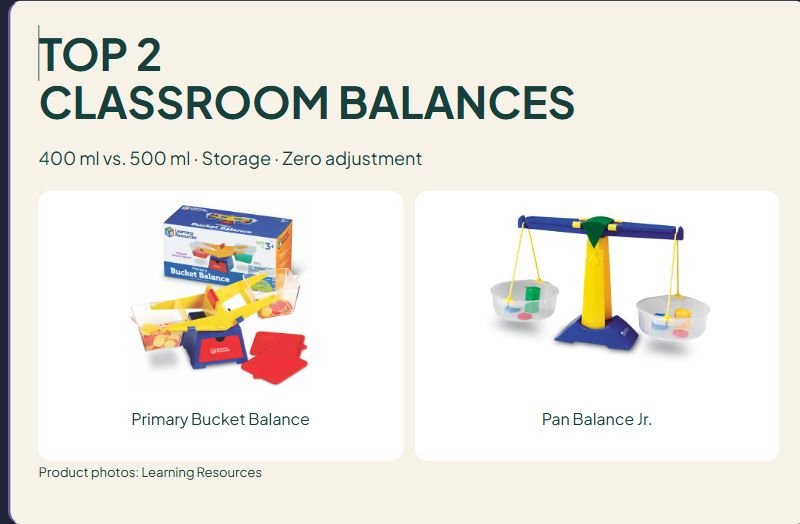
Primary Bucket Balance

Pan Balance Jr.
Product photos: Learning Resources
Affiliate disclosure: As an Amazon Associate I earn from qualifying purchases. Purchases through our links may earn a commission at no additional cost to you.
A classroom balance can make a comparison visible: one side drops, the other rises, or both settle level. But the right tool depends on the lesson. Comparing two classroom objects is different from finding a mass using marked weights, and a bucket's liquid volume is different from the load the mechanism can carry.
This guide compares two Learning Resources models using manufacturer documentation. It is not a hands-on review, a calibration test or a promise of laboratory accuracy. The primary pages contain a few inconsistent details, noted below so that a similar product name does not become an incorrect buying assumption.
Compare the two designs
| Model | Documented format | Relevant feature | Suitable lesson | Main limitation |
|---|---|---|---|---|
| Primary Bucket Balance LER1521 | Two removable clear 400 ml buckets with lids | Pour spouts, lids usable as platforms, built-in drawer | Early heavier/lighter and balance comparisons | Bucket volume does not establish maximum load |
| Pan Balance Jr. LER0898 | Detachable clear 500 ml buckets | Sliding compensator for zero adjustment | Comparing mass with a visible starting adjustment | Description incorrectly calls it Primary Bucket Balance; verify model |
1. Primary Bucket Balance: a starting point for comparison
The LER1521 has two removable graduated transparent buckets, each listed at 400 ml. The manufacturer describes pour spouts, lids that can serve as weighing platforms, and a built-in storage drawer. Its item header recommends ages 3+ and gives a small-parts warning for children under 3.
Those features suit a supervised lesson in which children predict which object will make one side drop, test their prediction and explain what happened. Transparent containers also let students see the objects they are comparing.
Reasons to choose it: Removable buckets can be emptied and cleaned separately. The lids provide an alternative platform arrangement described by the maker. A drawer can keep small teaching materials together between sessions.
Limitations: The page does not establish a maximum mass load or an independently verified measurement sensitivity. Its two dimension fields also disagree, so confirm the physical footprint if storage space is tight. A drawer for weights does not mean that a separate calibrated weight set is included.
Try this lesson: Compare two suitable classroom objects. Ask the child to predict which will make its side move down, then explain the observed result. Repeat with a larger but lighter object and a smaller but heavier one so that size is not treated as a reliable measure of mass.
2. Pan Balance Jr.: a smaller pan model with zero adjustment
The LER0898 page identifies the product as Pan Balance Jr. and specifies detachable 500 ml buckets and a sliding compensator. The description says it is intended for children ages 5 and up. A compensator is relevant because a balance should begin at its intended empty reference position before a comparison.
Reasons to choose it: The clear containers allow learners to see the contents. Detachable buckets support cleanup. The sliding adjustment can make the starting condition part of the lesson instead of something the adult handles invisibly.
Limitations: The description repeatedly uses the name Primary Bucket Balance even though the page title and model are Pan Balance Jr. Do not merge its 500 ml capacity with the LER1521's 400 ml specification or assume the products are identical. Confirm LER0898, the supplied buckets and the adjustment mechanism on the exact US listing. The maker's wording about accurate measurements is not evidence that we have tested the unit's accuracy.
Try this lesson: Show the empty buckets in their normal operating position and follow the product instructions to establish the starting balance. Add an object on one side, then add matching counters on the other until the beam balances. Record the result as a number of those counters, not as grams unless their individual masses are known and appropriate for that purpose.
Volume and mass are different buying specifications
A 400 ml bucket describes a volume of space. A capacity stated in grams describes a mass load. Those numbers cannot be substituted for one another, and a larger bucket does not by itself establish that the balance can handle a heavier object.
Use the same distinction in lessons. Two materials can occupy the same volume yet have different masses. If the learning goal is comparing mass, do not present an equal fill line as proof that both sides must balance.
For early work, solid objects may keep the task simpler. If using liquids is appropriate under the product instructions, plan for filling, emptying and cleanup. Removable containers help with handling, but do not make every liquid or classroom material suitable for the equipment.
What to check before choosing a balance
Start with the learning goal. Choose a bucket format for visible comparisons. If your lesson requires grams, check whether suitable marked masses are supplied or need to be obtained separately; this comparison does not establish an included marked-weight set for either product.
Check the starting adjustment. Read the instructions for the actual model and show learners what the empty reference position looks like. Moving a balance to a different surface, changing containers or leaving material in a bucket can change the conditions of the comparison.
Consider class quantity. One balance supports a shared station or a teacher demonstration. If every group must work at the same time, count the needed units and allow space for objects, weights and recording sheets. The number of included weights is not the number of independent weighing stations.
Read the exact model number and package contents. The words bucket balance and pan balance appear across related pages, and the reviewed descriptions are not entirely consistent. If a size or included accessory determines the purchase, resolve it before ordering rather than relying on a generic family photo.
Questions to ask during a lesson
Ask for a prediction before adding the objects. After observing the result, invite students to explain which evidence supports heavier, lighter or balanced. Use the same containers and setup when comparing results so that changes in equipment do not become hidden variables.
When counting nonstandard units such as identical classroom counters, explain what one unit represents. Different counters may not have the same mass. If using marked weights, name the unit and record the total clearly.
Give learners a role beyond placing objects in a bucket. They can describe a prediction, choose a comparison, record a result or explain a discrepancy. Physical access to small weights should not be the only way to participate in the mathematical discussion.
Frequently asked questions
Does a bucket's milliliter capacity tell me the maximum load? No. Volume and mass capacity describe different limits. Check the exact product instructions for permitted loading.
Are marked weights included? The reviewed package descriptions do not establish an included marked-weight set for either model. A storage drawer does not mean that separate marked weights are supplied.
Is the Junior model the same as the Primary Bucket Balance? The product pages use different model numbers and list different bucket volumes. The Junior description contains a naming inconsistency, so verify the model rather than treating them as identical.
Are these reviewed as laboratory instruments? No. This guide compares documented classroom features. We have not tested calibration, repeatability or conformity to a laboratory measurement standard.
If you plan to count objects as nonstandard units, our linking cube comparison describes three classroom formats. A cube count should not be labeled in grams unless the individual masses are known and appropriate.





Leave a Comment